
Pancreas Biliary System Gastrointestinal blockAnatomyLecture 4 Editing file
Pancreas & Biliary System Gastrointestinal block-Anatomy-Lecture 4 Editing file

Objectives At the end of the lecture, students should be able to: ● Describe the location, surface anatomy, parts, relations & peritoneal reflection of the pancreas and gallbladder. ● Describe blood supply, nerve supply andlymphatic drainage of pancreas and gallbladder. ● Describe Course of each of common hepatic, cystic and common bile duct and pancreatic ducts Color guide : Only in boys slides in Green Only in girls slides in Purple important in Red Notes in Grey

Pancreas Location ● ● ● Located in Epigastrium & Left upper quadrant (left hypochondriac) of abdomen behind the stomach. in front of spleen (from concavity of the duodenum to the hilum of spleen opposite the level of T 12– L 3 vertebrae). 12– 15 cm , 6 -10 inch in length and 60 -100 gram in weight. soft, lobulated elongated gland The greater part is Retroperitoneal behind the lesser sac. “J”-shaped or RETORT shaped Lies across the posterior abdominal wall in a transverse/oblique directions at the transpyloric plane (L 1 vertebra) (except the tail it lies at the level of T 12) has exocrine and endocrine functions. ● ● Exocrine component makes and secretes digestive enzymes into the intestine (Exocrine pancreas) comprise more than 95% of the pancreatic mass ● ● ● Endocrine component makes and secretes hormones (insulin, glucagon, somatostatin) control energy metabolism and storage throughout the body (Endocrine pancreas Islet's of Langerhans). comprise 1 -2% of pancreatic mass 3

Pancreas Parts 1 Head 2 Neck 3 Body 4 Tail Head ● ● ● ● enlarged, disc-shaped right end of the pancreas lies in the concavity of the C-shaped duodenal loop in front of the L 2 vertebra. Related to the 2 nd and 3 rd portions of the duodenum on the right & continues with the neck on the left. Anterior surface is related from above downward to: ○ The gastroduodenal artery, Transverse colon, root of the transverse mesocolon & jejunum Posterior surface is related to: ○ Inferior vena cava, left renal vein, bile duct & right crus of diaphragm Includes uncinate process (part extending to the left behind the superior mesenteric vessels). Uncinate process is related to: ○ anteriorly to superior mesenteric vessels ○ posteriorly to the abdominal aorta CLINICAL ANATOMY: Carcinoma of the head of pancreas : common , Compresses the bile duct leading to persistent obstructive jaundice May press the portal vein or may involve the stomach due to close vicinity of these structures to the head of pancreas Neck ● ● The constricted portion connecting the head & body. narrow band of pancreatic tissue that lies in front of origin of superior mesenteric artery and the confluence of the portal vein (made of union of splenic & superior mesenteric veins) Its antero-superior surface supports thepylorus of the stomach. The superior mesenteric vessels emerge from its inferior border. 4
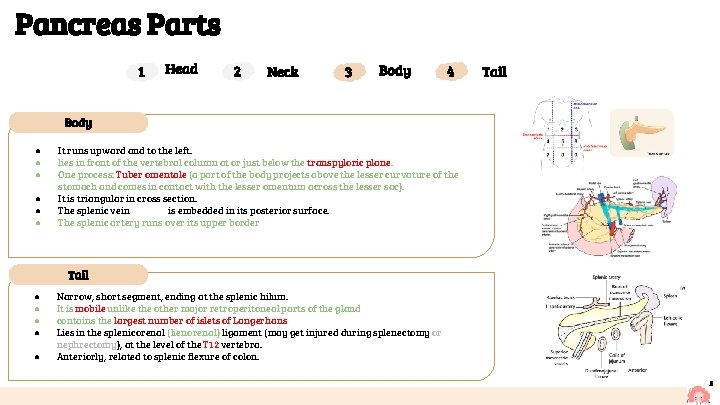
Pancreas Parts 1 Head 2 Neck 3 Body 4 Tail Body ● ● ● It runs upward and to the left. lies in front of the vertebral column at or just below the transpyloric plane. One process: Tuber omentale (a part of the body projects above the lesser curvature of the stomach and comes in contact with the lesser omentum across the lesser sac). It is triangular in cross section. The splenic vein is embedded in its posterior surface. The splenic artery runs over its upper border Tail ● ● ● Narrow, short segment, ending at the splenic hilum. It is mobile unlike the other major retroperitoneal parts of the gland contains the largest number of islets of Langerhans Lies in the splenicorenal (lienorenal) ligament (may get injured during splenectomy or nephrectomy), at the level of the T 12 vertebra. Anteriorly, related to splenic flexure of colon. 5

Pancreas relations Posterior relations (11) 1. 2. 3. Stomach separated by lesser sac. Transverse colon. transverse mesocolon. From Right to Left (from head to tail) 1. Bile duct. 2. portal vein 3. splenic veins. 4. inferior vena cava. 5. aorta. 6. origin of superior mesenteric artery. 7. Left psoas muscle. 8. left adrenal gland, 9. left renal vessels. 10. upper ⅓ of left kidney. 11. Hilum of the spleen. Anterior relations (3) 6

Pancreatic Ducts 2 ducts Main duct (of Wirsung) Accessory duct (of Santorini) ● runs the entire length of pancreas beginning from the tail. ● It receives many tributaries from tail, body, neck, inferior portion of head & uncinate process except upper portion of the head. ● Joins common bile duct & together they open into a small hepatopancreatic ampulla (Ampulla of Vater) in 2 nd part of the duodenal wall. ● The ampulla opens into the lumen of the duodenum by means of a small Papilla, (Major duodenal papilla). 8 -10 cm distal to the pylorus. ● drains superior portion of the head. ● It empties separately into 2 nd portion of duodenum at (minor duodenal papilla). about 2– 3 cm above the opening of main pancreatic duct (6– 8 cm distal to pylorus). CLINICAL ANATOMY : Acute pancreatitis 1. 2. 3. 4. acute inflammation of the pancreas Occurs due to obstruction of pancreatic duct, ingestion of alcohol, viral infections (mumps), or trauma serious condition because activated pancreatic enzymes leak into the substance of pancreas and initiates the autodigestion of the gland Clinically, it presents as very severe pain in the epigastric region radiating to the back, fever, nausea, and vomiting 7

Pancreas supply Arteries Veins Head & neck Supplied by branches from: 1. Celiac trunk through hepatic artery through gastroduodenal artery (GDA) through Superior pancreaticoduodenal artery 2. Superior mesenteric artery through Inferior pancreaticoduodenal artery Body & tail Head & neck Drained by: anterior and posterior venous arcades that form the superior & inferior pancreaticoduodenal veins which follow the corresponding arteries. Body & tail Drained by splenic vein, which is a tributary of portal vein Splenic artery (main artery) through 8 -10 branches Innervation Lymphatic Drainage Sympathetic ● Rich network that drains into: 1. pyloric nodes 2. hepatic nodes 3. splenic nodes ● Ultimately the efferent vessels drain into: 1. celiac lymph nodes 2. superior mesenteric lymph nodes. ● ● from the thoracic splanchnic nerves. have a predominantly inhibitory effect Parasympathetic ● ● from the vagus. stimulate both exocrine and endocrine secretions 8

Biliary system It consists of the ducts and organs (bile ducts, liver & gallbladder) involved in the production, storage & transportation of bile ● ● Bile is secreted by the liver cells at a constant rate of about 40 ml per hour. When digestion is not taking place, the sphincter of Oddi remains closed and the bile is stored and concentrated in the gallbladder; later, it is delivered to the duodenum. Bile duct Consists of: 1 Bile canaliculi The smallest tributaries of the bile ducts; situated in the portal canals of the liver Receives bile from the hepatocytes 2 Interlobular ducts join one another to form progressively larger ducts and, eventually, at the porta hepatis, form the right and left hepatic ducts 3 4 Intrahepatic ducts Right and left hepatic ducts 5 Common hepatic duct is about 1. 5 in. (4 cm) long • descends within the free margin of the lesser omentum. is joined on the right side by the cystic duct from the gallbladder to form the common bile duct 6 Cystic duct 7 Common bile duct (Bile duct) right drains the right lobe of the liver left drains the left lobe, the caudate lobe, & quadrate lobe. After a short course, the hepatic ducts unite to form the common hepatic duct 9
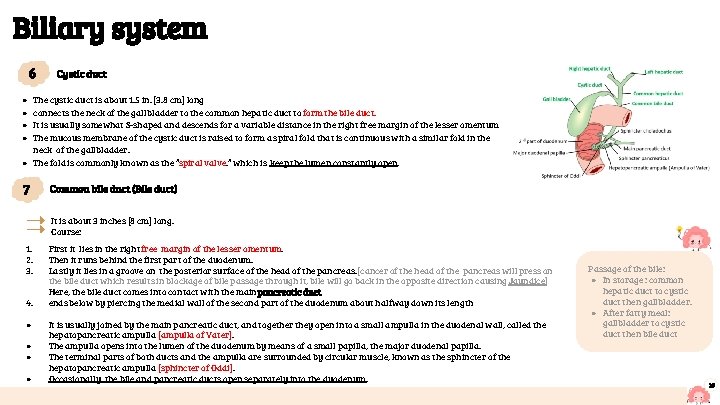
Biliary system 6 Cystic duct The cystic duct is about 1. 5 in. (3. 8 cm) long connects the neck of the gallbladder to the common hepatic duct to form the bile duct. It is usually somewhat S-shaped and descends for a variable distance in the right free margin of the lesser omentum The mucous membrane of the cystic duct is raised to form a spiral fold that is continuous with a similar fold in the neck of the gallbladder. ● The fold is commonly known as the “spiral valve. ” which is keep the lumen constantly open. ● ● 7 Common bile duct (Bile duct) It is about 3 inches (8 cm) long. Course: 1. 2. 3. 4. ● ● First it lies in the right free margin of the lesser omentum. Then it runs behind the first part of the duodenum. Lastly it lies in a groove on the posterior surface of the head of the pancreas. (cancer of the head of the pancreas will press on the bile duct which results in blockage of bile passage through it, bile will go back in the opposite direction causing Jaundice) Here, the bile duct comes into contact with the main pancreatic duct ends below by piercing the medial wall of the second part of the duodenum about halfway down its length It is usually joined by the main pancreatic duct, and together they open into a small ampulla in the duodenal wall, called the hepatopancreatic ampulla (ampulla of Vater). The ampulla opens into the lumen of the duodenum by means of a small papilla, the major duodenal papilla. The terminal parts of both ducts and the ampulla are surrounded by circular muscle, known as the sphincter of the hepatopancreatic ampulla (sphincter of Oddi). Occasionally, the bile and pancreatic ducts open separately into the duodenum. Passage of the bile: ● In storage : common hepatic duct to cystic duct then gallbladder. ● After fatty meal: gallbladder to cystic duct then bile duct 10

Biliary system Gallbladder ● ● ● A pear-shaped sac lying on the undersurface of the liver. It has a capacity of 30 to 50 ml , it stores bile, which is concentrated by absorbing water. It’s divided into: Fundus Body Neck is rounded and projects below the inferior margin of the liver, where it comes in contact with the anterior abdominal wall at the level of the tip of the ninth right costal cartilage. (as surface anatomy) Is lie in contact with the visceral surface of the liver and is directed upward, backward, and to the left. It becomes continuous with the cystic duct, which turns into the lesser omentum, joins the common hepatic duct, to form the bile duct The peritoneum completely surrounds the fundus of the gallbladder and binds the body and neck to the visceral surface of the liver. Relations Function Anteriorly Posteriorly anterior abdominal wall and the inferior surface of the liver. The transverse colon and the first and second parts of the duodenum 1 2 selectively absorbs bile salts concentrates & stores bile 4 excretes cholesterol 5 secretes mucus. 3 keeps the bile acid To aid in these functions, the mucous membrane is thrown into permanent folds that unite with each other, giving the surface a honeycombed appearance. When the bile is secreted by the liver cells, it contains water , salts, and acids, so after it arrives to the gallbladder. which is absorbs the water and salts, and keeps the acids unchanged. At the same time its wall secretes mucus and cholesterol. The longer the bile stays in the gallbladder the more it secretes mucus and cholesterol (which may lead to the formation of stones) 11

Biliary system Gallbladder Blood supply ● ● ● venous drainage Nerve supply ● Cystic artery, branch of the right hepatic artery. The cystic vein drains directly into the portal vein. Several small arteries and veins run between the liver and gallbladder. ● Sympathetic and parasympathetic vagal fibers form the celiac plexus. The gallbladder contracts in response to the hormone cholecystokinin (CCK), which is produced by the mucous membrane of the duodenum on the arrival of fatty food from the stomach. Lymphatic Drainage ● ● The lymph drains into a cystic lymph node situated near the neck of the gallbladder. From here, the lymph vessels pass to the hepatic nodes along the course of the hepatic artery and then to the celiac nodes. 12

QUIZ Q 1 Q 2 Q 3 Q 4 Q 5 Q 6 Q 7 Q 8 B C A D A A A B Q 1: The tail of the pancreas lies at the level of: Q 5: Anterior abdominal wall is in contact with fundus of gallbladder at level of ? A. T 10 A. the Tip of the Right Ninth costal cartilage. B. T 12 B. the Tip of the Right Eighth costal cartilage. C. L 1 C. the Tip of the Right Second costal cartilage. D. L 2 D. the Tip of the Left Ninth costal cartilage. Q 2: Which of the following has an anterior relation to the pancreas Q 6: the wall of gallbladder secretes: A. Splenic vein A. Mucus B. Bile duct B. Water C. Transverse mesocolon C. Acids D. Left psoas muscle Q 3: which one of the following lymph nodes the pancreatic vessels ultimately drain into: D. C&B A. Superior mesenteric A. bile canaliculi. B. Hepatic B. Intrahepatic ducts C. Splenic C. Common bile duct D. Pyloric D. None of the above Q 4: Which one of the following is true about the head of the pancreas: Q 8: the common bile duct comes into contact with: A. Its antero-superior surface supports the pylorus of the stomach A. Common hepatic duct B. It is triangular in cross section B. Main Pancreatic duct C. Anteriorly, related to splenic flexure of colon C. Cystic duct D. Includes uncinate process D. Right hepatic duct Q 7: The smallest interlobular tributaries of the bile ducts are receive from? 13
Members board Team leaders ● Abdulrahman Shadid Boys team: ● ● ● ● ● Mohammed Al-huqbani Salman Alagla Ziyad Al-jofan Ali Aldawood Khalid Nagshabandi Sameh nuser Abdullah Basamh Alwaleed Alsaleh Mohaned Makkawi Abdullah Alghamdi ● Ateen Almutairi Girls team : ● ● ● ● Ajeed Al Rashoud Taif Alotaibi Noura Al Turki Amirah Al-Zahrani Alhanouf Al-haluli Sara Al-Abdulkarem Renad Al Haqbani Nouf Al Humaidhi Jude Al Khalifah Nouf Al Hussaini Danah Al Halees Rema Al Mutawa Maha Al Nahdi Razan Al zohaifi Ghalia Alnufaei Contact us: Editing file
- Slides: 14