
PAM Person Activation Measure By Jacqui Hagley CCH
PAM Person Activation Measure By Jacqui Hagley – CC@H Community Matron Lisa Langford – OT Professional Lead Neil Moffat – ICT Team Manager
Housekeeping

Ice Breaker
Ice Breaker Please find a partner…. . Identify 10 things you have in common… You have 5 minutes starting from now
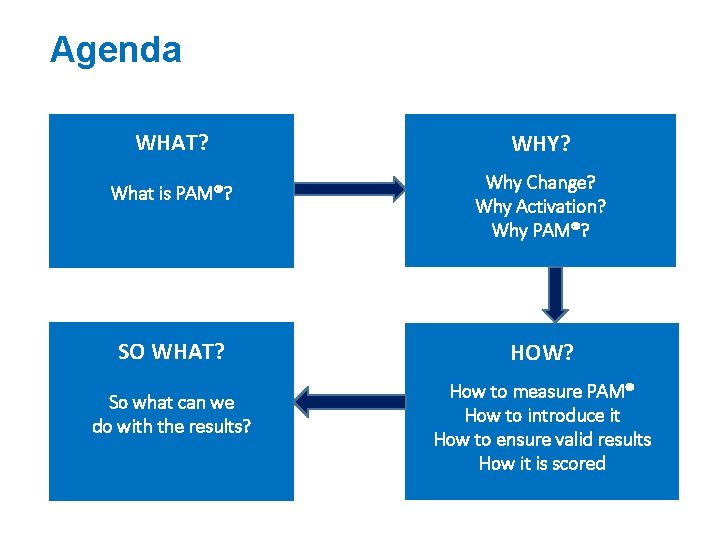
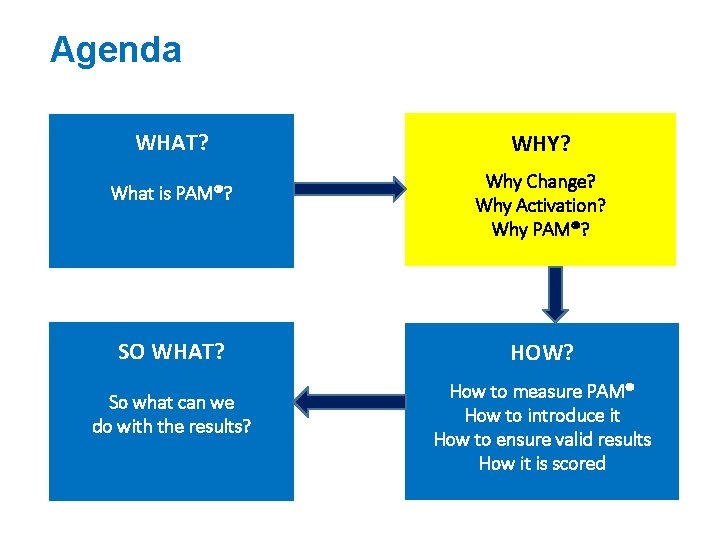
Agenda WHAT? What is PAM®? SO WHAT? So what can we do with the results? WHY? Why Change? Why Activation? Why PAM®? HOW? How to measure PAM® How to introduce it How to ensure valid results How it is scored
Today’s Learning Goals To understand… 1. The Why, What, How and ‘So What’ of the PAM® tool 2. What Activation is and why it is important 3. How to implement PAM® well 4. The connection between Health Coaching & PAM® 5. How to interpret PAM® results to inform your person-centred approach. 6. Tailoring your approach to people at different levels of activation. 7. How using PAM® will affect your caseload management and supervisions
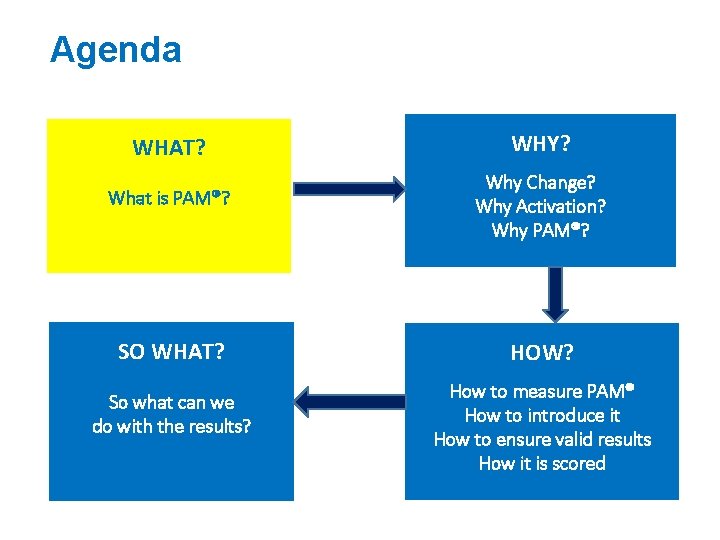
Agenda WHAT? WHY? What is PAM®? Why Change? Why Activation? Why PAM®? SO WHAT? HOW? So what can we do with the results? How to measure PAM® How to introduce it How to ensure valid results How it is scored
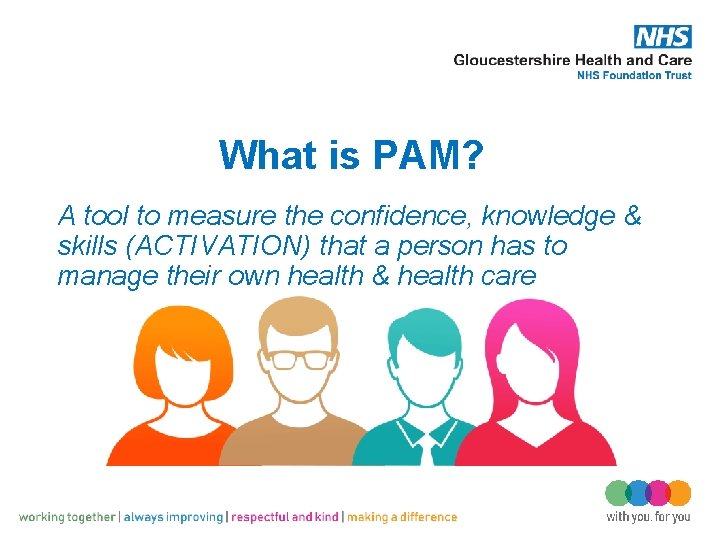
What is PAM? A tool to measure the confidence, knowledge & skills (ACTIVATION) that a person has to manage their own health & health care
What is PAM? • A form with 13 questions each with 5 possible answers • Once scored, gives a level of activation from 1 (low) to 4 (high) • Results in percentage score 1 -100 • Percentage score shows changes within a level • Enables the healthcare professional to tailor approach to the person.
Task 1 Please complete a PAM yourselves What are your thoughts?
Agenda WHAT? What is PAM®? SO WHAT? So what can we do with the results? WHY? Why Change? Why Activation? Why PAM®? HOW? How to measure PAM® How to introduce it How to ensure valid results How it is scored
Task 2 In successful Long-Term Condition management, who makes the most important contribution? Patient H&SC

How do you know who is knowledgeable, skillful and confident? Escalator Video Clip
Determinants of Health What percentage do you think the following Health factors play in an individual’s general health? ? Lifestyle ? Health Care ? Environment ? Human Biology
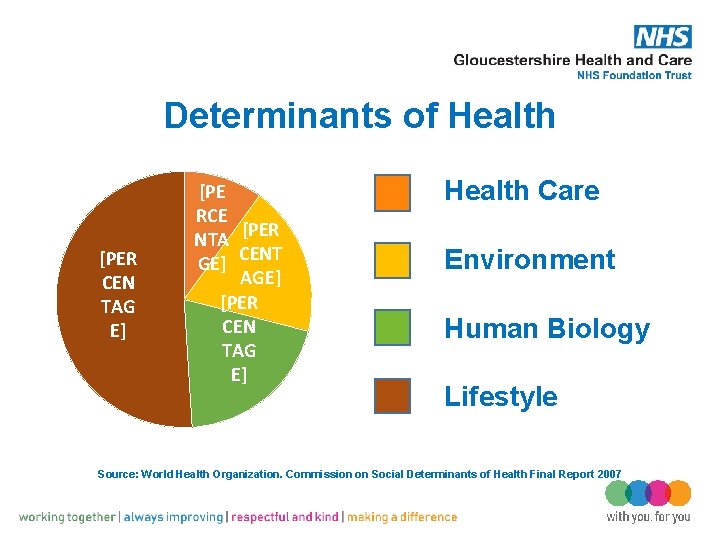
Determinants of Health [PER CEN TAG E] [PE RCE [PER NTA CENT GE] AGE] [PER CEN TAG E] Health Care Environment Human Biology Lifestyle Source: World Health Organization. Commission on Social Determinants of Health Final Report 2007
Task 3 Why is Activation Important - for the Patient ? - for the Organisation ? - for Health Professionals?
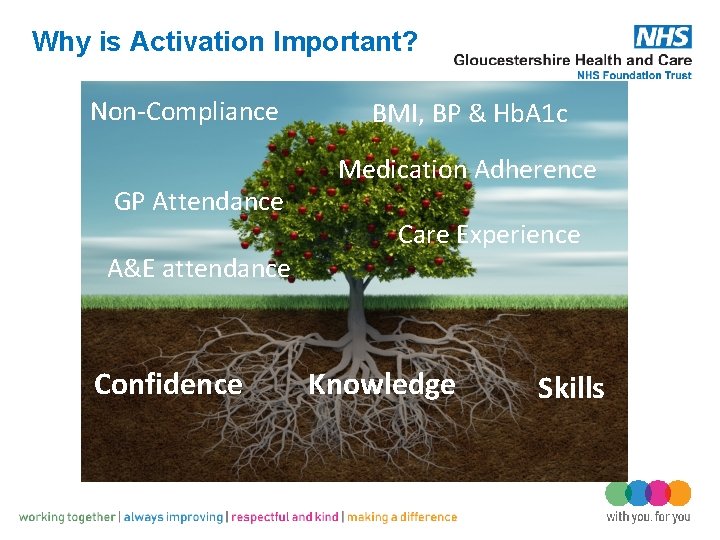
Why is Activation Important? Non-Compliance GP Attendance A&E attendance Confidence BMI, BP & Hb. A 1 c Medication Adherence Care Experience Knowledge Skills
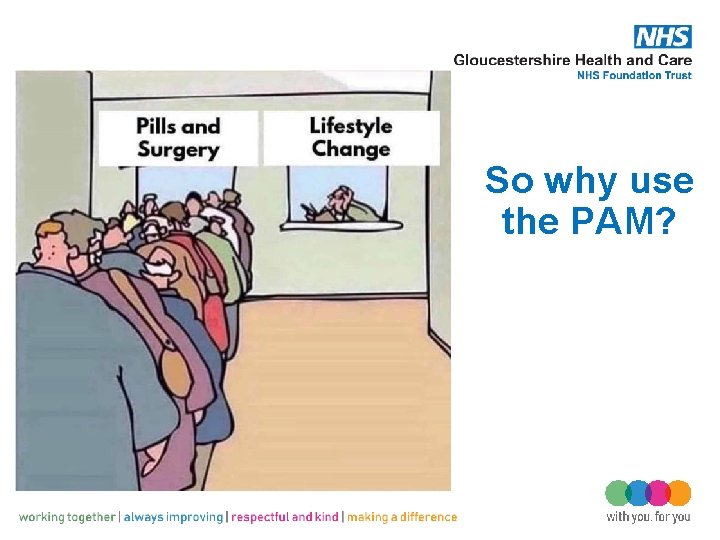
So why use the PAM?
More highly activated patients… Make more informed choices Are better with self-management & prevention Work more effectively with HPs Use less healthcare resource Report higher Quality of Life Are more satisfied with care they receive
BREAK 15 mins
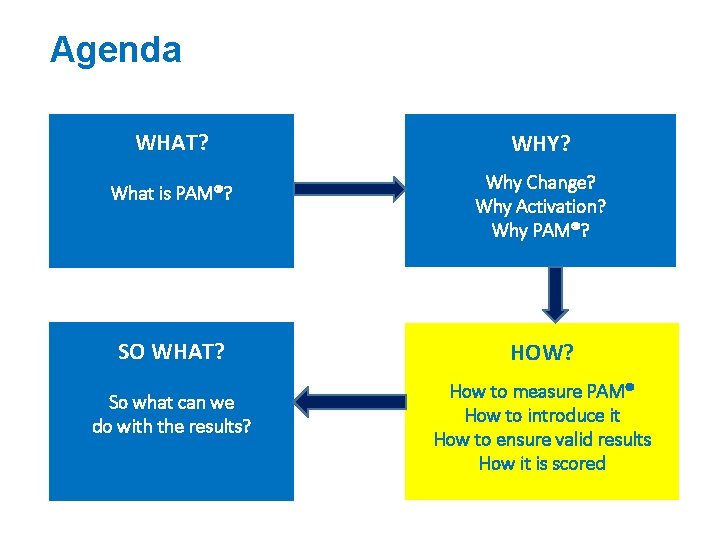
Agenda WHAT? What is PAM®? SO WHAT? So what can we do with the results? WHY? Why Change? Why Activation? Why PAM®? HOW? How to measure PAM® How to introduce it How to ensure valid results How it is scored
How do we measure Pam? • 13 statements with 5 possible responses starting with disagree strongly • The questions are weighted differently & the results are entered into a spreadsheet to generate the level and the score • Questions are designed to make the patient think • PAM is a validated tool to be used as printed • Do not change any of the questions or try to explain them in a different way
Task 4 What factors might bias the results?
What factors could bias the results? Health Professional related: • Explanation • Application • Interpretation Patient related: • Trying to please the practitioner • Don’t want to appear badly • Cognitive impairment Environmental factors
Key Points • • Introduction is key Consider the person Set the stage – explain the why Explain what it is, how it will benefit their care and how long it will take • Emphasize that all answers and results are confidential • To achieve best results, the person needs to answer honestly
Task 5 How will you introduce PAM to a patient ? Take 5 minutes to write your script
Role Play Demonstration
What are your thoughts on the two role plays? • What went well? • What didn’t go so well? • Would could be the consequences?
Task 6 Make any changes to your PAM script & practice with a partner Feedback to group with ‘appreciation’ comment
True or False Quiz To achieve best results, the individual must be completely honest in responding True
True or False Quiz Its OK to re-word the statement if the individual does not understand it False
True or False Quiz If the person answers ‘disagree strongly’ for all answers, that is a PAM Level 1 & 0% score False
True or False Quiz If you don’t get a response after re-reading the statement, select N/A for an answer True
True or False Quiz You can read out the statements in any order False
True or False Quiz Variation in response is to be expected True
True or False Quiz If all responses are the same, Stop, Check their understanding, Re-administer True
True or False Quiz If all responses are ‘agree strongly’ that will be PAM level 4 & score of 100% True
How to ensure valid responses • Read the statements and the answers in the order that they appear • Do not change the wording • Do not interpret the statements for the patient • Allow adequate time for the person to respond • If the individual responds yes/no – ask them to clarify • Variation in response is expected • If all responses are the same: Stop Check their understanding Re-administer • If an individual cannot or will not respond to a PAM statement, select N/A
How is the PAM scored? • The individual’s responses need to be added to the Insignia spread sheet for the score and PAM activation level to be calculated. • You cannot estimate someone’s level unless they have answered agree strongly to every score. • No patient identifiable data is sent to Insignia. • It will take 20 -30 seconds to input the data to receive the score. • The score needs to be recorded in the individual’s record.
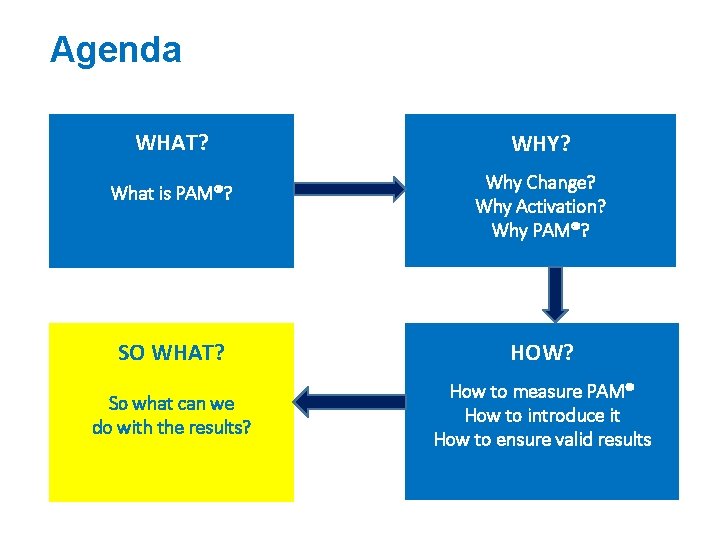
Agenda WHAT? What is PAM®? SO WHAT? So what can we do with the results? WHY? Why Change? Why Activation? Why PAM®? HOW? How to measure PAM® How to introduce it How to ensure valid results How it is scored

Task 7 Let’s sense check our own knowledge, skills and confidence in activity
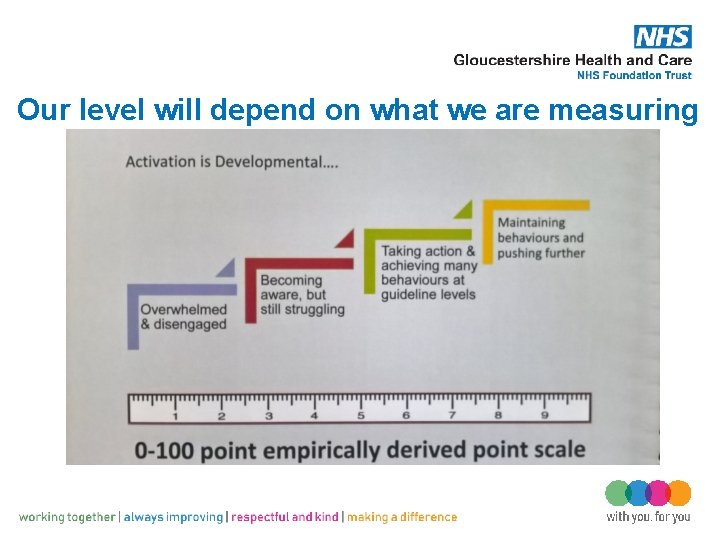
Our level will depend on what we are measuring
Task 8 Which PAM level do you think these patients are?
Task 8 a Which words best describe a patient from each of the 4 PAM levels?
Task 8 b Now reduce the words for each PAM level to the 5 most pertinent. Now reduce each PAM level to 1 word.
Discussion How do you think having this understanding of your patients’ PAM level will impact how you engage with them going forwards?
Task 9 Now consider which words best describe your intervention with each PAM level
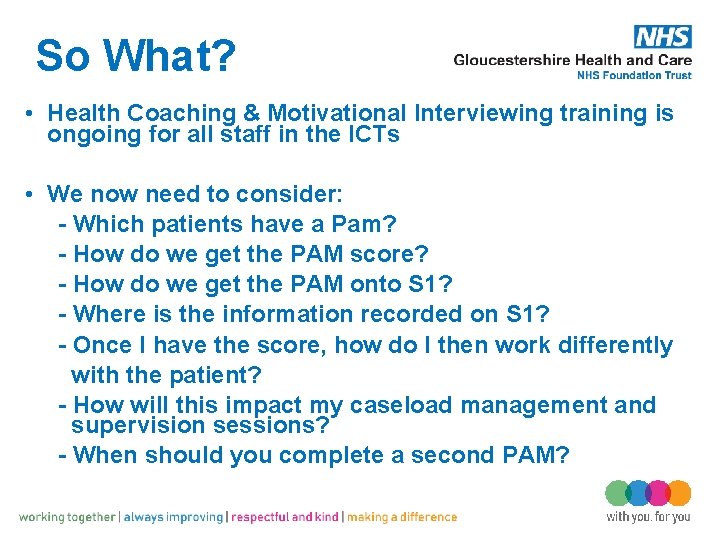
So What? • Health Coaching & Motivational Interviewing training is ongoing for all staff in the ICTs • We now need to consider: - Which patients have a Pam? - How do we get the PAM score? - How do we get the PAM onto S 1? - Where is the information recorded on S 1? - Once I have the score, how do I then work differently with the patient? - How will this impact my caseload management and supervision sessions? - When should you complete a second PAM?
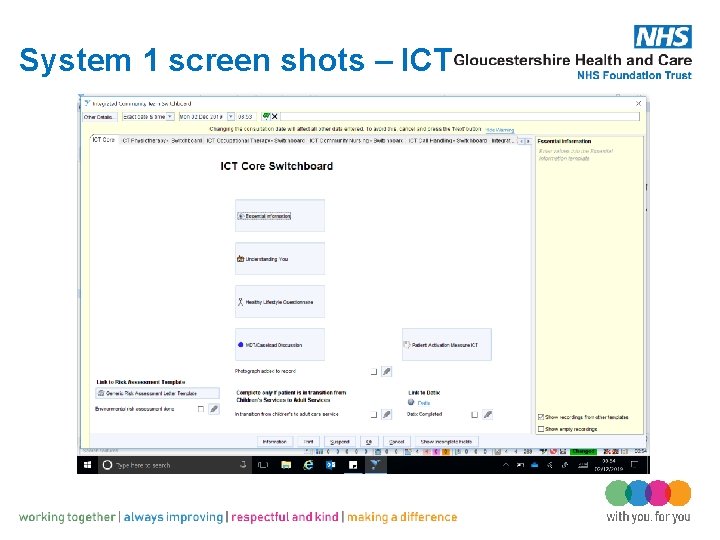
System 1 screen shots – ICT
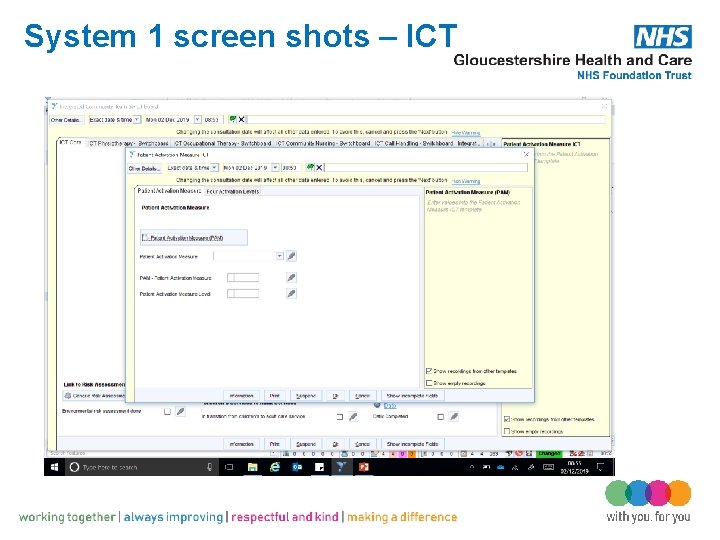
System 1 screen shots – ICT
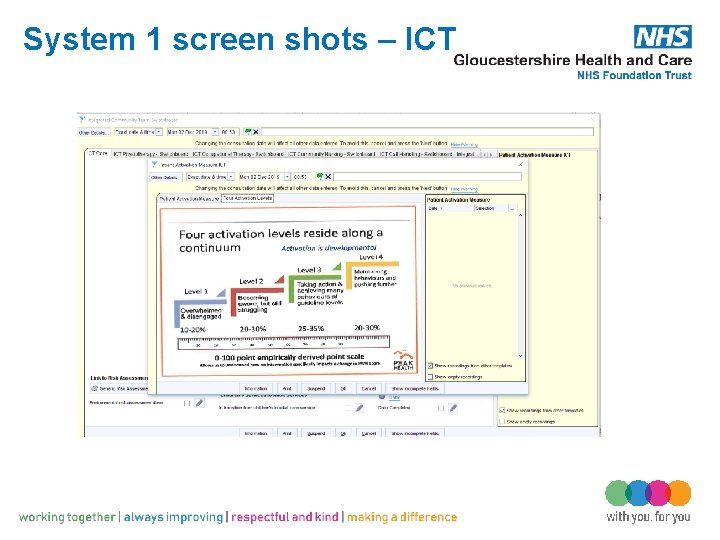
System 1 screen shots – ICT
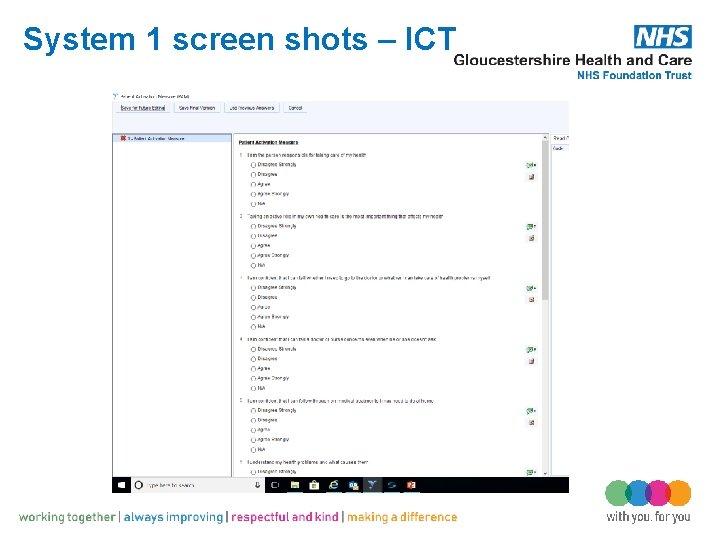
System 1 screen shots – ICT
Task 9 Quiz
In Summary…. 1. The Why, the What, the How and ‘So What’ of the PAM® tool 2. What Activation is and why it is important 3. How to implement PAM® well 4. The connection between Health Coaching & PAM® 5. How to interpret PAM® results to inform your personcentred approach 6. Tailoring your approach to people at different levels of activation 7. How using PAM® will affect your caseload management and supervision sessions
Many thanks for Listening Any questions?
- Slides: 55