
PALLIATIVE CARE HOSPICE CARE A Comparison to Guide


- Slides: 35
PALLIATIVE CARE & HOSPICE CARE A Comparison to Guide Timely Referrals Tracy Wodatch, RN, BSN VP Clinical and Regulatory Services November 2015
PROGRAM OBJECTIVES • Define Palliative Care and Hospice Care • State the differences between Palliative Care and Hospice Care with respect to eligibility, timing, payment, location and treatment • Heighten awareness of importance in initiating conversations about goals of care, preferences, and end-of-life care • Based on Interact 2 tool presented, identify appropriate patients for referral to hospice care
PALLIATIVE CARE • Many people confuse palliative care and hospice, thinking they are one and the same. Although they share a similar philosophy, they are not the same. • By definition, Palliative Care focuses on relieving symptoms that are related to serious, chronic illnesses. • Palliative Care can be used at any stage of a serious illness — not just the advanced stages.
HOSPICE CARE • Hospice care is Palliative Care but with a focus on serving and comforting patients and families at the end of their lives or as the illness becomes terminal. • All Hospice care is considered Palliative but not all Palliative care is Hospice.
PALLIATIVE AND HOSPICE CARE • Both Palliative Care and Hospice Care use an interdisciplinary team approach to focus on quality of life or "comfort care, " including the active management of pain and other symptoms, as well as the psychological, social and spiritual issues often experienced with serious illness and at the end of life.
“COMFORT CARE” • Comfort care is medical care/interventions that focus on relieving symptoms and optimizing patient comfort. Comfort care generally does not seek to cure or aggressively treat illness or disease. • However, with Palliative Care, a patient may seek comfort care while still seeking treatment for the illness.
PALLIATIVE VS HOSPICE VS COMFORT CARE • Both Palliative and Hospice Care philosophies of care, an interdisciplinary team approach to holistic care • Comfort care is medical care or interventions not a philosophy of care
So…What are the differences?
PALLIATIVE AND HOSPICE CARE: A COMPARISON Let’s consider the following criteria: • Eligibility • Timing • Payment • Location • Treatment
ELIGIBILITY Palliative Care: • Palliative care is for people of any age and at any stage in an illness, whether that illness is curable, chronic, or life-threatening. • If you or a loved one are suffering from symptoms of a disease or disorder, be sure to ask your current physician for a referral for a palliative care consult.
ELIGIBILITY Hospice Care: • Specific to the Medicare Hospice Benefit, a patient is eligible for hospice care if two physicians (usually PCP and Hospice Medical Director) determine that the patient has six months or less to live if the terminal illness runs is normal course. • Patients must be re-assessed for eligibility at regular intervals in order to meet ongoing coverage criteria, but there is no limit on the amount of time a patient can be on the hospice benefit.
TIMING Palliative Care • There are no timing restrictions. • Palliative care can be received by patients at any time, at any stage of illness whether it be terminal or not. • Should the patient’s serious illness become terminal with a prognosis of six months of less, it may be appropriate to consider a referral to hospice care.
TIMING Hospice Care • Now is the best time to learn more about hospice and ask questions about what to expect from hospice services. • Although end-of-life care may be difficult to discuss, it is best for family members to share their wishes long before it becomes a concern.
PAYMENT Palliative Care • Many insurance companies cover both Hospice and Palliative Care. • Medicare coverage for Palliative home care can be challenging as the patient must meet Medicare eligibility which includes being homebound or confined to the home. – People with a serious illness may not be homebound as they try to maintain a quality of life including socialization outside the home.
The Medicare Hospice Benefit is an all inclusive program which pays for: § § § Physician services – Hospice Medical Director works in conjunction with attending MD Nursing care Medical appliances and supplies Prescription medications Durable medical equipment Social work services § § Short-term inpatient care for pain & symptom management Spiritual care/Interfaith Minister Respite Care Bereavement services: Ø Grief & Bereavement Counseling Ø Bereavement support for 12 months following the patient’s death Private Insurance Plans most often mirror the Medicare hospice benefit.
What levels of Hospice Care available? There are 4 levels of hospice care available from Medicare Hospice Benefit because patients require different intensities of care during the course of their disease Routine Home Care Hospice is paid the routine home care rate for each day the patient is under care of the hospice. Routine care includes all aspects of care from nursing to home health aides regardless of volume or intensity of service. Continuous Home Care Continuous Care is as necessary to maintain the terminally ill individual at home (does not have to be continuous) within a 24 hour period of time. A min. of 8 hours of direct hands on care by a RN or LPN must be provided within a 24 hour period of time. Frequent medication adjustment to control symptoms in a period of a crisis. Short Term - General Inpatient Care that cannot feasibly be provided in a home setting. An acute change in patients symptoms require aggressive nursing care, intensive management of symptoms. This is usually in a skilled nursing facility or a hospital setting. Inpatient Respite Care Provided in a skilled nursing care facility or hospital setting. Hospice pays the facility an inpatient respite care rate for each day of which the beneficiary is in an approved inpatient facility & is receiving respite care. Payment for respite care maybe made for a max. of 5 continuous days at a time including the date of admission but not counting the day of discharge.
LOCATION OF CARE Palliative Care • It is most common to receive Palliative Care through your physician’s office, home care services, hospitals or nursing homes. • Many Cancer Centers are now offering Palliative Care services
LOCATION OF CARE Hospice Care • In most cases, hospice is provided in the patient’s home. • Hospice care is also provided in freestanding hospice facilities, hospitals, or nursing homes. • The hospice team provides services wherever the patient resides—such as in an assisted living, group home or nursing home.
LOCATIONS OF CARE IN CT Inpatient Hospice Care in CT • 3 licensed and certified inpatient hospice facilities in CT: – Danbury: Center for Comfort Care and Healing (12 beds all private rooms) – Waterbury: VITAS 12 -bed unit (all private rooms) at St Mary’s Hospital – Branford: CT Hospice (54 -bed, 4 bed rooms) • Hospice providers also through contract provide inpatient hospice care in nursing homes and hospitals
TREATMENT Palliative Care • Since there are no time limits on when you can receive palliative care, it acts to fill the gap for patients who want and need comfort at any stage of any disease, whether terminal or chronic. In a palliative care program, there is no expectation that life-prolonging therapies will be avoided. • It is important to note, however, that there may be exceptions. – Some hospice programs provide life-prolonging treatments, and some palliative care programs concentrate mostly on end-of-life care. – Consult your physician or care-administrator for the best service for you.
TREATMENT Hospice Care • Most hospice programs concentrate on comfort rather than cure. – By electing not to receive extensive life-prolonging treatment, hospice patients and their families can concentrate on getting the most out of the time they have left, without some of the negative side-effects that life prolonging treatments can have. • Most hospice patients can achieve a level of comfort that allows them and their families to concentrate on the emotional and practical issues of dying. • The focus of hospice care is more on the quality not the quantity of the life remaining.
So…why is there so much confusion?
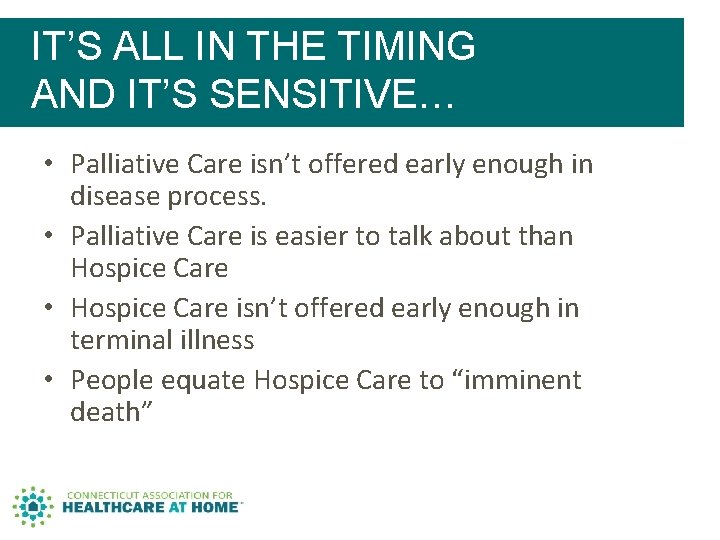
IT’S ALL IN THE TIMING AND IT’S SENSITIVE… • Palliative Care isn’t offered early enough in disease process. • Palliative Care is easier to talk about than Hospice Care • Hospice Care isn’t offered early enough in terminal illness • People equate Hospice Care to “imminent death”
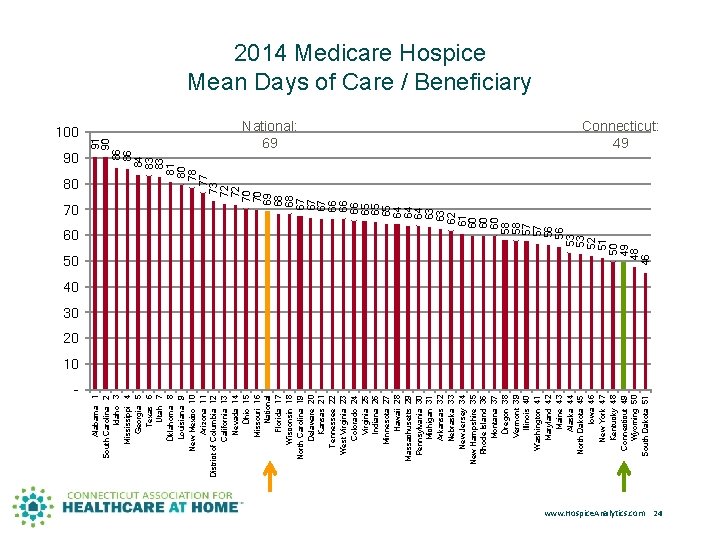
90 80 70 60 50 91 90 86 86 84 83 83 81 80 78 77 73 72 72 70 70 69 68 68 67 67 67 66 66 66 65 65 65 64 64 64 63 63 62 61 60 60 60 58 58 57 57 56 56 53 53 52 51 50 49 48 46 100 Alabama 1 South Carolina 2 Idaho 3 Mississippi 4 Georgia 5 Texas 6 Utah 7 Oklahoma 8 Louisiana 9 New Mexico 10 Arizona 11 District of Columbia 12 California 13 Nevada 14 Ohio 15 Missouri 16 National Florida 17 Wisconsin 18 North Carolina 19 Delaware 20 Kansas 21 Tennessee 22 West Virginia 23 Colorado 24 Virginia 25 Indiana 26 Minnesota 27 Hawaii 28 Massachusetts 29 Pennsylvania 30 Michigan 31 Arkansas 32 Nebraska 33 New Jersey 34 New Hampshire 35 Rhode Island 36 Montana 37 Oregon 38 Vermont 39 Illinois 40 Washington 41 Maryland 42 Maine 43 Alaska 44 North Dakota 45 Iowa 46 New York 47 Kentucky 48 Connecticut 49 Wyoming 50 South Dakota 51 2014 Medicare Hospice Mean Days of Care / Beneficiary National: 69 Connecticut: 49 40 30 20 10 www. Hospice. Analytics. com 24
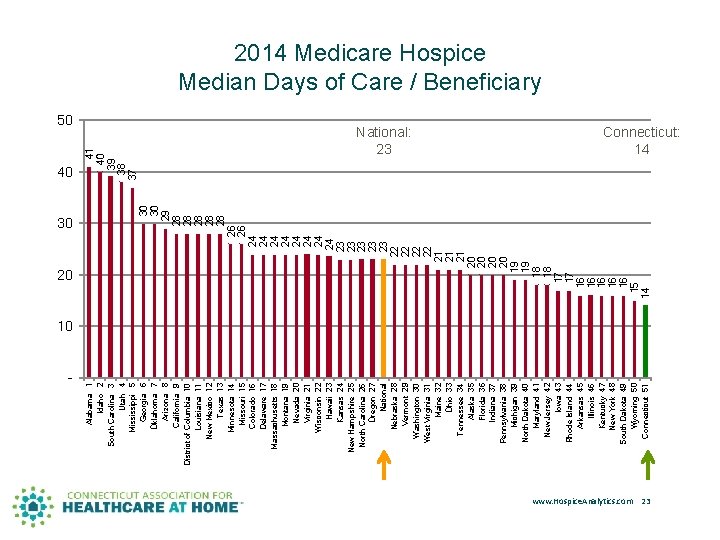
20 30 30 29 28 28 28 26 26 24 24 23 23 23 22 22 21 21 21 20 20 19 19 18 18 17 17 16 16 16 15 14 30 41 40 39 38 37 40 Alabama 1 Idaho 2 South Carolina 3 Utah 4 Mississippi 5 Georgia 6 Oklahoma 7 Arizona 8 California 9 District of Columbia 10 Louisiana 11 New Mexico 12 Texas 13 Minnesota 14 Missouri 15 Colorado 16 Delaware 17 Massachusetts 18 Montana 19 Nevada 20 Virginia 21 Wisconsin 22 Hawaii 23 Kansas 24 New Hampshire 25 North Carolina 26 Oregon 27 National Nebraska 28 Vermont 29 Washington 30 West Virginia 31 Maine 32 Ohio 33 Tennessee 34 Alaska 35 Florida 36 Indiana 37 Pennsylvania 38 Michigan 39 North Dakota 40 Maryland 41 New Jersey 42 Iowa 43 Rhode Island 44 Arkansas 45 Illinois 46 Kentucky 47 New York 48 South Dakota 49 Wyoming 50 Connecticut 51 2014 Medicare Hospice Median Days of Care / Beneficiary 50 National: 23 Connecticut: 14 10 www. Hospice. Analytics. com 23
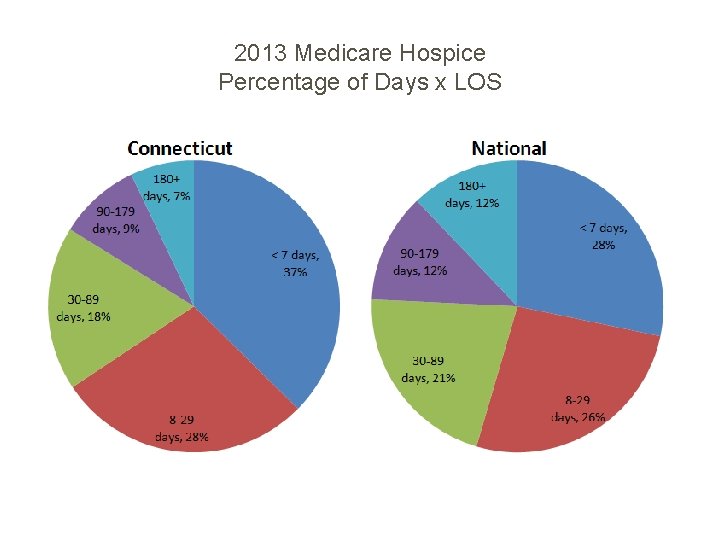
2013 Medicare Hospice Percentage of Days x LOS
*NEW* ADVANCED CARE PLANNING CODES FOR 2016 • CMS established two new CPT codes for physicians to document advance care planning conversations during annual checkups – one code for the first 30 minutes – a second add-on code for additional 30 minute conversations – Effective January 1, 2016
NEW ACP BILLING CODES 2016 Advance Care Planning (ACP) as an Optional Element of an Annual Wellness Visit (AWV) Identify those with serious illnesses • Effective January 1, 2016, when ACP services are provided as a part of an AWV, practitioners would report CPT code 99497 (plus add-on code 99498 for each additional 30 minutes, if applicable) for the ACP services in addition to either of the AWV codes G 0438 and G 0439. CPT codes 99497 and 99498 used to describe ACP are separately payable under the Medicare Physician Fee Schedule (MPFS). • Critical Access Hospitals (CAHs) may also bill for these professional services provided on or after January 1, 2016, using type of bill 85 X with revenue codes 96 X, 97 X, and 98 X. • For full instructions, view MLN Article MM 9271 https: //www. cms. gov/Outreach-and-Education/Medicare-Learning. Network-MLN/MLNMatters. Articles/Downloads/MM 9271. pdf
ADVANCED CARE PLANNING AND GOALS OF CARE • Advanced Care Planning Communication Guide: Overview (www. interact 2. net) – The INTERACT Advance Care Planning Communication Guide is designed to assist health professionals to initiate and carry out conversations with patients and their families about goals of care and preferences throughout the disease process as well as when there has been a decline in health status. – The Guide can be useful for education, including roleplaying exercises and simulation training.
REFERRAL CONSIDERATIONS Identifying Patients Appropriate for Hospice or Palliative (www. interact 2. net) – CHF – COPD – Dementia – Cancer
MORE OBVIOUS CONSIDERATIONS • Frequent Emergency Room visits and/or hospitalizations over the last 6 months • Sudden, major decline in functional status with no identified reversible causes • Primary diagnosis of metastatic cancer with chronic pain and/or poor ADL function, not on chemotherapy • Semi-comatose or comatose state with no identified reversible causes • Inability or difficulty taking oral medicines • Minimal oral intake (or receiving continuous or intermittent IV hydration) • Mottling of extremities related to poor oral intake or volume depletion
EARLY CONVERSATIONS LEAD TO: Informed Choice and Positive Patient Experience Identify those with serious illnesses Offer palliative care early concurrent with treatment Discuss goals of care throughout illness Document wishes and encourage patient to discuss wishes with family and all providers of care • Offer hospice as early as possible once prognosis estimated as 6 months or less • •
MOLST PILOT • MOLST pilot (April 16, 2015 to October 1, 2016) – Windham and Greater Hartford (UCONN Health Center and Hartford Healthcare) • “Medical order for life-sustaining treatment” “… a written medical order by a physician (MD/DO), advanced practice registered nurse (APRN) or physician assistant (PA) – to effectuate a patient’s request for life-sustaining treatment – when the patient has been determined by a physician to be approaching the end stage of a serious, life limiting illness or is in a condition of advanced, chronic progressive frailty; ” – • Anticipate legislation to be raised to extend the pilot through October 2017 and expand pilot participation
PALLIATIVE CARE ADVISORY COUNCIL • Public Act 13 -55 establishes a 13 -member Palliative Care Advisory Council within the Department of Public Health. • The council must (1) analyze the current state of palliative care in Connecticut and (2) advise DPH on matters related to improving palliative care and the quality of life for people with serious or chronic illnesses. • Recommendations due to DPH Commissioner by January 1, 2016
Presentation based on newly released “Palliative vs. Hospice Care Info Sheet” THANK YOU!