
Palliative Care Emergencies Additional module if needed Learning
- Slides: 40
Palliative Care Emergencies Additional module if needed
Learning objectives Understand emergency /urgent / important n Describe common emergencies in PC n Explore principles of essential management n Outline management for specific common emergencies in PC n
Questions ■ In any given situation we must use ■ knowledge ■ ■ skill ■ ■ know how we should do diplomacy ■ ■ know what we should do attitude ■ ■ know what we could do know what the patient wants us to do / not do judgement ■ make an active/ negotiated decision
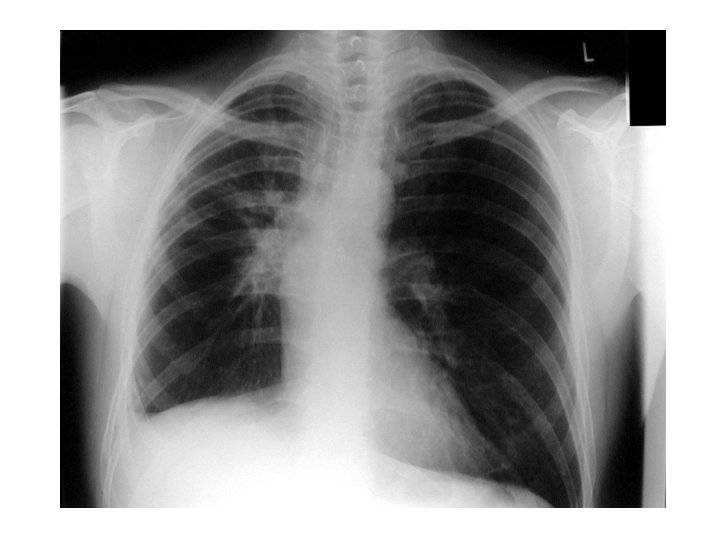
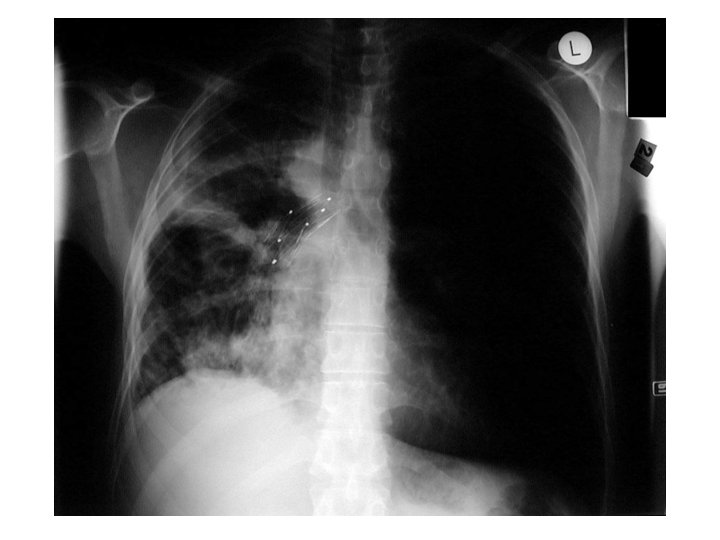
Emergencies n n n n n severe pain confusion spinal cord compression fractures metabolic - hypercalcaemia seizures haemorrhage superior vena cava obstruction respiratory obstruction
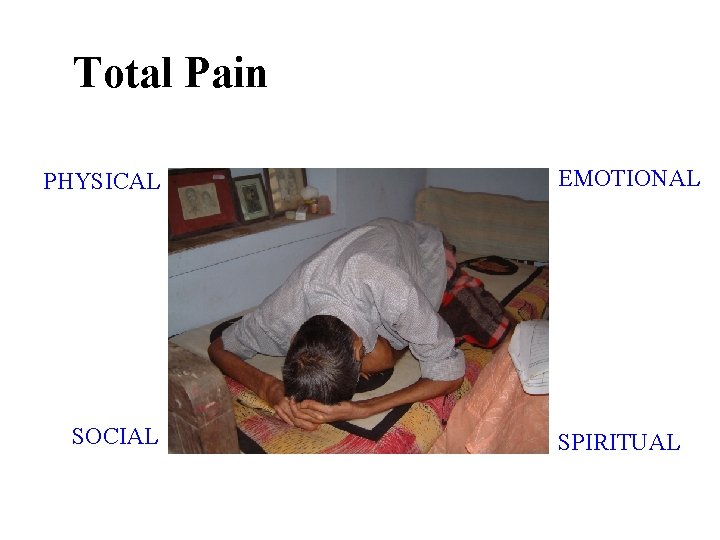
Total Pain PHYSICAL SOCIAL EMOTIONAL SPIRITUAL
Confusion ■ confusion ■ ■ up to 75% patients advanced illness often fluctuates terminal restlessness (mild) terminal delerium (severe)
Confusion Causes n biochemical / drugs n pain n cerebral irritation n infection n constipation / retention n hypoxia / respiratory distress n anxiety / spiritual distress
Confusion Management ■ treat reversible causes ■ ■ adjust environment ■ ■ familiar voices, music, soft lighting, avoid loud noise / don’t use restraints explain / support ■ ■ stop medications / insert catheter / start antibiotics / treat constipation family needs pharmacological intervention
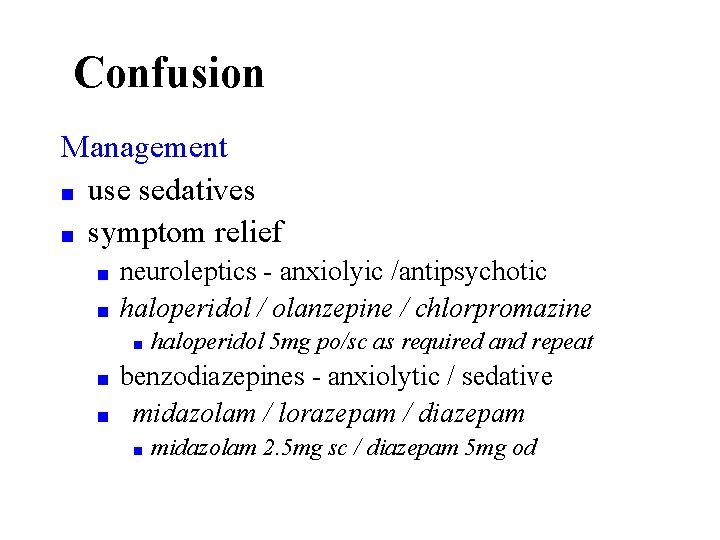
Confusion Management ■ use sedatives ■ symptom relief ■ ■ neuroleptics - anxiolyic /antipsychotic haloperidol / olanzepine / chlorpromazine ■ ■ ■ haloperidol 5 mg po/sc as required and repeat benzodiazepines - anxiolytic / sedative midazolam / lorazepam / diazepam ■ midazolam 2. 5 mg sc / diazepam 5 mg od
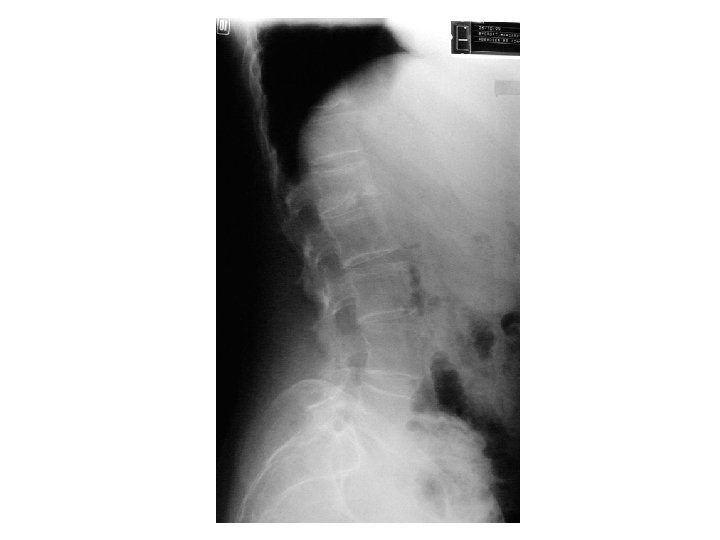
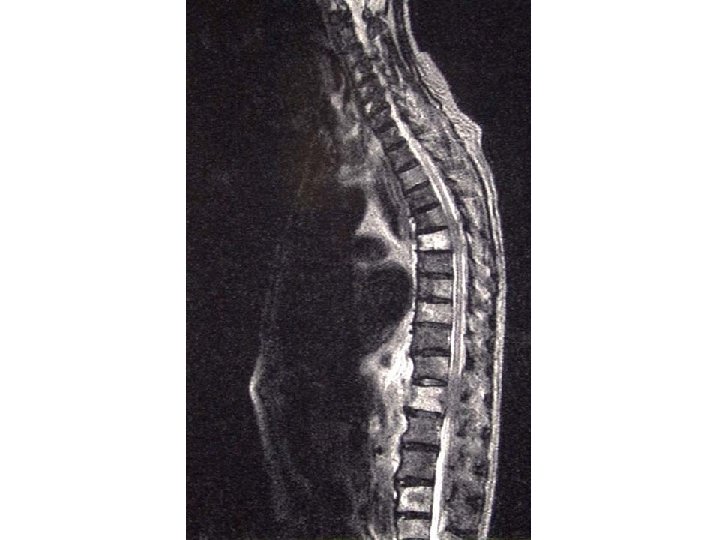
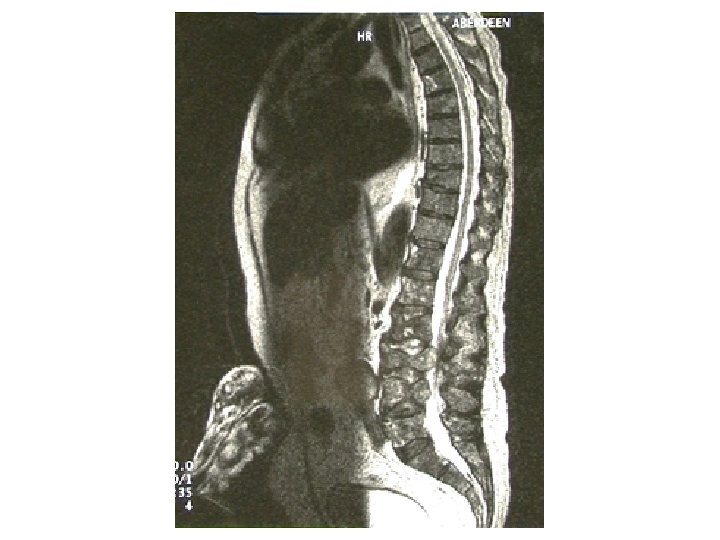
Spinal Cord Compression Incidence ■ 3% patients advanced cancer ■ > one level 20% ■ common ■ ■ ■ breast bronchus prostate
Spinal Cord Compression Mechanism ■ metastatic spread to bone 85% ■ direct tumour extension 10% ■ intramedullary primary 4% ■ haematogenous spread to epidural space 1%
Spinal Cord Compression Presentation n pain >90% n weakness >75% n sensory level >50% n sphincter dysfunction >40% nb. pain usually predates other symptoms
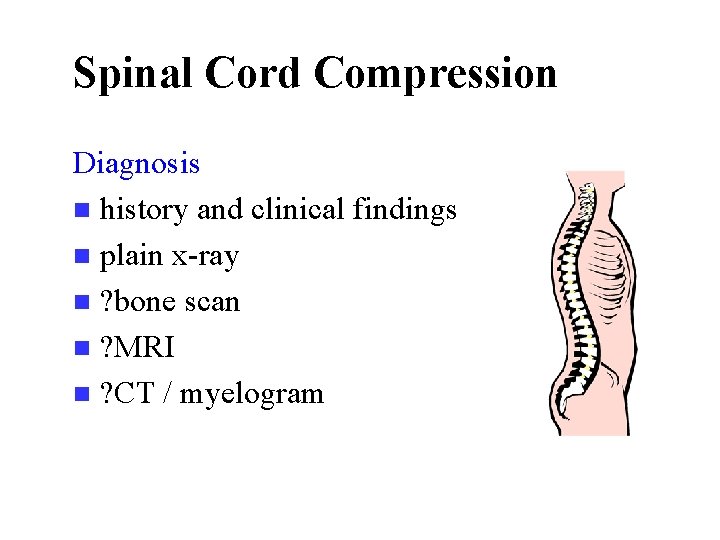
Spinal Cord Compression Diagnosis n history and clinical findings n plain x-ray n ? bone scan n ? MRI n ? CT / myelogram
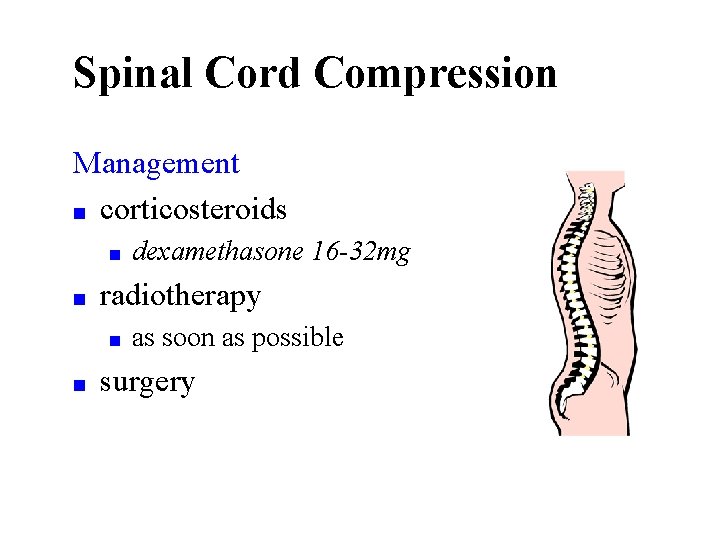
Spinal Cord Compression Management ■ corticosteroids ■ ■ radiotherapy ■ ■ dexamethasone 16 -32 mg as soon as possible surgery
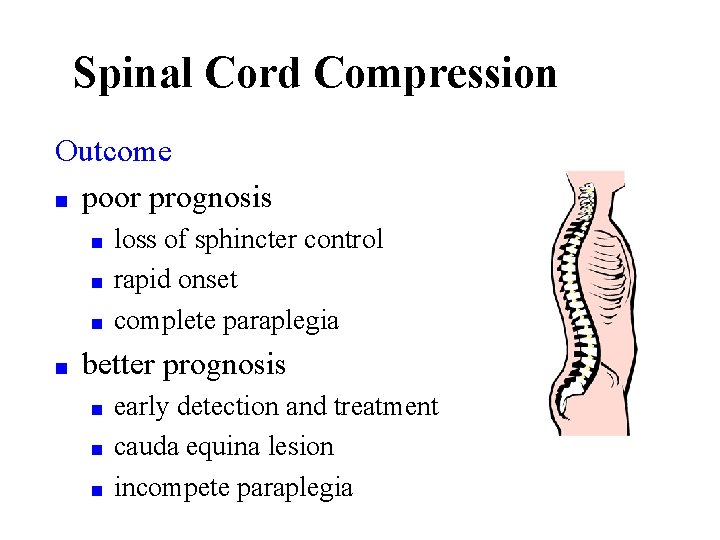
Spinal Cord Compression Outcome ■ poor prognosis ■ ■ loss of sphincter control rapid onset complete paraplegia better prognosis ■ ■ ■ early detection and treatment cauda equina lesion incompete paraplegia
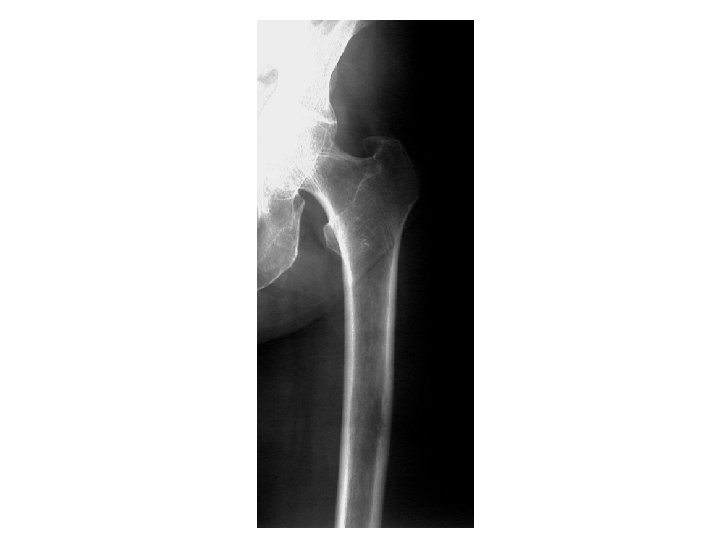
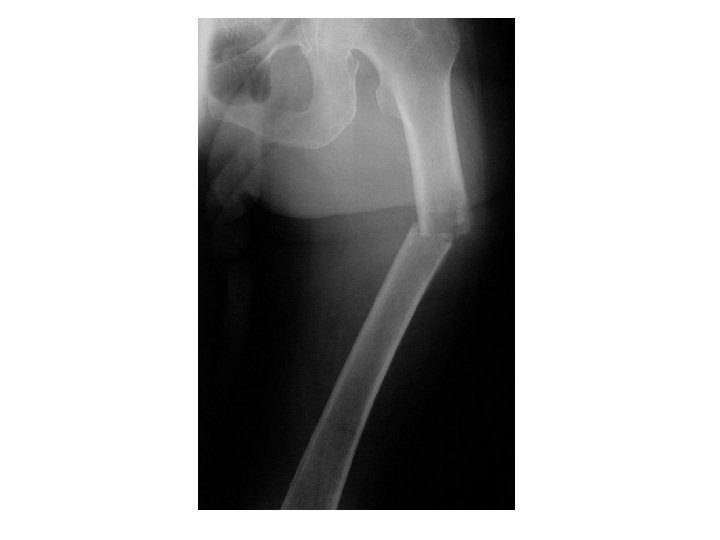
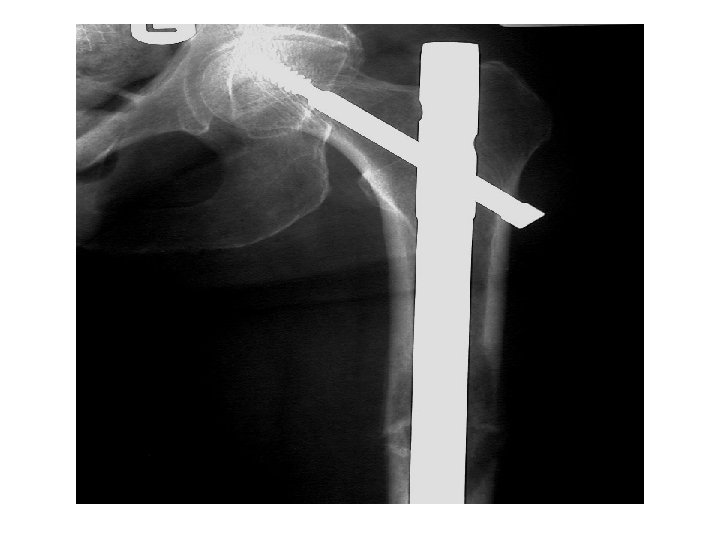
Fracture ■ ■ ■ common with metastatic bone disease may be terminal event management ■ ■ anticipate radiotherapy surgery neuraxial therapies
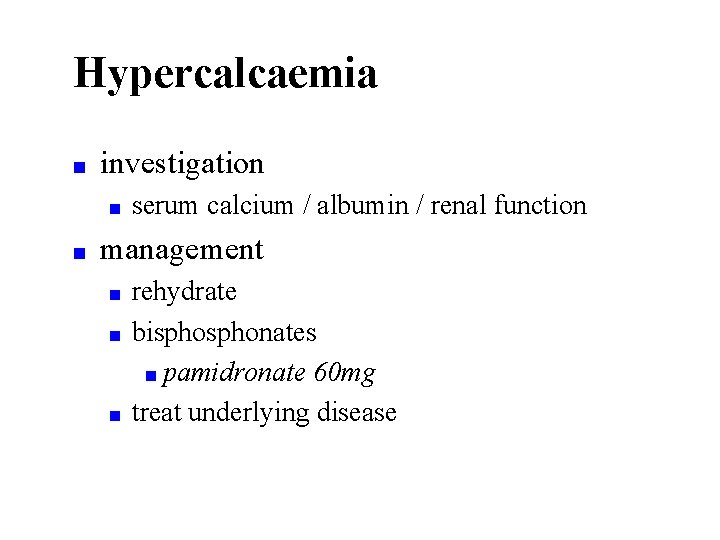
Hypercalcaemia ■ ■ ■ commonest metabolic complication rate of rise determines emergency common ■ ■ ■ up to 50% breast and myeloma lung / renal / cervix / head and neck diagnosis ■ thirst / polyuria / confusion / pain / nausea and vomiing / constipation / dehydration / coma
Hypercalcaemia ■ investigation ■ ■ serum calcium / albumin / renal function management ■ ■ ■ rehydrate bisphonates ■ pamidronate 60 mg treat underlying disease
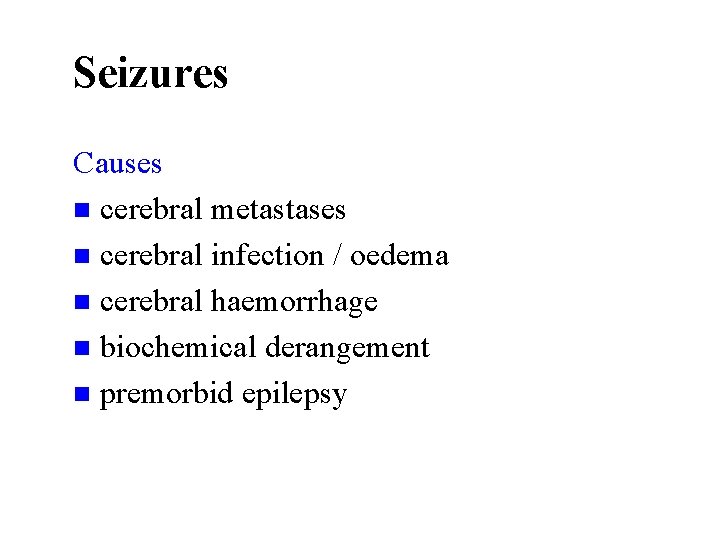
Seizures Causes n cerebral metastases n cerebral infection / oedema n cerebral haemorrhage n biochemical derangement n premorbid epilepsy
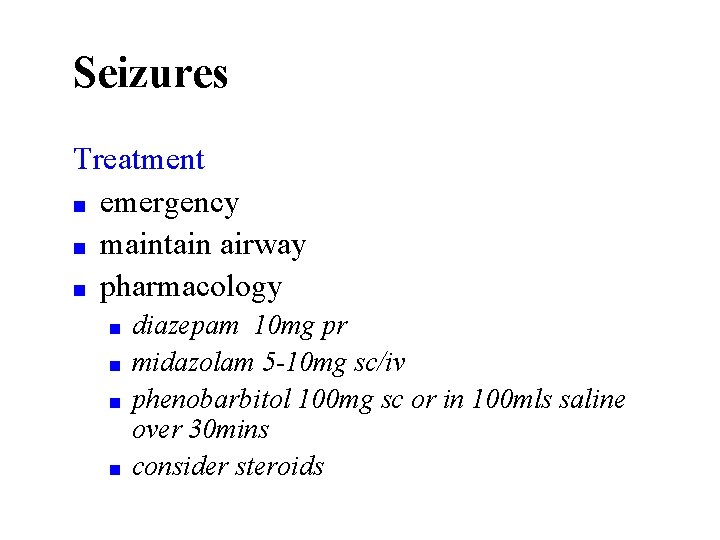
Seizures Treatment ■ emergency ■ maintain airway ■ pharmacology ■ ■ diazepam 10 mg pr midazolam 5 -10 mg sc/iv phenobarbitol 100 mg sc or in 100 mls saline over 30 mins consider steroids
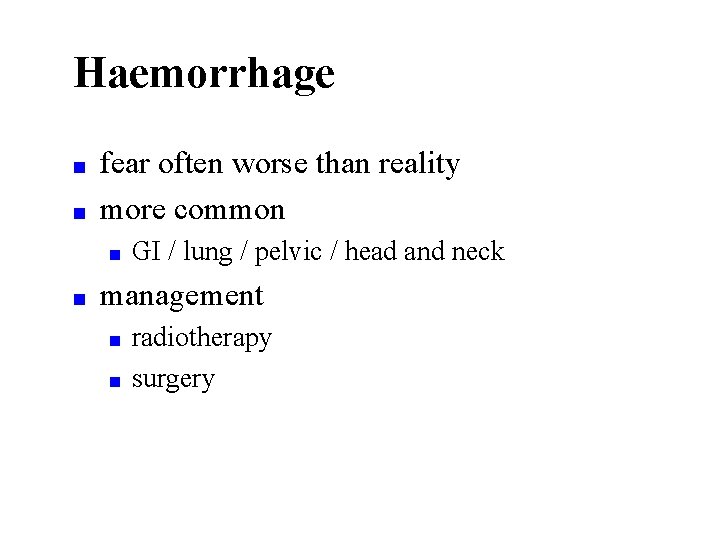
Haemorrhage ■ ■ fear often worse than reality more common ■ ■ GI / lung / pelvic / head and neck management ■ ■ radiotherapy surgery
Haemorrhage Management ■ topical ■ ■ mild oozing ■ topical sucralfate moderate oozing ■ dilute hemloc (adrenaline 1: 1000 soaked swab)
Haemorrhage Management ■ oral ■ ■ ■ ethamsylate 500 mg QID (tranexamic acid) sucralfate 1 g bd-qds 1% alum bladder irrigation
Massive Haemorrhage Management ■ anticipate ■ prevent (if possible) ■ keep calm ■ skilled person (if available) ■ sedation (if possible) ■ ■ benzodiazepine / morphine vaginal pack / local measures / surgery
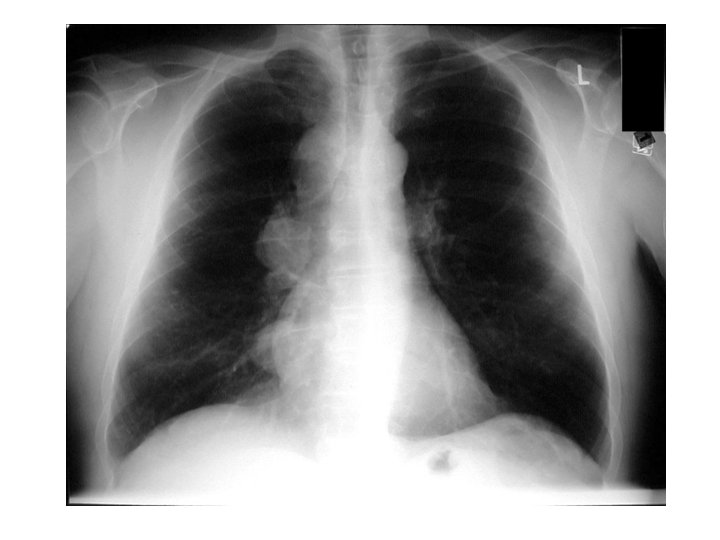
SVCO Superior venal cava obstruction ■ 75% SVCO is in lung carcinoma ■ extrinsic compression / mediastinum ■ symptoms/signs ■ ■ depend on extent and speed of development symptoms worse on lying flat facial +/- arm swelling engorged neck and chest wall veins
SVCO Management n stat iv dexamethasone 8 -16 mg then po n ? urgent referral for radiotherapy n stent n ? chemotherapy
Respiratory Obstruction ■ ■ ■ acute reversible or irreversible ? relieve symptoms regardless of cause Pharmacological ■ parenteral morphine ■ s/l lorazepam 0. 5 - 2. 0 mg PRN / parenteral midazolam ■ ? steroids - dexamethasone Non-pharmacological ■ fan, presence
Stridor acute stridor is very rare n iv dexamethasone stat n iv midazolam, if severe agitation n ? referral for stent /DXT n
Conclusions can be physical, social, spiritual, psychological n cause team tension n challenge n opportunity n bridges specialties n teamwork n
n These resources are developed as part of the THET multi-country project whose goal is to strengthen and integrate palliative care into national health systems through a public health primary care approach – – – Acknowledgement given to Cairdeas International Palliative Care Trust and MPCU for their preparation and adaptation part of the teaching materials for the Palliative Care Toolkit training with modules as per the Training Manual can be used as basic PC presentations when facilitators are encouraged to adapt and make contextual