
Palliative care Analgesia Nausea and Vomiting Breaking bad
Palliative care: Analgesia Nausea and Vomiting Breaking bad news Dr Edward Davis 11. 04. 2012
Objectives l Analgesia – – – l Nausea and vomiting – – l Types of analgesia Indications Routes Conversions Syringe drivers Causes Treatment Breaking bad news
Brainstorm Types of analgesia in palliative care

Morphine l l Sevredol Oramorph Zomorph MST
Diamorphine l Traditionally used in community setting
Oxycodone l l Oxynorm (short acting) Oxycontin (long acting)
Patches l Buprenorphine – – l Bu. Trans (lower doses, 7 days) Transtec (higher doses, 96 hours) Fentanyl patch – 72 hour
Abstral l l Lozenge Breakthrough for cancer pain Moving patients Dysphagia Need to be
Alfentanil l Used if volume of Diamorphine too great for Syringe driver
Conversions l Useful table in Palliative care handbook

Scenarios
Scenario 1 Mr Jones is a 45 year old man with metastatic lung cancer. He is taking 80 mg of Oramorph daily for pain relief. You feel it is appropriate to commence him on a long acting oral morphine preparation. What preparation would you commence, at which dose, and how much would you recommend he takes for breakthrough pain?
Scenario 2 Mr Jones mediastinal disease worsens and causes him dysphagia. He is now taking 50 mg BD of MST and has required 20 mg of breakthrough Oramorph in the last 24 hours. He is not keen on taking so many tablets. What analgesic preparations would you consider commencing? What dose would you commence and what would his breakthrough dose be.
Scenario 3 Mr Jones is now bed bound and his analgesic requirements continue to increase. He is struggling to take oral medications and you feel that he is approaching the end of life. You decide a syringe driver should be commenced. He now has a 150 mcg/hr fentanyl patch and had required 320 mg of oral morphine for breakthrough. What preparation would you use in the driver and at which dose? What would the breakthrough dose be?
Nausea and vomiting
Common causes l l l l l Drugs Biochemical Infection Cancer tx Vestibular Constipation Intestinal obstruction Raised ICP Anxiety

Features Cause Large vol, infrequent, relief after Gastric stasis Similar to above but forceful vomiting Gastric outflow obstruction Low volume vomiting , fullness Squashed stomach syndrome Food sticking, vomit after drinking/eating Oesophageal obstruction Nausea, faecal vomit, abdo pain, colic Bowel obstruction Nausea or sudden vomiting on movement Vestibular Nausea in waves, predisposed by previous experience, relieved with distraction Anxiety Constant nausea, variable vomiting Chemical induced

Treatment l l Treat reversible cause Antiemetic – – Regular and max dose s/c or po Target cause Review and revise
Treatment 2 l Non pharmacological – – – Calm environment Avoid food smells Cool fizzy drinks Ginger/ peppermint Carbohydrate food Acupuncture
Metoclopramide l l Prokinetic and central Use – – l Gastric stasis Opioids 10 mg TDS, 30 -120 mg/24 hr
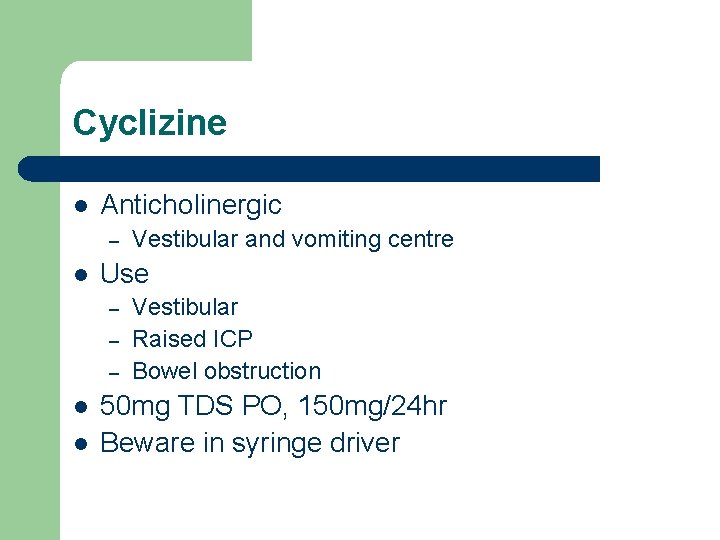
Cyclizine l Anticholinergic – l Use – – – l l Vestibular and vomiting centre Vestibular Raised ICP Bowel obstruction 50 mg TDS PO, 150 mg/24 hr Beware in syringe driver
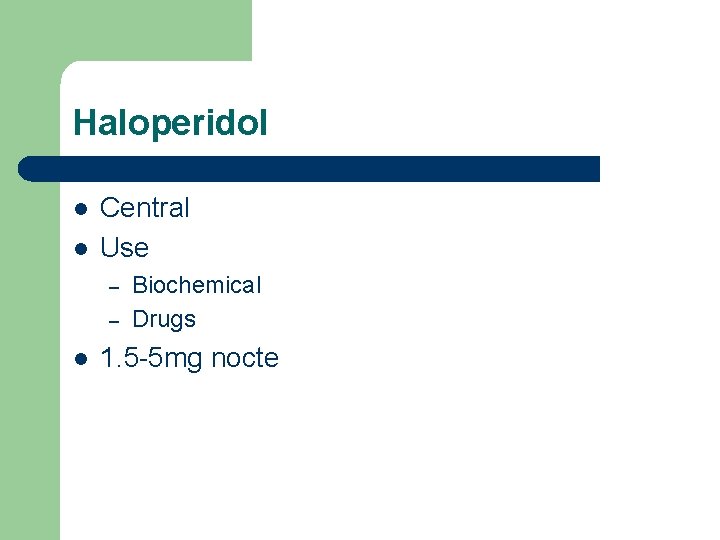
Haloperidol l l Central Use – – l Biochemical Drugs 1. 5 -5 mg nocte
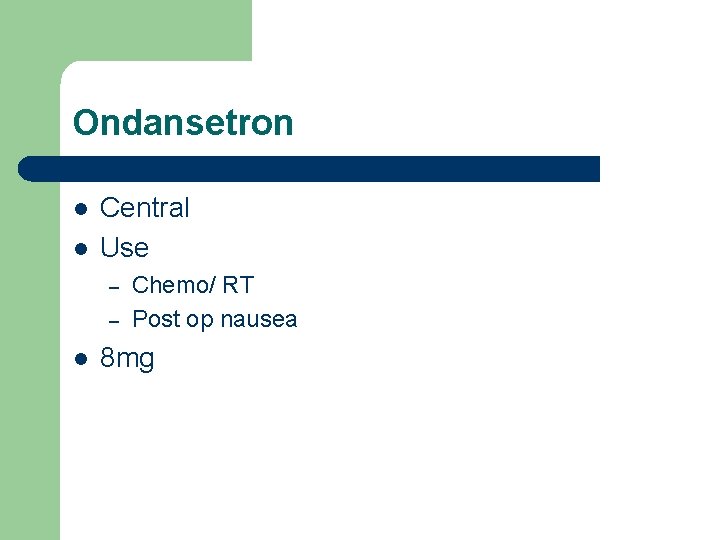
Ondansetron l l Central Use – – l Chemo/ RT Post op nausea 8 mg
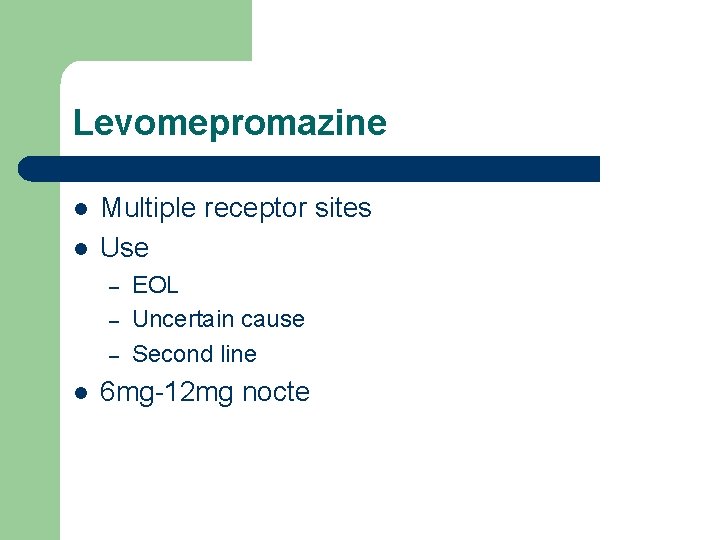
Levomepromazine l l Multiple receptor sites Use – – – l EOL Uncertain cause Second line 6 mg-12 mg nocte

Breaking bad news
SPIKES l l Robert Buckman Useful structure to bear in mind
S: Setting up l l Know all the facts Set a time Bleep free Privacy
P: Perception l l Check patient understanding “It would help me to know what you understand about your illness? ”
I: Invitation l l Respect patients who do not want to know all information “Are you the type of person who likes detailed information, or would you like a general overview? ”
K: Knowledge l Warning shot – l l l “I am sorry to tell you”. Level of vocabulary and knowledge of patient Non technical Chunking and checking Avoid “there is nothing more we can do” Encourage questions
E: Emotions l l l l Empathy Observe for emotion “How are you feeling? ” Identify the reason for the emotion Acknowledge and understand patient’s emotions Silence is golden Allow for pauses
S: Strategy and summary l l l Summary and plan Patient’s concerns Support available
Summary l l l Analgesia Antiemetics Breaking bad news – SPIKES

Thanks for listening
- Slides: 34