
Palay Check The System Concepts Principles Key Checks

- Slides: 39
® Palay. Check The System: Concepts, Principles, & Key Checks Part 1: Understanding the Palay. Check System
ANO ITO? Palay. Check
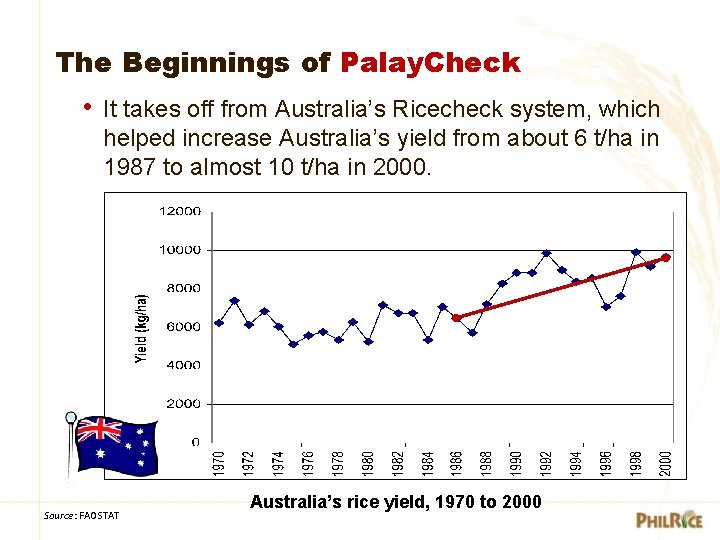
The Beginnings of Palay. Check • It takes off from Australia’s Ricecheck system, which helped increase Australia’s yield from about 6 t/ha in 1987 to almost 10 t/ha in 2000. Source: FAOSTAT Australia’s rice yield, 1970 to 2000
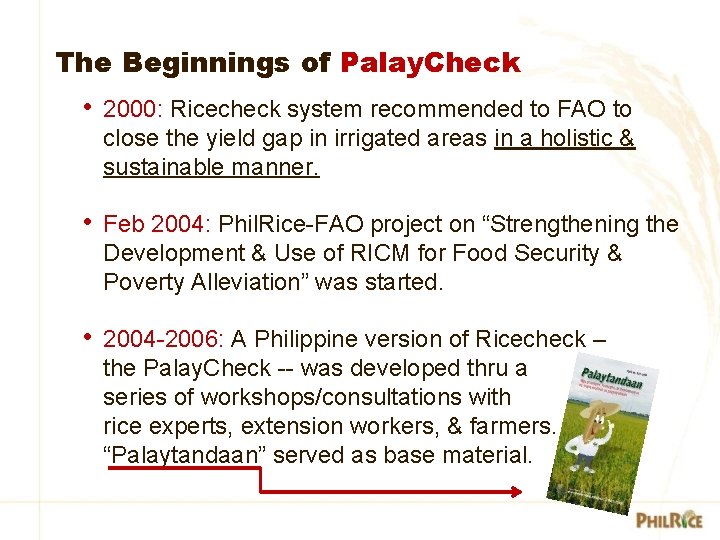
The Beginnings of Palay. Check • 2000: Ricecheck system recommended to FAO to close the yield gap in irrigated areas in a holistic & sustainable manner. • Feb 2004: Phil. Rice-FAO project on “Strengthening the Development & Use of RICM for Food Security & Poverty Alleviation” was started. • 2004 -2006: A Philippine version of Ricecheck – the Palay. Check -- was developed thru a series of workshops/consultations with rice experts, extension workers, & farmers. “Palaytandaan” served as base material.
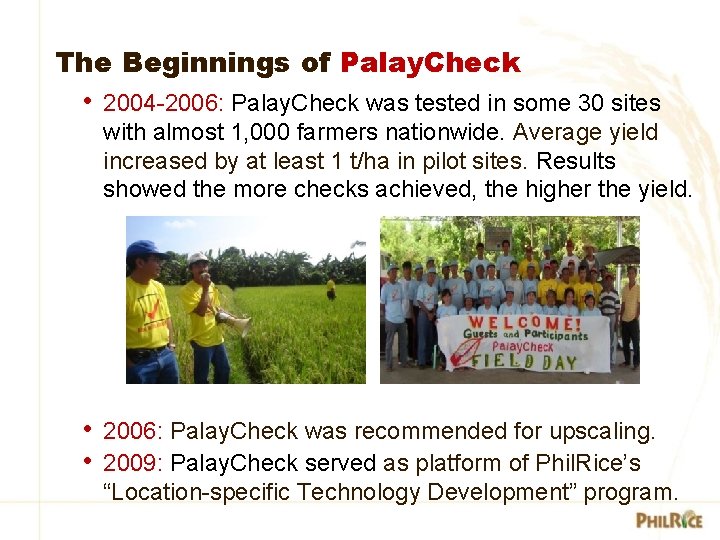
The Beginnings of Palay. Check • 2004 -2006: Palay. Check was tested in some 30 sites with almost 1, 000 farmers nationwide. Average yield increased by at least 1 t/ha in pilot sites. Results showed the more checks achieved, the higher the yield. • • 2006: Palay. Check was recommended for upscaling. 2009: Palay. Check served as platform of Phil. Rice’s “Location-specific Technology Development” program.
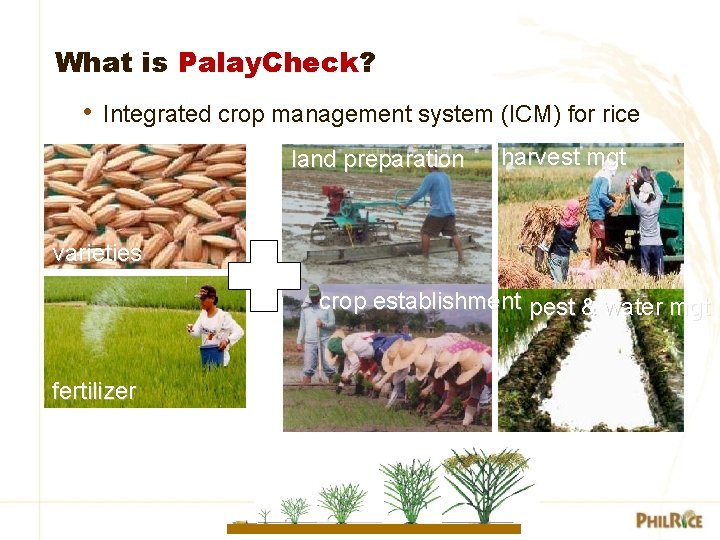
What is Palay. Check? • Integrated crop management system (ICM) for rice land preparation harvest mgt varieties crop establishment pest & water mgt fertilizer
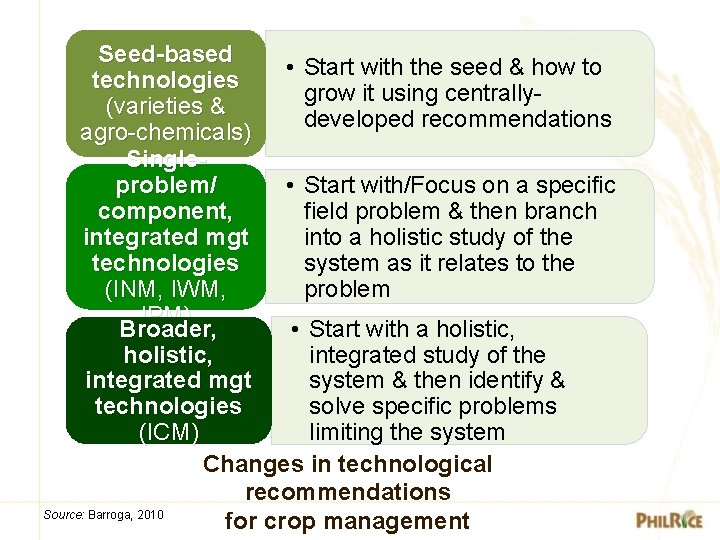
Seed-based • Start with the seed & how to technologies grow it using centrally(varieties & developed recommendations agro-chemicals) Singleproblem/ • Start with/Focus on a specific component, field problem & then branch integrated mgt into a holistic study of the technologies system as it relates to the (INM, IWM, problem IPM) • Start with a holistic, Broader, integrated study of the holistic, system & then identify & integrated mgt technologies solve specific problems (ICM) limiting the system Changes in technological recommendations Source: Barroga, 2010 for crop management
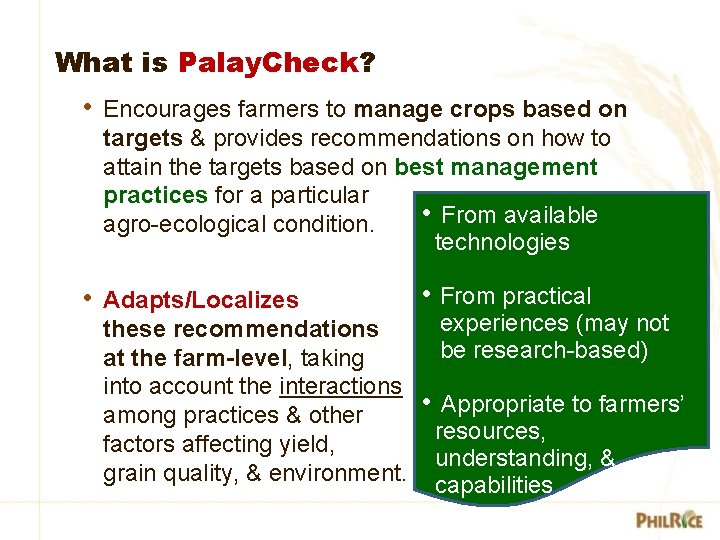
What is Palay. Check? • Encourages farmers to manage crops based on targets & provides recommendations on how to attain the targets based on best management practices for a particular • From available agro-ecological condition. technologies • Adapts/Localizes these recommendations at the farm-level, taking into account the interactions among practices & other factors affecting yield, grain quality, & environment. • From practical experiences (may not be research-based) • Appropriate to farmers’ resources, understanding, & capabilities
PALAYCHECK: Gagawing SWAK ang teknolohiya sa bukid niyo!
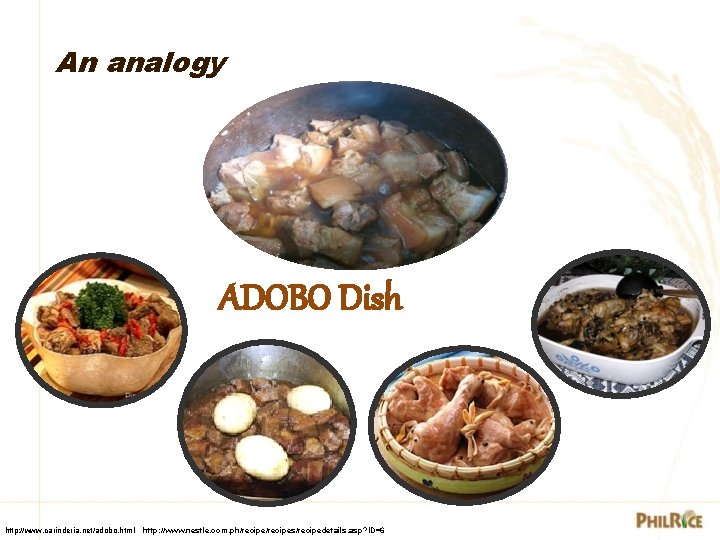
An analogy ADOBO Dish http: //www. carinderia. net/adobo. html http: //www. nestle. com. ph/recipes/recipedetails. asp? ID=6
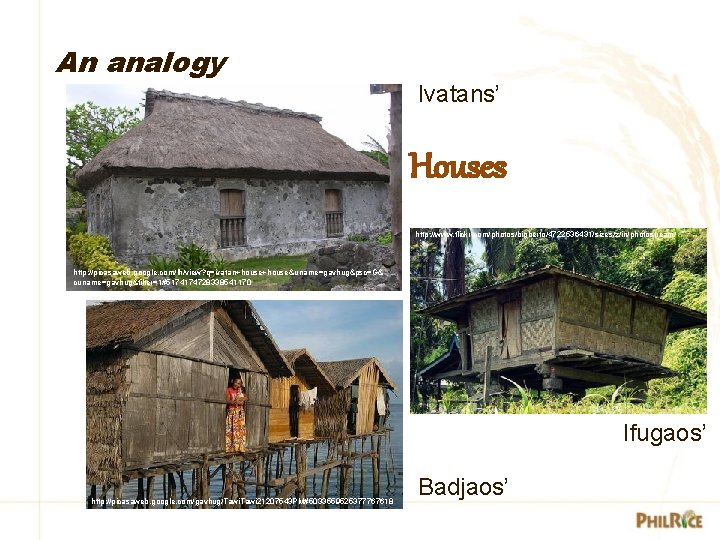
An analogy Ivatans’ Houses http: //www. flickr. com/photos/bigberto/4722536431/sizes/z/in/photostream/ http: //picasaweb. google. com/lh/view? q=ivatan+house&uname=gavhug&psc=G& cuname=gavhug&filter=1#5174174728338541170 Ifugaos’ http: //picasaweb. google. com/gavhug/Tawi 21207543 PM#5033559525377767618 Badjaos’
What is Palay. Check? • Provides a collaborative learning framework for farmers to improve on their understanding of production principles & their management skills to enable technology localization, with facilitation from technically-competent resource persons.
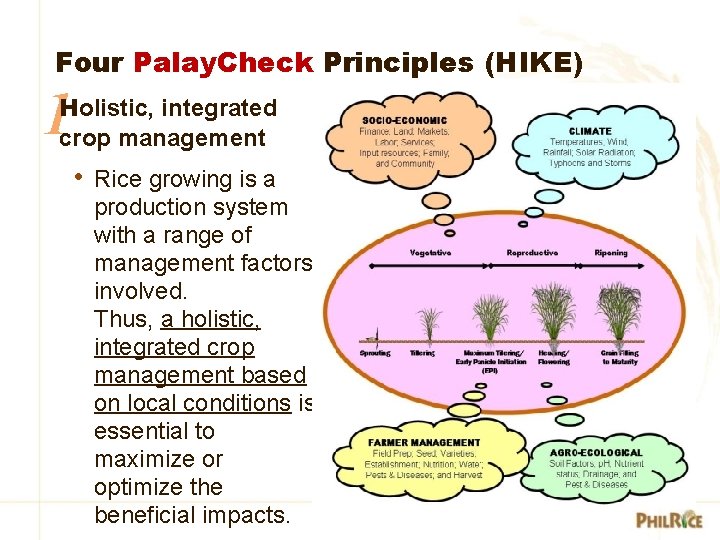
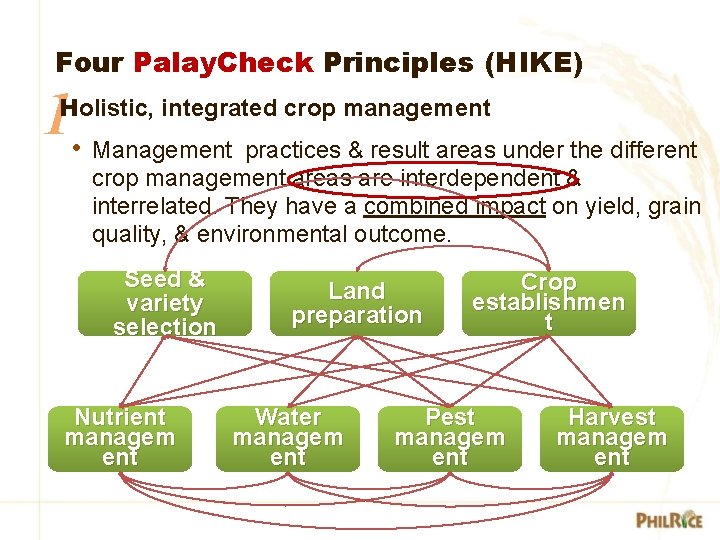
Four Palay. Check Principles (HIKE) 1 Holistic, integrated crop management • Rice growing is a production system with a range of management factors involved. Thus, a holistic, integrated crop management based on local conditions is essential to maximize or optimize the beneficial impacts.
Four Palay. Check Principles (HIKE) 1 • Holistic, integrated crop management Management practices & result areas under the different crop management areas are interdependent & interrelated. They have a combined impact on yield, grain quality, & environmental outcome. Seed & variety selection Nutrient managem ent Land preparation Water managem ent Crop establishmen t Pest managem ent Harvest managem ent
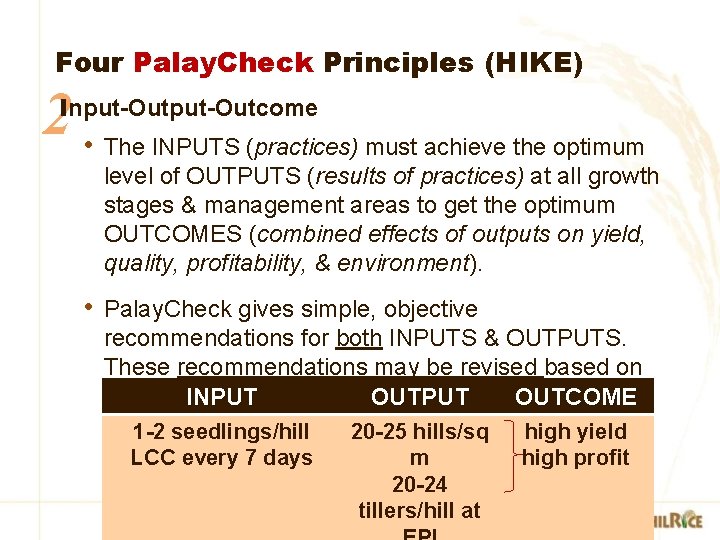
Four Palay. Check Principles (HIKE) 2 • Input-Outcome • The INPUTS (practices) must achieve the optimum level of OUTPUTS (results of practices) at all growth stages & management areas to get the optimum OUTCOMES (combined effects of outputs on yield, quality, profitability, & environment). Palay. Check gives simple, objective recommendations for both INPUTS & OUTPUTS. These recommendations may be revised based on new findings & experiences. INPUT OUTCOME 1 -2 seedlings/hill LCC every 7 days 20 -25 hills/sq m 20 -24 tillers/hill at high yield high profit
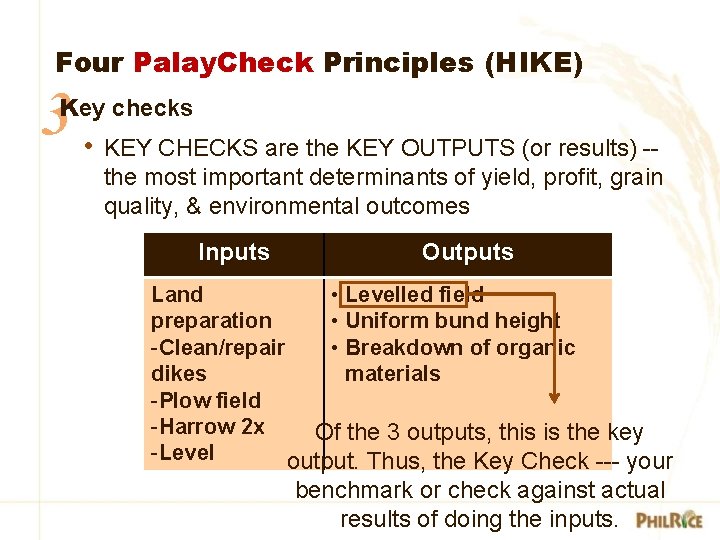
Four Palay. Check Principles (HIKE) 3 • Key checks KEY CHECKS are the KEY OUTPUTS (or results) -the most important determinants of yield, profit, grain quality, & environmental outcomes Inputs Outputs Land • Levelled field preparation • Uniform bund height -Clean/repair • Breakdown of organic dikes materials -Plow field -Harrow 2 x Of the 3 outputs, this is the key -Level output. Thus, the Key Check --- your benchmark or check against actual results of doing the inputs.
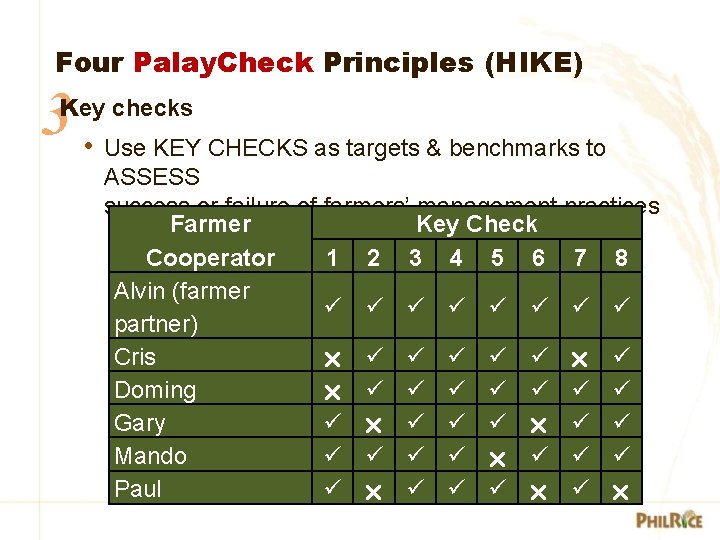
Four Palay. Check Principles (HIKE) 3 • Key checks Use KEY CHECKS as targets & benchmarks to ASSESS success or failure of farmers’ management practices Farmer Key Check 1 2 3 4 5 6 7 8 Cooperator Alvin (farmer partner) Cris Doming Gary Mando Paul
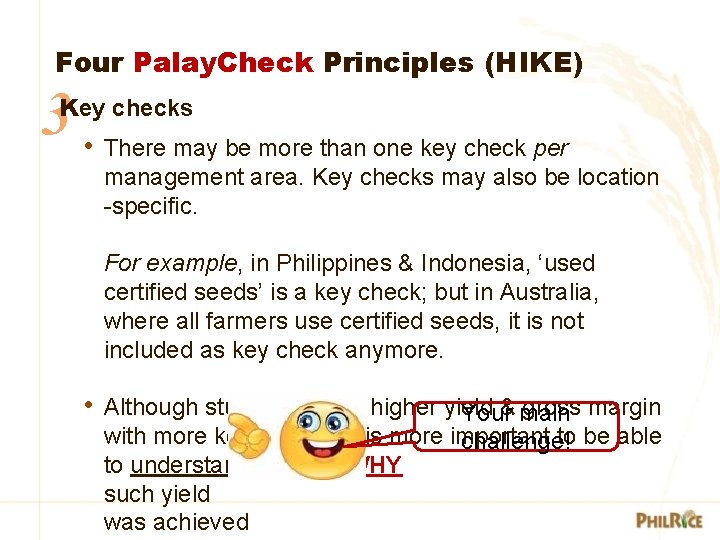
Four Palay. Check Principles (HIKE) 3 • Key checks There may be more than one key check per management area. Key checks may also be location -specific. For example, in Philippines & Indonesia, ‘used certified seeds’ is a key check; but in Australia, where all farmers use certified seeds, it is not included as key check anymore. • Although studies imply a higher yield & main gross margin Your with more key checks, it is more important to be able challenge! to understand/ explain WHY such yield was achieved
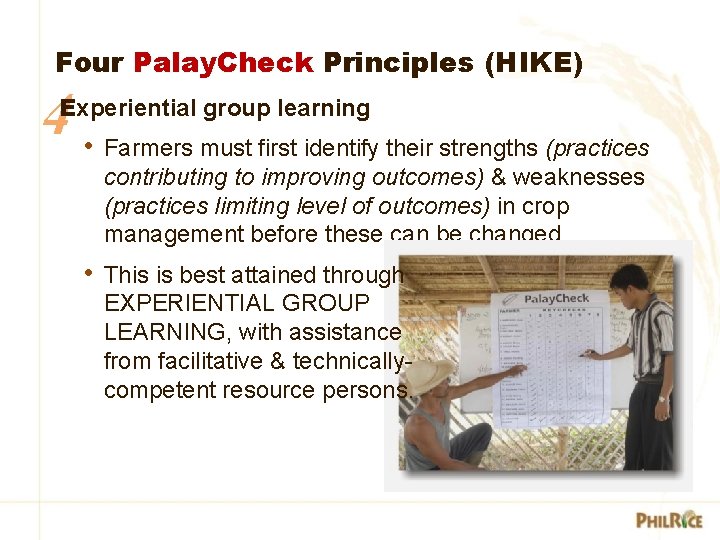
Four Palay. Check Principles (HIKE) 4 • Experiential group learning • Farmers must first identify their strengths (practices contributing to improving outcomes) & weaknesses (practices limiting level of outcomes) in crop management before these can be changed. This is best attained through EXPERIENTIAL GROUP LEARNING, with assistance from facilitative & technicallycompetent resource persons.
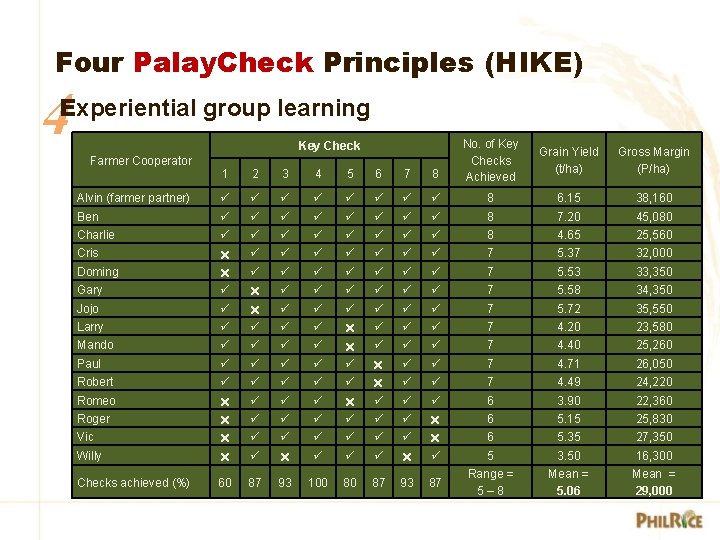
Four Palay. Check Principles (HIKE) 4 Experiential group learning 1 2 3 4 5 6 7 8 No. of Key Checks Achieved Alvin (farmer partner) 8 6. 15 38, 160 Ben 8 7. 20 45, 080 Charlie 8 4. 65 25, 560 Cris 7 5. 37 32, 000 Doming 7 5. 53 33, 350 Gary 7 5. 58 34, 350 Jojo 7 5. 72 35, 550 Larry 7 4. 20 23, 580 Mando 7 4. 40 25, 260 Paul 7 4. 71 26, 050 Robert 7 4. 49 24, 220 Romeo 6 3. 90 22, 360 Roger 6 5. 15 25, 830 Vic 6 5. 35 27, 350 Willy 5 3. 50 16, 300 Checks achieved (%) 60 87 93 100 80 87 93 87 Range = 5– 8 Mean = 5. 06 Mean = 29, 000 Key Check Farmer Cooperator Grain Yield (t/ha) Gross Margin (P/ha)
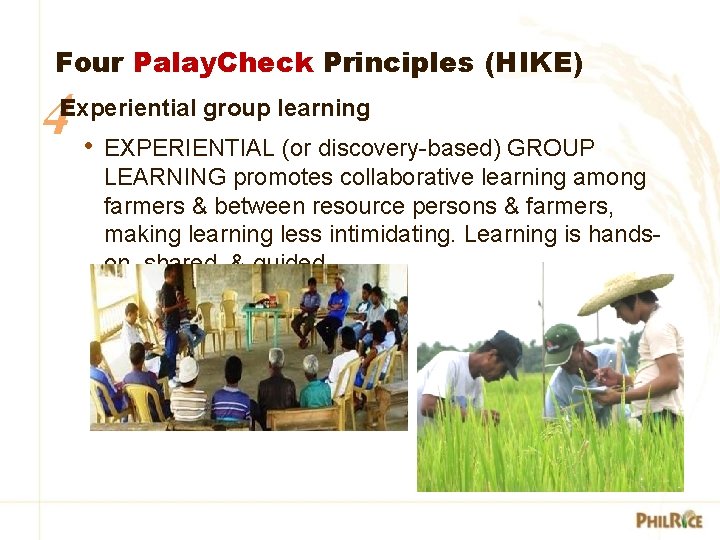
Four Palay. Check Principles (HIKE) 4 • Experiential group learning EXPERIENTIAL (or discovery-based) GROUP LEARNING promotes collaborative learning among farmers & between resource persons & farmers, making learning less intimidating. Learning is handson, shared, & guided.
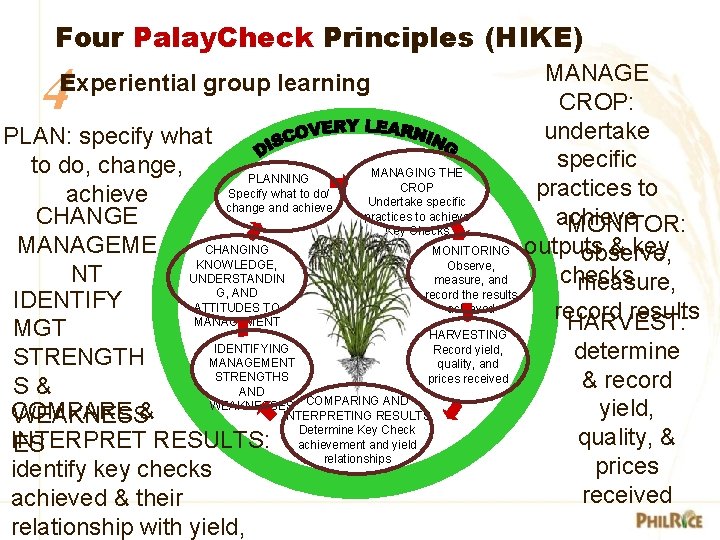
Four Palay. Check Principles (HIKE) 4 Experiential group learning PLAN: specify what to do, change, MANAGING THE PLANNING CROP Specify what to do/ achieve Undertake specific change and achieve practices to achieve CHANGE Key Checks MANAGEME CHANGING MONITORING KNOWLEDGE, Observe, NT UNDERSTANDIN measure, and G, AND record the results IDENTIFY ATTITUDES TO achieved MANAGEMENT MGT HARVESTING IDENTIFYING Record yield, STRENGTH MANAGEMENT quality, and STRENGTHS prices received S& AND WEAKNESSES COMPARING AND COMPARE & INTERPRETING RESULTS WEAKNESS Determine Key Check INTERPRET RESULTS: achievement and yield ES relationships identify key checks achieved & their relationship with yield, MANAGE CROP: undertake specific practices to achieve MONITOR: outputs & key observe, checks measure, record results HARVEST: determine & record yield, quality, & prices received
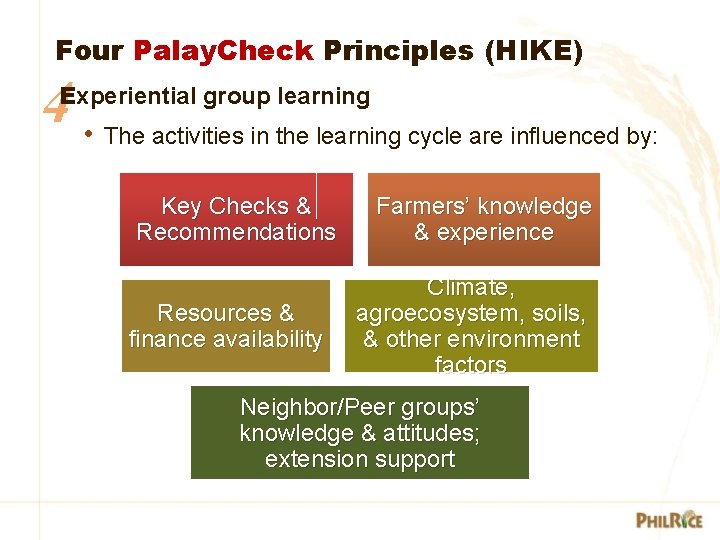
Four Palay. Check Principles (HIKE) 4 • Experiential group learning The activities in the learning cycle are influenced by: Key Checks & Recommendations Resources & finance availability Farmers’ knowledge & experience Climate, agroecosystem, soils, & other environment factors Neighbor/Peer groups’ knowledge & attitudes; extension support
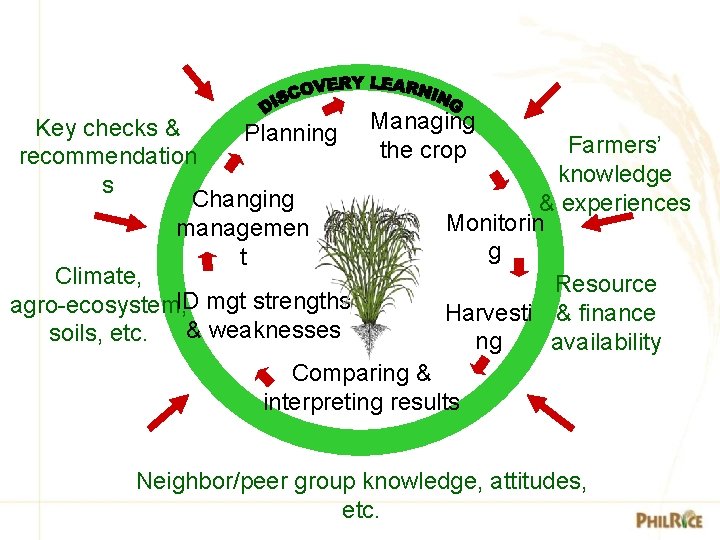
Key checks & Planning Managing Farmers’ the crop recommendation knowledge s Changing & experiences Monitorin managemen g t Climate, Resource agro-ecosystem, ID mgt strengths Harvesti & finance & weaknesses soils, etc. ng availability Comparing & interpreting results Neighbor/peer group knowledge, attitudes, etc.
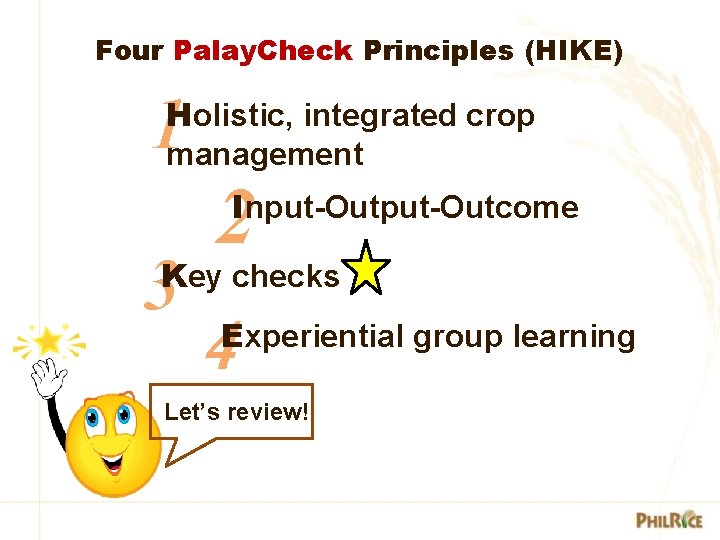
Four Palay. Check Principles (HIKE) 1 Holistic, integrated crop management 2 Input-Outcome 3 Key checks 4 Experiential group learning Let’s review!
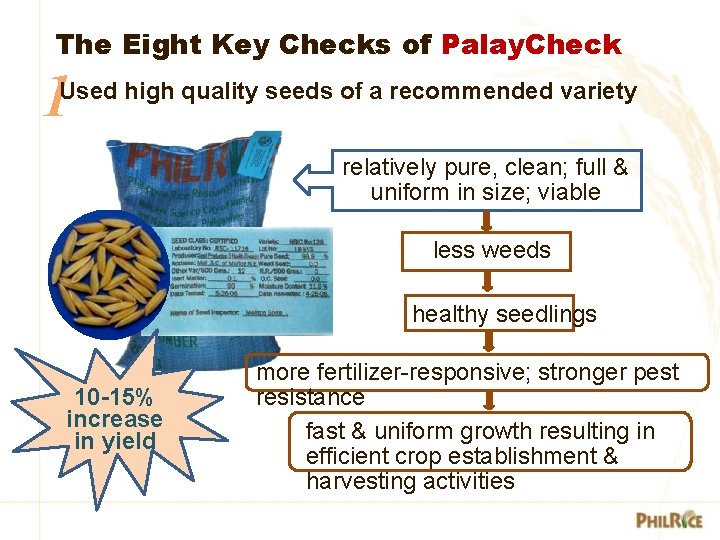
The Eight Key Checks of Palay. Check 1 Used high quality seeds of a recommended variety relatively pure, clean; full & uniform in size; viable less weeds healthy seedlings 10 -15% increase in yield more fertilizer-responsive; stronger pest resistance fast & uniform growth resulting in efficient crop establishment & harvesting activities
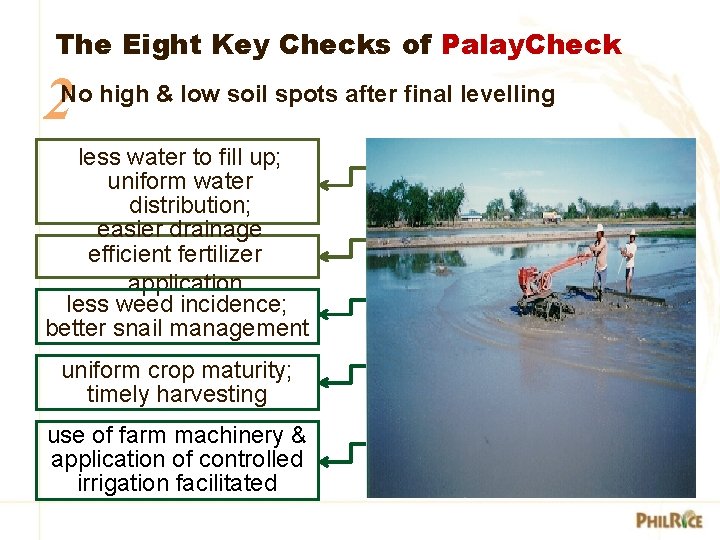
The Eight Key Checks of Palay. Check 2 No high & low soil spots after final levelling less water to fill up; uniform water distribution; easier drainage efficient fertilizer application less weed incidence; better snail management uniform crop maturity; timely harvesting use of farm machinery & application of controlled irrigation facilitated
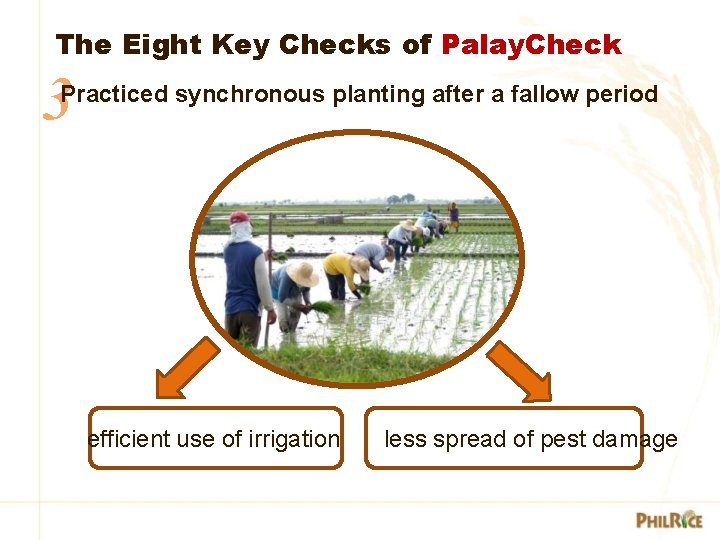
The Eight Key Checks of Palay. Check 3 Practiced synchronous planting after a fallow period efficient use of irrigation less spread of pest damage
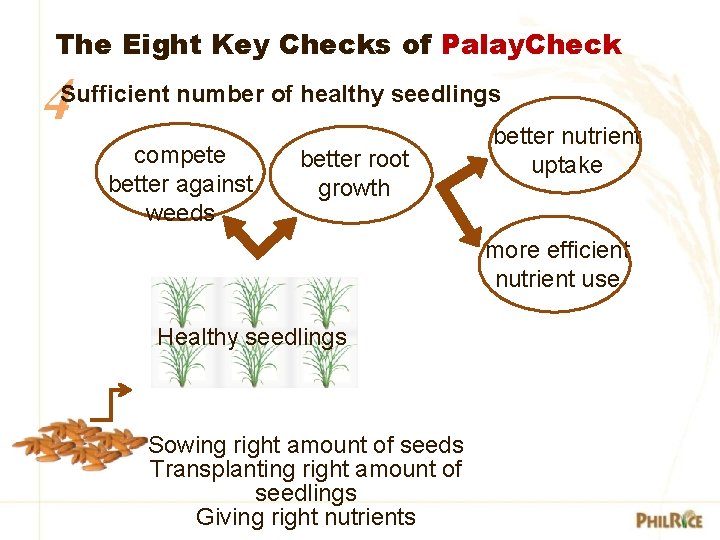
The Eight Key Checks of Palay. Check 4 Sufficient number of healthy seedlings compete better against weeds better root growth better nutrient uptake more efficient nutrient use Healthy seedlings Sowing right amount of seeds Transplanting right amount of seedlings Giving right nutrients
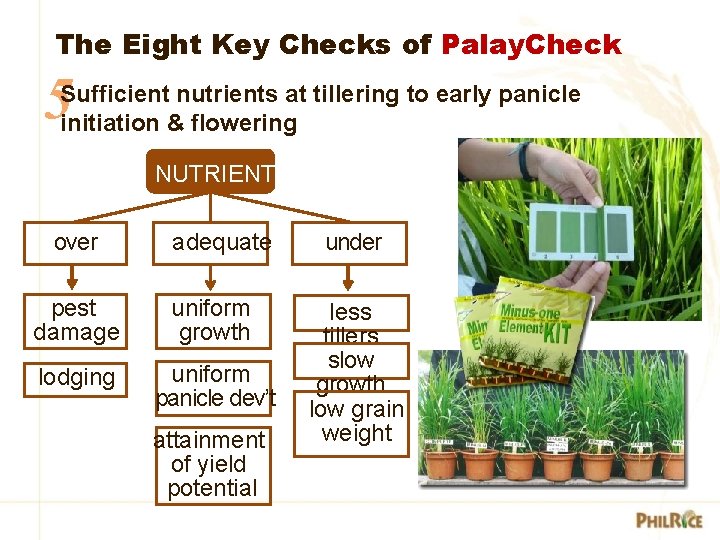
The Eight Key Checks of Palay. Check 5 Sufficient nutrients at tillering to early panicle initiation & flowering NUTRIENTS over adequate pest damage uniform growth lodging uniform panicle dev’t attainment of yield potential under less tillers slow growth low grain weight
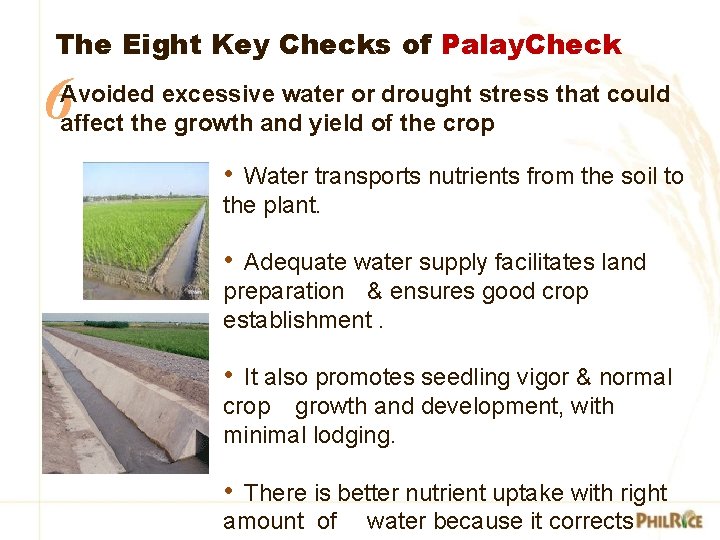
The Eight Key Checks of Palay. Check 6 Avoided excessive water or drought stress that could affect the growth and yield of the crop • Water transports nutrients from the soil to the plant. • Adequate water supply facilitates land preparation & ensures good crop establishment. • It also promotes seedling vigor & normal crop growth and development, with minimal lodging. • There is better nutrient uptake with right amount of water because it corrects
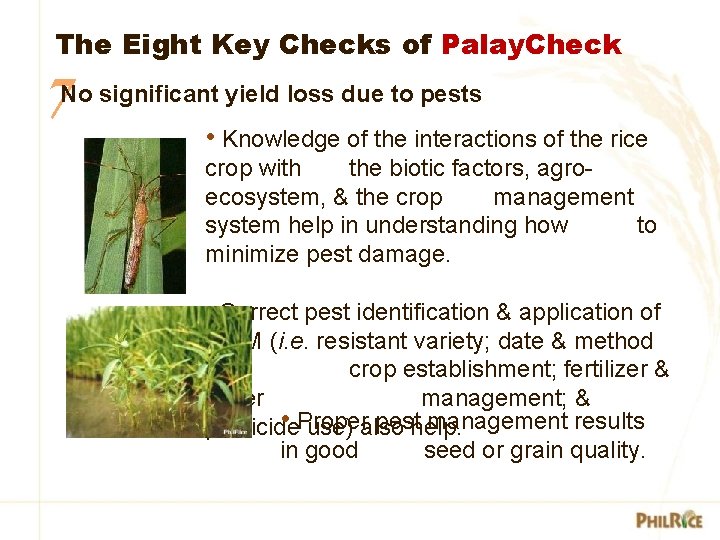
The Eight Key Checks of Palay. Check 7 No significant yield loss due to pests • Knowledge of the interactions of the rice crop with the biotic factors, agroecosystem, & the crop management system help in understanding how to minimize pest damage. • Correct pest identification & application of ICM (i. e. resistant variety; date & method of crop establishment; fertilizer & water management; & • Proper pesthelp. management results pesticide use) also in good seed or grain quality.
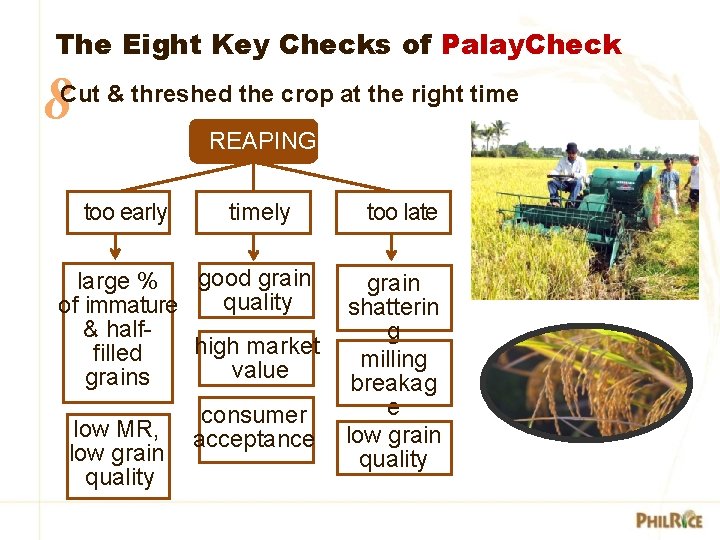
The Eight Key Checks of Palay. Check 8 Cut & threshed the crop at the right time REAPING too early timely good grain large % quality of immature & halfhigh market filled value grains low MR, low grain quality consumer acceptance too late grain shatterin g milling breakag e low grain quality
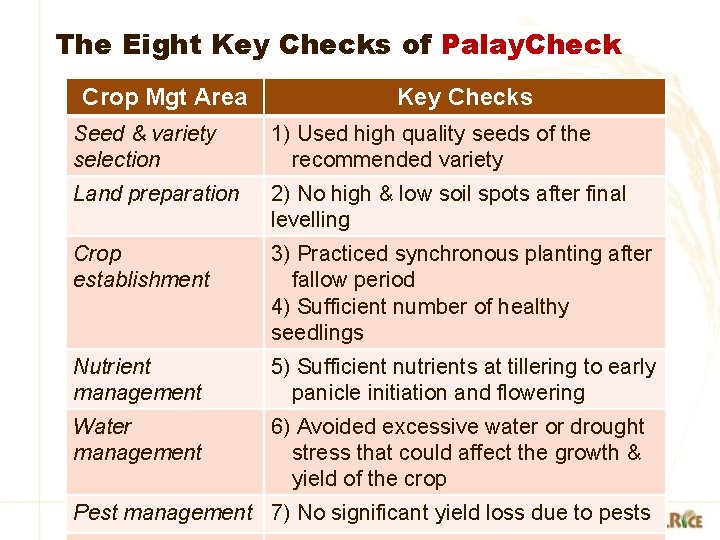
The Eight Key Checks of Palay. Check Crop Mgt Area Key Checks Seed & variety selection 1) Used high quality seeds of the recommended variety Land preparation 2) No high & low soil spots after final levelling Crop establishment 3) Practiced synchronous planting after fallow period 4) Sufficient number of healthy seedlings Nutrient management 5) Sufficient nutrients at tillering to early panicle initiation and flowering Water management 6) Avoided excessive water or drought stress that could affect the growth & yield of the crop Pest management 7) No significant yield loss due to pests
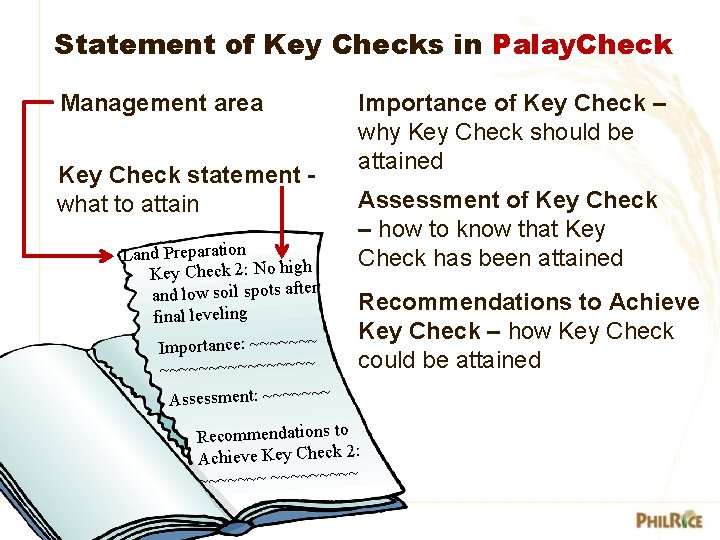
Statement of Key Checks in Palay. Check Management area Key Check statement what to attain Land Preparation Key Check 2: No high and low soil spots after final leveling Importance: ~~~~~~~~~~~~ Assessment: ~~~~~~~ Importance of Key Check – why Key Check should be attained Assessment of Key Check – how to know that Key Check has been attained Recommendations to Achieve Key Check – how Key Check could be attained Recommendations to Achieve Key Check 2: ~~~~~~~~~
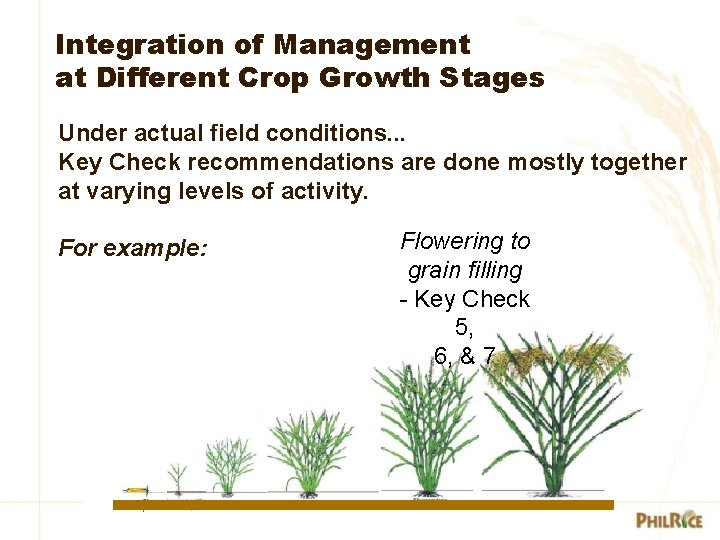
Integration of Management at Different Crop Growth Stages Under actual field conditions. . . Key Check recommendations are done mostly together at varying levels of activity. For example: Flowering to grain filling - Key Check 5, 6, & 7
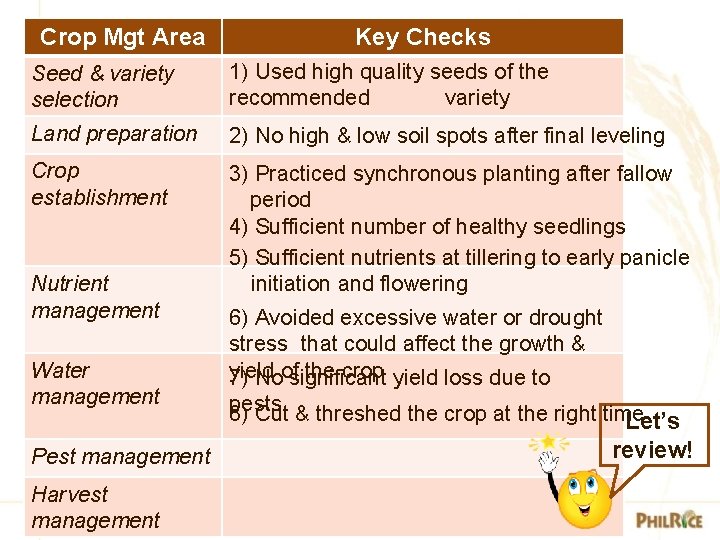
Crop Mgt Area Key Checks Seed & variety selection 1) Used high quality seeds of the recommended variety Land preparation 2) No high & low soil spots after final leveling Crop establishment 3) Practiced synchronous planting after fallow period 4) Sufficient number of healthy seedlings 5) Sufficient nutrients at tillering to early panicle initiation and flowering Nutrient management Water management Pest management Harvest management 6) Avoided excessive water or drought stress that could affect the growth & yield the crop yield loss due to 7) Noofsignificant pests 8) Cut & threshed the crop at the right time Let’s review!
PALAYCHECK: Gagawing SWAK ang teknolohiya sa bukid niyo!
CREDITS Instructional presentation designer: Dr. Karen Eloisa Barroga Sources & reviewers of technical content: Mr. Salvador Yabes; Mrs. Anita Antonio; Mrs. Ofelia Malonzo Note: Adapted from a powerpoint presentation developed by: Mr. Salvador Yabes For more information, visit: You may use, remix, tweak, & build upon this presentation non-commercially. However, always use with acknowledgment. Unless otherwise stated, the names listed are Phil. Rice staffers. Produced in 2011 Text: 0920 -911 -1398