
Pakistan rules and regulations Genetic resources and conservation

- Slides: 18
Pakistan rules and regulations Genetic resources and conservation BS Biotechnology (6 th Semester) University of Sargodha
Types of Law • Constitutional Law: The body or branch of law concerned with the study, interpretation, and application of a country or state’s constitution, including the issues of governance, the powers of the branches and levels of government, civil liberties, and civil rights. • Statutes: a written law passed by a legislative body. • Administrative law: Rules and regulations issues by the officials in the executive branch • Court-made law: the interpretations that court make of other kinds of law
Act: Acts are passed by legislators in the parliament Ordinance: Ordinances are passed by the municipalities and can only be applied within a city limits or specific areas. Rule: Rules are the set of instructions upheld by organizations or institutes. These can vary from place to place. Regulations: Regulations are officially implemented by the government and have legal connotations. These are rigid and are asked to be followed without any discrimination.
Statutes in Pakistan for environment protection Pakistan Environmental Protection Act, 1997 • It provides for the protection, conservation, rehabilitation and improvement of the environment; for prevention and control of pollution and for the protection of sustainable development. Forest Act, 1927 • This law empowers provincial governments to manage forests under their area. The government can reserve the state-owned forest land, assume control of privately owned forest land declare any government owned land in a protected area. It prohibits the clearing of forest for cultivation, grazing, hunting, removing forest produce, quarrying and felling, lopping and topping of tree, branches in reserved or protected areas.
Statutes in Pakistan for environment protection Pakistan Terrestrial Water & Maritime Zones Act, 1976 • It includes provisions for preservation, development and protection of marine environment and control of marine pollution and exploration, development, conservation and management of living resources in Pakistan’s Exclusive Economic Zone (EEZ). A ship carrying nuclear and hazardous substances will have to inform the Government of Pakistan.
Statutes in Pakistan for environment protection The Agricultural Pesticide Ordinance, 1971 • It allows for the registration and control of pesticides use but there is no specific legislation for the use of fertilizers. It regulates the importation, manufacture, distribution, sale and use of pesticides for agriculture including plant growth regulations and there use in forestry. These rules were amended in 1984. These rules establish the Agricultural Technical Advisory Committee (APTA) for carrying out the registration of pesticides. APTA obtains information about the product including name, composition, active ingredients, efficacy, labeling and direction of use as well as methods for analysis of disposal of surplus pesticides and packaging
Statutes in Pakistan for environment protection Pakistan Penal Code, 1860 This is a penal code for all offences charged in Pakistan. It was originally prepared by Lord Macaulay with a great consultation in 1860 on the behalf of the Government of India as the Indian Penal Code. After the independence in 1947, Pakistan inherited the same code and subsequently after several amendments by different governments, in Pakistan it is now a mixture of Islamic and English Law. Presently, the Pakistan Penal Code is still in effect and can be amended by the Senate of Pakistan.
Statutes in Pakistan for environment protection Pakistan Penal Code, 1860 • This code also prevent the pollution by punishing the polluter of the environment. These pollutions are of following types ➢ Punishment for water pollution ➢ Punishment for atmospheric pollution ➢ Punishments for general pollution
Statutes in Pakistan for environment protection General pollution can be: ➢ Public nuisance ➢ Spread of Infection ➢ Adulteration of Food, Drink and Drugs ➢ Negligent Handling of Poisons ➢ Combustibles and Explosives ➢ Act Endangering Human Life ➢ Personal Safety of Others ➢ Mischief
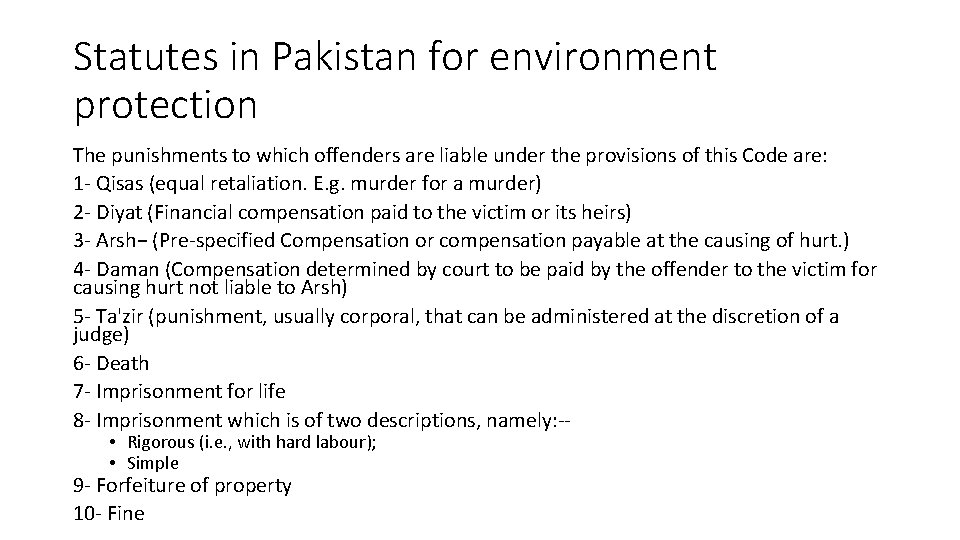
Statutes in Pakistan for environment protection The punishments to which offenders are liable under the provisions of this Code are: 1 - Qisas (equal retaliation. E. g. murder for a murder) 2 - Diyat (Financial compensation paid to the victim or its heirs) 3 - Arsh− (Pre-specified Compensation or compensation payable at the causing of hurt. ) 4 - Daman (Compensation determined by court to be paid by the offender to the victim for causing hurt not liable to Arsh) 5 - Ta'zir (punishment, usually corporal, that can be administered at the discretion of a judge) 6 - Death 7 - Imprisonment for life 8 - Imprisonment which is of two descriptions, namely: - • Rigorous (i. e. , with hard labour); • Simple 9 - Forfeiture of property 10 - Fine
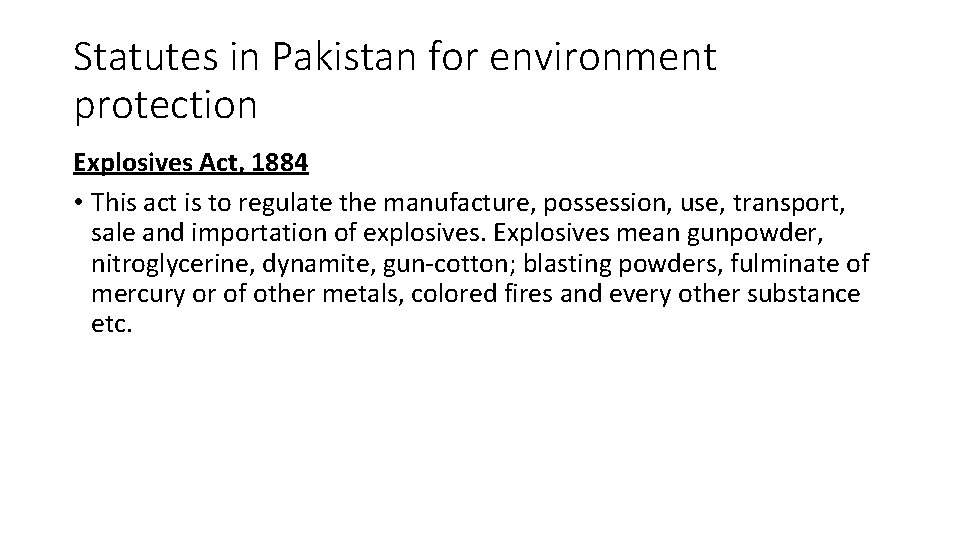
Statutes in Pakistan for environment protection Explosives Act, 1884 • This act is to regulate the manufacture, possession, use, transport, sale and importation of explosives. Explosives mean gunpowder, nitroglycerine, dynamite, gun-cotton; blasting powders, fulminate of mercury or of other metals, colored fires and every other substance etc.
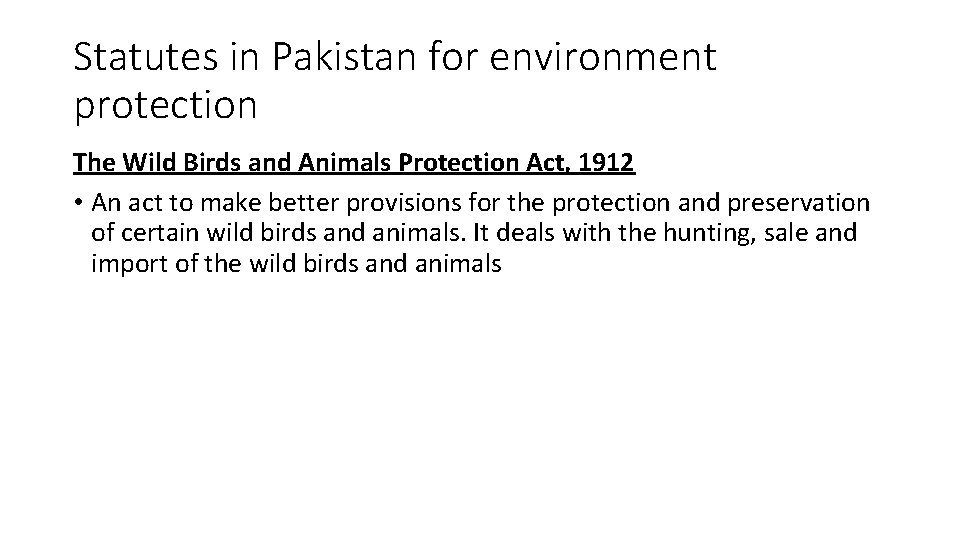
Statutes in Pakistan for environment protection The Wild Birds and Animals Protection Act, 1912 • An act to make better provisions for the protection and preservation of certain wild birds and animals. It deals with the hunting, sale and import of the wild birds and animals
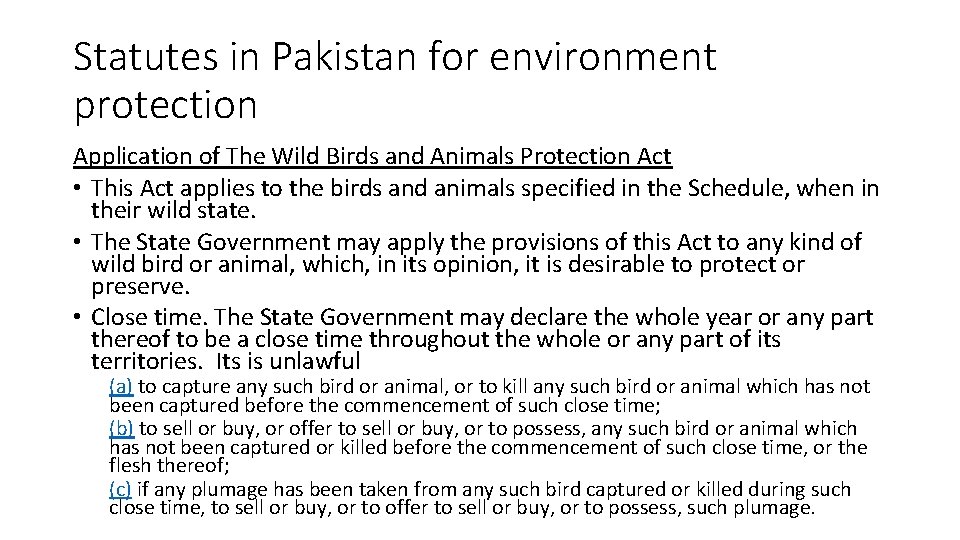
Statutes in Pakistan for environment protection Application of The Wild Birds and Animals Protection Act • This Act applies to the birds and animals specified in the Schedule, when in their wild state. • The State Government may apply the provisions of this Act to any kind of wild bird or animal, which, in its opinion, it is desirable to protect or preserve. • Close time. The State Government may declare the whole year or any part thereof to be a close time throughout the whole or any part of its territories. Its is unlawful (a) to capture any such bird or animal, or to kill any such bird or animal which has not been captured before the commencement of such close time; (b) to sell or buy, or offer to sell or buy, or to possess, any such bird or animal which has not been captured or killed before the commencement of such close time, or the flesh thereof; (c) if any plumage has been taken from any such bird captured or killed during such close time, to sell or buy, or to offer to sell or buy, or to possess, such plumage.
Statutes in Pakistan for environment protection • Penalties. • Whoever does, or attempts to do, any act in violation of this act, shall be punishable with fine. • Whoever, having already been convicted of an offence under this section, is again convicted thereunder shall, on every subsequent conviction, be punishable with imprisonment for a term which may extend to one month, or with fine which my be increased, or with both.
Statutes in Pakistan for environment protection The Canal & Drainage Act, 1873 • It seeks to regulate and control the development of irrigation and distribution of supplies
Rules & Regulations National Environmental Quality Standards( self-monitoring and reporting by industry) Rules, 2001 • There are 32 parameters prescribing permissible levels of pollutants in liquid effluent while 16 parameters for gaseous emission • Pakistan Environmental Protection Council (PEPC) for a committee named as Environmental standard committee. • These rules have been made to specify limits to the industrial pollution. EIP (Environmental Improvement Plans) are established. Ever industry will have to provide their levels of pollution regularly to EIP. Then these will be examined.
Rules & Regulations Environmental Samples Rules , 2001 These rules are for the proper sampling of different tests. In this regulation many methods are present for the sample collection, handling, transportation and analysis. • An authorized person will take the samples in clean bottles. • These shall be closed and handled in a proper way. • Samples should be labelled. • Sample mixing will be prevented. If a person does not follow these rules he will be punished under these rules.
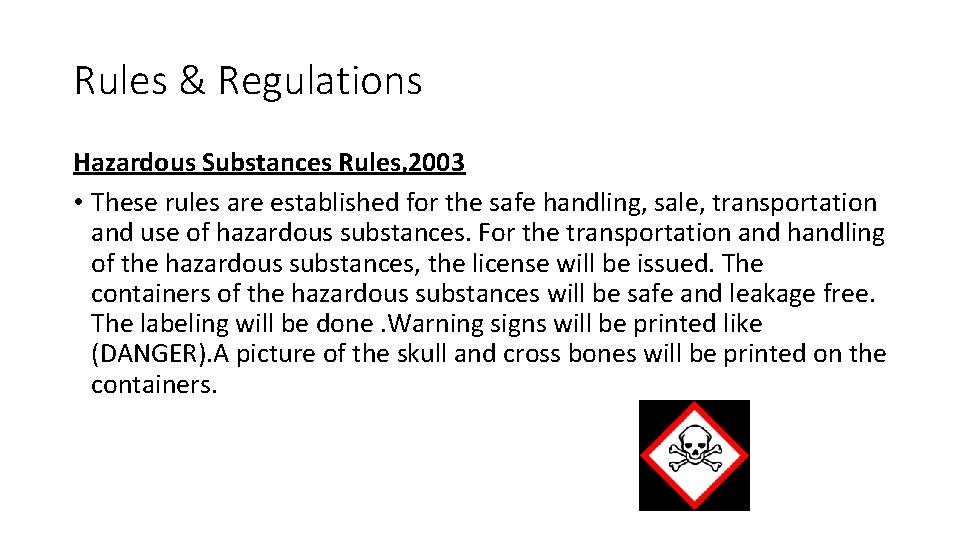
Rules & Regulations Hazardous Substances Rules, 2003 • These rules are established for the safe handling, sale, transportation and use of hazardous substances. For the transportation and handling of the hazardous substances, the license will be issued. The containers of the hazardous substances will be safe and leakage free. The labeling will be done. Warning signs will be printed like (DANGER). A picture of the skull and cross bones will be printed on the containers.