
Pain Management for Nurses Completion of this program







- Slides: 42
Pain Management for Nurses Completion of this program and posttest will provide 0. 5 CE for nurses. Annual Pain Management Education SLUHN - 2015
Pain Management for Nurses Be sure to set and view this program in Slide Show format. Annual Pain Management Education SLUHN - 2015
Pain Management for Nurses It is imperative that you proceed through this program using mouse clicks. CLICK CLICK CLICK Annual Pain Management Education SLUHN - 2015
Pain Management for Nurses Program Objectives • Review The Joint Commission pain management guidelines. • Highlight key role-specific practice expectations regarding pain management. • Review various interventions for managing pain. • Understand how to integrate multimodal analgesia into the pain management treatment plan. • Review appropriate analgesic dosing. Annual Pain Management Education SLUHN - 2015
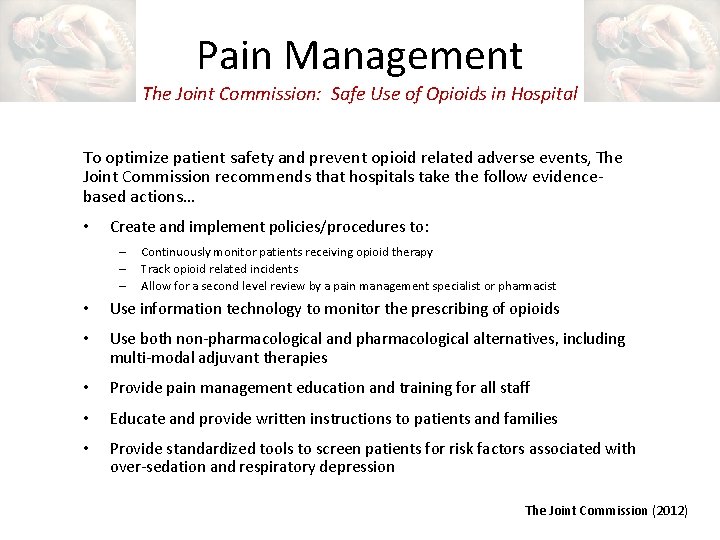
Pain Management The Joint Commission: Safe Use of Opioids in Hospital To optimize patient safety and prevent opioid related adverse events, The Joint Commission recommends that hospitals take the follow evidencebased actions… • Create and implement policies/procedures to: – – – Continuously monitor patients receiving opioid therapy Track opioid related incidents Allow for a second level review by a pain management specialist or pharmacist • Use information technology to monitor the prescribing of opioids • Use both non-pharmacological and pharmacological alternatives, including multi-modal adjuvant therapies • Provide pain management education and training for all staff • Educate and provide written instructions to patients and families • Provide standardized tools to screen patients for risk factors associated with over-sedation and respiratory depression The Joint Commission (2012)
Pain Management The Joint Commission Practice Highlights For safe and effective pain management… Conduct a thorough history and full body assessment prior to opioid initiation. Screen patients who are at high risk for respiratory depression and over-sedation. Assess history of analgesic use. Screen for potential risks for dependency, addiction, and abuse. Utilize an individualized, multimodal treatment plan. Opioid titration should occur slowly to allow for adequate pain control with the lowest effective dose. Medication orders must include an indication (intensity of pain): mild, moderate, severe, or breakthrough. The Joint Commission (2012)
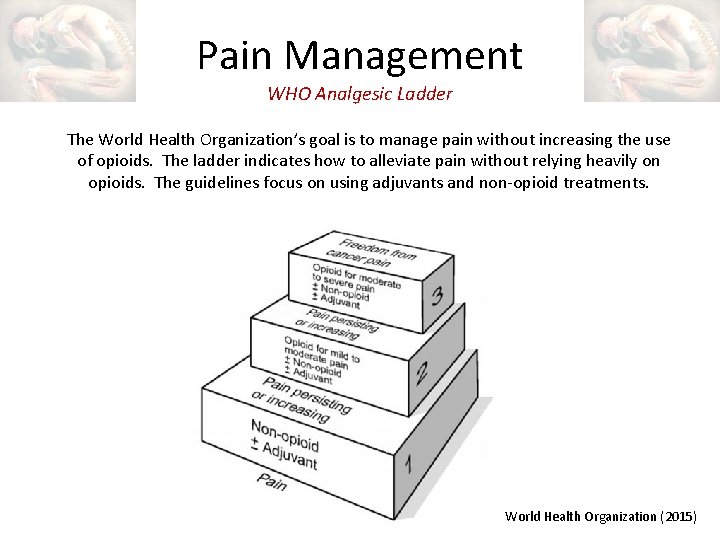
Pain Management WHO Analgesic Ladder The World Health Organization’s goal is to manage pain without increasing the use of opioids. The ladder indicates how to alleviate pain without relying heavily on opioids. The guidelines focus on using adjuvants and non-opioid treatments. World Health Organization (2015)
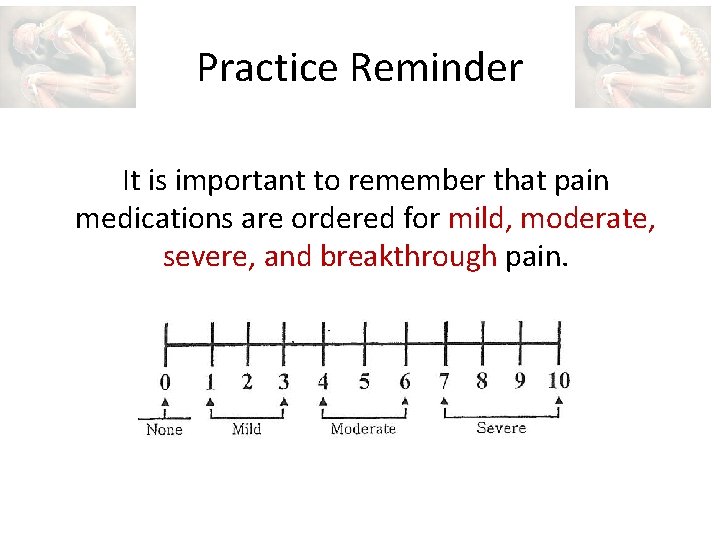
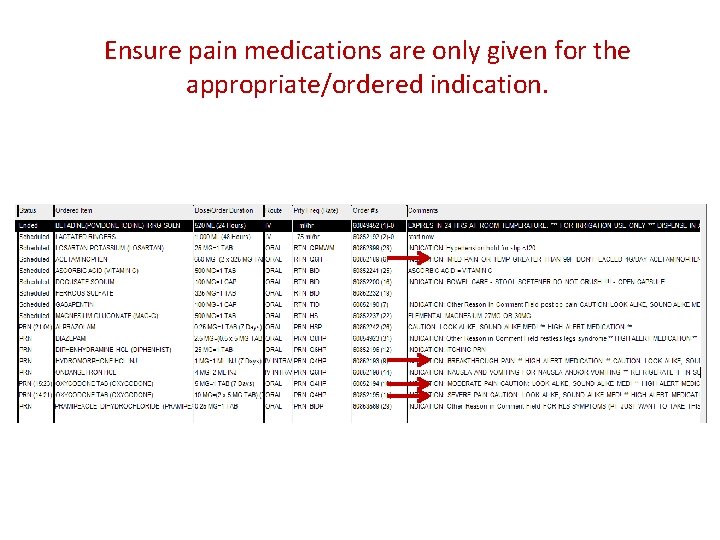
Practice Reminder It is important to remember that pain medications are ordered for mild, moderate, severe, and breakthrough pain.
Ensure pain medications are only given for the appropriate/ordered indication.
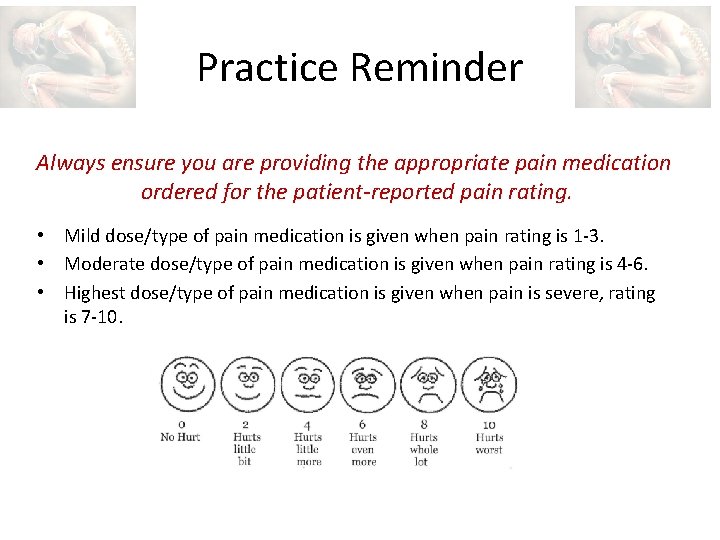
Practice Reminder Always ensure you are providing the appropriate pain medication ordered for the patient-reported pain rating. • Mild dose/type of pain medication is given when pain rating is 1 -3. • Moderate dose/type of pain medication is given when pain rating is 4 -6. • Highest dose/type of pain medication is given when pain is severe, rating is 7 -10.
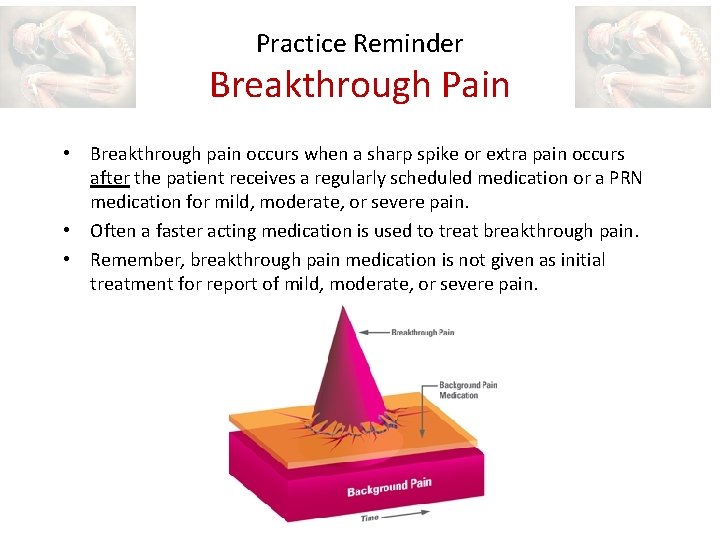
Practice Reminder Breakthrough Pain • Breakthrough pain occurs when a sharp spike or extra pain occurs after the patient receives a regularly scheduled medication or a PRN medication for mild, moderate, or severe pain. • Often a faster acting medication is used to treat breakthrough pain. • Remember, breakthrough pain medication is not given as initial treatment for report of mild, moderate, or severe pain.
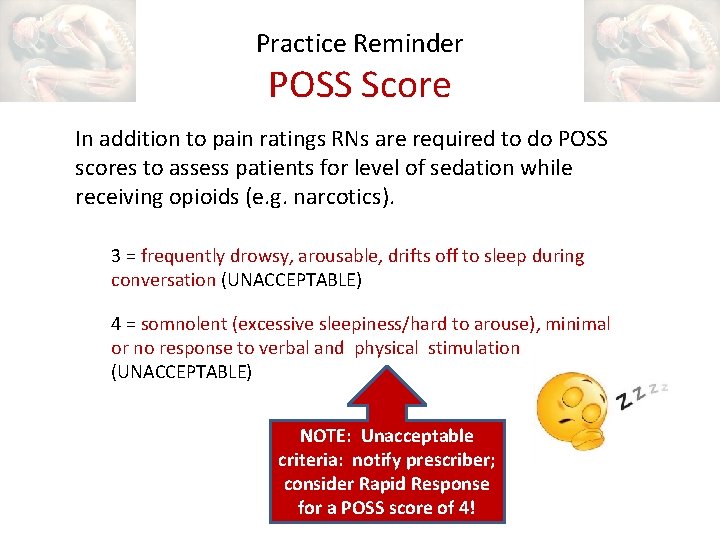
Practice Reminder POSS Score In addition to pain ratings RNs are required to do POSS scores to assess patients for level of sedation while receiving opioids (e. g. narcotics). 3 = frequently drowsy, arousable, drifts off to sleep during conversation (UNACCEPTABLE) 4 = somnolent (excessive sleepiness/hard to arouse), minimal or no response to verbal and physical stimulation (UNACCEPTABLE) NOTE: Unacceptable criteria: notify prescriber; consider Rapid Response for a POSS score of 4!
Case Study for Nurses • Ms. Jones: 68 y/o female admitted with SOB, productive cough, and fever. Chest X-ray is positive for pneumonia. • Abnormal Labs: WBC 20. 4 • Vitals: Temp. 101 F, Pulse 94, Resp. 24, BP 130/82 • PMH: HTN, DM, Anxiety, Depression, Chronic back pain, Fibromyalgia, Osteoporosis
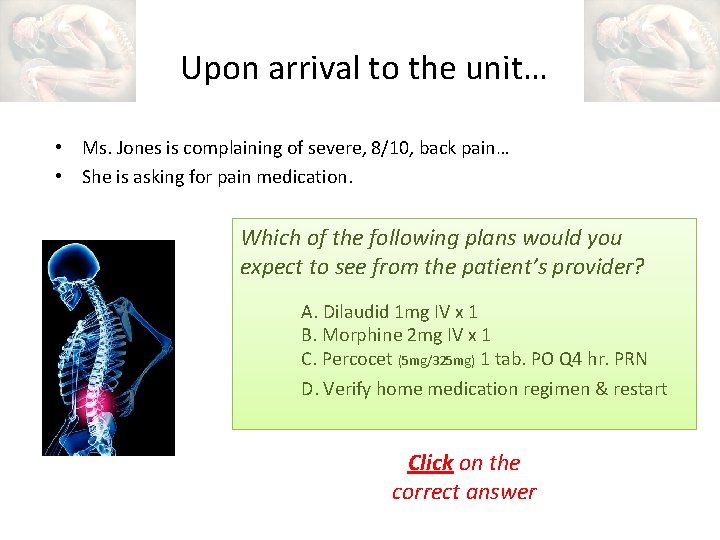
Upon arrival to the unit… • Ms. Jones is complaining of severe, 8/10, back pain… • She is asking for pain medication. Which of the following plans would you expect to see from the patient’s provider? A. Dilaudid 1 mg IV x 1 B. Morphine 2 mg IV x 1 C. Percocet (5 mg/325 mg) 1 tab. PO Q 4 hr. PRN D. Verify home medication regimen & restart Click on the correct answer
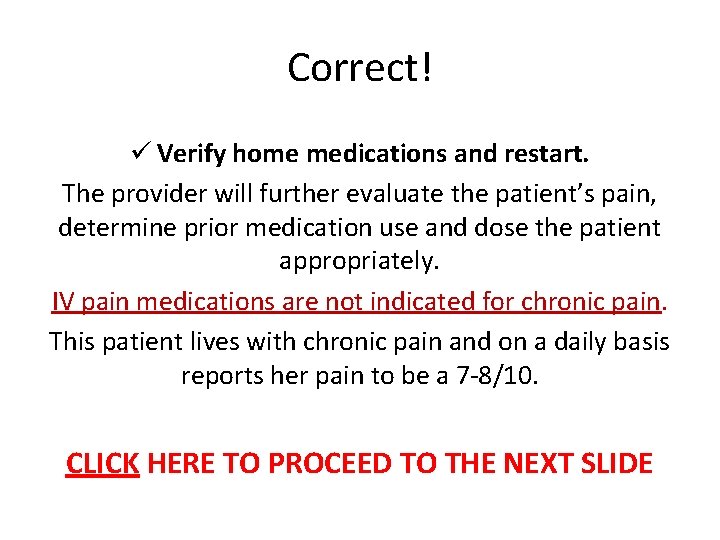
Correct! ü Verify home medications and restart. The provider will further evaluate the patient’s pain, determine prior medication use and dose the patient appropriately. IV pain medications are not indicated for chronic pain. This patient lives with chronic pain and on a daily basis reports her pain to be a 7 -8/10. CLICK HERE TO PROCEED TO THE NEXT SLIDE
Incorrect Please click here to go back to the question and try again.
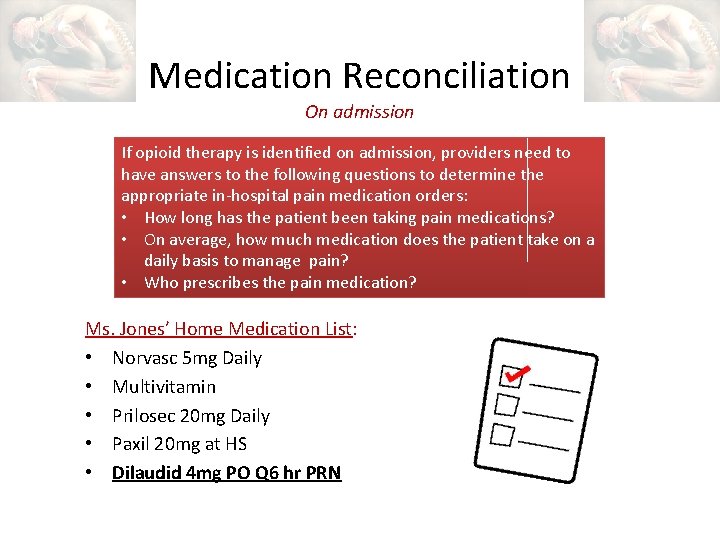
Medication Reconciliation On admission If opioid therapy is identified on admission, providers need to have answers to the following questions to determine the appropriate in-hospital pain medication orders: • How long has the patient been taking pain medications? • On average, how much medication does the patient take on a daily basis to manage pain? • Who prescribes the pain medication? Ms. Jones’ Home Medication List: • Norvasc 5 mg Daily • Multivitamin • Prilosec 20 mg Daily • Paxil 20 mg at HS • Dilaudid 4 mg PO Q 6 hr PRN
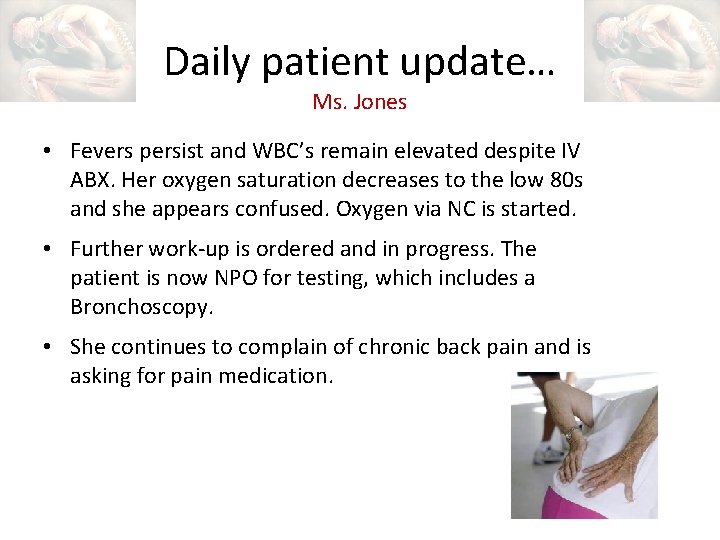
Daily patient update… Ms. Jones • Fevers persist and WBC’s remain elevated despite IV ABX. Her oxygen saturation decreases to the low 80 s and she appears confused. Oxygen via NC is started. • Further work-up is ordered and in progress. The patient is now NPO for testing, which includes a Bronchoscopy. • She continues to complain of chronic back pain and is asking for pain medication.
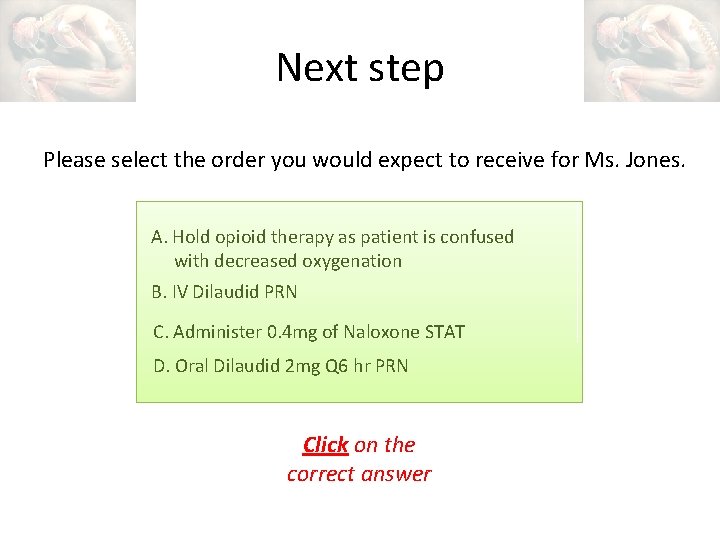
Next step Please select the order you would expect to receive for Ms. Jones. A. Hold opioid therapy as patient is confused with decreased oxygenation B. IV Dilaudid PRN C. Administer 0. 4 mg of Naloxone STAT D. Oral Dilaudid 2 mg Q 6 hr PRN Click on the correct answer
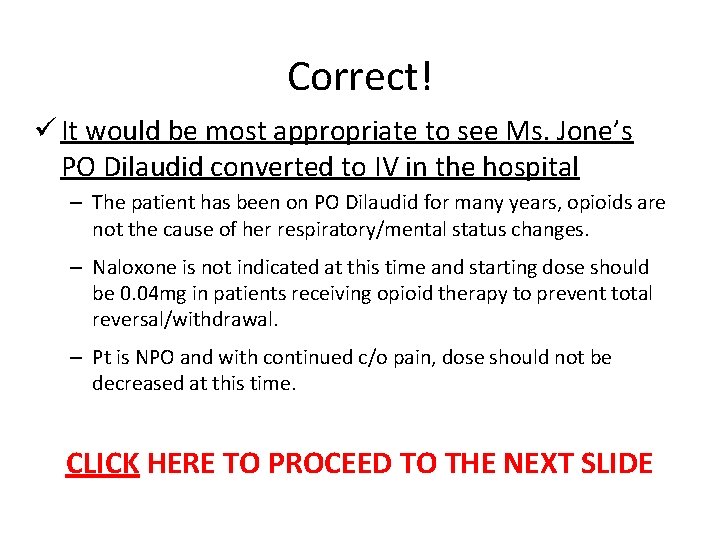
Correct! ü It would be most appropriate to see Ms. Jone’s PO Dilaudid converted to IV in the hospital – The patient has been on PO Dilaudid for many years, opioids are not the cause of her respiratory/mental status changes. – Naloxone is not indicated at this time and starting dose should be 0. 04 mg in patients receiving opioid therapy to prevent total reversal/withdrawal. – Pt is NPO and with continued c/o pain, dose should not be decreased at this time. CLICK HERE TO PROCEED TO THE NEXT SLIDE
Incorrect Please click here to go back to the question and try again.
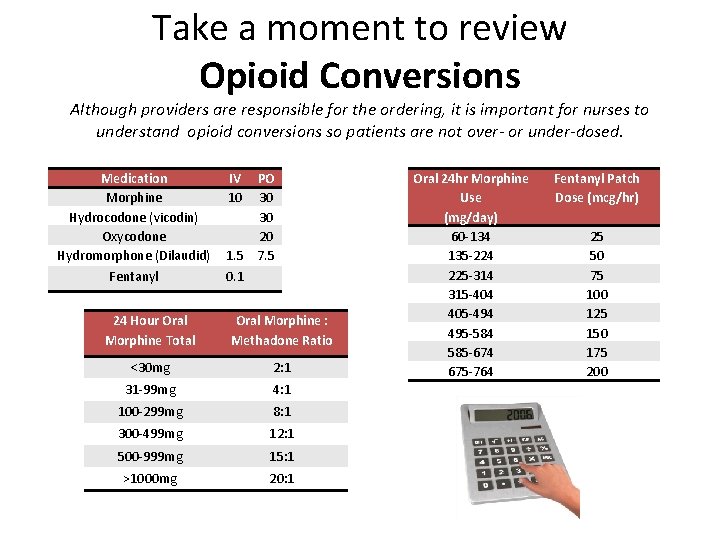
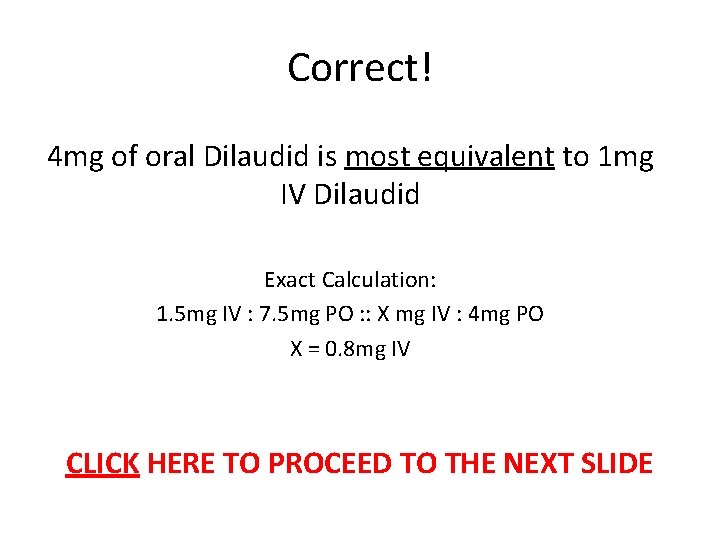
Take a moment to review Opioid Conversions Although providers are responsible for the ordering, it is important for nurses to understand opioid conversions so patients are not over- or under-dosed. Medication Morphine Hydrocodone (vicodin) Oxycodone Hydromorphone (Dilaudid) Fentanyl IV 10 PO 30 30 20 1. 5 7. 5 0. 1 24 Hour Oral Morphine Total Oral Morphine : Methadone Ratio <30 mg 2: 1 31 -99 mg 4: 1 100 -299 mg 8: 1 300 -499 mg 12: 1 500 -999 mg 15: 1 >1000 mg 20: 1 Oral 24 hr Morphine Use (mg/day) 60 -134 135 -224 225 -314 315 -404 405 -494 495 -584 585 -674 675 -764 Fentanyl Patch Dose (mcg/hr) 25 50 75 100 125 150 175 200
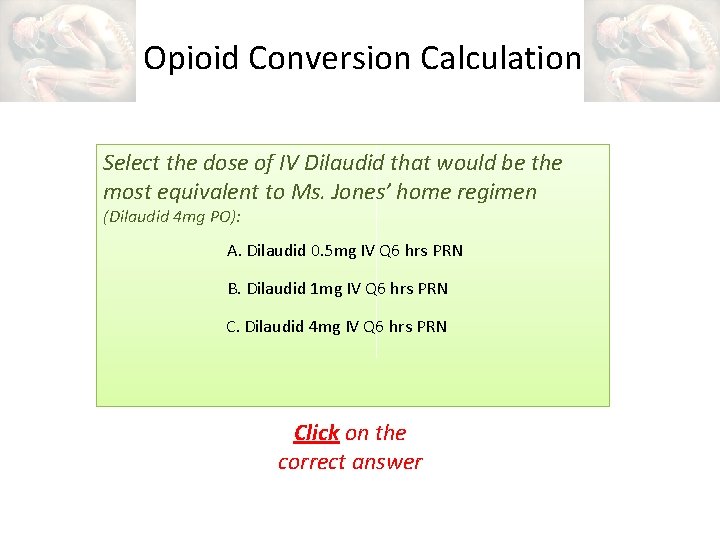
Opioid Conversion Calculation Select the dose of IV Dilaudid that would be the most equivalent to Ms. Jones’ home regimen (Dilaudid 4 mg PO): A. Dilaudid 0. 5 mg IV Q 6 hrs PRN B. Dilaudid 1 mg IV Q 6 hrs PRN C. Dilaudid 4 mg IV Q 6 hrs PRN Click on the correct answer
Correct! 4 mg of oral Dilaudid is most equivalent to 1 mg IV Dilaudid Exact Calculation: 1. 5 mg IV : 7. 5 mg PO : : X mg IV : 4 mg PO X = 0. 8 mg IV CLICK HERE TO PROCEED TO THE NEXT SLIDE
Incorrect Please click here to go back to the question and try again.
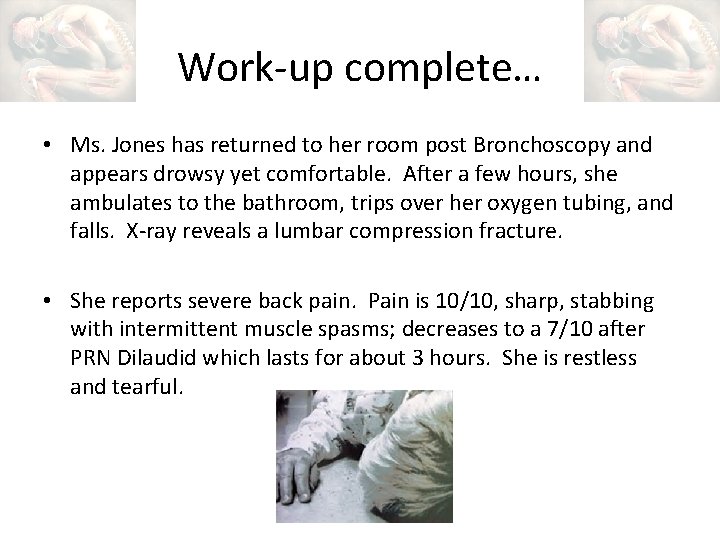
Work-up complete… • Ms. Jones has returned to her room post Bronchoscopy and appears drowsy yet comfortable. After a few hours, she ambulates to the bathroom, trips over her oxygen tubing, and falls. X-ray reveals a lumbar compression fracture. • She reports severe back pain. Pain is 10/10, sharp, stabbing with intermittent muscle spasms; decreases to a 7/10 after PRN Dilaudid which lasts for about 3 hours. She is restless and tearful.
Adjust the plan of care Which of the following actions/orders would you expect to see from the provider based on Ms. Jones’ current status? Current pain regimen: Dilaudid 1 mg IV Q 6 hrs PRN A. Nothing as the patient is reporting some relief B. An increase in the dose of the Dilaudid C. An increase in the frequency of the Dilaudid D. An increase in the dose and frequency of the Dilaudid Click on the correct answer
Correct! ü The dose and frequency should be increased. Pain is now acute; expect higher opioid requirements in an opioid tolerant patient. Dosing interval should be every 3 -4 hours, initially, until her pain is under control. CLICK HERE TO PROCEED TO THE NEXT SLIDE
Incorrect Please click here to go back to the question and try again.
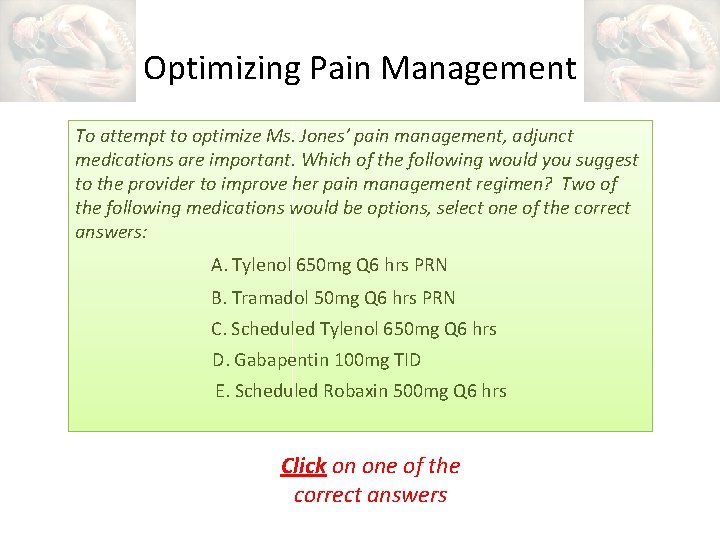
Optimizing Pain Management To attempt to optimize Ms. Jones’ pain management, adjunct medications are important. Which of the following would you suggest to the provider to improve her pain management regimen? Two of the following medications would be options, select one of the correct answers: A. Tylenol 650 mg Q 6 hrs PRN B. Tramadol 50 mg Q 6 hrs PRN C. Scheduled Tylenol 650 mg Q 6 hrs D. Gabapentin 100 mg TID E. Scheduled Robaxin 500 mg Q 6 hrs Click on one of the correct answers
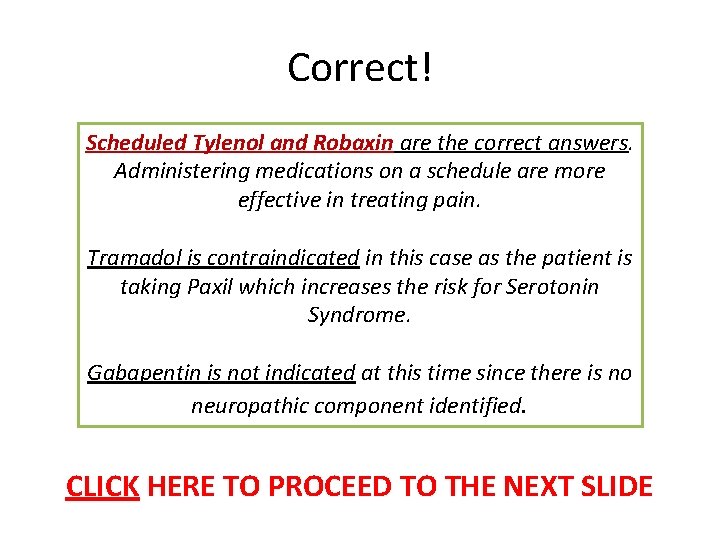
Correct! Scheduled Tylenol and Robaxin are the correct answers. Administering medications on a schedule are more effective in treating pain. Tramadol is contraindicated in this case as the patient is taking Paxil which increases the risk for Serotonin Syndrome. Gabapentin is not indicated at this time since there is no neuropathic component identified. CLICK HERE TO PROCEED TO THE NEXT SLIDE
Incorrect Please click here to go back to the question and try again.
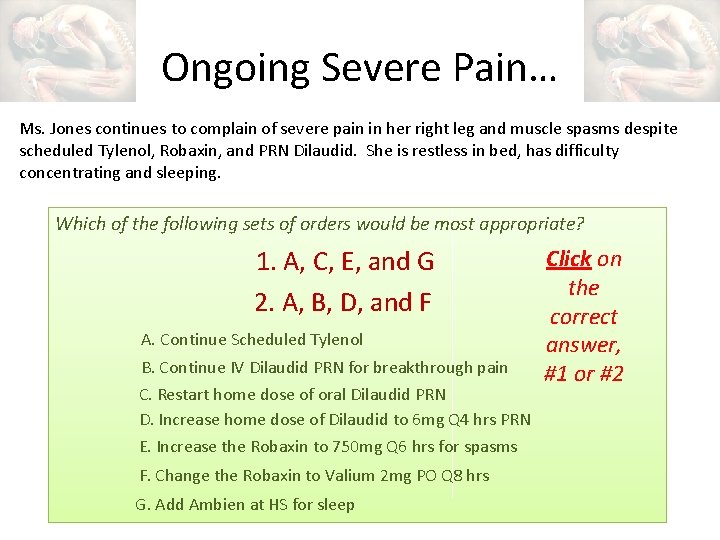
Ongoing Severe Pain… Ms. Jones continues to complain of severe pain in her right leg and muscle spasms despite scheduled Tylenol, Robaxin, and PRN Dilaudid. She is restless in bed, has difficulty concentrating and sleeping. Which of the following sets of orders would be most appropriate? 1. A, C, E, and G 2. A, B, D, and F A. Continue Scheduled Tylenol B. Continue IV Dilaudid PRN for breakthrough pain C. Restart home dose of oral Dilaudid PRN D. Increase home dose of Dilaudid to 6 mg Q 4 hrs PRN E. Increase the Robaxin to 750 mg Q 6 hrs for spasms F. Change the Robaxin to Valium 2 mg PO Q 8 hrs G. Add Ambien at HS for sleep Click on the correct answer, #1 or #2
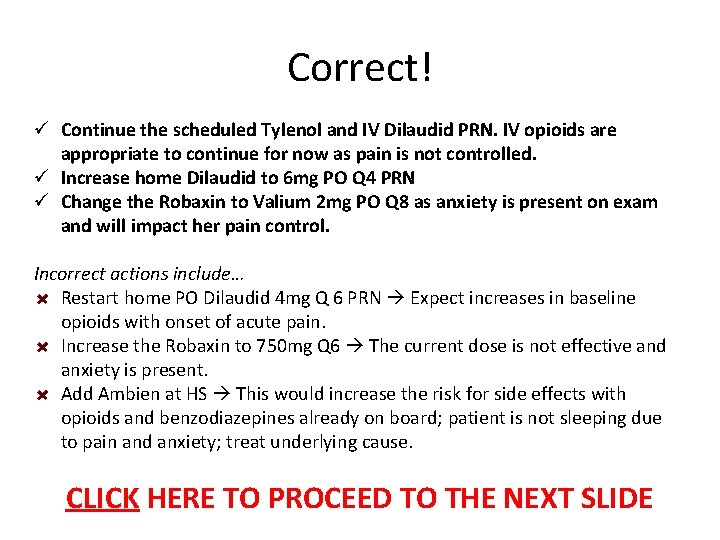
Correct! ü Continue the scheduled Tylenol and IV Dilaudid PRN. IV opioids are appropriate to continue for now as pain is not controlled. ü Increase home Dilaudid to 6 mg PO Q 4 PRN ü Change the Robaxin to Valium 2 mg PO Q 8 as anxiety is present on exam and will impact her pain control. Incorrect actions include… Restart home PO Dilaudid 4 mg Q 6 PRN Expect increases in baseline opioids with onset of acute pain. Increase the Robaxin to 750 mg Q 6 The current dose is not effective and anxiety is present. Add Ambien at HS This would increase the risk for side effects with opioids and benzodiazepines already on board; patient is not sleeping due to pain and anxiety; treat underlying cause. CLICK HERE TO PROCEED TO THE NEXT SLIDE
Incorrect Please click here to go back to the question and try again.
Pain Control Improving… Over the next 24 hours, Ms. Jones’ spasms and anxiety improve. Pain is manageable with PRN Dilaudid but she continues to report end-of-dose failure. The provider decides to add a Sustained Release (SR) opioid to her regimen to optimize her level of function. • Prior to initiating SR opioid therapy in the acute care setting, the following need to be addressed… Verify Insurance coverage (many require a prior authorization) Consider cost Identify out-patient follow up
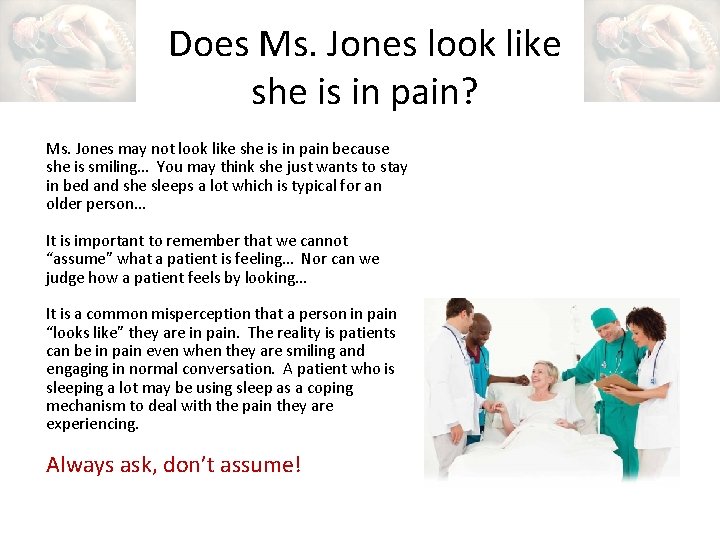
Does Ms. Jones look like she is in pain? Ms. Jones may not look like she is in pain because she is smiling… You may think she just wants to stay in bed and she sleeps a lot which is typical for an older person… It is important to remember that we cannot “assume” what a patient is feeling… Nor can we judge how a patient feels by looking… It is a common misperception that a person in pain “looks like” they are in pain. The reality is patients can be in pain even when they are smiling and engaging in normal conversation. A patient who is sleeping a lot may be using sleep as a coping mechanism to deal with the pain they are experiencing. Always ask, don’t assume!
Scripting To show that you care, can you identify some examples of what to say to Ms. Jones regarding her pain and pain management while she is in the hospital? “I want to do all that I can to help with your pain and make you as comfortable as possible. ” or “There may be some discomfort because of your condition; however we want to make you as comfortable as possible. ” Remember, even the things you say to a patient can affect a patient’s pain management (positively or negatively)!
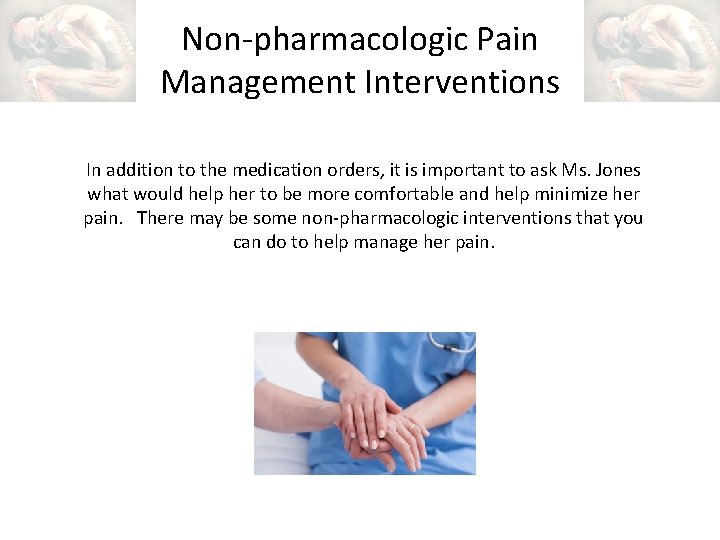
Non-pharmacologic Pain Management Interventions In addition to the medication orders, it is important to ask Ms. Jones what would help her to be more comfortable and help minimize her pain. There may be some non-pharmacologic interventions that you can do to help manage her pain.
Can you identify any nonpharmacologic pain management interventions? Repositioning Distraction Conversation Music Appropriate use of humor Imagery Ask about pain in hourly rounds Use of heat or cold Breathing techniques Temperature of room Relaxation
Conclusion If pain is not managed effectively, every aspect of the patient’s well being will be affected including eating, sleeping, and other activities of daily living. Improving pain management focuses on a team approach while putting patients at the forefront of their care. Trust your patients, listen to their needs, be open and honest, and involve them in the decision making process and treatment plan. You play a key role in managing a patient’s pain.
Thank you for completing the 2015 pain management education for nurses. 0. 5 CE will be provided to nurses for successfully completing this program. You print a certificate of completion forrecords your You cancan print a certificate of completion for your once youonce haveyou completed this program associated records haveposttest. completed thisand program and understand the content. Completion of this program will be recorded automatically in. Completion the St. Luke’s Edu. Tracker System once you have of this program will be recorded achieved 100% on the posttest. automatically in the St. Luke’s Edu. Tracker System. Proceed to “Take Test”. Please contact a member of the Network Pain PI Team with any questions.