
Pager Duty Business Value Assessment onshow now frmmmddyyyy
![Pager. Duty Business Value Assessment [onshow. . now; frm=‘mm-dd-yyyy’] [onshow. c_name]](https://slidetodoc.com/presentation_image_h/180750bd9936015c6c52411d70e71a9d/image-1.jpg "Pager. Duty Business Value Assessment [onshow. . now; frm=‘mm-dd-yyyy’] [onshow. c_name]")
Pager. Duty Business Value Assessment [onshow. . now; frm=‘mm-dd-yyyy’] [onshow. c_name]
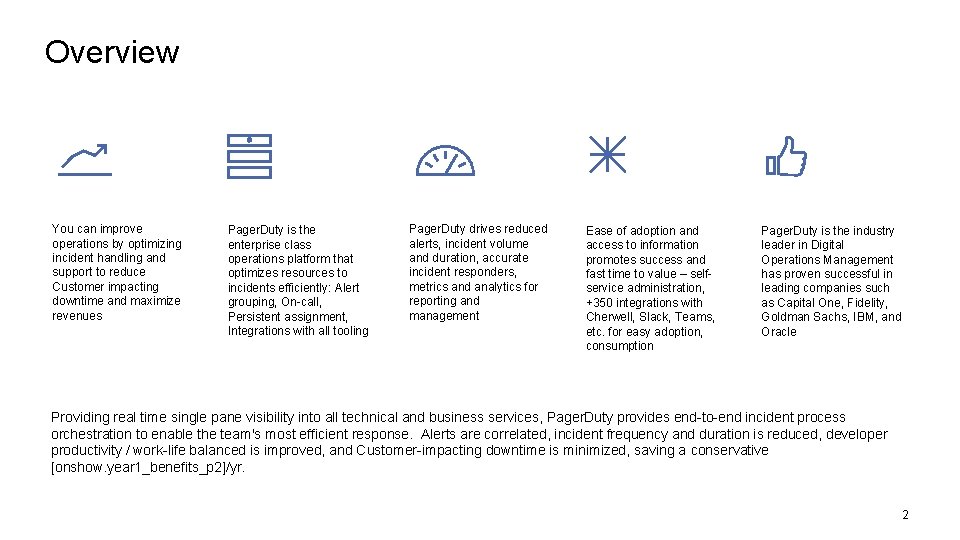
Overview You can improve operations by optimizing incident handling and support to reduce Customer impacting downtime and maximize revenues Pager. Duty is the enterprise class operations platform that optimizes resources to incidents efficiently: Alert grouping, On-call, Persistent assignment, Integrations with all tooling Pager. Duty drives reduced alerts, incident volume and duration, accurate incident responders, metrics and analytics for reporting and management Ease of adoption and access to information promotes success and fast time to value – selfservice administration, +350 integrations with Cherwell, Slack, Teams, etc. for easy adoption, consumption Pager. Duty is the industry leader in Digital Operations Management has proven successful in leading companies such as Capital One, Fidelity, Goldman Sachs, IBM, and Oracle Providing real time single pane visibility into all technical and business services, Pager. Duty provides end-to-end incident process orchestration to enable the team's most efficient response. Alerts are correlated, incident frequency and duration is reduced, developer productivity / work-life balanced is improved, and Customer-impacting downtime is minimized, saving a conservative [onshow. year 1_benefits_p 2]/yr. 2
Contributors First Last Name Title, Role “Characterizing quote about business challenge or pain goes here. ” 3
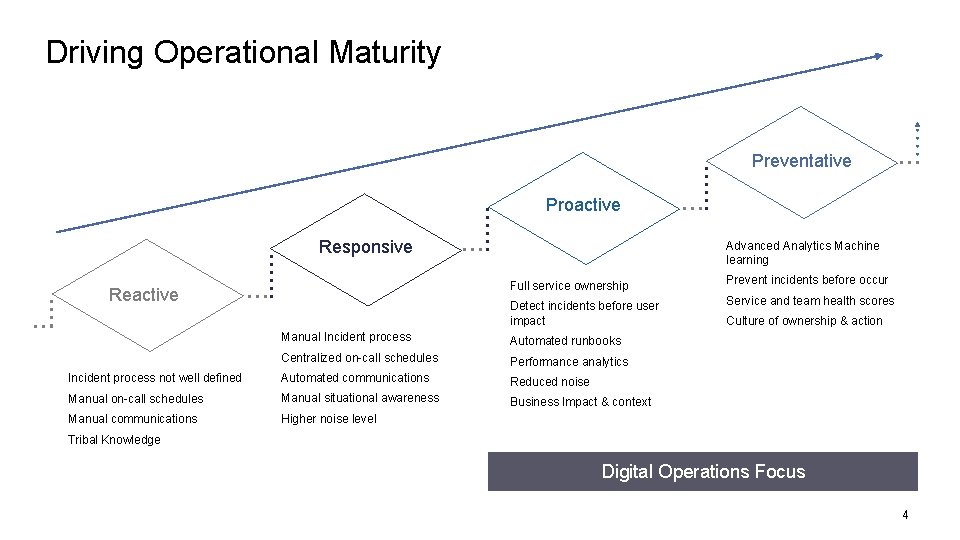
Driving Operational Maturity Preventative Proactive Responsive Reactive Advanced Analytics Machine learning Full service ownership Prevent incidents before occur Detect incidents before user impact Service and team health scores Manual Incident process Automated runbooks Centralized on-call schedules Performance analytics Incident process not well defined Automated communications Reduced noise Manual on-call schedules Manual situational awareness Business Impact & context Manual communications Higher noise level Culture of ownership & action Tribal Knowledge Digital Operations Focus 4
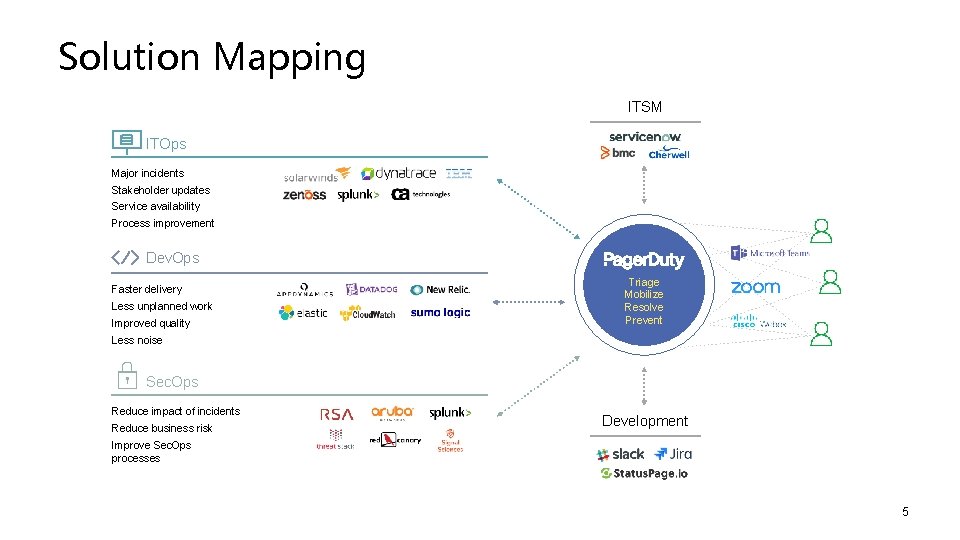
Solution Mapping ITSM ITOps Major incidents Stakeholder updates Service availability Process improvement Dev. Ops Faster delivery Less unplanned work Improved quality Triage Mobilize Resolve Prevent Less noise Sec. Ops Reduce impact of incidents Reduce business risk Development Improve Sec. Ops processes 5
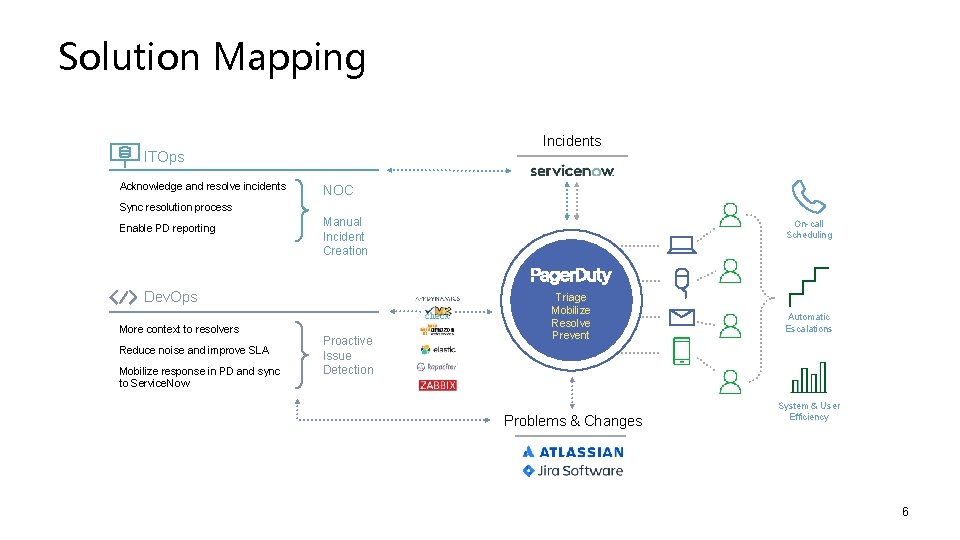
Solution Mapping Incidents ITOps Acknowledge and resolve incidents NOC Sync resolution process Enable PD reporting Manual Incident Creation Dev. Ops More context to resolvers Reduce noise and improve SLA Mobilize response in PD and sync to Service. Now Proactive Issue Detection On-call Scheduling Triage Mobilize Resolve Prevent Problems & Changes Automatic Escalations System & User Efficiency 6
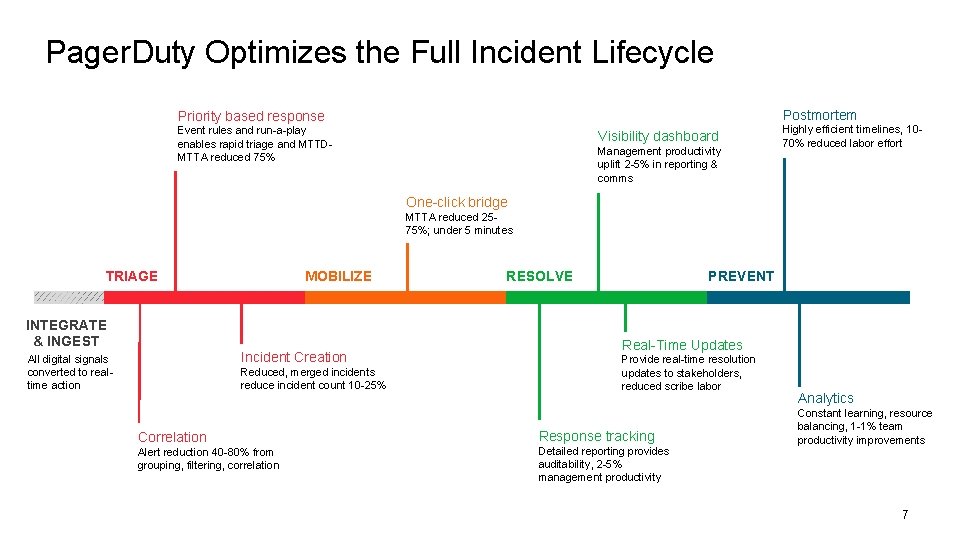
Pager. Duty Optimizes the Full Incident Lifecycle Postmortem Priority based response Event rules and run-a-play enables rapid triage and MTTDMTTA reduced 75% Visibility dashboard Management productivity uplift 2 -5% in reporting & comms Highly efficient timelines, 1070% reduced labor effort One-click bridge MTTA reduced 2575%; under 5 minutes TRIAGE MOBILIZE INTEGRATE & INGEST Incident Creation All digital signals converted to realtime action Reduced, merged incidents reduce incident count 10 -25% Correlation Alert reduction 40 -80% from grouping, filtering, correlation PREVENT RESOLVE Real-Time Updates Provide real-time resolution updates to stakeholders, reduced scribe labor Response tracking Detailed reporting provides auditability, 2 -5% management productivity Analytics Constant learning, resource balancing, 1 -1% team productivity improvements 7
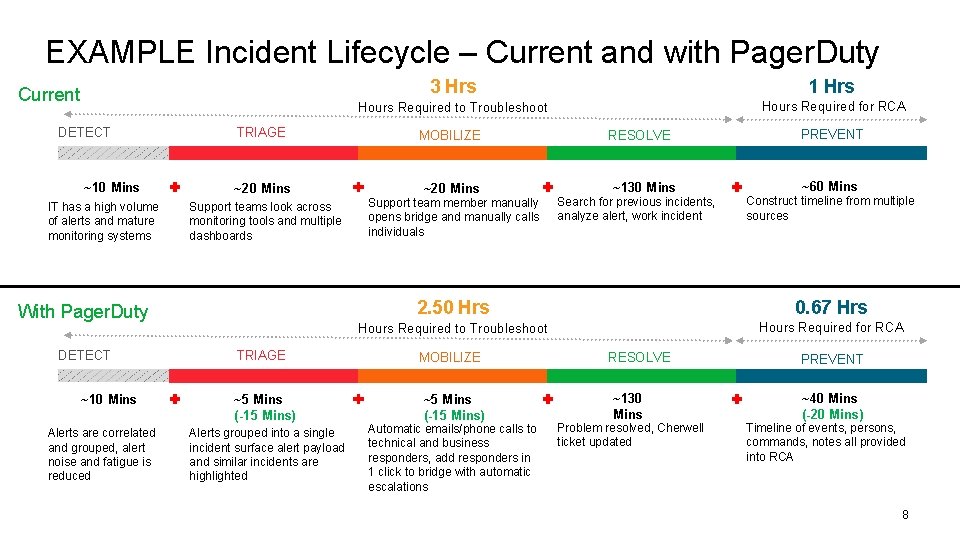
EXAMPLE Incident Lifecycle – Current and with Pager. Duty Current DETECT ~10 Mins IT has a high volume of alerts and mature monitoring systems 3 Hrs 1 Hrs Hours Required to Troubleshoot Hours Required for RCA TRIAGE MOBILIZE ~20 Mins Support teams look across monitoring tools and multiple dashboards Support team member manually opens bridge and manually calls individuals RESOLVE ~130 Mins Search for previous incidents, analyze alert, work incident PREVENT ~60 Mins Construct timeline from multiple sources With Pager. Duty DETECT ~10 Mins Alerts are correlated and grouped, alert noise and fatigue is reduced TRIAGE ~5 Mins (-15 Mins) Alerts grouped into a single incident surface alert payload and similar incidents are highlighted 2. 50 Hrs 0. 67 Hrs Hours Required to Troubleshoot Hours Required for RCA MOBILIZE ~5 Mins (-15 Mins) Automatic emails/phone calls to technical and business responders, add responders in 1 click to bridge with automatic escalations RESOLVE ~130 Mins Problem resolved, Cherwell ticket updated PREVENT ~40 Mins (-20 Mins) Timeline of events, persons, commands, notes all provided into RCA 8
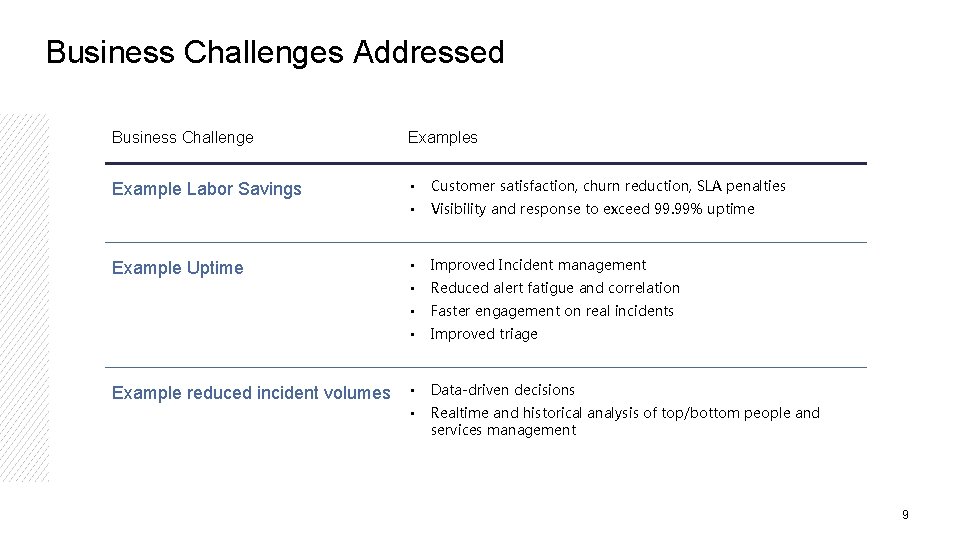
Business Challenges Addressed Business Challenge Examples Example Labor Savings • Customer satisfaction, churn reduction, SLA penalties • Visibility and response to exceed 99. 99% uptime • Improved Incident management • Reduced alert fatigue and correlation • Faster engagement on real incidents • Improved triage • Data-driven decisions • Realtime and historical analysis of top/bottom people and services management Example Uptime Example reduced incident volumes 9
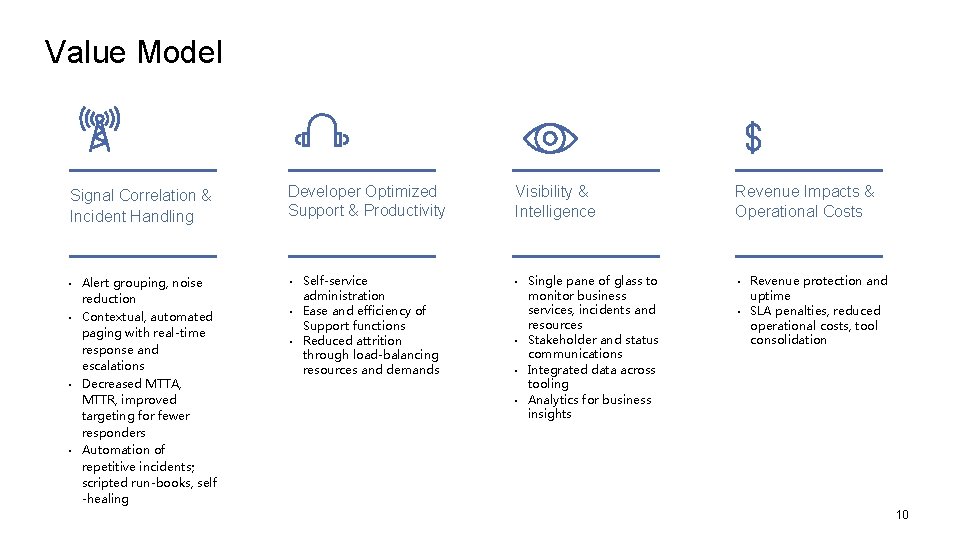
Value Model Signal Correlation & Incident Handling Developer Optimized Support & Productivity Visibility & Intelligence Revenue Impacts & Operational Costs • Alert grouping, noise • Self-service • Single pane of glass to • Revenue protection and reduction • Contextual, automated paging with real-time response and escalations • Decreased MTTA, MTTR, improved targeting for fewer responders • Automation of repetitive incidents; scripted run-books, self -healing administration • Ease and efficiency of Support functions • Reduced attrition through load-balancing resources and demands monitor business services, incidents and resources • Stakeholder and status communications • Integrated data across tooling • Analytics for business insights uptime • SLA penalties, reduced operational costs, tool consolidation 10
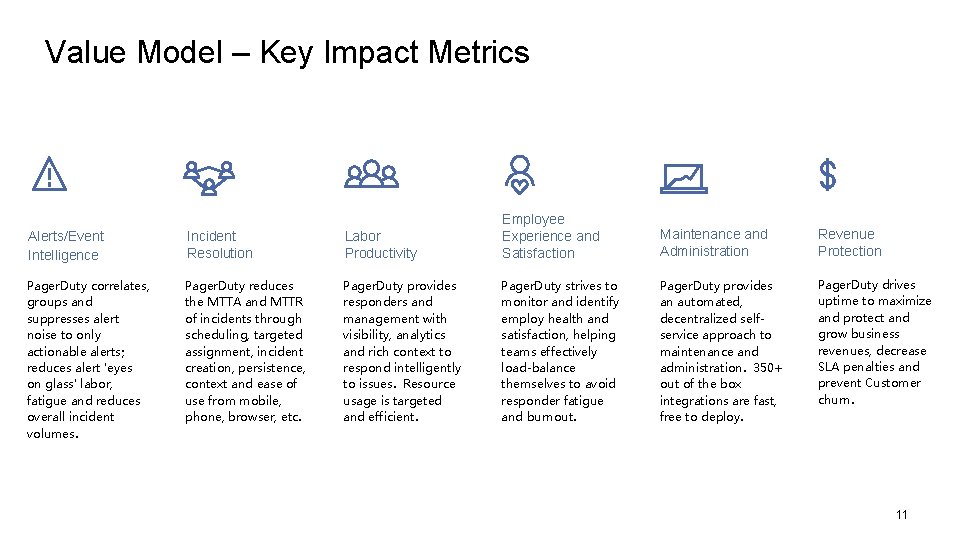
Value Model – Key Impact Metrics Alerts/Event Intelligence Incident Resolution Labor Productivity Employee Experience and Satisfaction Pager. Duty correlates, groups and suppresses alert noise to only actionable alerts; reduces alert 'eyes on glass' labor, fatigue and reduces overall incident volumes. Pager. Duty reduces the MTTA and MTTR of incidents through scheduling, targeted assignment, incident creation, persistence, context and ease of use from mobile, phone, browser, etc. Pager. Duty provides responders and management with visibility, analytics and rich context to respond intelligently to issues. Resource usage is targeted and efficient. Pager. Duty strives to monitor and identify employ health and satisfaction, helping teams effectively load-balance themselves to avoid responder fatigue and burnout. Maintenance and Administration Revenue Protection Pager. Duty provides an automated, decentralized selfservice approach to maintenance and administration. 350+ out of the box integrations are fast, free to deploy. Pager. Duty drives uptime to maximize and protect and grow business revenues, decrease SLA penalties and prevent Customer churn. 11
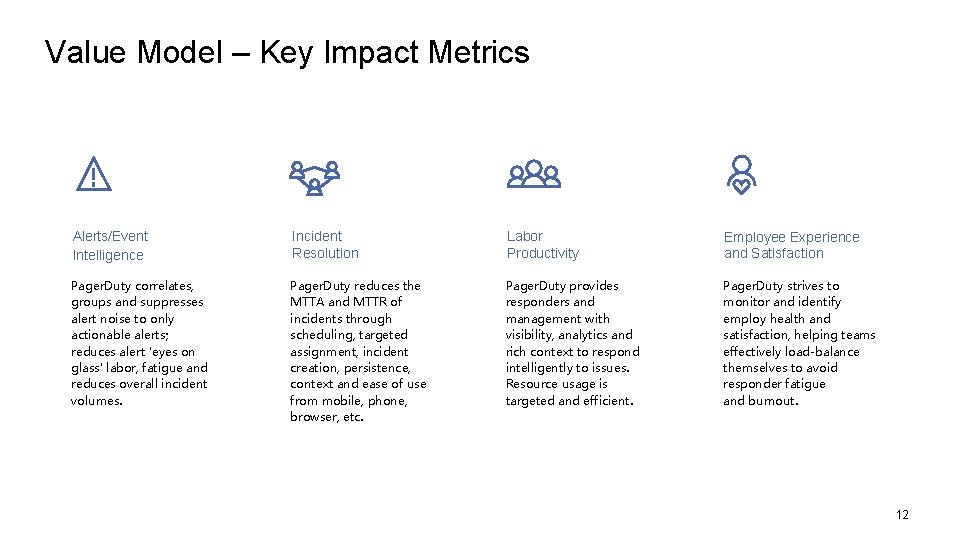
Value Model – Key Impact Metrics Alerts/Event Intelligence Incident Resolution Labor Productivity Employee Experience and Satisfaction Pager. Duty correlates, groups and suppresses alert noise to only actionable alerts; reduces alert 'eyes on glass' labor, fatigue and reduces overall incident volumes. Pager. Duty reduces the MTTA and MTTR of incidents through scheduling, targeted assignment, incident creation, persistence, context and ease of use from mobile, phone, browser, etc. Pager. Duty provides responders and management with visibility, analytics and rich context to respond intelligently to issues. Resource usage is targeted and efficient. Pager. Duty strives to monitor and identify employ health and satisfaction, helping teams effectively load-balance themselves to avoid responder fatigue and burnout. 12
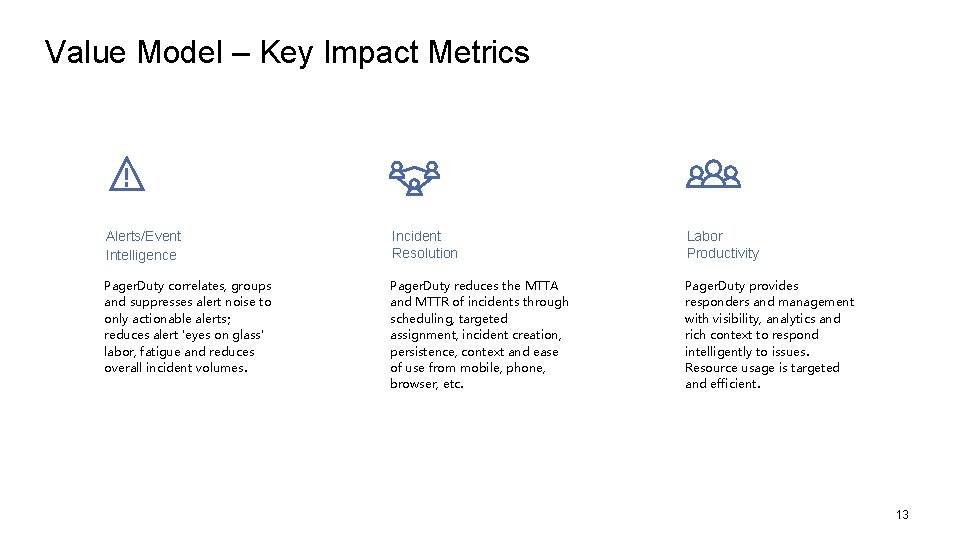
Value Model – Key Impact Metrics Alerts/Event Intelligence Incident Resolution Labor Productivity Pager. Duty correlates, groups and suppresses alert noise to only actionable alerts; reduces alert 'eyes on glass' labor, fatigue and reduces overall incident volumes. Pager. Duty reduces the MTTA and MTTR of incidents through scheduling, targeted assignment, incident creation, persistence, context and ease of use from mobile, phone, browser, etc. Pager. Duty provides responders and management with visibility, analytics and rich context to respond intelligently to issues. Resource usage is targeted and efficient. 13
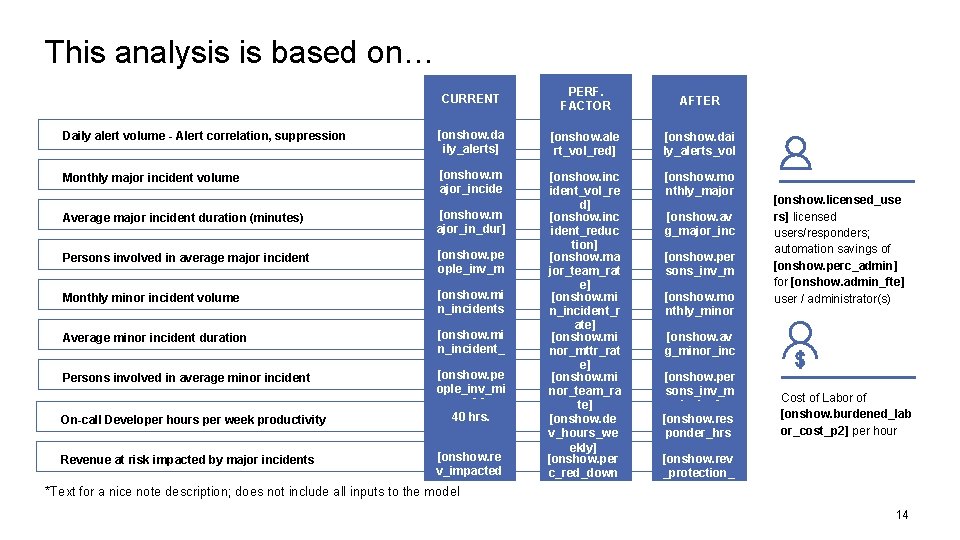
This analysis is based on… CURRENT PERF. FACTOR Daily alert volume - Alert correlation, suppression [onshow. da ily_alerts] [onshow. ale rt_vol_red] Monthly major incident volume [onshow. m ajor_incide nts] [onshow. m ajor_in_dur] [onshow. inc ident_vol_re d] [onshow. inc ident_reduc tion] [onshow. ma jor_team_rat e] [onshow. mi n_incident_r ate] [onshow. mi nor_mttr_rat e] [onshow. mi nor_team_ra te] [onshow. de v_hours_we ekly] [onshow. per c_red_down time]% Average major incident duration (minutes) Persons involved in average major incident Monthly minor incident volume Average minor incident duration Persons involved in average minor incident On-call Developer hours per week productivity Revenue at risk impacted by major incidents [onshow. pe ople_inv_m aj_fr] [onshow. mi n_incidents ] [onshow. mi n_incident_ time] [onshow. pe ople_inv_mi n_fr] 40 hrs. [onshow. re v_impacted _maj_inc] *Text for a nice note description; does not include all inputs to the model AFTER [onshow. dai ly_alerts_vol ume] [onshow. mo nthly_major _inc_rate] [onshow. av g_major_inc _dur] [onshow. per sons_inv_m aj_inc] [onshow. mo nthly_minor _inc_rate] [onshow. av g_minor_inc _dur] [onshow. per sons_inv_m in_inc] [onshow. res ponder_hrs _saved] hrs. [onshow. rev _protection_ output] [onshow. licensed_use rs] licensed users/responders; automation savings of [onshow. perc_admin] for [onshow. admin_fte] user / administrator(s) Cost of Labor of [onshow. burdened_lab or_cost_p 2] per hour 14
![This analysis is based on… [onshow. licensed_use rs] licensed users/responders; automation savings of [onshow.](http://slidetodoc.com/presentation_image_h/180750bd9936015c6c52411d70e71a9d/image-15.jpg "This analysis is based on… [onshow. licensed_use rs] licensed users/responders; automation savings of [onshow.")
This analysis is based on… [onshow. licensed_use rs] licensed users/responders; automation savings of [onshow. perc_admin] for [onshow. admin_fte] user / administrator(s) Productivity improvements to responders saving [onshow. responder_hrs_ saved] hour(s) weekly when on call [onshow. responder_perc ent] of the time and managers saving [onshow. management_hr s_saved] hour(s) weekly [onshow. daily_alerts] daily alerts, [onshow. major_incidents] monthly major incidents, each with an average team of [onshow. people_inv_maj_ fr] persons, for an average [onshow. major_in_dur] minutes and [onshow. min_incidents] monthly minor incidents, each with an average team Revenue protection of savings is based on [onshow. people_inv_min_ [onshow. revenue_of_ri fr] persons, for an average sk] of [onshow. rev_p 2] [onshow. min_incident_tim revenues being e] minutes impacted [onshow. percent_dow ntime_inc] of incidents Alert volumes reduced [onshow. alert_vol_red ] and major incident volumes reduced [onshow. incident_vol _red], minor incident volumes reduced [onshow. min_incident _rate] SLA penalty reduction of [onshow. sla_penalty] % totaling [onshow. sla_tb_p 2] annually Major incident duration reduced [onshow. incident_redu ction] and minor incident duration reduced [onshow. minor_mttr_r ate] Cost of Labor of [onshow. burdened_lab or_cost_p 2] per hour 15
![Value Model 3 Year Business Savings Summary [vcs; block=begin; comm=text: p; sub 1=(metrics)][vcs. na](http://slidetodoc.com/presentation_image_h/180750bd9936015c6c52411d70e71a9d/image-16.jpg "Value Model 3 Year Business Savings Summary [vcs; block=begin; comm=text: p; sub 1=(metrics)][vcs. na")
Value Model 3 Year Business Savings Summary [vcs; block=begin; comm=text: p; sub 1=(metrics)][vcs. na [vcs. vc_yr 1_total me] _p 2] [vcs_sub 1; block=begin; comm=text: p][vcs_sub 1. metric [vcs_sub 1. yr 1_p 2] _name] [vcs_sub 1; block=end; comm=text: p] xx [vcs; block=end; comm=text: p] xx Totals [onshow. year 1_benefits_p 2] [vcs. vc_yr 3_sum _p 2] [vcs_sub 1. yr 3_su m_p 2] [onshow. year 3_bs_p 2] Benefits by Value Category [PERCE NTAGE] Revenue Protection 46% Incident Resolution 40% Alerts and Event Intelligence Labor Productivity 16
![Pager. Duty Benefit Summary Benefits [metrics; block=begin][metrics. metric_name] [metrics; block=end] Total Savings Investment [costs;](http://slidetodoc.com/presentation_image_h/180750bd9936015c6c52411d70e71a9d/image-17.jpg "Pager. Duty Benefit Summary Benefits [metrics; block=begin][metrics. metric_name] [metrics; block=end] Total Savings Investment [costs;")
Pager. Duty Benefit Summary Benefits [metrics; block=begin][metrics. metric_name] [metrics; block=end] Total Savings Investment [costs; block=begin][costs. cost_type] [costs; block=end] xx Total Investment Net Benefits Year 1 Year 2 Year 3 [metrics. year 1_benefits_p 2] [metrics. year 2_benefits_p 2] [metrics. year 3_benefits_p 2] [onshow. year 1_benefits_p 2] [onshow. year 2_benefits_p 2] [onshow. year 3_benefits_p 2] Year 1 Year 2 Year 3 [costs. yr 1_costs_p 2] [costs. yr 2_costs_p 2] [costs. yr 3_costs_p 2] [onshow. year 1_costs_p 2] [onshow. year 2_costs_p 2] [onshow. year 3_costs_p 2] [onshow. nb 1_p 2] [onshow. nb 2_p 2] [onshow. nb 3_p 2] 17
![Financial Impact for [onshow. c_name] Providing real time single pane visibility into all technical](http://slidetodoc.com/presentation_image_h/180750bd9936015c6c52411d70e71a9d/image-18.jpg "Financial Impact for [onshow. c_name] Providing real time single pane visibility into all technical")
Financial Impact for [onshow. c_name] Providing real time single pane visibility into all technical and business services, Pager. Duty provides end-to-end incident process orchestration to enable the team's most efficient response. Alerts are correlated, incident frequency and duration is reduced, developer productivity / work-life balanced is improved, and Customer-impacting downtime is minimized, saving a conservative [onshow. year 1_benefits_p 2]/yr. Potential Impact Annual Benefits by Value Category (Benefits over three years) [onshow. tb_fmt] [onshow. npv_fmt] TOTAL BENEFIT NET PRESENT VALUE (NPV) [onshow. roi_p 2]% [onshow. pb_fr] ROI (Benefits vs. Cost) PAYBACK PERIOD (Months) Labor Productivity 15% 37% 22% Revenue Protection 26% Value Category [vcs 3; block=begin][vcs 3. name] Annual savings of [onshow. year 1_benefits_p 2] Incident Resolution Alerts and Event Intelligence 3 -year Benefit [vcs 3. vc_total_p 2] [vcs 3; block=end] based on year one investment of [onshow. year 1_costs_p 2]. *Estimated cost and savings based on model only, not a substitute for proposal. 18
Thank You Appendix Follows 12 -17 -2019
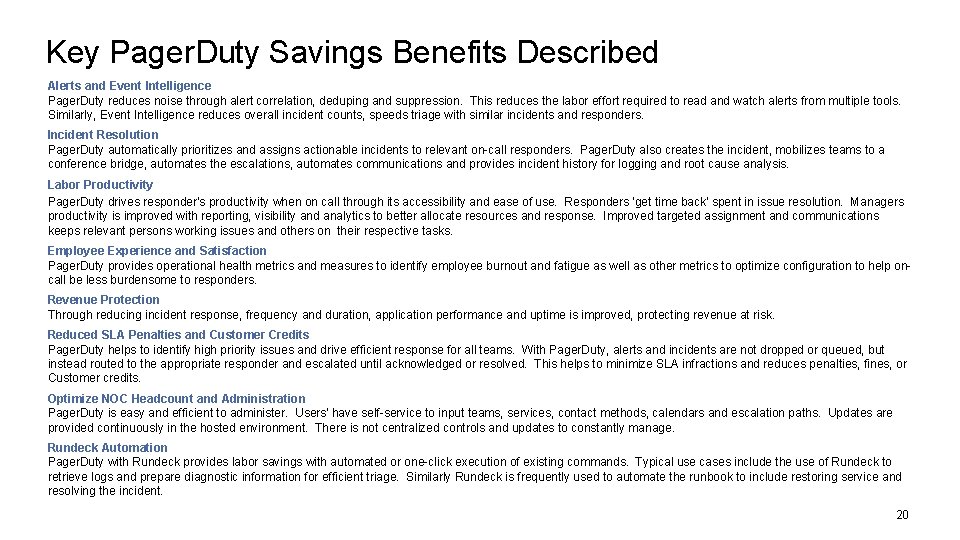
Key Pager. Duty Savings Benefits Described Alerts and Event Intelligence Pager. Duty reduces noise through alert correlation, deduping and suppression. This reduces the labor effort required to read and watch alerts from multiple tools. Similarly, Event Intelligence reduces overall incident counts, speeds triage with similar incidents and responders. Incident Resolution Pager. Duty automatically prioritizes and assigns actionable incidents to relevant on-call responders. Pager. Duty also creates the incident, mobilizes teams to a conference bridge, automates the escalations, automates communications and provides incident history for logging and root cause analysis. Labor Productivity Pager. Duty drives responder's productivity when on call through its accessibility and ease of use. Responders 'get time back' spent in issue resolution. Managers productivity is improved with reporting, visibility and analytics to better allocate resources and response. Improved targeted assignment and communications keeps relevant persons working issues and others on their respective tasks. Employee Experience and Satisfaction Pager. Duty provides operational health metrics and measures to identify employee burnout and fatigue as well as other metrics to optimize configuration to help oncall be less burdensome to responders. Revenue Protection Through reducing incident response, frequency and duration, application performance and uptime is improved, protecting revenue at risk. Reduced SLA Penalties and Customer Credits Pager. Duty helps to identify high priority issues and drive efficient response for all teams. With Pager. Duty, alerts and incidents are not dropped or queued, but instead routed to the appropriate responder and escalated until acknowledged or resolved. This helps to minimize SLA infractions and reduces penalties, fines, or Customer credits. Optimize NOC Headcount and Administration Pager. Duty is easy and efficient to administer. Users' have self-service to input teams, services, contact methods, calendars and escalation paths. Updates are provided continuously in the hosted environment. There is not centralized controls and updates to constantly manage. Rundeck Automation Pager. Duty with Rundeck provides labor savings with automated or one-click execution of existing commands. Typical use cases include the use of Rundeck to retrieve logs and prepare diagnostic information for efficient triage. Similarly Rundeck is frequently used to automate the runbook to include restoring service and resolving the incident. 20
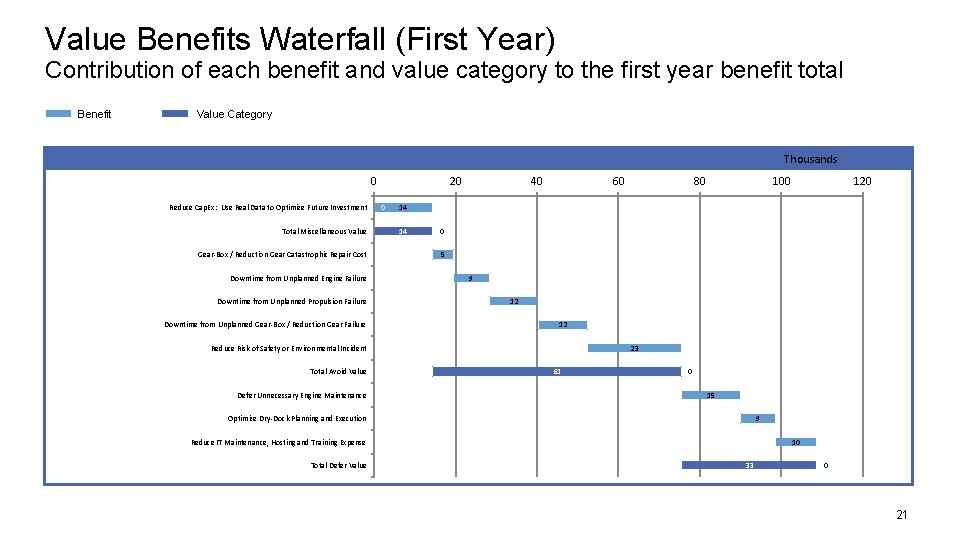
Value Benefits Waterfall (First Year) Contribution of each benefit and value category to the first year benefit total Benefit Value Category Thousands 0 Reduce Cap. Ex: Use Real Data to Optimize Future Investment 20 0 Total Miscellaneous Value 0 Downtime from Unplanned Engine Failure 0 Downtime from Unplanned Propulsion Failure 0 Downtime from Unplanned Gear-Box / Reduction Gear Failure 0 Reduce Risk of Safety or Environmental Incident 0 Total Avoid Value 0 Optimize Dry-Dock Planning and Execution 0 Reduce IT Maintenance, Hosting and Training Expense 0 80 100 120 0 5 9 12 12 23 61 Defer Unnecessary Engine Maintenance Total Defer Value 60 14 14 Gear-Box / Reduction Gear Catastrophic Repair Cost 40 0 15 9 10 33 0 21
![[met. value_category] [met. metric_name] [met. description] [met. features] [met. year 1_benefits _p 2] 1](http://slidetodoc.com/presentation_image_h/180750bd9936015c6c52411d70e71a9d/image-22.jpg "[met. value_category] [met. metric_name] [met. description] [met. features] [met. year 1_benefits _p 2] 1")
[met. value_category] [met. metric_name] [met. description] [met. features] [met. year 1_benefits _p 2] 1 st Year benefit based on [met. delta]% of potential annual value Formula [met. driver_factor] [met. driver_value_fr ] X Typical Improvement [met. impact][met. ab br] X [met. financial_facto r] [met. financial_value _fr] 22
![[met. value_category] [met. metric_name] [met. description] [met. features] [met. year 1_benefits _p 2] 1](http://slidetodoc.com/presentation_image_h/180750bd9936015c6c52411d70e71a9d/image-23.jpg "[met. value_category] [met. metric_name] [met. description] [met. features] [met. year 1_benefits _p 2] 1")
[met. value_category] [met. metric_name] [met. description] [met. features] [met. year 1_benefits _p 2] 1 st Year benefit based on [met. delta]% of potential annual value Formula [met. driver_factor] [met. driver_value_fr ] X Typical Improvement [met. impact][met. ab br] X [met. financial_facto r] [met. financial_value _fr] 23
![[met. value_category] [met. metric_name] [met. description] [met. features] [met. year 1_benefits _p 2] 1](http://slidetodoc.com/presentation_image_h/180750bd9936015c6c52411d70e71a9d/image-24.jpg "[met. value_category] [met. metric_name] [met. description] [met. features] [met. year 1_benefits _p 2] 1")
[met. value_category] [met. metric_name] [met. description] [met. features] [met. year 1_benefits _p 2] 1 st Year benefit based on [met. delta]% of potential annual value Formula [met. driver_factor] [met. driver_value_fr ] X Typical Improvement [met. impact][met. ab br] X [met. financial_facto r] [met. financial_value _fr] 24
![[met. value_category] [met. metric_name] [met. description] [met. features] [met. year 1_benefits _p 2] 1](http://slidetodoc.com/presentation_image_h/180750bd9936015c6c52411d70e71a9d/image-25.jpg "[met. value_category] [met. metric_name] [met. description] [met. features] [met. year 1_benefits _p 2] 1")
[met. value_category] [met. metric_name] [met. description] [met. features] [met. year 1_benefits _p 2] 1 st Year benefit based on [met. delta]% of potential annual value Formula [met. driver_factor] [met. driver_value_fr ] X Typical Improvement [met. impact][met. ab br] X [met. financial_facto r] [met. financial_value _fr] 25
![[met. value_category] [met. metric_name] [met. description] [met. features] [met. year 1_benefits _p 2] 1](http://slidetodoc.com/presentation_image_h/180750bd9936015c6c52411d70e71a9d/image-26.jpg "[met. value_category] [met. metric_name] [met. description] [met. features] [met. year 1_benefits _p 2] 1")
[met. value_category] [met. metric_name] [met. description] [met. features] [met. year 1_benefits _p 2] 1 st Year benefit based on [met. delta]% of potential annual value Formula [met. driver_factor] [met. driver_value_fr ] X Typical Improvement [met. impact][met. ab br] X [met. financial_facto r] [met. financial_value _fr] 26
![[met. value_category] [met. metric_name] [met. description] [met. features] [met. year 1_benefits _p 2] 1](http://slidetodoc.com/presentation_image_h/180750bd9936015c6c52411d70e71a9d/image-27.jpg "[met. value_category] [met. metric_name] [met. description] [met. features] [met. year 1_benefits _p 2] 1")
[met. value_category] [met. metric_name] [met. description] [met. features] [met. year 1_benefits _p 2] 1 st Year benefit based on [met. delta]% of potential annual value Formula [met. driver_factor] [met. driver_value_fr ] X Typical Improvement [met. impact][met. ab br] X [met. financial_facto r] [met. financial_value _fr] 27
![[met. value_category] [met. metric_name] [met. description] [met. features] [met. year 1_benefits _p 2] 1](http://slidetodoc.com/presentation_image_h/180750bd9936015c6c52411d70e71a9d/image-28.jpg "[met. value_category] [met. metric_name] [met. description] [met. features] [met. year 1_benefits _p 2] 1")
[met. value_category] [met. metric_name] [met. description] [met. features] [met. year 1_benefits _p 2] 1 st Year benefit based on [met. delta]% of potential annual value Formula [met. driver_factor] [met. driver_value_fr ] X Typical Improvement [met. impact][met. ab br] X [met. financial_facto r] [met. financial_value _fr] 28
![[met. value_category] [met. metric_name] [met. description] [met. features] [met. year 1_benefits _p 2] 1](http://slidetodoc.com/presentation_image_h/180750bd9936015c6c52411d70e71a9d/image-29.jpg "[met. value_category] [met. metric_name] [met. description] [met. features] [met. year 1_benefits _p 2] 1")
[met. value_category] [met. metric_name] [met. description] [met. features] [met. year 1_benefits _p 2] 1 st Year benefit based on [met. delta]% of potential annual value Formula [met. driver_factor] [met. driver_value_fr ] X Typical Improvement [met. impact][met. ab br] X [met. financial_facto r] [met. financial_value _fr] 29
![[met. value_category] [met. metric_name] [met. description] [met. features] [met. year 1_benefits _p 2] 1](http://slidetodoc.com/presentation_image_h/180750bd9936015c6c52411d70e71a9d/image-30.jpg "[met. value_category] [met. metric_name] [met. description] [met. features] [met. year 1_benefits _p 2] 1")
[met. value_category] [met. metric_name] [met. description] [met. features] [met. year 1_benefits _p 2] 1 st Year benefit based on [met. delta]% of potential annual value Formula [met. driver_factor] [met. driver_value_fr ] X Typical Improvement [met. impact][met. ab br] X [met. financial_facto r] [met. financial_value _fr] 30
![[met. value_category] [met. metric_name] [met. description] [met. features] [met. year 1_benefits _p 2] 1](http://slidetodoc.com/presentation_image_h/180750bd9936015c6c52411d70e71a9d/image-31.jpg "[met. value_category] [met. metric_name] [met. description] [met. features] [met. year 1_benefits _p 2] 1")
[met. value_category] [met. metric_name] [met. description] [met. features] [met. year 1_benefits _p 2] 1 st Year benefit based on [met. delta]% of potential annual value Formula [met. driver_factor] [met. driver_value_fr ] X Typical Improvement [met. impact][met. ab br] X [met. financial_facto r] [met. financial_value _fr] 31
![[met. value_category] [met. metric_name] [met. description] [met. features] [met. year 1_benefits _p 2] 1](http://slidetodoc.com/presentation_image_h/180750bd9936015c6c52411d70e71a9d/image-32.jpg "[met. value_category] [met. metric_name] [met. description] [met. features] [met. year 1_benefits _p 2] 1")
[met. value_category] [met. metric_name] [met. description] [met. features] [met. year 1_benefits _p 2] 1 st Year benefit based on [met. delta]% of potential annual value Formula [met. driver_factor] [met. driver_value_fr ] X Typical Improvement [met. impact][met. ab br] X [met. financial_facto r] [met. financial_value _fr] 32
![[met. value_category] [met. metric_name] [met. description] [met. features] [met. year 1_benefits _p 2] 1](http://slidetodoc.com/presentation_image_h/180750bd9936015c6c52411d70e71a9d/image-33.jpg "[met. value_category] [met. metric_name] [met. description] [met. features] [met. year 1_benefits _p 2] 1")
[met. value_category] [met. metric_name] [met. description] [met. features] [met. year 1_benefits _p 2] 1 st Year benefit based on [met. delta]% of potential annual value Formula [met. driver_factor] [met. driver_value_fr ] X Typical Improvement [met. impact][met. ab br] X [met. financial_facto r] [met. financial_value _fr] 33
![[met. value_category] [met. metric_name] [met. description] [met. features] [met. year 1_benefits _p 2] 1](http://slidetodoc.com/presentation_image_h/180750bd9936015c6c52411d70e71a9d/image-34.jpg "[met. value_category] [met. metric_name] [met. description] [met. features] [met. year 1_benefits _p 2] 1")
[met. value_category] [met. metric_name] [met. description] [met. features] [met. year 1_benefits _p 2] 1 st Year benefit based on [met. delta]% of potential annual value Formula [met. driver_factor] [met. driver_value_fr ] X Typical Improvement [met. impact][met. ab br] X [met. financial_facto r] [met. financial_value _fr] 34
![[met. value_category] [met. metric_name] [met. description] [met. features] [met. year 1_benefits _p 2] 1](http://slidetodoc.com/presentation_image_h/180750bd9936015c6c52411d70e71a9d/image-35.jpg "[met. value_category] [met. metric_name] [met. description] [met. features] [met. year 1_benefits _p 2] 1")
[met. value_category] [met. metric_name] [met. description] [met. features] [met. year 1_benefits _p 2] 1 st Year benefit based on [met. delta]% of potential annual value Formula [met. driver_factor] [met. driver_value_fr ] X Typical Improvement [met. impact][met. ab br] X [met. financial_facto r] [met. financial_value _fr] 35
![Driver Factor Assumptions (per year) Assumptions [drivers; block=begin][drivers. driver_factor] [drivers. driver_value_fr] [drivers; block=end] xx](http://slidetodoc.com/presentation_image_h/180750bd9936015c6c52411d70e71a9d/image-36.jpg "Driver Factor Assumptions (per year) Assumptions [drivers; block=begin][drivers. driver_factor] [drivers. driver_value_fr] [drivers; block=end] xx")
Driver Factor Assumptions (per year) Assumptions [drivers; block=begin][drivers. driver_factor] [drivers. driver_value_fr] [drivers; block=end] xx 36
![Financial Factor Assumptions (per year) Assumptions [financials; block=begin][financials. financial_factor] [financials. financial_value_fr] [financials; block=end] xx](http://slidetodoc.com/presentation_image_h/180750bd9936015c6c52411d70e71a9d/image-37.jpg "Financial Factor Assumptions (per year) Assumptions [financials; block=begin][financials. financial_factor] [financials. financial_value_fr] [financials; block=end] xx")
Financial Factor Assumptions (per year) Assumptions [financials; block=begin][financials. financial_factor] [financials. financial_value_fr] [financials; block=end] xx 37

Thank You 12 -17 -2019
![[onshow. account_name] Benefits in Summary The economics projected over three years justify the investment](http://slidetodoc.com/presentation_image_h/180750bd9936015c6c52411d70e71a9d/image-39.jpg "[onshow. account_name] Benefits in Summary The economics projected over three years justify the investment")
[onshow. account_name] Benefits in Summary The economics projected over three years justify the investment Annual savings of [onshow. year 1_benefits_p 2] based on year one investment of [onshow. year 1_costs_p 2]. [onshow. t b_fmt] TOTAL BENEFIT Thousands [onshow. p b_p 2] Mos. ROI PAYBACK PERIOD ROI Benefits vs Cost *Estimated cost and savings based on model only, not a substitute for proposal. [onshow. r oi_p 2]% 2, 000 1, 500 1, 000 500 0 Year 1 Year 2 Benefits Year 3 Investment 39
![Business Challenge Pager. Duty Benefits Example Labor Savings [vcs 2; block=begin; sub 1=(metrics)][vcs 2.](http://slidetodoc.com/presentation_image_h/180750bd9936015c6c52411d70e71a9d/image-40.jpg "Business Challenge Pager. Duty Benefits Example Labor Savings [vcs 2; block=begin; sub 1=(metrics)][vcs 2.")
Business Challenge Pager. Duty Benefits Example Labor Savings [vcs 2; block=begin; sub 1=(metrics)][vcs 2. name] • Customer satisfaction, churn reduction, SLA penalties • [vcs 2_sub 1; block=begin][vcs 2_sub 1. improvement_fac tor] ([vcs 2_sub 1. range]) • Visibility and response to exceed 99. 99% uptime • [vcs 2_sub 1; block=end] [vcs 2; block=end] Example Uptime • Improved Incident management • Reduced alert fatigue and correlation • Faster engagement on real incidents • Improved triage Example reduced incident volumes • Data-driven decisions • Realtime and historical analysis of top/bottom people and services management 40
- Slides: 40