
Paediatric Knee MRI Indications for GP referred Medicare
- Slides: 6
Paediatric Knee MRI
Indications for GP referred Medicare Rebatable MRI knee studies in children under 16 years of age Following radiographic examination: • for internal joint derangement Differs from adult rebate criteria: • Cruciate ligament, meniscal or articular surface injury such as acute fractures or osteochondritis dissecans • may be acute or chronic (therefore covers conditions such as osteochondritis dissecans) unlike the adult knee rebate that must be for acute injury
Traumatic & overuse causes of knee pain in children Acute trauma • Patellar dislocation • Cruciate ligament tears • Meniscal tears • Avulsion injuries (e. g, tibial spine) • Physeal (Salter Harris fractures) • Osteochondral fracture Nonacute/overuse (repetitive microtrauma) • Osteochondritis dissecans • Apophysitis (e. g. , Osgood-Schlatter’s, Sinding-Larsen-Johannson) • Stress fractures
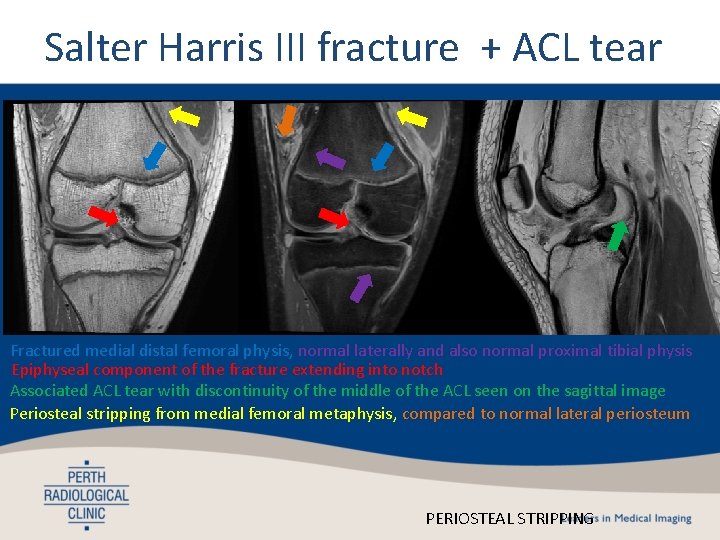
Salter Harris III fracture + ACL tear Fractured medial distal femoral physis, normal laterally and also normal proximal tibial physis Epiphyseal component of the fracture extending into notch Associated ACL tear with discontinuity of the middle of the ACL seen on the sagittal image Periosteal stripping from medial femoral metaphysis, compared to normal lateral periosteum PERIOSTEAL STRIPPING
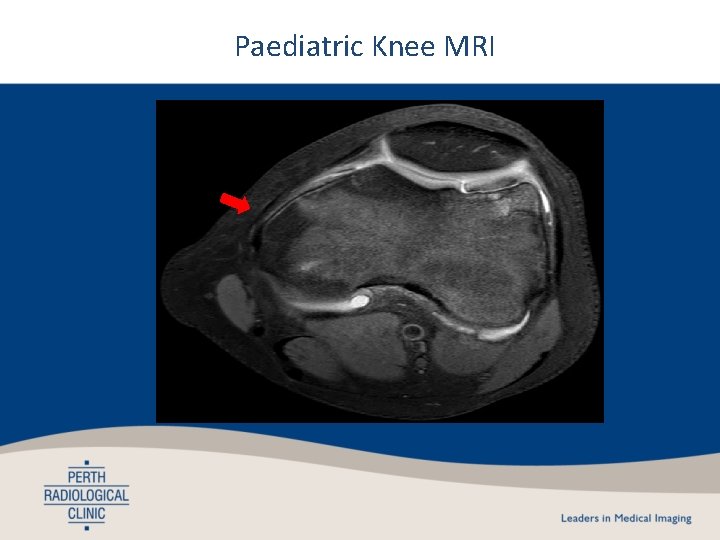
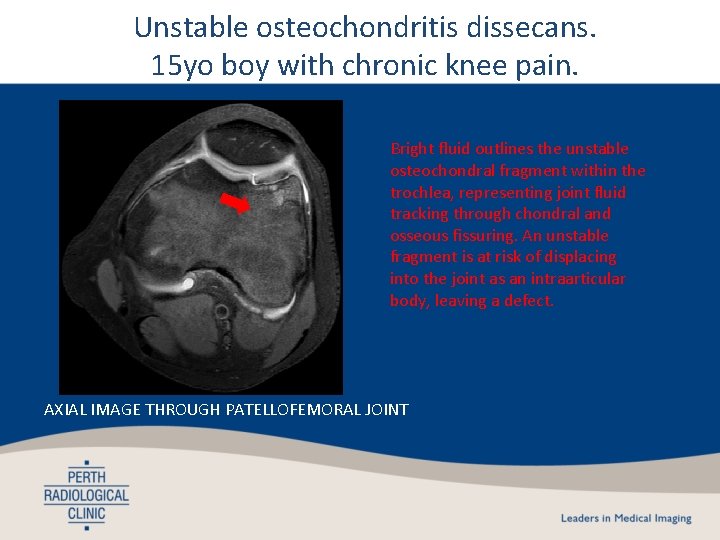
Unstable osteochondritis dissecans. 15 yo boy with chronic knee pain. Bright fluid outlines the unstable osteochondral fragment within the trochlea, representing joint fluid tracking through chondral and osseous fissuring. An unstable fragment is at risk of displacing into the joint as an intraarticular body, leaving a defect. AXIAL IMAGE THROUGH PATELLOFEMORAL JOINT
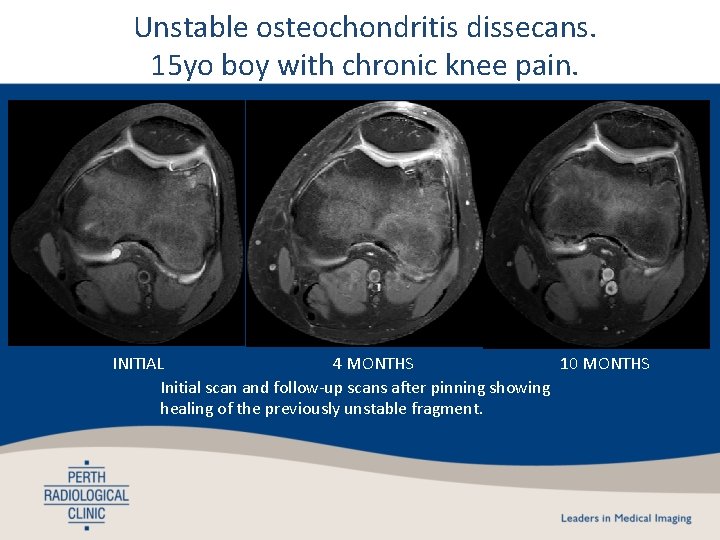
Unstable osteochondritis dissecans. 15 yo boy with chronic knee pain. INITIAL 4 MONTHS 10 MONTHS Initial scan and follow-up scans after pinning showing healing of the previously unstable fragment.