
Paediatric Community Acquired Pneumonia based on BTS guidelines
Paediatric Community Acquired Pneumonia (based on BTS guidelines for the management of community aquired pneumonia)
PNEUMONIA “Inflammation of the lung” -From Greek pneumōn meaning ‘lung’

Community Acquired Pneumonia • Defined as the presence of signs and symptoms of pneumonia in a previously healthy child due to an infection which has been acquired outside hospital • 120 million annual worldwide incidence of pneumonia in children <5 years old • mortality rate 8. 7% severe pneumonia • >80% of all childhood pneumonia deaths occur in children <2 years old • mortality rate reduced from 4 -6 million in early 1980 s to ∼ 0. 9 million in 20151 • still second most common cause of childhood mortality worldwide second only to neonatal/preterm birth complications 1 1 JAMA Pediatr. 2017; 171(6): 573
Community Acquired Pneumonia • Incidence higher in boys 1 • Incidence of severe pneumonia higher in children < 5 years of age 1 • Marked seasonal pattern with winter preponderance for hospital admission due to pneumococcal infection (December and January 3 -5 x higher than August) 2 • Winter preponderance also noted for many viral infections including respiratory syncytial virus, influenza and parainfluenza 1 & 2 3 1 JAMA Pediatr. 2017; 171: 573 2 Epidemiol Infect 2007; 135: 262 3 Journal of Infection 2006; 52: 37

Aetiology • Viruses most prevalent cause of CAP in childhood particularly during infancy • RSV, influenza and human metapneumovirus most common viruses 1 • Strep. Pneumoniae most common bacterial cause of CAP 1 • Incidence and severity of disease significantly reduced since introduction of pneumococcal conjugate vaccine 2 1 Thorax 2019; 74: 261 2 Clin Infect Dis 2014; 58: 918
Aetiology • Less frequent causative bacterial pathogens include: • Group A streptococcal infection – associated with more severe illness particularly empyema 1 • Staph. Aureus – associated with an acute severe illness, pneumatocoeles and empyema • Haemophilus influenzae type b (Hib) was a frequent cause of CAP before Hib immunisation –still important in countries without universal vaccination 2 • Mycoplasma pneumonia and Chlamydia trachomatis are a more common cause of CAP in older children 3 1 Can J Infect Dis 2014; 25: 151 2 J Glob Health 2013; 3: 2013 3 NEJM 2015; 372: 835

Clinical Features • No single symptom or sign is pathognomic for CAP in children • May present with fever, cough, tachypnoea, breathlessness or difficulty in breathing, wheeze or chest pain • May also present with abdo pain and/or vomiting +/- headache • Large study of children hospitalised with CAP and CXR changes 1: • 95% presented with cough, 90% fever, 75% anorexia, 70% short of breath 1 NEJM 2015; 372: 835
Clinical Features • Tachypnoea • relatively specific but not sensitive 1 • associated with hypoxaemia in infants (>70 bpm)2 • Increased work of breathing • signs include grunting, nasal flaring and chest retractions or indrawing • highly specific for pneumonia 1 • Chest examination • Crackles on auscultation • Wheeze more common with CAP due to atypical bacteria and viruses (also consistent with asthma and bronchiolitis) • Signs of consolidated lung including vocal resonance, vocal fremitus, reduced breath sounds, dullness to percussion 1 JAMA 2017; 318: 426 2 Ann Trop Paediatr 1998; 18: 31
Radiological Investigations • Chest radiographs in childhood CAP have a number of limitations: • findings do NOT correlate well with aetiologic agent 1 • have limited impact on therapeutic decisions • lateral views do not add diagnostic value • Chest radiography should not be considered a routine investigation in children thought to have CAP • Consider performing a Chest X-Ray (Antero-Posterior) particularly in those: • with hypoxaemia • with significant respiratory distress 1 Thorax 2002; 57: 438
General Investigations • Pulse oximetry provides a non-invasive, easy to use estimate of arterial oxygenation • hypoxaemia (<92% in air) indicates severe disease • Acute phase reactants (C reactive protein, procalcitonin, white blood cell count) • raised levels associated with bacterial pneumonia but significant overlap with pneumonia of viral aetiology – therefore of little clinical utility 1 1 PIDJ 2008; 27: 95
Microbiological Investigations • Microbiological diagnosis should be attempted in children with severe pneumonia sufficient to require paediatric intensive care admission or those with complications of CAP • Microbiological investigations should not be considered routine in those with milder disease or those treated in the community • Microbiological methods should include: • blood culture • nasopharyngeal and/or nasal swabs for PCR viral detection • acute and convalescent serology for viruses & atypical bacteria • pleural fluid for microscopy, culture and/or PCR
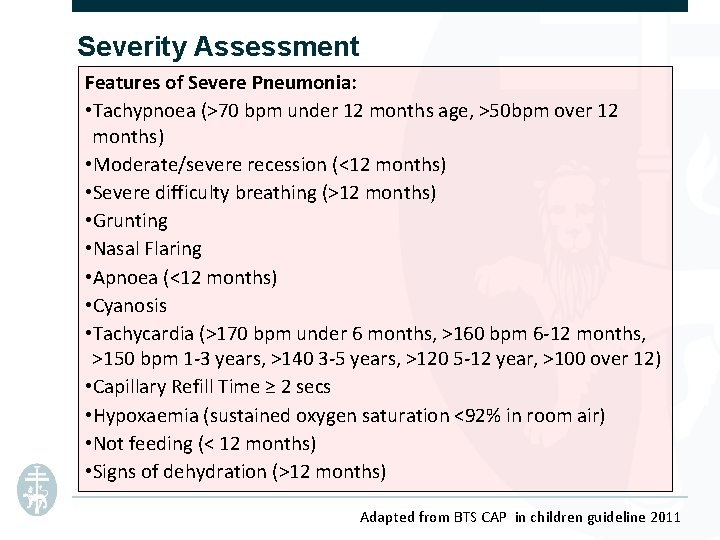
Severity Assessment Features of Severe Pneumonia: • Tachypnoea (>70 bpm under 12 months age, >50 bpm over 12 months) • Moderate/severe recession (<12 months) • Severe difficulty breathing (>12 months) • Grunting • Nasal Flaring • Apnoea (<12 months) • Cyanosis • Tachycardia (>170 bpm under 6 months, >160 bpm 6 -12 months, >150 bpm 1 -3 years, >140 3 -5 years, >120 5 -12 year, >100 over 12) • Capillary Refill Time ≥ 2 secs • Hypoxaemia (sustained oxygen saturation <92% in room air) • Not feeding (< 12 months) • Signs of dehydration (>12 months) Adapted from BTS CAP in children guideline 2011
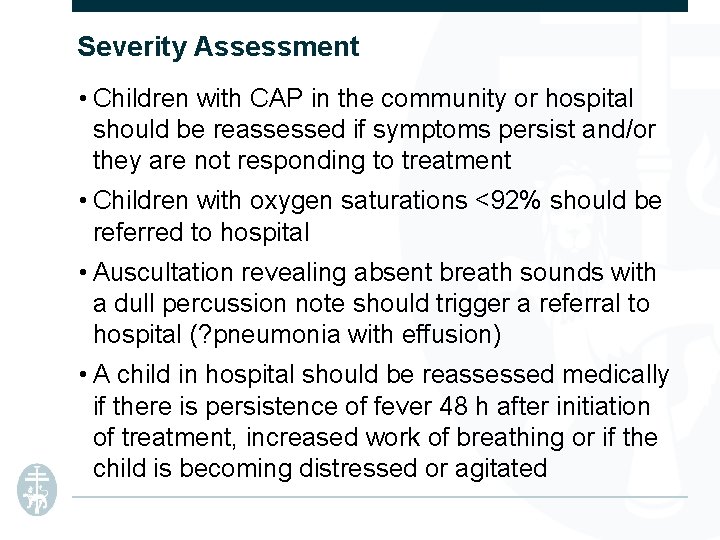
Severity Assessment • Children with CAP in the community or hospital should be reassessed if symptoms persist and/or they are not responding to treatment • Children with oxygen saturations <92% should be referred to hospital • Auscultation revealing absent breath sounds with a dull percussion note should trigger a referral to hospital (? pneumonia with effusion) • A child in hospital should be reassessed medically if there is persistence of fever 48 h after initiation of treatment, increased work of breathing or if the child is becoming distressed or agitated
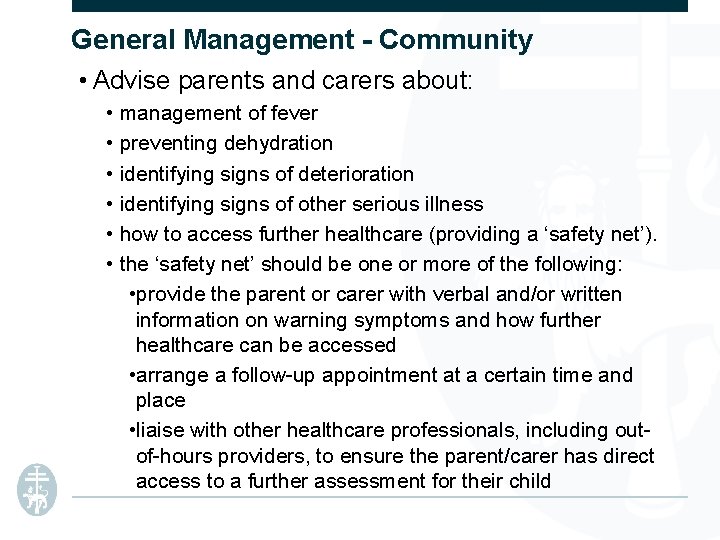
General Management - Community • Advise parents and carers about: • management of fever • preventing dehydration • identifying signs of deterioration • identifying signs of other serious illness • how to access further healthcare (providing a ‘safety net’). • the ‘safety net’ should be one or more of the following: • provide the parent or carer with verbal and/or written information on warning symptoms and how further healthcare can be accessed • arrange a follow-up appointment at a certain time and place • liaise with other healthcare professionals, including outof-hours providers, to ensure the parent/carer has direct access to a further assessment for their child
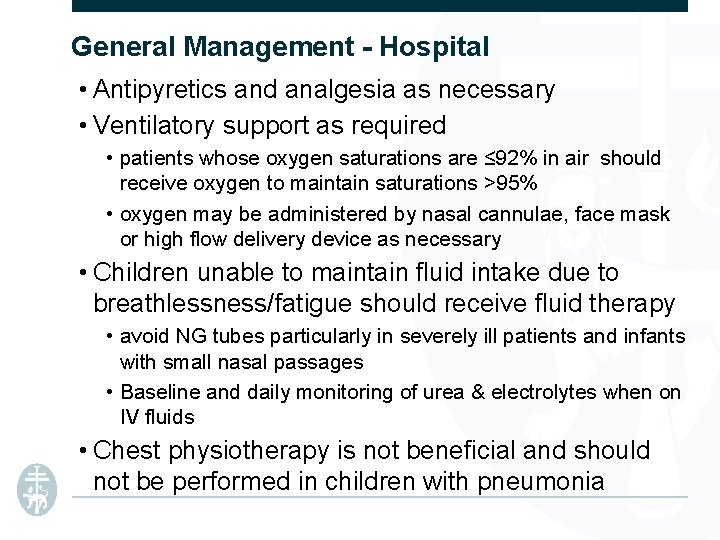
General Management - Hospital • Antipyretics and analgesia as necessary • Ventilatory support as required • patients whose oxygen saturations are ≤ 92% in air should receive oxygen to maintain saturations >95% • oxygen may be administered by nasal cannulae, face mask or high flow delivery device as necessary • Children unable to maintain fluid intake due to breathlessness/fatigue should receive fluid therapy • avoid NG tubes particularly in severely ill patients and infants with small nasal passages • Baseline and daily monitoring of urea & electrolytes when on IV fluids • Chest physiotherapy is not beneficial and should not be performed in children with pneumonia
Antibiotic Management • All children with a clear clinical diagnosis of pneumonia should receive antibiotics as viral and bacterial pneumonia cannot be reliably distinguished from each other • Amoxicillin is recommended as first choice for oral antibiotic therapy (alternatives are co-amoxiclav, cefaclor and macrolide antibiotics) • Macrolide antibiotics may be added at any age if there is no response to first-line empirical therapy • Macrolide antibiotics should be used if either mycoplasma or chlamydia pneumonia is suspected or in very severe disease • Co-amoxiclav should be used for pneumonia associated with influenza
Antibiotic Management • Antibiotics administered orally are safe and effective for children presenting with even severe CAP 1 • Intravenous antibiotics should be used in the treatment of pneumonia in children when the child is unable to tolerate oral fluids or absorb oral antibiotics (eg because of vomiting) or presents with signs of septicaemia or complicated pneumonia • Recommended intravenous antibiotics for severe pneumonia include amoxicillin, co-amoxiclav, cefuroxime and cefotaxime or ceftriaxone (local antibiotic guidelines should be consulted) 1 Thorax 2007; 62: 1102
Complications and Failure to Improve • Pleural effusion and empyema • consider with fever beyond 7 days or not settling after 48 hours antibiotics 1 • CXR reveals fluid in pleural space; amount of fluid best estimated with ultrasound • if patient persistently febrile the pleural space should be drained • further details: BTS guidelines for the management of pleural infection in children 2 • Necrotising pneumonia • characterised by necrosis and liquefaction of lung tissue • Usually 2 o to pneumococcus (particularly serotypes 3&19), Staph. aureus and group A Streptococcus 3 • Prolonged course of IV antibiotics often required 1 Clin Infect Dis 2002; 34: 434 2 Thorax 2005; 60: i 1 3 Eur Resp J 2008; 31: 1285
Complications and Failure to Improve • Lung abscess • thick walled cavity within the lung tissue that contains purulent liquid • may be secondary to aspiration (especially in children with neurodevelopmental delay), congenital malformations and immunodeficiency • may result from inadequate or delayed treatment of lobar pneumonia • similar presentation to CAP initially but progresses indolently • mainstay of therapy is a prolonged course of parenteral antibiotics
Complications and Failure to Improve • If a child remains feverish or unwell 48 h after hospital admission with pneumonia, re-evaluation is necessary with consideration given to possible complications
Prognosis and Follow Up • Overall prognosis excellent with no long-term consequences • Pneumonia mortality rate in developed countries is <1 per 1000 per year 1 • Follow up not necessary for children with uncomplicated CAP who are asymptomatic residual radiographic findings are rare and, even when present, do not result in additional therapy 2 • Children with severe pneumonia, empyema and lung abscess should be followed up after discharge until they have recovered completely and their chest x-ray has returned to near normal 1 Clin Infect Dis 2017; 65: 1721 2 Ped Pulmonol 2005; 40: 223
References 1 2 3 4 5 6 7 8 9 10 11 12 13 14 15 16 Kassebaum N, Kyu HH, Zoeckler L, et al. Child and Adolescent Health From 1990 to 2015: Findings From the Global Burden of Diseases, Injuries, and Risk Factors 2015 Study. JAMA Pediatr 2017; 171: 573– 92. Clark JE, Hammal D, Hampton F, Spencer D, Parker L. Epidemiology of community-acquired pneumonia in children seen in hospital. Epidemiol Infect 2007; 135: 262– 9. Melegaro A, Edmunds WJ, Pebody R, Miller E, George R. The current burden of pneumococcal disease in England Wales. J Infect 2006; 52: 37– 48. Bhuiyan MU, Snelling TL, West R, et al. The contribution of viruses and bacteria to community-acquired pneumonia in vaccinated children: a case–control study. Thorax 2019; 74: 261– 9. Angoulvant F, Levy C, Grimprel E, et al. Early Impact of 13 -Valent Pneumococcal Conjugate Vaccine on Community-Acquired Pneumonia in Children. Clin Infect Dis 2014; 58: 918– 24. Pernica JM, Moldovan I, Chan F, Slinger R. Real-time polymerase chain reaction for microbiological diagnosis of parapneumonic effusions in Canadian children. Can J Infect Dis Med Microbiol 2014; 25: 151– 4. Rudan I, O’Brien KL, Nair H, et al. Epidemiology and etiology of childhood pneumonia in 2010: estimates of incidence, severe morbidity, mortality, underlying risk factors and causative pathogens for 192 countries. J Glob Health 2013; 3. DOI: 10. 7189/jogh. 03. 010401. Jain S, Williams DJ, Arnold SR, et al. Community-Acquired Pneumonia Requiring Hospitalization among U. S. Children. N Engl J Med 2015; 372: 835– 45. Shah SN, Bachur RG, Simel DL, Neuman MI. Does This Child Have Pneumonia? : The Rational Clinical Examination Systematic Review. JAMA 2017; 318: 462– 71. Smyth A, Carty H, Hart CA. Clinical predictors of hypoxaemia in children with pneumonia. Ann Trop Paediatr 1998; 18: 31– 40. Virkki R, Juven T, Rikalainen H, Svedström E, Mertsola J, Ruuskanen O. Differentiation of bacterial and viral pneumonia in children. Thorax 2002; 57: 438– 41. Flood RG, Badik J, Aronoff SC. The Utility of Serum C-Reactive Protein in Differentiating Bacterial from Nonbacterial Pneumonia in Children: A Meta-Analysis of 1230 Children. ET J 2008; 27: 95– 9. Atkinson M, Lakhanpaul M, Smyth A, et al. Comparison of oral amoxicillin and intravenous benzyl penicillin for community acquired pneumonia in children (PIVOT trial): a multicentre pragmatic randomised controlled equivalence trial. Thorax 2007; 62: 1102– 6. Sawicki GS, Lu FL, Valim C, Cleveland RH, Colin AA. Necrotising pneumonia is an increasingly detected complication of pneumonia in children. Eur Respir J 2008; 31: 1285– 91. Wu J, Yang S, Cao Q, et al. Pneumonia Mortality in Children Aged <5 Years in 56 Countries: A Retrospective Analysis of Trends from 1960 to 2012. Clin Infect Dis 2017; 65: 1721– 8. Virkki R, Juven T, Mertsola J, Ruuskanen O. Radiographic follow-up of pneumonia in children. Pediatr Pulmonol 2005; 40: 223– 7.
- Slides: 22