
Padova October 25 2017 MERGING REVEALS NEUTRON STAR
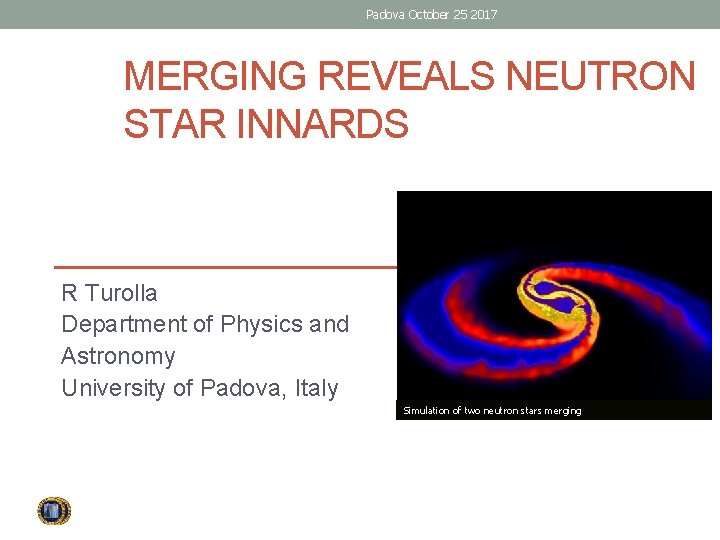
Padova October 25 2017 MERGING REVEALS NEUTRON STAR INNARDS R Turolla Department of Physics and Astronomy University of Padova, Italy Simulation of two neutron stars merging
Padova October 25 2017 Basics • Compact objects, i. e. neutron stars and black holes, are born in the core collapse following a supernova (SN) explosion • Present rate of SN events in the Galaxy: ≈ 0. 01/yr (possibly higher in the past) • Galactic population of compact objects: ≈ 108 – 109 (≈ 1% of stars) • Nature of compact remnant depends on progenitor mass
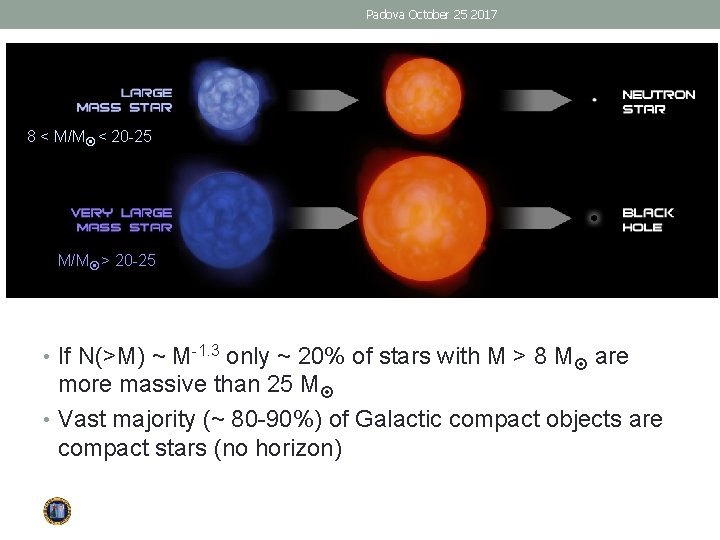
Padova October 25 2017 8 < M/M < 20 -25 M/M > 20 -25 • If N(>M) ~ M-1. 3 only ~ 20% of stars with M > 8 M are more massive than 25 M • Vast majority (~ 80 -90%) of Galactic compact objects are compact stars (no horizon)
Padova October 25 2017 Neutron Stars in a Nutshell • Why neutrons ? • Because of the huge density electrons are completely degenerate • Their Fermi energy becomes larger than p-n mass difference, Q ~ 1. 29 Me. V • Electron capture e-+p → n+ν is energetically favourable at ρ > 107 g/cm 3, or R < 104 km for M ~ 1 M • Typical radius R ≈ 10 km, masses 0. 1 < M/M < 3 (theoretical estimates) • Highly relativistic objects • Huge compactness, M/R ~ 0. 15 (M/M )(R/10 km)-1 • Large specific angular momentum, J/M ~ 0. 25 (1 ms/P) (M/M )(R/10 km)2
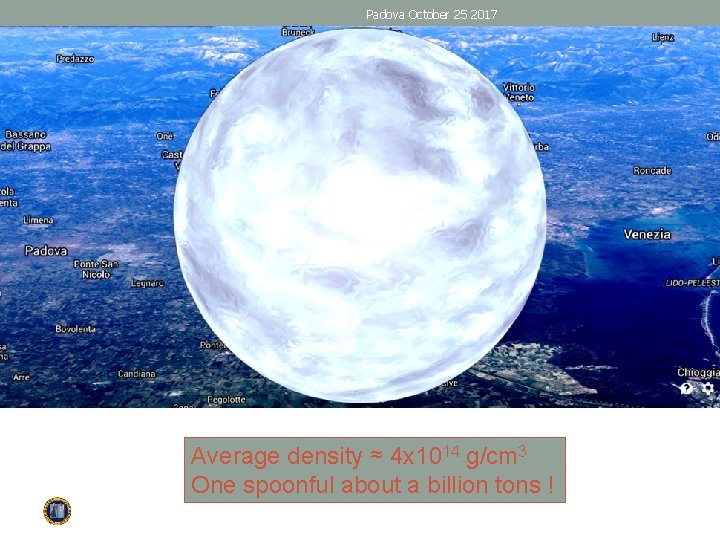
Padova October 25 2017 Average density ≈ 4 x 10¹⁴ g/cm 3 One spoonful about a billion tons !

Padova October 25 2017 Neutron Star Structure Spherically symmetric space-time Hydrostatic equilibrium (TOV) Gravitational mass Einstein equation
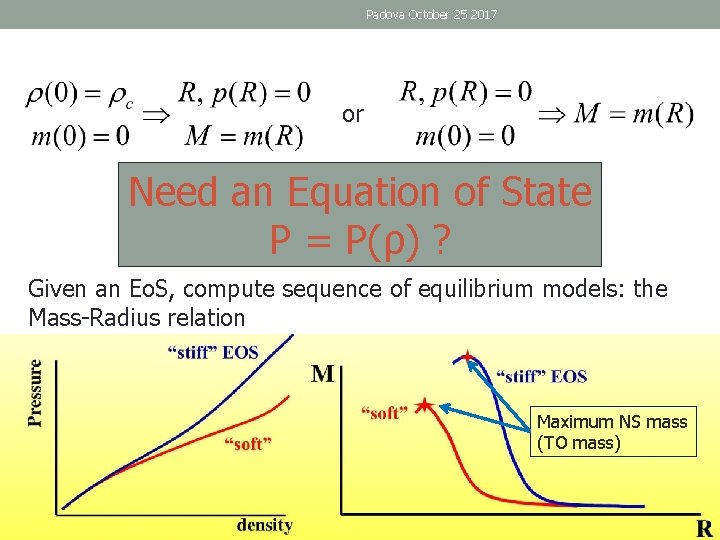
Padova October 25 2017 or Need an Equation of State P = P(ρ) ? Given an Eo. S, compute sequence of equilibrium models: the Mass-Radius relation Maximum NS mass (TO mass)
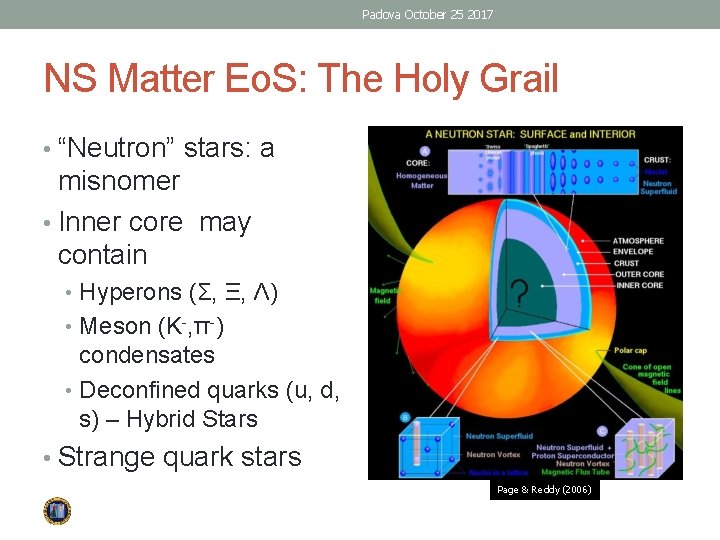
Padova October 25 2017 NS Matter Eo. S: The Holy Grail • “Neutron” stars: a misnomer • Inner core may contain • Hyperons (Σ, Ξ, Λ) • Meson (K-, π-) condensates • Deconfined quarks (u, d, s) – Hybrid Stars • Strange quark stars Page & Reddy (2006)
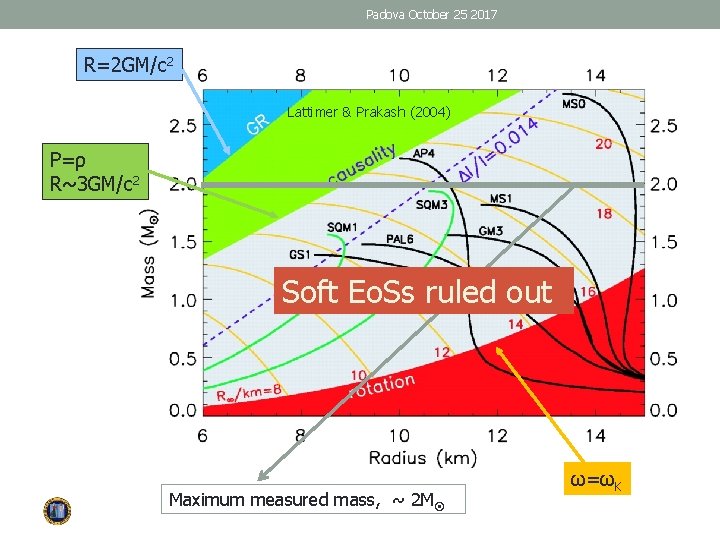
Padova October 25 2017 R=2 GM/c 2 Lattimer & Prakash (2004) P=ρ R~3 GM/c 2 Soft Eo. Ss ruled out Maximum measured mass, ~ 2 M ω=ωK
Padova October 25 2017 NSs in Binaries • Majority of stars are in binary or multiple systems • A binary initially formed by two massive stars may survive the double SN event and form a NS+NS system • Eight presently known in the Galaxy, including the Hulse-Taylor binary (first indirect evidence for GWs) and the double pulsar PSR J 0737− 3039 • Allow a very precise determination of NS masses
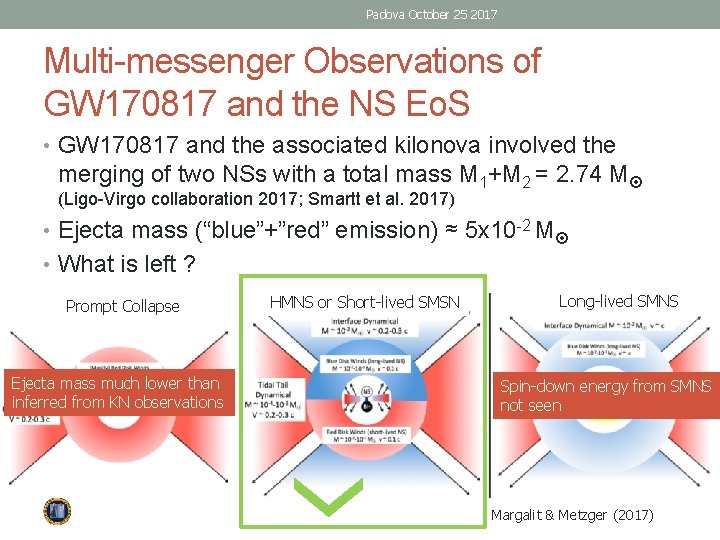
Padova October 25 2017 Multi-messenger Observations of GW 170817 and the NS Eo. S • GW 170817 and the associated kilonova involved the merging of two NSs with a total mass M 1+M 2 = 2. 74 M (Ligo-Virgo collaboration 2017; Smartt et al. 2017) • Ejecta mass (“blue”+”red” emission) ≈ 5 x 10 -2 M • What is left ? Prompt Collapse Ejecta mass much lower than inferred from KN observations HMNS or Short-lived SMSN Long-lived SMNS Spin-down energy from SMNS not seen Margalit & Metzger (2017)
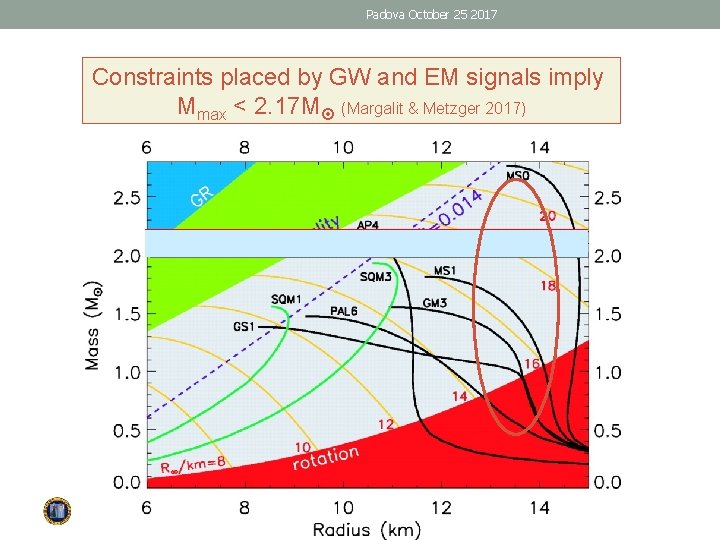
Padova October 25 2017 Constraints placed by GW and EM signals imply Mmax < 2. 17 M (Margalit & Metzger 2017)
- Slides: 12