
PADME project at DAFNE BTF Mauro Raggi Laboratori
PADME project at DAFNE BTF Mauro Raggi Laboratori Nazionali di Frascati PADME kick-off Meeting Frascati, 20 -21 April 2015 PADME website http: //www. lnf. infn. it/acceleratori/padme/index. html
Outline Positron Annihilation into Dark Matter Experiment PADME proposal Beam conditions and the Target The electromagnetic calorimeter The dipole magnet The spectrometer The Vacuum chamber Analysis technique for annihilation production Signal selection criteria Positron flux measurement Limit evaluation Conclusion and prospects M. Raggi PADME kick-off Meering Frascati 20 -21/04/15 2
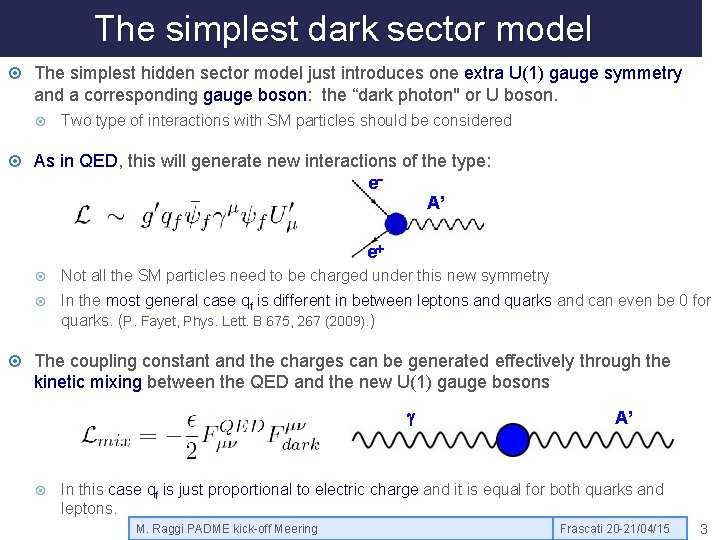
The simplest dark sector model The simplest hidden sector model just introduces one extra U(1) gauge symmetry and a corresponding gauge boson: the “dark photon" or U boson. Two type of interactions with SM particles should be considered As in QED, this will generate new interactions of the type: e. A’ e+ Not all the SM particles need to be charged under this new symmetry In the most general case qf is different in between leptons and quarks and can even be 0 for quarks. (P. Fayet, Phys. Lett. B 675, 267 (2009). ) The coupling constant and the charges can be generated effectively through the kinetic mixing between the QED and the new U(1) gauge bosons g A’ In this case qf is just proportional to electric charge and it is equal for both quarks and leptons. M. Raggi PADME kick-off Meering Frascati 20 -21/04/15 3
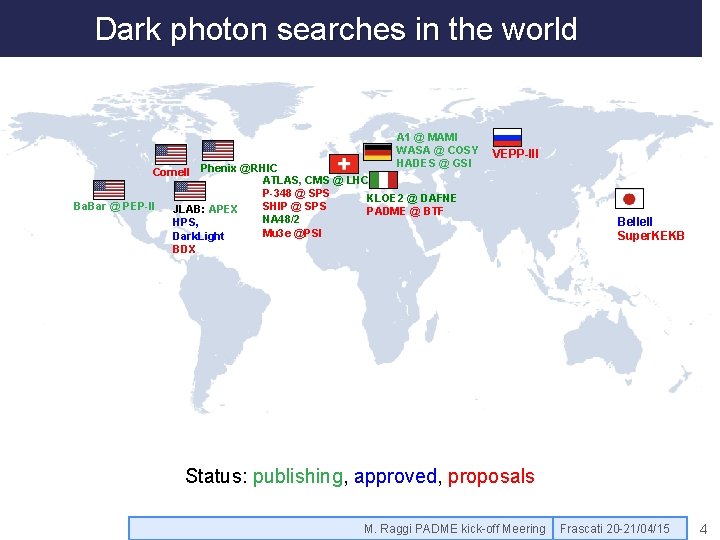
Dark photon searches in the world A 1 @ MAMI WASA @ COSY HADES @ GSI VEPP-III Cornell Phenix @RHIC ATLAS, CMS @ LHC P-348 @ SPS KLOE 2 @ DAFNE SHIP @ SPS Ba. Bar @ PEP-II JLAB: APEX PADME @ BTF NA 48/2 HPS, Mu 3 e @PSI Dark. Light BDX Belle. II Super. KEKB Status: publishing, approved, proposals M. Raggi PADME kick-off Meering Frascati 20 -21/04/15 4
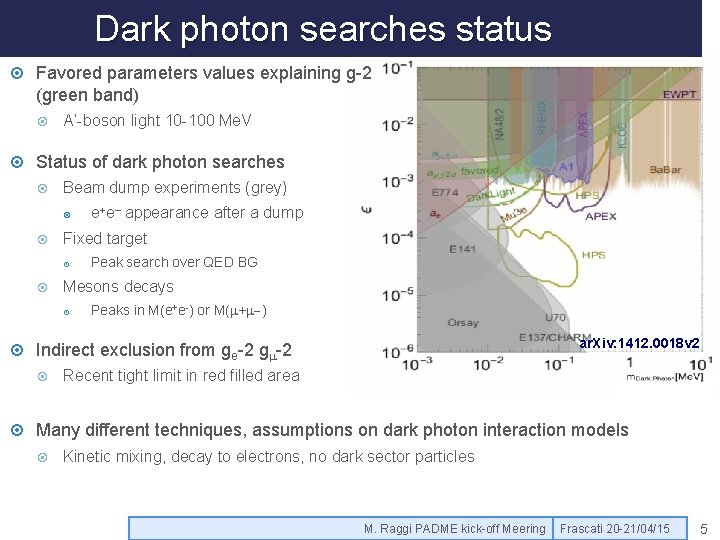
Dark photon searches status Favored parameters values explaining g-2 (green band) A’-boson light 10 -100 Me. V Status of dark photon searches Beam dump experiments (grey) Fixed target e+e- appearance after a dump Peak search over QED BG Mesons decays Peaks in M(e+e-) or M(m+m-) ar. Xiv: 1412. 0018 v 2 Indirect exclusion from ge-2 gm-2 Recent tight limit in red filled area Many different techniques, assumptions on dark photon interaction models Kinetic mixing, decay to electrons, no dark sector particles M. Raggi PADME kick-off Meering Frascati 20 -21/04/15 5
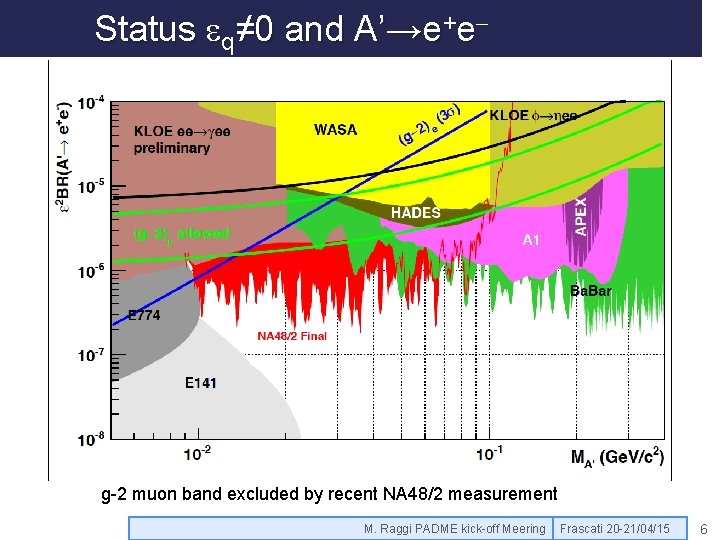
Status eq≠ 0 and A’→e+e- g-2 muon band excluded by recent NA 48/2 measurement M. Raggi PADME kick-off Meering Frascati 20 -21/04/15 6
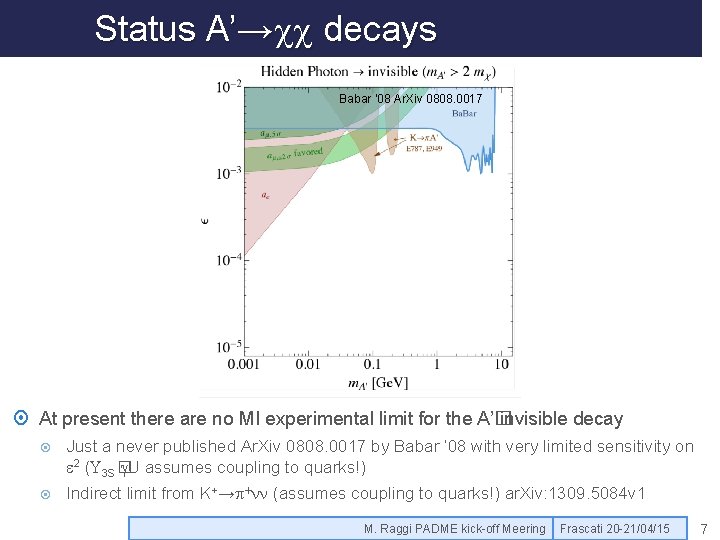
Status A’→cc decays Babar ’ 08 Ar. Xiv 0808. 0017 At present there are no MI experimental limit for the A’� invisible decay Just a never published Ar. Xiv 0808. 0017 by Babar ‘ 08 with very limited sensitivity on e 2 (U 3 S� g. U assumes coupling to quarks!) Indirect limit from K+→p+nn (assumes coupling to quarks!) ar. Xiv: 1309. 5084 v 1 M. Raggi PADME kick-off Meering Frascati 20 -21/04/15 7
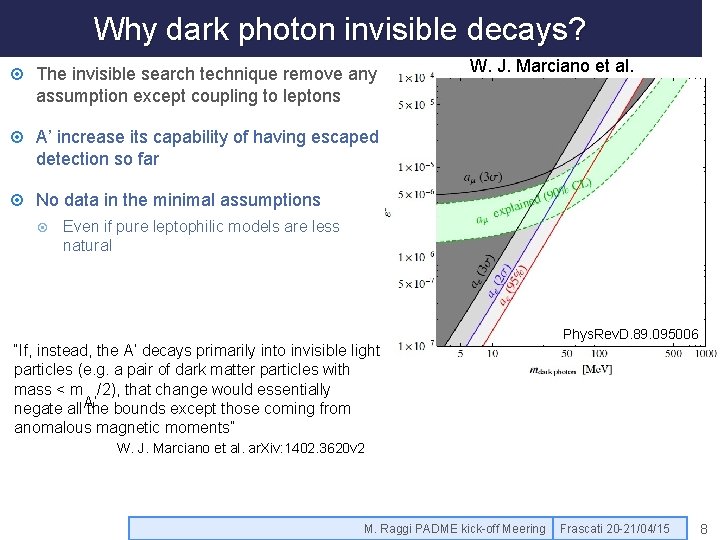
Why dark photon invisible decays? The invisible search technique remove any assumption except coupling to leptons W. J. Marciano et al. A’ increase its capability of having escaped detection so far No data in the minimal assumptions Even if pure leptophilic models are less natural “If, instead, the A’ decays primarily into invisible light particles (e. g. a pair of dark matter particles with mass < m /2), that change would essentially negate all. A’ the bounds except those coming from anomalous magnetic moments” Phys. Rev. D. 89. 095006 W. J. Marciano et al. ar. Xiv: 1402. 3620 v 2 M. Raggi PADME kick-off Meering Frascati 20 -21/04/15 8
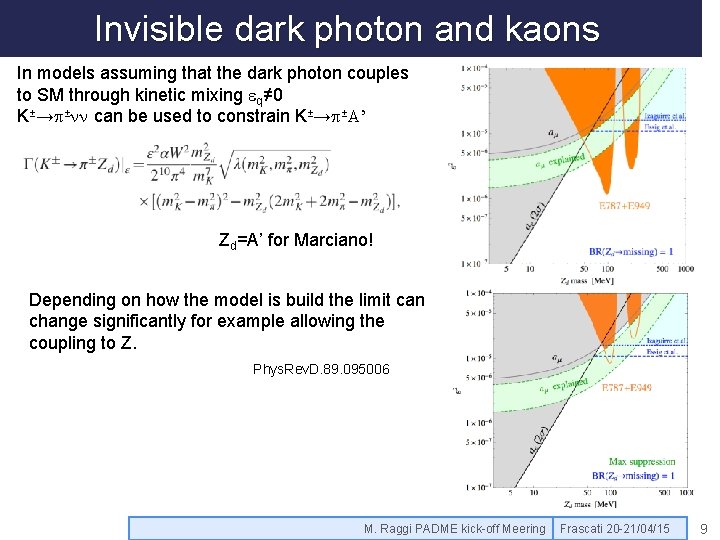
Invisible dark photon and kaons In models assuming that the dark photon couples to SM through kinetic mixing eq≠ 0 K±→p±nn can be used to constrain K±→p±A’ Zd=A’ for Marciano! Depending on how the model is build the limit can change significantly for example allowing the coupling to Z. Phys. Rev. D. 89. 095006 M. Raggi PADME kick-off Meering Frascati 20 -21/04/15 9
The PADME approach At present all experimental results rely on at least one of the following model dependent assumptions: A’ decays to e+e- (visible decay assumption BR(A’→e+e- = 1) A’ couples with the same strength to all fermions (eq= el) (kinetic mixing) In the most general scenario (PADME) A’ can decay to dark sector particles lighter than the A’ BR(A’→e+e- <<1) Dump and meson decay experiment only limit e 2 BR(A’→e+e- <<1) A’ can couple to quark with a coupling constant smaller el or even 0 Suppressed or no production at hadronic machines and in mesons decays PADME aims to detect A’ produced in e+e- annihilation and decaying into invisible by searching for missing mass in e+e-→g. A’ A’→cc No assumption on the A’ decays products and coupling to quarks Only minimal assumption: A’ bosons couples to leptons PAMDE will limits the coupling of any new light particle produced in e+e- collision (scalars (Hd), vectors (A’ and Zd)) M. Raggi PADME kick-off Meering Frascati 20 -21/04/15 10
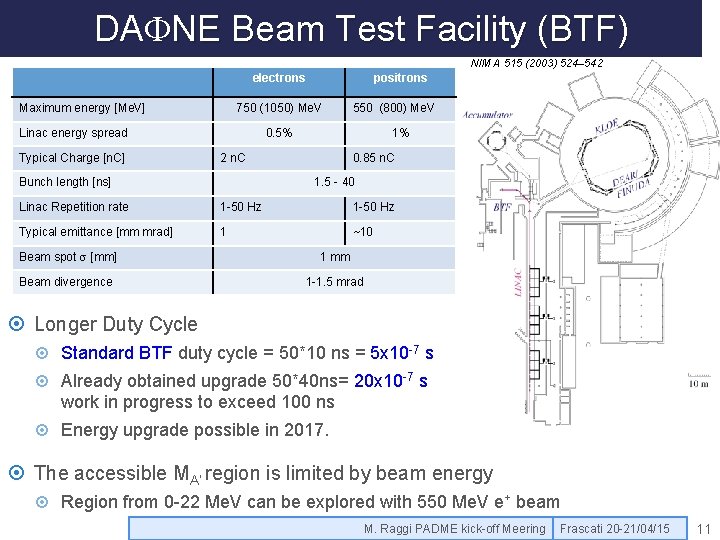
DAFNE Beam Test Facility (BTF) NIM A 515 (2003) 524– 542 electrons Maximum energy [Me. V] 750 (1050) Me. V Linac energy spread Typical Charge [n. C] positrons 550 (800) Me. V 0. 5% 1% 2 n. C Bunch length [ns] 0. 85 n. C 1. 5 - 40 Linac Repetition rate 1 -50 Hz Typical emittance [mm mrad] 1 ~10 Beam spot s [mm] 1 mm Beam divergence 1 -1. 5 mrad Longer Duty Cycle Standard BTF duty cycle = 50*10 ns = 5 x 10 -7 s Already obtained upgrade 50*40 ns= 20 x 10 -7 s work in progress to exceed 100 ns Energy upgrade possible in 2017. The accessible MA’ region is limited by beam energy Region from 0 -22 Me. V can be explored with 550 Me. V e+ beam M. Raggi PADME kick-off Meering Frascati 20 -21/04/15 11
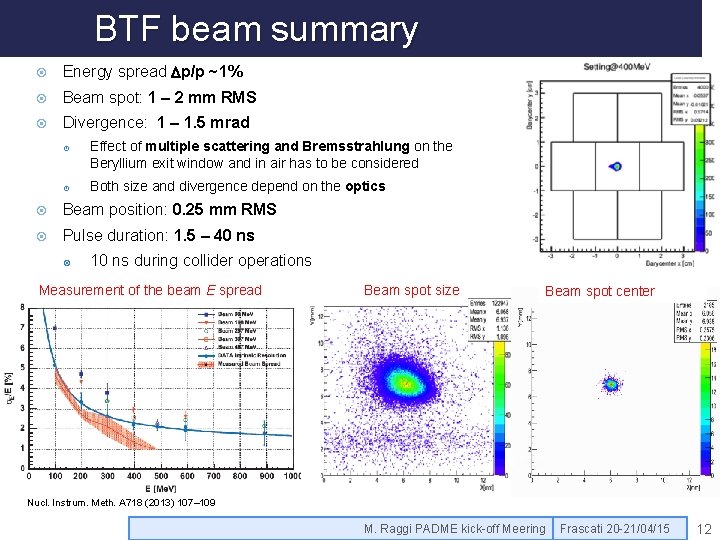
BTF beam summary Energy spread Dp/p ~1% Beam spot: 1 – 2 mm RMS Divergence: 1 – 1. 5 mrad Effect of multiple scattering and Bremsstrahlung on the Beryllium exit window and in air has to be considered Both size and divergence depend on the optics Beam position: 0. 25 mm RMS Pulse duration: 1. 5 – 40 ns 10 ns during collider operations Measurement of the beam E spread Beam spot size Beam spot center Beam E spread Nucl. Instrum. Meth. A 718 (2013) 107– 109 M. Raggi PADME kick-off Meering Frascati 20 -21/04/15 12
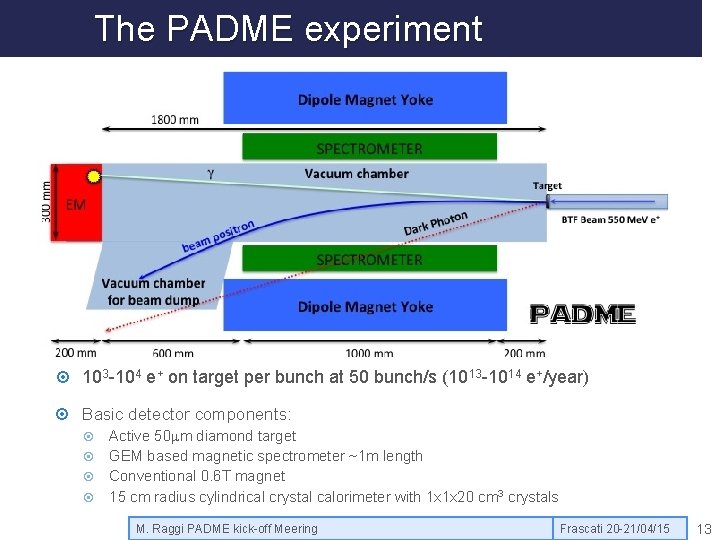
The PADME experiment 103 -104 e+ on target per bunch at 50 bunch/s (1013 -1014 e+/year) Basic detector components: Active 50 mm diamond target GEM based magnetic spectrometer ~1 m length Conventional 0. 6 T magnet 1. 75 m 15 cm radius cylindrical crystal calorimeter with 1 x 1 x 20 cm 3 crystals M. Raggi PADME kick-off Meering Frascati 20 -21/04/15 13
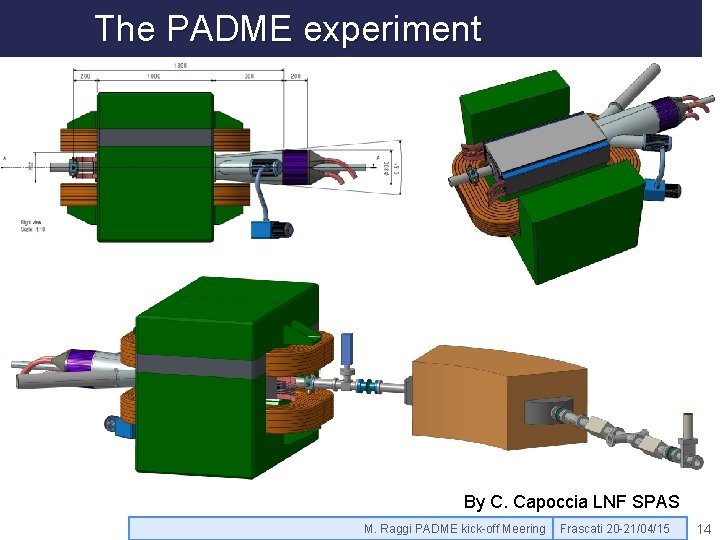
The PADME experiment By C. Capoccia LNF SPAS M. Raggi PADME kick-off Meering Frascati 20 -21/04/15 14
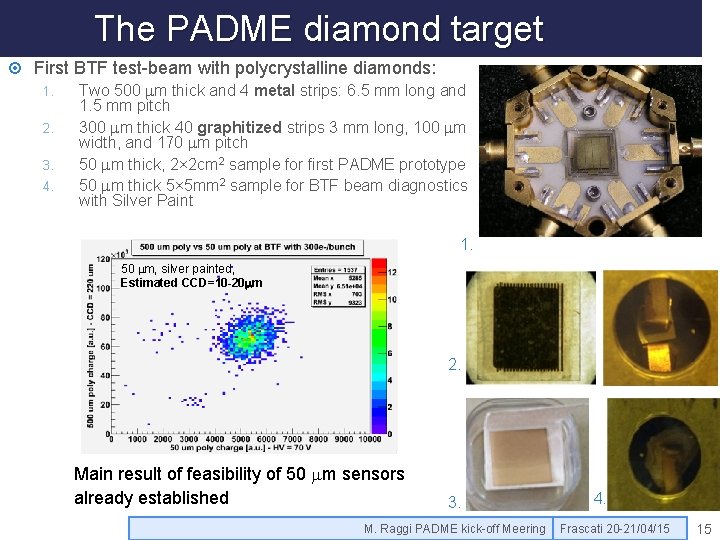
The PADME diamond target First BTF test-beam with polycrystalline diamonds: 1. 2. 3. 4. Two 500 mm thick and 4 metal strips: 6. 5 mm long and 1. 5 mm pitch 300 mm thick 40 graphitized strips 3 mm long, 100 mm width, and 170 mm pitch 50 mm thick, 2× 2 cm 2 sample for first PADME prototype 50 mm thick 5× 5 mm 2 sample for BTF beam diagnostics with Silver Paint 1. 50 mm, silver painted, Estimated CCD=10 -20 mm 2. Main result of feasibility of 50 mm sensors already established 3. M. Raggi PADME kick-off Meering 4. Frascati 20 -21/04/15 15
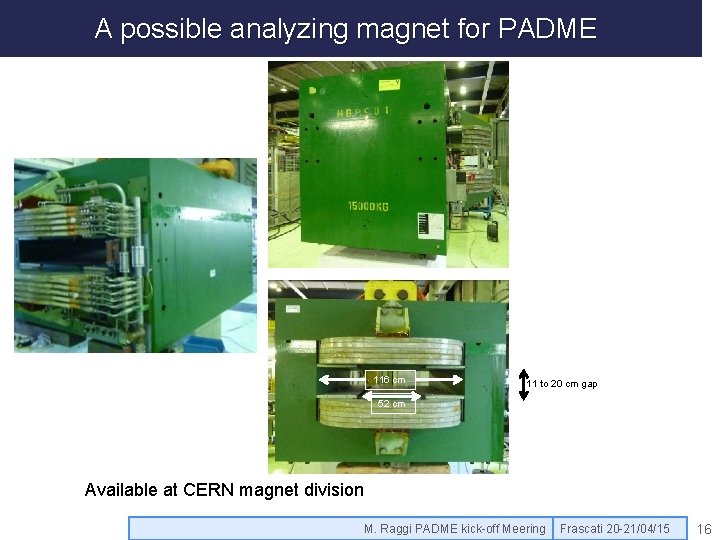
A possible analyzing magnet for PADME 116 cm 11 to 20 cm gap 52 cm Available at CERN magnet division M. Raggi PADME kick-off Meering Frascati 20 -21/04/15 16
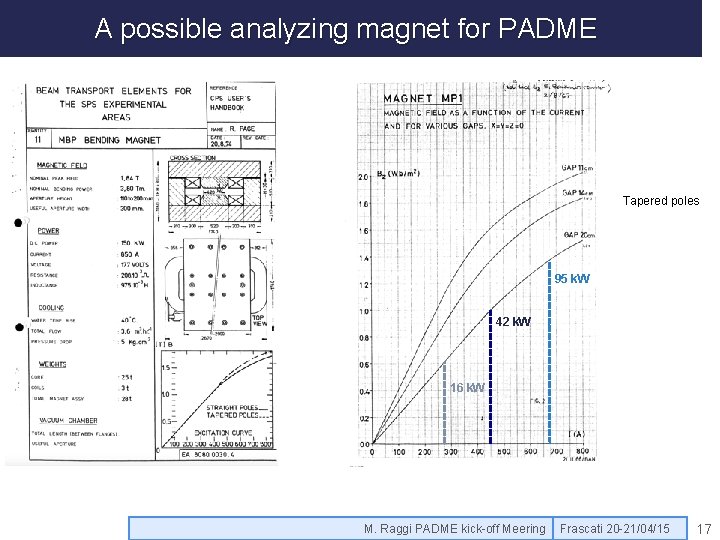
A possible analyzing magnet for PADME Tapered poles 95 k. W 42 k. W 16 k. W M. Raggi PADME kick-off Meering Frascati 20 -21/04/15 17
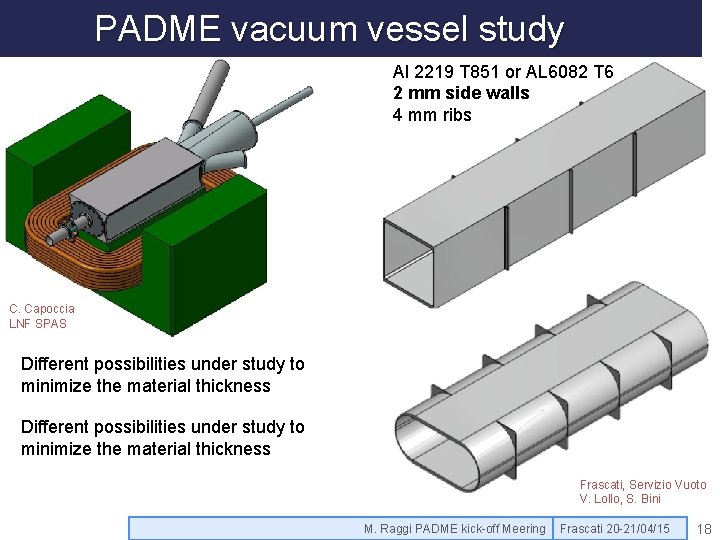
PADME vacuum vessel study Al 2219 T 851 or AL 6082 T 6 2 mm side walls 4 mm ribs C. Capoccia LNF SPAS Different possibilities under study to minimize the material thickness Frascati, Servizio Vuoto V. Lollo, S. Bini M. Raggi PADME kick-off Meering Frascati 20 -21/04/15 18
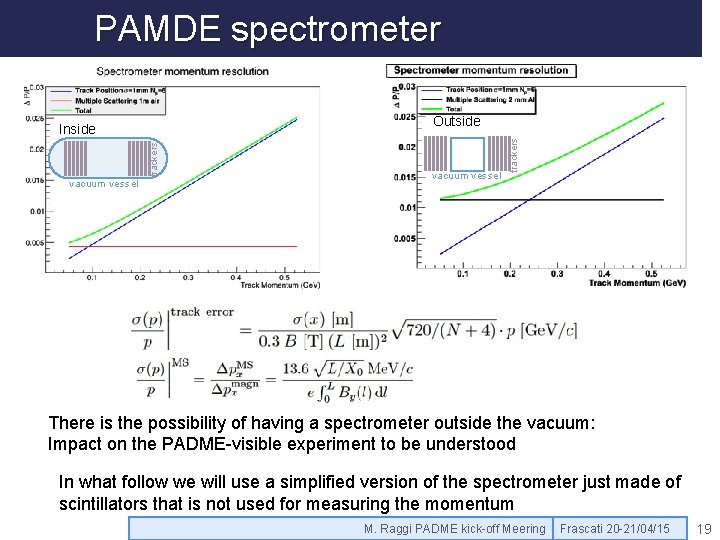
PAMDE spectrometer trackers vacuum vessel trackers Outside Inside There is the possibility of having a spectrometer outside the vacuum: Impact on the PADME-visible experiment to be understood In what follow we will use a simplified version of the spectrometer just made of scintillators that is not used for measuring the momentum M. Raggi PADME kick-off Meering Frascati 20 -21/04/15 19
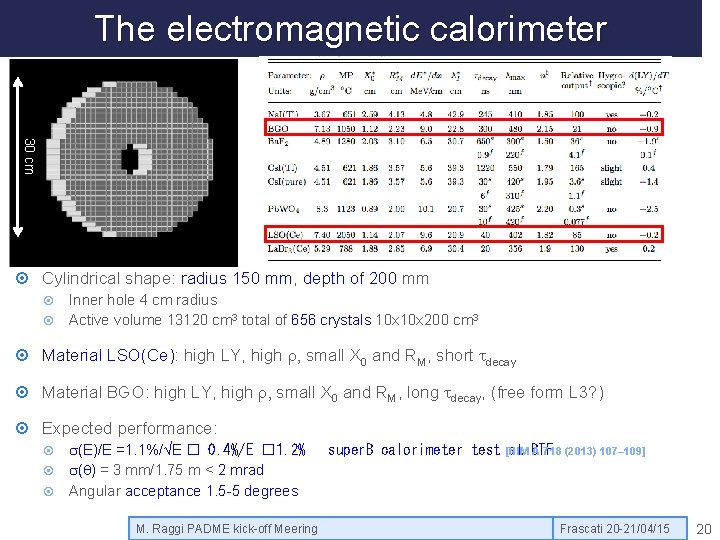
The electromagnetic calorimeter 30 cm Cylindrical shape: radius 150 mm, depth of 200 mm Inner hole 4 cm radius Active volume 13120 cm 3 total of 656 crystals 10 x 200 cm 3 Material LSO(Ce): high LY, high r, small X 0 and RM, short tdecay Material BGO: high LY, high r, small X 0 and RM, long tdecay, (free form L 3? ) Expected performance: s(E)/E =1. 1%/√E � 0. 4%/E � 1. 2% s(q) = 3 mm/1. 75 m < 2 mrad Angular acceptance 1. 5 -5 degrees M. Raggi PADME kick-off Meering super. B calorimeter test [NIM at BTF A 718 (2013) 107– 109] Frascati 20 -21/04/15 20
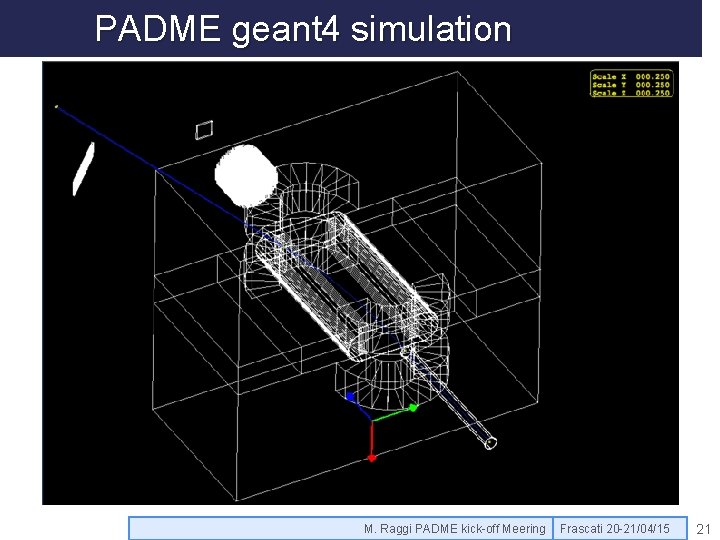
PADME geant 4 simulation M. Raggi PADME kick-off Meering Frascati 20 -21/04/15 21
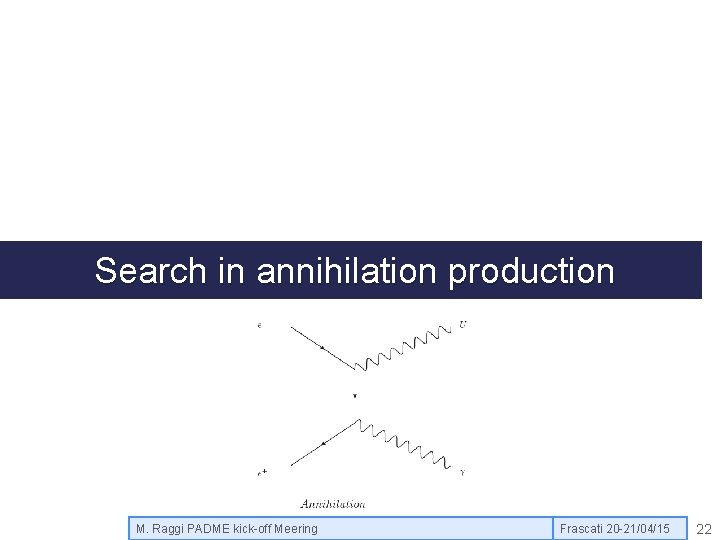
Search in annihilation production M. Raggi PADME kick-off Meering Frascati 20 -21/04/15 22
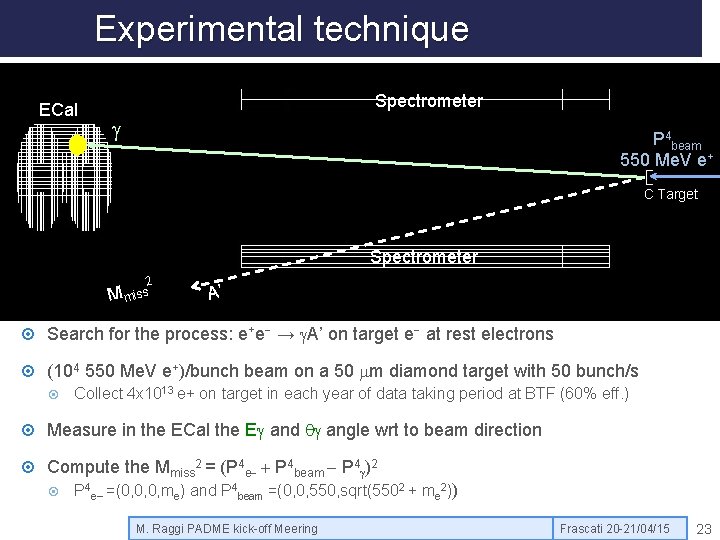
Experimental technique ECal Spectrometer g P 4 beam 550 Me. V e+ C Target Spectrometer 2 s s i Mm A’ Search for the process: e+e- → g. A’ on target e- at rest electrons (104 550 Me. V e+)/bunch beam on a 50 mm diamond target with 50 bunch/s Collect 4 x 10¹³ e+ on target in each year of data taking period at BTF (60% eff. ) Measure in the ECal the Eg and qg angle wrt to beam direction Compute the Mmiss 2 = (P 4 e- + P 4 beam - P 4 g)2 P 4 e- =(0, 0, 0, me) and P 4 beam =(0, 0, 550, sqrt(5502 + me 2)) M. Raggi PADME kick-off Meering Frascati 20 -21/04/15 23
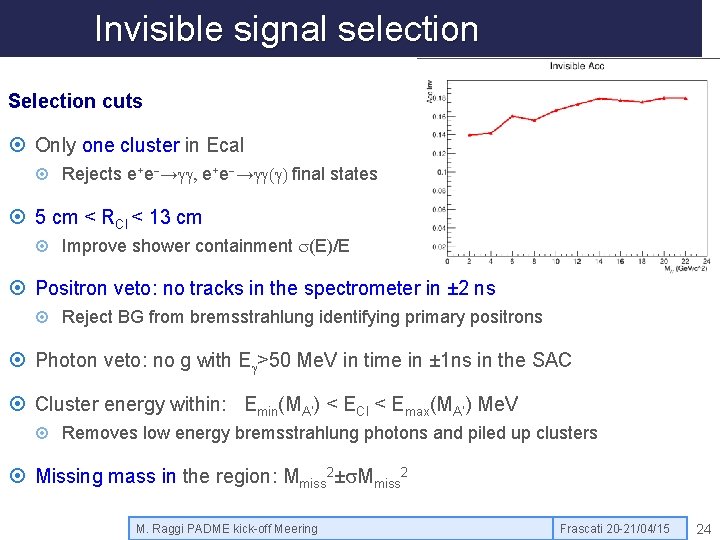
Invisible signal selection Selection cuts Only one cluster in Ecal Rejects e+e-→gg, e+e-→gg(g) final states 5 cm < RCl < 13 cm Improve shower containment s(E)/E Positron veto: no tracks in the spectrometer in ± 2 ns Reject BG from bremsstrahlung identifying primary positrons Photon veto: no g with Eg>50 Me. V in time in ± 1 ns in the SAC Cluster energy within: Emin(MA’) < ECl < Emax(MA’) Me. V Removes low energy bremsstrahlung photons and piled up clusters Missing mass in the region: Mmiss 2±s. Mmiss 2 M. Raggi PADME kick-off Meering Frascati 20 -21/04/15 24
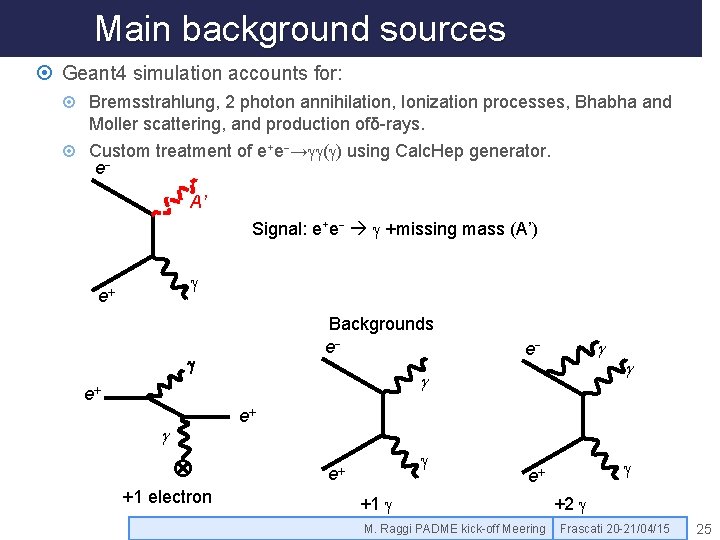
Main background sources Geant 4 simulation accounts for: Bremsstrahlung, 2 photon annihilation, Ionization processes, Bhabha and Moller scattering, and production ofδ-rays. Custom treatment of e+e-→gg(g) using Calc. Hep generator. e. A’ Signal: e+e- g +missing mass (A’) g e+ Backgrounds e- g g e+ +1 electron g e- g e+ +1 g M. Raggi PADME kick-off Meering +2 g Frascati 20 -21/04/15 25
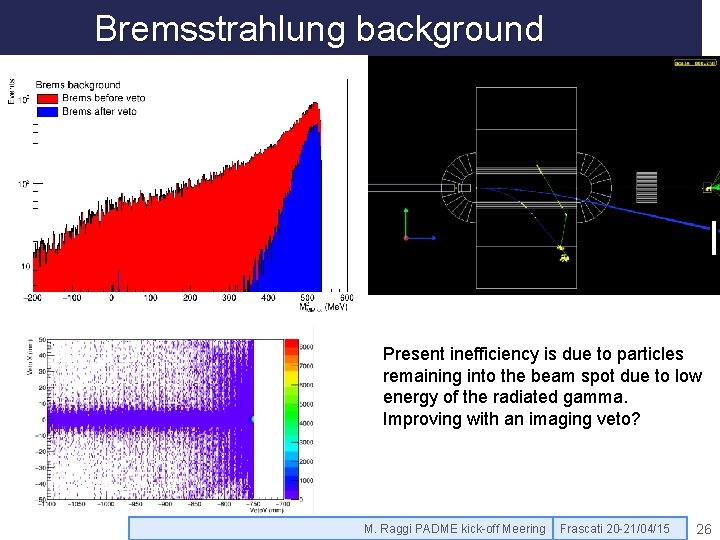
Bremsstrahlung background Present inefficiency is due to particles remaining into the beam spot due to low energy of the radiated gamma. Improving with an imaging veto? M. Raggi PADME kick-off Meering Frascati 20 -21/04/15 26
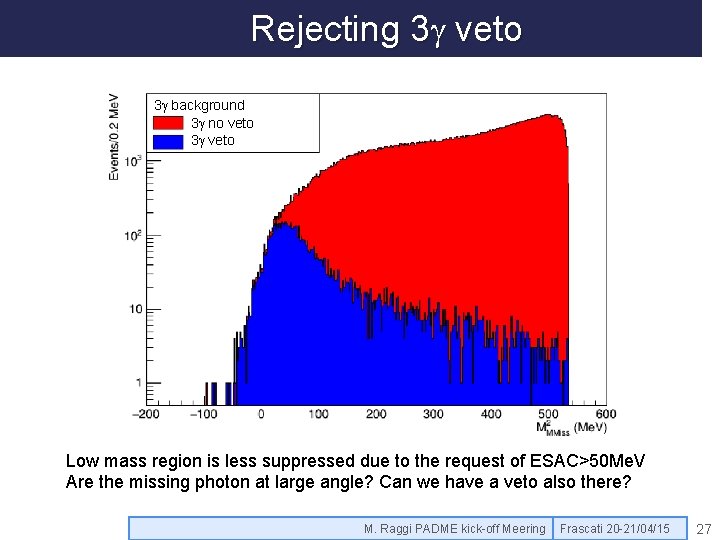
Rejecting 3 g veto 3 g background 3 g no veto 3 g veto Low mass region is less suppressed due to the request of ESAC>50 Me. V Are the missing photon at large angle? Can we have a veto also there? M. Raggi PADME kick-off Meering Frascati 20 -21/04/15 27
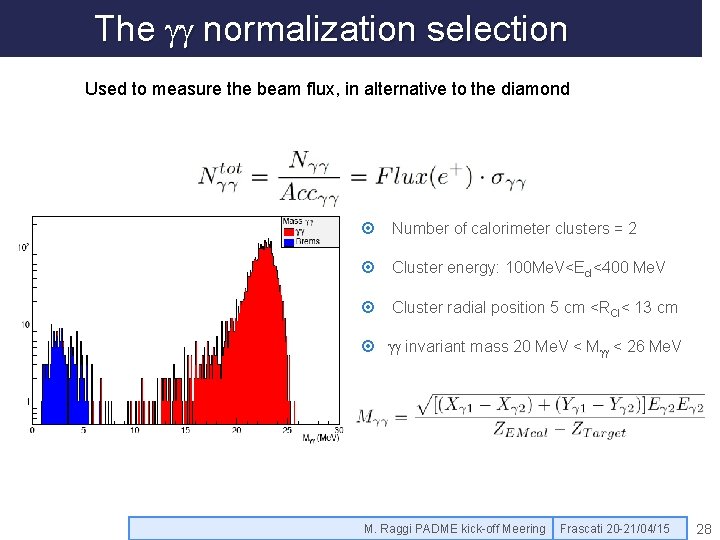
The gg normalization selection Used to measure the beam flux, in alternative to the diamond Number of calorimeter clusters = 2 Cluster energy: 100 Me. V<Ecl<400 Me. V Cluster radial position 5 cm <RCl< 13 cm gg invariant mass 20 Me. V < Mgg < 26 Me. V M. Raggi PADME kick-off Meering Frascati 20 -21/04/15 28
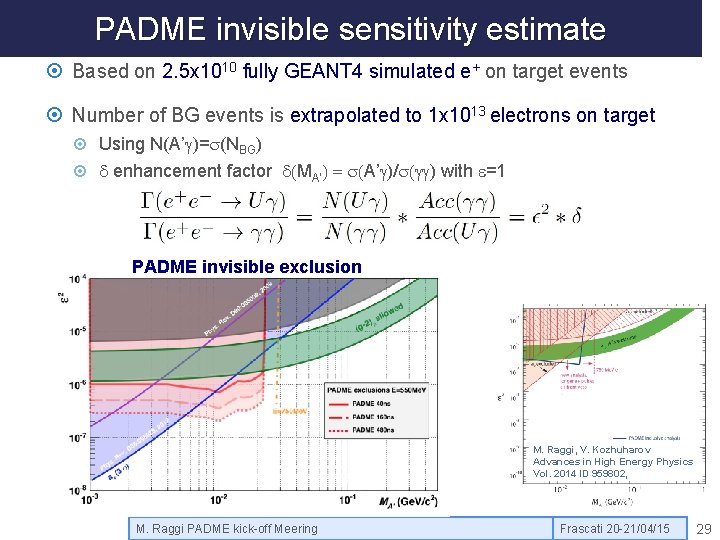
PADME invisible sensitivity estimate Based on 2. 5 x 10¹⁰ fully GEANT 4 simulated e+ on target events Number of BG events is extrapolated to 1 x 10¹³ electrons on target Using N(A’g)=s(NBG) d enhancement factor d(MA’) = s(A’g)/s(gg) with e=1 PADME invisible exclusion M. Raggi, V. Kozhuharov Advances in High Energy Physics Vol. 2014 ID 959802, M. Raggi PADME kick-off Meering Frascati 20 -21/04/15 29
Limiting factors to sensitivity The limiting factor to the present sensitivity are: The 50 Hz repetition rate of the linac (coupling) The energy of the linac (mass) The efficiency of the positron veto due to beam spot and energy spread Gamma veto for low energy. Possible improvements Smaller beam energy spread (0. 25% is not out of reach) Smaller spot size (0. 5 mm is in within reach) Energy up to 1 Ge. V is technically possible M. Raggi PADME kick-off Meering Frascati 20 -21/04/15 30
PADME project plans Project has been presented as a “What Next” Project in INFN CSN 1 The project has received positive comments form CSN 1 referees Proposal for R&D financing will be discussed in the July CSN 1 meeting Proto collaboration formed including LNF, Rome 1, Lecce and Sofia university 6 weeks test beam time asked at DAFNE BTF in 2015 Study the prototype of BGO calorimeter solution (L 3 crystals) Test diamond target prototypes Study the maximum beam current per bunch and beam spot size Optimize beam characteristics for PADME operation bunch length, number of particle per bunch, background, beam positioning stability M. Raggi PADME kick-off Meering Frascati 20 -21/04/15 31
Conclusions and plans An experiment running at DAFNE BTF sensitive to both A’→invisible and A’→e+e- decays has been proposed to INFN CSN 1 Exclusion limit in e 2 down to 1 -2・ 10 -6 can be achieved in invisible decays with the present BTF beam parameters in the region MA’ 2 -22 Me. V (28 with e+ energy 750 Me. V) M. Raggi and V. Kozhuharov, Advances in High Energy Physics Vol. 2014 ID 959802, Possible reduction of beam energy spread 0. 25% beam spot to 0. 5 x 0. 5 mm 2 and bunch width to the level of 500 ns will be desirable to back ground reduction and e 2 sensitivity region improvements. M. Raggi PADME kick-off Meering Frascati 20 -21/04/15 32
Welcome to the dark side 33
SPARE SLIDES M. Raggi PADME kick-off Meering Frascati 20 -21/04/15 34
- Slides: 34