
PACMAN study of FSI and triangulation for the
- Slides: 20
PACMAN study of FSI and µ-triangulation for the pre-alignment of CLIC Hélène MAINAUD DURAND
Agenda a study on Particle Accelerator Components’ Metrology and Alignment to the Nanometer scale Outline • PACMAN: • As a ITN program • Technical objectives • Development of FSI for PACMAN: • Introduction of FSI system • Current status • Developments foreseen • Development of µ-triangulation for PACMAN: • Introduction to µ-triangulation • Current status • Developments foreseen
PACMAN as a ITN Marie Curie action Provides EC funding for post-grads to participate in CERN project Initial Training Network • Improve career perspectives of Early Stage Researchers (ESR) in both public & private sectors • Make research careers more attractive Innovative Doctoral Program • • • Management at CERN 10 ESRs must be working towards a Ph. D Associated partners from industry and universities Secondment of at least 3 months in industry for each ESR
PACMAN as a ITN High quality training program • Training through research at CERN and at universities • Through secondments in the industrial partners • Scientific, academic and technological training courses organized by PACMAN • Transferable skills training courses 3 PACMAN workshops • First workshop: 02 -04 February 2015 setup the scenario • Plus a workshop on Intellectual Property and Technology Transfer foreseen in 2016. . Special emphasis put on women scientists dedicated outreach activities. . .
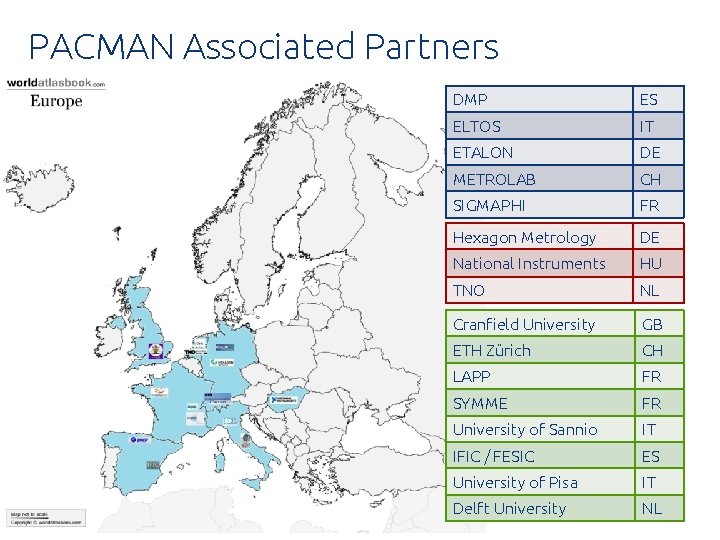
PACMAN Associated Partners DMP ES ELTOS IT ETALON DE METROLAB CH SIGMAPHI FR Hexagon Metrology DE National Instruments HU TNO NL Cranfield University GB ETH Zürich CH LAPP FR SYMME FR University of Sannio IT IFIC / FESIC ES University of Pisa IT Delft University NL
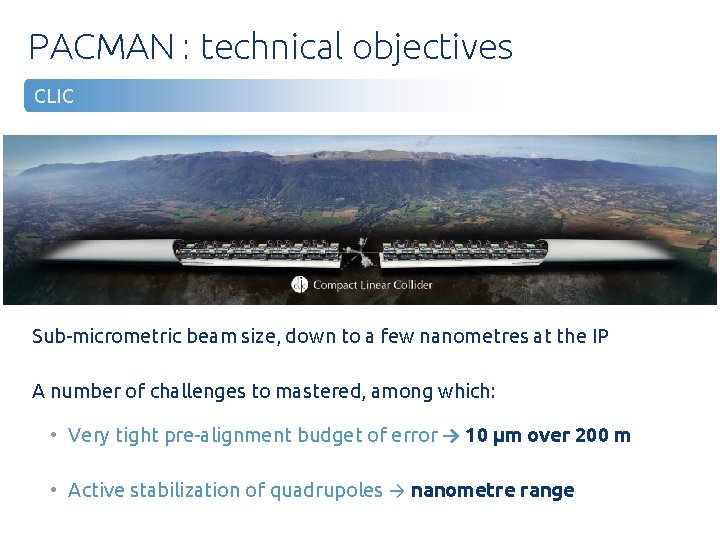
PACMAN : technical objectives CLIC Sub-micrometric beam size, down to a few nanometres at the IP A number of challenges to mastered, among which: • Very tight pre-alignment budget of error → 10 µm over 200 m • Active stabilization of quadrupoles → nanometre range
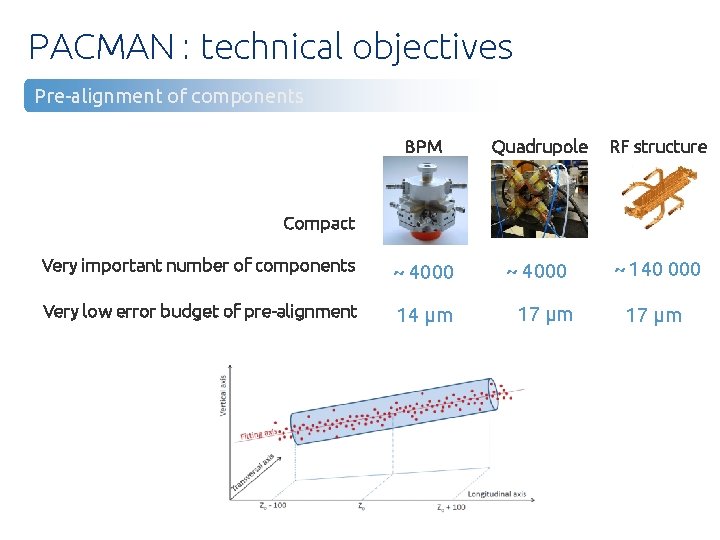
PACMAN : technical objectives Pre-alignment of components BPM Quadrupole RF structure Very important number of components ~ 4000 ~ 140 000 Very low error budget of pre-alignment 14 µm Compact 17 µm
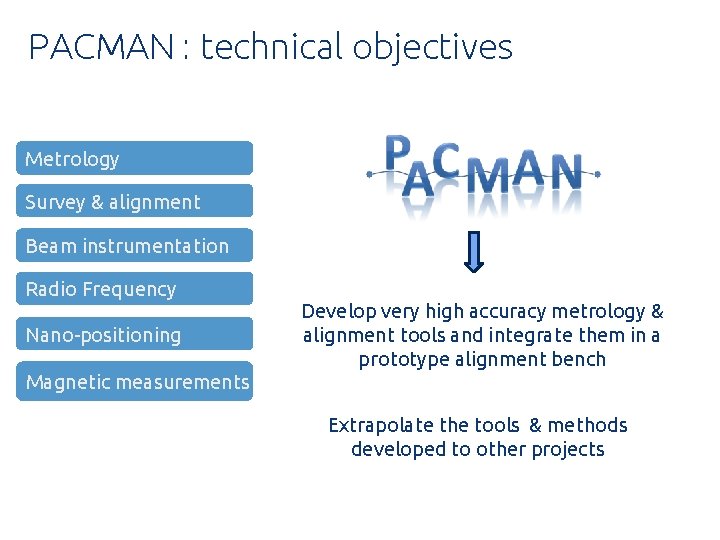
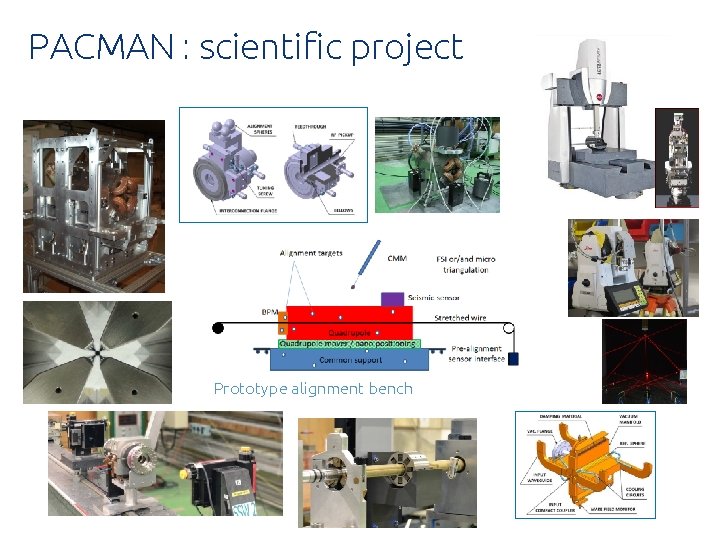
PACMAN : technical objectives Metrology Survey & alignment Beam instrumentation Radio Frequency Nano-positioning Develop very high accuracy metrology & alignment tools and integrate them in a prototype alignment bench Magnetic measurements Extrapolate the tools & methods developed to other projects
PACMAN : scientific project Prototype alignment bench
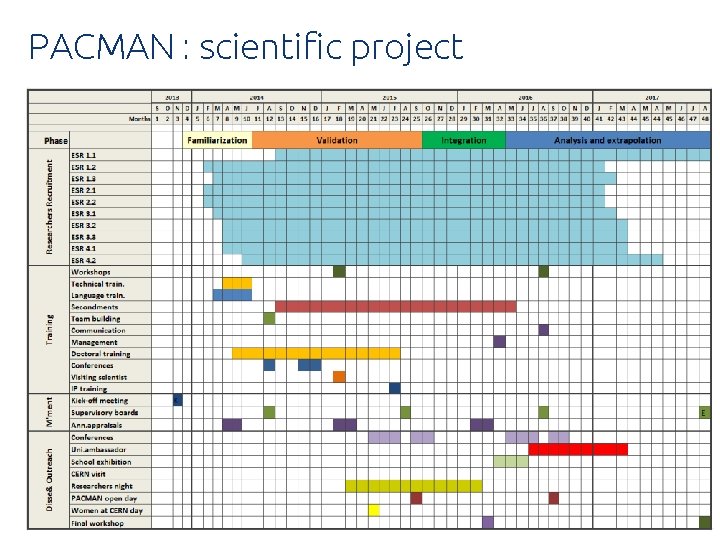
PACMAN : scientific project
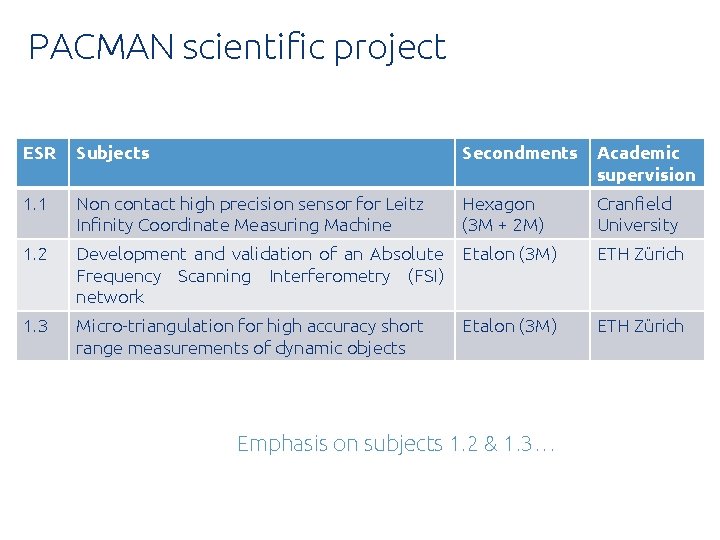
PACMAN scientific project ESR Subjects Secondments Academic supervision 1. 1 Non contact high precision sensor for Leitz Infinity Coordinate Measuring Machine Hexagon (3 M + 2 M) Cranfield University 1. 2 Development and validation of an Absolute Frequency Scanning Interferometry (FSI) network Etalon (3 M) ETH Zürich 1. 3 Micro-triangulation for high accuracy short range measurements of dynamic objects Etalon (3 M) ETH Zürich Emphasis on subjects 1. 2 & 1. 3…
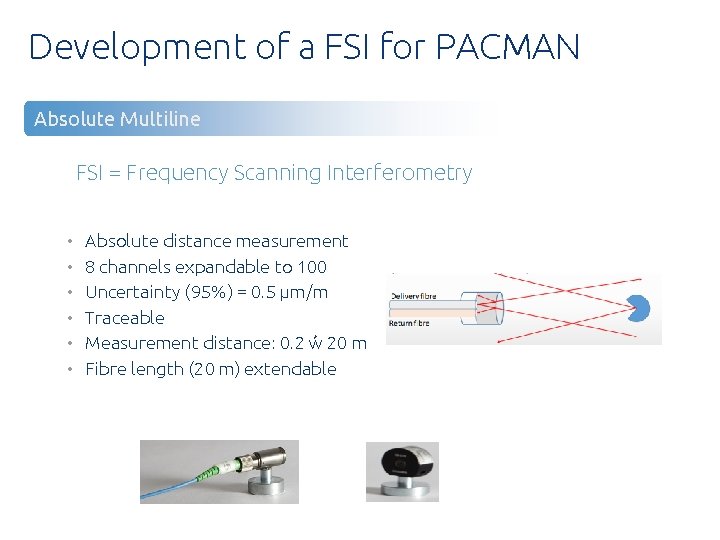
Development of a FSI for PACMAN Absolute Multiline FSI = Frequency Scanning Interferometry • • • Absolute distance measurement 8 channels expandable to 100 Uncertainty (95%) = 0. 5 µm/m Traceable Measurement distance: 0. 2 – 20 m Fibre length (20 m) extendable
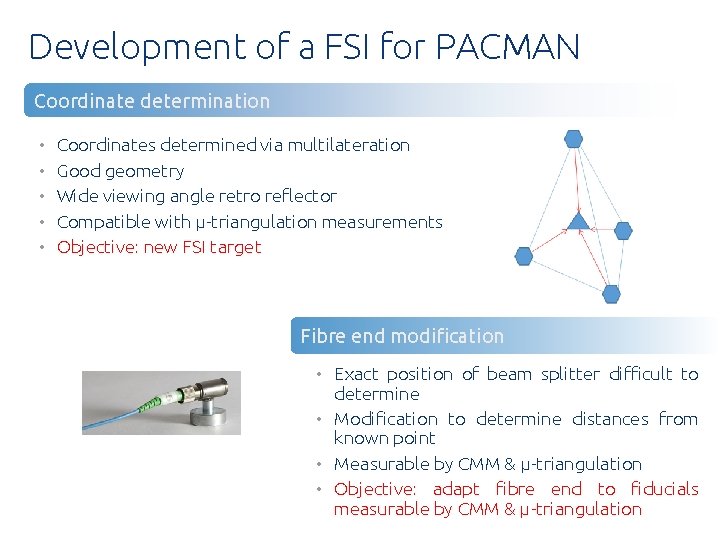
Development of a FSI for PACMAN Coordinate determination • • • Coordinates determined via multilateration Good geometry Wide viewing angle retro reflector Compatible with µ-triangulation measurements Objective: new FSI target Fibre end modification • Exact position of beam splitter difficult to determine • Modification to determine distances from known point • Measurable by CMM & µ-triangulation • Objective: adapt fibre end to fiducials measurable by CMM & µ-triangulation
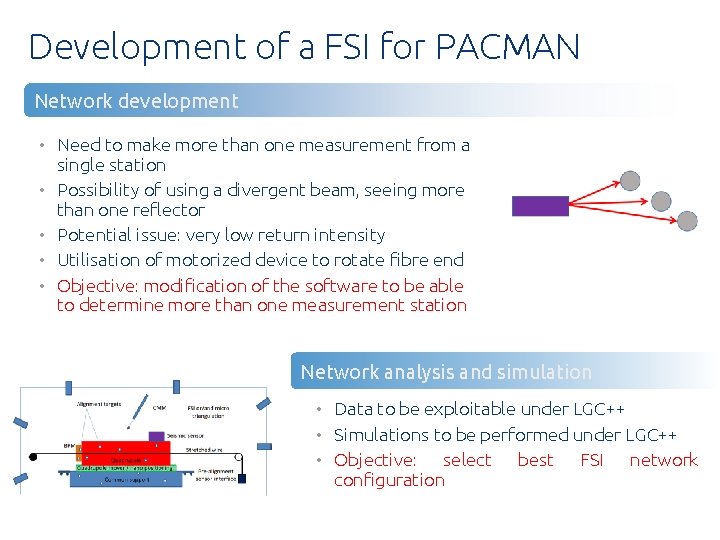
Development of a FSI for PACMAN Network development • Need to make more than one measurement from a single station • Possibility of using a divergent beam, seeing more than one reflector • Potential issue: very low return intensity • Utilisation of motorized device to rotate fibre end • Objective: modification of the software to be able to determine more than one measurement station Network analysis and simulation • Data to be exploitable under LGC++ • Simulations to be performed under LGC++ • Objective: select best FSI network configuration
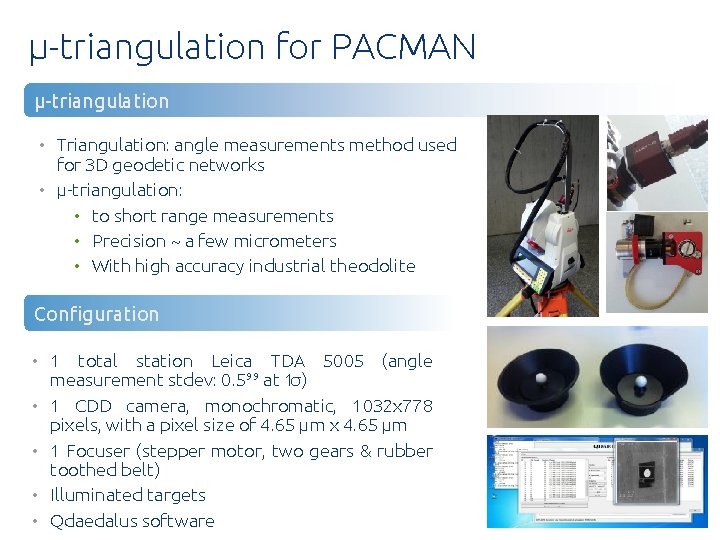
µ-triangulation for PACMAN µ-triangulation • Triangulation: angle measurements method used for 3 D geodetic networks • µ-triangulation: • to short range measurements • Precision ~ a few micrometers • With high accuracy industrial theodolite Configuration • 1 total station Leica TDA 5005 (angle measurement stdev: 0. 5’’ at 1σ) • 1 CDD camera, monochromatic, 1032 x 778 pixels, with a pixel size of 4. 65 µm x 4. 65 µm • 1 Focuser (stepper motor, two gears & rubber toothed belt) • Illuminated targets • Qdaedalus software
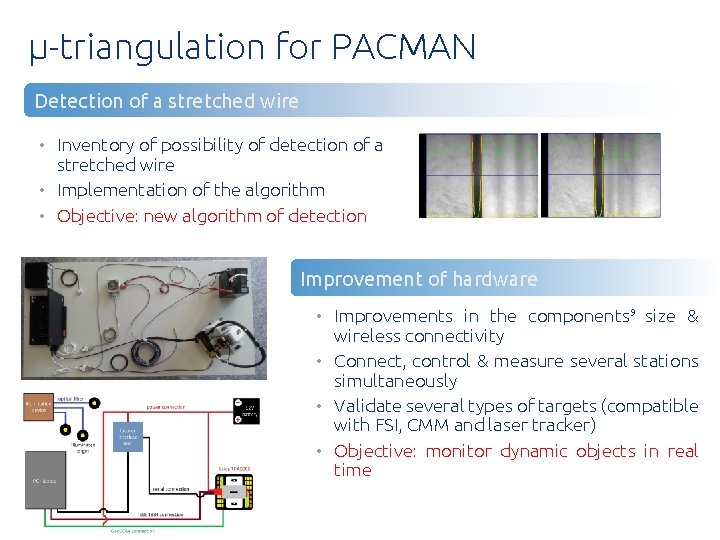
µ-triangulation for PACMAN Detection of a stretched wire • Inventory of possibility of detection of a stretched wire • Implementation of the algorithm • Objective: new algorithm of detection Improvement of hardware • Improvements in the components’ size & wireless connectivity • Connect, control & measure several stations simultaneously • Validate several types of targets (compatible with FSI, CMM and laser tracker) • Objective: monitor dynamic objects in real time
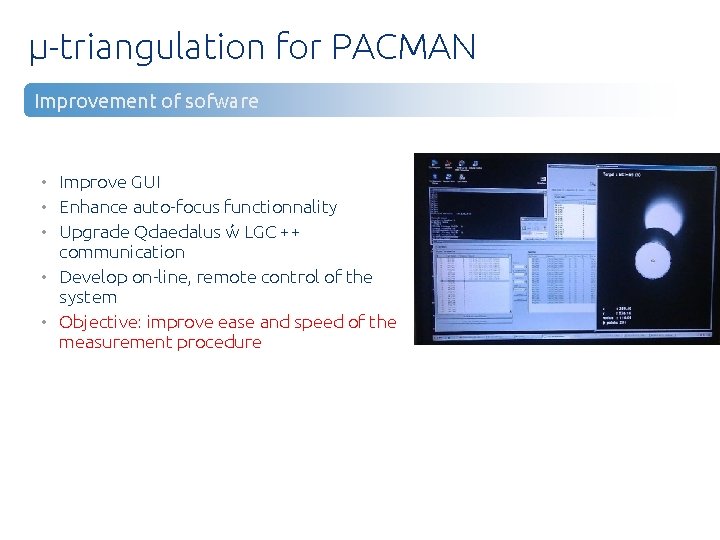
µ-triangulation for PACMAN Improvement of sofware • Improve GUI • Enhance auto-focus functionnality • Upgrade Qdaedalus – LGC ++ communication • Develop on-line, remote control of the system • Objective: improve ease and speed of the measurement procedure
µ-triangulation &FSI for PACMAN Strategy Upgrade of both technologies for PACMAN Inter-comparison • Between both on a dedicated mock-up → End of 2015 • With CMM measurements → mid 2016 Extrapolation towards a portable solution of measurement
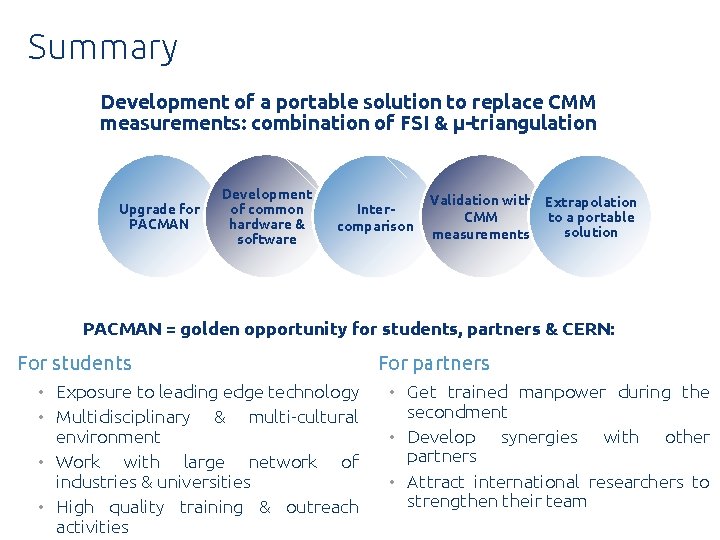
Summary Development of a portable solution to replace CMM measurements: combination of FSI & µ-triangulation Upgrade for PACMAN Development of common hardware & software Intercomparison Validation with Extrapolation to a portable CMM solution measurements PACMAN = golden opportunity for students, partners & CERN: For students • Exposure to leading edge technology • Multidisciplinary & multi-cultural environment • Work with large network of industries & universities • High quality training & outreach activities For partners • Get trained manpower during the secondment • Develop synergies with other partners • Attract international researchers to strengthen their team
Thank you very much