
Packet Transport Mechanisms for Data Center Networks Mohammad
![Data Center Workloads & Requirements • Partition/Aggregate (Query) • Short messages [50 KB-1 MB]](https://slidetodoc.com/presentation_image_h2/cfe953276da9a040efc05a375f583d49/image-13.jpg "Data Center Workloads & Requirements • Partition/Aggregate (Query) • Short messages [50 KB-1 MB]")

- Slides: 45
Packet Transport Mechanisms for Data Center Networks Mohammad Alizadeh Net. Seminar (April 12, 2012) Stanford University
Data Centers • Huge investments: R&D, business – Upwards of $250 Million for a mega DC • Most global IP traffic originates or terminates in DCs – In 2011 (Cisco Global Cloud Index): • ~315 Exa. Bytes in WANs • ~1500 Exa. Bytes in DCs 2
This talk is about packet transport inside the data center. 3
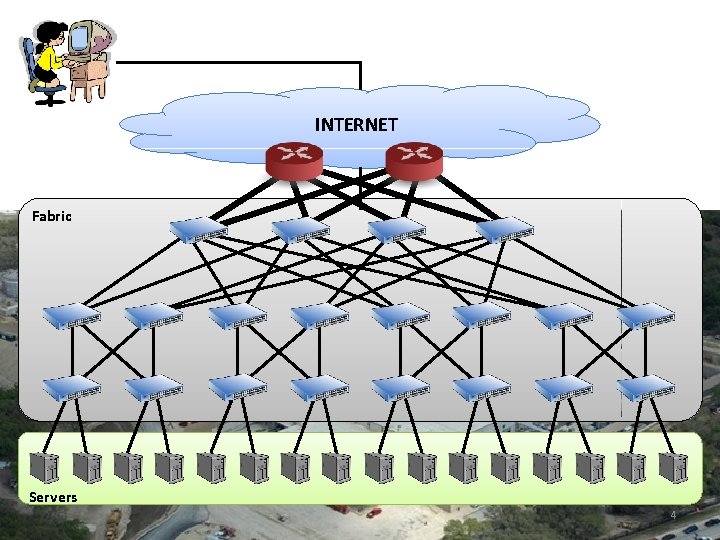
INTERNET Fabric Servers 4
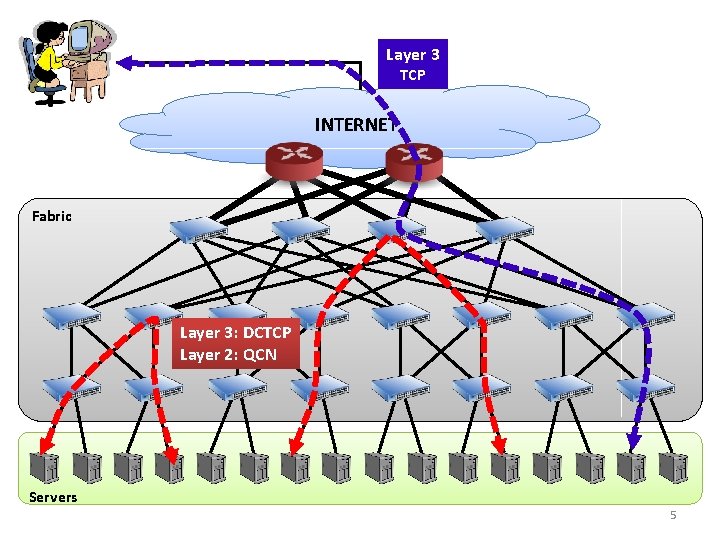
Layer 3 TCP INTERNET Fabric Layer 3: DCTCP Layer 2: QCN Servers 5
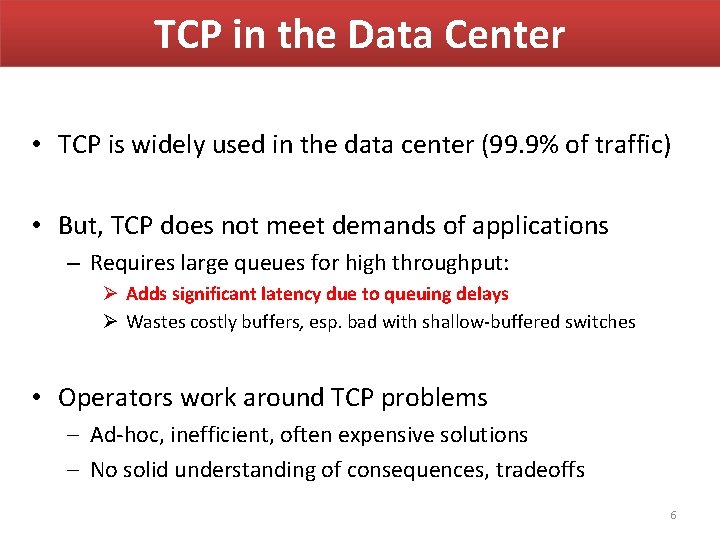
TCP in the Data Center • TCP is widely used in the data center (99. 9% of traffic) • But, TCP does not meet demands of applications – Requires large queues for high throughput: Ø Adds significant latency due to queuing delays Ø Wastes costly buffers, esp. bad with shallow-buffered switches • Operators work around TCP problems ‒ Ad-hoc, inefficient, often expensive solutions ‒ No solid understanding of consequences, tradeoffs 6
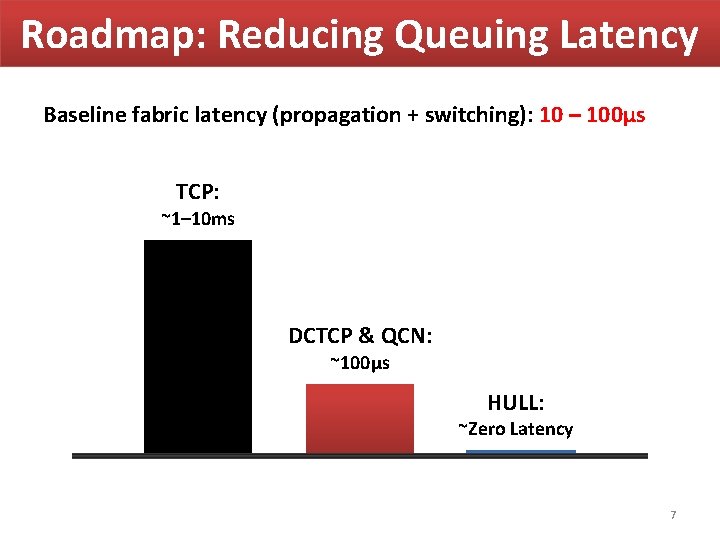
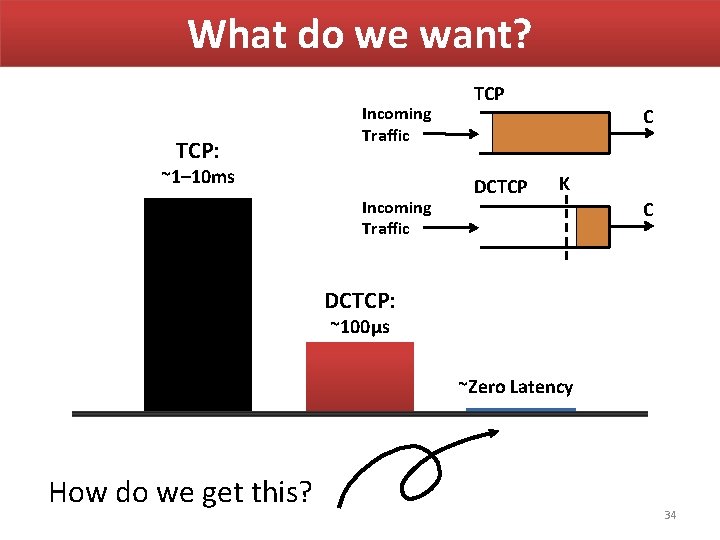
Roadmap: Reducing Queuing Latency Baseline fabric latency (propagation + switching): 10 – 100μs TCP: ~1– 10 ms DCTCP & QCN: ~100μs HULL: ~Zero Latency 7
Data Center TCP with Albert Greenberg, Dave Maltz, Jitu Padhye, Balaji Prabhakar, Sudipta Sengupta, Murari Sridharan SIGCOMM 2010
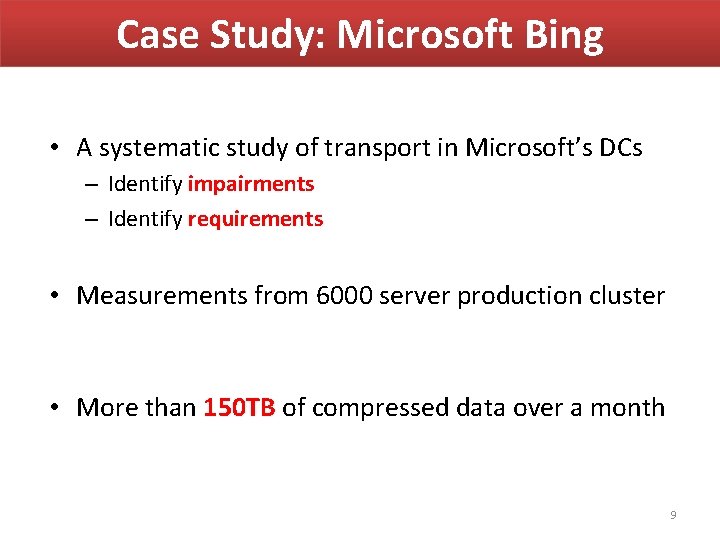
Case Study: Microsoft Bing • A systematic study of transport in Microsoft’s DCs – Identify impairments – Identify requirements • Measurements from 6000 server production cluster • More than 150 TB of compressed data over a month 9
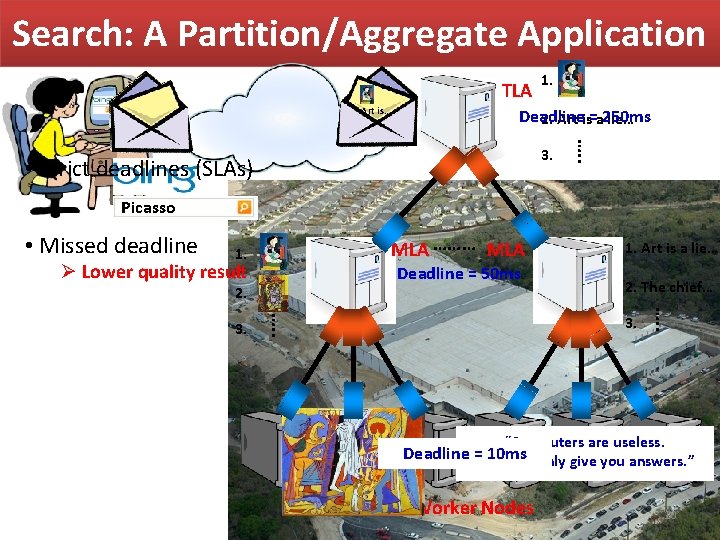
Search: A Partition/Aggregate Application TLA Picasso Art is… 1. Deadline 2. Art is=a 250 ms lie… • Strict deadlines (SLAs) …. . 3. Picasso • Missed deadline MLA ……… MLA 1. Ø Lower quality result Deadline = 50 ms 2. The chief… …. . 3. 1. Art is a lie… “Everything imagine real. ” “It is“Computers your you workcan in are lifeuseless. that is the Good realize lots artists of the money. “ truth. steal. ” but itwith must good find sense. “ you working. ” “I'd “Art like “Bad isto aenemy lie live artists that as makes poor man us is “The “Inspiration chief does ofacopy. creativity exist, Deadline =They 10 ms can ultimate only give seduction. “ you answers. ” Worker Nodes 10
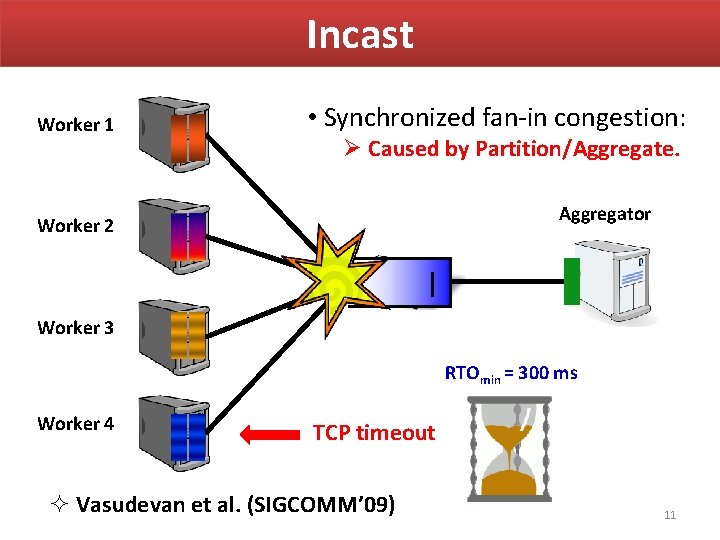
Incast Worker 1 • Synchronized fan-in congestion: Ø Caused by Partition/Aggregate. Aggregator Worker 2 Worker 3 RTOmin = 300 ms Worker 4 TCP timeout ² Vasudevan et al. (SIGCOMM’ 09) 11
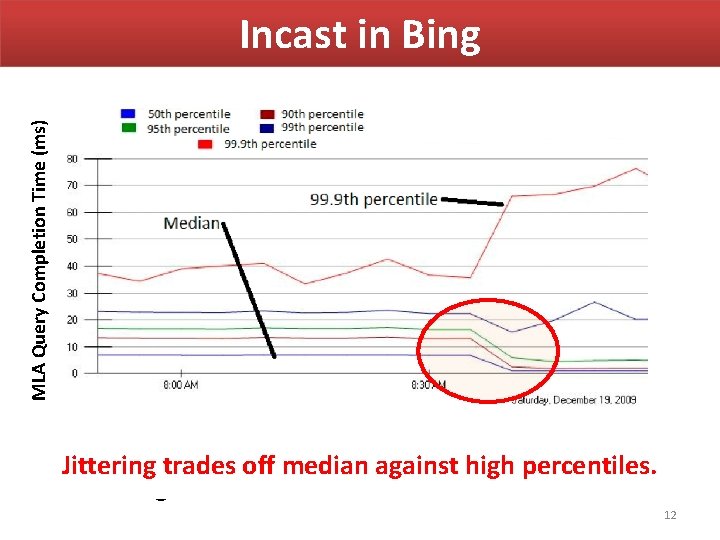
MLA Query Completion Time (ms) Incast in Bing • Requests are jittered over 10 ms window. Jittering trades off median against high percentiles. • Jittering switched off around 8: 30 am. 12
Data Center Workloads & Requirements • Partition/Aggregate (Query) • Short messages [50 KB-1 MB] (Coordination, Control state) • Large flows [1 MB-100 MB] (Data update) High Burst-Tolerance Low Latency High Throughput The challenge is to achieve these three together. 13
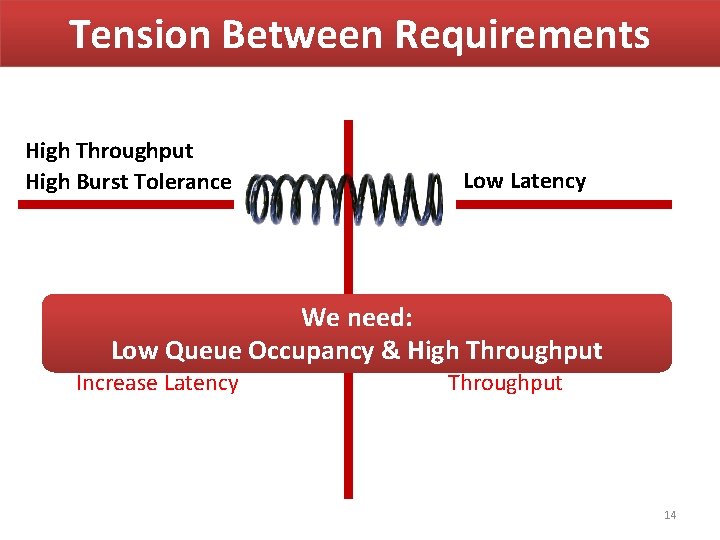
Tension Between Requirements High Throughput High Burst Tolerance Low Latency We need: Shallow Buffers: Deep Buffers: Low Delays Queue Occupancy & High Throughput Ø Queuing Ø Bad for Bursts & Increase Latency Throughput 14
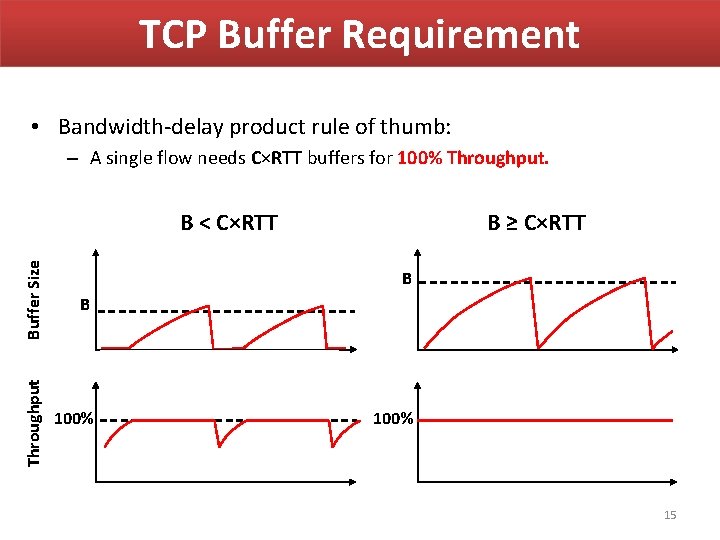
TCP Buffer Requirement • Bandwidth-delay product rule of thumb: – A single flow needs C×RTT buffers for 100% Throughput. Buffer Size B Throughput B < C×RTT 100% B ≥ C×RTT B 100% 15
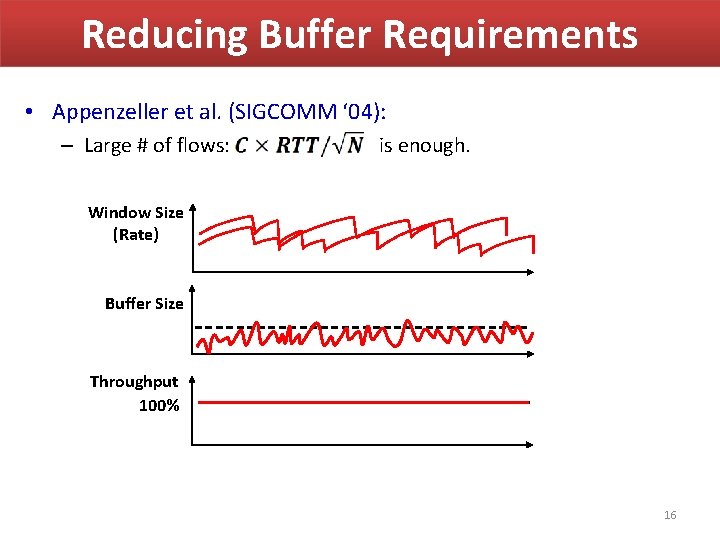
Reducing Buffer Requirements • Appenzeller et al. (SIGCOMM ‘ 04): – Large # of flows: is enough. Window Size (Rate) Buffer Size Throughput 100% 16
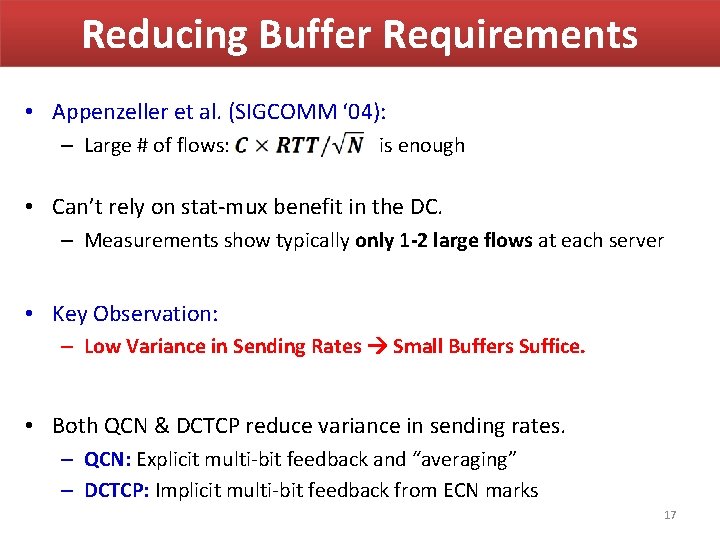
Reducing Buffer Requirements • Appenzeller et al. (SIGCOMM ‘ 04): – Large # of flows: is enough • Can’t rely on stat-mux benefit in the DC. – Measurements show typically only 1 -2 large flows at each server • Key Observation: – Low Variance in Sending Rates Small Buffers Suffice. • Both QCN & DCTCP reduce variance in sending rates. – QCN: Explicit multi-bit feedback and “averaging” – DCTCP: Implicit multi-bit feedback from ECN marks 17
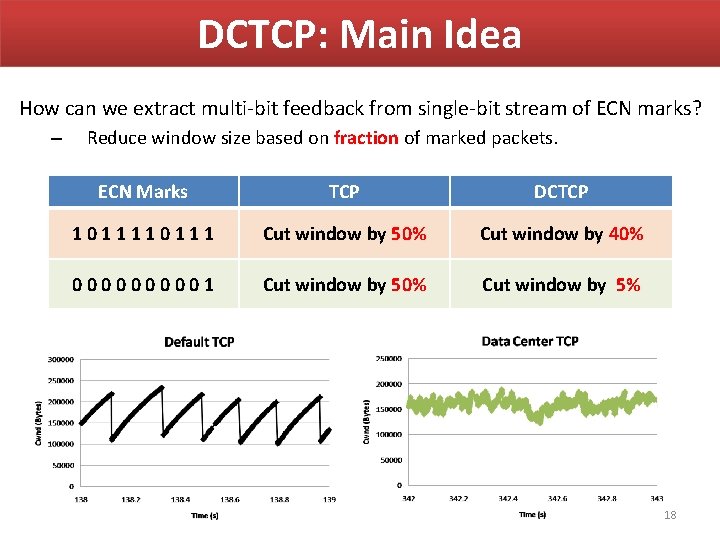
DCTCP: Main Idea How can we extract multi-bit feedback from single-bit stream of ECN marks? – Reduce window size based on fraction of marked packets. ECN Marks TCP DCTCP 10111 Cut window by 50% Cut window by 40% 000001 Cut window by 50% Cut window by 5% 18
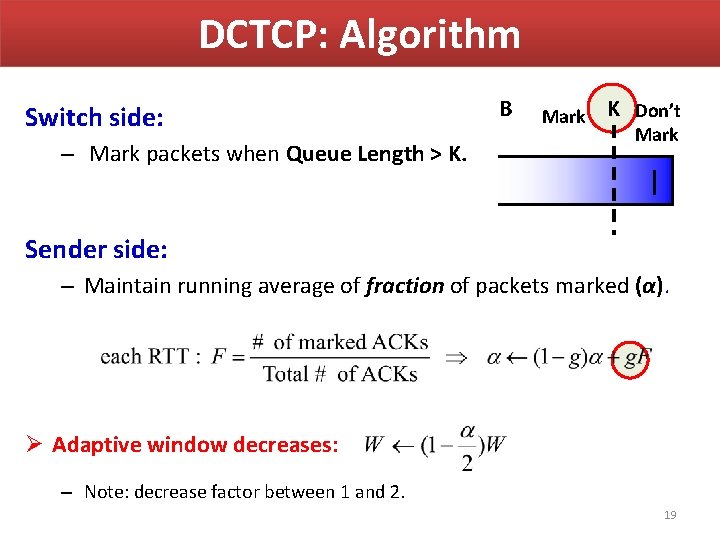
DCTCP: Algorithm Switch side: – Mark packets when Queue Length > K. B Mark K Don’t Mark Sender side: – Maintain running average of fraction of packets marked (α). Ø Adaptive window decreases: – Note: decrease factor between 1 and 2. 19
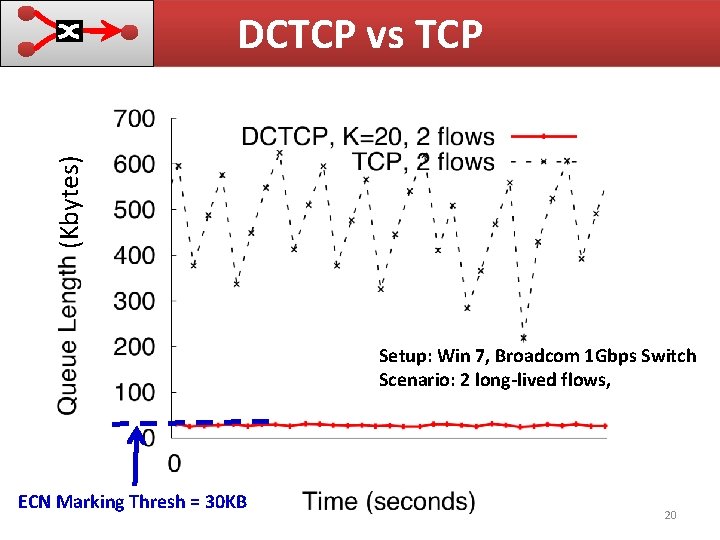
(Kbytes) DCTCP vs TCP Setup: Win 7, Broadcom 1 Gbps Switch Scenario: 2 long-lived flows, ECN Marking Thresh = 30 KB 20
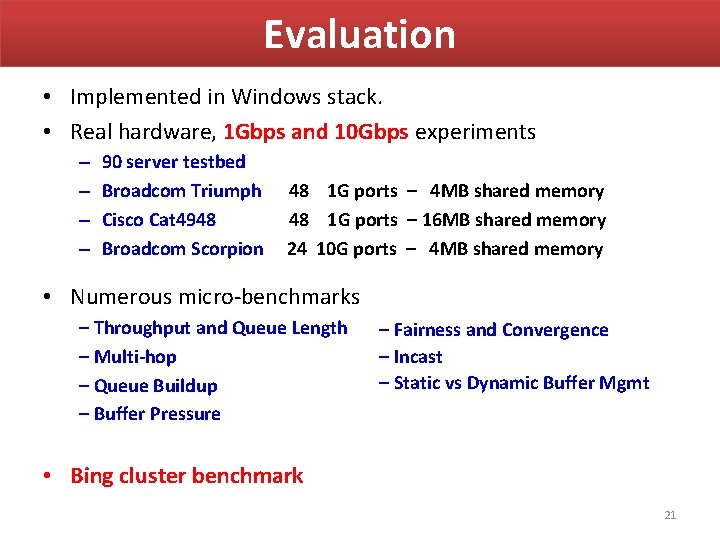
Evaluation • Implemented in Windows stack. • Real hardware, 1 Gbps and 10 Gbps experiments – – 90 server testbed Broadcom Triumph Cisco Cat 4948 Broadcom Scorpion 48 1 G ports – 4 MB shared memory 48 1 G ports – 16 MB shared memory 24 10 G ports – 4 MB shared memory • Numerous micro-benchmarks – Throughput and Queue Length – Multi-hop – Queue Buildup – Buffer Pressure – Fairness and Convergence – Incast – Static vs Dynamic Buffer Mgmt • Bing cluster benchmark 21
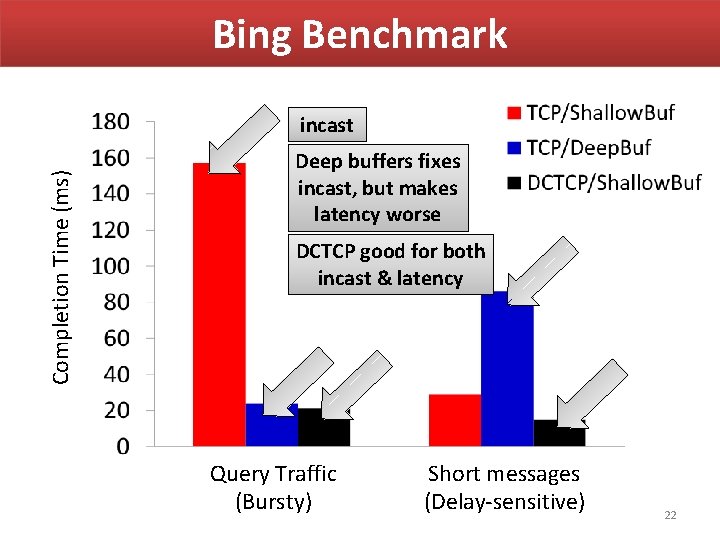
Bing Benchmark Completion Time (ms) incast Deep buffers fixes incast, but makes latency worse DCTCP good for both incast & latency Query Traffic (Bursty) Short messages (Delay-sensitive) 22
Analysis of DCTCP with Adel Javanmrd, Balaji Prabhakar SIGMETRICS 2011
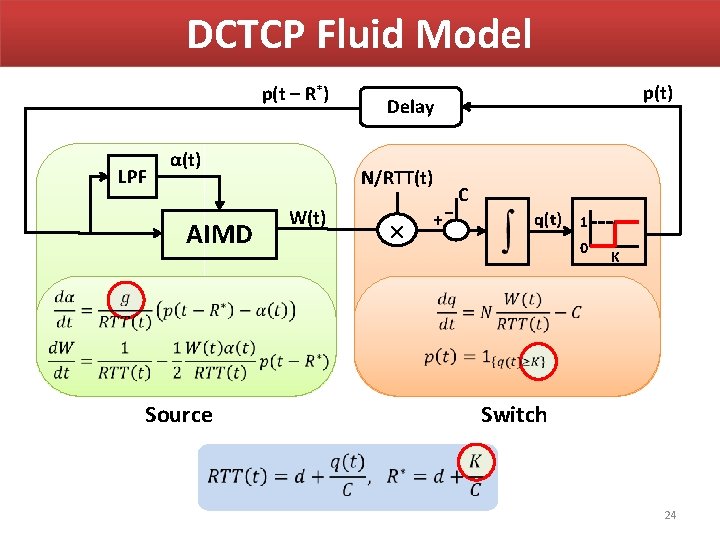
DCTCP Fluid Model p(t – R*) LPF α(t) AIMD Source Delay N/RTT(t) W(t) p(t) × +− C q(t) 1 0 K Switch 24
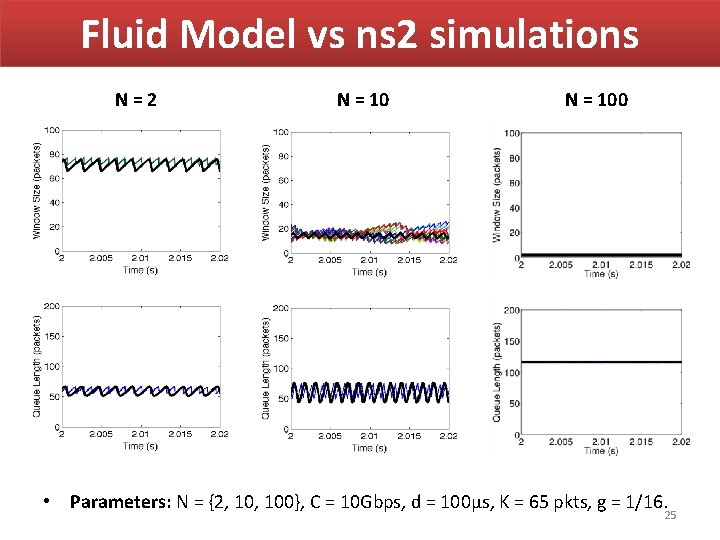
Fluid Model vs ns 2 simulations N=2 N = 100 • Parameters: N = {2, 100}, C = 10 Gbps, d = 100μs, K = 65 pkts, g = 1/16. 25
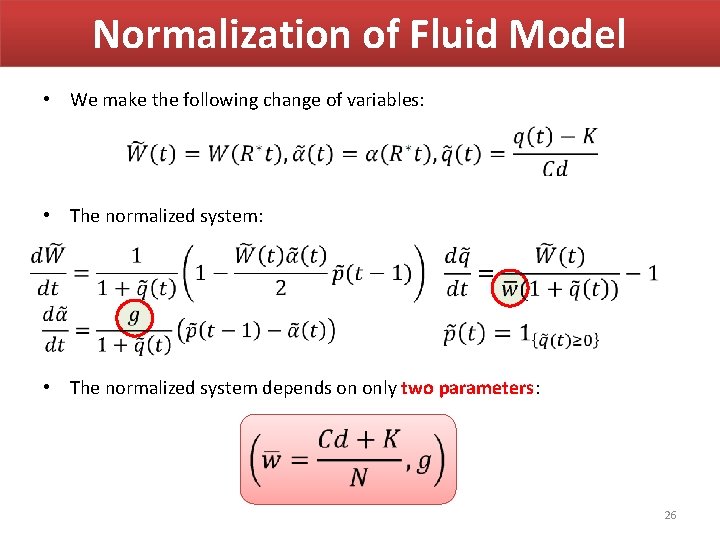
Normalization of Fluid Model • We make the following change of variables: • The normalized system depends on only two parameters: 26
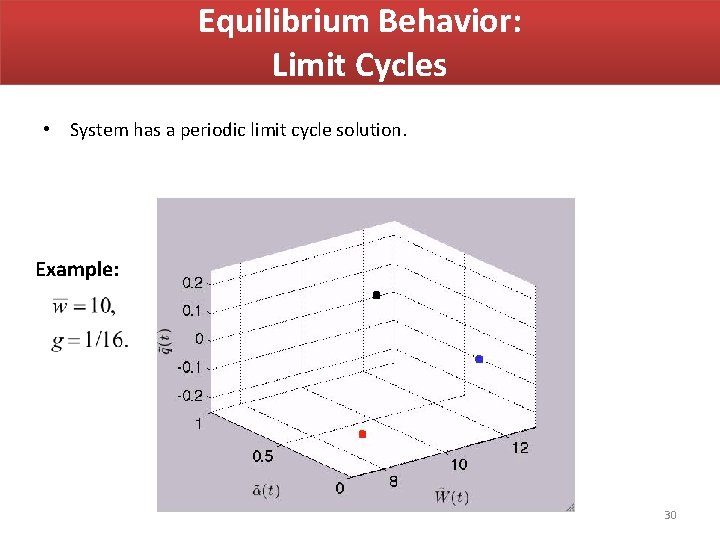
Equilibrium Behavior: Limit Cycles • System has a periodic limit cycle solution. Example: 30
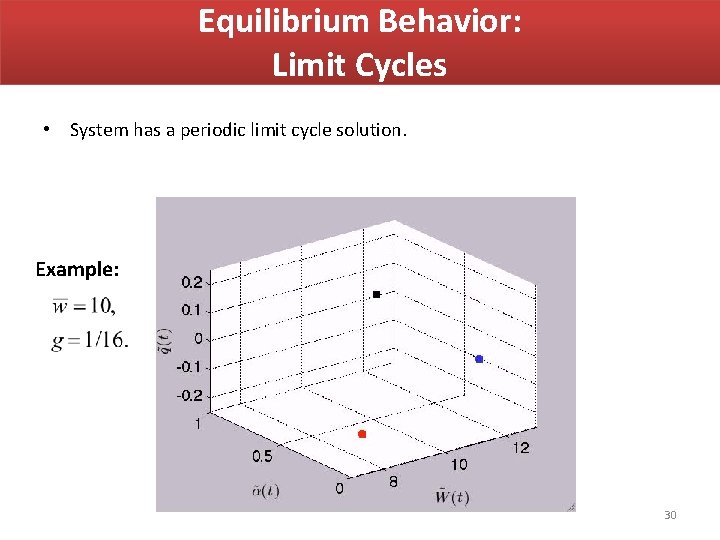
Equilibrium Behavior: Limit Cycles • System has a periodic limit cycle solution. Example: 30
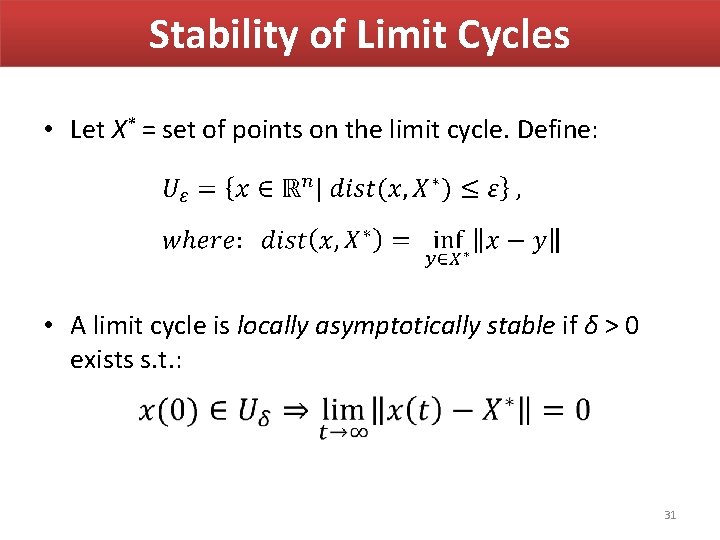
Stability of Limit Cycles • Let X* = set of points on the limit cycle. Define: • A limit cycle is locally asymptotically stable if δ > 0 exists s. t. : 31
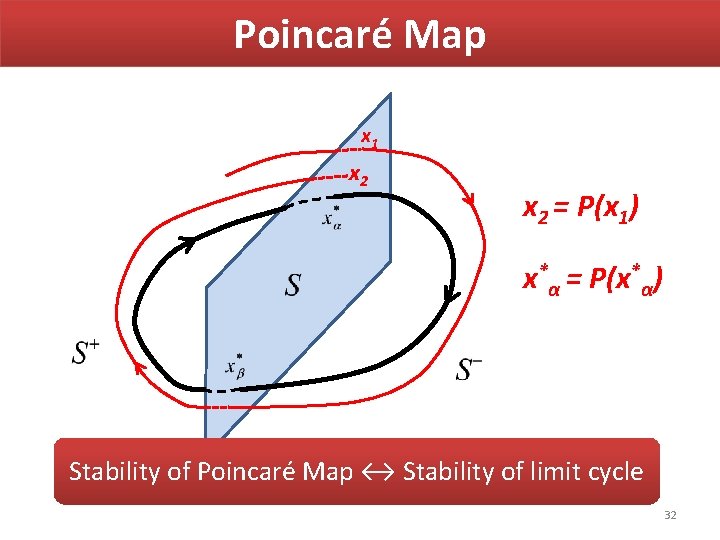
Poincaré Map x 1 x 2 = P(x 1) x*α = P(x*α) Stability of Poincaré Map ↔ Stability of limit cycle 32
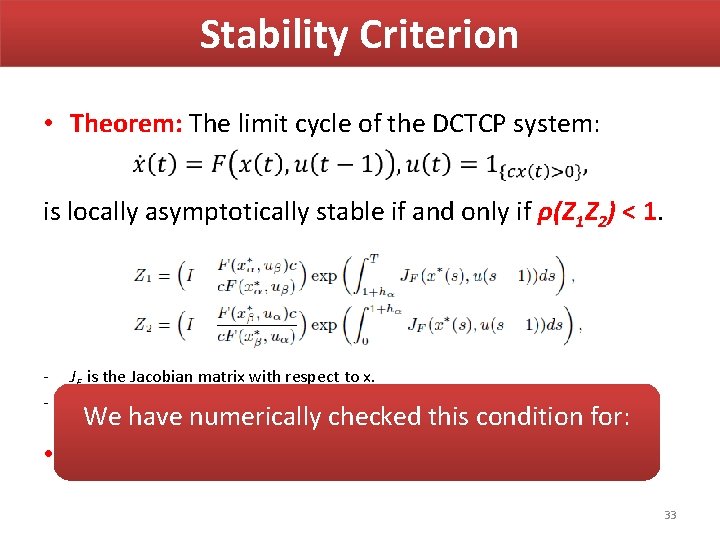
Stability Criterion • Theorem: The limit cycle of the DCTCP system: is locally asymptotically stable if and only if ρ(Z 1 Z 2) < 1. - JF is the Jacobian matrix with respect to x. T = (1 + hα)+(1 + hβ) is the period of the limit cycle. We have numerically checked this condition for: • Proof: Show that P(x*α + δ) = x*α + Z 1 Z 2δ + O(|δ|2). 33
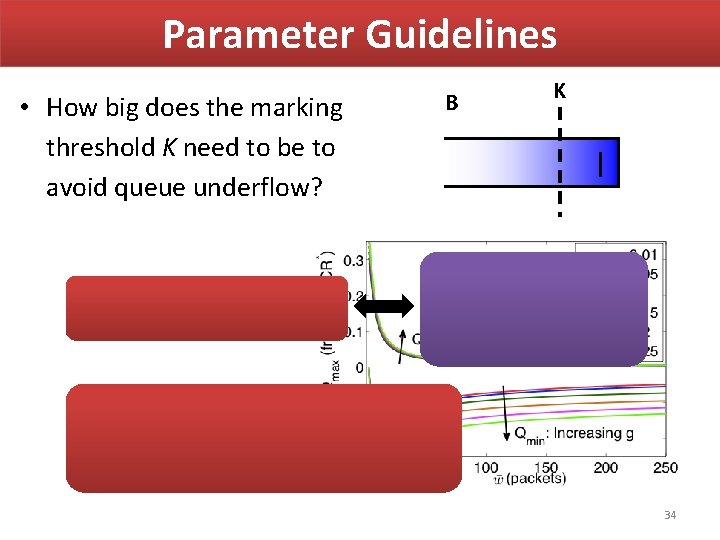
Parameter Guidelines • How big does the marking threshold K need to be to avoid queue underflow? B K 34
HULL: Ultra Low Latency with Abdul Kabbani, Tom Edsall, Balaji Prabhakar, Amin Vahdat, Masato Yasuda To appear in NSDI 2012
What do we want? TCP: Incoming Traffic ~1– 10 ms Incoming Traffic TCP DCTCP C K C DCTCP: ~100μs ~Zero Latency How do we get this? 34
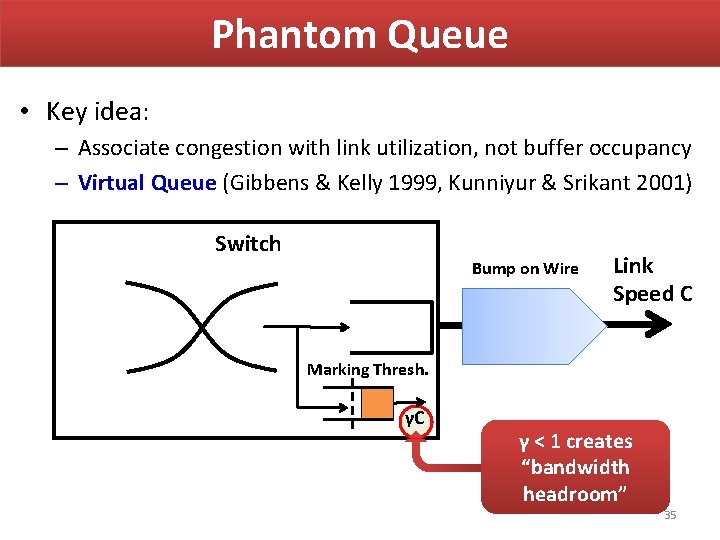
Phantom Queue • Key idea: – Associate congestion with link utilization, not buffer occupancy – Virtual Queue (Gibbens & Kelly 1999, Kunniyur & Srikant 2001) Switch Bump on Wire Link Speed C Marking Thresh. γC γ < 1 creates “bandwidth headroom” 35
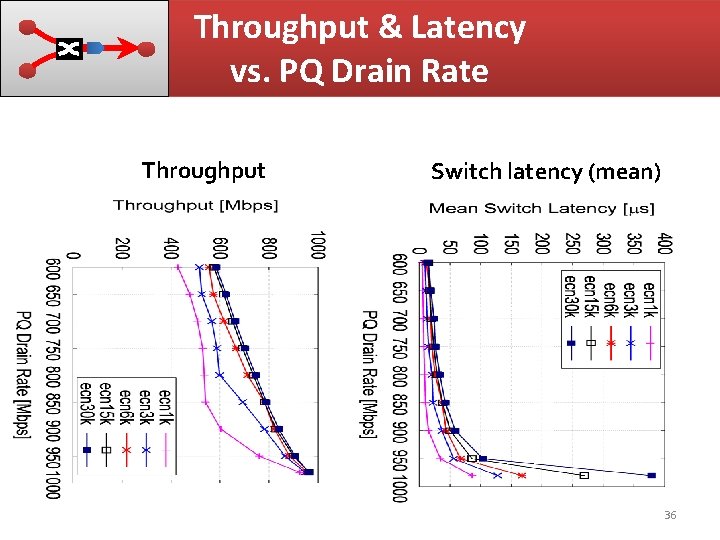
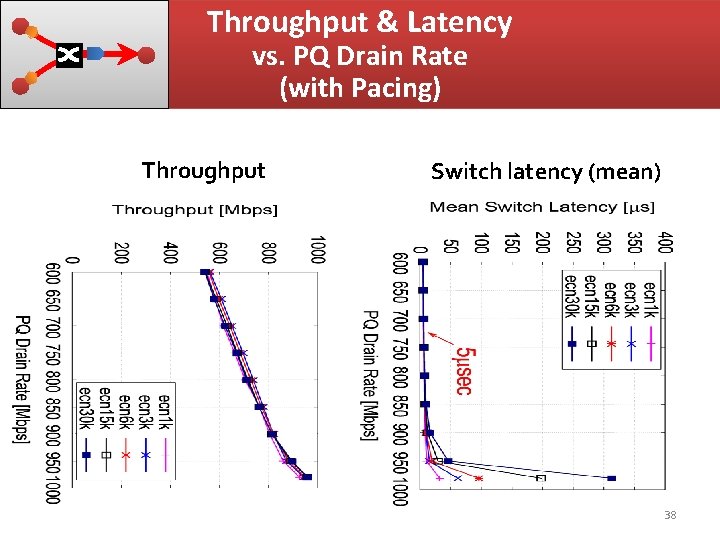
Throughput & Latency vs. PQ Drain Rate Throughput Switch latency (mean) 36
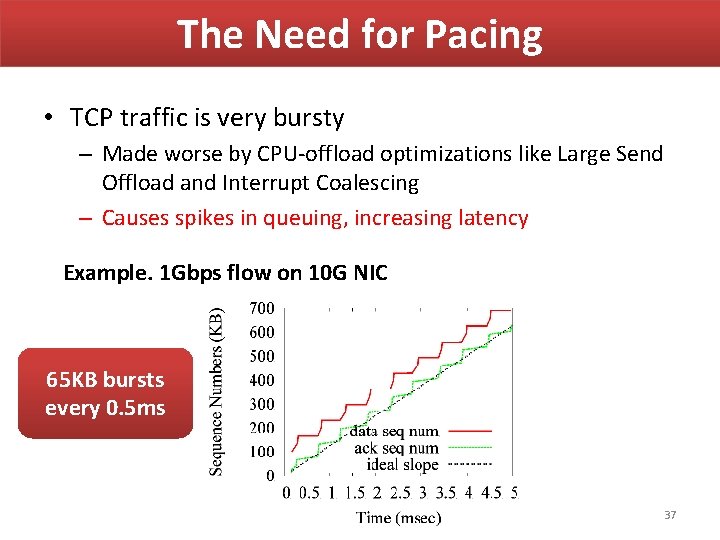
The Need for Pacing • TCP traffic is very bursty – Made worse by CPU-offload optimizations like Large Send Offload and Interrupt Coalescing – Causes spikes in queuing, increasing latency Example. 1 Gbps flow on 10 G NIC 65 KB bursts every 0. 5 ms 37
Throughput & Latency vs. PQ Drain Rate (with Pacing) Throughput Switch latency (mean) 38
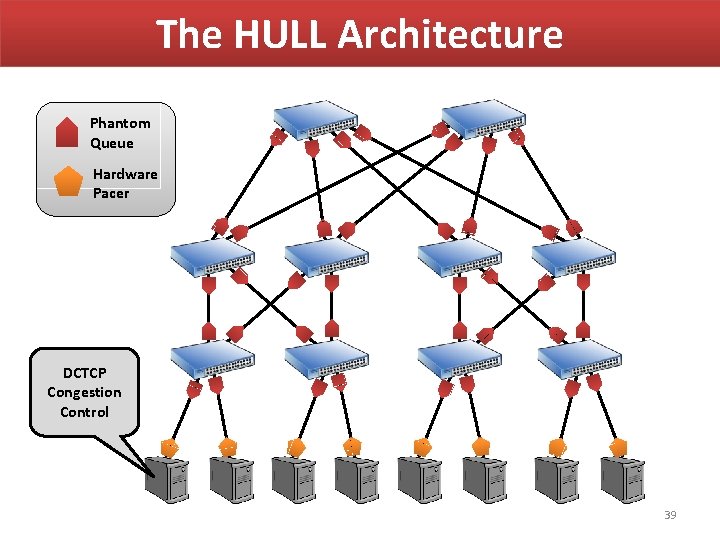
The HULL Architecture Phantom Queue Hardware Pacer DCTCP Congestion Control 39
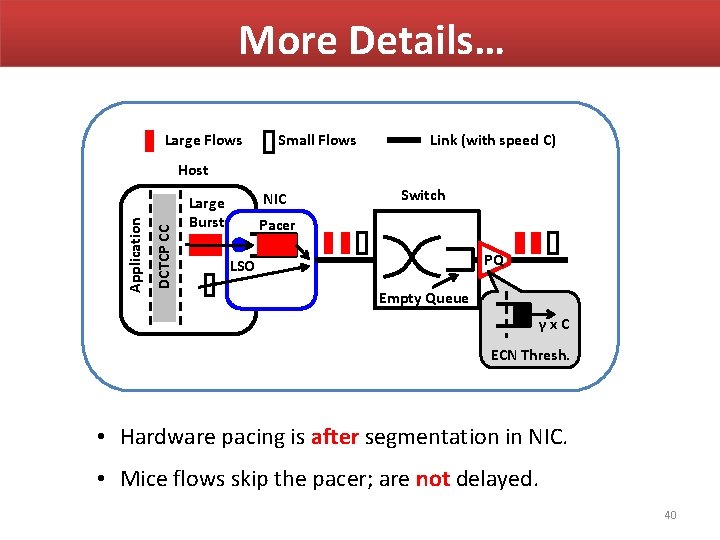
More Details… Large Flows Small Flows Link (with speed C) DCTCP CC Application Host NIC Large Burst Switch Pacer PQ LSO Empty Queue γx. C ECN Thresh. • Hardware pacing is after segmentation in NIC. • Mice flows skip the pacer; are not delayed. 40
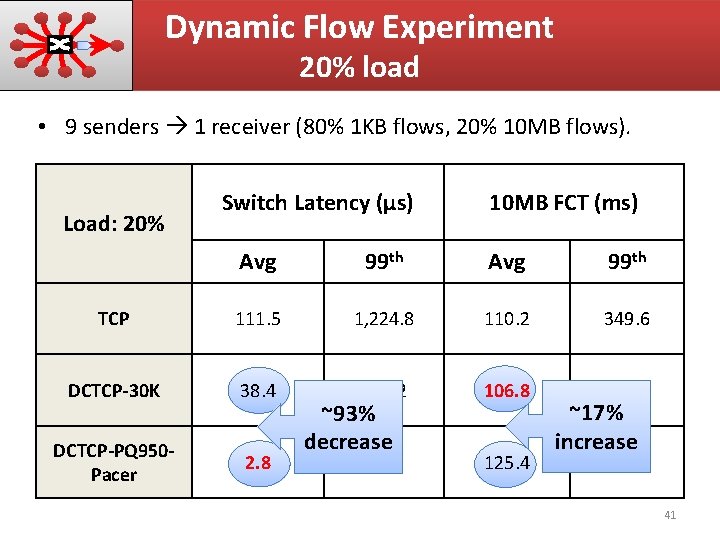
Dynamic Flow Experiment 20% load • 9 senders 1 receiver (80% 1 KB flows, 20% 10 MB flows). Load: 20% Switch Latency (μs) 10 MB FCT (ms) Avg 99 th TCP 111. 5 1, 224. 8 110. 2 349. 6 DCTCP-30 K 38. 4 295. 2 106. 8 301. 7 DCTCP-PQ 950 Pacer 2. 8 18. 6 125. 4 ~93% decrease ~17% increase 359. 9 41
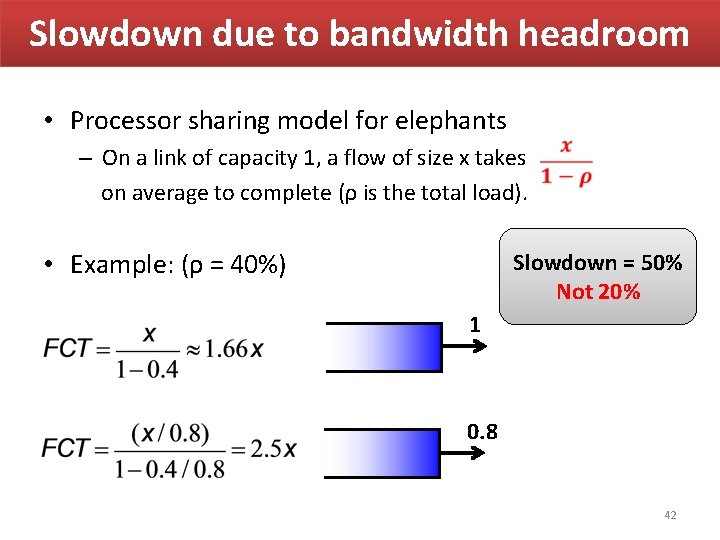
Slowdown due to bandwidth headroom • Processor sharing model for elephants – On a link of capacity 1, a flow of size x takes on average to complete (ρ is the total load). • Example: (ρ = 40%) Slowdown = 50% Not 20% 1 0. 8 42
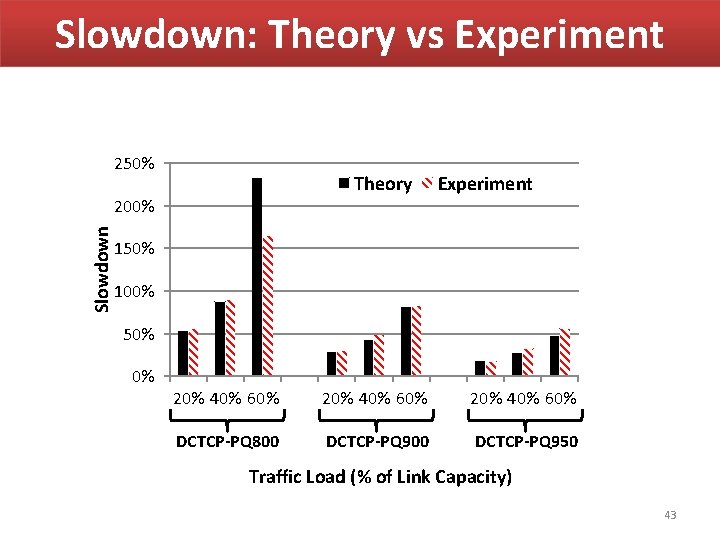
Slowdown: Theory vs Experiment 250% Theory Slowdown 200% Experiment 150% 100% 50% 0% 20% 40% 60% DCTCP-PQ 800 DCTCP-PQ 950 Traffic Load (% of Link Capacity) 43
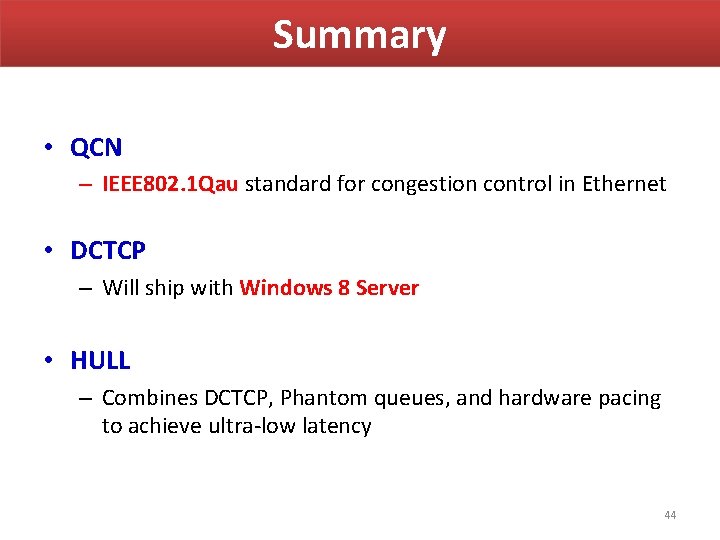
Summary • QCN – IEEE 802. 1 Qau standard for congestion control in Ethernet • DCTCP – Will ship with Windows 8 Server • HULL – Combines DCTCP, Phantom queues, and hardware pacing to achieve ultra-low latency 44
Thank you!