
Packet Clearing House PCH What is PCH n





- Slides: 34
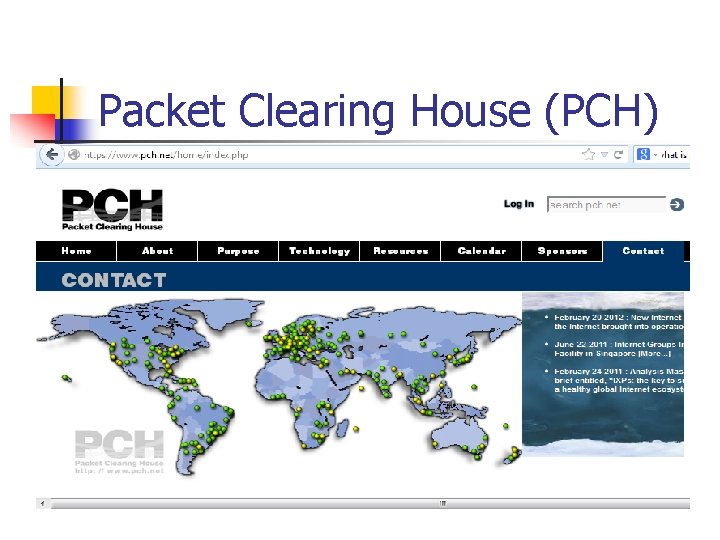
Packet Clearing House (PCH)
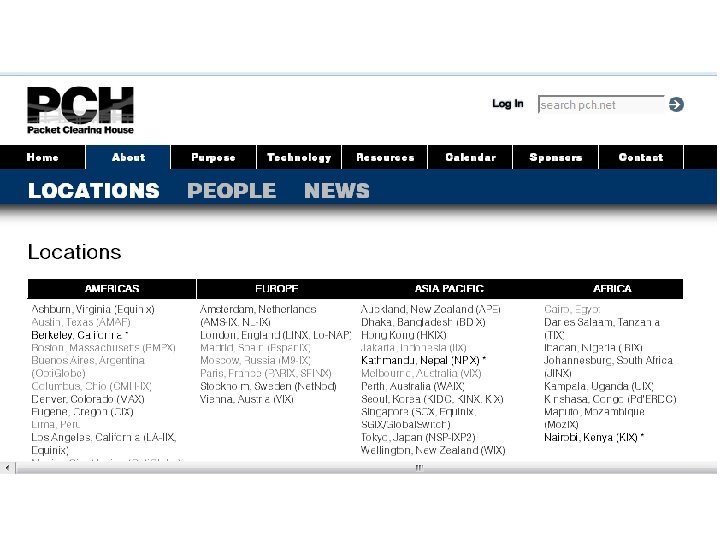
What is PCH? n n Packet Clearing House is a non-profit research institute that supports operations and analysis in the areas of Internet traffic exchange, routing, economics, and global network development. Originally formed in 1994 to provide efficient regional and local network interconnection
PCH n n neutral independent network interconnection and provider of route-servers at major exchange points worldwide. PCH also provides equipment, training, data, and operational support to organizations and individual researchers seeking to improve the quality, robustness, and accessibility of the Internet
PCH Activities n n construction of Internet Exchanges Points (IXPs) throughout the developing world; operation of the Inter-Network Operations Center Dial-By. ASN (INOC-DBA) global Internet infrastructure protection hotline; support for globally distributed domain name system (DNS) resources; implementation of network research data collection initiatives throughout the world
PCH activities n The development and presentation of educational materials to foster a better understanding of Internet architectural principles and their policy implications among policy makers, technologists, and the general public.
PCH Operation n INTERNET EXCHANGE SUPPORT n n PCH provides support both to Internet exchange facilities in the process of formation and to those that are already up and running. Supply the switching equipment that forms the technological core of exchanges, often to most valuable contribution is in the form of education, technical expertise, and mediation with policy and economic officials of the local government.
PCH Operation n Works with the exchange, its memberparticipants, and regulatory authorities to create a new business model that satisfies each of the stakeholders and provides long-term financial stability
PCH Operation n n PCH also provides Layer-3 route servers to facilitate easier and safer interconnection between participants at the exchange. As new participants join the exchange, they receive the immediate benefit of full use of the exchange as soon as they contact the route server
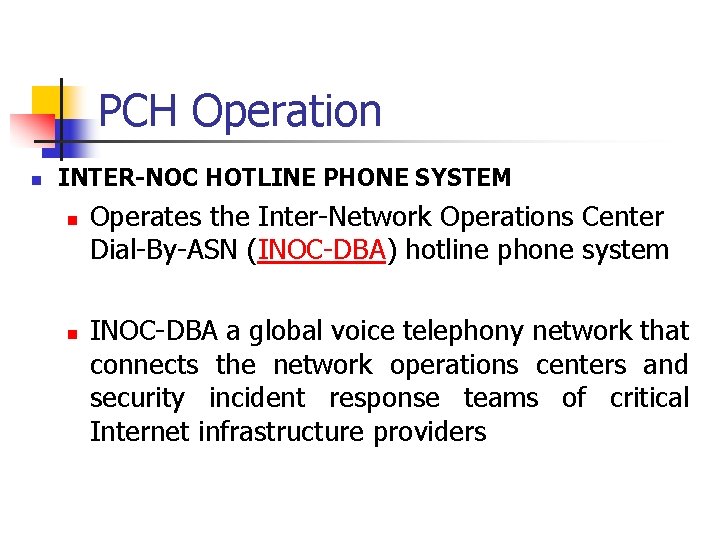
PCH Operation n INTER-NOC HOTLINE PHONE SYSTEM n n Operates the Inter-Network Operations Center Dial-By-ASN (INOC-DBA) hotline phone system INOC-DBA a global voice telephony network that connects the network operations centers and security incident response teams of critical Internet infrastructure providers
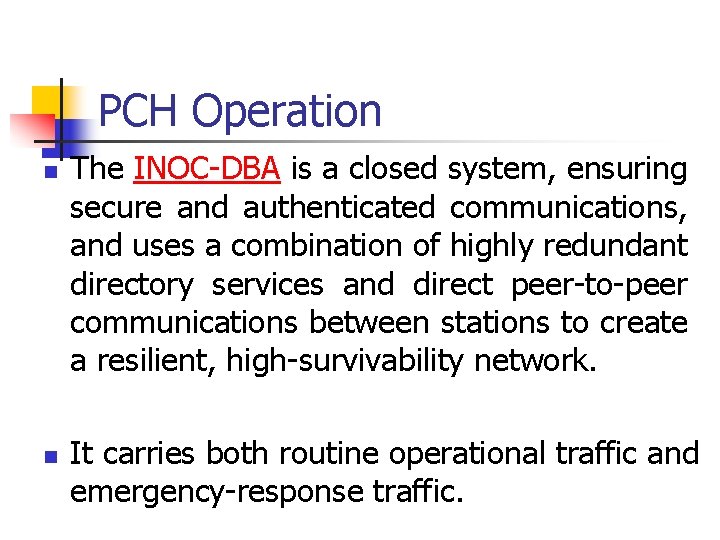
PCH Operation n n The INOC-DBA is a closed system, ensuring secure and authenticated communications, and uses a combination of highly redundant directory services and direct peer-to-peer communications between stations to create a resilient, high-survivability network. It carries both routine operational traffic and emergency-response traffic.
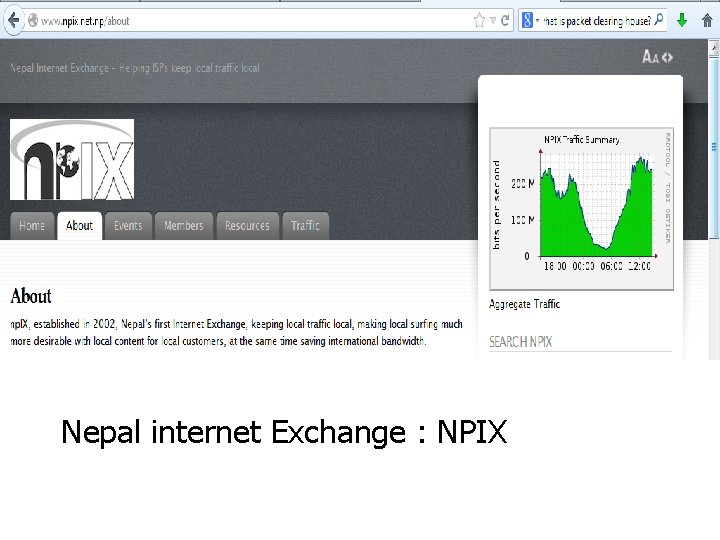
Nepal internet Exchange : NPIX
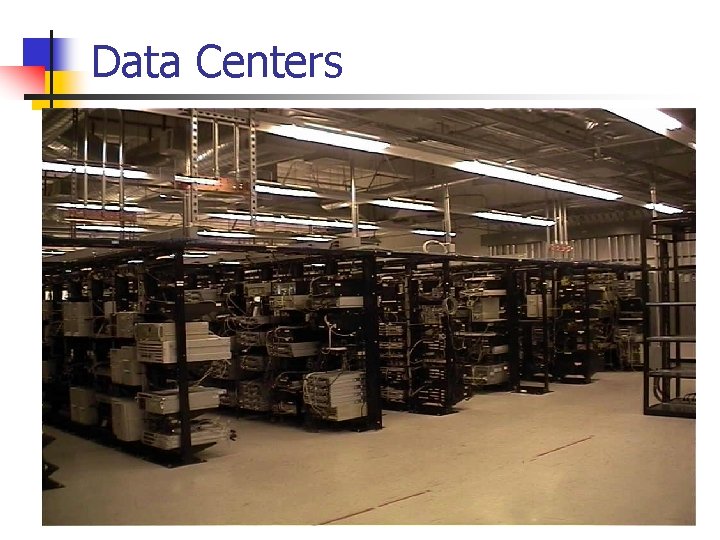
Data Centers
Data Centers n What is a Data Center? n A Data center or NOC (network operations center) is a place to consolidate application servers, Web servers, communications equipment, security systems, system administrators, support personnel, and anything or anybody else that provides data services. A data center benefits from centralized management, support, backup control, power management, security, and so on. It may be housed in a single room or fill an entire building. Special equipment is usually installed to protect against power outages, natural disasters, and security breaches.
Value of Your Data Center n n Data Centers are specialized environments that safeguard your company's most valuable equipment and intellectual property. Data Centers house the devices that do the following: n n n Process your business transactions Host your website Process and store your intellectual property Maintain your financial records Route your e-mails
Data Centers n n Good design begins with facility concept plan Before you even think about the computers, there are many other “design decisions” to be made: n n n Physical security needs Cooling issues / Environment Factors Electrical requirements Floor loading restrictions Fire detection/suppression? Growth/floor planning?
What do you need to know? n n Physical design and construction of a Data Center How to customize the environment to meet your company's needs How to organize and manage your Data Center effectively so downtime is minimized, troubleshooting is easier, and the room's infrastructure is fully used So, how much is acceptable to spend on the construction of your Data Center? That depends. To determine the answer, you need to know the value of what your Data Center is protecting.
Location, Location n n Determine needs: Often, a location in a suburban settings is better than a city. Common sense factors: n n Avoid co-location with neighbors involved in any kind of hazmat manufacturing or distribution Avoid locations that may be prone to flooding – even if you seal the building, you have to be able to physically get there!
Data Centers n n n You can not have software security without first having physical security! Can be as simple as a card key, a proximity badge, or a cipher-lock, which is a key pad that requires the user to enter a multi-digit numeric code. At the top of the line are biometric security systems, which can include, but not limited to, handprint recognition, iris scans, and face recognition. Cameras often a good idea
Cooling n n n Computers, packed together, produce a LOT of heat! Problem getting worse – as computers get faster, they’re consuming more power. More Power = More heat per square foot. Extremely expensive HVAC systems that provide redundant cooling.
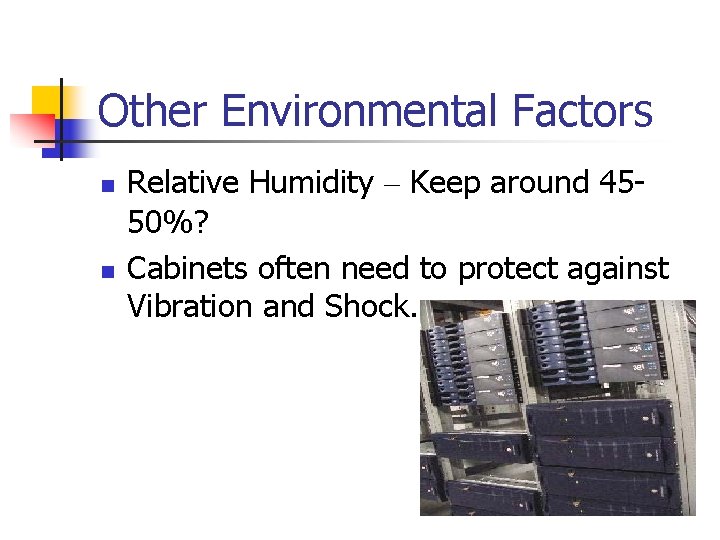
Other Environmental Factors n n Relative Humidity – Keep around 4550%? Cabinets often need to protect against Vibration and Shock.
Crisis Management n n n Expect the worst, hope for the best Have a plan in the event something disastrous happens Several companies offer “emergency” services (Sungard)
Purpose of building data center n Why is your company building this Data Center? n What needs must it meet? n n What specific functions does it need to perform, and perform well, to be considered a success? What level of availability does your business require?
Understanding Client Needs n Talk to the people who work in the room (your client), and find out the following: n n What servers they want it to support How much connectivity those devices need What their power requirements are Whether clients see trends among the equipment they are ordering most commonly n Focus on current needs along with future needs. n Clients knows well their current needs. n Clients may do not have any idea about future needs.
Cross-Functional Support n n Responsibility for a company's Data Center is typically shared among multiple departments and personnel. Example: n n Security manager typically governs physical access into the Data Center. IT manager coordinates where servers are physically deployed. Each one has different point of view with regards to security access. Solution: Foster communication and seek compromise
Architecting a Productive Data Center n n n In order to have well designed data center you need to follow five essential design strategy: Make It Robust Make It Modular Make It Flexible Standardize Promote Good Habits
Data Center Design Criteria n n n Availability Infrastructure Tiers One Room or Several? Life Span Budget Decisions
Data Center Design Criteria n Availability: n n The degree to which Data Center devices function continuously is known as the room's availability or its uptime. Availability is represented as a percentage of time. How many days, hours, and minutes is the Data Center's electrical infrastructure operational and supplying power over a given time period
Data Center Design Criteria n Infrastructure Tiers n n The higher the availability you want your Data Center to achieve, the more layers of infrastructure it must have. N capacity is the amount of infrastructure required to support all servers or networking devices in the Data Center, assuming that the space is filled to maximum capacity and all devices are functioning. n N+1 infrastructure can support the Data Center at full server capacity and includes an additional component
Data Center Design Criteria n One Room or Several? n n One large Data Center is simpler to manage than several smaller ones. Having only one server environment puts all of your eggs in one basket.
n Life Span n n How long it is expected to support your company's needs without having to be expanded or retrofitted, or otherwise undergo major changes. The most effective strategy is to design a Data Center with a projected life span of a few years.
n Budget Decisions n n It is not good to spend millions of dollars on a server environment to protect your company's assets if that cost drives your business into bankruptcy. The most obvious costs for a Data Center are labor and materials associated with its initial construction, which, even for a room smaller than 1000 square feet or 100 square meters, normally runs into hundreds of thousands of dollars. This includes: n n Initial construction Consulting fees Real estate Ongoing operational expenses
Tips for a Successful Project n n n Define expectations and communicate them early and often Expect long lead times on infrastructure items Establish deadline-based incentives for timesensitive projects Document everything Visit the construction site frequently