
Packed Tower Gas Absorption Jaymarie Aera B Furuc
Packed Tower Gas Absorption Jaymarie Aera B. Furuc 5 Ch. EC 1
Introduction: Gas Absorption • Gas absorption is a process in which a gaseous mixture is brought into contact with a liquid, during this contact a component is transferred between the gas stream and the liquid stream. 2
Introduction: Gas Absorption The appropriateness of gas absorption as a pollution control method is generally dependent on: • availability of suitable solvent • required removal efficiency • pollutant concentration in the inlet vapor • capacity required for handling waste gas • recovery value of the pollutant 3
Rationale for Equipment Selection: Packed Tower Packed towers are custom-designed to provide removal efficiencies in the range of 95% to 99% for acid and toxic gases with a low pressure drop, handle higher liquid rates, and have relatively lower water consumption requirements than other types of absorbers It is filled with packing materials that provide a large surface area to facilitate contact between the liquid and gas. 4

Rationale for Equipment Selection: Packed Tower Packed towers are preferred to plate towers when acid and other corrosive materials are involved because tower construction can be of fiberglass, polyvinylchloride, or other less costly, corrosive-resistant materials. 5
Goal of Design The goal of ths design is to efficiently absorb 95% of HCl from air using water with caustic in solution. 6
Material for Construction Hastelloy C 276 is a Nickel chromium-molybdenum wrought alloy that is considered the most versatile corrosion resistant alloy available “HASTELLOY C 276 (UNS N 10276)” High Performance Alloys, Inc. Retrived from: http: //www. hpalloy. com/Alloys/descriptions/HASTELLOYC_276. html The packing used is 2 -inches ceramic raschig rings because metal and plastic packings cannot be used in highly corrosive pollutants 7
Feedstock Gas Stream • HCl-Air waste gas • The presence of HCl comes from waste and combustibles Liquid Stream • Water with caustic in solution. • Water is inexpensive and readily available. 8
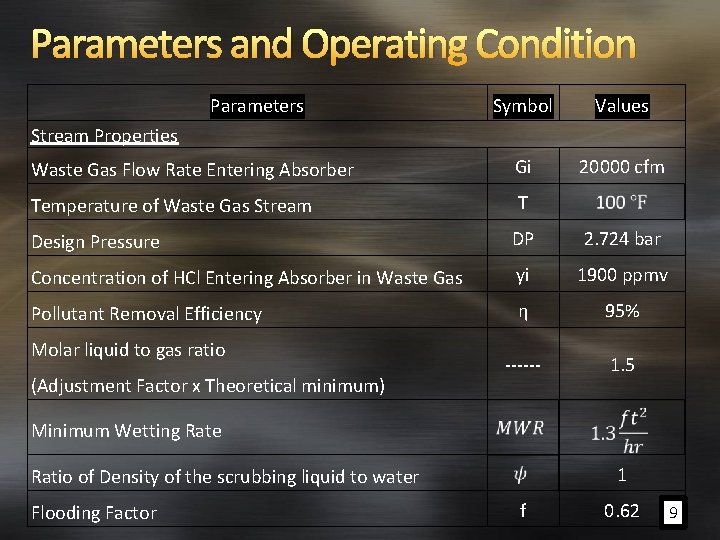
Parameters and Operating Condition Parameters Symbol Values Waste Gas Flow Rate Entering Absorber Gi 20000 cfm Temperature of Waste Gas Stream T Stream Properties Design Pressure DP 2. 724 bar Concentration of HCl Entering Absorber in Waste Gas yi 1900 ppmv Pollutant Removal Efficiency η 95% ------ 1. 5 Molar liquid to gas ratio (Adjustment Factor x Theoretical minimum) Minimum Wetting Rate 1 Ratio of Density of the scrubbing liquid to water Flooding Factor f 0. 62 9

Assumptions: Waste gas and Solvent is assumed to behave as an ideal solution. The process is not reaction rate limited. Negligible changes in moisture content. The volume change in liquid stream entering and exiting the absorber is assumed negligible. A dilute solution of caustic (Na 2 O) is assumed to have the same physical properties as water. No HCl in Solvent entering the absorber. 10
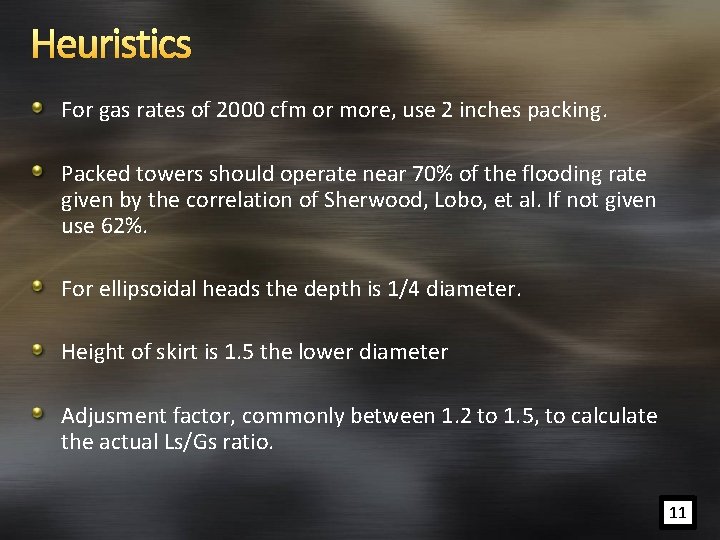
Heuristics For gas rates of 2000 cfm or more, use 2 inches packing. Packed towers should operate near 70% of the flooding rate given by the correlation of Sherwood, Lobo, et al. If not given use 62%. For ellipsoidal heads the depth is 1/4 diameter. Height of skirt is 1. 5 the lower diameter Adjusment factor, commonly between 1. 2 to 1. 5, to calculate the actual Ls/Gs ratio. 11
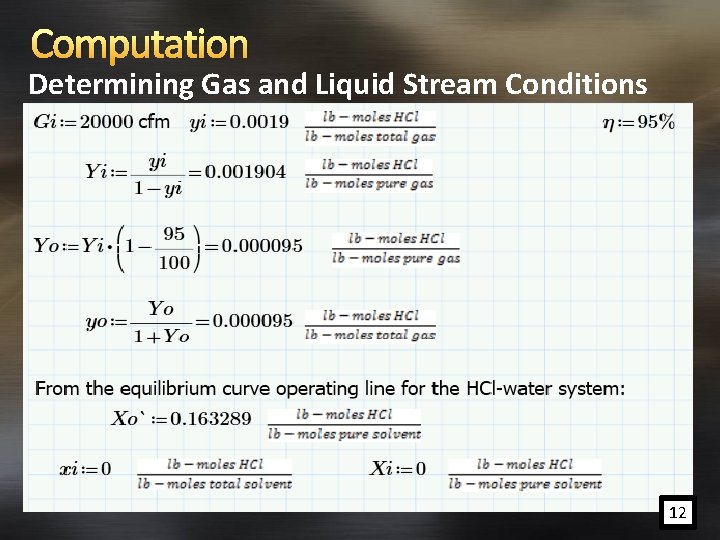
Computation Determining Gas and Liquid Stream Conditions 12
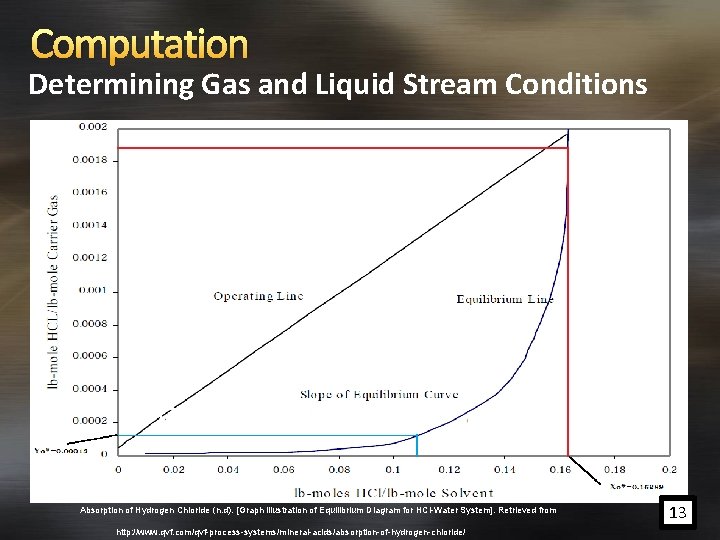
Computation Determining Gas and Liquid Stream Conditions Absorption of Hydrogen Chloride (n. d). [Graph illustration of Equilibrium Diagram for HCl-Water System]. Retrieved from http: //www. qvf. com/qvf-process-systems/mineral-acids/absorption-of-hydrogen-chloride/ 13
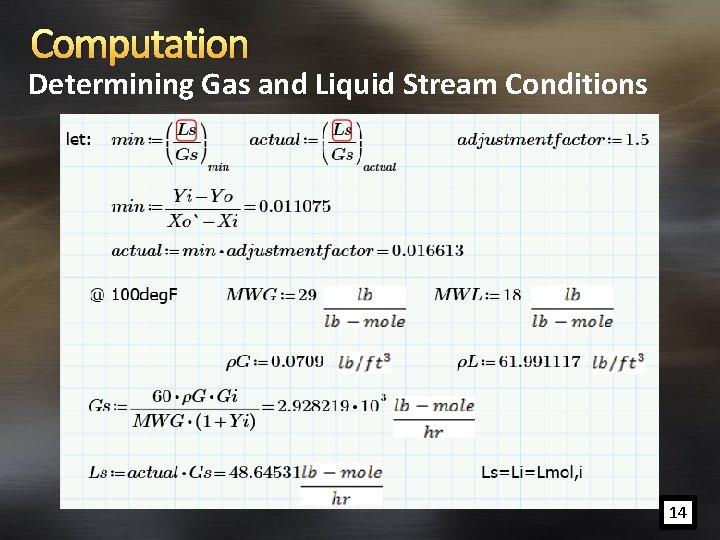
Computation Determining Gas and Liquid Stream Conditions 14
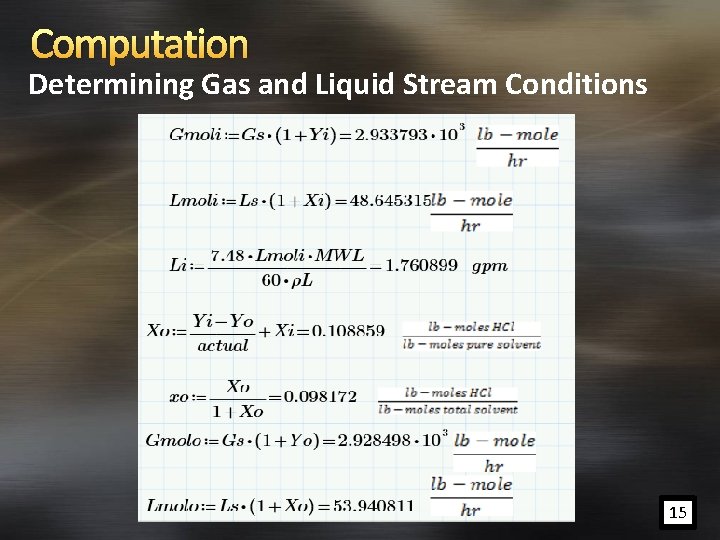
Computation Determining Gas and Liquid Stream Conditions 15
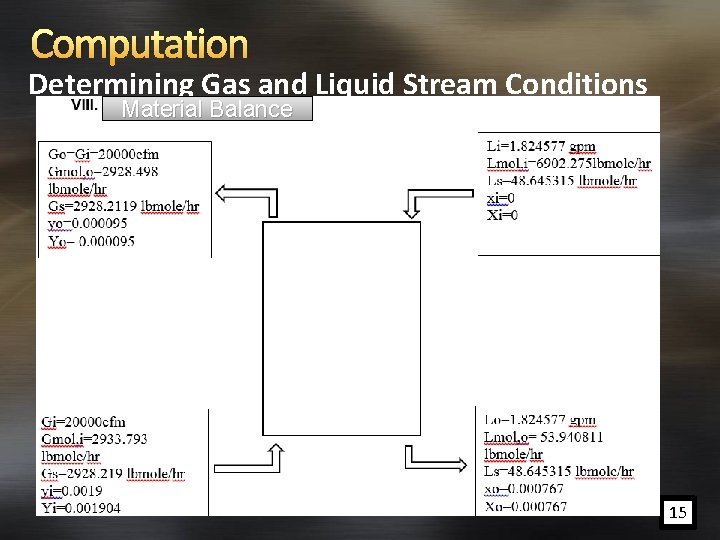
Computation Determining Gas and Liquid Stream Conditions Material Balance 15
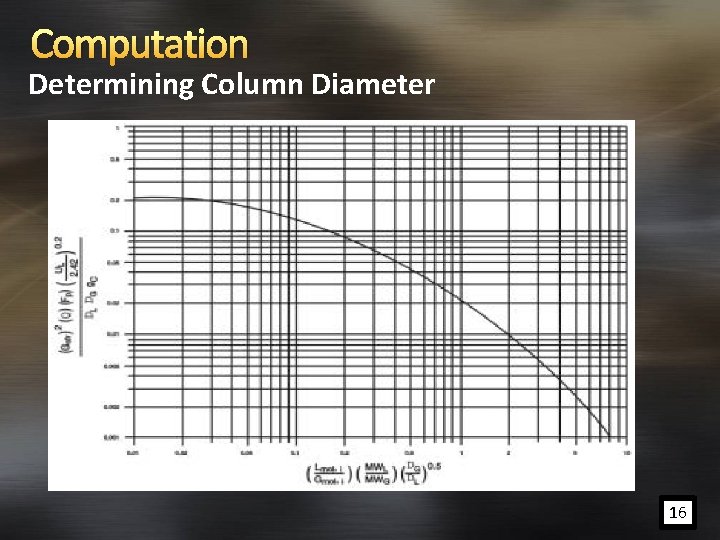
Computation Determining Column Diameter 16
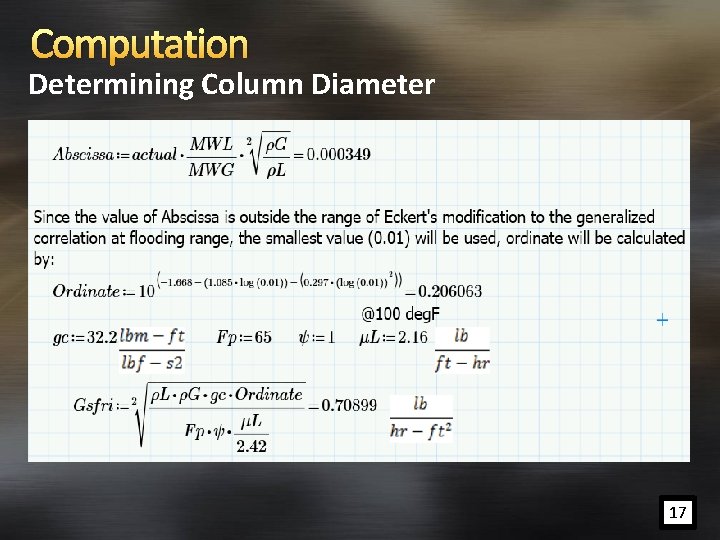
Computation Determining Column Diameter 17
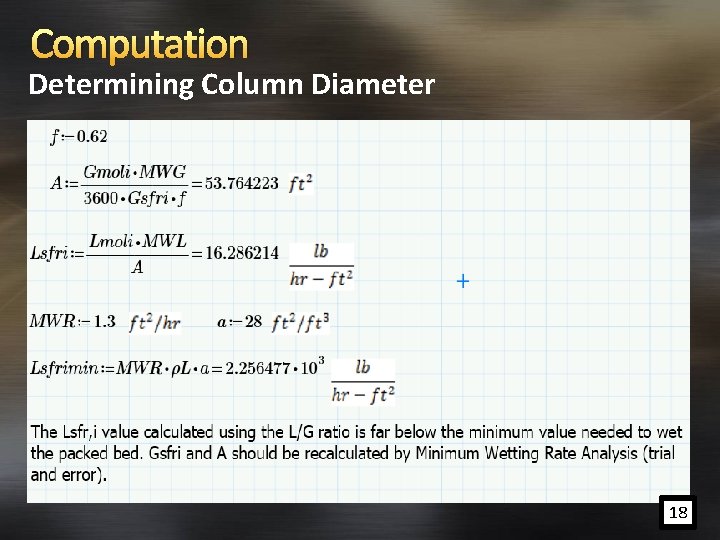
Computation Determining Column Diameter 18
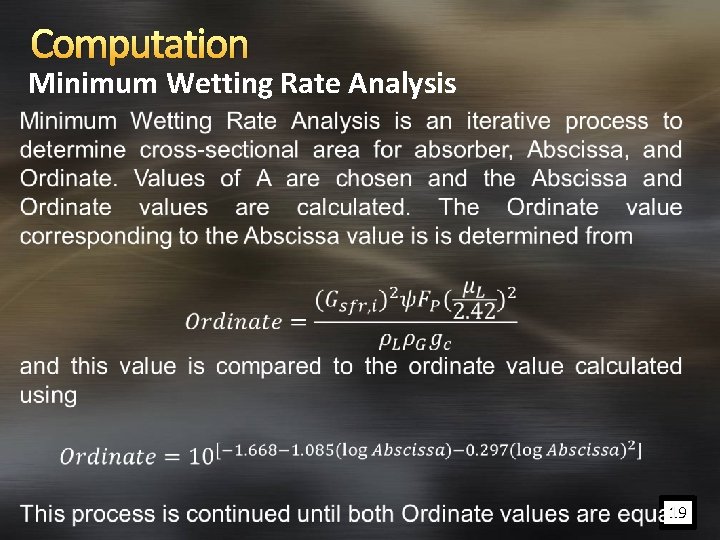
Computation Minimum Wetting Rate Analysis 19
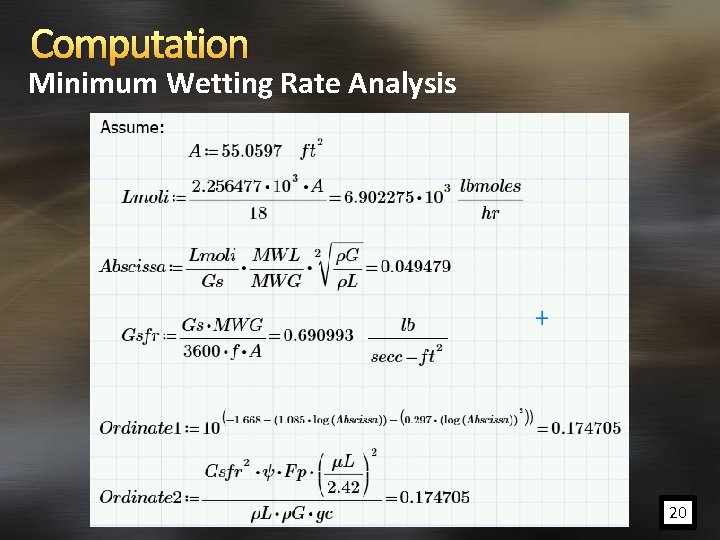
Computation Minimum Wetting Rate Analysis 20

Computation Determining Column Diameter and Absorption Factor 21
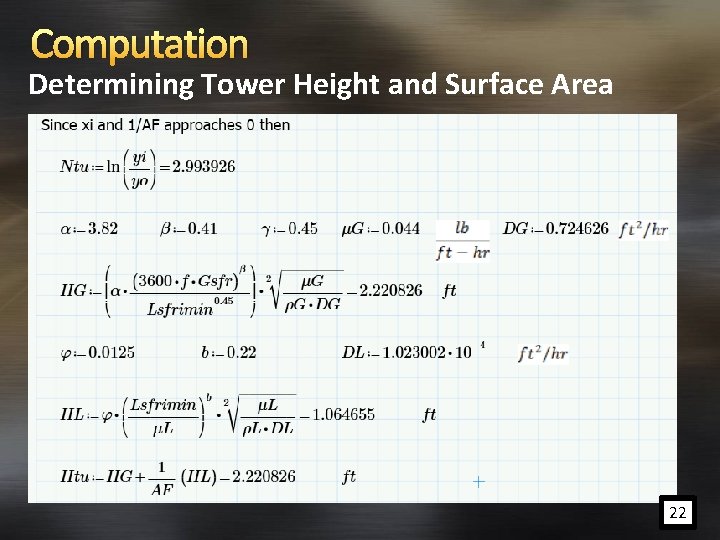
Computation Determining Tower Height and Surface Area 22
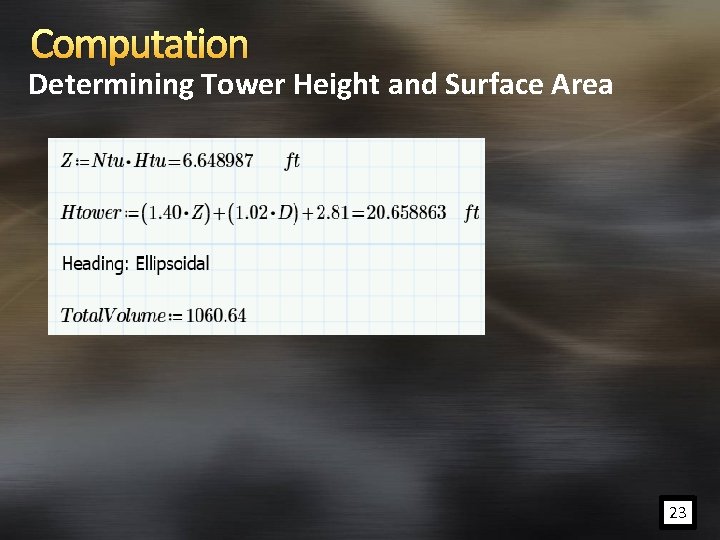
Computation Determining Tower Height and Surface Area 23
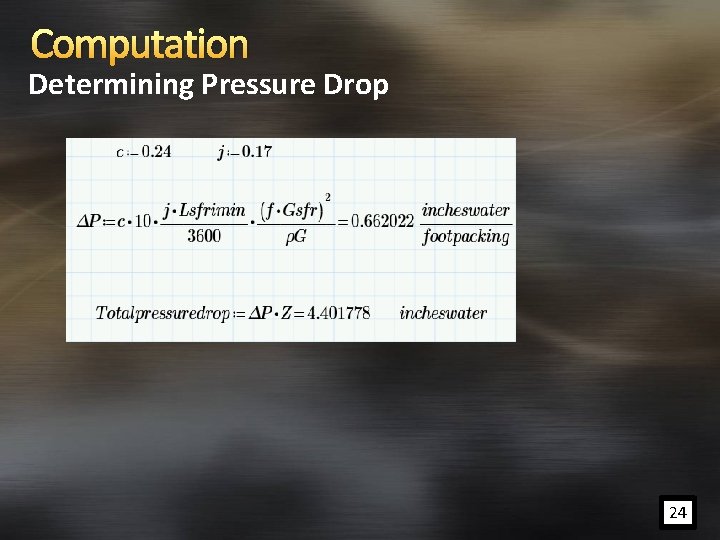
Computation Determining Pressure Drop 24
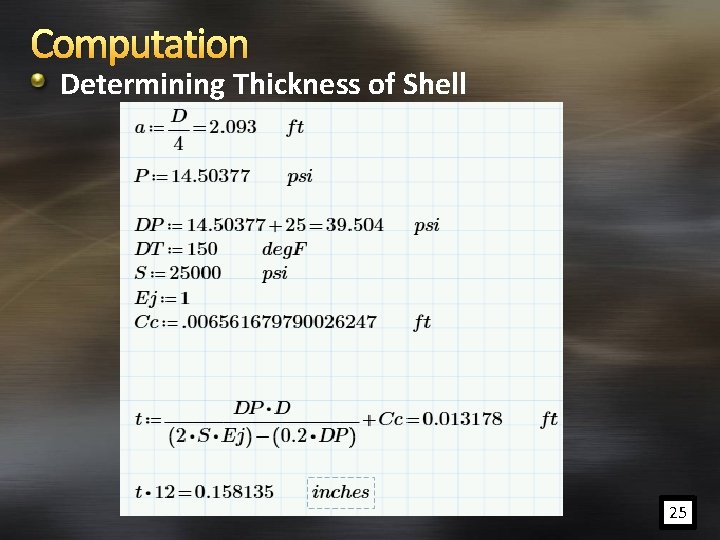
Computation Determining Thickness of Shell 25
26

27
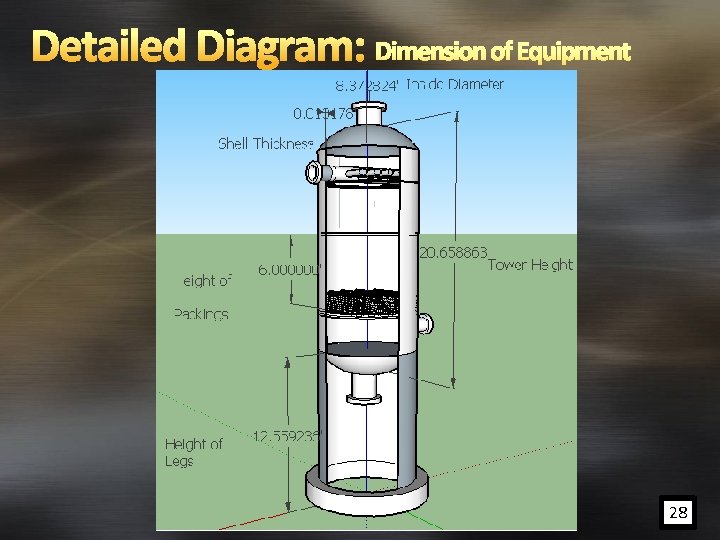
28
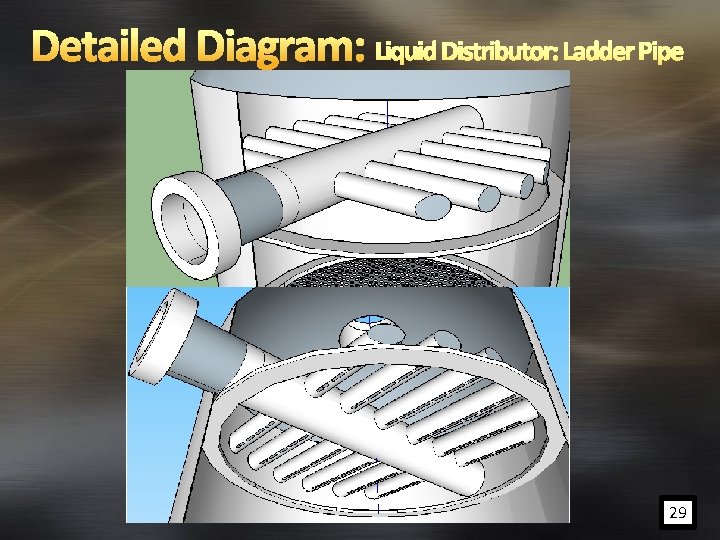
29
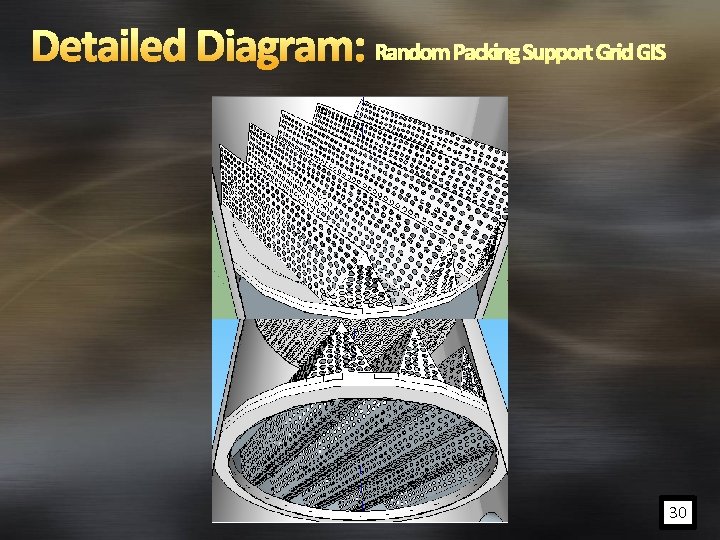
30
“EPA AIR POLLUTION CONTROL COST MANUAL”, United States Environmental Protection Agency Office of Air Quality Planning and Standards Research Triangle Park, North Carolina 27711 EPA/452/B-02001 “HASTELLOY C 276 (UNS N 10276)” High Performance Alloys, Inc. Retrived from: http: //www. hpalloy. com/Alloys/descriptions/HASTELLOYC_276. htm l “Packed Tower - High Performance Acid Gas Removal” Envitech, Inc. 2924 Emerson Street, San Diego, CA. Available from: http: //www. envitechinc. com/packed-tower Absorption of Hydrogen Chloride (n. d). [Graph illustration of Equilibrium Diagram for HCl-Water System]. Retrieved from http: //www. qvf. com/qvfprocess-systems/mineral-acids/absorption-of-hydrogen-chloride/ 31
![CIRCOR Instrumentation Technologies (CIT). Gyrolok® Flareless Tube Fittings Tubing Data Charts [Data File]. Retrived](http://slidetodoc.com/presentation_image_h/bc8bb3fa60432f20746b7cecc0ee71ac/image-33.jpg "CIRCOR Instrumentation Technologies (CIT). Gyrolok® Flareless Tube Fittings Tubing Data Charts [Data File]. Retrived")
CIRCOR Instrumentation Technologies (CIT). Gyrolok® Flareless Tube Fittings Tubing Data Charts [Data File]. Retrived from: http: //www. iceweb. com. au/tubings/tubingdatachart. pdf Coker, A. K. , “Understanding the Basics of Packed-Column Design”, Chemical Engineering Progress, November 1991, pp. 93 -99. Perry, R. H. and C. H. Chilton, Eds. , Chemical Engineers’ Handbook (Sixth edition), Mc. Graw-Hill Book Company, New York, 1984. R. L. , Earle (1983). “Unit Operations in Food Processing”. Published by NZIFST (Inc. ). Retrived from: http: //www. nzifst. org. nz/unitoperations/conteqseparation 8. htm 32
- Slides: 33