
PACKAGING COMPUTATIONAL BIOLOGY TOOLS FOR BROAD DISTRIBUTION AND
PACKAGING COMPUTATIONAL BIOLOGY TOOLS FOR BROAD DISTRIBUTION AND EASE-OFREUSE Matthew Vaughn @mattdotvaughn Director, Life Sciences Computing Texas Advanced Computing Center http: //www. slideshare. net/mattdotvaughn 1
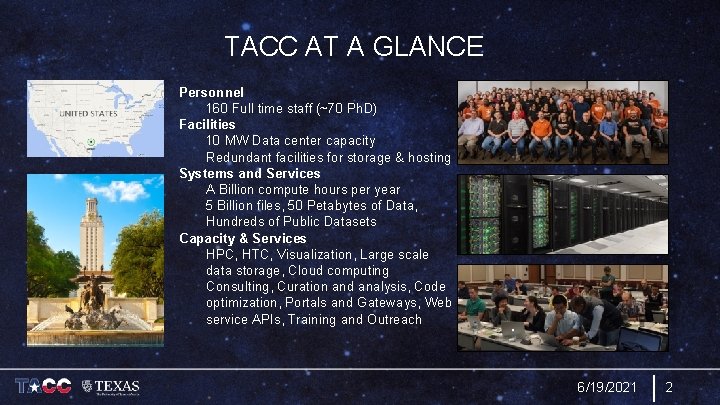
TACC AT A GLANCE Personnel 160 Full time staff (~70 Ph. D) Facilities 10 MW Data center capacity Redundant facilities for storage & hosting Systems and Services A Billion compute hours per year 5 Billion files, 50 Petabytes of Data, Hundreds of Public Datasets Capacity & Services HPC, HTC, Visualization, Large scale data storage, Cloud computing Consulting, Curation and analysis, Code optimization, Portals and Gateways, Web service APIs, Training and Outreach 6/19/2021 2
SCIENTIFIC COMPUTING: EARLY DAYS • • • C/C++/FORTRAN/PERL/SHELL MPI LAPACK/BLAS/PETSC SGE UNIX X 86/PPC/SPARC 6/19/2021 3
SCIENTIFIC COMPUTING: NOW LANGUAGES FRAMEWORKS HARDWARE • Python 2 & 3 • R • Julia • Perl • Matlab • Java • Scala, Clojure, etc • . NET • C/C++ • Swift • Haskell • Go • Javascript • Map. Reduce Hadoop, Storm, Pachyderm, Cloudera • Event & Streaming: Kinesis, Azure Stream Analytics, Camel, Streambase • Deep/Machine Learning: Watson, Azure BI, Tensorflow, Caffe • In-memory parsing: Kognito, Apache Spark • Containers: Docker, Rocket, MESOS, Kubernetes • Cloud: AWS, GCE, Open. Stack, v. Cloud, Azure • Many-core computing - 50 -100 threads/node* • Xeon / Xeon Phi • GPU • Open. Power • ARM • Shen. Wei • Multi-level memory architecture • Hierarchical storage • FPGAs • Quantum-like systems 6/19/2021 4
NOT JUST ONE DATA TSUNAMI BUT THOUSANDS OF THEM 6/19/2021 5

EMERGENCE OF CLOUD TECHNOLOGY AND BUSINESS MODELS 6/19/2021 6
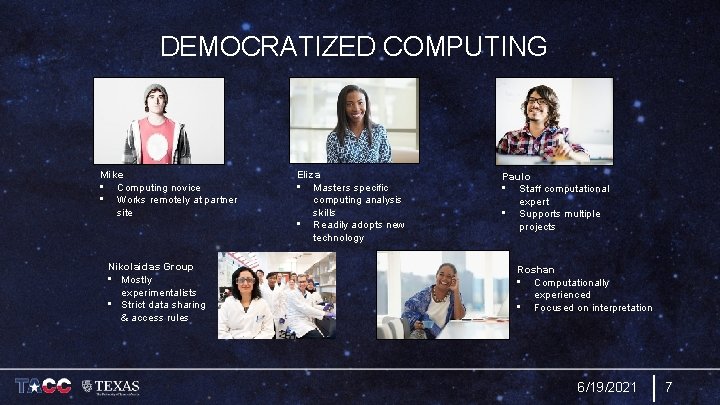
DEMOCRATIZED COMPUTING Mike • Computing novice • Works remotely at partner site Nikolaidas Group • Mostly experimentalists • Strict data sharing & access rules Eliza • Masters specific computing analysis skills • Readily adopts new technology Paulo • Staff computational expert • Supports multiple projects Roshan • Computationally experienced • Focused on interpretation 6/19/2021 7
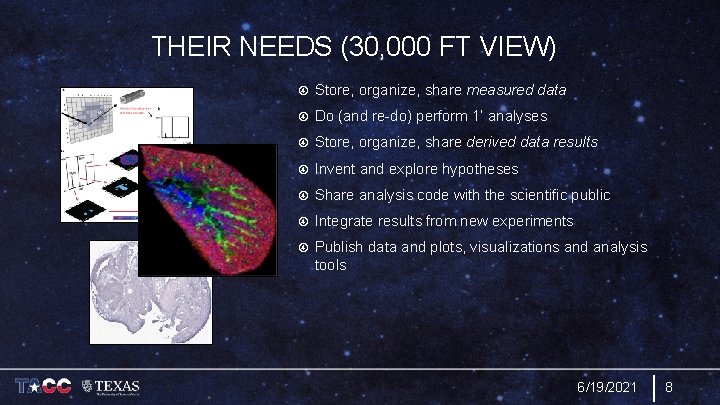
THEIR NEEDS (30, 000 FT VIEW) Store, organize, share measured data Do (and re-do) perform 1’ analyses Store, organize, share derived data results Invent and explore hypotheses Share analysis code with the scientific public Integrate results from new experiments Publish data and plots, visualizations and analysis tools 6/19/2021 8
THEIR NEEDS (500 FT VIEW) Data lifecycle management Fine-grained permissions and roles Discoverability Version control Domesticating promising new analysis codes Wrestling with immature technology Making their science internally reproducible Adopting efficient analytical methods 6/19/2021 9
HOW DO WE HELP RESEARCHERS WITH DIVERSE NEEDS AND BACKGROUNDS KEEP UP WITH ADVANCES IN COMPUTATIONAL BIOLOGY? 6/19/2021 10
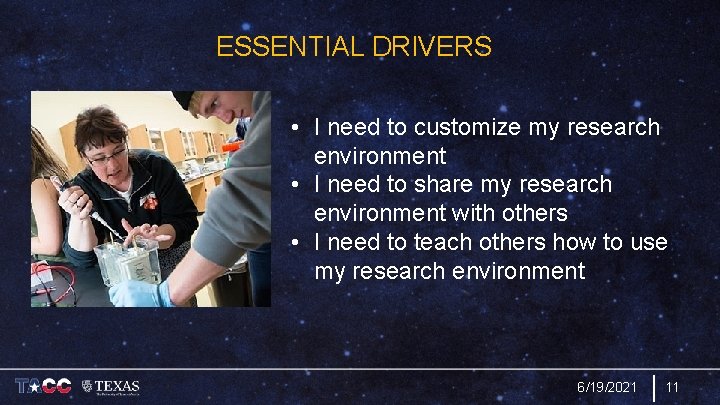
ESSENTIAL DRIVERS • I need to customize my research environment • I need to share my research environment with others • I need to teach others how to use my research environment 6/19/2021 11
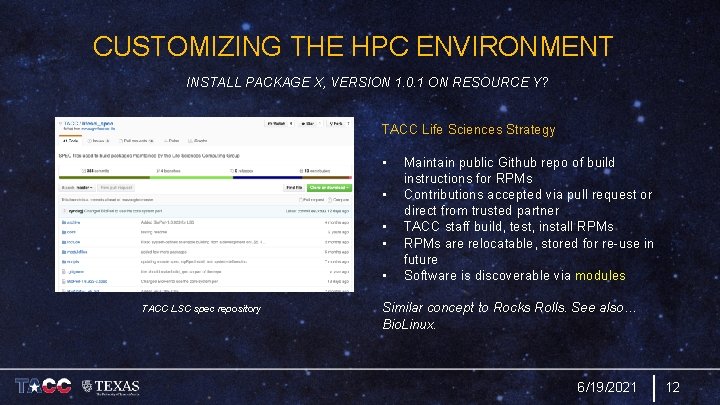
CUSTOMIZING THE HPC ENVIRONMENT INSTALL PACKAGE X, VERSION 1. 0. 1 ON RESOURCE Y? TACC Life Sciences Strategy • • • TACC LSC spec repository Maintain public Github repo of build instructions for RPMs Contributions accepted via pull request or direct from trusted partner TACC staff build, test, install RPMs are relocatable, stored for re-use in future Software is discoverable via modules Similar concept to Rocks Rolls. See also… Bio. Linux. 6/19/2021 12
PROS AND CONS PROS • Direct path for community contribution • Digital footprint is small: Spec files + RPM artifacts • Build instructions are discoverable, version controlled, attributable • Resulting digital artifacts are reusable on the host system CONS • Learning curve is steep. Need to master RPM build system plus host-specific build systems • TACC staff still have to build/test/deploy • SPEC files have dialects. Impedes portability between systems. • RPMs only work on target system. VERDICT: NOT HELPFUL AT ALL FOR TRAINING. DOES IMPROVE THE WORK ENVIRONMENT. 6/19/2021 13
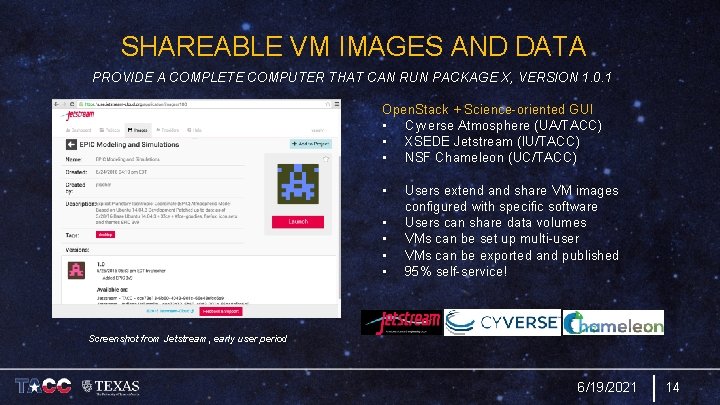
SHAREABLE VM IMAGES AND DATA PROVIDE A COMPLETE COMPUTER THAT CAN RUN PACKAGE X, VERSION 1. 0. 1 Open. Stack + Science-oriented GUI • Cyverse Atmosphere (UA/TACC) • XSEDE Jetstream (IU/TACC) • NSF Chameleon (UC/TACC) • • • Users extend and share VM images configured with specific software Users can share data volumes VMs can be set up multi-user VMs can be exported and published 95% self-service! Screenshot from Jetstream, early user period 6/19/2021 14
PROS AND CONS PROS • Entirely self-service VM image publishing • Versioned VM images plus extra metadata is good for reproducible analysis • Learning curve for USING the cloud system is shallow • Learning curve for building and sharing VMs is modest • Multiple operating systems are supported CONS • Portability between cloud providers is limited • Orchestrating 2+ VMs is very difficult • Digital footprint is the application plus OS, per version • Requires either purchase of commercial cloud capacity or sustained investment in private cloud (OS/Euc/Nebula) VERDICT: QUITE HELPFUL FOR TRAINING OR SOFTWARE SHARING, BUT… 6/19/2021 15
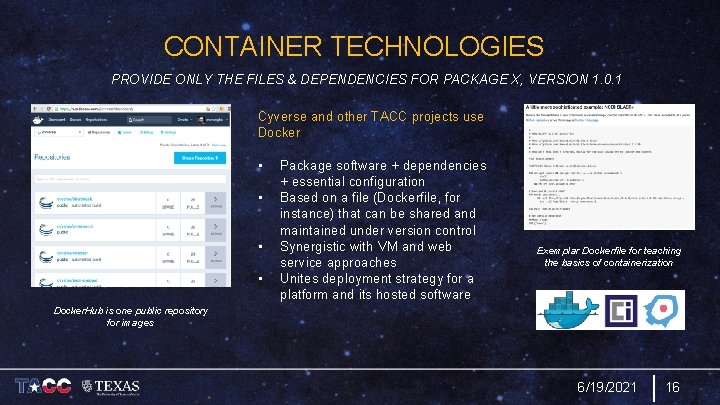
CONTAINER TECHNOLOGIES PROVIDE ONLY THE FILES & DEPENDENCIES FOR PACKAGE X, VERSION 1. 0. 1 Cyverse and other TACC projects use Docker • • Package software + dependencies + essential configuration Based on a file (Dockerfile, for instance) that can be shared and maintained under version control Synergistic with VM and web service approaches Unites deployment strategy for a platform and its hosted software Exemplar Dockerfile for teaching the basics of containerization Docker. Hub is one public repository for images 6/19/2021 16
PROS AND CONS PROS • Minimal storage footprint – just the deltas beyond base operating system footprint • Instructions for building images are plaintext files in a DSL • Images can be made FAIR via standards and public repositories • Students eagerly adopt docker run x: 1. 0. 1 command CONS • Usage requires reasonable understanding of key Linux technologies • Images themselves lack documentation and validation • Software must be based on Linux kernel 3. 10+ • Not optimized for large or persistent data • Most public-funded infrastructure does not support containers VERDICT: HELPFUL FOR SHARING AND TEACHING, IF USED & RESOURCED PROPERLY 6/19/2021 17
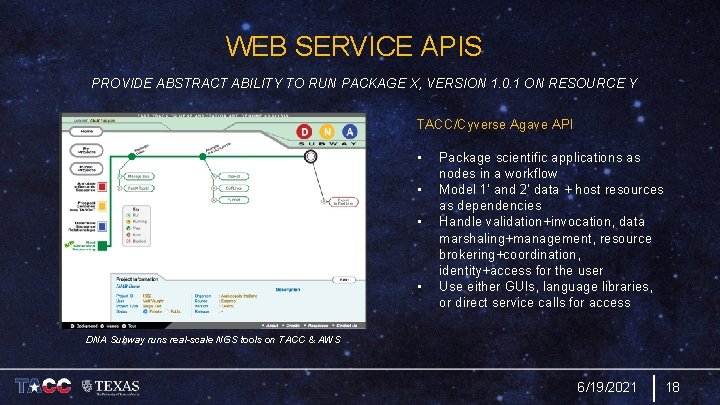
WEB SERVICE APIS PROVIDE ABSTRACT ABILITY TO RUN PACKAGE X, VERSION 1. 0. 1 ON RESOURCE Y TACC/Cyverse Agave API • • Package scientific applications as nodes in a workflow Model 1' and 2' data + host resources as dependencies Handle validation+invocation, data marshaling+management, resource brokering+coordination, identity+access for the user Use either GUIs, language libraries, or direct service calls for access DNA Subway runs real-scale NGS tools on TACC & AWS 6/19/2021 18
PROS AND CONS PROS • Digital footprint is small: Application + dependencies only • Compute and storage protocols are abstracted from end users • Provenance is captured and maintained CONS • Requires non-trivial investment by tool developers • Direct usage (not via portal) is challenging for end users • Expectation management and user support for end users is challenging • Requires sustained investment in maintaining the services platform in addition to its resources VERDICT: HELPFUL TO ENABLE USE OF REAL-SCALE TOOLS & DATA 6/19/2021 19
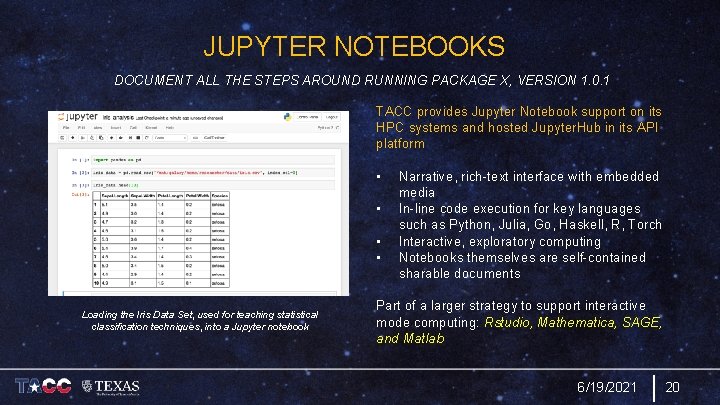
JUPYTER NOTEBOOKS DOCUMENT ALL THE STEPS AROUND RUNNING PACKAGE X, VERSION 1. 0. 1 TACC provides Jupyter Notebook support on its HPC systems and hosted Jupyter. Hub in its API platform • • Loading the Iris Data Set, used for teaching statistical classification techniques, into a Jupyter notebook Narrative, rich-text interface with embedded media In-line code execution for key languages such as Python, Julia, Go, Haskell, R, Torch Interactive, exploratory computing Notebooks themselves are self-contained sharable documents Part of a larger strategy to support interactive mode computing: Rstudio, Mathematica, SAGE, and Matlab 6/19/2021 20
PROS AND CONS PROS • Digital footprint is small: Notebooks are text docs • Narrative support plus interactive widgets are first-class aspects • Closest analog yet to team programming (but async!) CONS • Notebook infrastructure itself needs resourcing • Notebooks don’t natively provide the software or data dependencies for a given workflow • They also don’t scale (natively) • Need to train end users in how to use Notebooks + the specific bioinformatics skills VERDICT: FANTASTIC PLATFORM TO AUTHOR INTERACTIVE TUTORIALS & GUIDES, BUT… 6/19/2021 21
NO SILVER BULLETS § § § Installable RPMs aren’t that easy to build VM s aren’t always portable or scalable Jupyter Notebooks need pre-configured hosts Containers need support for persistent data The cloud is an abstraction for “someone else’s problem” THESE TOOLS COMPLEMENT ONE ANOTHER Bioinformatics training 6/19/2021 22
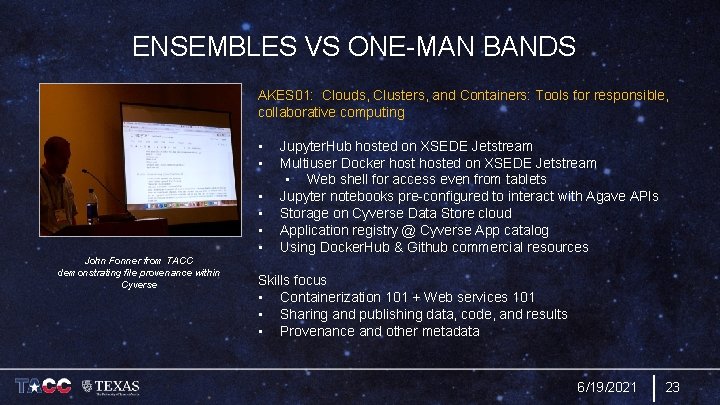
ENSEMBLES VS ONE-MAN BANDS AKES 01: Clouds, Clusters, and Containers: Tools for responsible, collaborative computing • • • John Fonner from TACC demonstrating file provenance within Cyverse Jupyter. Hub hosted on XSEDE Jetstream Multiuser Docker hosted on XSEDE Jetstream • Web shell for access even from tablets Jupyter notebooks pre-configured to interact with Agave APIs Storage on Cyverse Data Store cloud Application registry @ Cyverse App catalog Using Docker. Hub & Github commercial resources Skills focus • Containerization 101 + Web services 101 • Sharing and publishing data, code, and results • Provenance and other metadata 6/19/2021 23

QUESTIONS AND DISCUSSIONS 6/19/2021 24
- Slides: 24