
Packages The primary purpose of a package is
![Function body FUNCTION function_name [<parameter list>] RETURN data_type is [declaration] Begin [sequential statements] END](https://slidetodoc.com/presentation_image/7160986a70d05b4e7bb03285c0ea6411/image-12.jpg "Function body FUNCTION function_name [<parameter list>] RETURN data_type is [declaration] Begin [sequential statements] END")
![Function body (cont. . ) • <parameter list> = [CONSTANT] constant_name: constant_type; or •](https://slidetodoc.com/presentation_image/7160986a70d05b4e7bb03285c0ea6411/image-13.jpg "Function body (cont. . ) • <parameter list> = [CONSTANT] constant_name: constant_type; or •")
![Procedure body Procedure procedure_name [<parameter list>] is [declarations] Begin (sequential statements) End procedure_name; 16/11/2006](https://slidetodoc.com/presentation_image/7160986a70d05b4e7bb03285c0ea6411/image-25.jpg "Procedure body Procedure procedure_name [<parameter list>] is [declarations] Begin (sequential statements) End procedure_name; 16/11/2006")
![<parameter list> • <parameter list> = [CONSTANT] constant_name: mode type • <parameter list> =](https://slidetodoc.com/presentation_image/7160986a70d05b4e7bb03285c0ea6411/image-27.jpg "<parameter list> • <parameter list> = [CONSTANT] constant_name: mode type • <parameter list> =")
- Slides: 29
Packages • The primary purpose of a package is to encapsulate elements that can be shred (globally) among two or more design units. • A package is a common storage area used to hold data to be shared among a number of entities • Declaring data inside of a package allows the data to be referenced by other entities; thus data can be shared. 16/11/2006 DSD, USIT, GGSIPU 1
Package (cont. . ) • A package consists of two parts: – A package declaration section – A package body 16/11/2006 DSD, USIT, GGSIPU 2
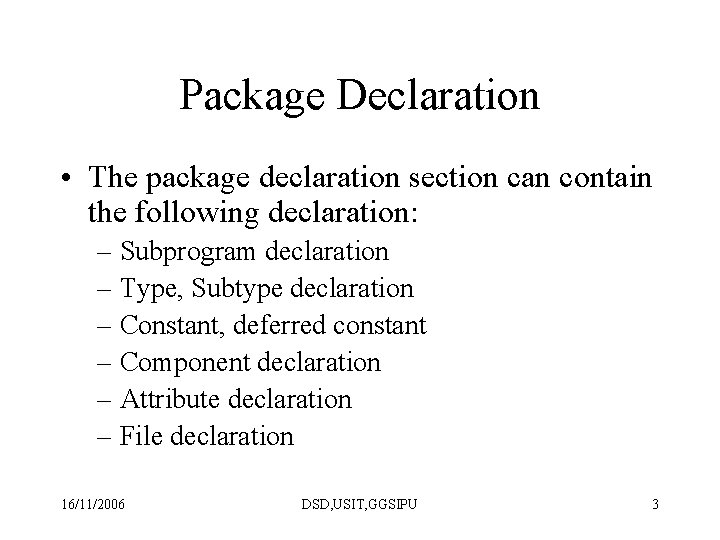
Package Declaration • The package declaration section can contain the following declaration: – Subprogram declaration – Type, Subtype declaration – Constant, deferred constant – Component declaration – Attribute declaration – File declaration 16/11/2006 DSD, USIT, GGSIPU 3
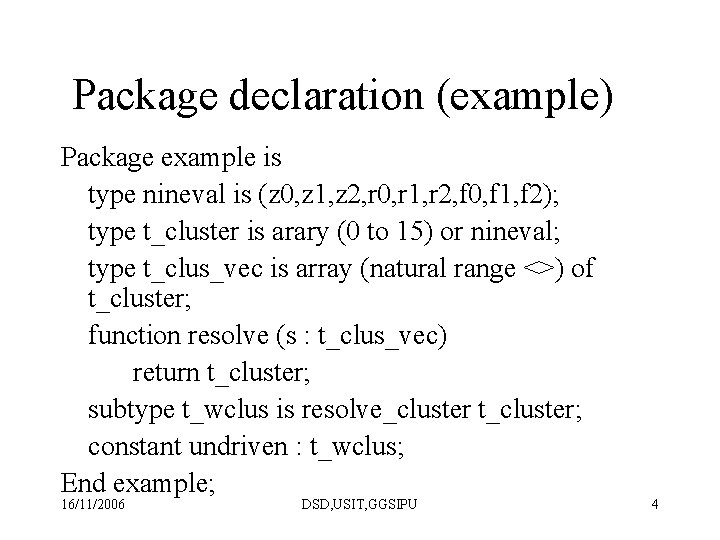
Package declaration (example) Package example is type nineval is (z 0, z 1, z 2, r 0, r 1, r 2, f 0, f 1, f 2); type t_cluster is arary (0 to 15) or nineval; type t_clus_vec is array (natural range <>) of t_cluster; function resolve (s : t_clus_vec) return t_cluster; subtype t_wclus is resolve_cluster t_cluster; constant undriven : t_wclus; End example; 16/11/2006 DSD, USIT, GGSIPU 4
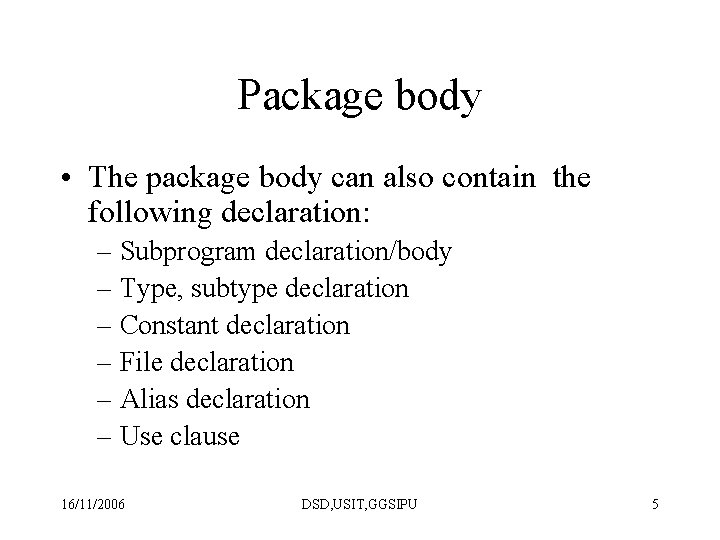
Package body • The package body can also contain the following declaration: – Subprogram declaration/body – Type, subtype declaration – Constant declaration – File declaration – Alias declaration – Use clause 16/11/2006 DSD, USIT, GGSIPU 5
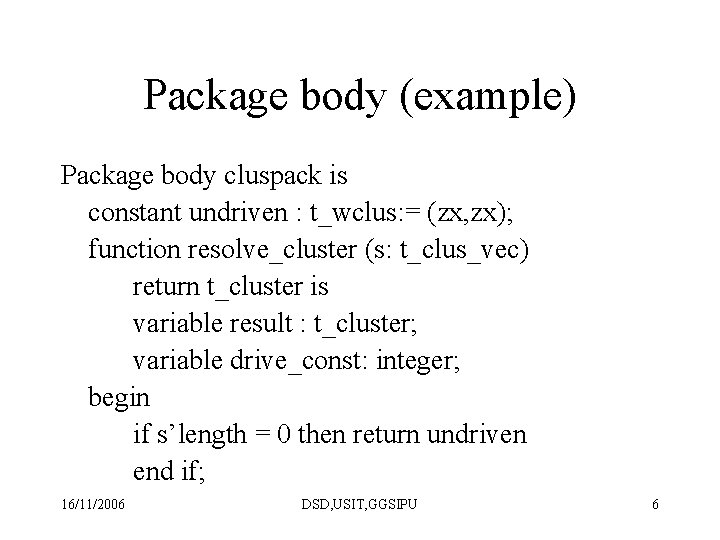
Package body (example) Package body cluspack is constant undriven : t_wclus: = (zx, zx); function resolve_cluster (s: t_clus_vec) return t_cluster is variable result : t_cluster; variable drive_const: integer; begin if s’length = 0 then return undriven end if; 16/11/2006 DSD, USIT, GGSIPU 6
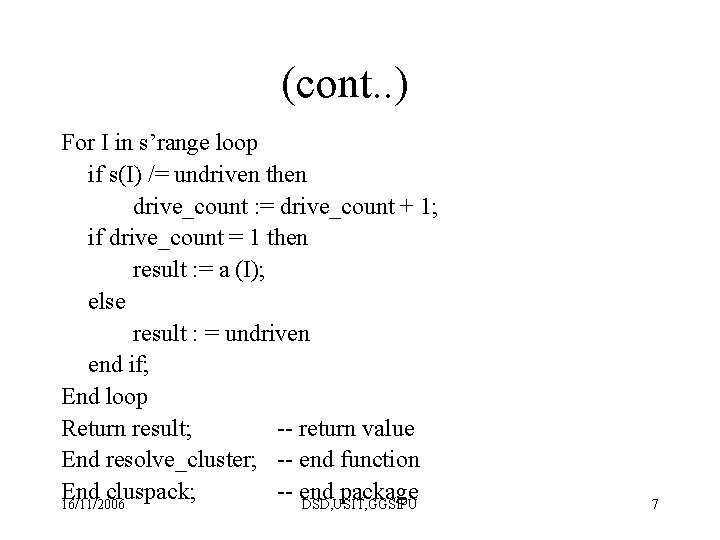
(cont. . ) For I in s’range loop if s(I) /= undriven then drive_count : = drive_count + 1; if drive_count = 1 then result : = a (I); else result : = undriven end if; End loop Return result; -- return value End resolve_cluster; -- end function End cluspack; -- end package 16/11/2006 DSD, USIT, GGSIPU 7
Subprograms • Subprograms consist of – Procedure – Function 16/11/2006 DSD, USIT, GGSIPU 8
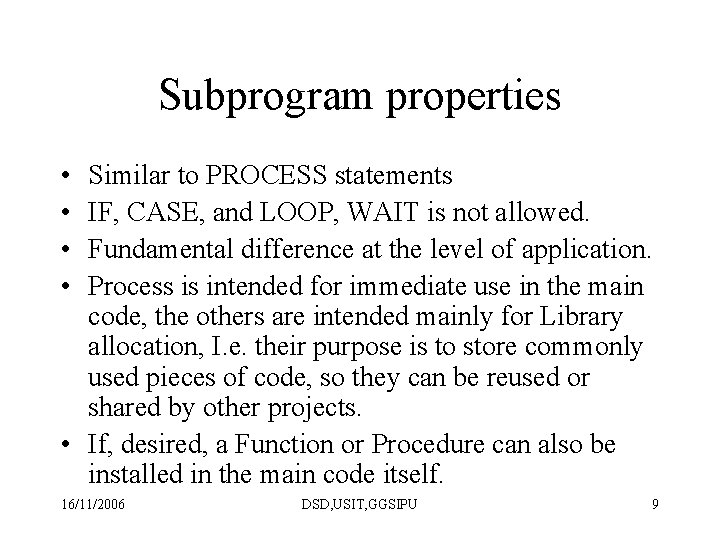
Subprogram properties • • Similar to PROCESS statements IF, CASE, and LOOP, WAIT is not allowed. Fundamental difference at the level of application. Process is intended for immediate use in the main code, the others are intended mainly for Library allocation, I. e. their purpose is to store commonly used pieces of code, so they can be reused or shared by other projects. • If, desired, a Function or Procedure can also be installed in the main code itself. 16/11/2006 DSD, USIT, GGSIPU 9
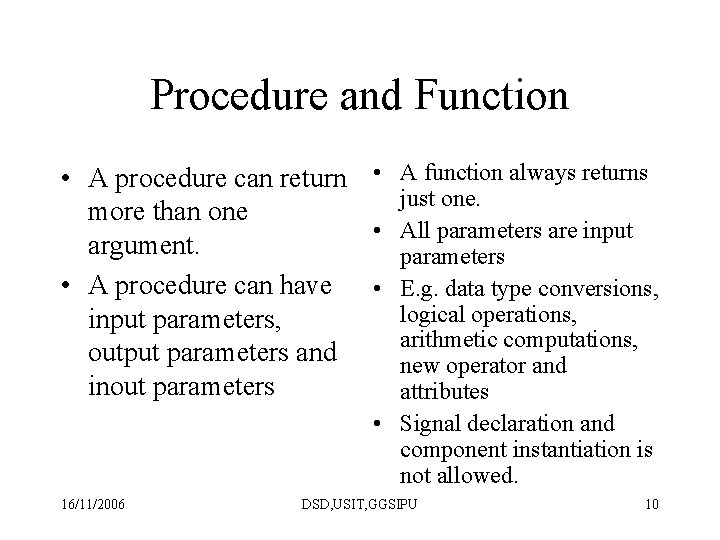
Procedure and Function • A procedure can return • A function always returns just one. more than one • All parameters are input argument. parameters • A procedure can have • E. g. data type conversions, logical operations, input parameters, arithmetic computations, output parameters and new operator and inout parameters attributes • Signal declaration and component instantiation is not allowed. 16/11/2006 DSD, USIT, GGSIPU 10
Function syntax • To construct and use of a function, two parts are necessary: – The function body and – A call to the function 16/11/2006 DSD, USIT, GGSIPU 11
Function body FUNCTION function_name [<parameter list>] RETURN data_type is [declaration] Begin [sequential statements] END function_name; 16/11/2006 DSD, USIT, GGSIPU 12
Function body (cont. . ) • <parameter list> = [CONSTANT] constant_name: constant_type; or • • <parameter list>= SIGNAL signal_name: signal_type; VARIABLES are not allowed. There can be any type of synthesizable data types. No range specification should be included (e. g. do not enter range when using INTEGER or TO/Down to when using std_logic_vector) • There is only one return value, whose type is specified by data_type. 16/11/2006 DSD, USIT, GGSIPU 13
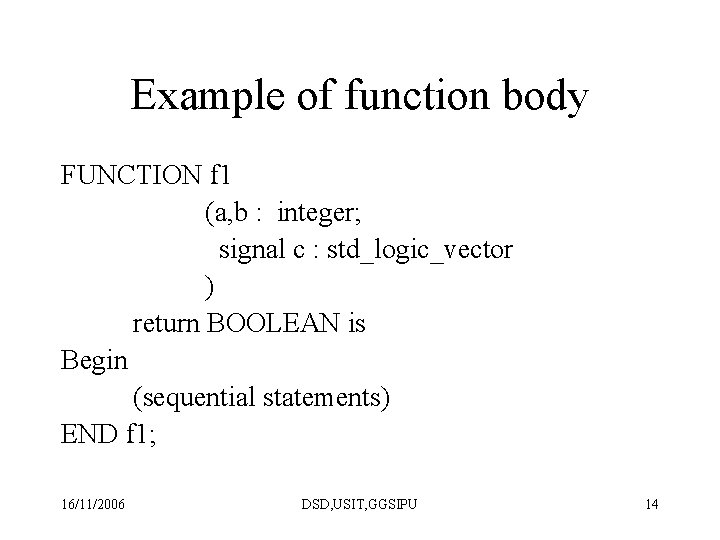
Example of function body FUNCTION f 1 (a, b : integer; signal c : std_logic_vector ) return BOOLEAN is Begin (sequential statements) END f 1; 16/11/2006 DSD, USIT, GGSIPU 14
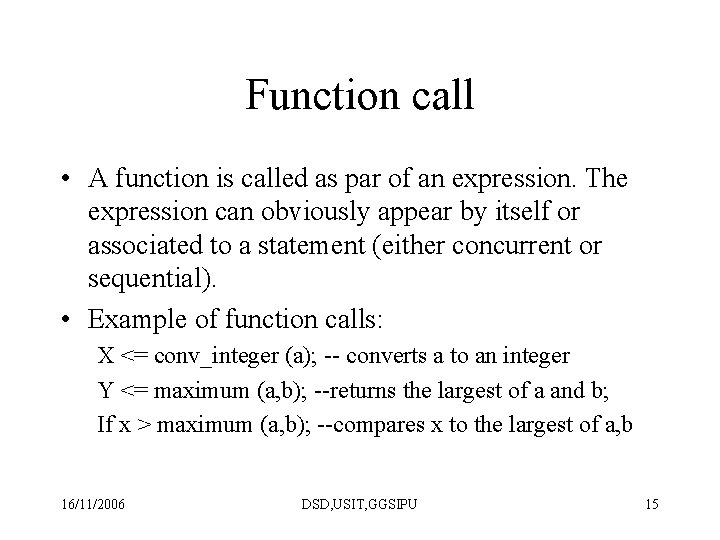
Function call • A function is called as par of an expression. The expression can obviously appear by itself or associated to a statement (either concurrent or sequential). • Example of function calls: X <= conv_integer (a); -- converts a to an integer Y <= maximum (a, b); --returns the largest of a and b; If x > maximum (a, b); --compares x to the largest of a, b 16/11/2006 DSD, USIT, GGSIPU 15
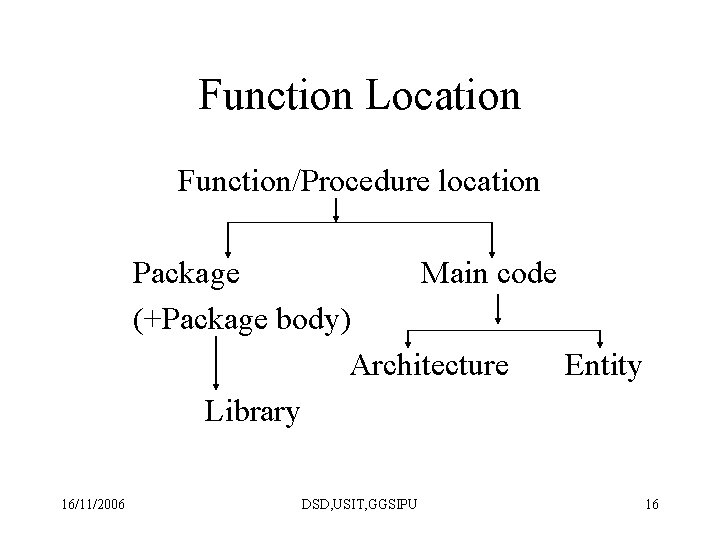
Function Location Function/Procedure location Package Main code (+Package body) Architecture Entity Library 16/11/2006 DSD, USIT, GGSIPU 16
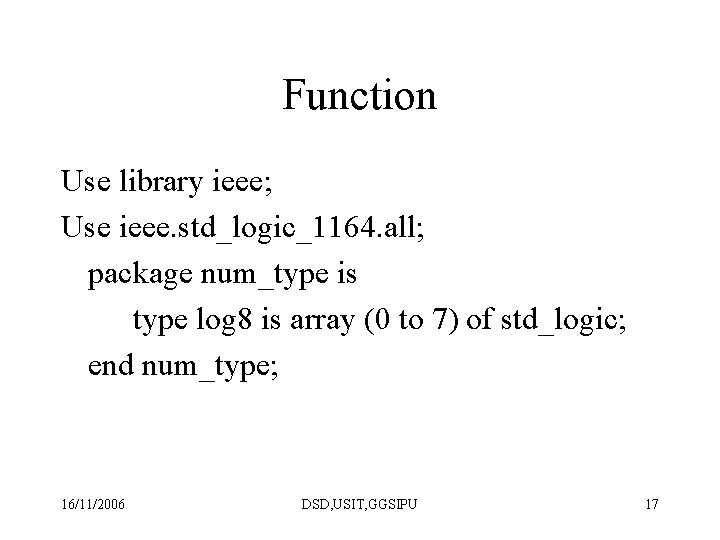
Function Use library ieee; Use ieee. std_logic_1164. all; package num_type is type log 8 is array (0 to 7) of std_logic; end num_type; 16/11/2006 DSD, USIT, GGSIPU 17
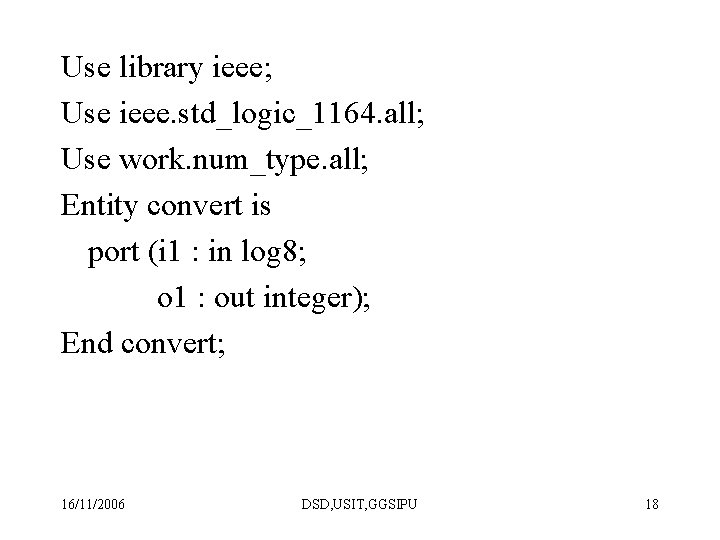
Use library ieee; Use ieee. std_logic_1164. all; Use work. num_type. all; Entity convert is port (i 1 : in log 8; o 1 : out integer); End convert; 16/11/2006 DSD, USIT, GGSIPU 18
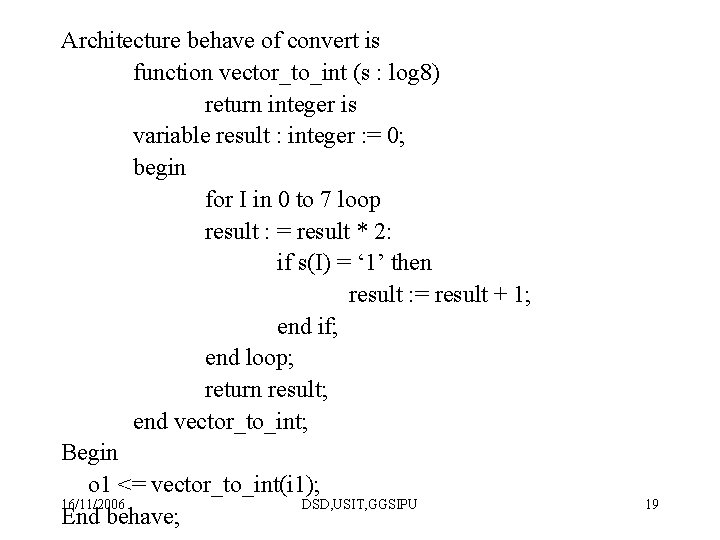
Architecture behave of convert is function vector_to_int (s : log 8) return integer is variable result : integer : = 0; begin for I in 0 to 7 loop result : = result * 2: if s(I) = ‘ 1’ then result : = result + 1; end if; end loop; return result; end vector_to_int; Begin o 1 <= vector_to_int(i 1); 16/11/2006 DSD, USIT, GGSIPU End behave; 19
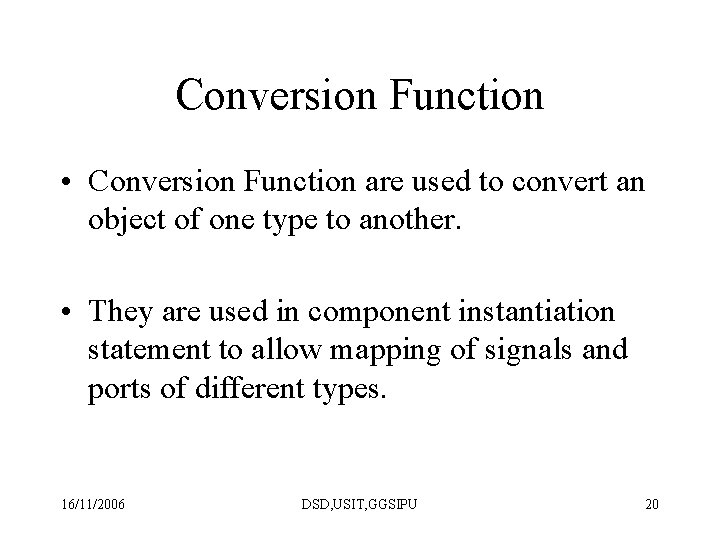
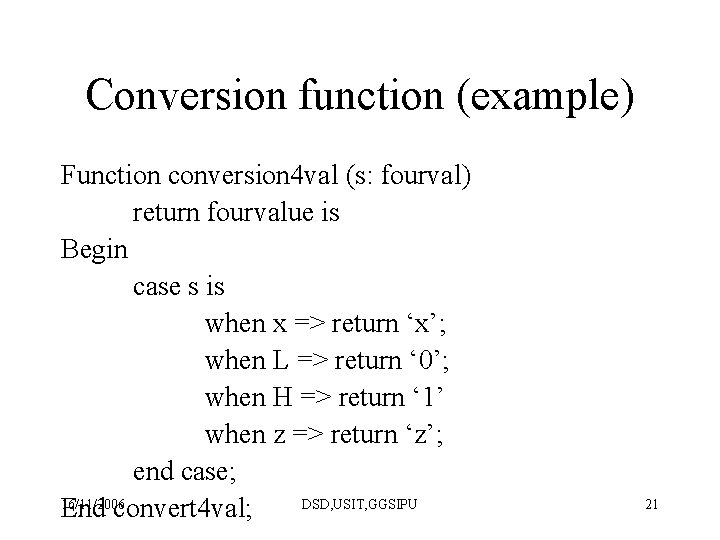
Conversion Function • Conversion Function are used to convert an object of one type to another. • They are used in component instantiation statement to allow mapping of signals and ports of different types. 16/11/2006 DSD, USIT, GGSIPU 20
Conversion function (example) Function conversion 4 val (s: fourval) return fourvalue is Begin case s is when x => return ‘x’; when L => return ‘ 0’; when H => return ‘ 1’ when z => return ‘z’; end case; 16/11/2006 DSD, USIT, GGSIPU End convert 4 val; 21
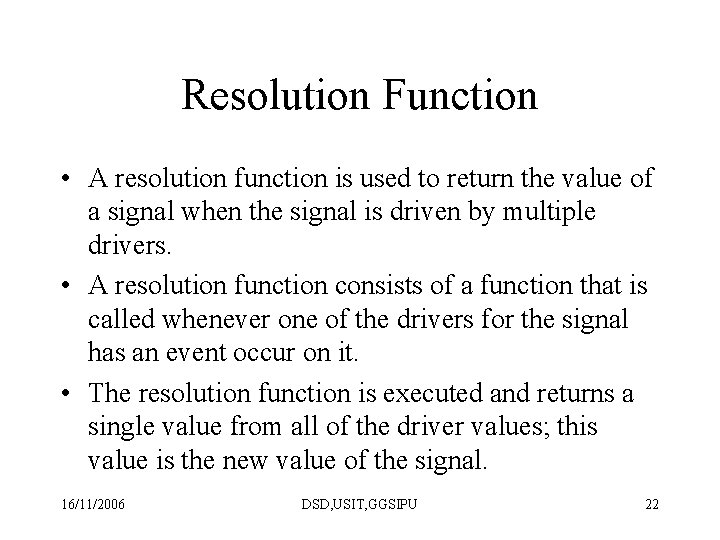
Resolution Function • A resolution function is used to return the value of a signal when the signal is driven by multiple drivers. • A resolution function consists of a function that is called whenever one of the drivers for the signal has an event occur on it. • The resolution function is executed and returns a single value from all of the driver values; this value is the new value of the signal. 16/11/2006 DSD, USIT, GGSIPU 22
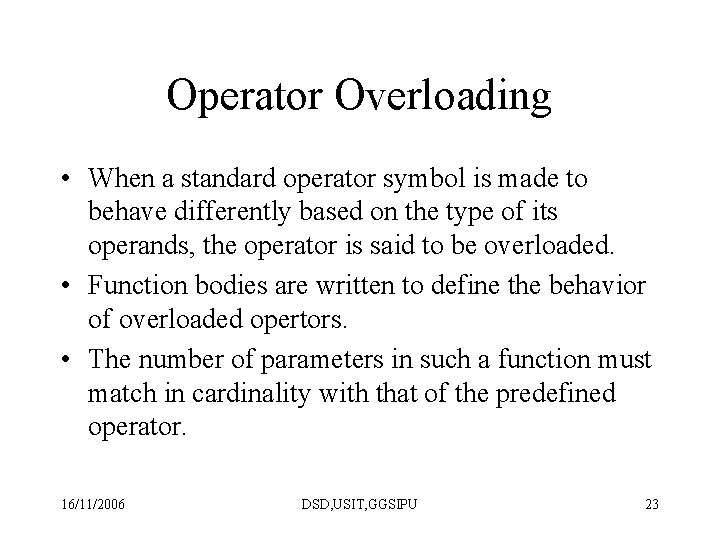
Operator Overloading • When a standard operator symbol is made to behave differently based on the type of its operands, the operator is said to be overloaded. • Function bodies are written to define the behavior of overloaded opertors. • The number of parameters in such a function must match in cardinality with that of the predefined operator. 16/11/2006 DSD, USIT, GGSIPU 23
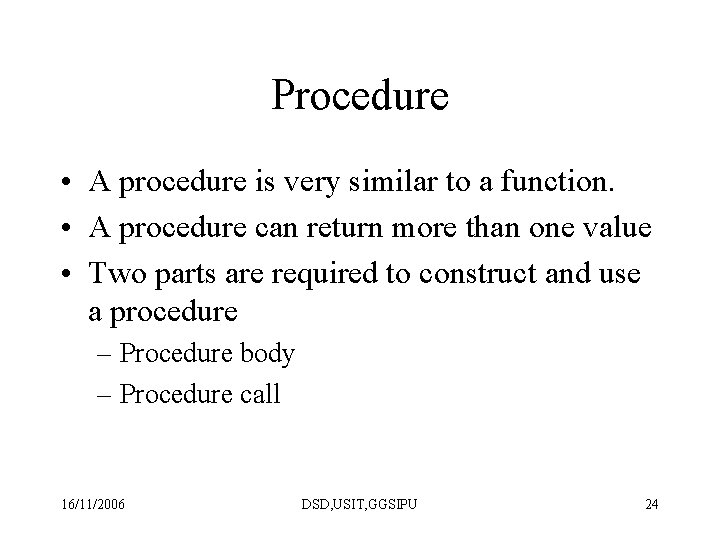
Procedure • A procedure is very similar to a function. • A procedure can return more than one value • Two parts are required to construct and use a procedure – Procedure body – Procedure call 16/11/2006 DSD, USIT, GGSIPU 24
Procedure body Procedure procedure_name [<parameter list>] is [declarations] Begin (sequential statements) End procedure_name; 16/11/2006 DSD, USIT, GGSIPU 25
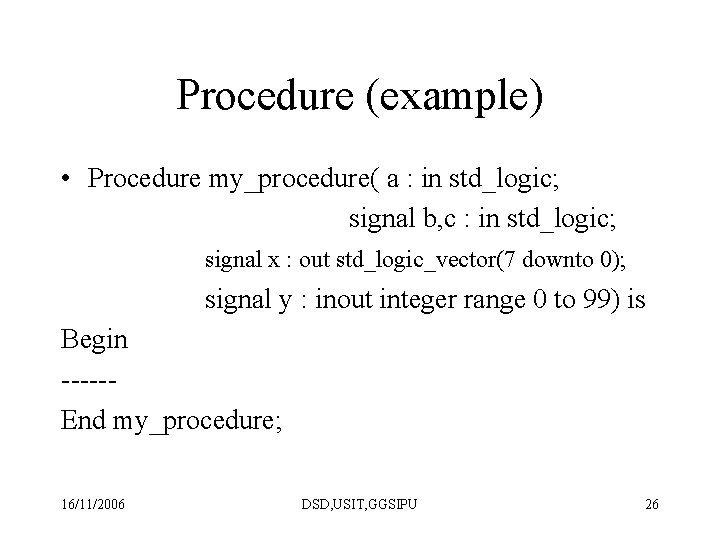
Procedure (example) • Procedure my_procedure( a : in std_logic; signal b, c : in std_logic; signal x : out std_logic_vector(7 downto 0); signal y : inout integer range 0 to 99) is Begin -----End my_procedure; 16/11/2006 DSD, USIT, GGSIPU 26
<parameter list> • <parameter list> = [CONSTANT] constant_name: mode type • <parameter list> = SIGNAL signal_name: mode type; or • <parameter list> = VARIABLE variable_name : mode type • A procedure can have any number of IN, OUT or INOUT parameters, Which can be SIGNALS, VARIABLES, or CONSTANTS. 16/11/2006 DSD, USIT, GGSIPU 27
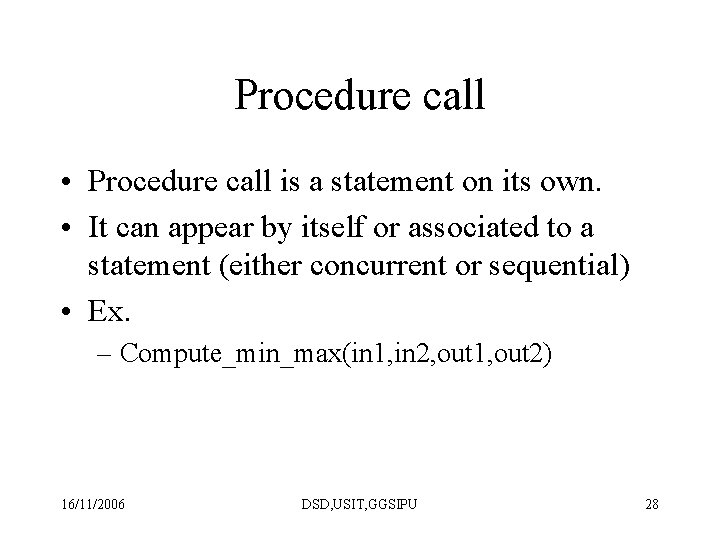
Procedure call • Procedure call is a statement on its own. • It can appear by itself or associated to a statement (either concurrent or sequential) • Ex. – Compute_min_max(in 1, in 2, out 1, out 2) 16/11/2006 DSD, USIT, GGSIPU 28
Procedure Location • The typical locations of a procedure are the same as those of a function. 16/11/2006 DSD, USIT, GGSIPU 29