
Pacing Guides Grade 2 Quarter 1 Students read
- Slides: 4
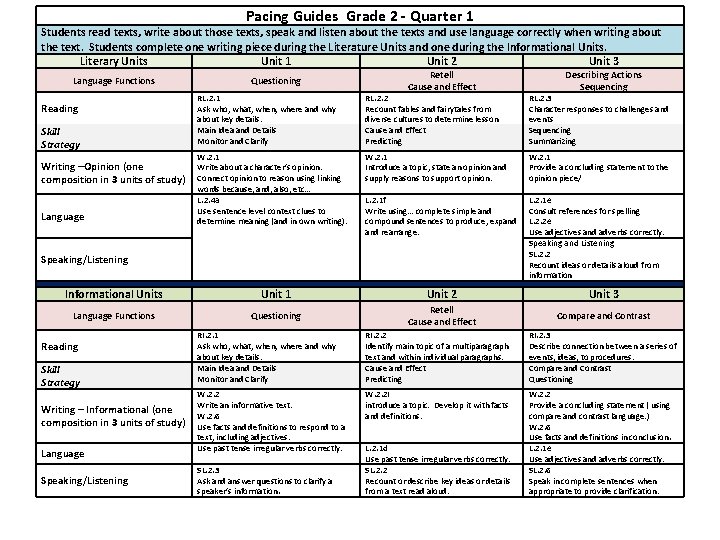
Pacing Guides Grade 2 - Quarter 1 Students read texts, write about those texts, speak and listen about the texts and use language correctly when writing about the text. Students complete one writing piece during the Literature Units and one during the Informational Units. Literary Units Unit 1 Unit 2 Unit 3 Language Functions Reading Skill Strategy Writing –Opinion (one composition in 3 units of study) Language Questioning Retell Cause and Effect Describing Actions Sequencing RL. 2. 1 Ask who, what, when, where and why about key details. Main Idea and Details Monitor and Clarify RL. 2. 2 Recount fables and fairytales from diverse cultures to determine lesson Cause and Effect Predicting RL. 2. 3 Character responses to challenges and events Sequencing Summarizing W. 2. 1 Write about a character’s opinion. Connect opinion to reason using linking words because, and, also, etc… L. 2. 4 a Use sentence level context clues to determine meaning (and in own writing). W. 2. 1 Introduce a topic, state an opinion and supply reasons to support opinion. W. 2. 1 Provide a concluding statement to the opinion piece/ L. 2. 1 f Write using… complete simple and compound sentences to produce, expand rearrange. L. 2. 1 e Consult references for spelling L. 2. 2 e Use adjectives and adverbs correctly. Speaking and Listening SL. 2. 2 Recount ideas or details aloud from information Speaking/Listening Informational Units Unit 1 Unit 2 Unit 3 Language Functions Questioning Retell Cause and Effect Compare and Contrast Reading Skill Strategy Writing – Informational (one composition in 3 units of study) Language Speaking/Listening RI. 2. 1 Ask who, what, when, where and why about key details. Main Idea and Details Monitor and Clarify RI. 2. 2 Identify main topic of a multiparagraph text and within individual paragraphs. Cause and Effect Predicting RI. 2. 3 Describe connection between a series of events, ideas, to procedures. Compare and Contrast Questioning W. 2. 2 Write an informative text. W. 2. 6 Use facts and definitions to respond to a text, including adjectives. Use past tense irregular verbs correctly. W. 2. 2 I introduce a topic. Develop it with facts and definitions. W. 2. 2 Provide a concluding statement ( using compare and contrast language. ) W. 2. 6 Use facts and definitions in conclusion. L. 2. 1 e Use adjectives and adverbs correctly. SL. 2. 6 Speak in complete sentences when appropriate to provide clarification. SL. 2. 3 Ask and answer questions to clarify a speaker’s information. L. 2. 1 d Use past tense irregular verbs correctly. SL. 2. 2 Recount or describe key ideas or details from a text read aloud.
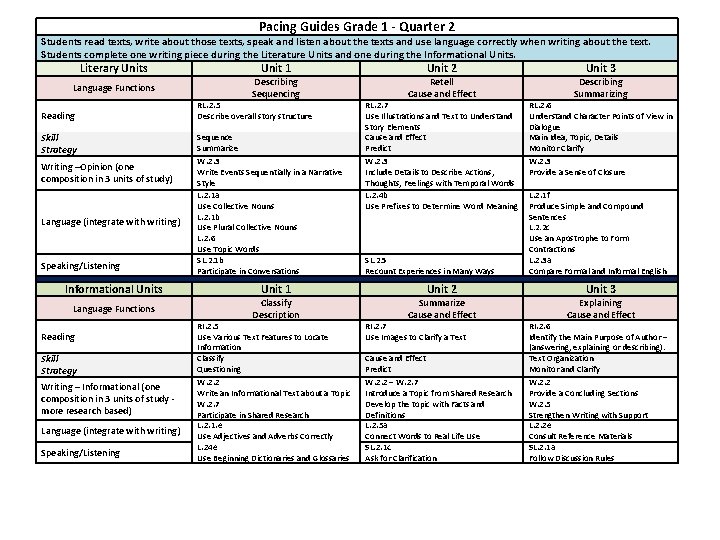
Pacing Guides Grade 1 - Quarter 2 Students read texts, write about those texts, speak and listen about the texts and use language correctly when writing about the text. Students complete one writing piece during the Literature Units and one during the Informational Units. Literary Units Language Functions Reading Skill Strategy Writing –Opinion (one composition in 3 units of study) Language (integrate with writing) Speaking/Listening Informational Units Language Functions Reading Skill Strategy Writing – Informational (one composition in 3 units of study more research based) Language (integrate with writing) Speaking/Listening Unit 1 Describing Sequencing RL. 2. 5 Describe overall story structure Sequence Summarize W. 2. 3 Write Events Sequentially in a Narrative Style L. 2. 1 a Use Collective Nouns L. 2. 1 b Use Plural Collective Nouns L. 2. 6 Use Topic Words SL. 2. 1 b Participate in Conversations Unit 1 Classify Description RI. 2. 5 Use Various Text Features to Locate Information Classify Questioning W. 2. 2 Write an Informational Text about a Topic W. 2. 7 Participate in Shared Research L. 2. 1. e Use Adjectives and Adverbs Correctly L. 24 e Use Beginning Dictionaries and Glossaries Unit 2 Retell Cause and Effect RL. 2. 7 Use Illustrations and Text to Understand Story Elements Cause and Effect Predict W. 2. 3 Include Details to Describe Actions, Thoughts, Feelings with Temporal Words L. 2. 4 b Use Prefixes to Determine Word Meaning SL. 2. 5 Recount Experiences in Many Ways Unit 2 Summarize Cause and Effect RI. 2. 7 Use Images to Clarify a Text Cause and Effect Predict W. 2. 2 – W. 2. 7 Introduce a Topic from Shared Research Develop the topic with Facts and Definitions L. 2. 5 a Connect Words to Real Life Use SL. 2. 1 c Ask for Clarification Unit 3 Describing Summarizing RL. 2. 6 Understand Character Points of View in Dialogue Main Idea, Topic, Details Monitor Clarify W. 2. 3 Provide a Sense of Closure L. 2. 1 f Produce Simple and Compound Sentences L. 2. 2 c Use an Apostrophe to Form Contractions L. 2. 3 a Compare Formal and Informal English Unit 3 Explaining Cause and Effect RI. 2. 6 Identify the Main Purpose of Author – (answering, explaining or describing). Text Organization Monitor and Clarify W. 2. 2 Provide a Concluding Sections W. 2. 5 Strengthen Writing with Support L. 2. 2 e Consult Reference Materials SL. 2. 1 a Follow Discussion Rules
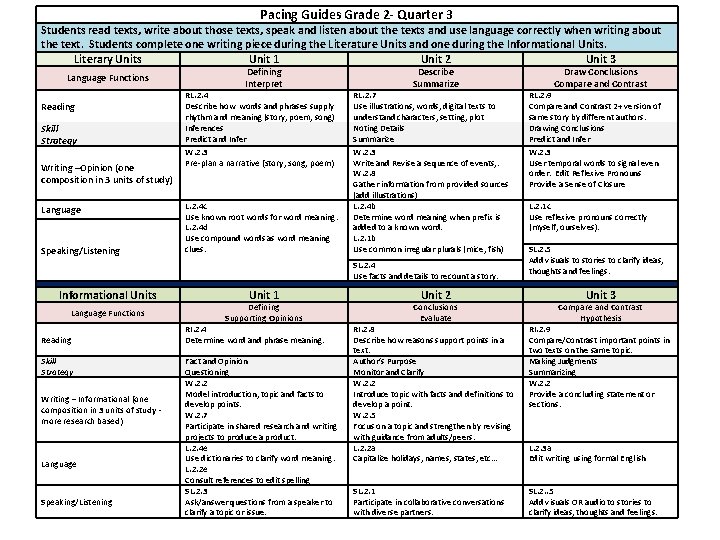
Pacing Guides Grade 2 - Quarter 3 Students read texts, write about those texts, speak and listen about the texts and use language correctly when writing about the text. Students complete one writing piece during the Literature Units and one during the Informational Units. Literary Units Unit 1 Unit 2 Unit 3 Language Functions Reading Skill Strategy Writing –Opinion (one composition in 3 units of study) Language Speaking/Listening Defining Interpret RL. 2. 4 Describe how words and phrases supply rhythm and meaning (story, poem, song) Inferences Predict and Infer W. 2. 3 Pre-plan a narrative (story, song, poem) L. 2. 4 c Use known root words for word meaning. L. 2. 4 d Use compound words as word meaning clues. Describe Summarize RL. 2. 7 Use illustrations, words, digital texts to understand characters, setting, plot Noting Details Summarize W. 2. 3 Write and Revise a sequence of events, . W. 2. 8 Gather information from provided sources (add illustrations) L. 2. 4 b Determine word meaning when prefix is added to a known word. L. 2. 1 b Use common irregular plurals (mice, fish) SL. 2. 4 Use facts and details to recount a story. Informational Units Language Functions Reading Skill Strategy Writing – Informational (one composition in 3 units of study more research based) Language Speaking/Listening Unit 1 Defining Supporting Opinions RI. 2. 4 Determine word and phrase meaning. Fact and Opinion Questioning W. 2. 2 Model introduction, topic and facts to develop points. W. 2. 7 Participate in shared research and writing projects to produce a product. L. 2. 4 e Use dictionaries to clarify word meaning. L. 2. 2 e Consult references to edit spelling SL. 2. 3 Ask/answer questions from a speaker to clarify a topic or issue. Unit 2 Conclusions Evaluate Draw Conclusions Compare and Contrast RL. 2. 9 Compare and Contrast 2+ version of same story by different authors. Drawing Conclusions Predict and Infer W. 2. 3 User temporal words to signal even order. Edit Reflexive Pronouns Provide a Sense of Closure L. 2. 1 c Use reflexive pronouns correctly (myself, ourselves). SL. 2. 5 Add visuals to stories to clarify ideas, thoughts and feelings. Unit 3 Compare and Contrast Hypothesis RI. 2. 8 Describe how reasons support points in a text. Author’s Purpose Monitor and Clarify W. 2. 2 Introduce topic with facts and definitions to develop a point. W. 2. 5 Focus on a topic and strengthen by revising with guidance from adults/peers. L. 2. 2 a Capitalize holidays, names, states, etc… RI. 2. 9 Compare/Contrast important points in two texts on the same topic. Making Judgments Summarizing W. 2. 2 Provide a concluding statement or sections. SL. 2. 1 Participate in collaborative conversations with diverse partners. SL. 2. . 5 Add visuals OR audio to stories to clarify ideas, thoughts and feelings. L. 2. 3 a Edit writing using formal English
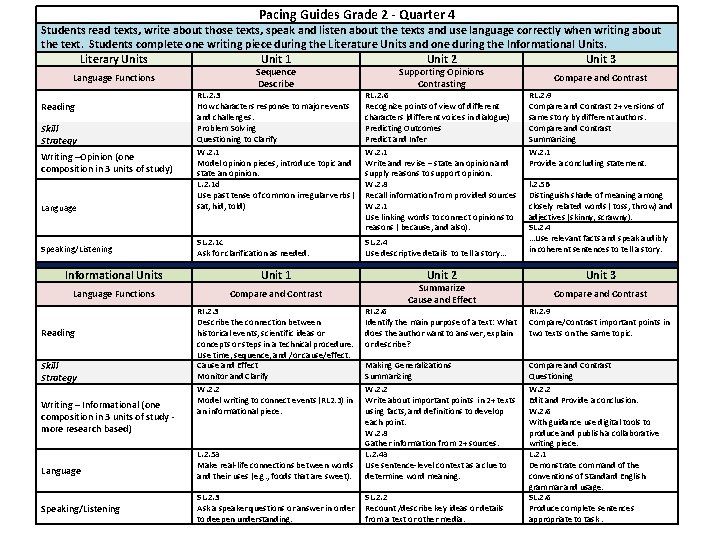
Pacing Guides Grade 2 - Quarter 4 Students read texts, write about those texts, speak and listen about the texts and use language correctly when writing about the text. Students complete one writing piece during the Literature Units and one during the Informational Units. Literary Units Unit 1 Unit 2 Unit 3 Language Functions Sequence Describe Supporting Opinions Contrasting Language RL. 2. 3 How characters response to major events and challenges. Problem Solving Questioning to Clarify W. 2. 1 Model opinion pieces, introduce topic and state an opinion. L. 2. 1 d Use past tense of common irregular verbs ( sat, hid, told) RL. 2. 6 Recognize points of view of different characters (different voices in dialogue) Predicting Outcomes Predict and Infer W. 2. 1 Write and revise – state an opinion and supply reasons to support opinion. W. 2. 8 Recall information from provided sources W. 2. 1 Use linking words to connect opinions to reasons ( because, and also). Speaking/Listening SL. 2. 1 c Ask for clarification as needed. SL. 2. 4 Use descriptive details to tell a story… Reading Skill Strategy Writing –Opinion (one composition in 3 units of study) Informational Units Unit 1 Language Functions Compare and Contrast Reading Skill Strategy Writing – Informational (one composition in 3 units of study more research based) Language Speaking/Listening RI. 2. 3 Describe the connection between historical events, scientific ideas or concepts or steps in a technical procedure. Use time, sequence, and /or cause/effect. Cause and Effect Monitor and Clarify W. 2. 2 Model writing to connect events (RL 2. 3) in an informational piece. Unit 2 Summarize Cause and Effect Compare and Contrast RL. 2. 9 Compare and Contrast 2+ versions of same story by different authors. Compare and Contrast Summarizing W. 2. 1 Provide a concluding statement. l. 2. 5 B Distinguish shade of meaning among closely related words ( toss, throw) and adjectives (skinny, scrawny). SL. 2. 4 …Use relevant facts and speak audibly in coherent sentences to tell a story. Unit 3 Compare and Contrast RI. 2. 6 Identify the main purpose of a text: What does the author want to answer, explain or describe? RI. 2. 9 Compare/Contrast important points in two texts on the same topic. L. 2. 5 a Make real-life connections between words and their uses (e. g. , foods that are sweet). Making Generalizations Summarizing W. 2. 2 Write about important points in 2+ texts using facts, and definitions to develop each point. W. 2. 8 Gather information from 2+ sources. L. 2. 4 a Use sentence-level context as a clue to determine word meaning. SL. 2. 3 Ask a speaker questions or answer in order to deepen understanding. SL. 2. 2 Recount /describe key ideas or details from a text or other media. Compare and Contrast Questioning W. 2. 2 Edit and Provide a conclusion. W. 2. 6 With guidance use digital tools to produce and publish a collaborative writing piece. L. 2. 1 Demonstrate command of the conventions of Standard English grammar and usage. SL. 2. 6 Produce complete sentences appropriate to task.