
Pacific Youth Church Spirituality PACIFIC 206306 Seira AukusoSue
- Slides: 18
Pacific Youth: Church & Spirituality PACIFIC 206/306 Seira Aukuso-Su’e
Learning Objectives • Discuss and critically examine religion and spirituality in the contemporary Pacific. • Reflect on the relevance of spirituality for contemporary Pacific peoples. • Define the concepts of ancestral spirituality, religion and spirituality as a protective factor
Spirituality and religion are used interchangeably. They indicate two different aspects of the human experience. • Spirituality is the wellspring of divinity that is the source and essence of every soul. • Spirituality relates to a more personal search; to finding greater meaning and purpose in your existence. • Some elements of spirituality include: looking beyond outer appearances to the deeper significance and soul of everything, a deep love and respect for God – yourself – and others.
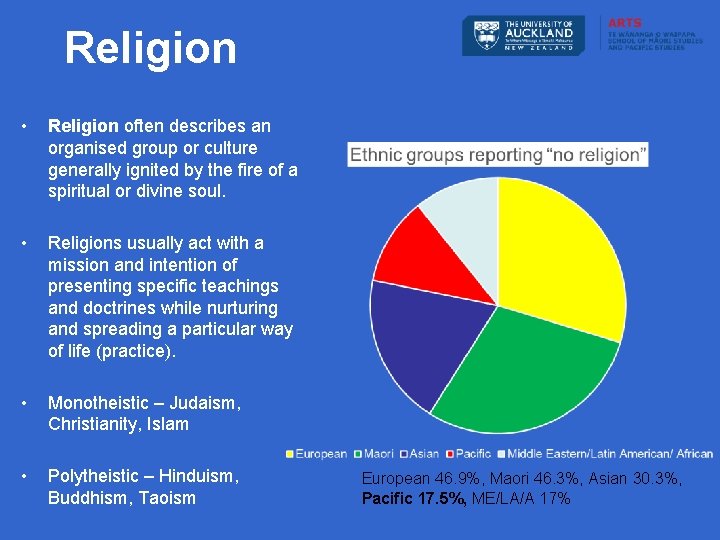
Religion • Religion often describes an organised group or culture generally ignited by the fire of a spiritual or divine soul. • Religions usually act with a mission and intention of presenting specific teachings and doctrines while nurturing and spreading a particular way of life (practice). • Monotheistic – Judaism, Christianity, Islam • Polytheistic – Hinduism, Buddhism, Taoism European 46. 9%, Maori 46. 3%, Asian 30. 3%, Pacific 17. 5%, ME/LA/A 17%
Church • Many people today understand the church as a building. • Biblical understanding – rooted in the Greek word ekklesia which is defined as “an assembly” or “called-out ones. ” • Church is not limited to that of a building, but of people
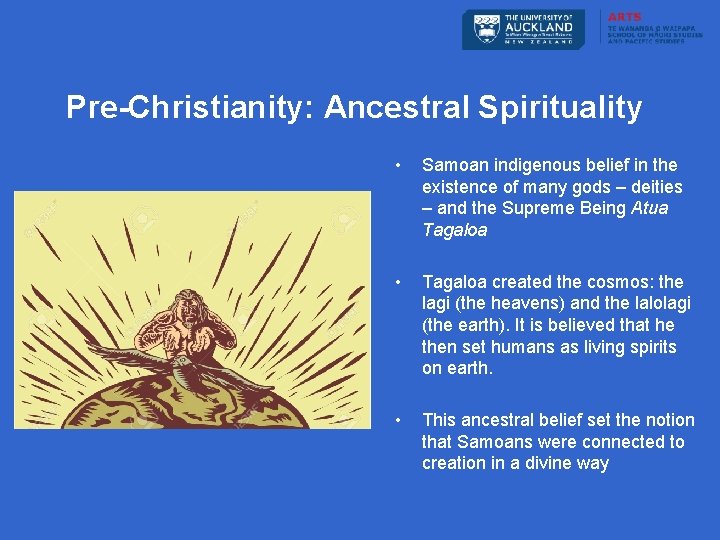
Pre-Christianity: Ancestral Spirituality • Samoan indigenous belief in the existence of many gods – deities – and the Supreme Being Atua Tagaloa • Tagaloa created the cosmos: the lagi (the heavens) and the lalolagi (the earth). It is believed that he then set humans as living spirits on earth. • This ancestral belief set the notion that Samoans were connected to creation in a divine way
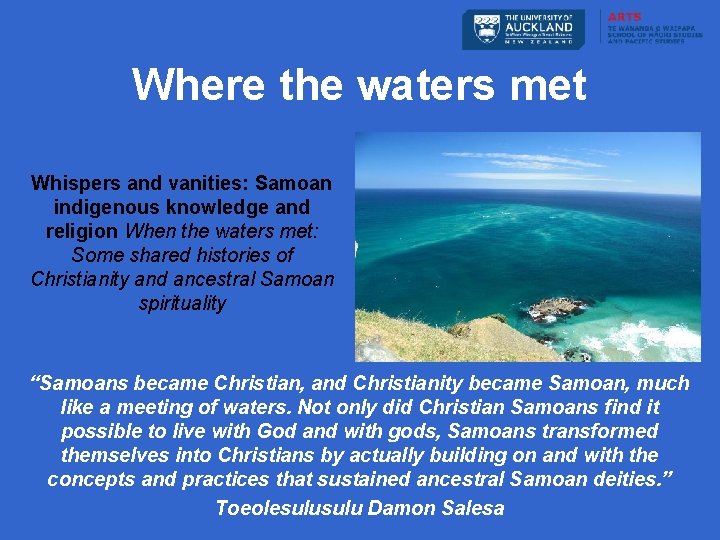
Where the waters met Whispers and vanities: Samoan indigenous knowledge and religion When the waters met: Some shared histories of Christianity and ancestral Samoan spirituality “Samoans became Christian, and Christianity became Samoan, much like a meeting of waters. Not only did Christian Samoans find it possible to live with God and with gods, Samoans transformed themselves into Christians by actually building on and with the concepts and practices that sustained ancestral Samoan deities. ” Toeolesulu Damon Salesa
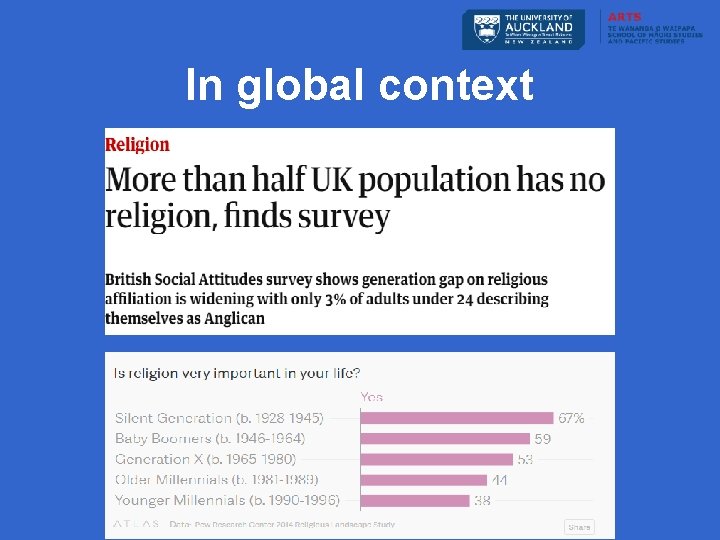
In global context
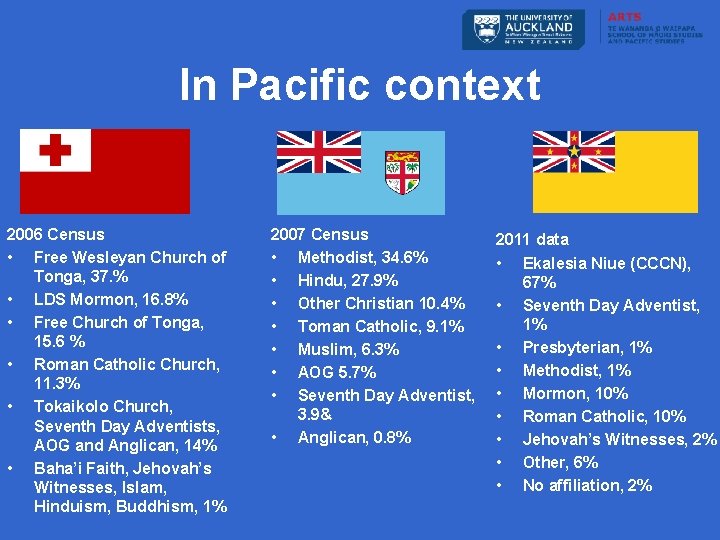
In Pacific context 2006 Census • Free Wesleyan Church of Tonga, 37. % • LDS Mormon, 16. 8% • Free Church of Tonga, 15. 6 % • Roman Catholic Church, 11. 3% • Tokaikolo Church, Seventh Day Adventists, AOG and Anglican, 14% • Baha’i Faith, Jehovah’s Witnesses, Islam, Hinduism, Buddhism, 1% 2007 Census • Methodist, 34. 6% • Hindu, 27. 9% • Other Christian 10. 4% • Toman Catholic, 9. 1% • Muslim, 6. 3% • AOG 5. 7% • Seventh Day Adventist, 3. 9& • Anglican, 0. 8% 2011 data • Ekalesia Niue (CCCN), 67% • Seventh Day Adventist, 1% • Presbyterian, 1% • Methodist, 1% • Mormon, 10% • Roman Catholic, 10% • Jehovah’s Witnesses, 2% • Other, 6% • No affiliation, 2%
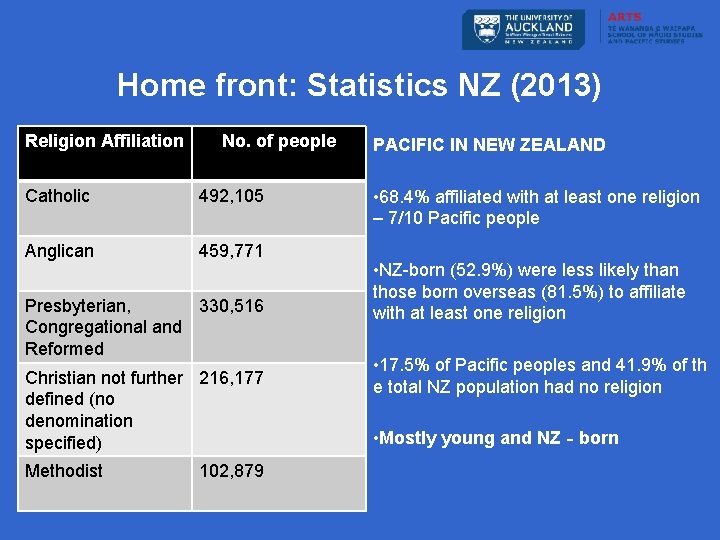
Home front: Statistics NZ (2013) Religion Affiliation No. of people Catholic 492, 105 Anglican 459, 771 Presbyterian, 330, 516 Congregational and Reformed Christian not further 216, 177 defined (no denomination specified) Methodist 102, 879 PACIFIC IN NEW ZEALAND • 68. 4% affiliated with at least one religion – 7/10 Pacific people • NZ-born (52. 9%) were less likely than those born overseas (81. 5%) to affiliate with at least one religion • 17. 5% of Pacific peoples and 41. 9% of th e total NZ population had no religion • Mostly young and NZ‐born
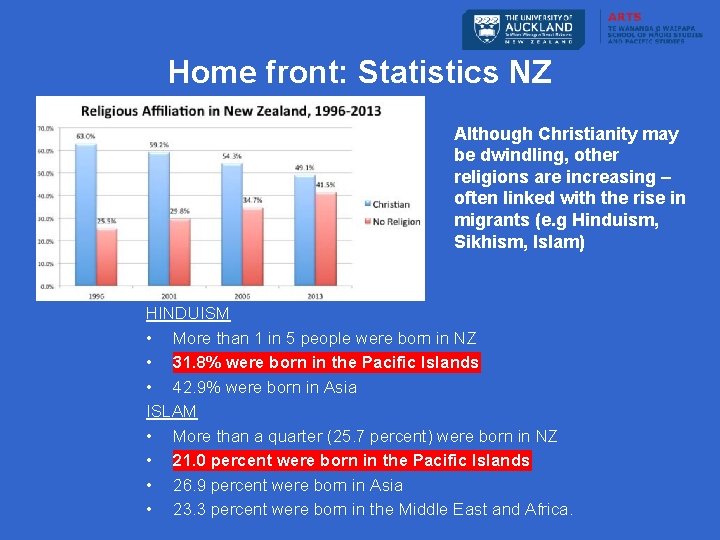
Home front: Statistics NZ Although Christianity may be dwindling, other religions are increasing – often linked with the rise in migrants (e. g Hinduism, Sikhism, Islam) HINDUISM • More than 1 in 5 people were born in NZ • 31. 8% were born in the Pacific Islands • 42. 9% were born in Asia ISLAM • More than a quarter (25. 7 percent) were born in NZ • 21. 0 percent were born in the Pacific Islands • 26. 9 percent were born in Asia • 23. 3 percent were born in the Middle East and Africa.
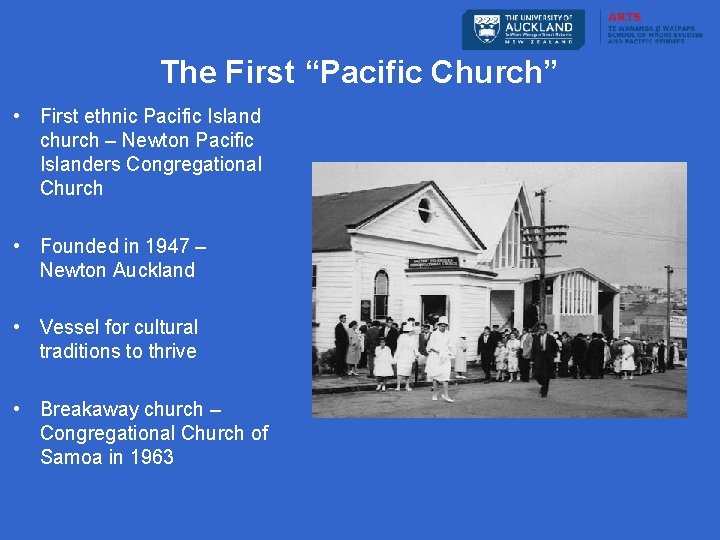
The First “Pacific Church” • First ethnic Pacific Island church – Newton Pacific Islanders Congregational Church • Founded in 1947 – Newton Auckland • Vessel for cultural traditions to thrive • Breakaway church – Congregational Church of Samoa in 1963
Pentecostal Migration • We have seen a decline in mainstream Protestant churches (Anglicans, Presbyterians, and Methodists); the only notable Christian growth is among some Pentecostal and independent evangelical churches. • WHAT IS CAUSING THIS SHIFT? NAMELY IN THE YOUNG PACIFIC POPULATION? • As financial pressures grow, many youth migrate to churches with fewer financial demands on their members while meeting their spiritual needs • The promotion of a personal relationship with God, more lively services, and less emphasis on ritual and cultural traditions have attracted Pacific youth.
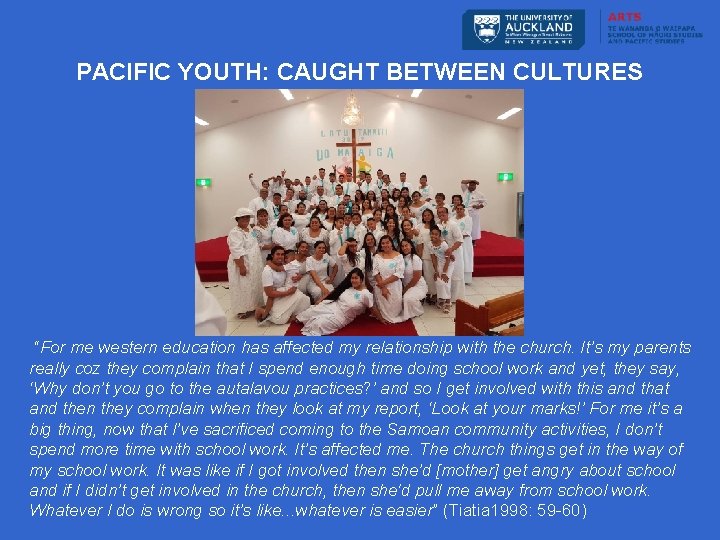
PACIFIC YOUTH: CAUGHT BETWEEN CULTURES “For me western education has affected my relationship with the church. It’s my parents really coz they complain that I spend enough time doing school work and yet, they say, ‘Why don’t you go to the autalavou practices? ’ and so I get involved with this and that and then they complain when they look at my report, ‘Look at your marks!’ For me it’s a big thing, now that I’ve sacrificed coming to the Samoan community activities, I don’t spend more time with school work. It’s affected me. The church things get in the way of my school work. It was like if I got involved then she’d [mother] get angry about school and if I didn’t get involved in the church, then she'd pull me away from school work. Whatever I do is wrong so it’s like. . . whatever is easier” (Tiatia 1998: 59 -60)
PACIFIC YOUTH: CAUGHT BETWEEN CULTURES AUTHORITY “The minister can dictate everything that the church does and if he doesn’t give them the room to make their own decisions, room to breathe, I think that’s where the church starts to divide, coz people’s ideas are being suppressed and people’s ways of worshiping. Like with the young people, they wanna grow but they can’t grow because the minister's going ‘oh no, you gotta worship this way and do it this way’. I think sometimes that’s another reason of why young people leave, because the minister’s not open to suggestions, he’s not willing to communicate with them” (Tiatia 1998: 88).
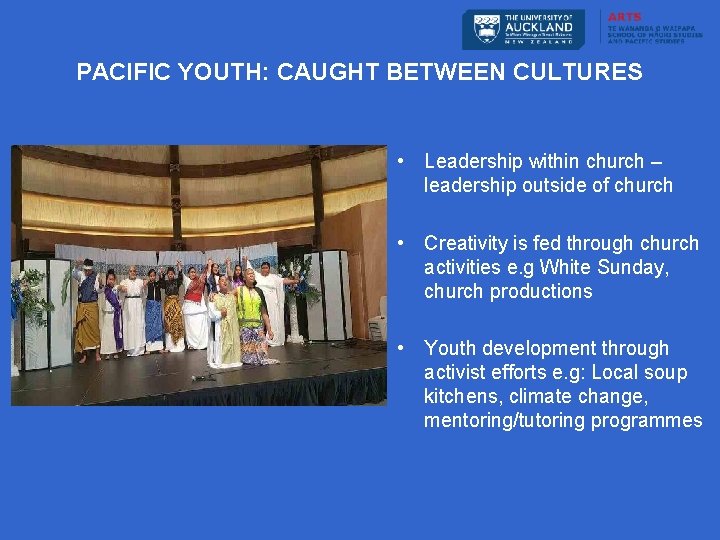
PACIFIC YOUTH: CAUGHT BETWEEN CULTURES • Leadership within church – leadership outside of church • Creativity is fed through church activities e. g White Sunday, church productions • Youth development through activist efforts e. g: Local soup kitchens, climate change, mentoring/tutoring programmes
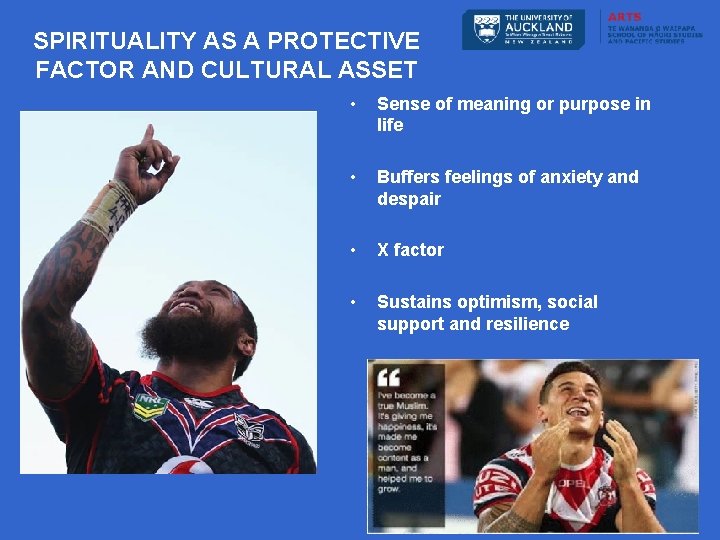
SPIRITUALITY AS A PROTECTIVE FACTOR AND CULTURAL ASSET • Sense of meaning or purpose in life • Buffers feelings of anxiety and despair • X factor • Sustains optimism, social support and resilience
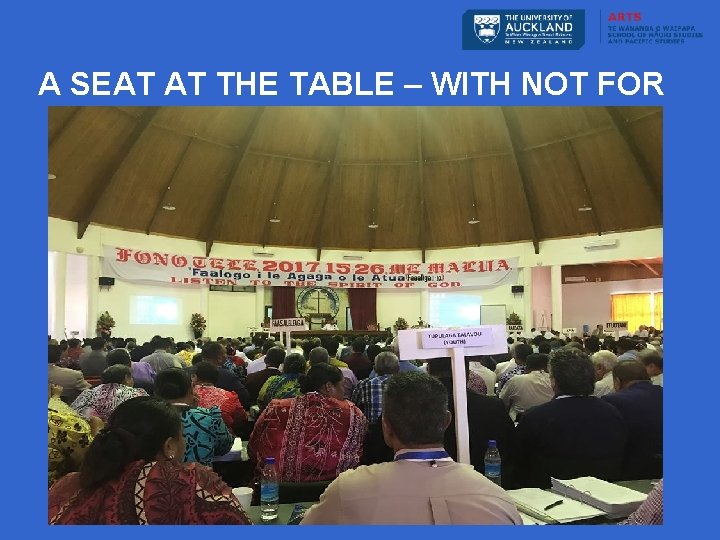
A SEAT AT THE TABLE – WITH NOT FOR