
Pacific Theater Bataan Death March After Japan attacked
Pacific Theater
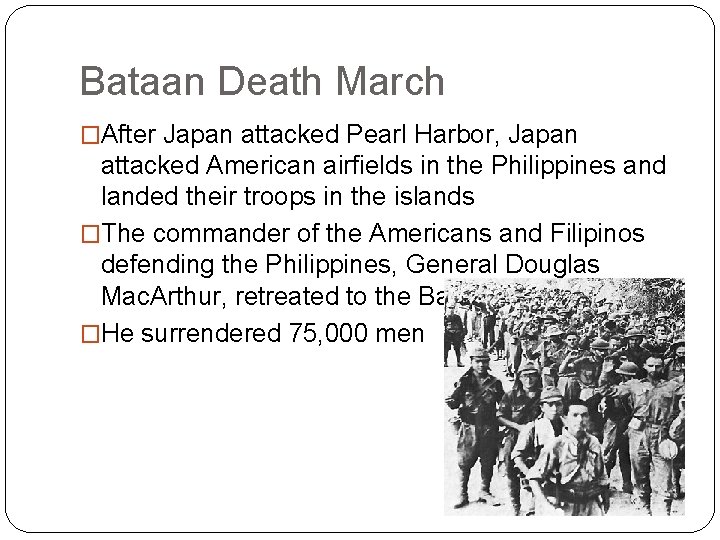
Bataan Death March �After Japan attacked Pearl Harbor, Japan attacked American airfields in the Philippines and landed their troops in the islands �The commander of the Americans and Filipinos defending the Philippines, General Douglas Mac. Arthur, retreated to the Bataan Peninsula �He surrendered 75, 000 men
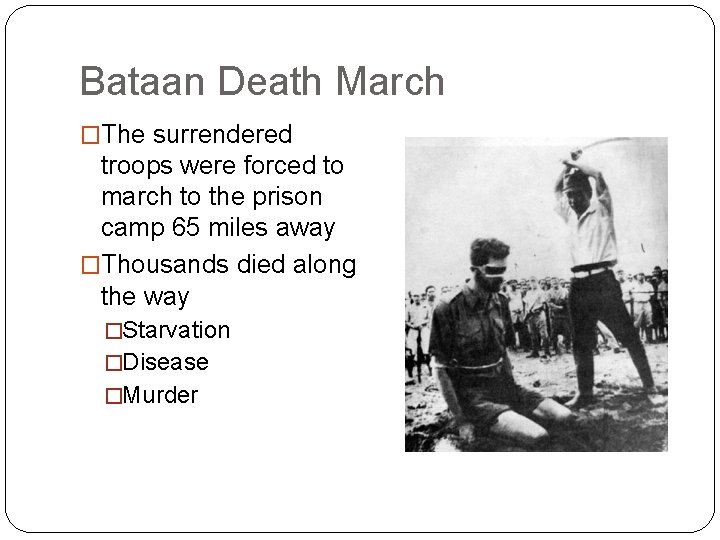
Bataan Death March �The surrendered troops were forced to march to the prison camp 65 miles away �Thousands died along the way �Starvation �Disease �Murder

Doolittle Raid �In response to the attack on Pearl Harbor, James Doolittle organized a bombing mission in Tokyo, Japan called the Doolittle Raid
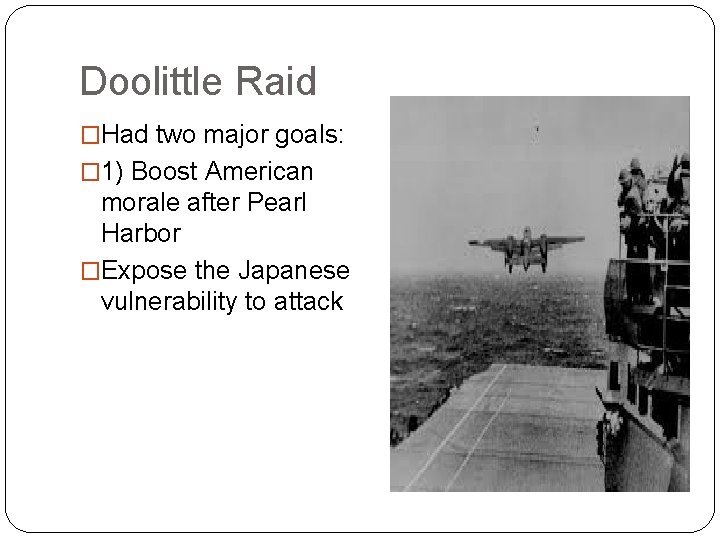
Doolittle Raid �Had two major goals: � 1) Boost American morale after Pearl Harbor �Expose the Japanese vulnerability to attack
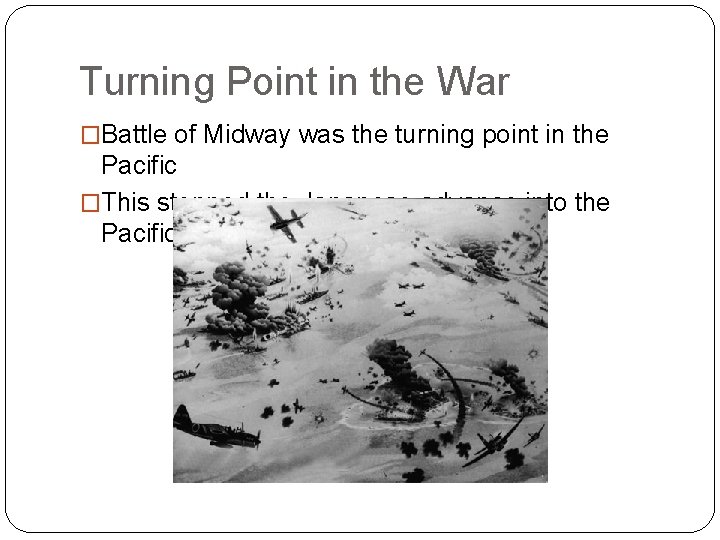
Turning Point in the War �Battle of Midway was the turning point in the Pacific �This stopped the Japanese advance into the Pacific
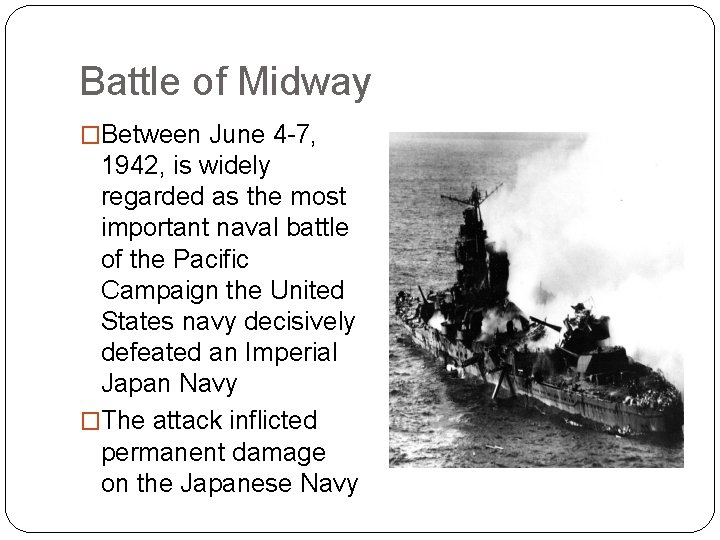
Battle of Midway �Between June 4 -7, 1942, is widely regarded as the most important naval battle of the Pacific Campaign the United States navy decisively defeated an Imperial Japan Navy �The attack inflicted permanent damage on the Japanese Navy
Consequences of the Battle of Midway �The consequence of the Battle of Midway for the Japanese were huge. At a stroke, they lost 4 vital aircraft carriers that were considered to be vital for the Pacific campaign �Whereas the Americans could replace the ‘Yorktown, ’ the Japanese would have found it very difficult to replace one carrier, let alone four
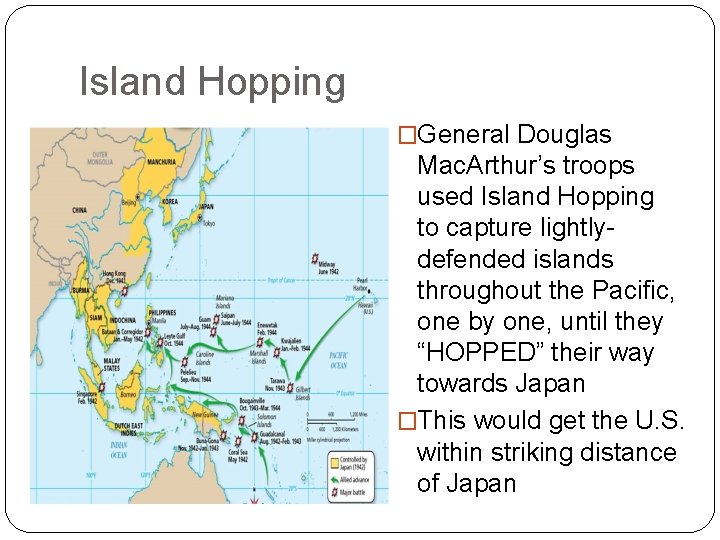
Island Hopping �General Douglas Mac. Arthur’s troops used Island Hopping to capture lightlydefended islands throughout the Pacific, one by one, until they “HOPPED” their way towards Japan �This would get the U. S. within striking distance of Japan
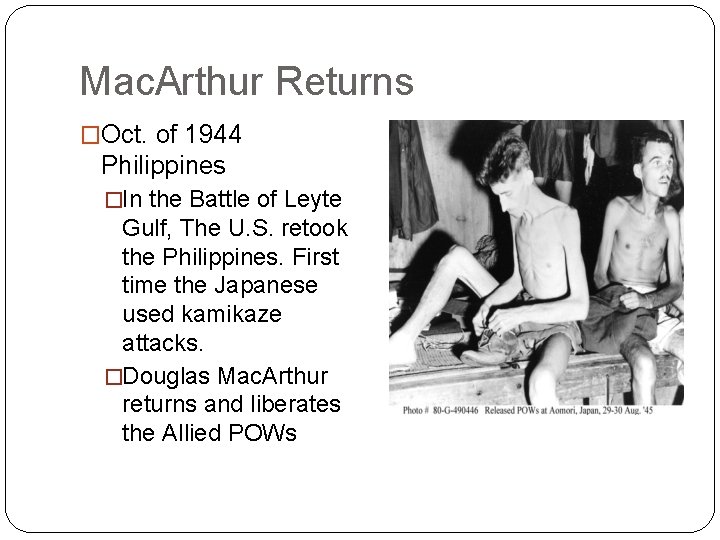
Mac. Arthur Returns �Oct. of 1944 Philippines �In the Battle of Leyte Gulf, The U. S. retook the Philippines. First time the Japanese used kamikaze attacks. �Douglas Mac. Arthur returns and liberates the Allied POWs
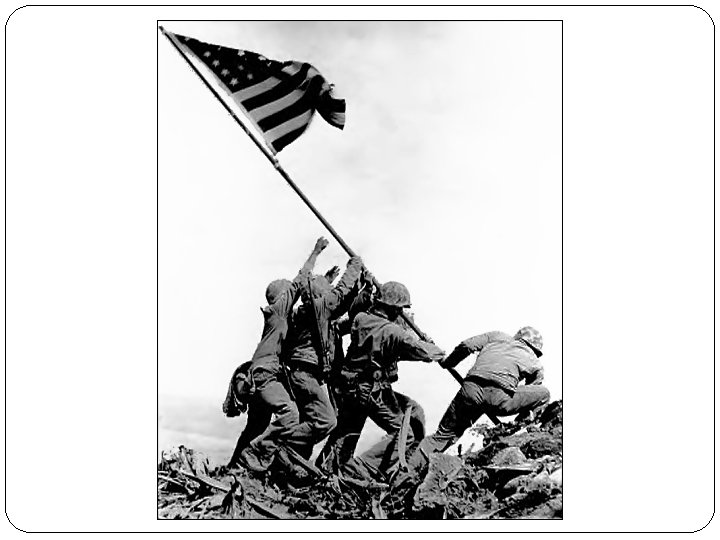
Iwo Jima and Okinawa �The U. S. fought Japan on numerous islands including Okinawa and Iwo Jima �These islands were used to launch aerial assaults on Japan �This was the first time an invaders flag flew over Japanese territory

Japan Refuses to Surrender �By 1945, the Japanese were pushed back to Japan with no way to win the war �They refused to give up and kamikaze soldiers made an invasion extremely dangerous
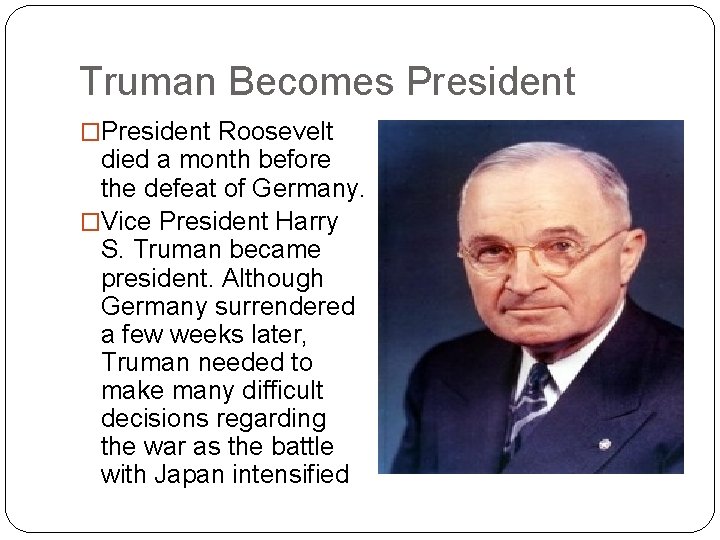
Truman Becomes President �President Roosevelt died a month before the defeat of Germany. �Vice President Harry S. Truman became president. Although Germany surrendered a few weeks later, Truman needed to make many difficult decisions regarding the war as the battle with Japan intensified
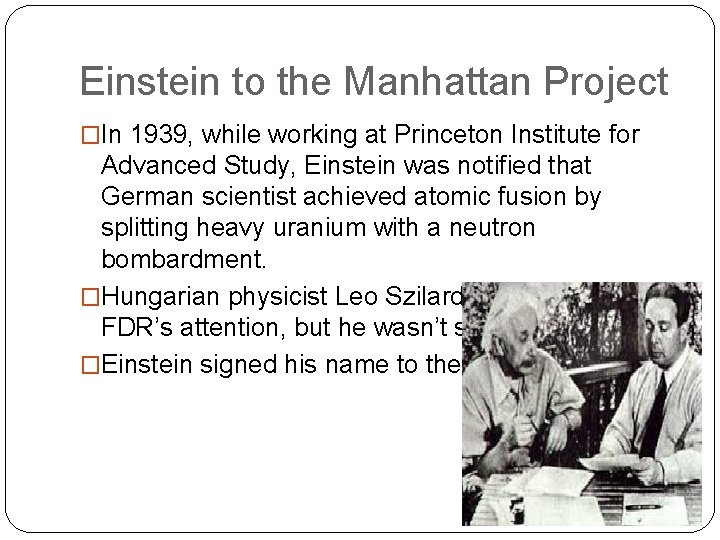
Einstein to the Manhattan Project �In 1939, while working at Princeton Institute for Advanced Study, Einstein was notified that German scientist achieved atomic fusion by splitting heavy uranium with a neutron bombardment. �Hungarian physicist Leo Szilard tried to catch FDR’s attention, but he wasn’t successful �Einstein signed his name to the letter
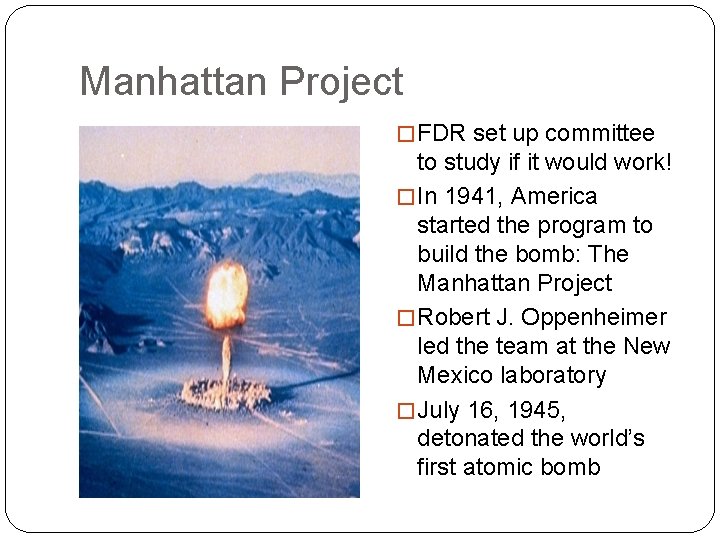
Manhattan Project � FDR set up committee to study if it would work! � In 1941, America started the program to build the bomb: The Manhattan Project � Robert J. Oppenheimer led the team at the New Mexico laboratory � July 16, 1945, detonated the world’s first atomic bomb
Truman’s Decision �Truman was forced to consider all options �A) Invade Japan with allied troops. This would result in high deaths on both sides and an unknown timeline �B) Drop an atomic bomb out in the Pacific away from people to show Japan our military strength �C) Drop the bomb without warning to “shock” Japan into surrendering
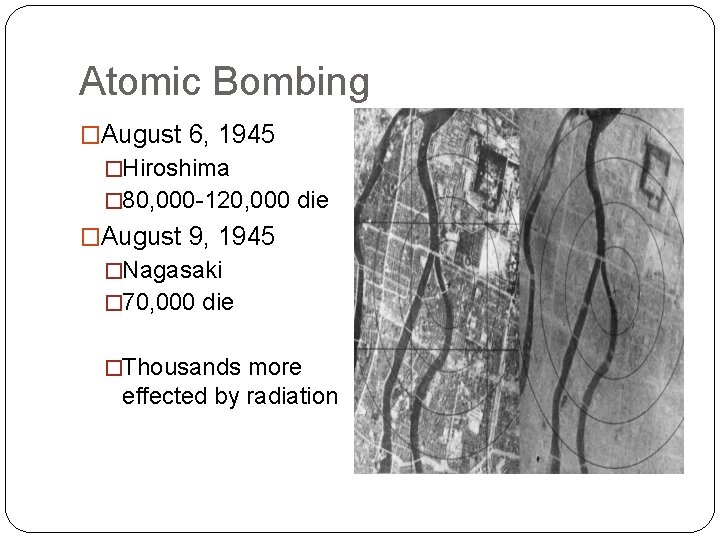
Atomic Bombing �August 6, 1945 �Hiroshima � 80, 000 -120, 000 die �August 9, 1945 �Nagasaki � 70, 000 die �Thousands more effected by radiation
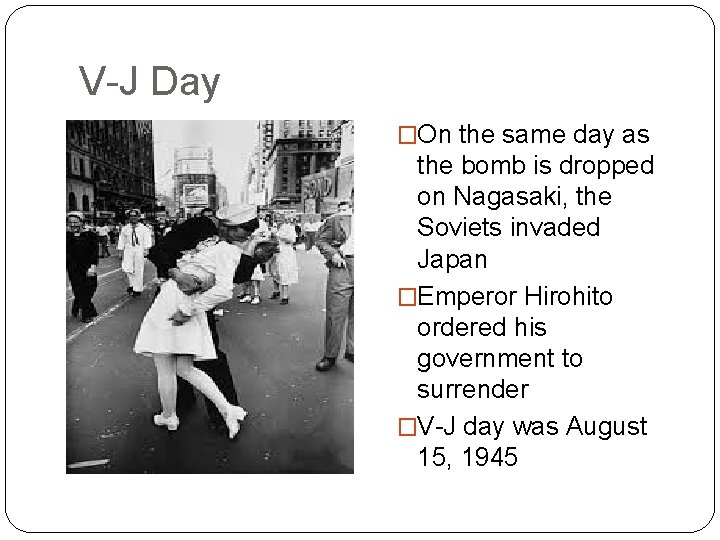
V-J Day �On the same day as the bomb is dropped on Nagasaki, the Soviets invaded Japan �Emperor Hirohito ordered his government to surrender �V-J day was August 15, 1945
Changes in Japan �Emperor loses power and becomes figure head �Japan becomes a democracy. Model their constitution after the United States �Bill of Rights guarntees freedoms, women have the right to vote �Constitution says Japan cannot attack another country �In 1951, peace treaty with Japan signed; U. S. occupation ends �US and Japan become allies
- Slides: 20