
Pacific Subtropical Highs Features Interacting with Midlatitude and

Pacific Subtropical Highs: Features Interacting with Midlatitude and Tropical Forcing Richard Grotjahn Atmospheric Science Program, Dept. of LAWR, Univ. of California Davis, CA 95616, USA
Organization of this talk: • Some Simple Observed Facts • Some simple conceptual models and questions • Monthly mean observed data analysis • Daily observed data analysis • Summary
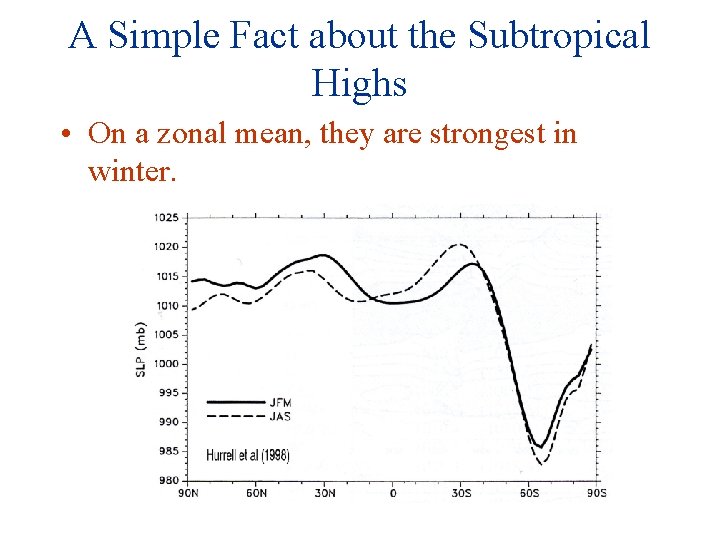
A Simple Fact about the Subtropical Highs • On a zonal mean, they are strongest in winter.
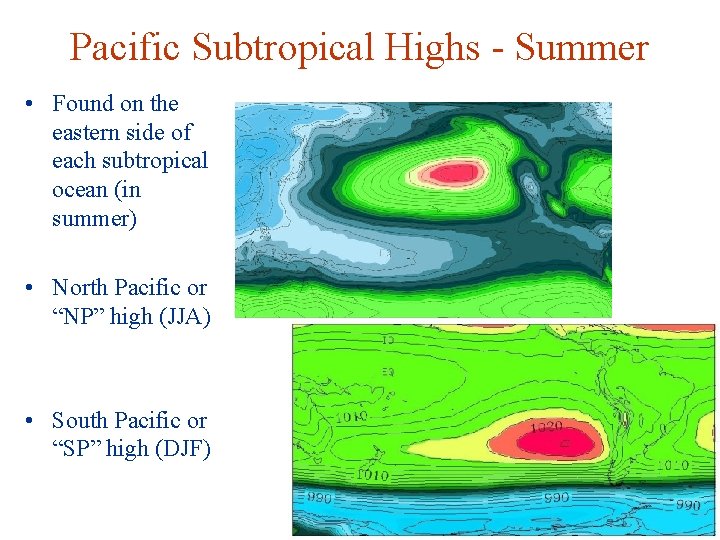
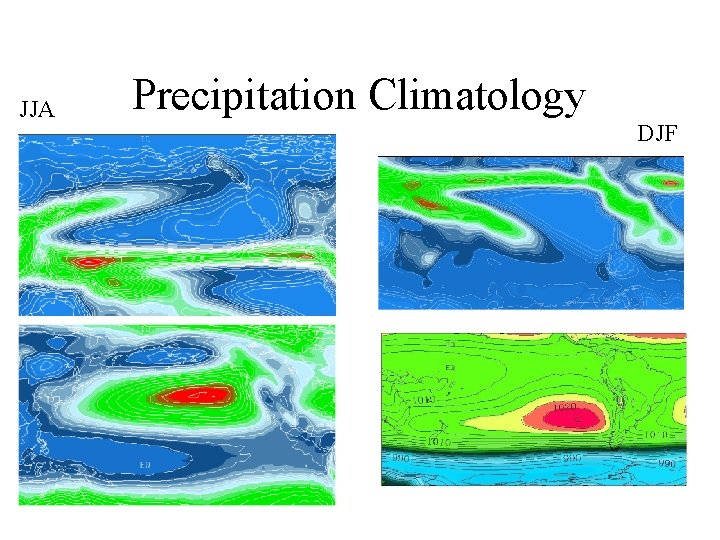
Pacific Subtropical Highs - Summer • Found on the eastern side of each subtropical ocean (in summer) • North Pacific or “NP” high (JJA) • South Pacific or “SP” high (DJF)
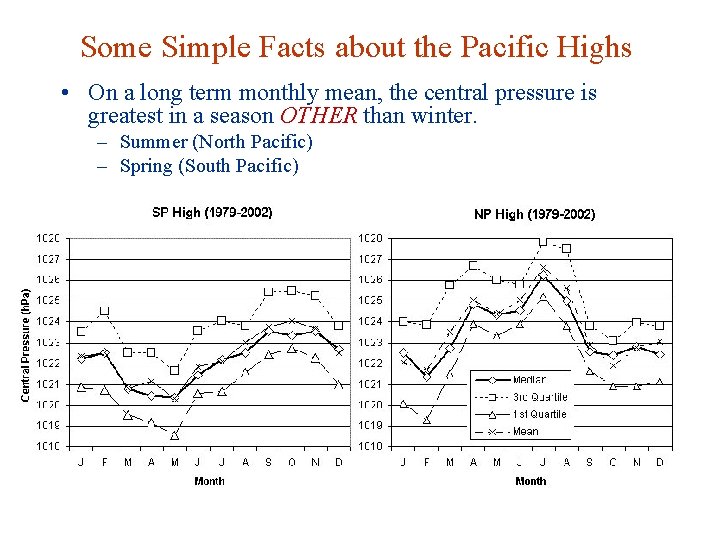
Some Simple Facts about the Pacific Highs • On a long term monthly mean, the central pressure is greatest in a season OTHER than winter. – Summer (North Pacific) – Spring (South Pacific)
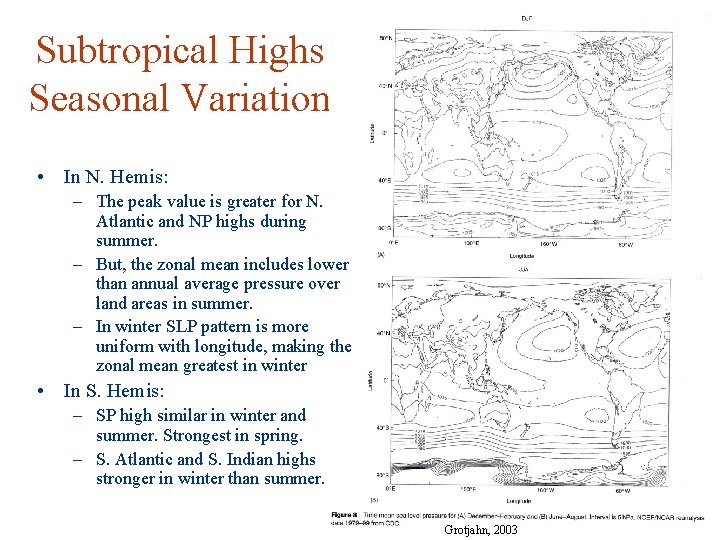
Subtropical Highs Seasonal Variation • In N. Hemis: – The peak value is greater for N. Atlantic and NP highs during summer. – But, the zonal mean includes lower than annual average pressure over land areas in summer. – In winter SLP pattern is more uniform with longitude, making the zonal mean greatest in winter • In S. Hemis: – SP high similar in winter and summer. Strongest in spring. – S. Atlantic and S. Indian highs stronger in winter than summer. Grotjahn, 2003
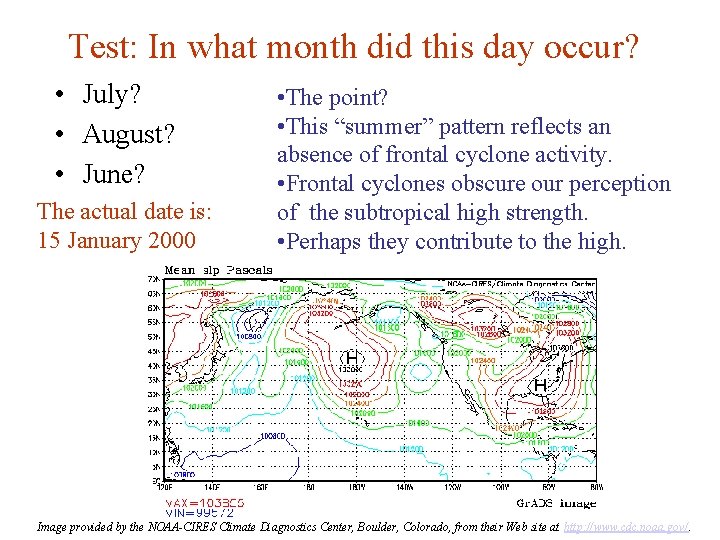
Test: In what month did this day occur? • July? • August? • June? The actual date is: 15 January 2000 • The point? • This “summer” pattern reflects an absence of frontal cyclone activity. • Frontal cyclones obscure our perception of the subtropical high strength. • Perhaps they contribute to the high. Image provided by the NOAA-CIRES Climate Diagnostics Center, Boulder, Colorado, from their Web site at http: //www. cdc. noaa. gov/.
Simple Conceptual Models
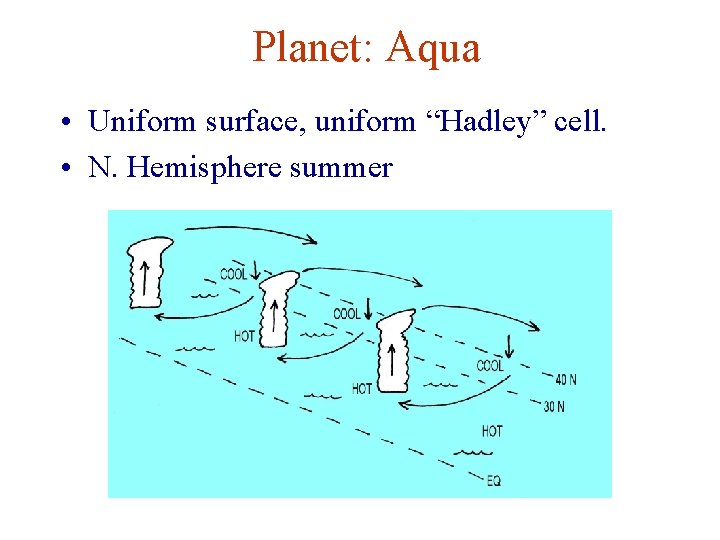
Planet: Aqua • Uniform surface, uniform “Hadley” cell. • N. Hemisphere summer
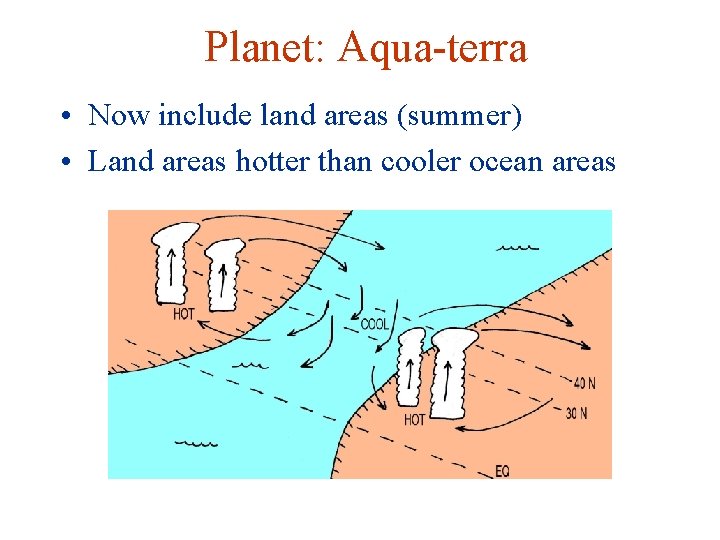
Planet: Aqua-terra • Now include land areas (summer) • Land areas hotter than cooler ocean areas
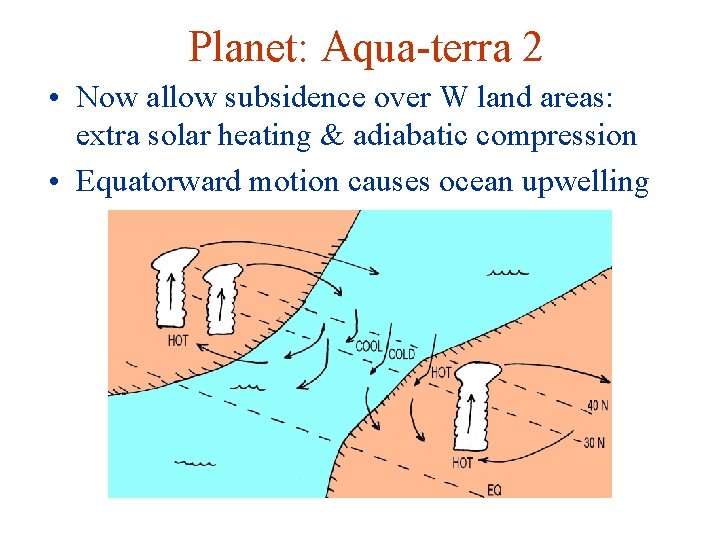
Planet: Aqua-terra 2 • Now allow subsidence over W land areas: extra solar heating & adiabatic compression • Equatorward motion causes ocean upwelling
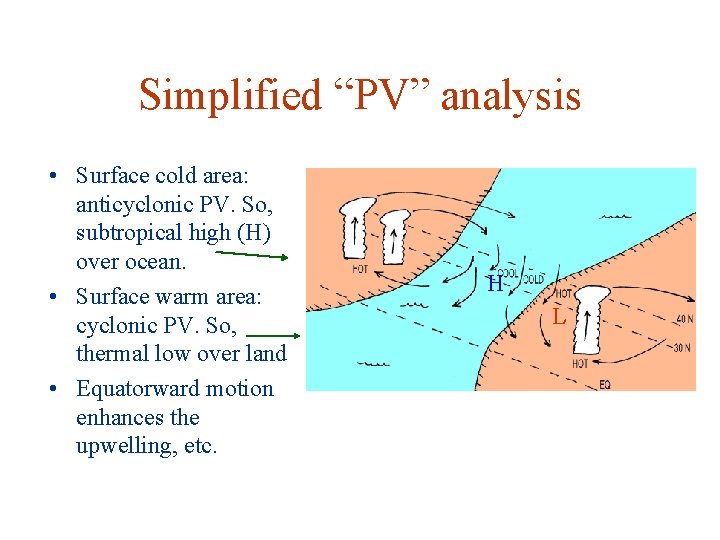
Simplified “PV” analysis • Surface cold area: anticyclonic PV. So, subtropical high (H) over ocean. • Surface warm area: cyclonic PV. So, thermal low over land • Equatorward motion enhances the upwelling, etc. H L
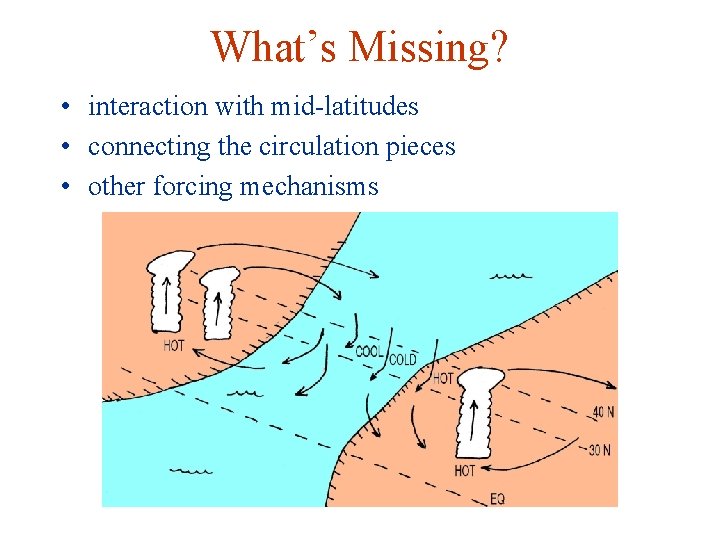
What’s Missing? • interaction with mid-latitudes • connecting the circulation pieces • other forcing mechanisms
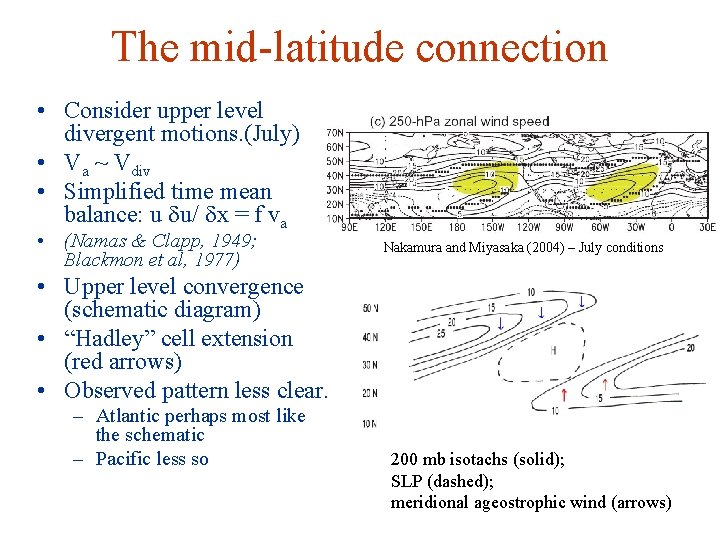
The mid-latitude connection • Consider upper level divergent motions. (July) • Va ~ Vdiv • Simplified time mean balance: u du/ dx = f va • (Namas & Clapp, 1949; Blackmon et al, 1977) Nakamura and Miyasaka (2004) – July conditions • Upper level convergence (schematic diagram) • “Hadley” cell extension (red arrows) • Observed pattern less clear. – Atlantic perhaps most like the schematic – Pacific less so 200 mb isotachs (solid); SLP (dashed); meridional ageostrophic wind (arrows)
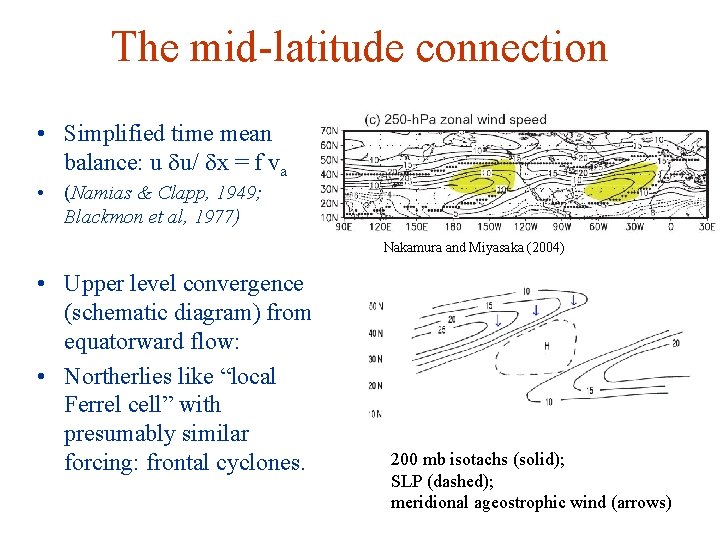
The mid-latitude connection • Simplified time mean balance: u du/ dx = f va • (Namias & Clapp, 1949; Blackmon et al, 1977) Nakamura and Miyasaka (2004) • Upper level convergence (schematic diagram) from equatorward flow: • Northerlies like “local Ferrel cell” with presumably similar forcing: frontal cyclones. 200 mb isotachs (solid); SLP (dashed); meridional ageostrophic wind (arrows)
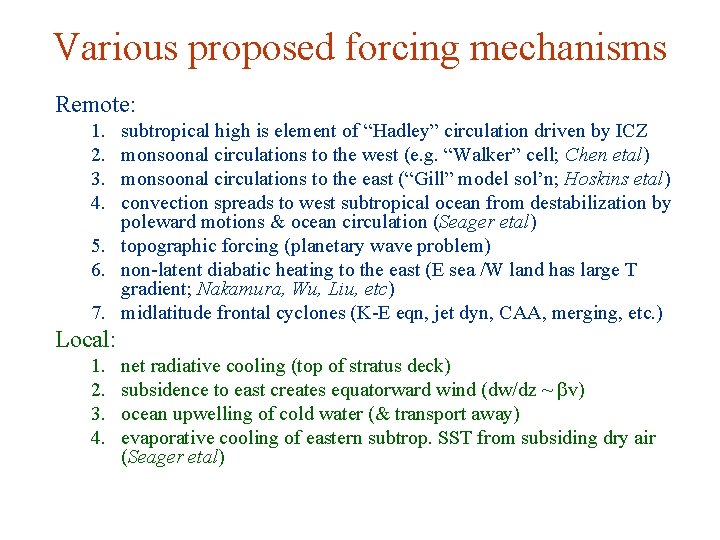
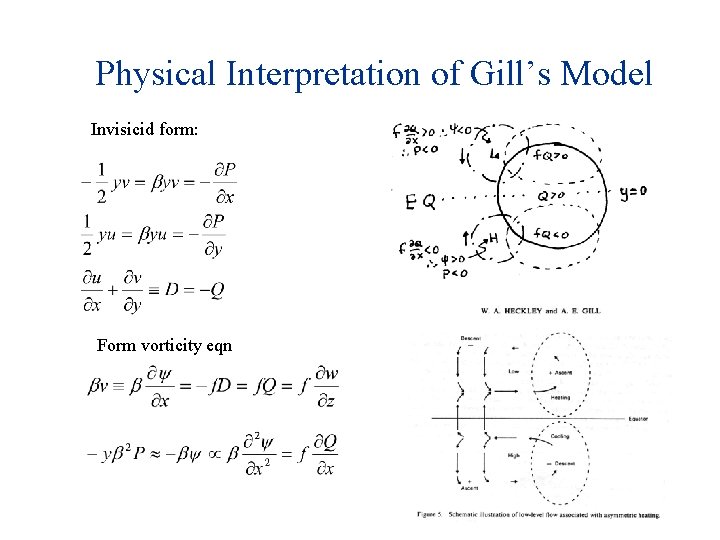
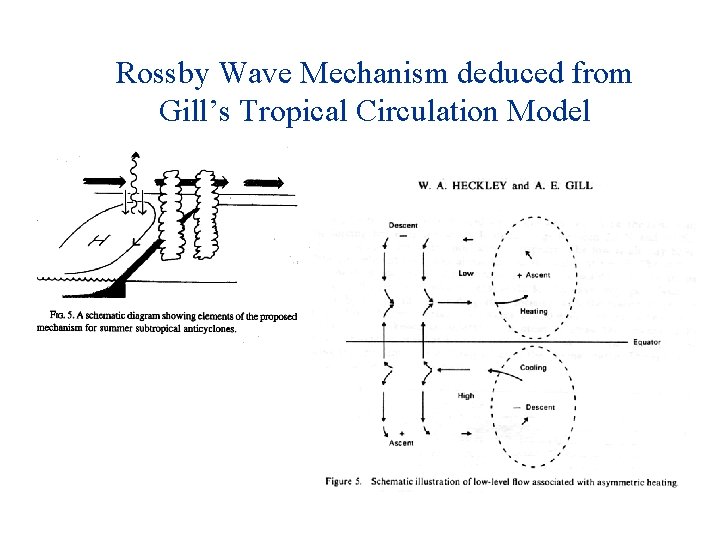
Various proposed forcing mechanisms Remote: 1. 2. 3. 4. subtropical high is element of “Hadley” circulation driven by ICZ monsoonal circulations to the west (e. g. “Walker” cell; Chen etal) monsoonal circulations to the east (“Gill” model sol’n; Hoskins etal) convection spreads to west subtropical ocean from destabilization by poleward motions & ocean circulation (Seager etal) 5. topographic forcing (planetary wave problem) 6. non-latent diabatic heating to the east (E sea /W land has large T gradient; Nakamura, Wu, Liu, etc) 7. midlatitude frontal cyclones (K-E eqn, jet dyn, CAA, merging, etc. ) Local: 1. 2. 3. 4. net radiative cooling (top of stratus deck) subsidence to east creates equatorward wind (dw/dz ~ bv) ocean upwelling of cold water (& transport away) evaporative cooling of eastern subtrop. SST from subsiding dry air (Seager etal)
Observed Divergent Circulations
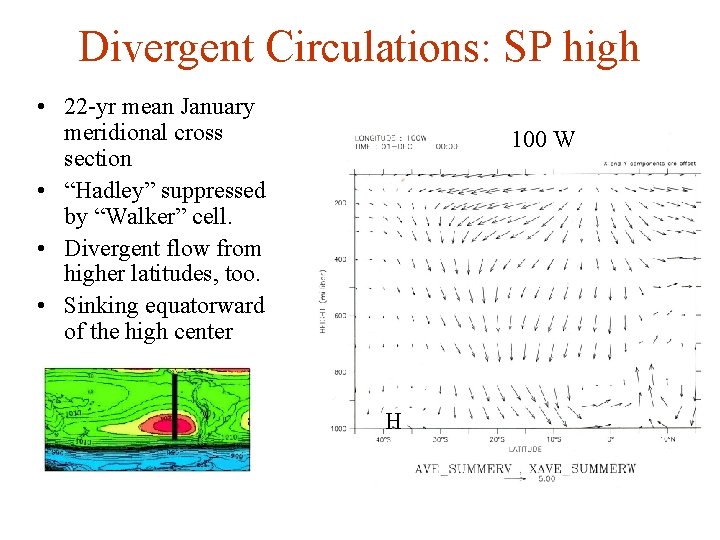
Divergent Circulations: SP high • 22 -yr mean January meridional cross section • “Hadley” suppressed by “Walker” cell. • Divergent flow from higher latitudes, too. • Sinking equatorward of the high center 100 W H
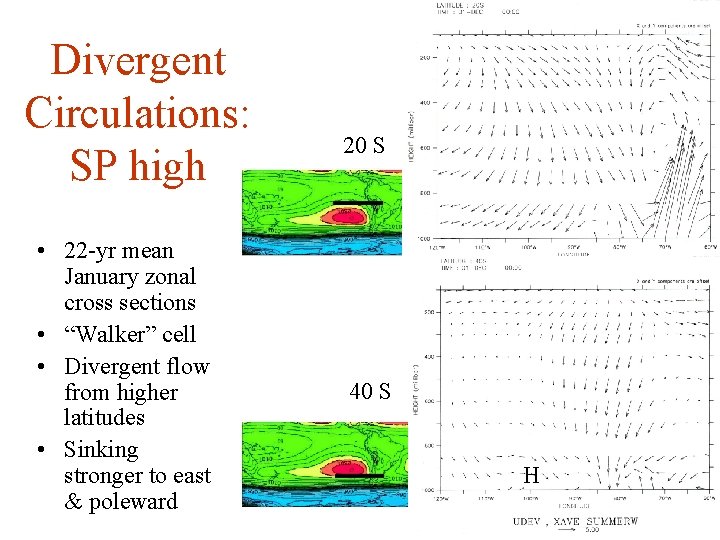
Divergent Circulations: SP high • 22 -yr mean January zonal cross sections • “Walker” cell • Divergent flow from higher latitudes • Sinking stronger to east & poleward 20 S 40 S H
Rising/Sinking Parts of Circulations (Observed)
Analysis Procedures (Monthly Data) Ø Preliminary study to identify coincident behavior. Ø Monthly NCEP/NCAR Reanalysis data (1979 -97). Ø Seasonal groupings, local “summer” emphasized. Ø Total and monthly anomaly (MA) fields. (MA defined as deviations from the average constructed from all occurrences of that month). Ø Monthly data cannot distinguish cause from effect. Ø Tools (significance test) shown here: composites (bootstrap resampling) 1 -point rank correlations (t- and D-statistics).
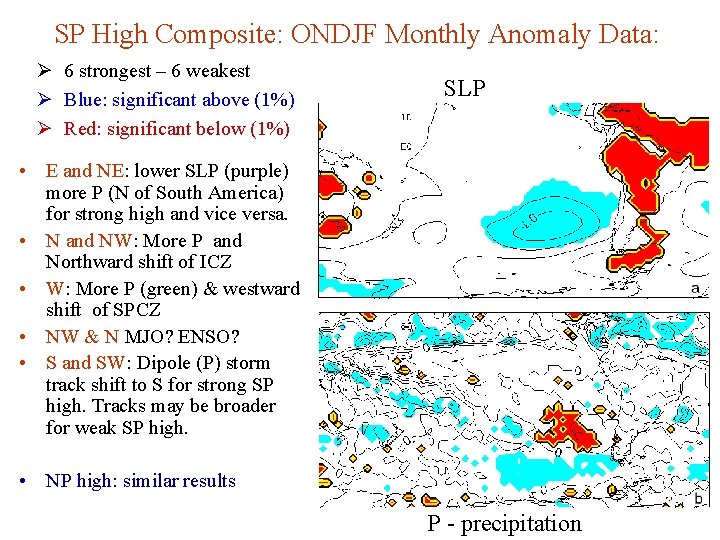
SP High Composite: ONDJF Monthly Anomaly Data: Ø 6 strongest – 6 weakest Ø Blue: significant above (1%) Ø Red: significant below (1%) SLP • E and NE: lower SLP (purple) more P (N of South America) for strong high and vice versa. • N and NW: More P and Northward shift of ICZ • W: More P (green) & westward shift of SPCZ • NW & N MJO? ENSO? • S and SW: Dipole (P) storm track shift to S for strong SP high. Tracks may be broader for weak SP high. • NP high: similar results P - precipitation
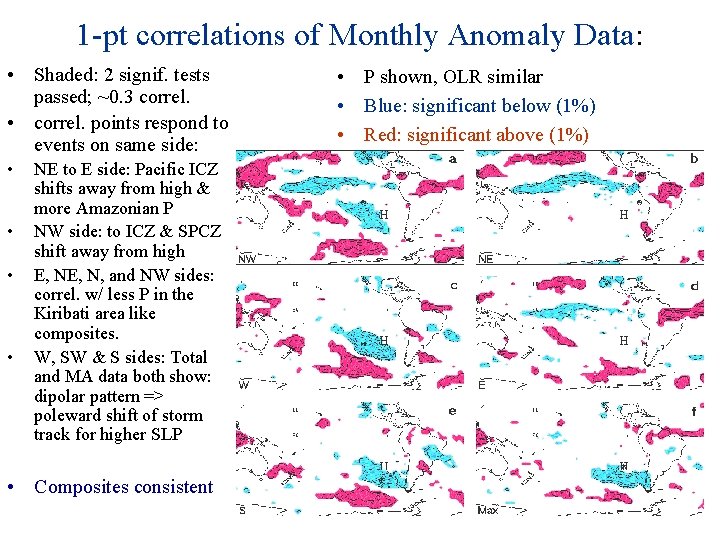
1 -pt correlations of Monthly Anomaly Data: • Shaded: 2 signif. tests passed; ~0. 3 correl. • correl. points respond to events on same side: • • NE to E side: Pacific ICZ shifts away from high & more Amazonian P NW side: to ICZ & SPCZ shift away from high E, N, and NW sides: correl. w/ less P in the Kiribati area like composites. W, SW & S sides: Total and MA data both show: dipolar pattern => poleward shift of storm track for higher SLP • Composites consistent • P shown, OLR similar • Blue: significant below (1%) • Red: significant above (1%)
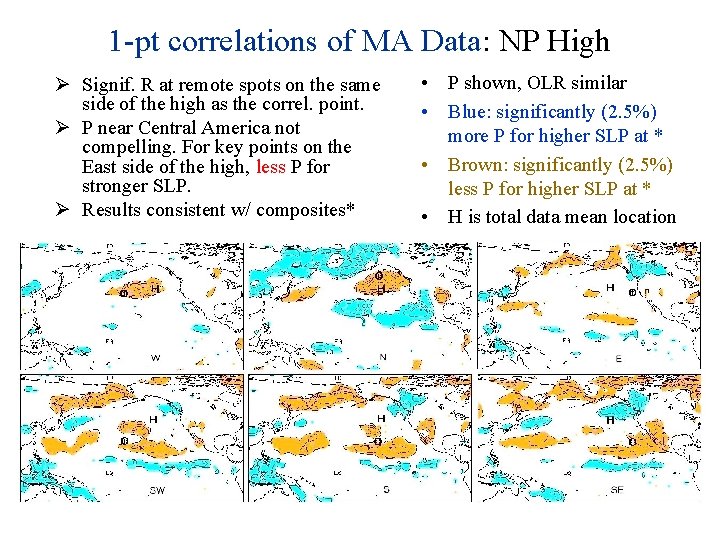
1 -pt correlations of MA Data: NP High Ø Signif. R at remote spots on the same side of the high as the correl. point. Ø P near Central America not compelling. For key points on the East side of the high, less P for stronger SLP. Ø Results consistent w/ composites* • P shown, OLR similar • Blue: significantly (2. 5%) more P for higher SLP at * • Brown: significantly (2. 5%) less P for higher SLP at * • H is total data mean location
Work with Daily Mean Data: SP high only • Data Source: • NOAA/CDC (Boulder CO, USA) • NCEP/NCAR reanalysis data • SLP, U, V • Ud, Velocity Potential (VP) from NCL commands. • Data record: • 90 -day DJF periods shown (122 day NDJF similar) • Drawn from 01/1990 through 08/2002 • Goal: • Prior work showed remote links now wish to establish cause and effect by using lags and leads.
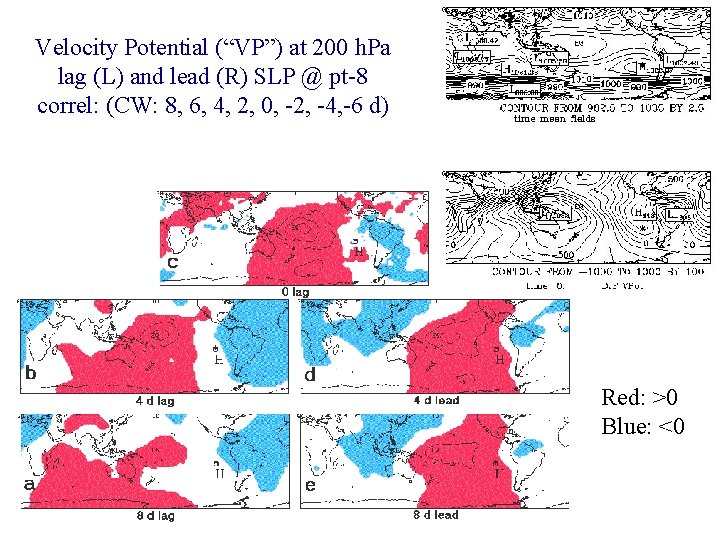
Velocity Potential (“VP”) at 200 h. Pa lag (L) and lead (R) SLP @ pt-8 correl: (CW: 8, 6, 4, 2, 0, -2, -4, -6 d) Red: >0 Blue: <0
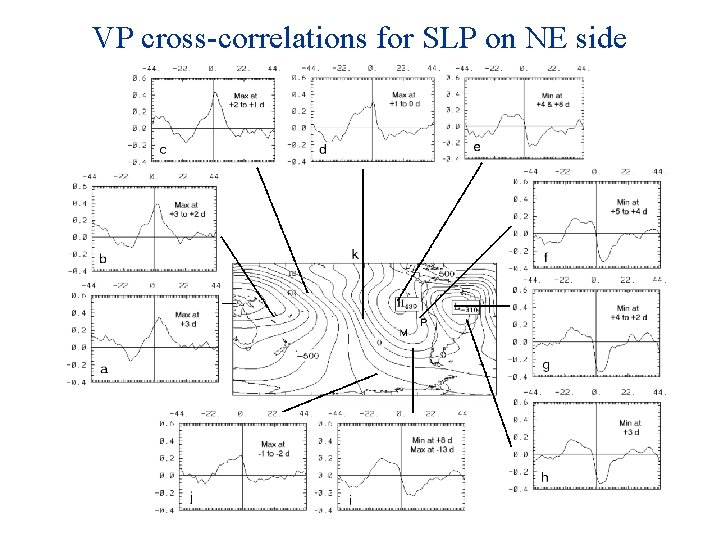
VP cross-correlations for SLP on NE side
Observed Divergent Wind Field • SP high • NP high
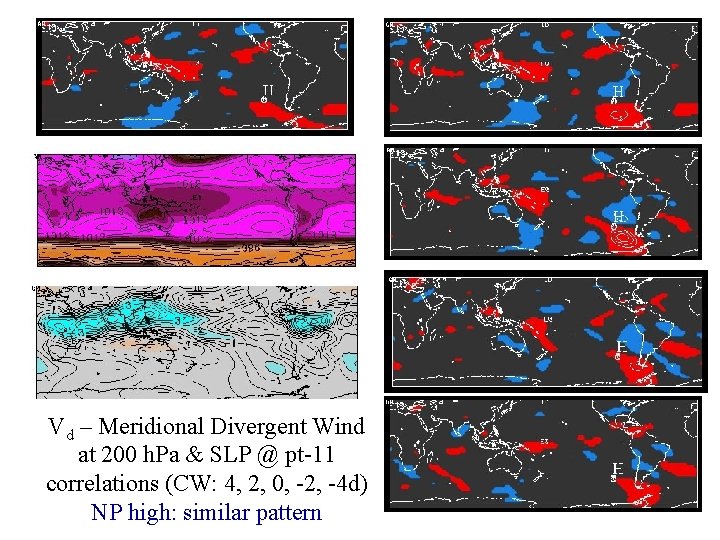
Vd – Meridional Divergent Wind at 200 h. Pa & SLP @ pt-11 correlations (CW: 4, 2, 0, -2, -4 d) NP high: similar pattern
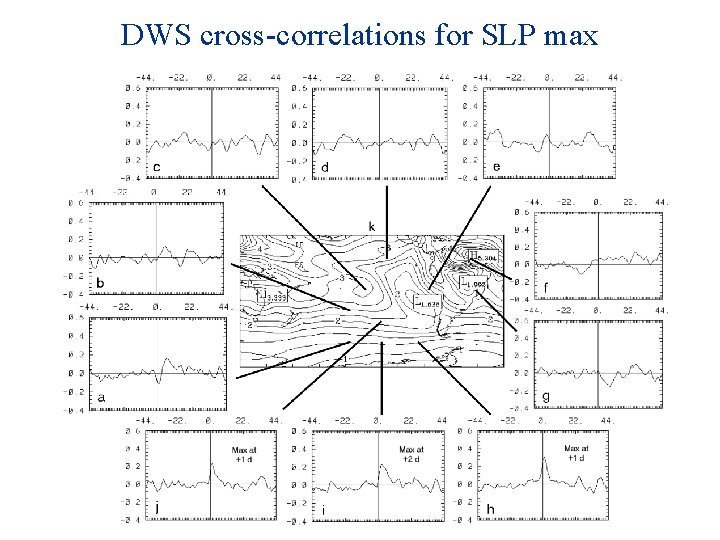
DWS cross-correlations for SLP max
What about the NP high daily data? • NP high very strongly influenced by day to day variation associated with traveling frontal cyclones. • NP high more strongly varies than SP high, which suggests filtering and/or subsampling to remove the high frequency variation from frontal cyclones.
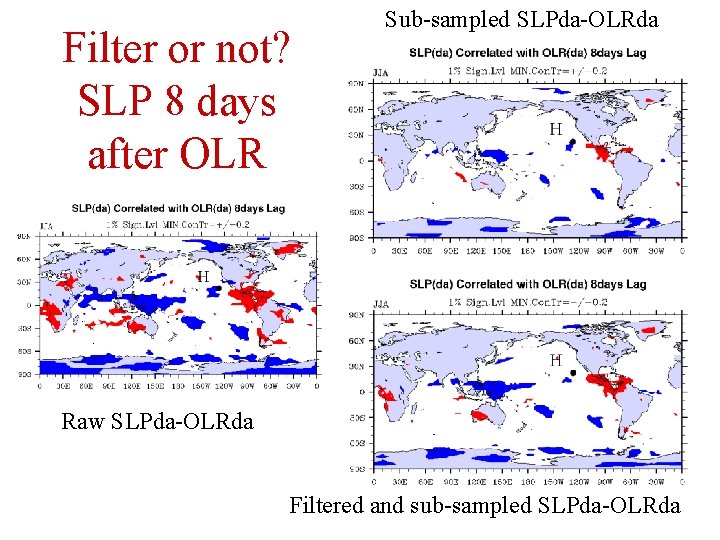
Filter or not? SLP 8 days after OLR Sub-sampled SLPda-OLRda Raw SLPda-OLRda Filtered and sub-sampled SLPda-OLRda
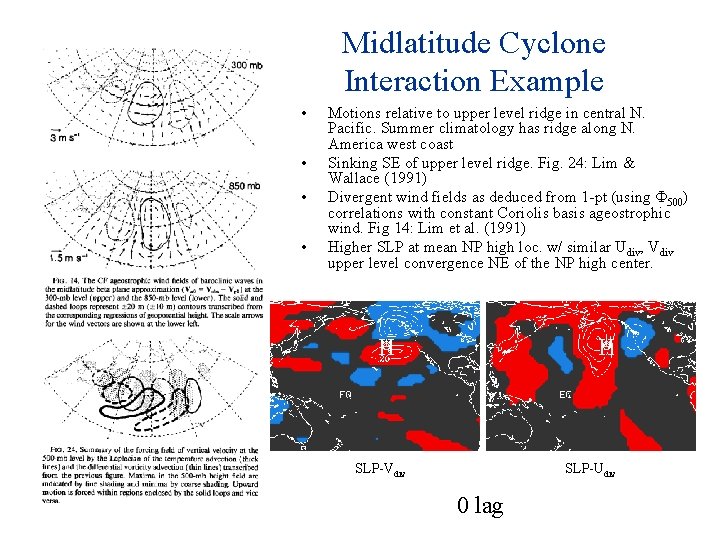
Midlatitude Cyclone Interaction Example • • Motions relative to upper level ridge in central N. Pacific. Summer climatology has ridge along N. America west coast Sinking SE of upper level ridge. Fig. 24: Lim & Wallace (1991) Divergent wind fields as deduced from 1 -pt (using F 500) correlations with constant Coriolis basis ageostrophic wind. Fig 14: Lim et al. (1991) Higher SLP at mean NP high loc. w/ similar Udiv, Vdiv upper level convergence NE of the NP high center. SLP-Vdiv SLP-Udiv 0 lag
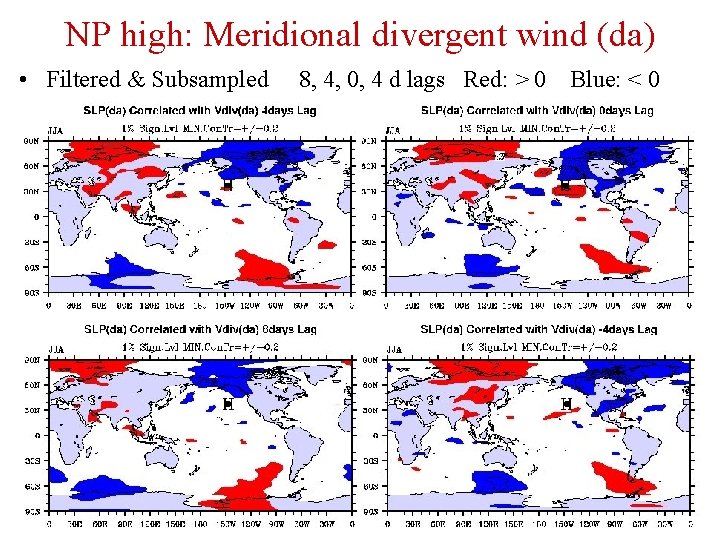
NP high: Meridional divergent wind (da) • Filtered & Subsampled 8, 4, 0, 4 d lags Red: > 0 Blue: < 0
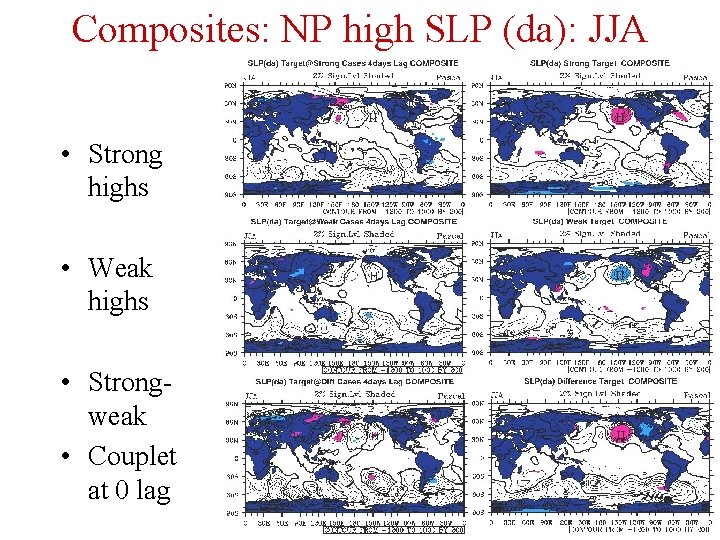
Composites: NP high SLP (da): JJA • Strong highs • Weak highs • Strongweak • Couplet at 0 lag
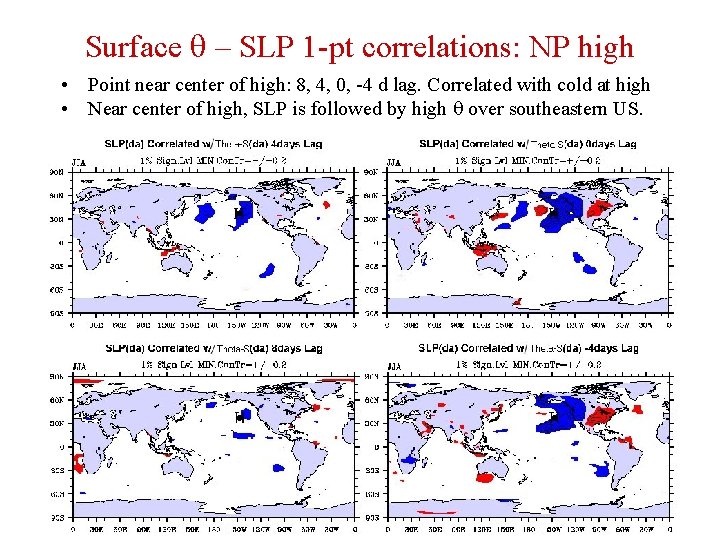
Surface q – SLP 1 -pt correlations: NP high • Point near center of high: 8, 4, 0, -4 d lag. Correlated with cold at high • Near center of high, SLP is followed by high q over southeastern US.
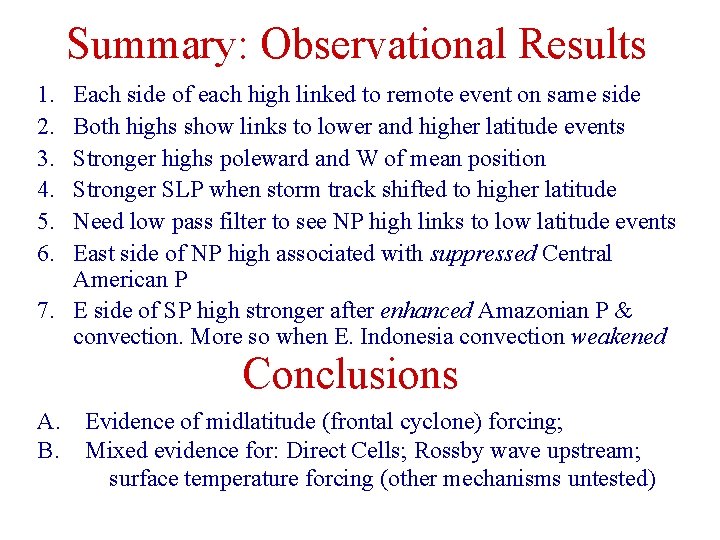
Summary: Observational Results 1. 2. 3. 4. 5. 6. Each side of each high linked to remote event on same side Both highs show links to lower and higher latitude events Stronger highs poleward and W of mean position Stronger SLP when storm track shifted to higher latitude Need low pass filter to see NP high links to low latitude events East side of NP high associated with suppressed Central American P 7. E side of SP high stronger after enhanced Amazonian P & convection. More so when E. Indonesia convection weakened Conclusions A. Evidence of midlatitude (frontal cyclone) forcing; B. Mixed evidence for: Direct Cells; Rossby wave upstream; surface temperature forcing (other mechanisms untested)
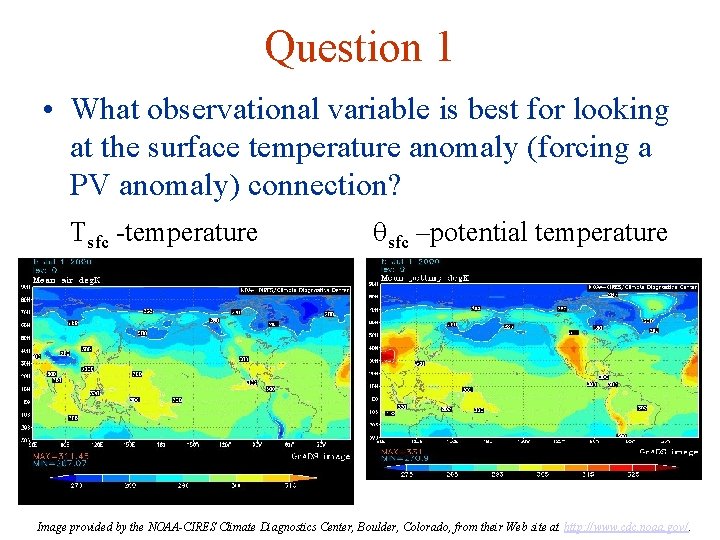
Question 1 • What observational variable is best for looking at the surface temperature anomaly (forcing a PV anomaly) connection? Tsfc -temperature qsfc –potential temperature Image provided by the NOAA-CIRES Climate Diagnostics Center, Boulder, Colorado, from their Web site at http: //www. cdc. noaa. gov/.
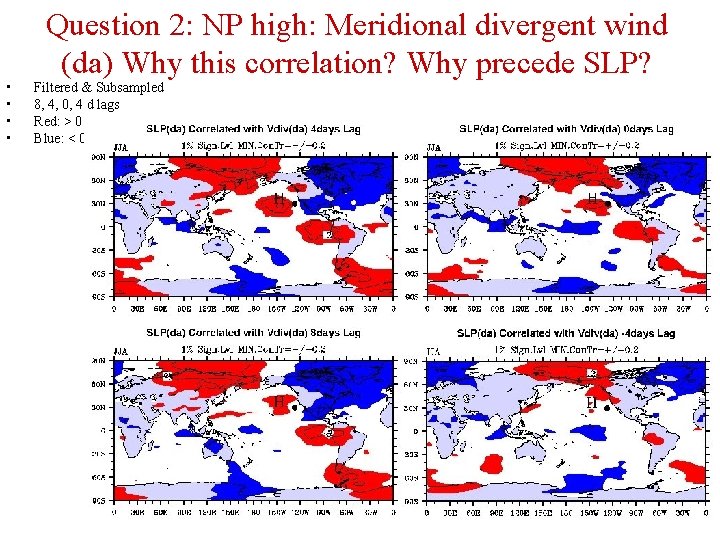
• • Question 2: NP high: Meridional divergent wind (da) Why this correlation? Why precede SLP? Filtered & Subsampled 8, 4, 0, 4 d lags Red: > 0 Blue: < 0
The End • Acknowledgements: – M. Osman – S. Immel – NSF
Storage • Not used due to time available
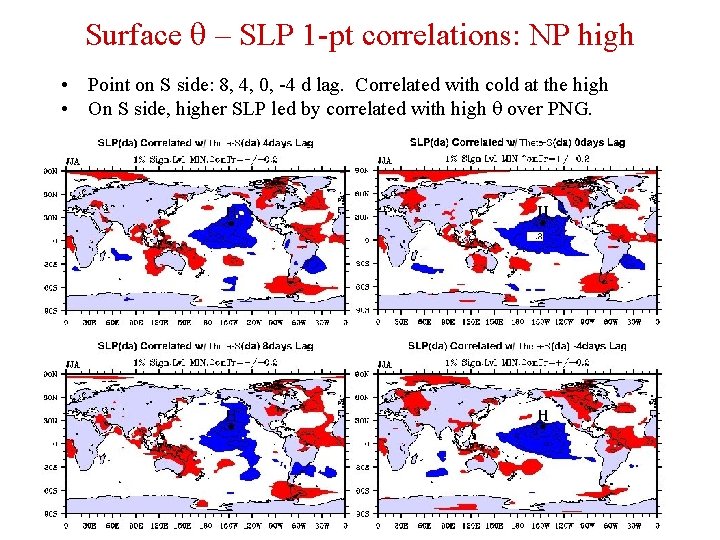
Surface q – SLP 1 -pt correlations: NP high • Point on S side: 8, 4, 0, -4 d lag. Correlated with cold at the high • On S side, higher SLP led by correlated with high q over PNG.
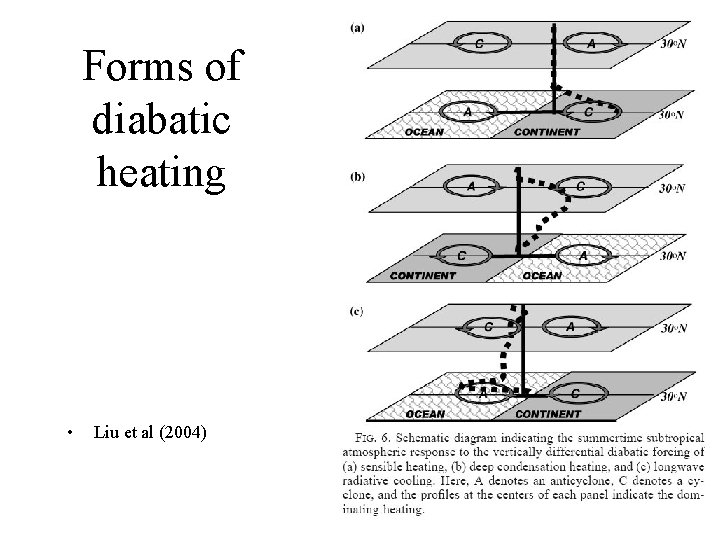
Forms of diabatic heating • Liu et al (2004)
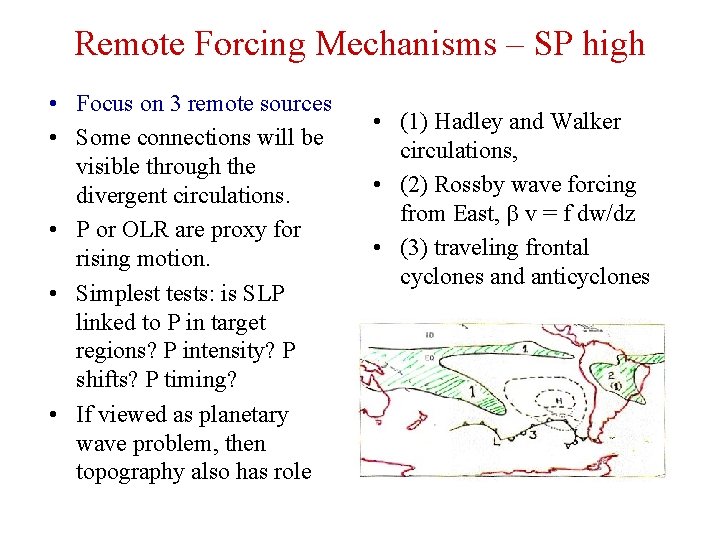
Remote Forcing Mechanisms – SP high • Focus on 3 remote sources • Some connections will be visible through the divergent circulations. • P or OLR are proxy for rising motion. • Simplest tests: is SLP linked to P in target regions? P intensity? P shifts? P timing? • If viewed as planetary wave problem, then topography also has role • (1) Hadley and Walker circulations, • (2) Rossby wave forcing from East, b v = f dw/dz • (3) traveling frontal cyclones and anticyclones
Test Proxies of strength of the rising sector of a circulation • P or OLR are proxy for rising motion. • Is SLP linked to: – – P in target regions? P intensity? P shifts? P timing? • Other scalar parts of divergent circulation? – Velocity potential – Divergent wind components, speed
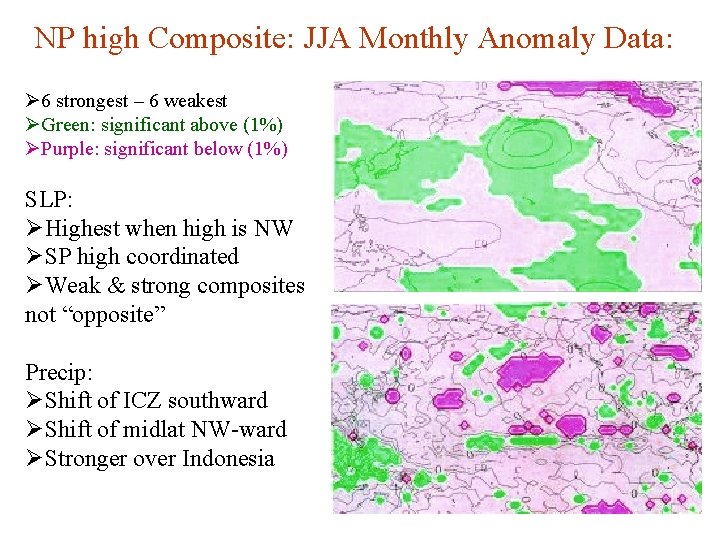
NP high Composite: JJA Monthly Anomaly Data: Ø 6 strongest – 6 weakest ØGreen: significant above (1%) ØPurple: significant below (1%) SLP: ØHighest when high is NW ØSP high coordinated ØWeak & strong composites not “opposite” Precip: ØShift of ICZ southward ØShift of midlat NW-ward ØStronger over Indonesia
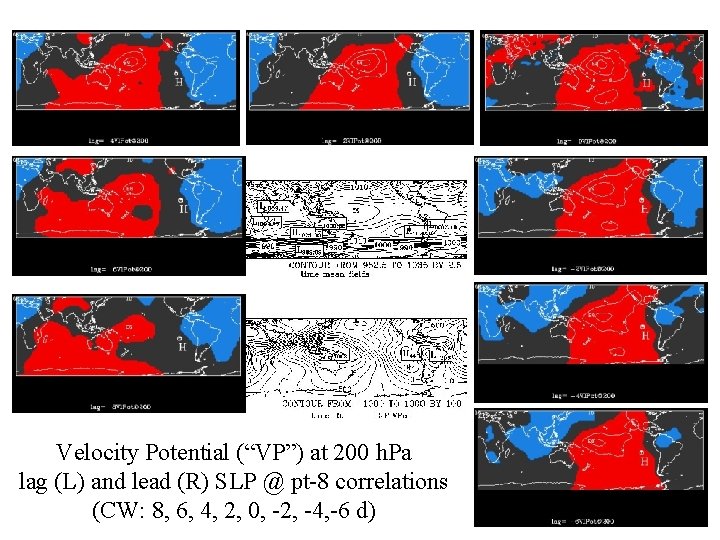
Velocity Potential (“VP”) at 200 h. Pa lag (L) and lead (R) SLP @ pt-8 correlations (CW: 8, 6, 4, 2, 0, -2, -4, -6 d)
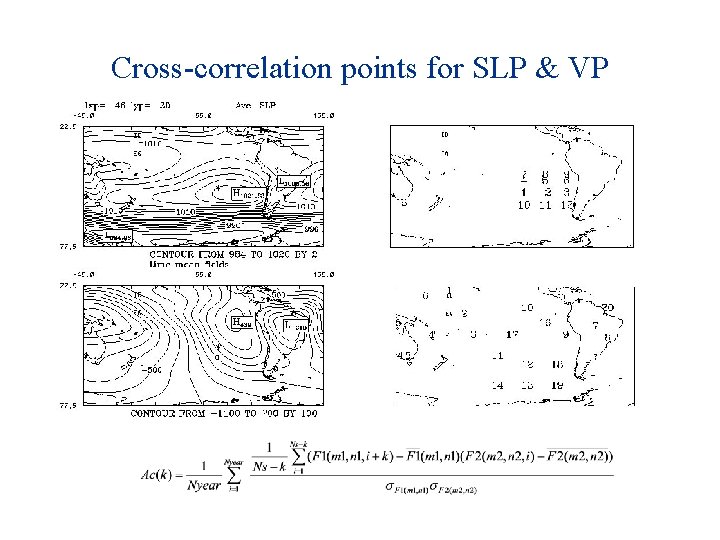
Cross-correlation points for SLP & VP
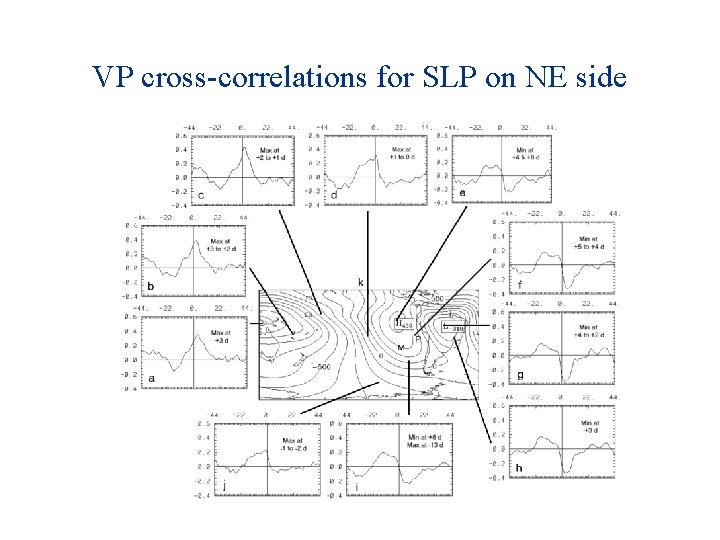
VP cross-correlations for SLP on NE side
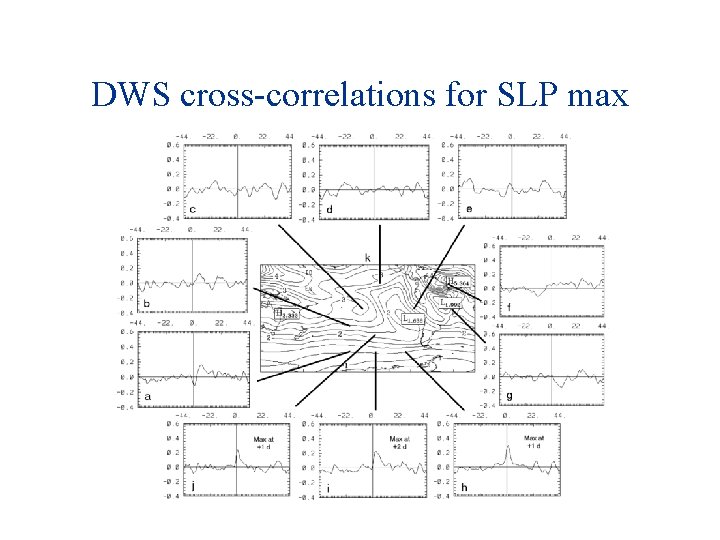
DWS cross-correlations for SLP max
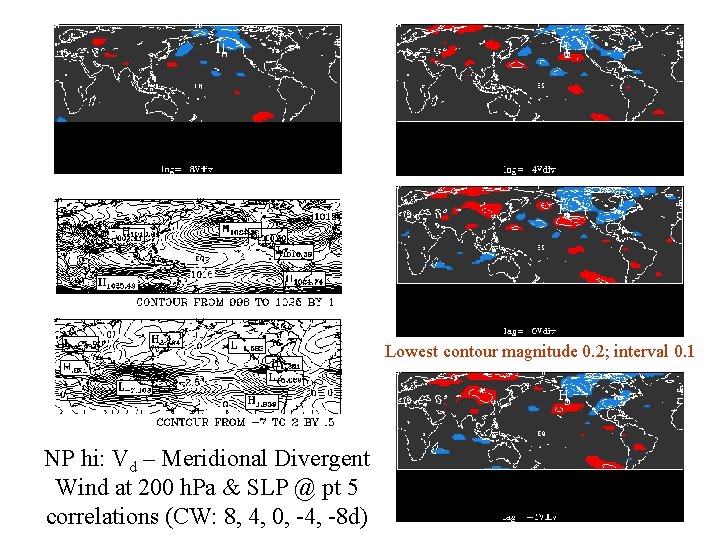
Lowest contour magnitude 0. 2; interval 0. 1 NP hi: Vd – Meridional Divergent Wind at 200 h. Pa & SLP @ pt 5 correlations (CW: 8, 4, 0, -4, -8 d)
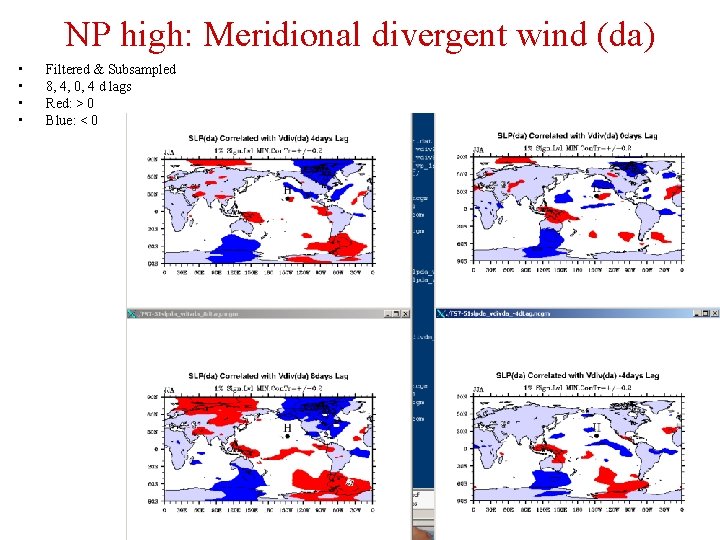
NP high: Meridional divergent wind (da) • • Filtered & Subsampled 8, 4, 0, 4 d lags Red: > 0 Blue: < 0
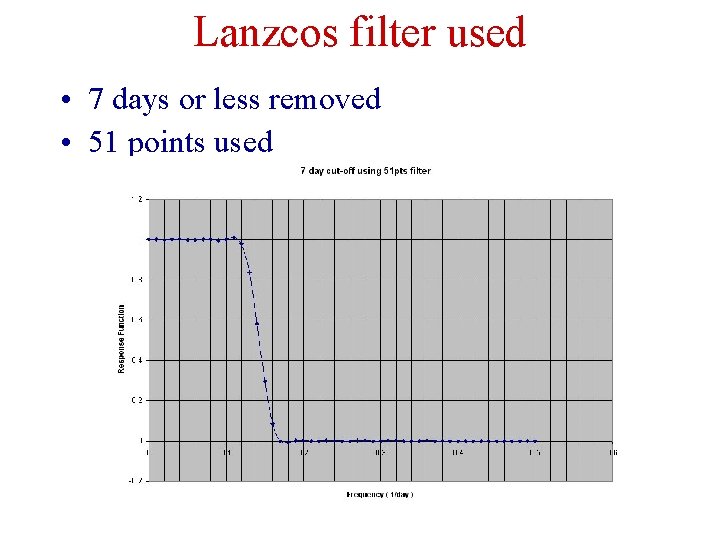
Lanzcos filter used • 7 days or less removed • 51 points used
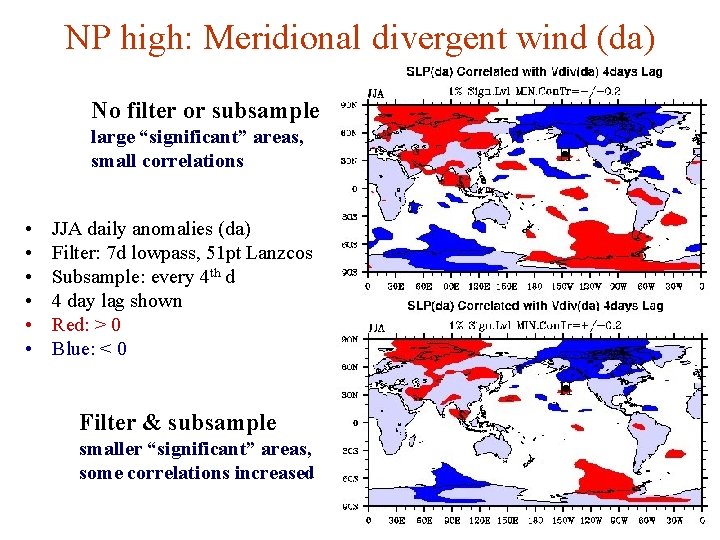
NP high: Meridional divergent wind (da) No filter or subsample large “significant” areas, small correlations • • • JJA daily anomalies (da) Filter: 7 d lowpass, 51 pt Lanzcos Subsample: every 4 th d 4 day lag shown Red: > 0 Blue: < 0 Filter & subsample smaller “significant” areas, some correlations increased
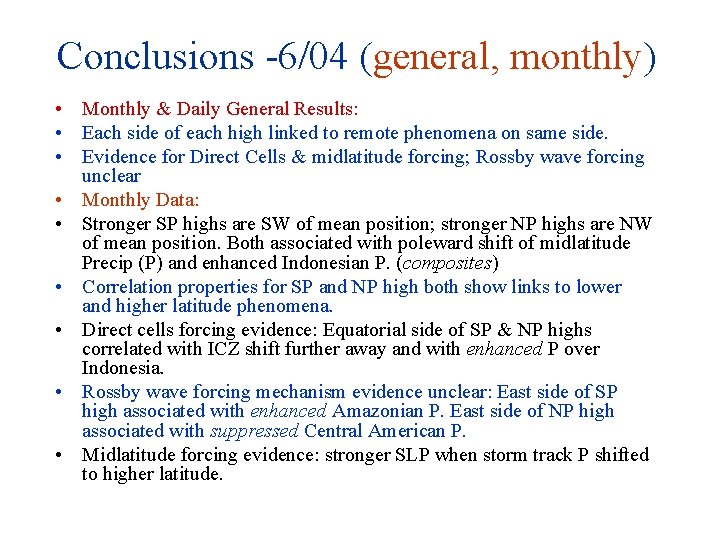
Conclusions -6/04 (general, monthly) • Monthly & Daily General Results: • Each side of each high linked to remote phenomena on same side. • Evidence for Direct Cells & midlatitude forcing; Rossby wave forcing unclear • Monthly Data: • Stronger SP highs are SW of mean position; stronger NP highs are NW of mean position. Both associated with poleward shift of midlatitude Precip (P) and enhanced Indonesian P. (composites) • Correlation properties for SP and NP high both show links to lower and higher latitude phenomena. • Direct cells forcing evidence: Equatorial side of SP & NP highs correlated with ICZ shift further away and with enhanced P over Indonesia. • Rossby wave forcing mechanism evidence unclear: East side of SP high associated with enhanced Amazonian P. East side of NP high associated with suppressed Central American P. • Midlatitude forcing evidence: stronger SLP when storm track P shifted to higher latitude.
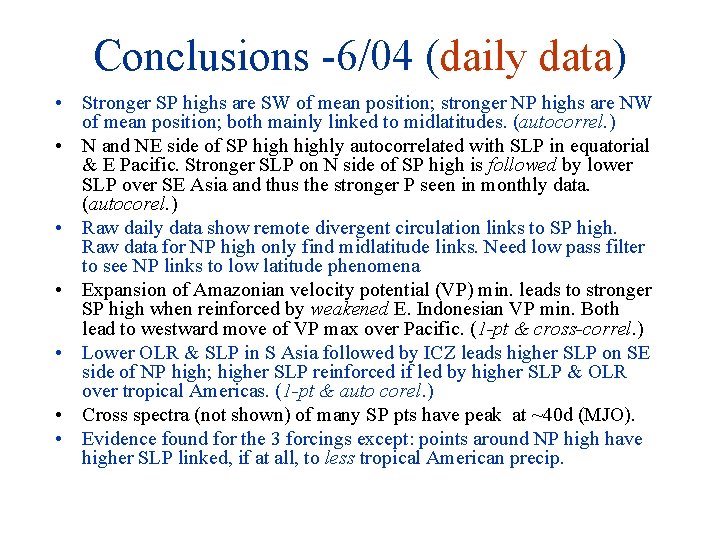
Conclusions -6/04 (daily data) • Stronger SP highs are SW of mean position; stronger NP highs are NW of mean position; both mainly linked to midlatitudes. (autocorrel. ) • N and NE side of SP highly autocorrelated with SLP in equatorial & E Pacific. Stronger SLP on N side of SP high is followed by lower SLP over SE Asia and thus the stronger P seen in monthly data. (autocorel. ) • Raw daily data show remote divergent circulation links to SP high. Raw data for NP high only find midlatitude links. Need low pass filter to see NP links to low latitude phenomena • Expansion of Amazonian velocity potential (VP) min. leads to stronger SP high when reinforced by weakened E. Indonesian VP min. Both lead to westward move of VP max over Pacific. (1 -pt & cross-correl. ) • Lower OLR & SLP in S Asia followed by ICZ leads higher SLP on SE side of NP high; higher SLP reinforced if led by higher SLP & OLR over tropical Americas. (1 -pt & auto corel. ) • Cross spectra (not shown) of many SP pts have peak at ~40 d (MJO). • Evidence found for the 3 forcings except: points around NP high have higher SLP linked, if at all, to less tropical American precip.
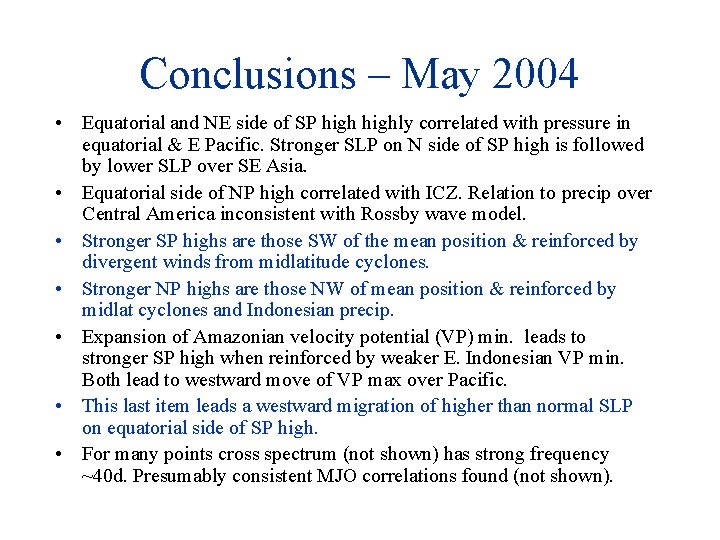
Conclusions – May 2004 • Equatorial and NE side of SP highly correlated with pressure in equatorial & E Pacific. Stronger SLP on N side of SP high is followed by lower SLP over SE Asia. • Equatorial side of NP high correlated with ICZ. Relation to precip over Central America inconsistent with Rossby wave model. • Stronger SP highs are those SW of the mean position & reinforced by divergent winds from midlatitude cyclones. • Stronger NP highs are those NW of mean position & reinforced by midlat cyclones and Indonesian precip. • Expansion of Amazonian velocity potential (VP) min. leads to stronger SP high when reinforced by weaker E. Indonesian VP min. Both lead to westward move of VP max over Pacific. • This last item leads a westward migration of higher than normal SLP on equatorial side of SP high. • For many points cross spectrum (not shown) has strong frequency ~40 d. Presumably consistent MJO correlations found (not shown).
• End of the planned talk
JJA Precipitation Climatology DJF
Physical Interpretation of Gill’s Model Invisicid form: Form vorticity eqn
Rossby Wave Mechanism deduced from Gill’s Tropical Circulation Model
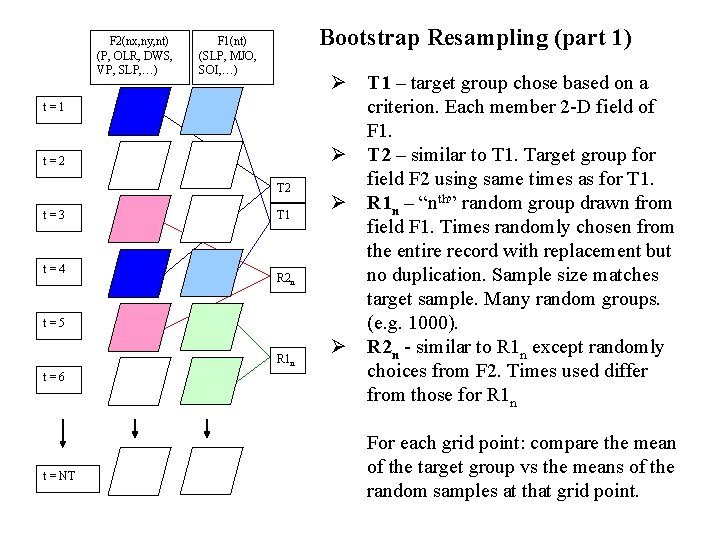
F 2(nx, ny, nt) (P, OLR, DWS, VP, SLP, …) Bootstrap Resampling (part 1) F 1(nt) (SLP, MJO, SOI, …) t=1 t=2 T 2 t=3 t=4 T 1 R 2 n t=5 R 1 n t=6 t = NT Ø T 1 – target group chose based on a criterion. Each member 2 -D field of F 1. Ø T 2 – similar to T 1. Target group for field F 2 using same times as for T 1. Ø R 1 n – “nth” random group drawn from field F 1. Times randomly chosen from the entire record with replacement but no duplication. Sample size matches target sample. Many random groups. (e. g. 1000). Ø R 2 n - similar to R 1 n except randomly choices from F 2. Times used differ from those for R 1 n For each grid point: compare the mean of the target group vs the means of the random samples at that grid point.
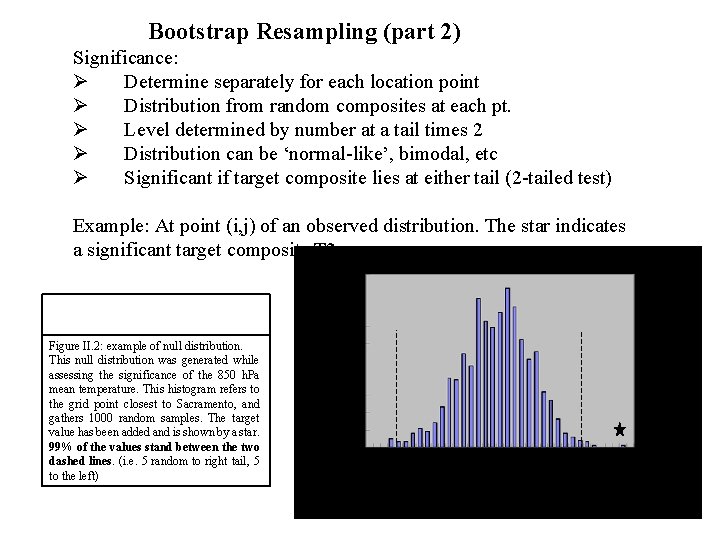
Bootstrap Resampling (part 2) Significance: Ø Determine separately for each location point Ø Distribution from random composites at each pt. Ø Level determined by number at a tail times 2 Ø Distribution can be ‘normal-like’, bimodal, etc Ø Significant if target composite lies at either tail (2 -tailed test) Example: At point (i, j) of an observed distribution. The star indicates a significant target composite T 2 Figure II. 2: example of null distribution. This null distribution was generated while assessing the significance of the 850 h. Pa mean temperature. This histogram refers to the grid point closest to Sacramento, and gathers 1000 random samples. The target value has been added and is shown by a star. 99% of the values stand between the two dashed lines. (i. e. 5 random to right tail, 5 to the left)
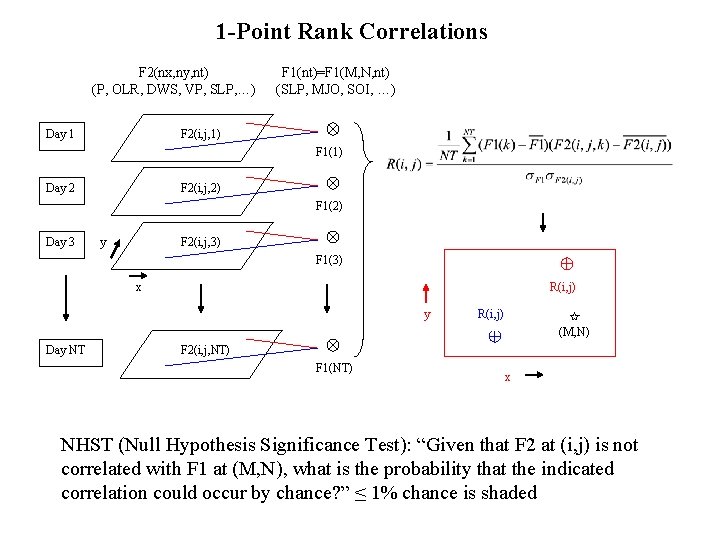
1 -Point Rank Correlations F 2(nx, ny, nt) (P, OLR, DWS, VP, SLP, …) Day 1 F 1(nt)=F 1(M, N, nt) (SLP, MJO, SOI, …) F 2(i, j, 1) F 1(1) Day 2 F 2(i, j, 2) F 1(2) Day 3 y F 2(i, j, 3) F 1(3) x R(i, j) y R(i, j) (M, N) Day NT F 2(i, j, NT) F 1(NT) x NHST (Null Hypothesis Significance Test): “Given that F 2 at (i, j) is not correlated with F 1 at (M, N), what is the probability that the indicated correlation could occur by chance? ” ≤ 1% chance is shaded
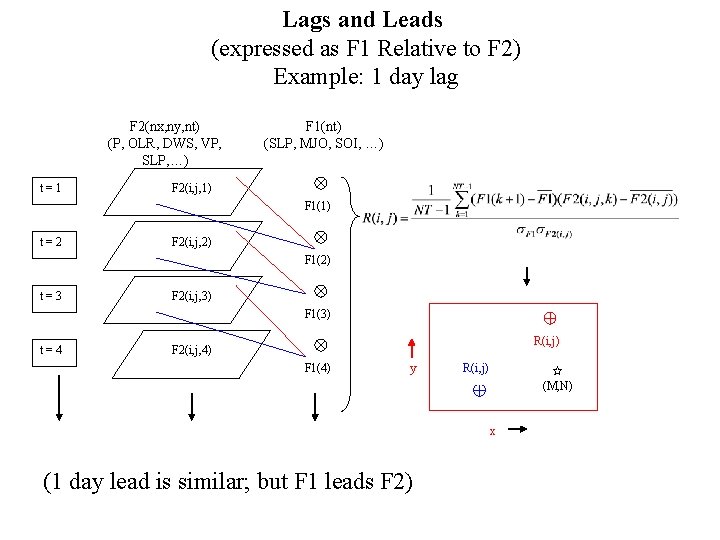
Lags and Leads (expressed as F 1 Relative to F 2) Example: 1 day lag F 2(nx, ny, nt) (P, OLR, DWS, VP, SLP, …) t=1 F 1(nt) (SLP, MJO, SOI, …) F 2(i, j, 1) F 1(1) t=2 F 2(i, j, 2) F 1(2) t=3 F 2(i, j, 3) F 1(3) t=4 R(i, j) F 2(i, j, 4) F 1(4) y R(i, j) (M, N) x (1 day lead is similar; but F 1 leads F 2)
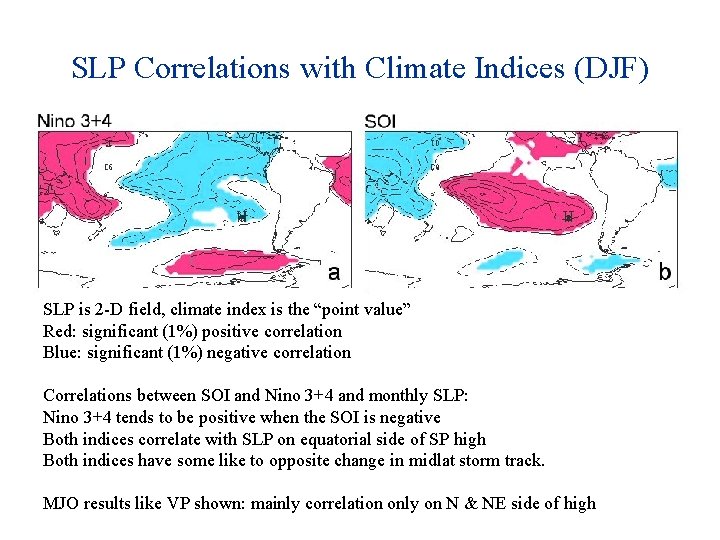
SLP Correlations with Climate Indices (DJF) SLP is 2 -D field, climate index is the “point value” Red: significant (1%) positive correlation Blue: significant (1%) negative correlation Correlations between SOI and Nino 3+4 and monthly SLP: Nino 3+4 tends to be positive when the SOI is negative Both indices correlate with SLP on equatorial side of SP high Both indices have some like to opposite change in midlat storm track. MJO results like VP shown: mainly correlation only on N & NE side of high
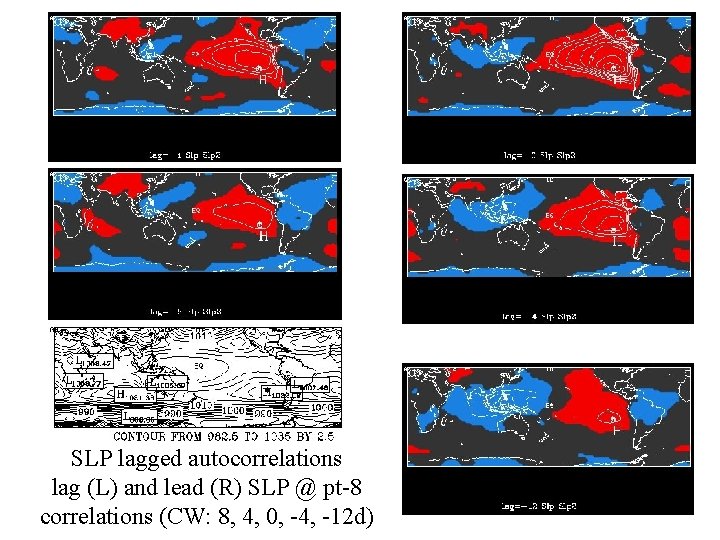
SLP lagged autocorrelations lag (L) and lead (R) SLP @ pt-8 correlations (CW: 8, 4, 0, -4, -12 d)
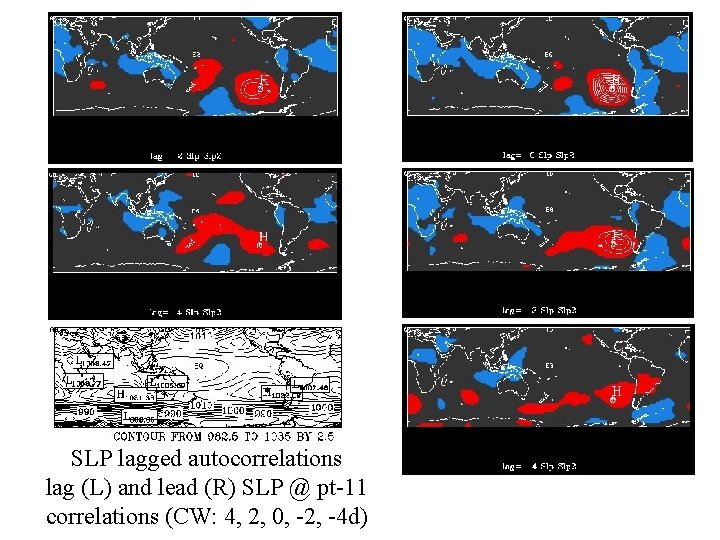
SLP lagged autocorrelations lag (L) and lead (R) SLP @ pt-11 correlations (CW: 4, 2, 0, -2, -4 d)
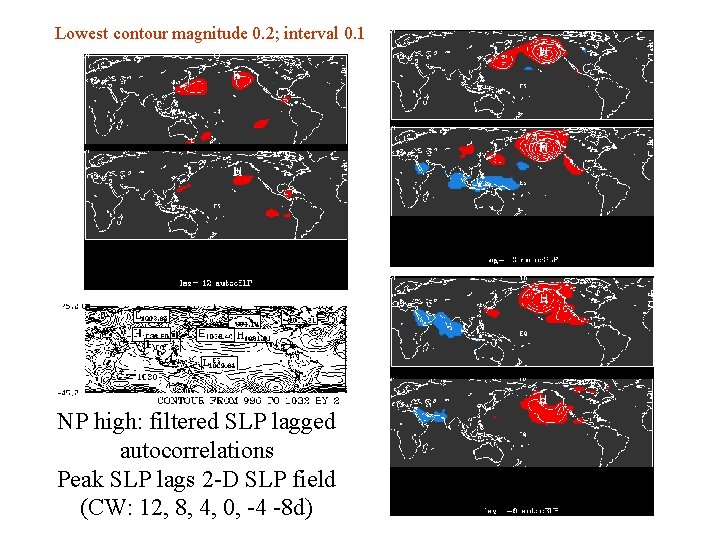
Lowest contour magnitude 0. 2; interval 0. 1 NP high: filtered SLP lagged autocorrelations Peak SLP lags 2 -D SLP field (CW: 12, 8, 4, 0, -4 -8 d)
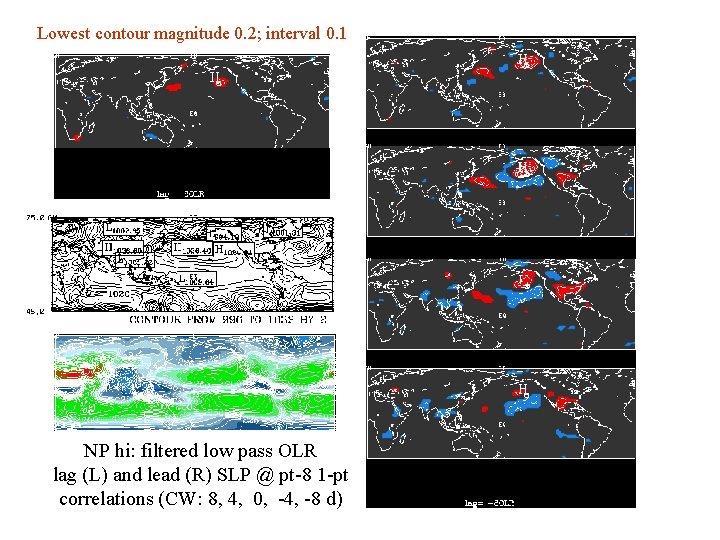
Lowest contour magnitude 0. 2; interval 0. 1 NP hi: filtered low pass OLR lag (L) and lead (R) SLP @ pt-8 1 -pt correlations (CW: 8, 4, 0, -4, -8 d)
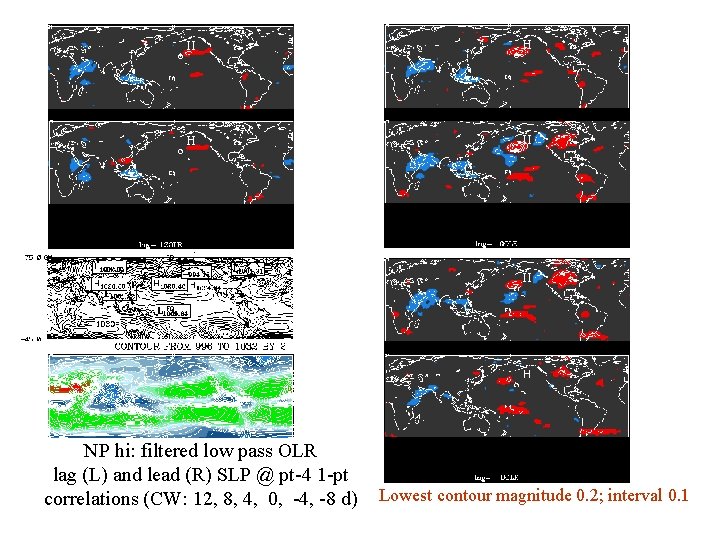
NP hi: filtered low pass OLR lag (L) and lead (R) SLP @ pt-4 1 -pt correlations (CW: 12, 8, 4, 0, -4, -8 d) Lowest contour magnitude 0. 2; interval 0. 1
Symbol test • • abcd efgh ijkl mnop qrst uvwxyz ABCDEFGHIJKLMNOPQUSTUVWXYZ !@#$%^&*()_+=-? ><; : |~`
- Slides: 72