
Pacific Inland Resources Landscape Reforestation Standard In Search



- Slides: 52
Pacific Inland Resources Landscape Reforestation Standard In Search of the Missing Link 1 SISCO Winter Workshop, Kamloops BC Gary Quanstrom, RPF Feb 25, 2016
THOUGHT FOR THE DAY 12 of the 13 Men that have walked on the Moon were Scouts Part of the Scout’s Law says that – “Scouts are Wise in the Use of All Resources” 2 This means Scouts focus Limited Resources on where they do the most “Common Good. ”
$$$ WHY DO I MENTION THIS? • BC Timber Harvest is targeted at an AAC of > 50 million m 3 / year • Forest Industry, spends ~ $0. 20 / m 3/ year collecting and managing Silviculture Survey Data. • This annual ~ $10 million investment equates to $100 million over the 10 year period between Timber Supply Reviews (TSRs) • I believe we can modify our practices to gain a much greater Value of Information, by >$2 million annually, by focusing our Limited Resources on where they do the most “Common Good. ”
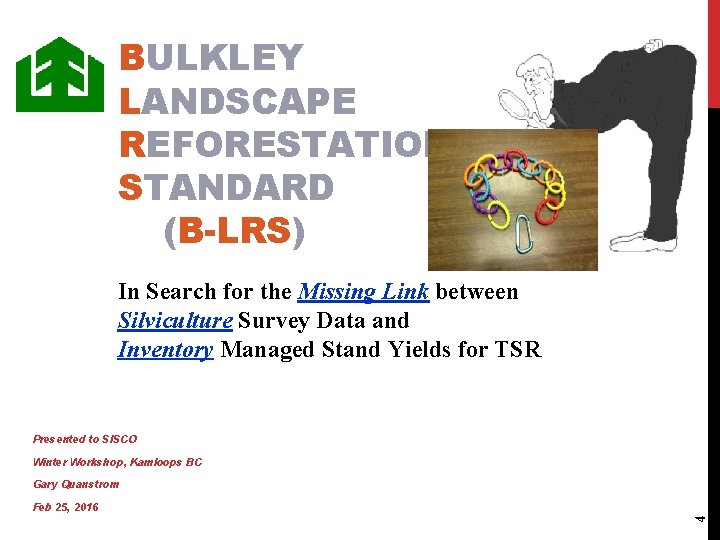
BULKLEY LANDSCAPE REFORESTATION STANDARD (B-LRS) In Search for the Missing Link between Silviculture Survey Data and Inventory Managed Stand Yields for TSR Presented to SISCO Winter Workshop, Kamloops BC Gary Quanstrom 4 Feb 25, 2016
THANKS SISCO AND TO THE SIX TEAMS OF ~ 30 PEOPLE WORKED TOGETHER ON THIS PROJECT TEAM Role 1. Coordination 2. Landscape Species Composition Targets (LSCTs) 3. Risk & Uncertainty -Forest Health -Climate Change 4. FAIB Modeling-TASS -TIPSY 5. Survey Methods 5 6. Compile and Report to RESULTS
Eleanor Mc. Williams Pat Martin Hubert Burger Jay Baker Mario Di Lucca Paul Rehsler Ken Polsson Richard Reich Dave Weaver Dave Coates Al Powelson Alex Woods Kevin Astridge Ken White Shirley Mah Phil Lepage Lorne Bedford Glen Buhr Jim Goudie Jennifer Plummer Barry Snowdon Erin Holtzman Jeff Mycock Erin Hall Larry Gardner Mei-Ching Tsoi Guy Burdikin Caroline Macleod Ian Cameron And Others 6 Thanks to
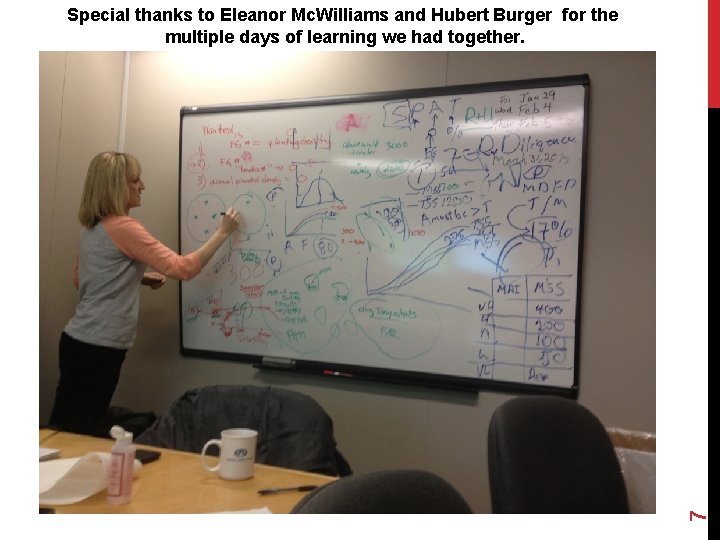
7 Special thanks to Eleanor Mc. Williams and Hubert Burger for the multiple days of learning we had together.
OUTLINE - ANSWER 5 QUESTIONS 8 1. Background to this process 2. What are Landscape Reforestation Standards and how are they different from the current standards 3. Benefits for the Public & Licensees 4. How was Consensus achieved 5. Next Steps in implementation
PIR –FSP-Landscape Reforestation Standards Background History • Why do this? 9 • What are the Drivers?
PURPOSE “The principle purpose of Silviculture Surveys is to forecast future yields. ” “Designing elegant Silviculture Surveys is pointless if the procedures for estimating future yields cannot use the additional information and vice versa. ” years ago 10 (Albert R. Stage 1983) … 33
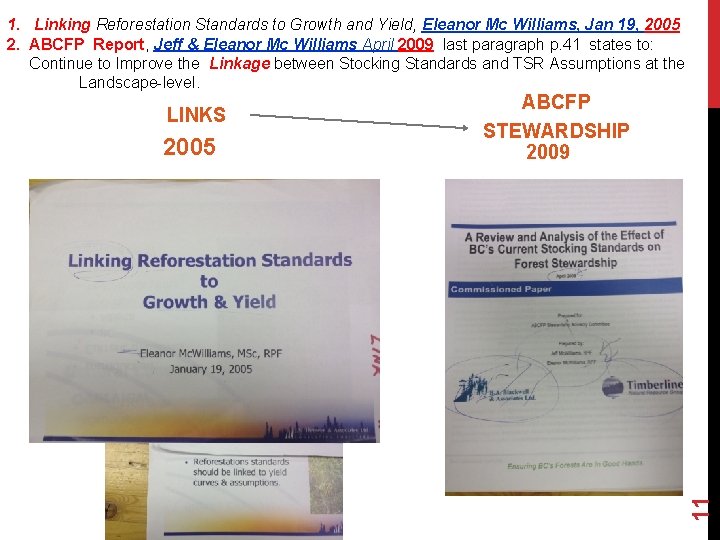
1. Linking Reforestation Standards to Growth and Yield, Eleanor Mc Williams, Jan 19, 2005 2. ABCFP Report, Jeff & Eleanor Mc Williams April 2009 last paragraph p. 41 states to: Continue to Improve the Linkage between Stocking Standards and TSR Assumptions at the Landscape-level. 2005 ABCFP STEWARDSHIP 2009 11 LINKS
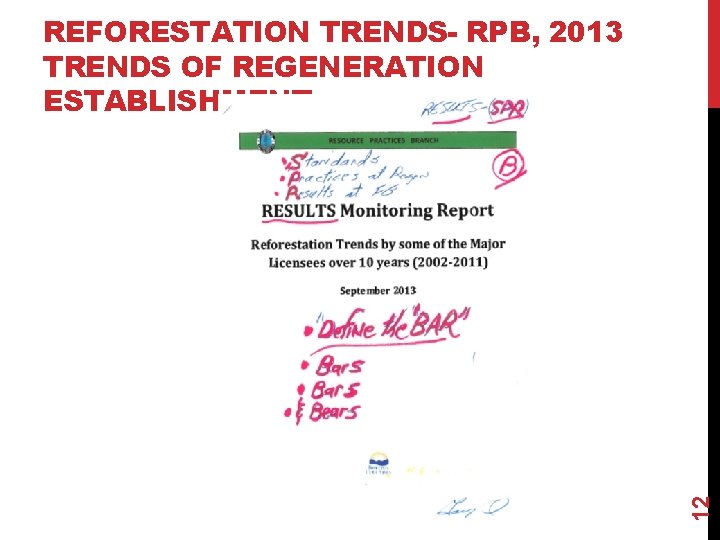
12 REFORESTATION TRENDS- RPB, 2013 TRENDS OF REGENERATION ESTABLISHMENT
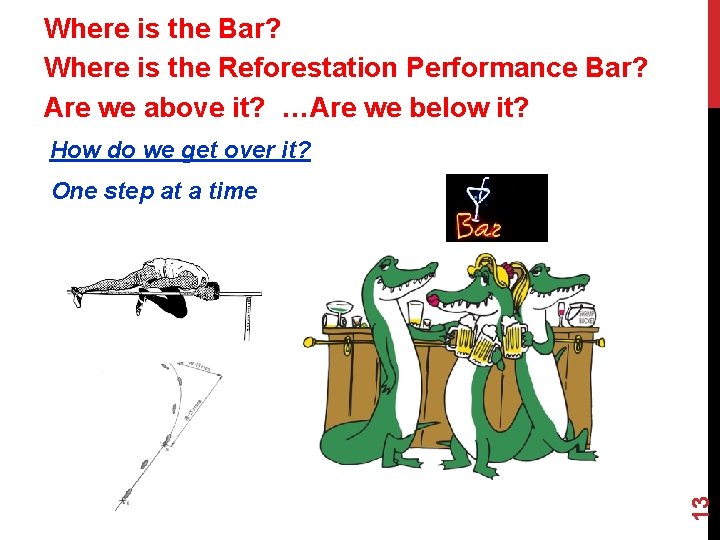
Where is the Bar? Where is the Reforestation Performance Bar? Are we above it? …Are we below it? How do we get over it? 13 One step at a time
TOM ETHIER ADM, FLNRO STEWARDSHIP DIVISION, 2012 14 “I strongly Encourage Both Government and Licensees to Work Together to come to a Common Understanding of the Risks and Uncertainties associated with Growth and Yield and Timber Supply to develop Innovative Stocking Standards”
CHIEF FORESTERS’ TOUR BEDNESTI ACTION PLAN (BAP) GOAL of the Bednesti Action Plan (BAP) is to: Align Stocking Standards with Timber Objectives across the Landscape, using Stand Monitoring and Growth and Yield Analysis systems that support achieving the stated Future Objectives, while also providing 15 accurate data on the current state of the forests
16 Successful Reforestation needs a process that integrates and LINKs: • future stand objectives, • growth and yield projections, • stocking standards, • early stand assessment methods, • post-free growing monitoring, • data management, and • timber supply analysis.
Currently there is a Lack of an identifiable strategy that outlines how these components are Linked. 17 These Landscape Standards are meant to provide a concrete example to help create these Linkages
PIR-FSP Landscape Reforestation Standards • What are they? 18 • How are they different from current standards?
NOT TOTALLY A NEW IDEA • We reviewed existing and DRAFT Landscape Standards • • Alberta ASR Ft St John Pilot Riverside (Tolko) Weyerhaeuser 19 • These Landscape Reforestation Standards are now Approved by the Chief Forester for our 2017 FSP.
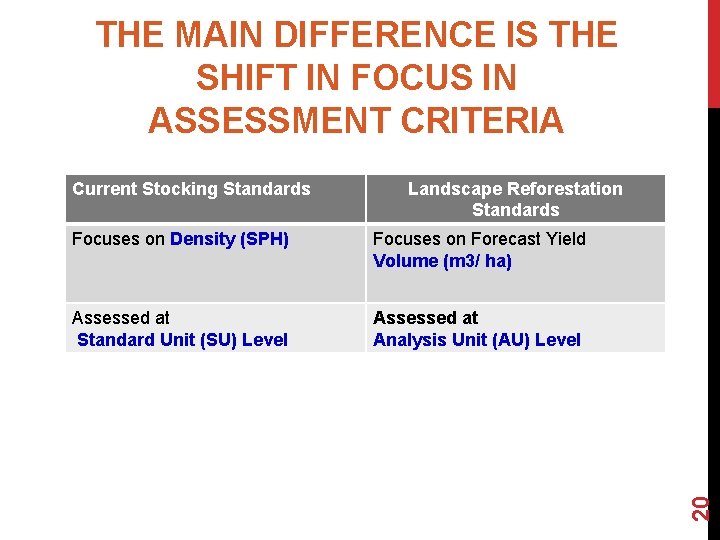
THE MAIN DIFFERENCE IS THE SHIFT IN FOCUS IN ASSESSMENT CRITERIA Landscape Reforestation Standards Focuses on Density (SPH) Focuses on Forecast Yield Volume (m 3/ ha) Assessed at Standard Unit (SU) Level Assessed at Analysis Unit (AU) Level 20 Current Stocking Standards
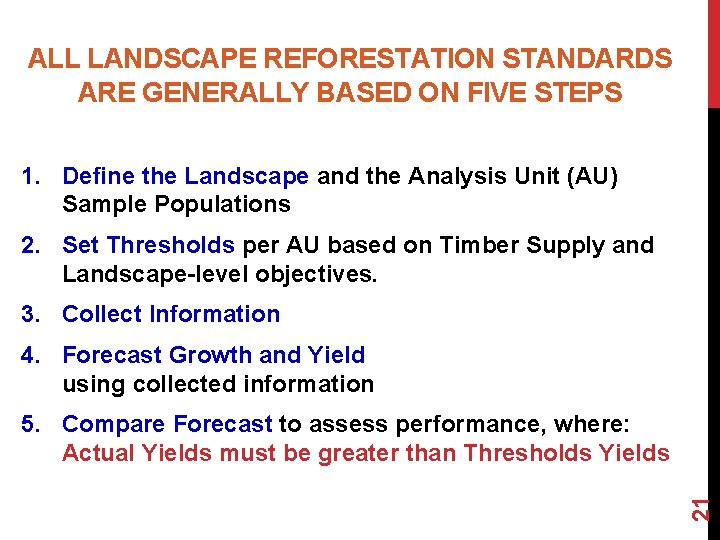
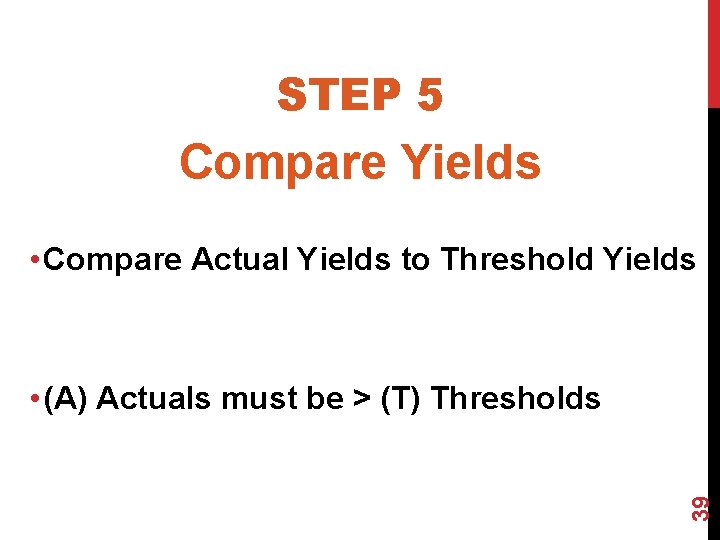
ALL LANDSCAPE REFORESTATION STANDARDS ARE GENERALLY BASED ON FIVE STEPS 1. Define the Landscape and the Analysis Unit (AU) Sample Populations 2. Set Thresholds per AU based on Timber Supply and Landscape-level objectives. 3. Collect Information 4. Forecast Growth and Yield using collected information 21 5. Compare Forecast to assess performance, where: Actual Yields must be greater than Thresholds Yields
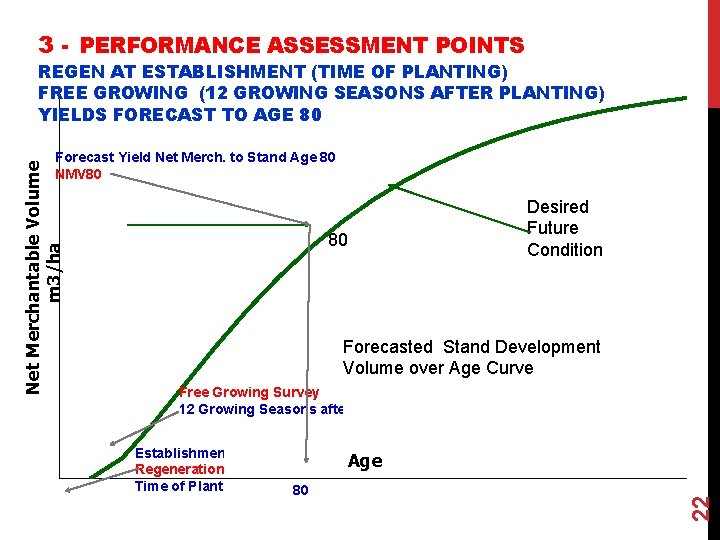
3 - PERFORMANCE ASSESSMENT POINTS REGEN AT ESTABLISHMENT (TIME OF PLANTING) FREE GROWING (12 GROWING SEASONS AFTER PLANTING) YIELDS FORECAST TO AGE 80 Desired Future Condition 80 Forecasted Stand Development Volume over Age Curve Free Growing Survey 12 Growing Seasons after Planting Establishment Regeneration Time of Planting Age 80 22 Net Merchantable Volume m 3/ha Forecast Yield Net Merch. to Stand Age 80 NMV 80
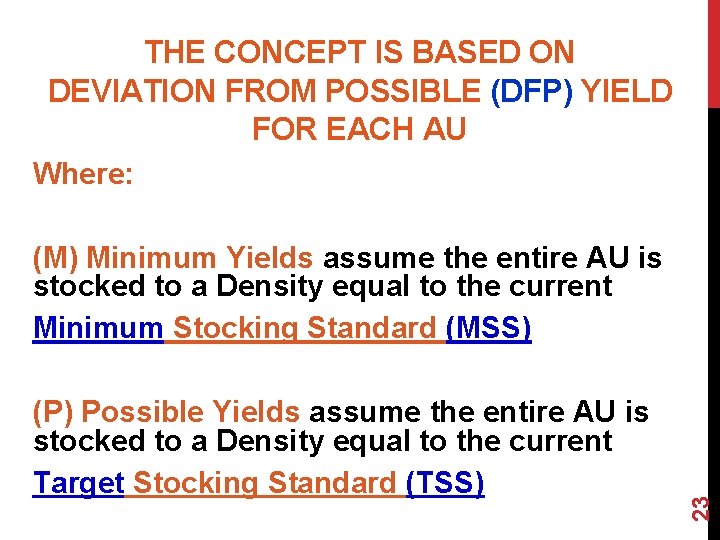
THE CONCEPT IS BASED ON DEVIATION FROM POSSIBLE (DFP) YIELD FOR EACH AU Where: (P) Possible Yields assume the entire AU is stocked to a Density equal to the current Target Stocking Standard (TSS) 23 (M) Minimum Yields assume the entire AU is stocked to a Density equal to the current Minimum Stocking Standard (MSS)
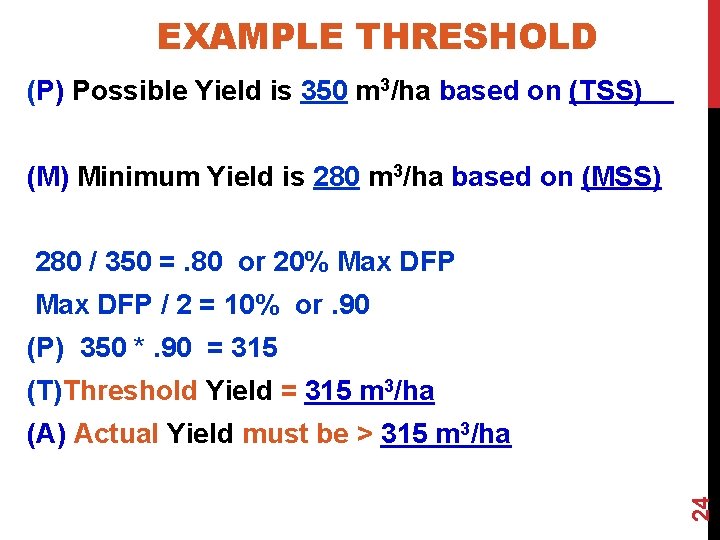
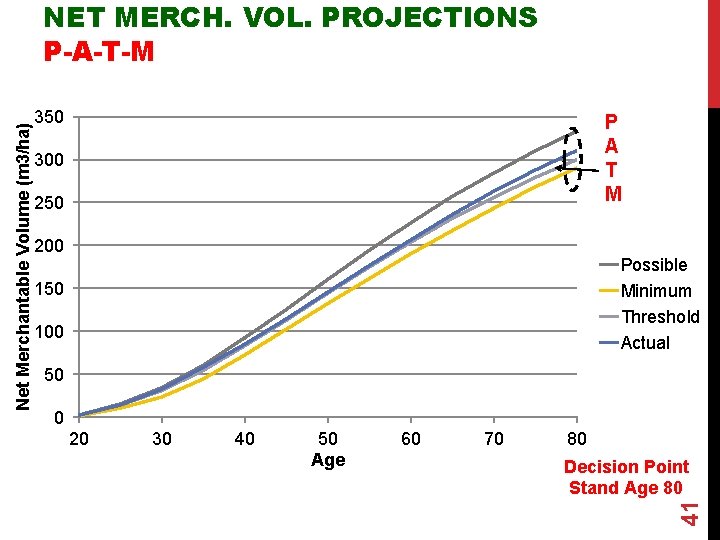
EXAMPLE THRESHOLD (P) Possible Yield is 350 m 3/ha based on (TSS) (M) Minimum Yield is 280 m 3/ha based on (MSS) 280 / 350 =. 80 or 20% Max DFP / 2 = 10% or. 90 (P) 350 *. 90 = 315 (T)Threshold Yield = 315 m 3/ha 24 (A) Actual Yield must be > 315 m 3/ha
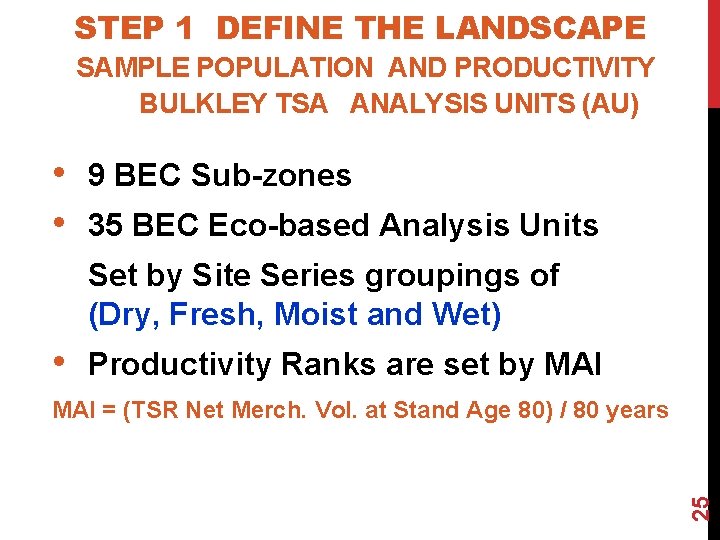
STEP 1 DEFINE THE LANDSCAPE SAMPLE POPULATION AND PRODUCTIVITY BULKLEY TSA ANALYSIS UNITS (AU) • 9 BEC Sub-zones • 35 BEC Eco-based Analysis Units Set by Site Series groupings of (Dry, Fresh, Moist and Wet) • Productivity Ranks are set by MAI 25 MAI = (TSR Net Merch. Vol. at Stand Age 80) / 80 years
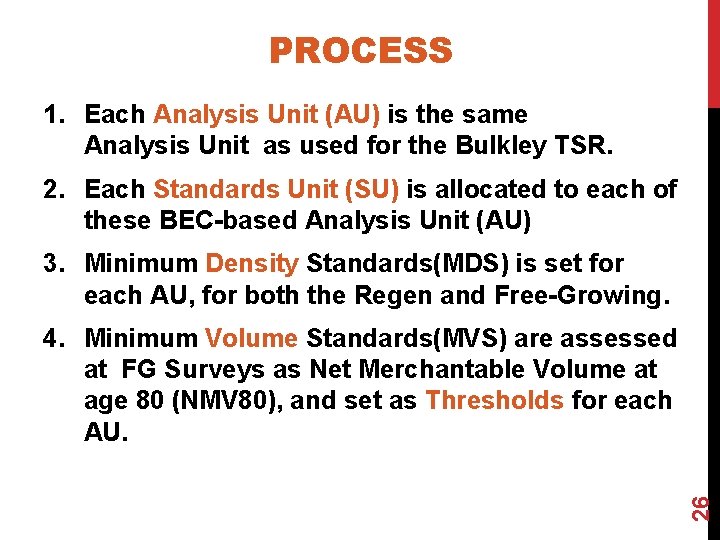
PROCESS 1. Each Analysis Unit (AU) is the same Analysis Unit as used for the Bulkley TSR. 2. Each Standards Unit (SU) is allocated to each of these BEC-based Analysis Unit (AU) 3. Minimum Density Standards(MDS) is set for each AU, for both the Regen and Free-Growing. 26 4. Minimum Volume Standards(MVS) are assessed at FG Surveys as Net Merchantable Volume at age 80 (NMV 80), and set as Thresholds for each AU.
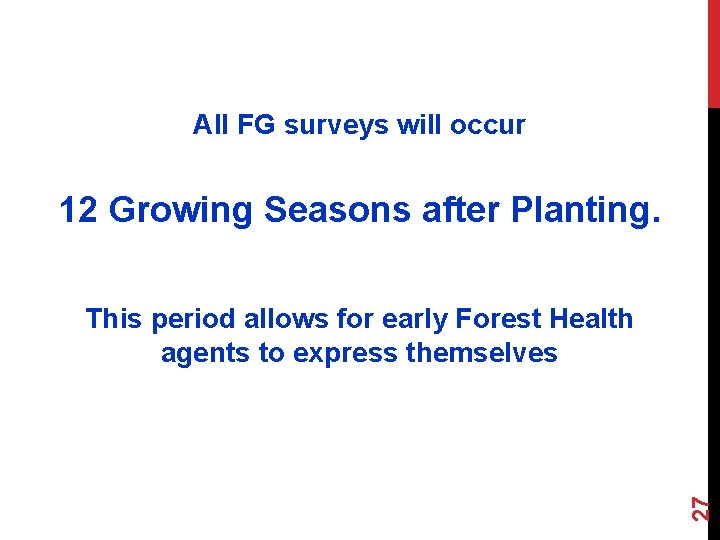
All FG surveys will occur 12 Growing Seasons after Planting. 27 This period allows for early Forest Health agents to express themselves
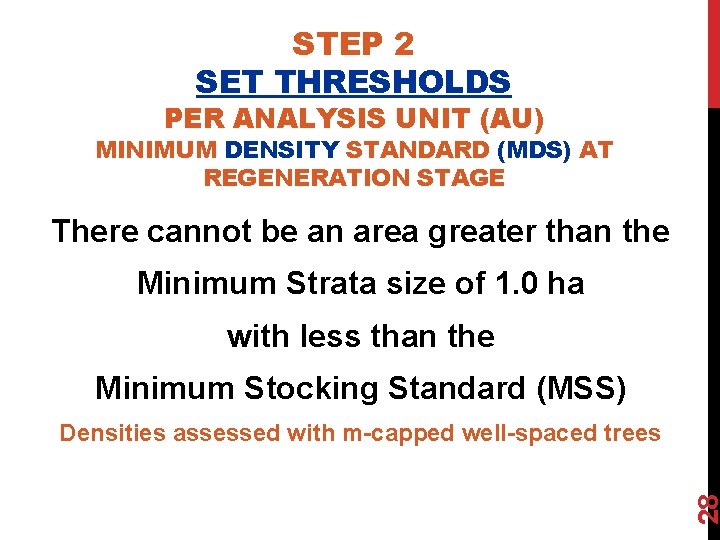
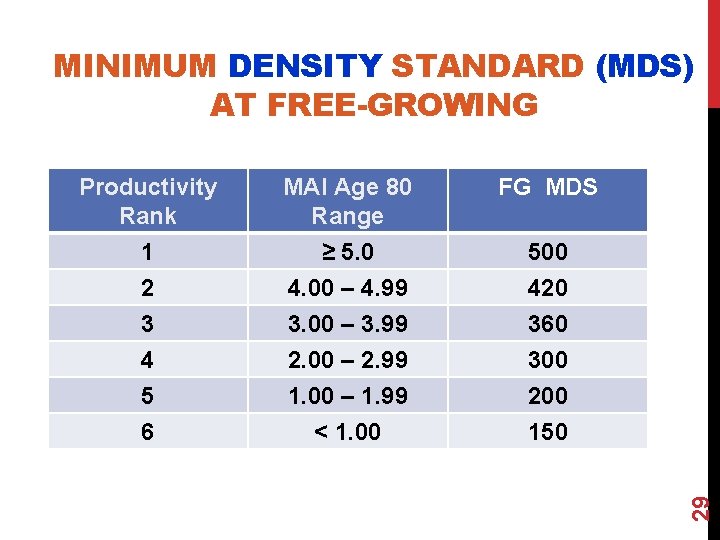
STEP 2 SET THRESHOLDS PER ANALYSIS UNIT (AU) MINIMUM DENSITY STANDARD (MDS) AT REGENERATION STAGE There cannot be an area greater than the Minimum Strata size of 1. 0 ha with less than the Minimum Stocking Standard (MSS) 28 Densities assessed with m-capped well-spaced trees
Productivity Rank MAI Age 80 Range FG MDS 1 2 3 4 5 6 ≥ 5. 0 4. 00 – 4. 99 3. 00 – 3. 99 2. 00 – 2. 99 1. 00 – 1. 99 < 1. 00 500 420 360 300 200 150 29 MINIMUM DENSITY STANDARD (MDS) AT FREE-GROWING
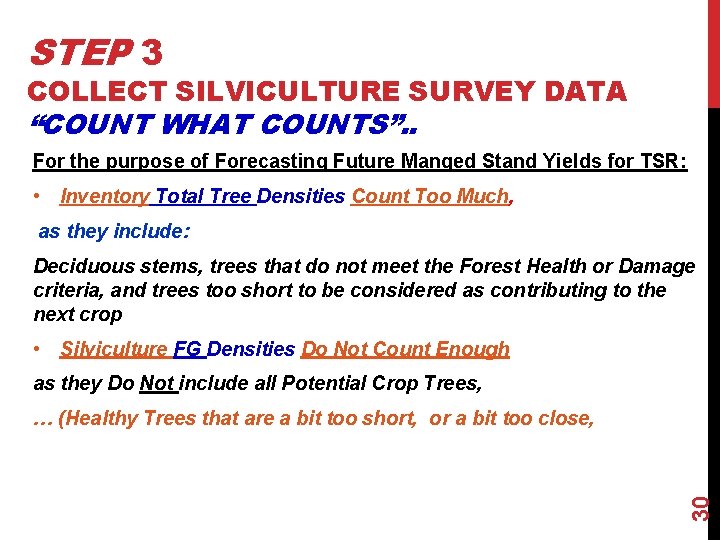
STEP 3 COLLECT SILVICULTURE SURVEY DATA “COUNT WHAT COUNTS”. . For the purpose of Forecasting Future Manged Stand Yields for TSR: • Inventory Total Tree Densities Count Too Much, as they include: Deciduous stems, trees that do not meet the Forest Health or Damage criteria, and trees too short to be considered as contributing to the next crop • Silviculture FG Densities Do Not Count Enough as they Do Not include all Potential Crop Trees, 30 … (Healthy Trees that are a bit too short, or a bit too close,
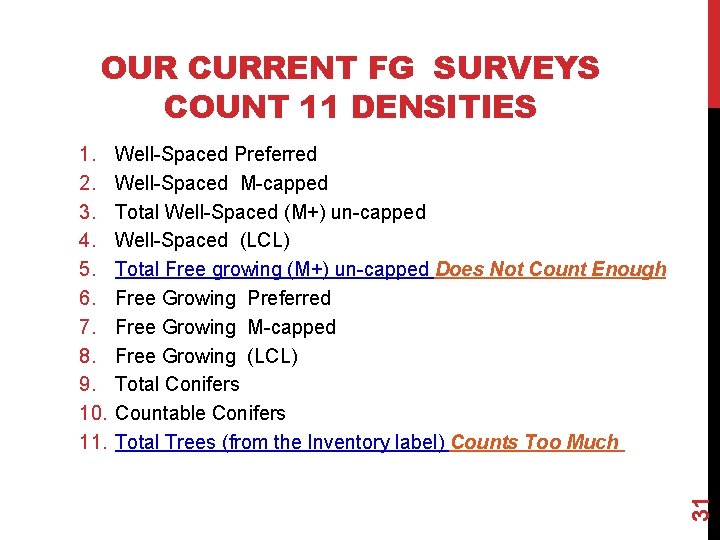
OUR CURRENT FG SURVEYS COUNT 11 DENSITIES Well-Spaced Preferred Well-Spaced M-capped Total Well-Spaced (M+) un-capped Well-Spaced (LCL) Total Free growing (M+) un-capped Does Not Count Enough Free Growing Preferred Free Growing M-capped Free Growing (LCL) Total Conifers Countable Conifers Total Trees (from the Inventory label) Counts Too Much 31 1. 2. 3. 4. 5. 6. 7. 8. 9. 10. 11.
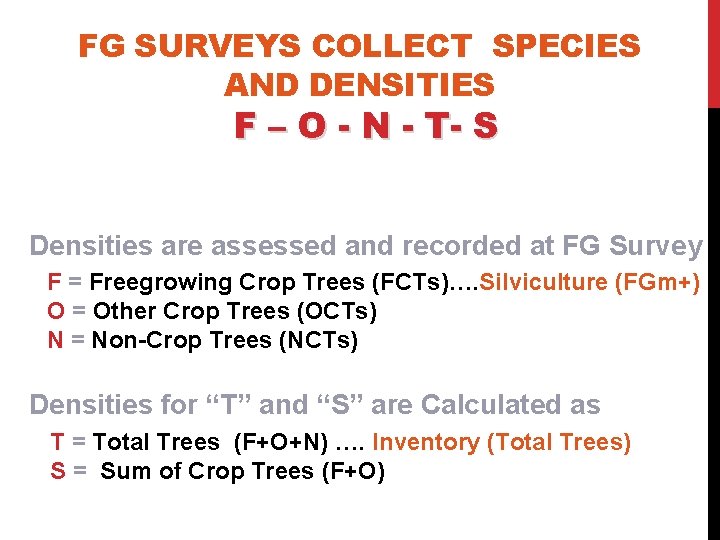
FG SURVEYS COLLECT SPECIES AND DENSITIES F – O - N - T- S Densities are assessed and recorded at FG Survey F = Freegrowing Crop Trees (FCTs)…. Silviculture (FGm+) O = Other Crop Trees (OCTs) N = Non-Crop Trees (NCTs) Densities for “T” and “S” are Calculated as T = Total Trees (F+O+N) …. Inventory (Total Trees) S = Sum of Crop Trees (F+O)
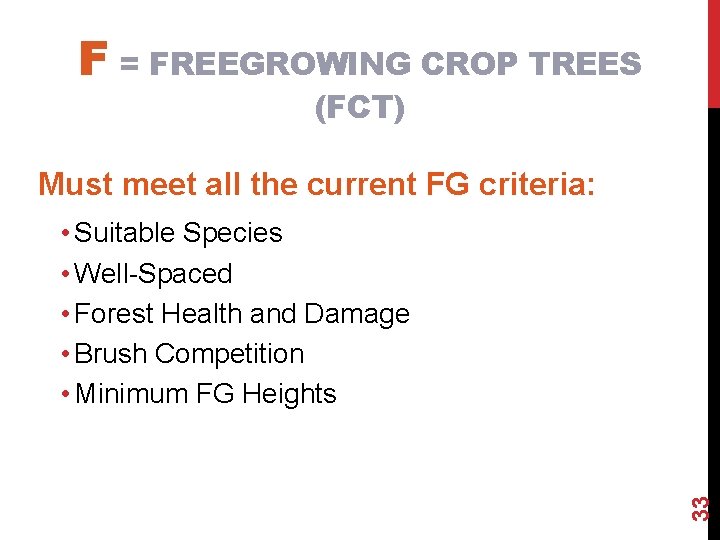
F = FREEGROWING CROP TREES (FCT) Must meet all the current FG criteria: 33 • Suitable Species • Well-Spaced • Forest Health and Damage • Brush Competition • Minimum FG Heights
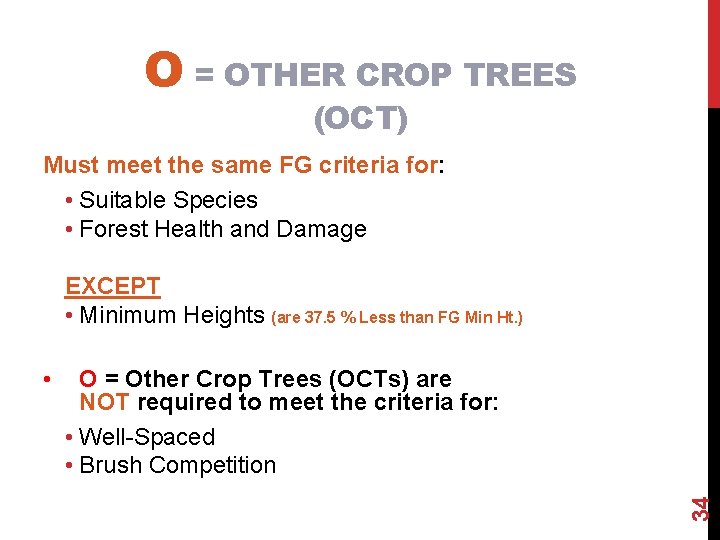
O = OTHER CROP TREES (OCT) Must meet the same FG criteria for: • Suitable Species • Forest Health and Damage EXCEPT • Minimum Heights (are 37. 5 % Less than FG Min Ht. ) O = Other Crop Trees (OCTs) are NOT required to meet the criteria for: • Well-Spaced • Brush Competition 34 •
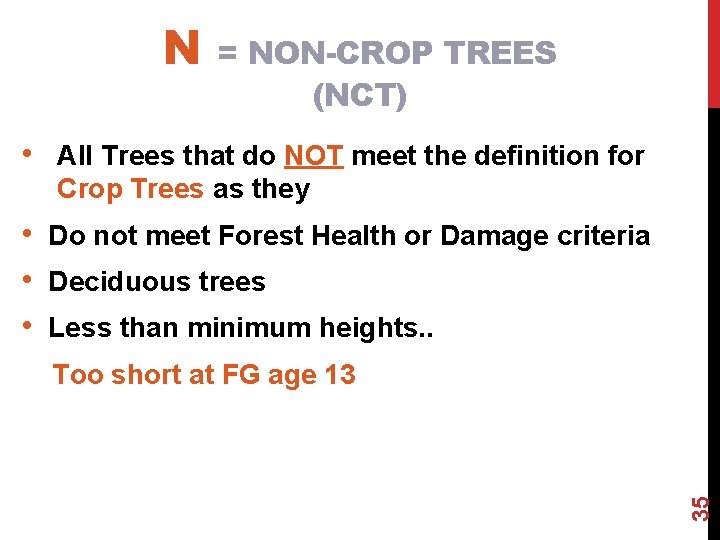
N = NON-CROP TREES (NCT) • All Trees that do NOT meet the definition for Crop Trees as they • Do not meet Forest Health or Damage criteria • Deciduous trees • Less than minimum heights. . 35 Too short at FG age 13
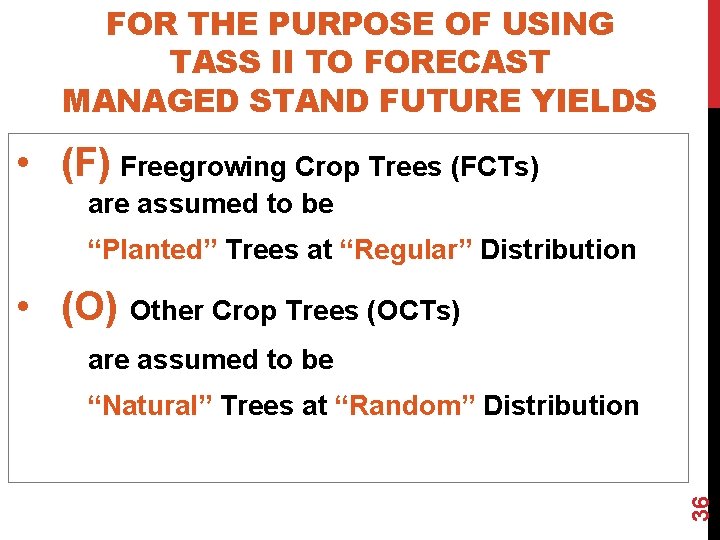
FOR THE PURPOSE OF USING TASS II TO FORECAST MANAGED STAND FUTURE YIELDS • (F) Freegrowing Crop Trees (FCTs) are assumed to be “Planted” Trees at “Regular” Distribution • (O) Other Crop Trees (OCTs) are assumed to be 36 “Natural” Trees at “Random” Distribution
Bars 1200 SPH 37 700 SPH
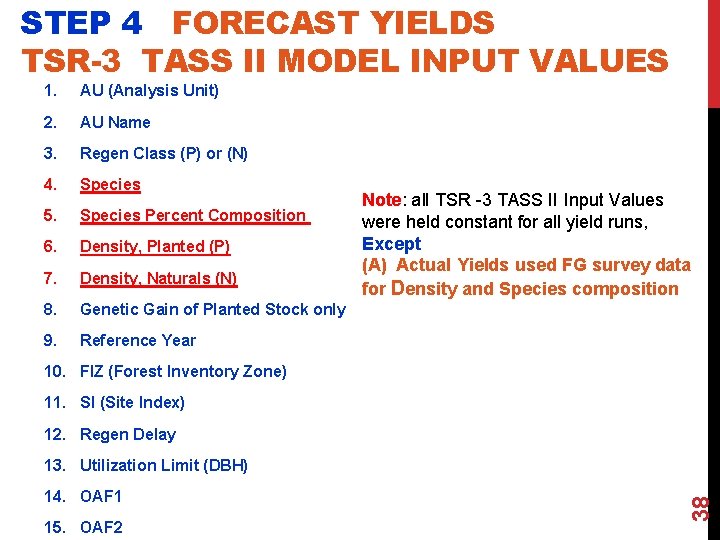
STEP 4 FORECAST YIELDS TSR-3 TASS II MODEL INPUT VALUES 1. AU (Analysis Unit) 2. AU Name 3. Regen Class (P) or (N) 4. Species 5. Species Percent Composition 6. Density, Planted (P) 7. Density, Naturals (N) 8. Genetic Gain of Planted Stock only 9. Reference Year Note: all TSR -3 TASS II Input Values were held constant for all yield runs, Except (A) Actual Yields used FG survey data for Density and Species composition 10. FIZ (Forest Inventory Zone) 11. SI (Site Index) 12. Regen Delay 14. OAF 1 15. OAF 2 38 13. Utilization Limit (DBH)
STEP 5 Compare Yields • Compare Actual Yields to Threshold Yields 39 • (A) Actuals must be > (T) Thresholds
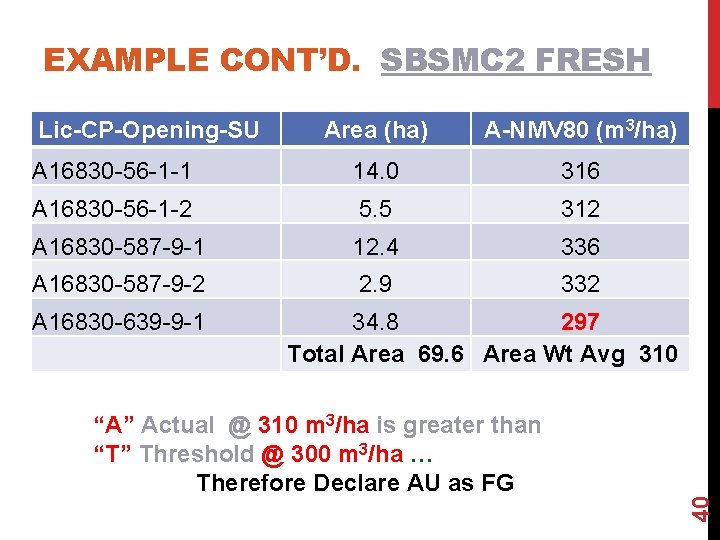
EXAMPLE CONT’D. SBSMC 2 FRESH Lic-CP-Opening-SU Area (ha) A-NMV 80 (m 3/ha) A 16830 -56 -1 -1 14. 0 316 A 16830 -56 -1 -2 5. 5 312 A 16830 -587 -9 -1 12. 4 336 A 16830 -587 -9 -2 2. 9 332 A 16830 -639 -9 -1 34. 8 297 Total Area 69. 6 Area Wt Avg 310 40 “A” Actual @ 310 m 3/ha is greater than “T” Threshold @ 300 m 3/ha … Therefore Declare AU as FG
350 P A T M 300 250 200 Possible Minimum Threshold Actual 150 100 50 0 20 30 40 50 Age 60 70 80 Decision Point Stand Age 80 41 Net Merchantable Volume (m 3/ha) NET MERCH. VOL. PROJECTIONS P-A-T-M
BENEFITS PIR –FSP LANDSCAPE REFORESTATION STANDARDS Links Reforestation Standards to (TSR) assumptions Provides 10 years of enhanced FG Survey data between TSRs Establishes Deviation from Possible (DFP) productivity Thresholds per Analysis Unit Increases the Standard beyond the required MSS Allows for Flexibility, and Freedom to Manage Timber and Other Resource Values through increasing: Diversity in Species Density and Composition] Habitat Variability Resiliency and Adaptability Return on Investments (ROI) Focused Treatment 42 • •
BENEFITS PIR –FSP-LANDSCAPE REFORESTATION STANDARDS Decreases $$$ Costs • Total Silviculture Treatments • Survey and Administration Costs Allows for a mutually agreed upon (RAMERS) 43 Robust Adaptive Management Evaluation & Reporting System that is Statistically Valid and it includes Measurable and Verifiable assessment procedures and results. While ensuring Forest Productivity on the Landscape
• LSCTs and ESS were defined for each BEC subzone variant within the Bulkley TSA by a team of Local, Regional and Provincial ecologists. • LSCTs are assessed on 5 -year rolling average Total Tree density • LSCTs are NOT linked directly to the Landscape Reforestation Standard (performance measure) • Corresponding Planting Strategies are included in FSP 44 LANDSCAPE SPECIES COMPOSITION TARGETS AND ECOLOGICALLY SUITABLE SPECIES
45 HOW WAS CONSENSUS ACHIEVED?
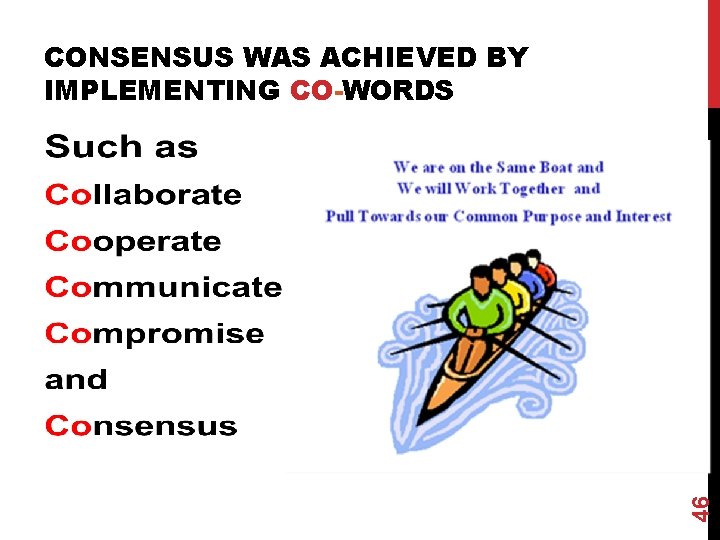
46 CONSENSUS WAS ACHIEVED BY IMPLEMENTING CO-WORDS
CONSENSUS WAS ACHIEVED BY 47 Teams of experts worked together. to develop a common understanding of the risks and uncertainties through quantifying the impacts to timber supply, based on field-tested data and through using growth and yield principles, tools and available expertise.
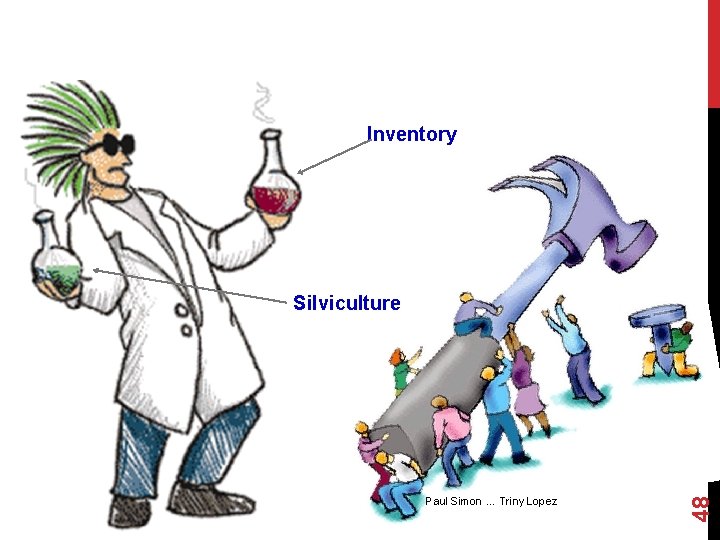
. Inventory Paul Simon … Triny Lopez 48 Silviculture
KNOW WHEN TO HOLD THEM KNOW WHEN TO FOLD THEM 49 Chief Forester’s Joint Review Team (JRT)
NEXT STEPS IMPLEMENT– MONITOR – ASSESS ADAPT AS REQUIRED • Clarify “Form and Manner” for reporting to RESULTS • Revise RESULTS for reporting Survey Data as F-O-N-T • Re-run PEM data as Analysis Units Vs Site Series • Have TASS III available at our desk-tops 50 after more training of course
NEXT STEPS These Landscape Reforestation Standards are meant to provide means to achieve those needs, as defined by the Provincial Timber Goals and Objectives, and the Chief Foresters’ Bednesti Action Plan, and provide an example Template for others to adapt and adopt. Blend this LRS Process with the • Bulkley TSA Higher Level Plan Objective (HLPO) Spatial Analysis to create • Bulkley Type 4 Silviculture Spatial Analysis of Investment Opportunities • Bulkley Integrated Silviculture Strategy (ISS): to support our (FSP) and Operations • Target Completion for all of the above is prior to March 31, 2017 51 • We are not asking for the Moon, but ……
52 WE NEED TO TAKE THESE NEXT STEPS TOWARDS SUCCESS