
P systems A Modelling Language Marian Gheorghe Department
- Slides: 26
P systems: A Modelling Language Marian Gheorghe Department of Computer Science University of Sheffield Unconventional Programming Paradigms; 15 -17 Sept’ 04 – Mont Saint Michel
Summary l Modelling bio-communities l State machines & P systems l Experiments l P systems – modelling paradigm l Future work Unconventional Programming Paradigms; 15 -17 Sept’ 04 – Mont Saint Michel
What is a model? l A simplified description of a complex entity or process www. cogsci. princeton. edu/cgi-bin/webwn l A representation of a set of components of a process, system, or subject area, generally developed for understanding, analysis, improvement, and/or replacement of the process www. ichnet. org/glossary. htm l A representation of reality used to simulate a process, understand a situation, predict an outcome, or analyze a problem www. epa. gov/maia/html/glossary. html Unconventional Programming Paradigms; 15 -17 Sept’ 04 – Mont Saint Michel
What to model? l Bio-communities: social insects (ants, bees, wasps), bacterium communities, cells l Component description/behaviour: structure, rules, l Interactions: type, dynamicity Unconventional Programming Paradigms; 15 -17 Sept’ 04 – Mont Saint Michel
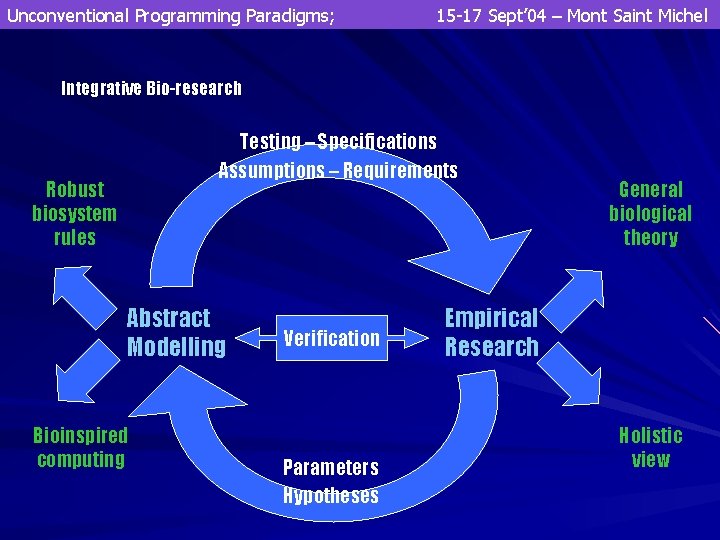
Unconventional Programming Paradigms; 15 -17 Sept’ 04 – Mont Saint Michel Integrative Bio-research Testing – Specifications Assumptions – Requirements Robust biosystem rules Abstract Modelling Bioinspired computing Verification Parameters Hypotheses General biological theory Empirical Research Holistic view
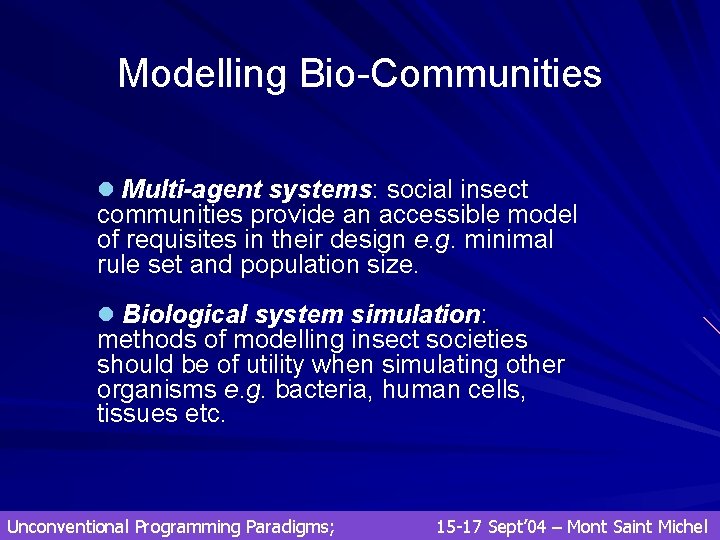
Modelling Bio-Communities l Multi-agent systems: social insect communities provide an accessible model of requisites in their design e. g. minimal rule set and population size. l Biological system simulation: methods of modelling insect societies should be of utility when simulating other organisms e. g. bacteria, human cells, tissues etc. Unconventional Programming Paradigms; 15 -17 Sept’ 04 – Mont Saint Michel
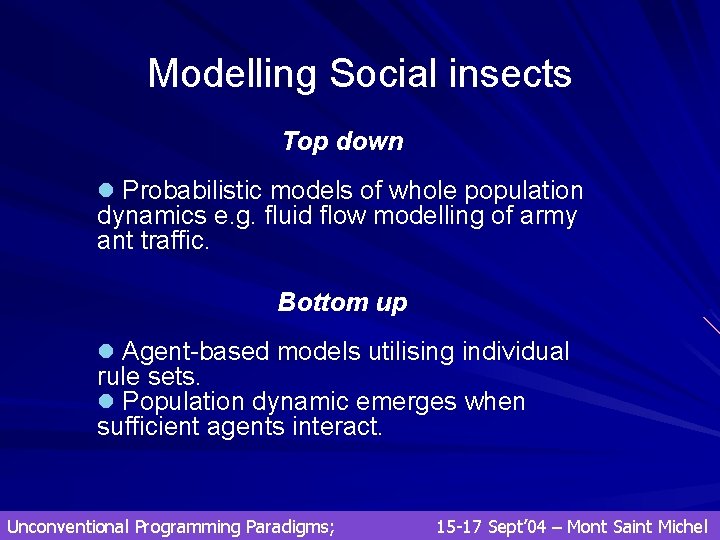
Modelling Social insects Top down l Probabilistic models of whole population dynamics e. g. fluid flow modelling of army ant traffic. Bottom up l Agent-based models utilising individual rule sets. l Population dynamic emerges when sufficient agents interact. Unconventional Programming Paradigms; 15 -17 Sept’ 04 – Mont Saint Michel
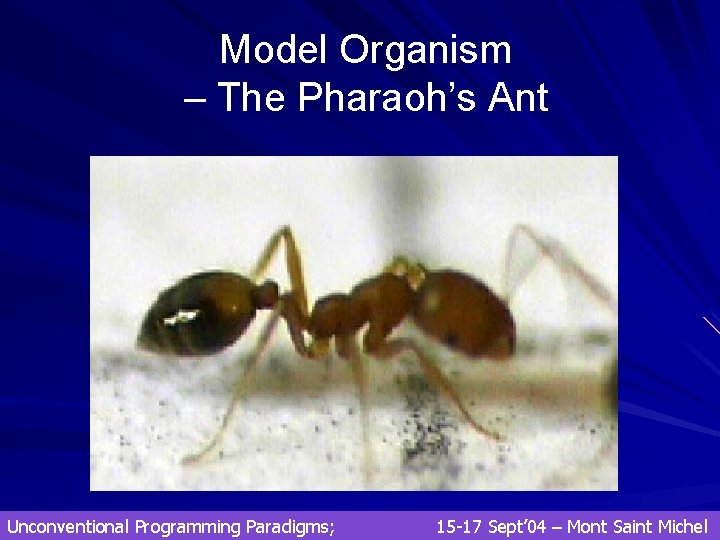
Model Organism – The Pharaoh’s Ant Unconventional Programming Paradigms; 15 -17 Sept’ 04 – Mont Saint Michel
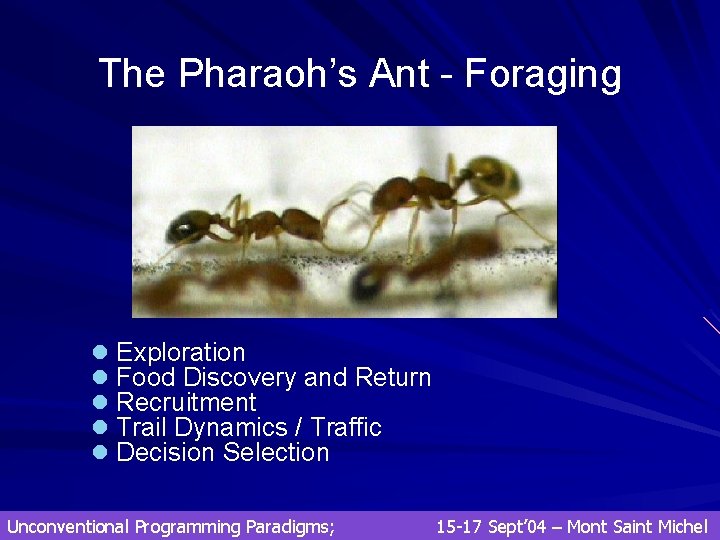
The Pharaoh’s Ant - Foraging l Exploration l Food Discovery and Return l Recruitment l Trail Dynamics / Traffic l Decision Selection Unconventional Programming Paradigms; 15 -17 Sept’ 04 – Mont Saint Michel
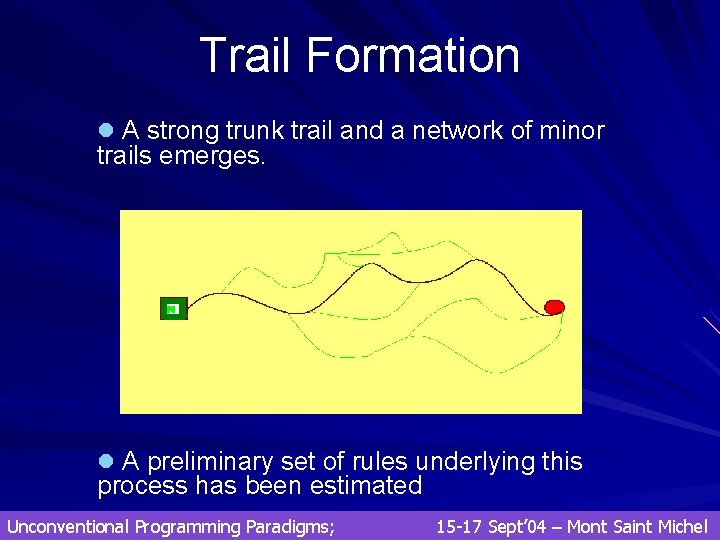
Trail Formation l A strong trunk trail and a network of minor trails emerges. l A preliminary set of rules underlying this process has been estimated Unconventional Programming Paradigms; 15 -17 Sept’ 04 – Mont Saint Michel
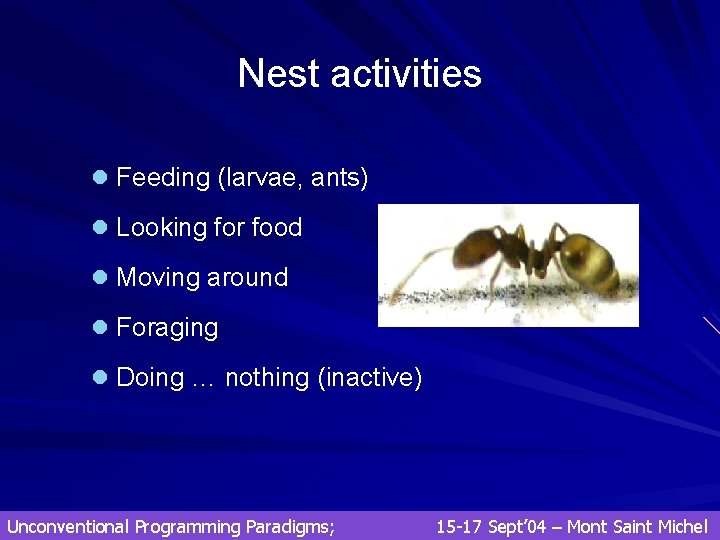
Nest activities l Feeding (larvae, ants) l Looking for food l Moving around l Foraging l Doing … nothing (inactive) Unconventional Programming Paradigms; 15 -17 Sept’ 04 – Mont Saint Michel
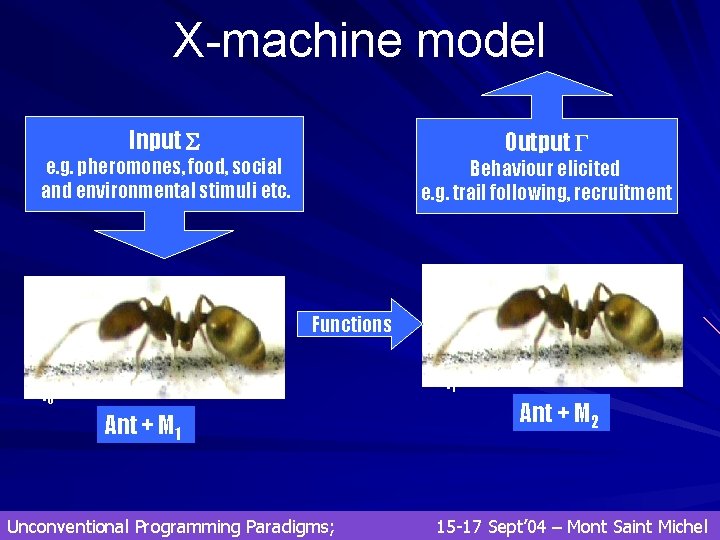
X-machine model Input Output Γ e. g. pheromones, food, social and environmental stimuli etc. Behaviour elicited e. g. trail following, recruitment Functions q 0 initial state Ant + M 1 Unconventional Programming Paradigms; q 1 next state Ant + M 2 15 -17 Sept’ 04 – Mont Saint Michel
Why X-machines ? l State machine model widespread in man-made systems’ construction l Well-developed verification and testing methods l Easy to model l Modularity l Graphical representation l Tools Unconventional Programming Paradigms; 15 -17 Sept’ 04 – Mont Saint Michel
Simulation results (Nest) l 3 cm x 3 cm nest size l 100 workers + 100 larvae l worker model: 7 states; 22 transitions l foraging happens in cycles (alterations may occur) l no specialisation l problem: tuning different parameters Unconventional Programming Paradigms; 15 -17 Sept’ 04 – Mont Saint Michel
Limitations l Communication model rather ad-hoc l No real formalism of functions associated with transitions l No tool for interacting components l… Unconventional Programming Paradigms; 15 -17 Sept’ 04 – Mont Saint Michel
A new modelling paradigm l Biologically motivated l Fully formal model l Genuinely distributed l Dynamic structure l… Unconventional Programming Paradigms; 15 -17 Sept’ 04 – Mont Saint Michel
P systems l Cellular biology l A hierarchical arrangement l Each membrane delimits a region l Each region contains a multiset of elements (simple molecules, DNA sequences, other regions…) l The chemicals/bio-elements evolve in time according to some (rewriting/combination) rules specific to each region or may be moved across the membranes l The rules may also dissolve/create/move regions l http: //psystems. disco. unimib. it Unconventional Programming Paradigms; 15 -17 Sept’ 04 – Mont Saint Michel
P systems a model of biocommunities l Initially an abstract model of cell structure and functioning l Tissue P systems l Population P systems l http: //psystems. disco. unimib. it Unconventional Programming Paradigms; 15 -17 Sept’ 04 – Mont Saint Michel
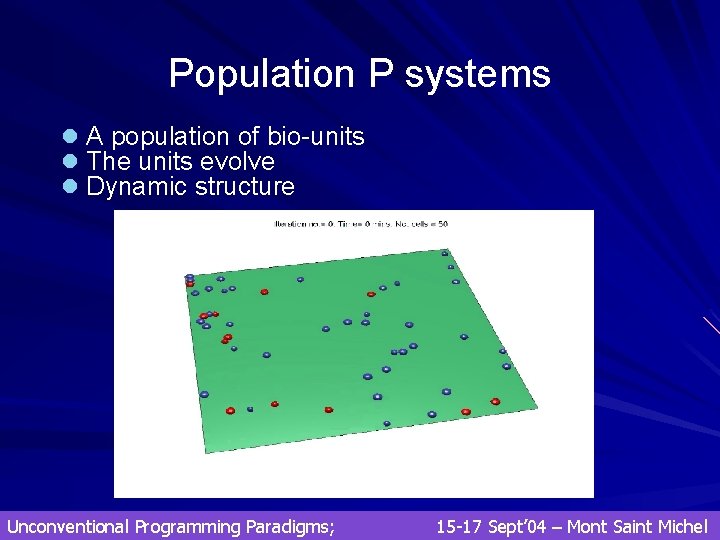
Population P systems l A population of bio-units l The units evolve l Dynamic structure Unconventional Programming Paradigms; 15 -17 Sept’ 04 – Mont Saint Michel
Population P systems (2) l Usual bio-units components (P systems) l Tissues P systems communication rules l Dynamic structure – Components – Links (bonds) Unconventional Programming Paradigms; 15 -17 Sept’ 04 – Mont Saint Michel
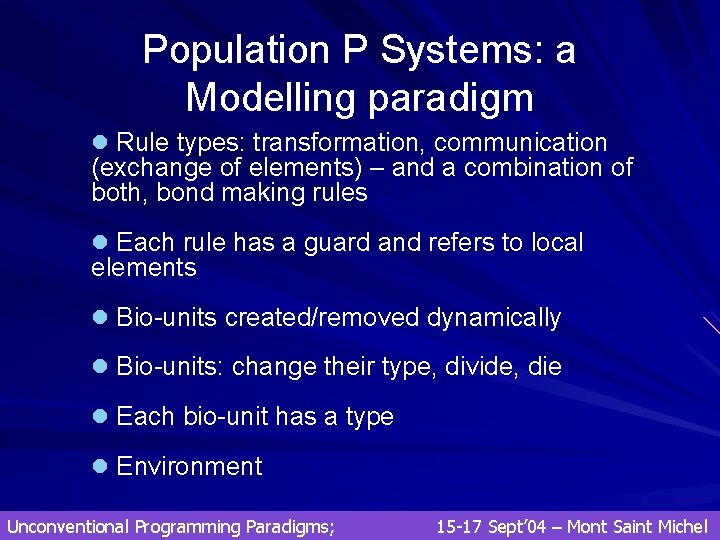
Population P Systems: a Modelling paradigm l Rule types: transformation, communication (exchange of elements) – and a combination of both, bond making rules l Each rule has a guard and refers to local elements l Bio-units created/removed dynamically l Bio-units: change their type, divide, die l Each bio-unit has a type l Environment Unconventional Programming Paradigms; 15 -17 Sept’ 04 – Mont Saint Michel
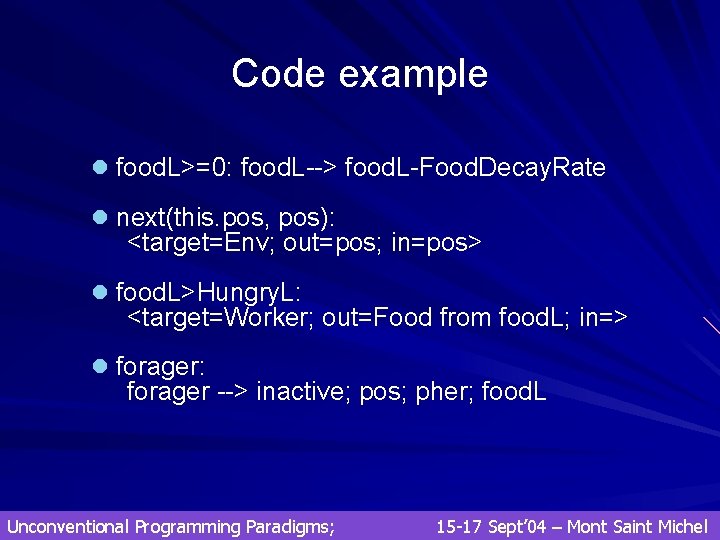
Code example l food. L>=0: food. L--> food. L-Food. Decay. Rate l next(this. pos, pos): <target=Env; out=pos; in=pos> l food. L>Hungry. L: <target=Worker; out=Food from food. L; in=> l forager: forager --> inactive; pos; pher; food. L Unconventional Programming Paradigms; 15 -17 Sept’ 04 – Mont Saint Michel
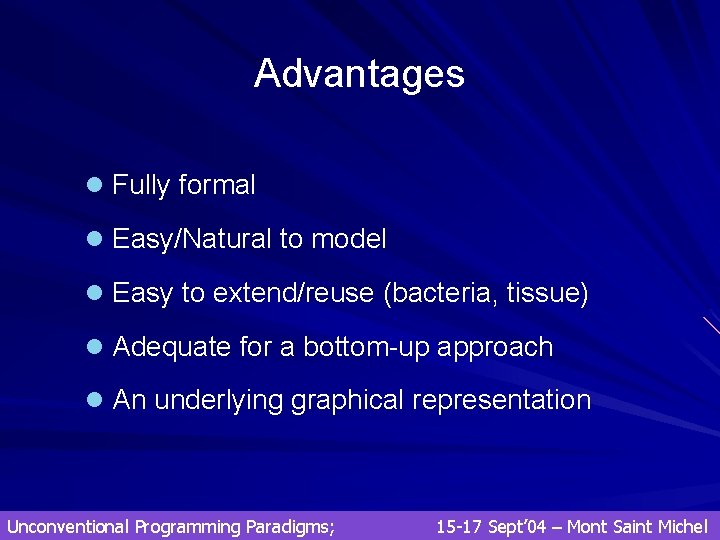
Advantages l Fully formal l Easy/Natural to model l Easy to extend/reuse (bacteria, tissue) l Adequate for a bottom-up approach l An underlying graphical representation Unconventional Programming Paradigms; 15 -17 Sept’ 04 – Mont Saint Michel
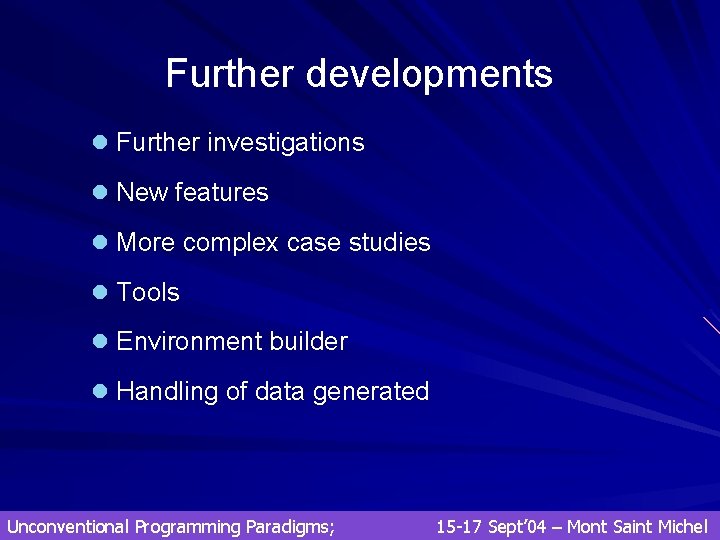
Further developments l Further investigations l New features l More complex case studies l Tools l Environment builder l Handling of data generated Unconventional Programming Paradigms; 15 -17 Sept’ 04 – Mont Saint Michel
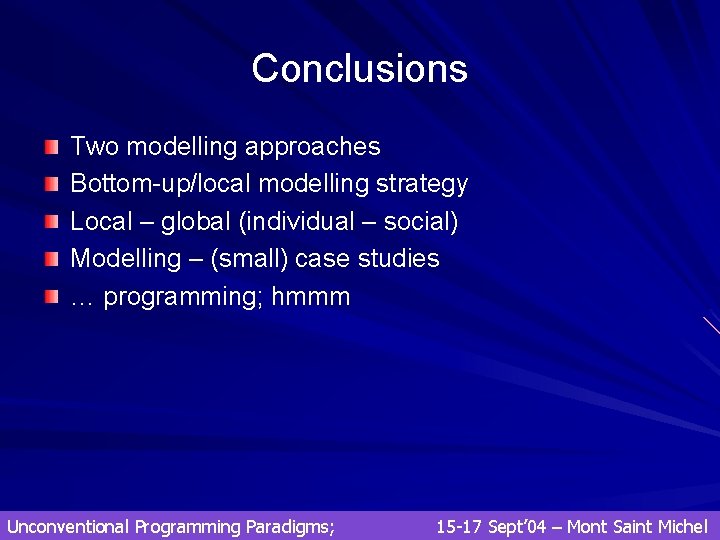
Conclusions Two modelling approaches Bottom-up/local modelling strategy Local – global (individual – social) Modelling – (small) case studies … programming; hmmm Unconventional Programming Paradigms; 15 -17 Sept’ 04 – Mont Saint Michel
Thanks Jean-Pierre Banâtre Jean-Louis Giavitto Pascal Fradet Olivier Michel Mike Holcombe Duncan Jackson Francesco Bernardini Fei Luo James Clarke Peter Langton Taihong Wu Unconventional Programming Paradigms; 15 -17 Sept’ 04 – Mont Saint Michel