
P NP and Exponential Problems Should have had
P, NP, and Exponential Problems Should have had this in CS 252 – Review and insights l Many problems have an exponential number of possibilities and we can test each option against some objective to see if it is a solution l – Note that this "testing" is fast (always polynomial!) If we can always find a solution with a deterministic algorithm which only tests a polynomial subset (of the potentially exponential cases) then the problem is in P l If not, the problem is in NP l In many cases (Edit distance, longest increasing subsequence, etc. ) we have been able to use smart algorithms (Greedy, DP, LP) to search a polynomial subset of the exponential possibilities to always get optimal solutions in polynomial time (class P) l For other tasks (TSP, ILP) there are no known polynomial solutions (class NP) l CS 312 – NP Problems 1
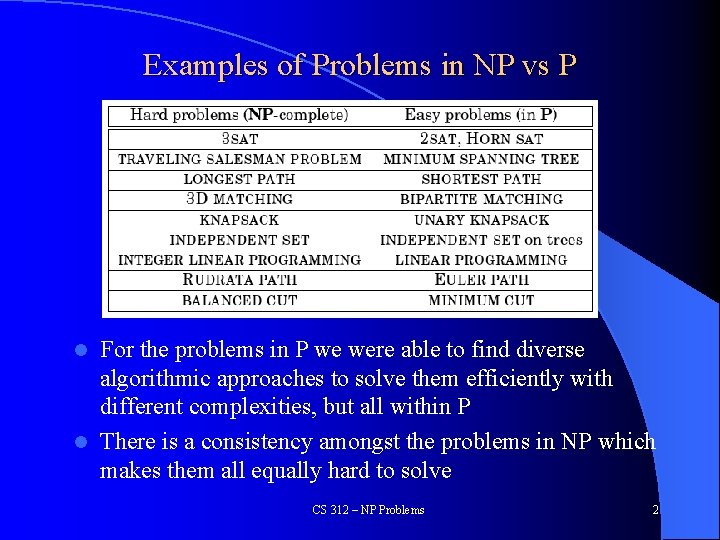
Examples of Problems in NP vs P For the problems in P we were able to find diverse algorithmic approaches to solve them efficiently with different complexities, but all within P l There is a consistency amongst the problems in NP which makes them all equally hard to solve l CS 312 – NP Problems 2
Tasks as Search Problems l l We can consider all these NP tasks as search problems Given an instance I of the problem, can we find a solution S to I, or state that no solutions exists – I could be a CNF equation for 3 SAT and S would be a particular variable setting For NP search problems there exists an efficient mechanism, C(I, S) which checks to see if a particular variable setting S is a solution to I l We would also like an efficient verification approach for optimization problems (like TSP) l We recast as: For an instance I does there exists an S ≤ b l – For TSP I would be a city distribution, S a path, and b an arbitrary distance – This is still an NP problem for arbitrary b – Now, for any particular path S we can quickly answer the question of whether S ≤ b (i. e. C(I, S)) – How could we find the optimal solution with this recasting? CS 312 – NP Problems 3
P –Polynomial Time Now we have the basis of a consistent search algorithm Test each of the exponential cases to see if it is a solution l If we have a deterministic algorithm which can make the decision by only checking a polynomial number of possibilities, then the task is in P (polynomial time) l P = Those problems which can be decided in polynomial time l Problems in P are efficient l CS 312 – NP Problems 4
NP – Non-Deterministic Polynomial Time l If we must test an exponential number of cases, then task is in NP (Non-Deterministic Polynomial Time) – Class NP are those problems that can be solved in polynomial time on a non-deterministic machine l Remember that a non-deterministic machine basically tries all alternatives in parallel, with the time complexity being equal to the longest path (always polynomial length) in the potentially exponentially wide search tree – Thus, the class NP are those problems that can be tested/verified in polynomial time l Deterministic implementations of non-deterministic machines require checking all possible solutions leading to exponential time complexity CS 312 – NP Problems 5
P P = problems that can be solved in polynomial time on a deterministic Turing Machine.
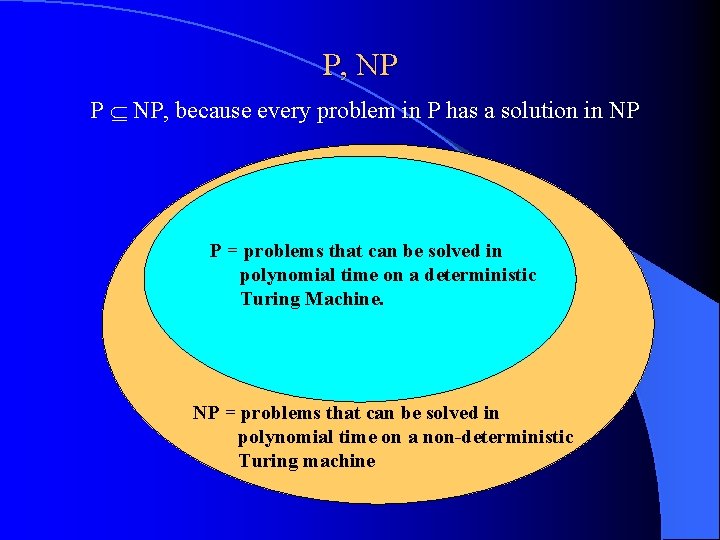
P, NP P NP, because every problem in P has a solution in NP P = problems that can be solved in polynomial time on a deterministic Turing Machine. NP = problems that can be solved in polynomial time on a non-deterministic Turing machine
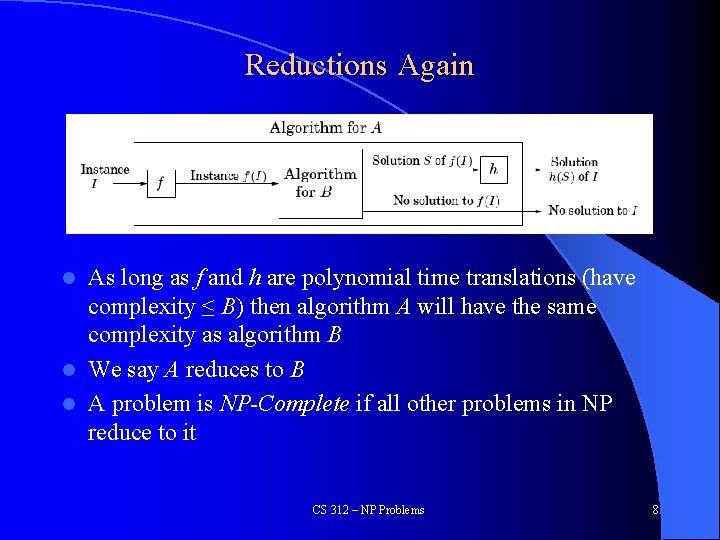
Reductions Again As long as f and h are polynomial time translations (have complexity ≤ B) then algorithm A will have the same complexity as algorithm B l We say A reduces to B l A problem is NP-Complete if all other problems in NP reduce to it l CS 312 – NP Problems 8
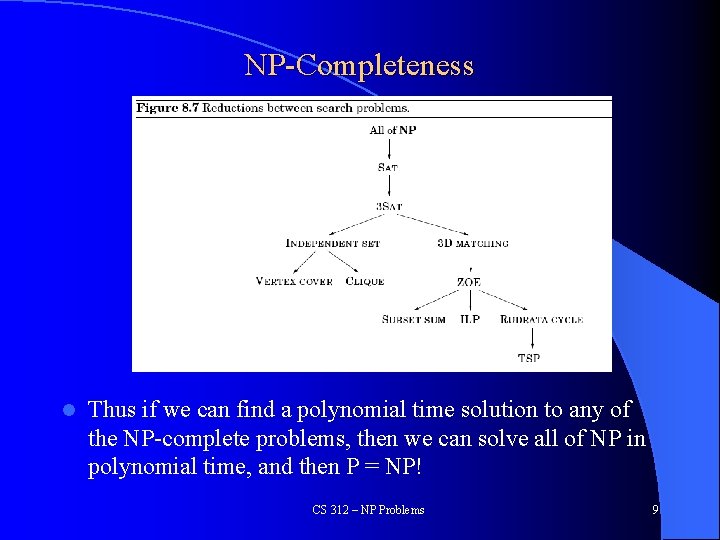
NP-Completeness l Thus if we can find a polynomial time solution to any of the NP-complete problems, then we can solve all of NP in polynomial time, and then P = NP! CS 312 – NP Problems 9

Proving a Problem is NP-Complete l 1. First prove that the problem is in NP – Show that any potential solution is verifiable in polynomial time l i. e. Does a certain setting of variables satisfy a SAT problem – This is why we showed that all NP optimization problems can be cast as search problems, in order to be verifiable l l l e. g. Is there a path less than b for some TSP problem When we test a particular solution, we just add up the path and test if it is less than b. O(n) to verify! 2. Next, prove that all problems in NP can reduce to it – As in Cook's theorem for SAT – Usually easier to show that a particular problem already in NP- complete reduces to it CS 312 – NP Problems 10

Unsolvable Problems l There are problems in higher complexity classes than NP – Guaranteed exponential, super-exponential, etc. – List all possible paths in a TSP problem – List the power-set of all possible paths in TSP, etc. l There is an even larger infinite class of unsolvable problems regardless of time available – For an arbitrary polynomial equation in many variables e. g. : – x 2 yz 3 + 3 y 2 z – 4 xy 5 z 2 = 7 – Are there integer values of the variables which solve it? (x, y, and z in this case) l Problems as Functions – Regularity vs Random – Also many regular problems that are not solvable: halting, etc. CS 312 – NP Problems 11
- Slides: 11