
p H Volume of Titrant AcidBase Titration O
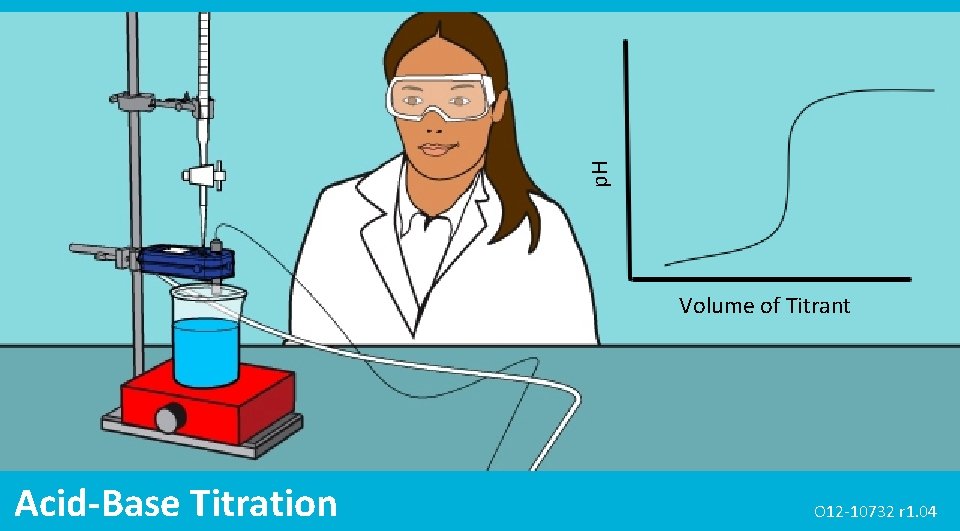
p. H Volume of Titrant Acid-Base Titration O 12 -10732 r 1. 04
Acid-Base Titration Introduction Journals and Snapshots The Snapshot button is used to capture the screen. The Journal is where snapshots are stored and viewed. The Share button is used to export or print your journal to turn in your work. Each page of this lab that contains the symbol should be inserted into your journal. After completing a lab page with the snapshot symbol, tap (in the upper right hand corner) to insert the page into your journal. Note: You may want to take a snapshot of the first page of this lab as a cover page for your Journal.
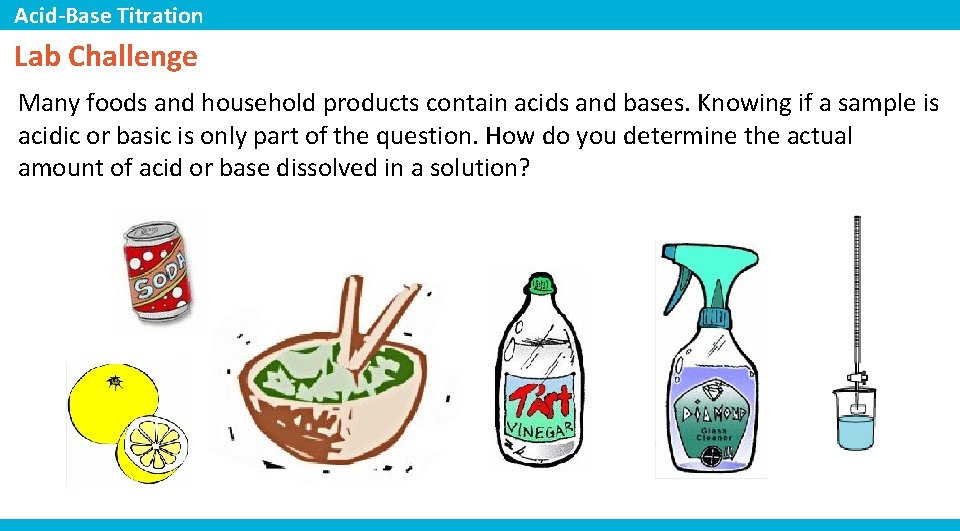
Acid-Base Titration Lab Challenge Many foods and household products contain acids and bases. Knowing if a sample is acidic or basic is only part of the question. How do you determine the actual amount of acid or base dissolved in a solution?
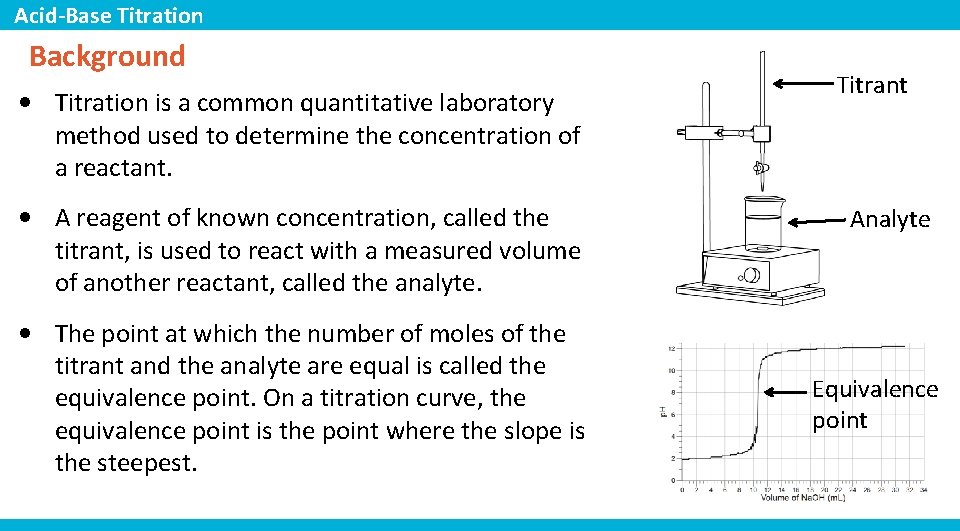
Acid-Base Titration Background • Titration is a common quantitative laboratory method used to determine the concentration of a reactant. • A reagent of known concentration, called the titrant, is used to react with a measured volume of another reactant, called the analyte. • The point at which the number of moles of the titrant and the analyte are equal is called the equivalence point. On a titration curve, the equivalence point is the point where the slope is the steepest. Titrant Analyte Equivalence point
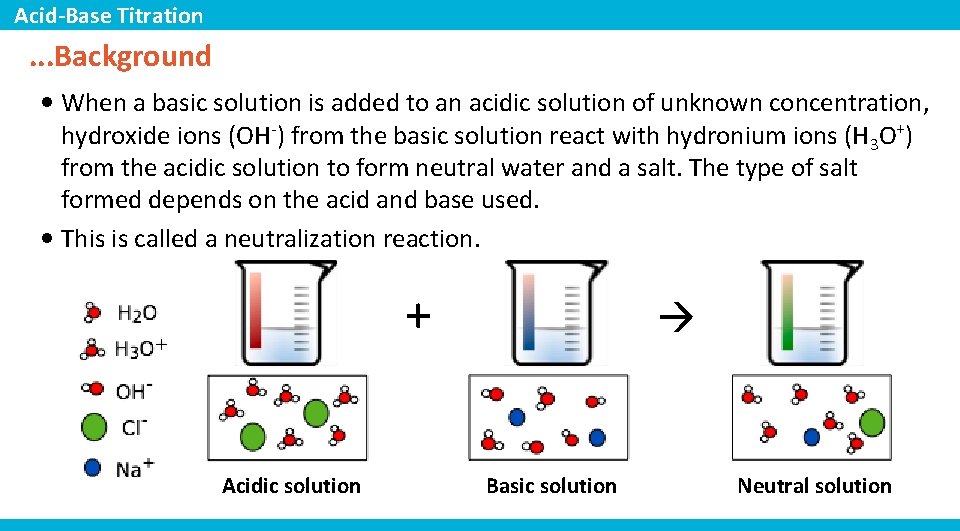
Acid-Base Titration . . . Background • When a basic solution is added to an acidic solution of unknown concentration, hydroxide ions (OH-) from the basic solution react with hydronium ions (H 3 O+) from the acidic solution to form neutral water and a salt. The type of salt formed depends on the acid and base used. • This is called a neutralization reaction. + Acidic solution Basic solution Neutral solution
Acid-Base Titration Self-Check 1. Titrations are used to determine the _______ of a reactant. a) density b) p. H c) mass d) concentration This image is a reminder that you need to tap to take a snapshot of this page after you have entered your response.
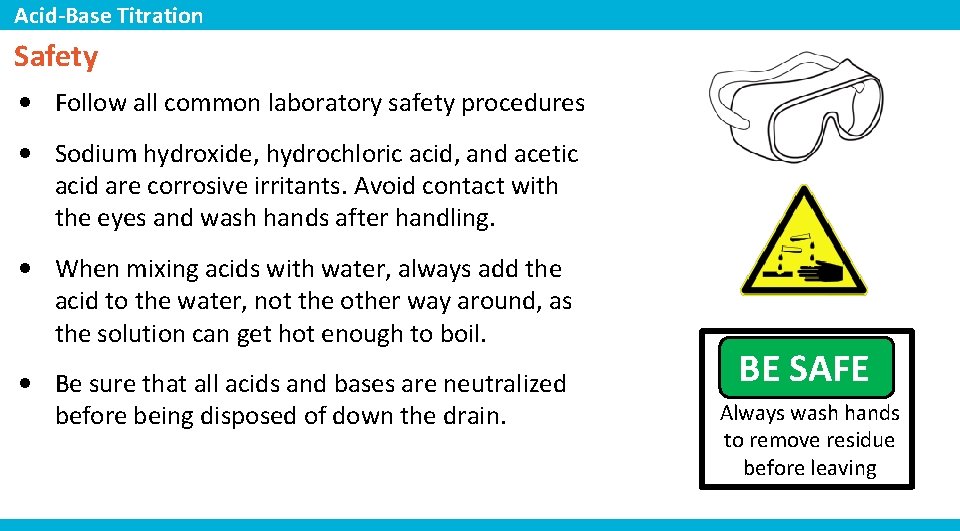
Acid-Base Titration Safety • Follow all common laboratory safety procedures • Sodium hydroxide, hydrochloric acid, and acetic acid are corrosive irritants. Avoid contact with the eyes and wash hands after handling. • When mixing acids with water, always add the acid to the water, not the other way around, as the solution can get hot enough to boil. • Be sure that all acids and bases are neutralized before being disposed of down the drain. BE SAFE Always wash hands to remove residue before leaving
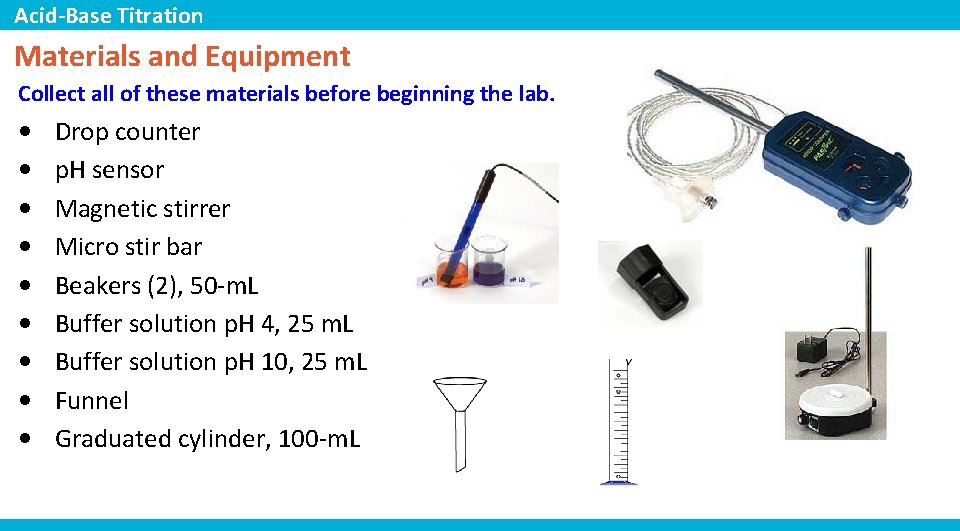
Acid-Base Titration Materials and Equipment Collect all of these materials before beginning the lab. • • • Drop counter p. H sensor Magnetic stirrer Micro stir bar Beakers (2), 50 -m. L Buffer solution p. H 4, 25 m. L Buffer solution p. H 10, 25 m. L Funnel Graduated cylinder, 100 -m. L
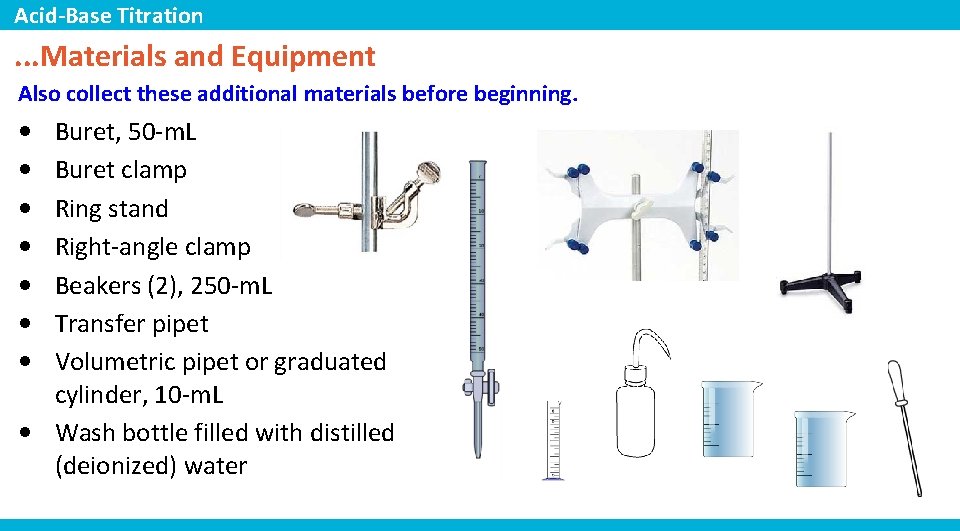
Acid-Base Titration . . . Materials and Equipment Also collect these additional materials before beginning. • • Buret, 50 -m. L Buret clamp Ring stand Right-angle clamp Beakers (2), 250 -m. L Transfer pipet Volumetric pipet or graduated cylinder, 10 -m. L • Wash bottle filled with distilled (deionized) water
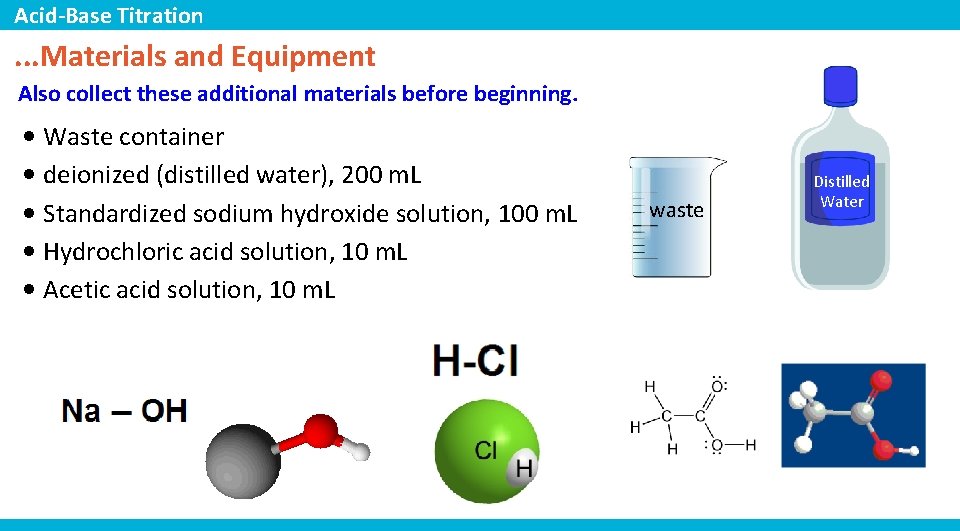
Acid-Base Titration . . . Materials and Equipment Also collect these additional materials before beginning. • Waste container • deionized (distilled water), 200 m. L • Standardized sodium hydroxide solution, 100 m. L • Hydrochloric acid solution, 10 m. L • Acetic acid solution, 10 m. L waste Distilled Water
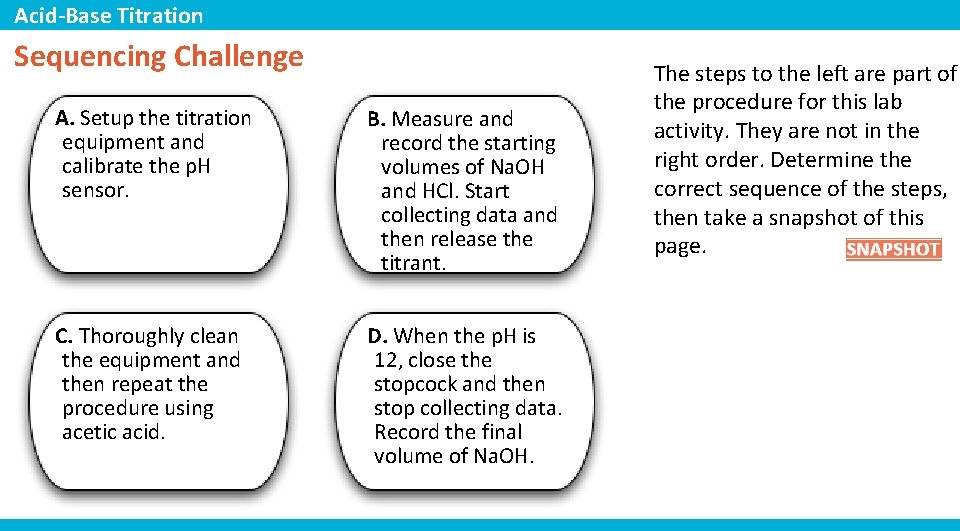
Acid-Base Titration Sequencing Challenge A. Setup the titration equipment and calibrate the p. H sensor. B. Measure and record the starting volumes of Na. OH and HCl. Start collecting data and then release the titrant. C. Thoroughly clean the equipment and then repeat the procedure using acetic acid. D. When the p. H is 12, close the stopcock and then stop collecting data. Record the final volume of Na. OH. The steps to the left are part of the procedure for this lab activity. They are not in the right order. Determine the correct sequence of the steps, then take a snapshot of this page.
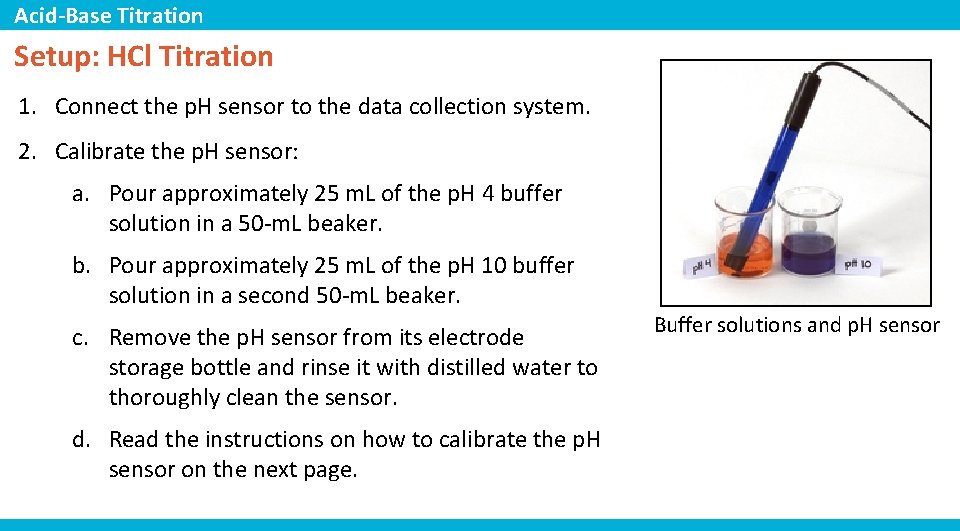
Acid-Base Titration Setup: HCl Titration 1. Connect the p. H sensor to the data collection system. 2. Calibrate the p. H sensor: a. Pour approximately 25 m. L of the p. H 4 buffer solution in a 50 -m. L beaker. b. Pour approximately 25 m. L of the p. H 10 buffer solution in a second 50 -m. L beaker. c. Remove the p. H sensor from its electrode storage bottle and rinse it with distilled water to thoroughly clean the sensor. d. Read the instructions on how to calibrate the p. H sensor on the next page. Buffer solutions and p. H sensor
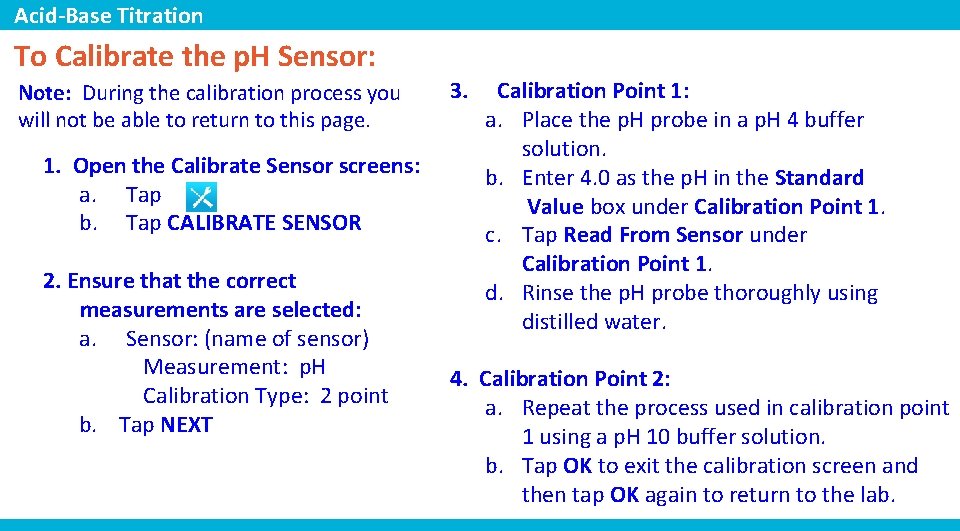
Acid-Base Titration To Calibrate the p. H Sensor: Note: During the calibration process you will not be able to return to this page. 1. Open the Calibrate Sensor screens: a. Tap b. Tap CALIBRATE SENSOR 2. Ensure that the correct measurements are selected: a. Sensor: (name of sensor) Measurement: p. H Calibration Type: 2 point b. Tap NEXT 3. Calibration Point 1: a. Place the p. H probe in a p. H 4 buffer solution. b. Enter 4. 0 as the p. H in the Standard Value box under Calibration Point 1. c. Tap Read From Sensor under Calibration Point 1. d. Rinse the p. H probe thoroughly using distilled water. 4. Calibration Point 2: a. Repeat the process used in calibration point 1 using a p. H 10 buffer solution. b. Tap OK to exit the calibration screen and then tap OK again to return to the lab.
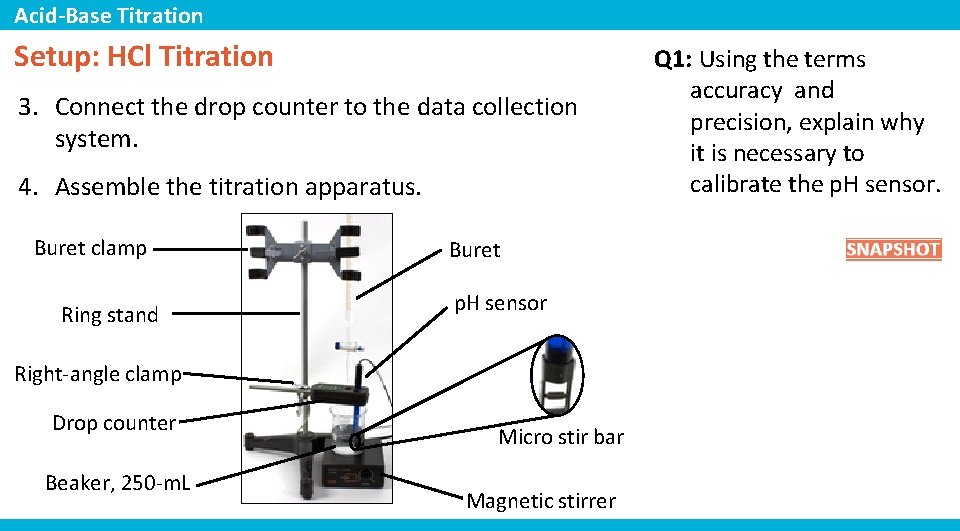
Acid-Base Titration Setup: HCl Titration 3. Connect the drop counter to the data collection system. 4. Assemble the titration apparatus. Buret clamp Ring stand Buret p. H sensor Right-angle clamp Drop counter Beaker, 250 -m. L Micro stir bar Magnetic stirrer Q 1: Using the terms accuracy and precision, explain why it is necessary to calibrate the p. H sensor.
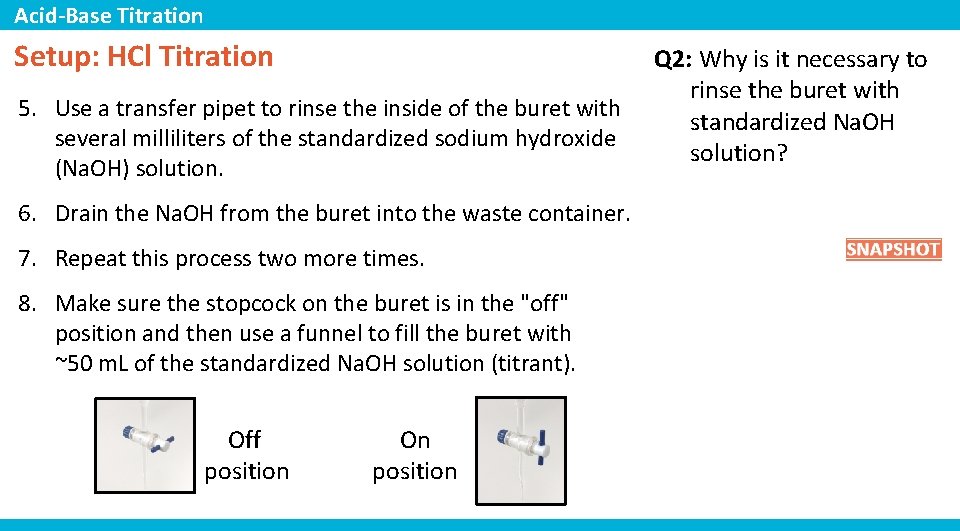
Acid-Base Titration Setup: HCl Titration 5. Use a transfer pipet to rinse the inside of the buret with several milliliters of the standardized sodium hydroxide (Na. OH) solution. 6. Drain the Na. OH from the buret into the waste container. 7. Repeat this process two more times. 8. Make sure the stopcock on the buret is in the "off" position and then use a funnel to fill the buret with ~50 m. L of the standardized Na. OH solution (titrant). Off position On position Q 2: Why is it necessary to rinse the buret with standardized Na. OH solution?
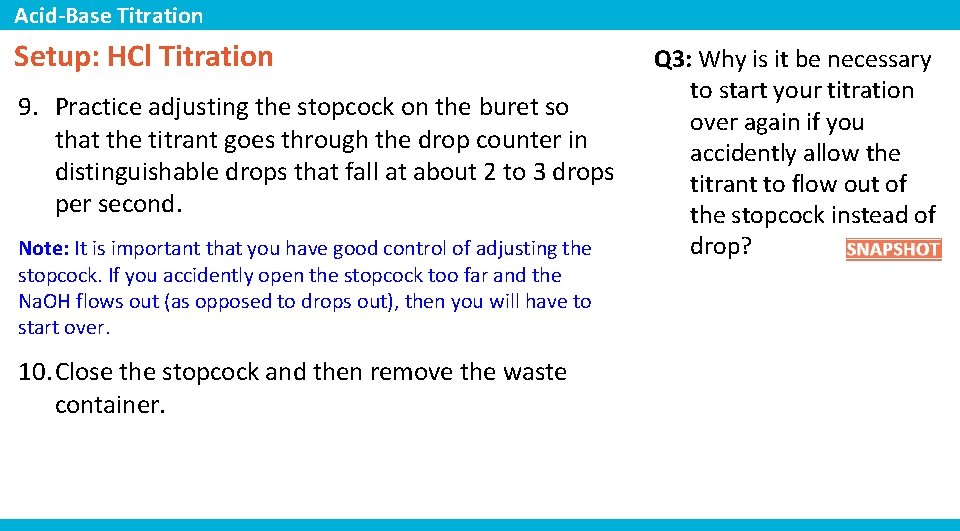
Acid-Base Titration Setup: HCl Titration 9. Practice adjusting the stopcock on the buret so that the titrant goes through the drop counter in distinguishable drops that fall at about 2 to 3 drops per second. Note: It is important that you have good control of adjusting the stopcock. If you accidently open the stopcock too far and the Na. OH flows out (as opposed to drops out), then you will have to start over. 10. Close the stopcock and then remove the waste container. Q 3: Why is it be necessary to start your titration over again if you accidently allow the titrant to flow out of the stopcock instead of drop?
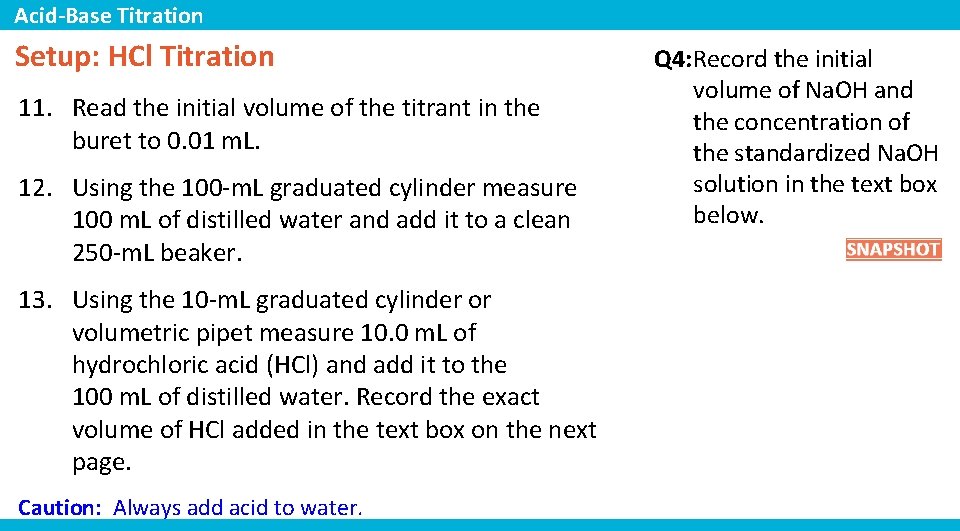
Acid-Base Titration Setup: HCl Titration 11. Read the initial volume of the titrant in the buret to 0. 01 m. L. 12. Using the 100 -m. L graduated cylinder measure 100 m. L of distilled water and add it to a clean 250 -m. L beaker. 13. Using the 10 -m. L graduated cylinder or volumetric pipet measure 10. 0 m. L of hydrochloric acid (HCl) and add it to the 100 m. L of distilled water. Record the exact volume of HCl added in the text box on the next page. Caution: Always add acid to water. Q 4: Record the initial volume of Na. OH and the concentration of the standardized Na. OH solution in the text box below.
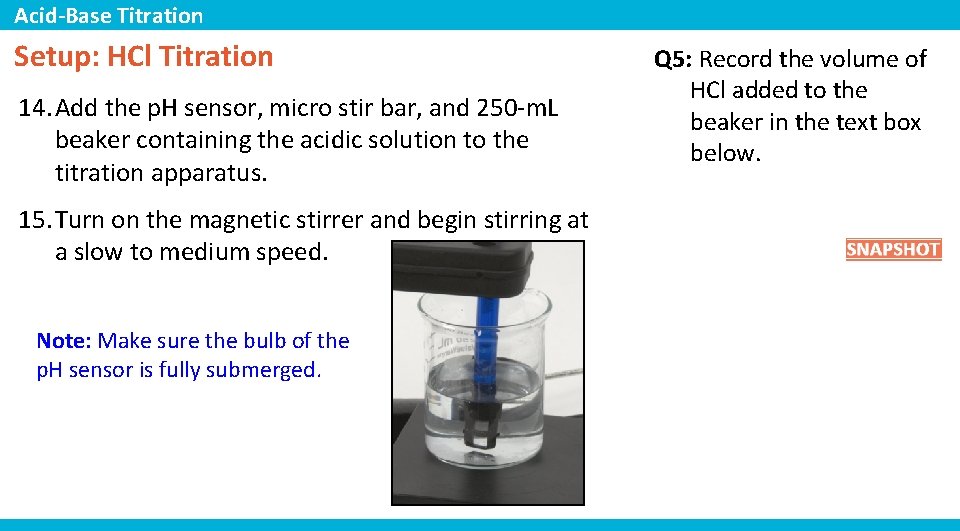
Acid-Base Titration Setup: HCl Titration 14. Add the p. H sensor, micro stir bar, and 250 -m. L beaker containing the acidic solution to the titration apparatus. 15. Turn on the magnetic stirrer and begin stirring at a slow to medium speed. Note: Make sure the bulb of the p. H sensor is fully submerged. Q 5: Record the volume of HCl added to the beaker in the text box below.
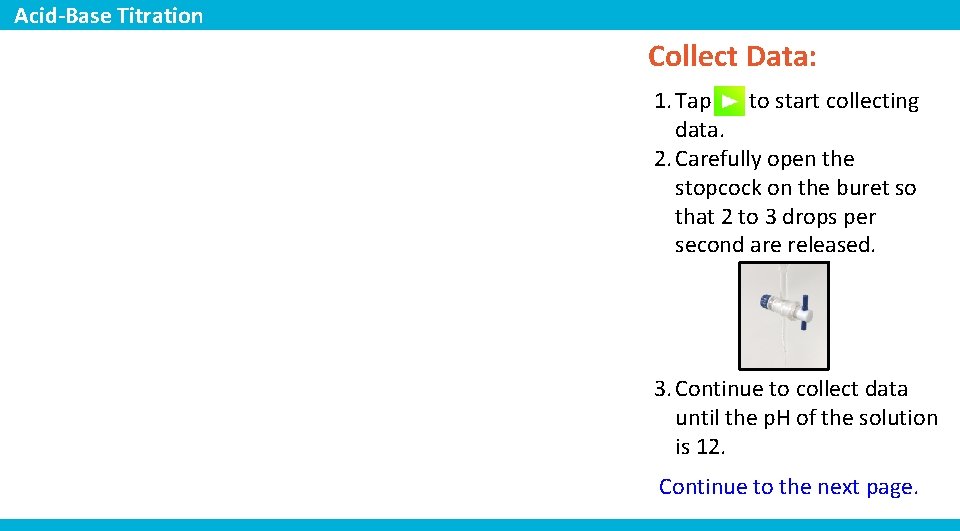
Acid-Base Titration Collect Data: 1. Tap to start collecting data. 2. Carefully open the stopcock on the buret so that 2 to 3 drops per second are released. 3. Continue to collect data until the p. H of the solution is 12. Continue to the next page.
Acid-Base Titration Q 6: Why is it necessary to stir Q 7: What substances are the solution during a being formed in the titration? beaker?
Acid-Base Titration Collect Data: 4. When the p. H of the solution is 12 close the stopcock. Continue to the next page.
Acid-Base Titration Collect Data: 5. Tap to stop data collection. 6. Record the final volume of Na. OH in the buret.
Acid-Base Titration Data Analysis: HCl 1. Determine the total volume of Na. OH used in the titration by following steps a-c below. Volume Na. OH = Final Volume Na. OH - Initial Volume of Na. OH Note: Initial and final volumes of Na. OH were recorded earlier in the journal. Refer to the journal to get these numbers. * a. Enter the final volume of Na. OH in the text box on the right. b. Record the initial volume of Na. OH in the text box on the right c. Subtract the initial volume of Na. OH from the final volume of Na. OH and record the total volume in the text box on the right. * To View a Page in the Journal: 1. Tap to open the Journal screen. 2. Tap or to scroll through the thumbnail size pages of the journal. 3. Tap the thumbnail image of the page to view it.
Acid-Base Titration Data Analysis: HCl 2. Create a calculation to convert drop count to volume (m. L). * Calc. Volume 1 = [drop count]*(volume of titrant/final drop count) Note: [drop count] = collected data volume of titrant = total volume of Na. OH used (it is in your journal) final drop count = the total number of drops added (it is displayed on the right) *To Create a Calculation: 1. Tap to open the Experiment Tools screen. 2. Tap CALCULATED DATA to open the calculator. 3. Enter the calculation in the space provided. 4. Tap Measurements to insert collected data into the calculation.
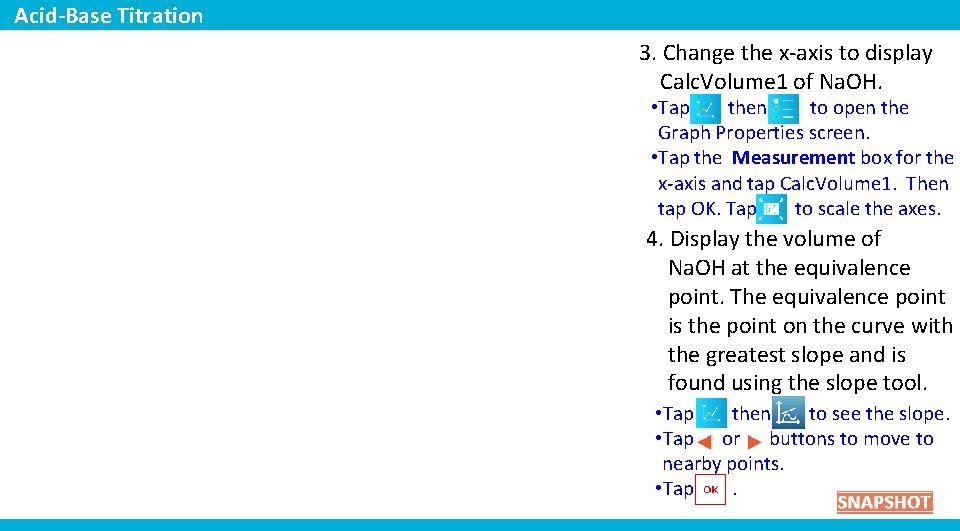
Acid-Base Titration 3. Change the x-axis to display Calc. Volume 1 of Na. OH. • Tap then to open the Graph Properties screen. • Tap the Measurement box for the x-axis and tap Calc. Volume 1. Then tap OK. Tap to scale the axes. 4. Display the volume of Na. OH at the equivalence point. The equivalence point is the point on the curve with the greatest slope and is found using the slope tool. • Tap then to see the slope. • Tap or buttons to move to nearby points. • Tap.
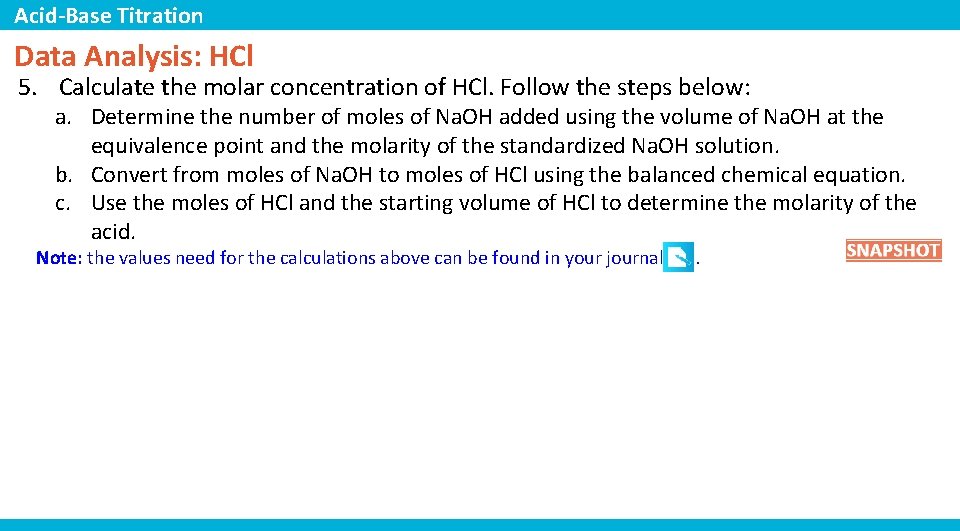
Acid-Base Titration Data Analysis: HCl 5. Calculate the molar concentration of HCl. Follow the steps below: a. Determine the number of moles of Na. OH added using the volume of Na. OH at the equivalence point and the molarity of the standardized Na. OH solution. b. Convert from moles of Na. OH to moles of HCl using the balanced chemical equation. c. Use the moles of HCl and the starting volume of HCl to determine the molarity of the acid. Note: the values need for the calculations above can be found in your journal .
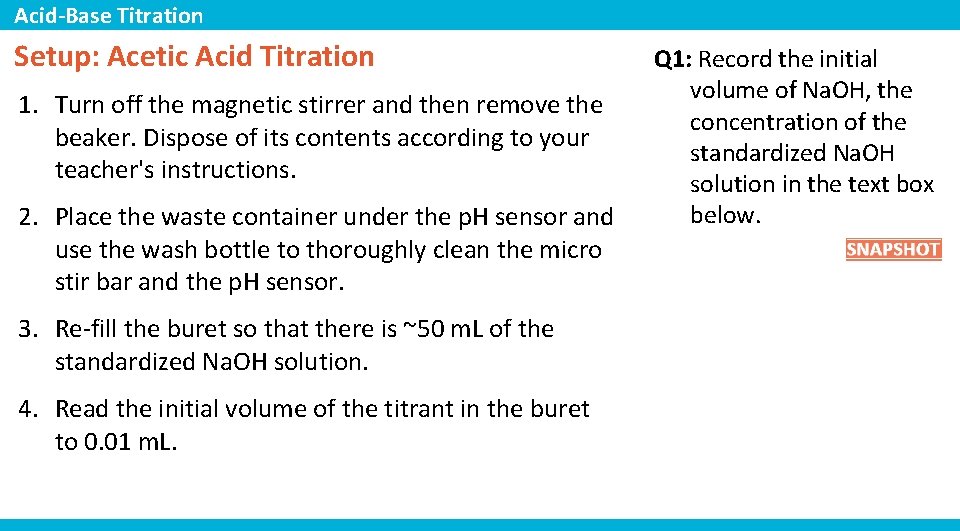
Acid-Base Titration Setup: Acetic Acid Titration 1. Turn off the magnetic stirrer and then remove the beaker. Dispose of its contents according to your teacher's instructions. 2. Place the waste container under the p. H sensor and use the wash bottle to thoroughly clean the micro stir bar and the p. H sensor. 3. Re-fill the buret so that there is ~50 m. L of the standardized Na. OH solution. 4. Read the initial volume of the titrant in the buret to 0. 01 m. L. Q 1: Record the initial volume of Na. OH, the concentration of the standardized Na. OH solution in the text box below.
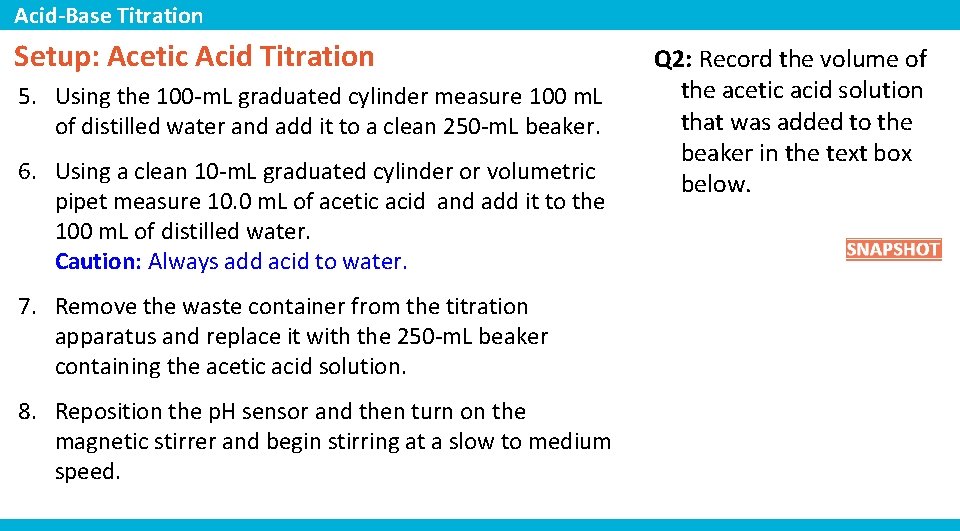
Acid-Base Titration Setup: Acetic Acid Titration 5. Using the 100 -m. L graduated cylinder measure 100 m. L of distilled water and add it to a clean 250 -m. L beaker. 6. Using a clean 10 -m. L graduated cylinder or volumetric pipet measure 10. 0 m. L of acetic acid and add it to the 100 m. L of distilled water. Caution: Always add acid to water. 7. Remove the waste container from the titration apparatus and replace it with the 250 -m. L beaker containing the acetic acid solution. 8. Reposition the p. H sensor and then turn on the magnetic stirrer and begin stirring at a slow to medium speed. Q 2: Record the volume of the acetic acid solution that was added to the beaker in the text box below.
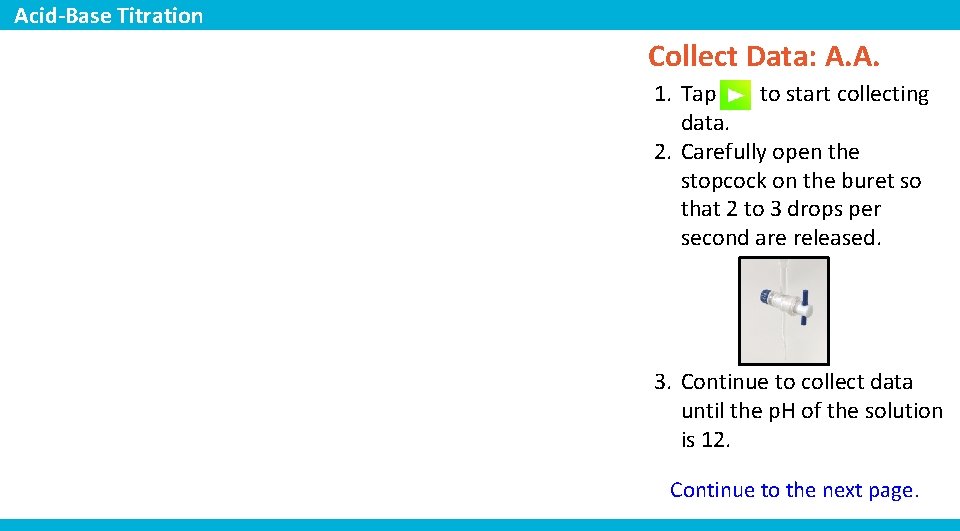
Acid-Base Titration Collect Data: A. A. 1. Tap to start collecting data. 2. Carefully open the stopcock on the buret so that 2 to 3 drops per second are released. 3. Continue to collect data until the p. H of the solution is 12. Continue to the next page.
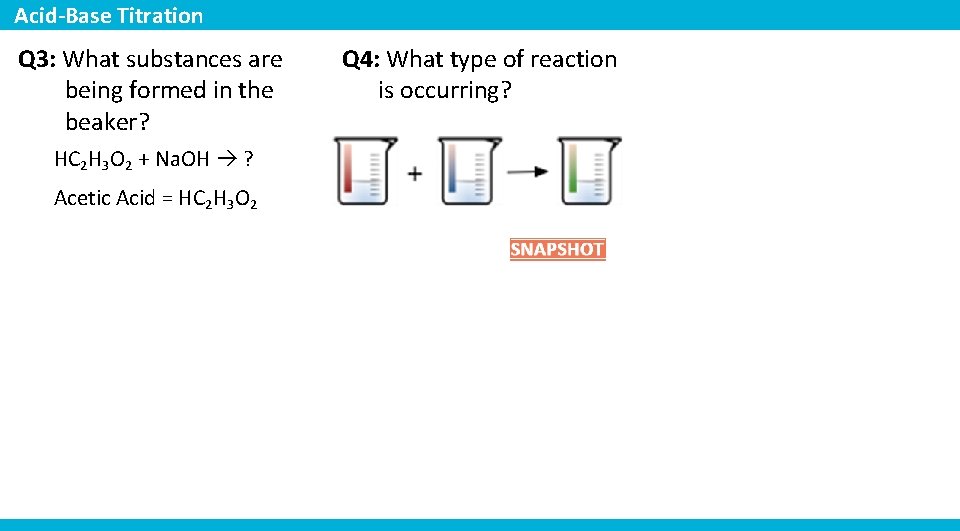
Acid-Base Titration Q 3: What substances are being formed in the beaker? HC 2 H 3 O 2 + Na. OH ? Acetic Acid = HC 2 H 3 O 2 Q 4: What type of reaction is occurring?
Acid-Base Titration Collect Data: A. A. 4. When the p. H of the solution is 12 close the stopcock. Continue to the next page.
Acid-Base Titration Collect Data: A. A. 5. Tap to stop data collection. 6. Record the final volume of Na. OH in the buret.
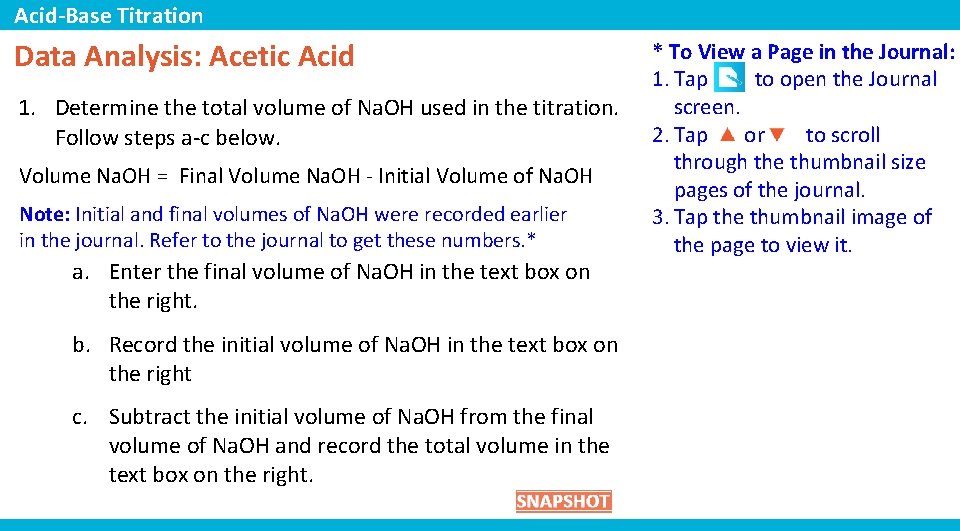
Acid-Base Titration Data Analysis: Acetic Acid 1. Determine the total volume of Na. OH used in the titration. Follow steps a-c below. Volume Na. OH = Final Volume Na. OH - Initial Volume of Na. OH Note: Initial and final volumes of Na. OH were recorded earlier in the journal. Refer to the journal to get these numbers. * a. Enter the final volume of Na. OH in the text box on the right. b. Record the initial volume of Na. OH in the text box on the right c. Subtract the initial volume of Na. OH from the final volume of Na. OH and record the total volume in the text box on the right. * To View a Page in the Journal: 1. Tap to open the Journal screen. 2. Tap or to scroll through the thumbnail size pages of the journal. 3. Tap the thumbnail image of the page to view it.
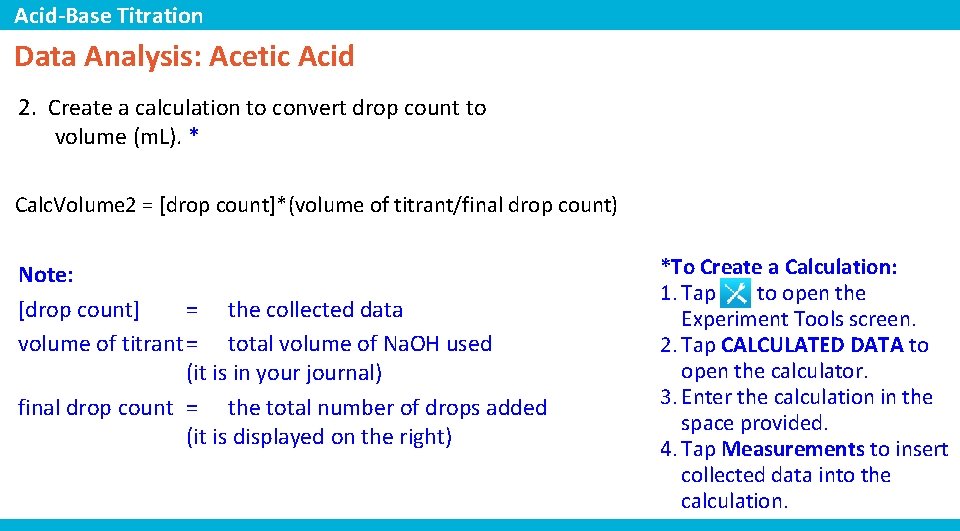
Acid-Base Titration Data Analysis: Acetic Acid 2. Create a calculation to convert drop count to volume (m. L). * Calc. Volume 2 = [drop count]*(volume of titrant/final drop count) Note: [drop count] = the collected data volume of titrant = total volume of Na. OH used (it is in your journal) final drop count = the total number of drops added (it is displayed on the right) *To Create a Calculation: 1. Tap to open the Experiment Tools screen. 2. Tap CALCULATED DATA to open the calculator. 3. Enter the calculation in the space provided. 4. Tap Measurements to insert collected data into the calculation.
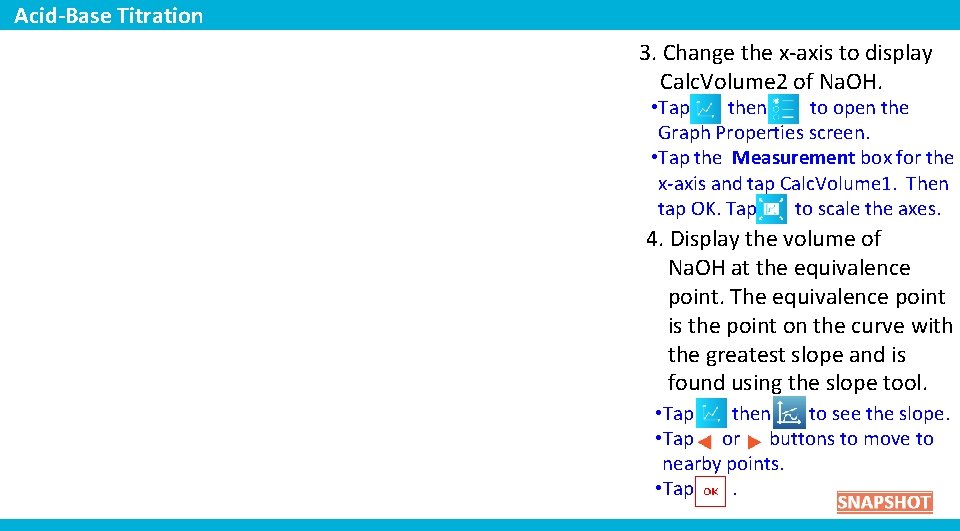
Acid-Base Titration 3. Change the x-axis to display Calc. Volume 2 of Na. OH. • Tap then to open the Graph Properties screen. • Tap the Measurement box for the x-axis and tap Calc. Volume 1. Then tap OK. Tap to scale the axes. 4. Display the volume of Na. OH at the equivalence point. The equivalence point is the point on the curve with the greatest slope and is found using the slope tool. • Tap then to see the slope. • Tap or buttons to move to nearby points. • Tap.
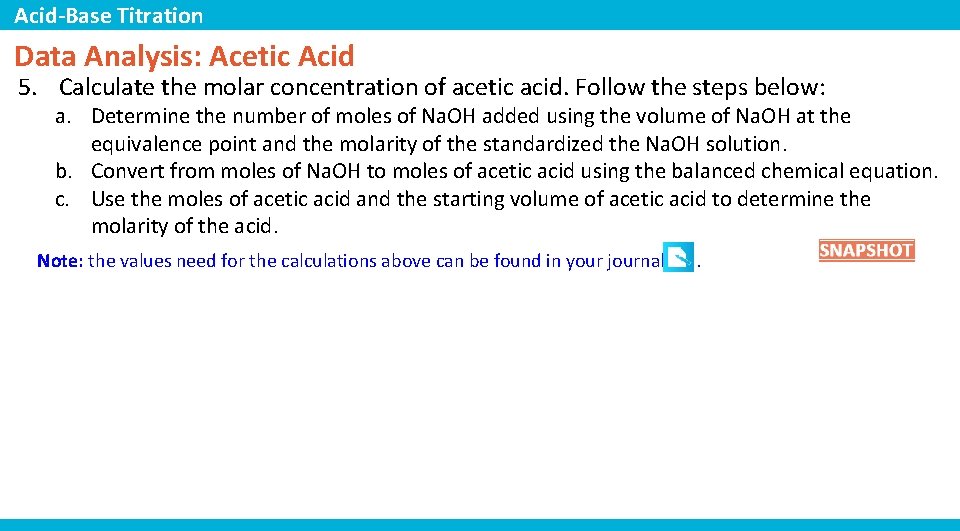
Acid-Base Titration Data Analysis: Acetic Acid 5. Calculate the molar concentration of acetic acid. Follow the steps below: a. Determine the number of moles of Na. OH added using the volume of Na. OH at the equivalence point and the molarity of the standardized the Na. OH solution. b. Convert from moles of Na. OH to moles of acetic acid using the balanced chemical equation. c. Use the moles of acetic acid and the starting volume of acetic acid to determine the molarity of the acid. Note: the values need for the calculations above can be found in your journal .
Acid-Base Titration Analysis 1. What is the significance of the point on the titration curve where the slope is the steepest?
Acid-Base Titration Analysis 2. What trend did you notice in the slope of the titration curve between the start of the titration and the equivalence point?
Acid-Base Titration Analysis 3. What is the likelihood that the concentration of acid and base is exactly equal at the experimentally determined equivalence point? Explain your reasoning.
Acid-Base Titration Analysis 4. What difference do you notice between the start of the titration and the equivalence point in the appearance of the titration curve for the two different acids?
Acid-Base Titration Analysis 5. What is the difference between p. H at the equivalence points between the two titration curves for the different acids? Explain.
Acid-Base Titration Synthesis 1. How could you determine the concentration of an unknown sodium hydroxide solution?
Acid-Base Titration Synthesis 2. Use the Prediction Button to sketch the titration curve for an acid that is weaker than acetic acid. *To Draw a Prediction: 1. Tap to open the tool palette. 2. Tap then use your finger to draw your prediction. 3. Tap when finished. 4. If you make a mistake, tap to clear your prediction.
Acid-Base Titration Synthesis 3. Explain the difference between the strength and the concentration of an acid solution.
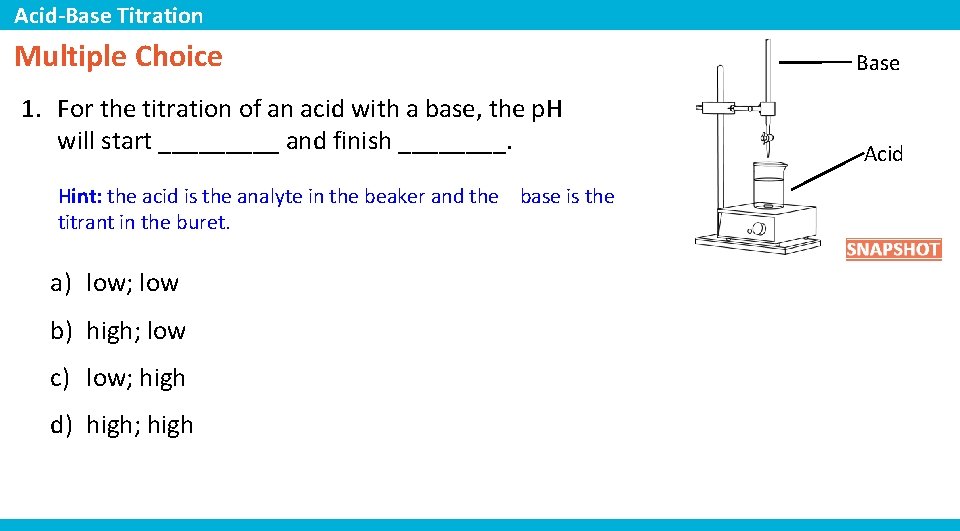
Acid-Base Titration Multiple Choice 1. For the titration of an acid with a base, the p. H will start _____ and finish ____. Hint: the acid is the analyte in the beaker and the base is the titrant in the buret. a) low; low b) high; low c) low; high d) high; high Base Acid
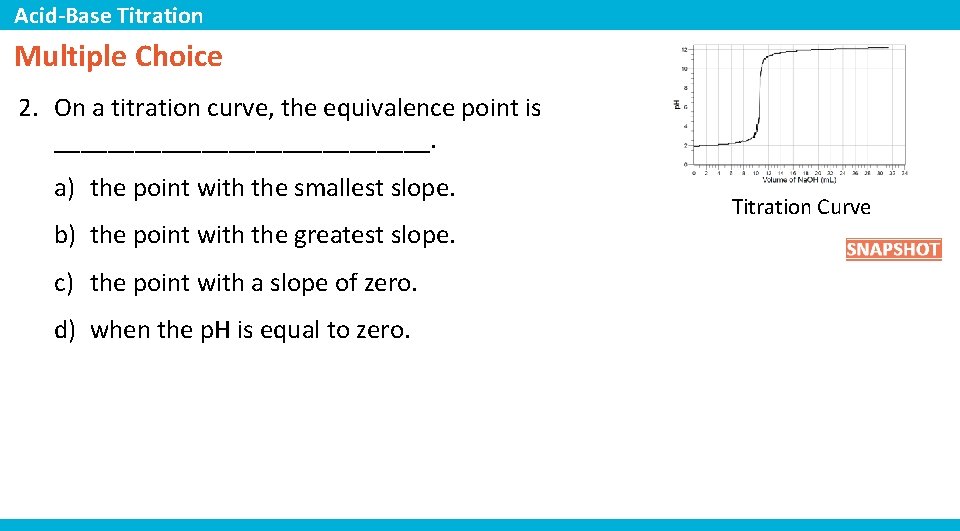
Acid-Base Titration Multiple Choice 2. On a titration curve, the equivalence point is ______________. a) the point with the smallest slope. b) the point with the greatest slope. c) the point with a slope of zero. d) when the p. H is equal to zero. Titration Curve
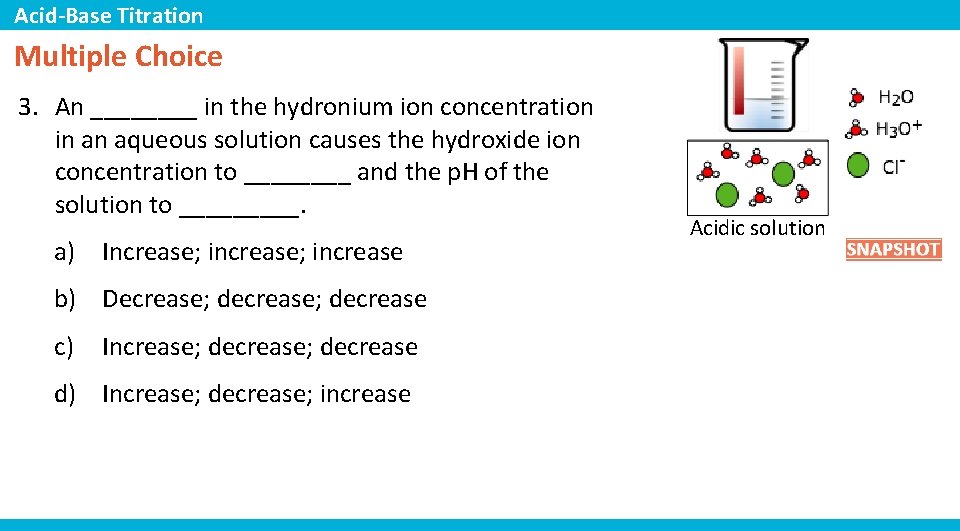
Acid-Base Titration Multiple Choice 3. An ____ in the hydronium ion concentration in an aqueous solution causes the hydroxide ion concentration to ____ and the p. H of the solution to _____. a) Increase; increase b) Decrease; decrease c) Increase; decrease d) Increase; decrease; increase Acidic solution
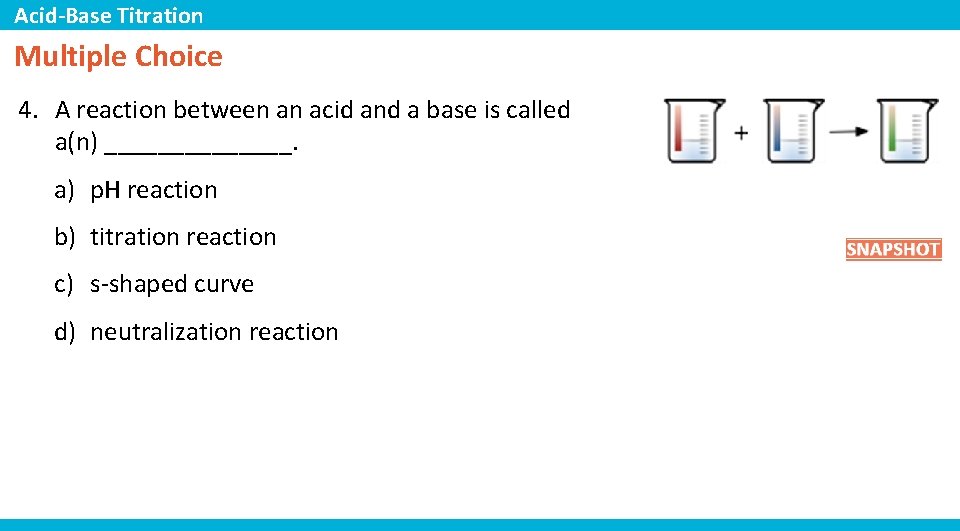
Acid-Base Titration Multiple Choice 4. A reaction between an acid and a base is called a(n) _______. a) p. H reaction b) titration reaction c) s-shaped curve d) neutralization reaction
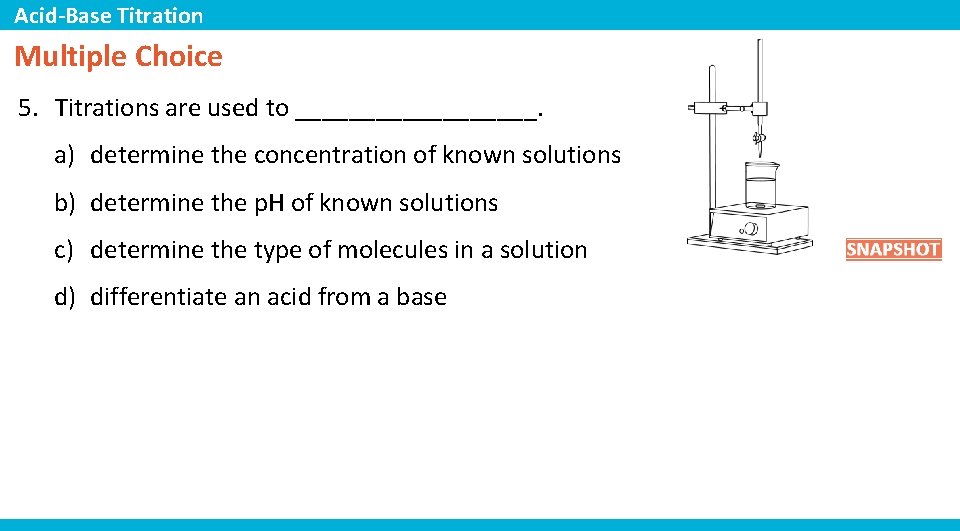
Acid-Base Titration Multiple Choice 5. Titrations are used to _________. a) determine the concentration of known solutions b) determine the p. H of known solutions c) determine the type of molecules in a solution d) differentiate an acid from a base
Acid-Base Titration Congratulations! You have completed the lab. Please remember to follow your teacher's instructions for cleaning-up and submitting your lab.
Acid-Base Titration References All images were taken from PASCO documentation, public domain clip art, or Wikimedia Foundation Commons. 1. 2. 3. 4. 5. 6. 7. 8. 9. SODA http: //freeclipartnow. com/food/beverages/soda-can. jpg. html SALAD http: //freeclipartnow. com/food/salad_png-rl. jpg. html GLASS CLEANER http: //freeclipartnow. com/household/chores/cleaners/glass-cleaner. jpg. html VINEGAR http: //freeclipartnow. com/household/chores/cleaners/vinegar. jpg. html LEMONS http: //freeclipartnow. com/food/fruits/grapefruit-4. jpg. html BURET http: //commons. wikimedia. org/wiki/File: buret. svg BEAKER http: //www. freeclipartnow. com/science/flasks-tubes/beaker-2. jpg. html BEAKER http: //freeclipartnow. com/science/flasks-tubes/beaker. jpg. html CORROSIVE WARNING http: //commons. wikimedia. org/wiki/Image: DIN_48442_Warnung_vor_Aetzenden_Stoffen_D-W 004. svg 10. BE SAFE http: //freeclipartnow. com/signs-symbols/warnings/safety-hands. jpg. html 11. ACETIC ACID http: //commons. wikimedia. org/wiki/File: Acetic_acid_structures. png 12. NAOH http: //wikimediafoundation. org/wiki/File: Na. OH. gif
- Slides: 51