
P 4 1 Precision Radial Velocity Spectrometer PRVS
![1. THE BASICS 3. CIII] emissivity (stellar 1 k. G dipolar field) Disk dynamo](https://slidetodoc.com/presentation_image/01032b51236a27bad84b4ad6111375b4/image-2.jpg "1. THE BASICS 3. CIII] emissivity (stellar 1 k. G dipolar field) Disk dynamo")
- Slides: 13
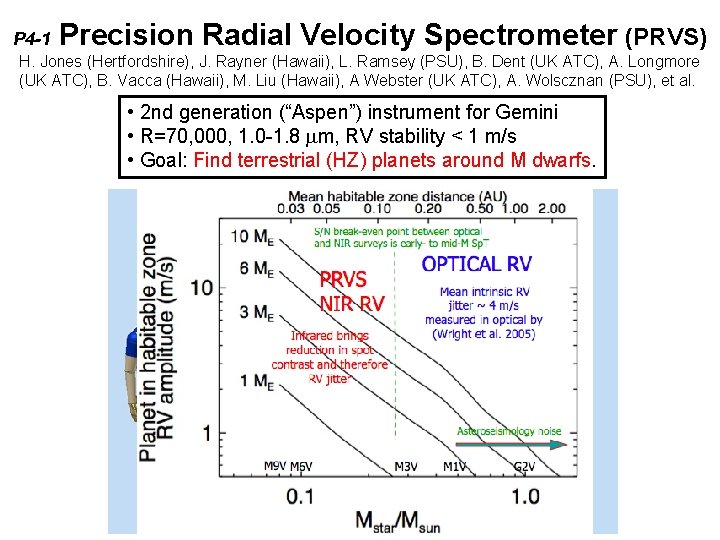
P 4 -1 Precision Radial Velocity Spectrometer (PRVS) H. Jones (Hertfordshire), J. Rayner (Hawaii), L. Ramsey (PSU), B. Dent (UK ATC), A. Longmore (UK ATC), B. Vacca (Hawaii), M. Liu (Hawaii), A Webster (UK ATC), A. Wolscznan (PSU), et al. • 2 nd generation (“Aspen”) instrument for Gemini • R=70, 000, 1. 0 -1. 8 m, RV stability < 1 m/s • Goal: Find terrestrial (HZ) planets around M dwarfs.
1. THE BASICS 3. CIII] emissivity (stellar 1 k. G dipolar field) Disk dynamo in action Episodic Plasmoids Ejection No disk dynamo z-axis Stellar Wind Disk Wind r-axis Gómez de Castro & von Rekowski, 2007 2. IMPACT ON THE DISK Propagation of 2 Me. V electrons in the inner border of the disk z-axis Disk Midplane • Most of the energy is releasead along the incidence direction within a beam of 2 107 cm and a depth of 8 107 cm (disk height 109 cm) • Energy spreading has to be done through the Hard Bremsstrahlung radiation energy cascade. Selective absorption by disk molecules produces PDRs 4. TRACEBILITY Optically thin lines emitted by the plasma @Tє[3000 -300, 000]K -> UV wavelengths 1993 2001 AB Dor: Gómez de Castro 2002 • A non-negligible source of ionization further than the atmosphere. • A source of high energy electrons to interact with molecules collisionally Gómez de Castro & Antonicci, 2007 Tracing the interaction of the stellar wind with the young planetary disk material RY Tau: Gómez de Castro & Verdugo, 2007, Ap. JL Detecting the output from accretion and outflow (densities and temperatures are similar)
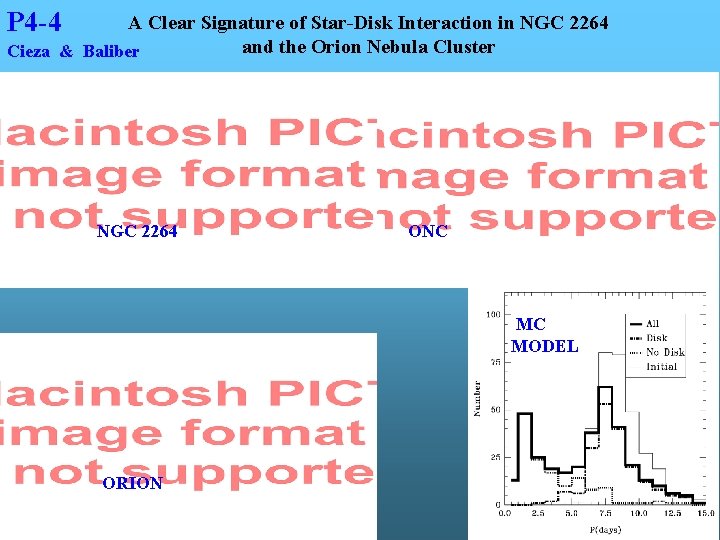
P 4 -4 A Clear Signature of Star-Disk Interaction in NGC 2264 and the Orion Nebula Cluster Cieza & Baliber NGC 2264 ONC MC MODEL ORION
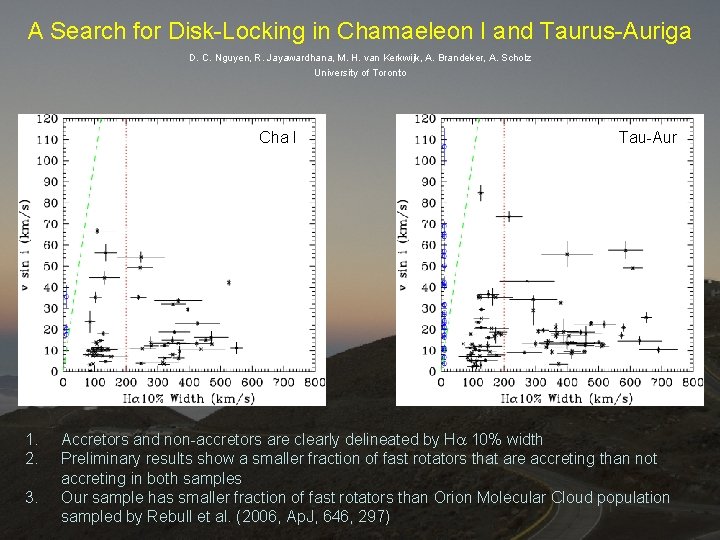
A Search for Disk-Locking in Chamaeleon I and Taurus-Auriga D. C. Nguyen, R. Jayawardhana, M. H. van Kerkwijk, A. Brandeker, A. Scholz University of Toronto Cha I 1. 2. 3. Tau-Aur Accretors and non-accretors are clearly delineated by H 10% width Preliminary results show a smaller fraction of fast rotators that are accreting than not accreting in both samples Our sample has smaller fraction of fast rotators than Orion Molecular Cloud population sampled by Rebull et al. (2006, Ap. J, 646, 297)
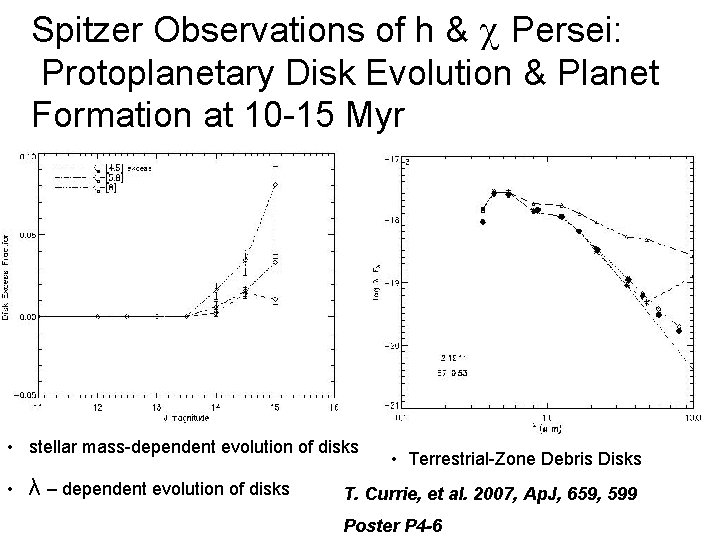
Spitzer Observations of h & Persei: Protoplanetary Disk Evolution & Planet Formation at 10 -15 Myr • stellar mass-dependent evolution of disks • λ – dependent evolution of disks • Terrestrial-Zone Debris Disks T. Currie, et al. 2007, Ap. J, 659, 599 Poster P 4 -6
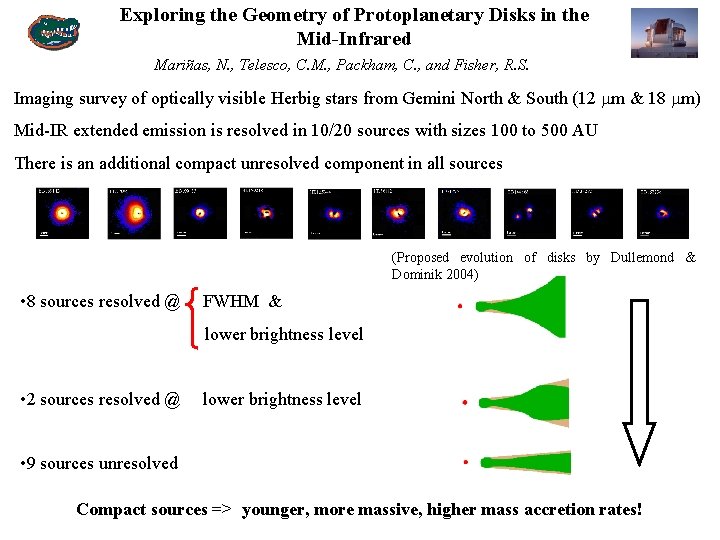
Exploring the Geometry of Protoplanetary Disks in the Mid-Infrared Mariñas, N. , Telesco, C. M. , Packham, C. , and Fisher, R. S. Imaging survey of optically visible Herbig stars from Gemini North & South (12 m & 18 m) Mid-IR extended emission is resolved in 10/20 sources with sizes 100 to 500 AU There is an additional compact unresolved component in all sources (Proposed evolution of disks by Dullemond & Dominik 2004) • 8 sources resolved @ FWHM & lower brightness level • 2 sources resolved @ lower brightness level • 9 sources unresolved Compact sources => younger, more massive, higher mass accretion rates!
Moerchen et al. P 4 -9 • Our study: image thermallyemitting dust in nearby (<100 pc) debris disk candidates (identified by Spitzer/MIPS photometry) with subarcsecond resolution • Observing program of 20 sources at 10 & 18 microns at Gemini is near completion • 2 sources spatially resolved so far: Zeta Lep & HD 32297
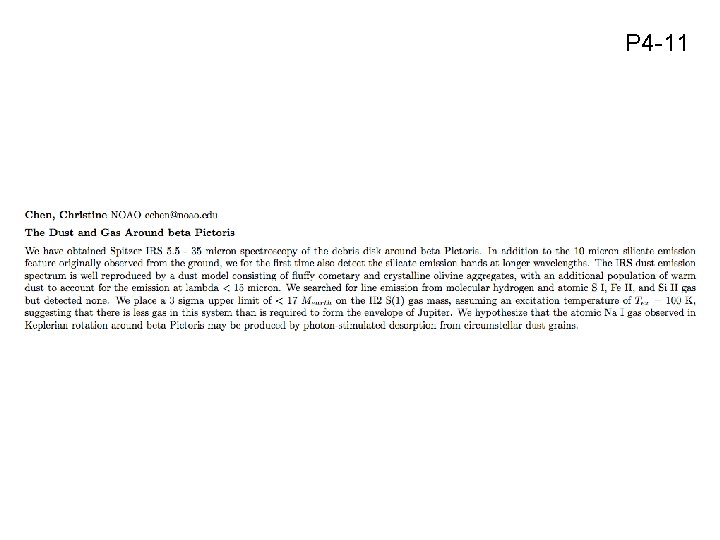
P 4 -11
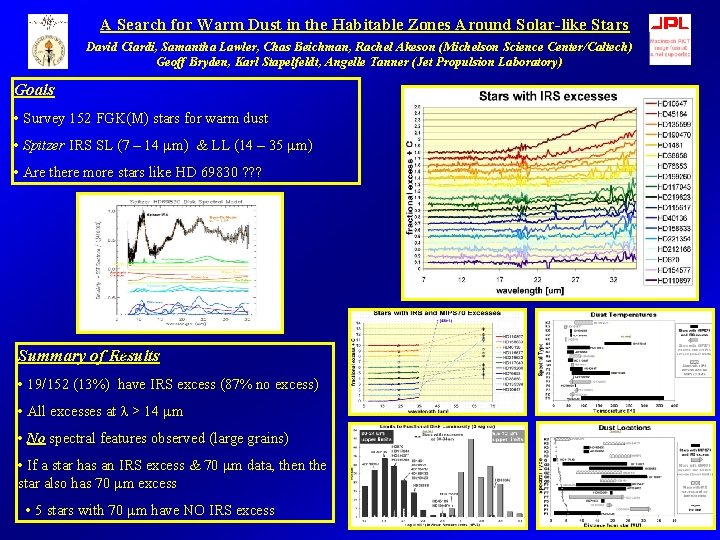
A Search for Warm Dust in the Habitable Zones Around Solar-like Stars David Ciardi, Samantha Lawler, Chas Beichman, Rachel Akeson (Michelson Science Center/Caltech) Geoff Bryden, Karl Stapelfeldt, Angelle Tanner (Jet Propulsion Laboratory) Goals • Survey 152 FGK(M) stars for warm dust • Spitzer IRS SL (7 – 14 m) & LL (14 – 35 m) • Are there more stars like HD 69830 ? ? ? Summary of Results Lisse et al. 2006 • 19/152 (13%) have IRS excess (87% no excess) • All excesses at l > 14 m • No spectral features observed (large grains) • If a star has an IRS excess & 70 m data, then the star also has 70 m excess • 5 stars with 70 m have NO IRS excess