
P 3 138 Viscosity in a Capillary Tube
P 3. 138*: Viscosity in a Capillary Tube Solved By: Rebecca Currier Patrick Thomas Andrew Quinn Nicole Hataway
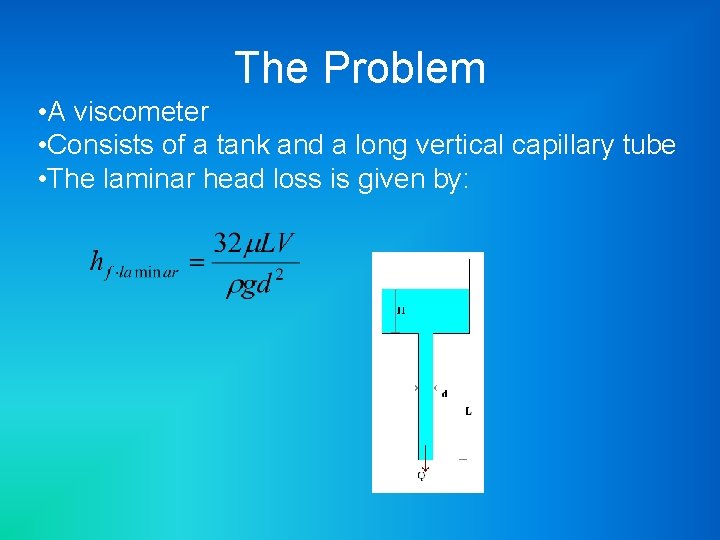
The Problem • A viscometer • Consists of a tank and a long vertical capillary tube • The laminar head loss is given by:
Find: a) If d, L, H, Q , T, and ρ are known, write an expression for the viscosity. b) Calculate the viscosity: T=20 o. C, ρ=681 kg/m^3 d=0. 041 in (1. 0414 mm) Q=0. 310 m. L/s L=36. 1 in (0. 91694 m) H=0. 154 m. c) Compare the experimental result with the published value of viscosity at this temperature, and report a percent error. d) Compute the percentage error in the calculation of viscosity that would occur if a student forgot to include the kinetic energy flux correction factor in part (b). Explain the importance of the kinetic energy flux correction factor in a problem such as this.
Assumptions • Neglect Entrance Losses • Laminar Flow • Standard Temperature and Pressure Conditions • Steady • Incompressible • Viscous • Liquid (We chose Gasoline, experimental ρ=681 kg/m^3)
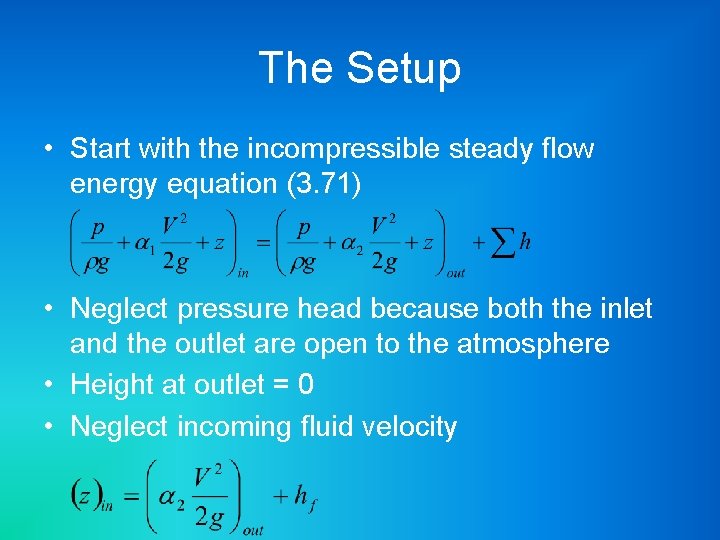
The Setup • Start with the incompressible steady flow energy equation (3. 71) • Neglect pressure head because both the inlet and the outlet are open to the atmosphere • Height at outlet = 0 • Neglect incoming fluid velocity
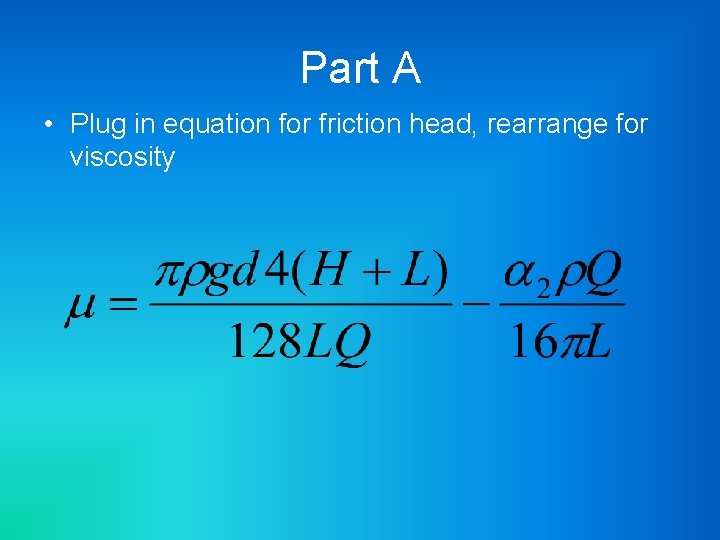
Part A • Plug in equation for friction head, rearrange for viscosity
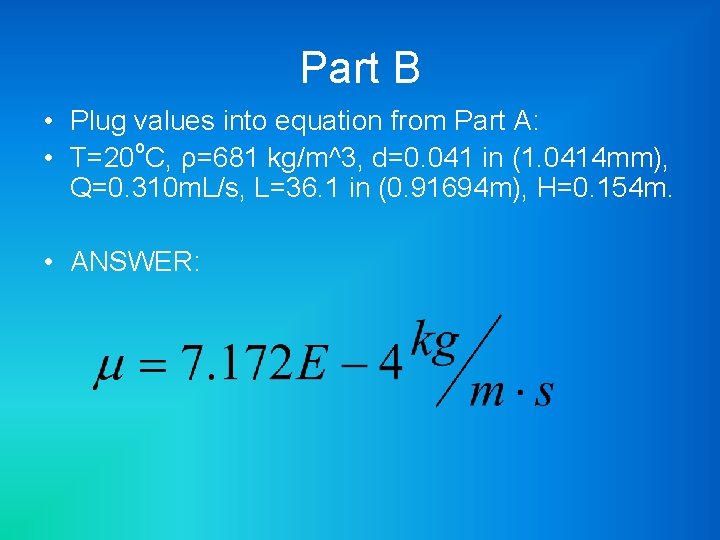
Part B • Plug values into equation from Part A: • T=20 o. C, ρ=681 kg/m^3, d=0. 041 in (1. 0414 mm), Q=0. 310 m. L/s, L=36. 1 in (0. 91694 m), H=0. 154 m. • ANSWER:
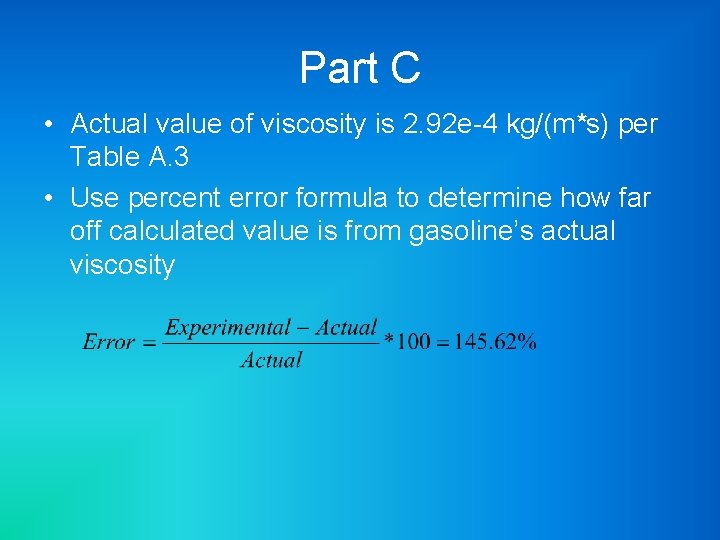
Part C • Actual value of viscosity is 2. 92 e-4 kg/(m*s) per Table A. 3 • Use percent error formula to determine how far off calculated value is from gasoline’s actual viscosity
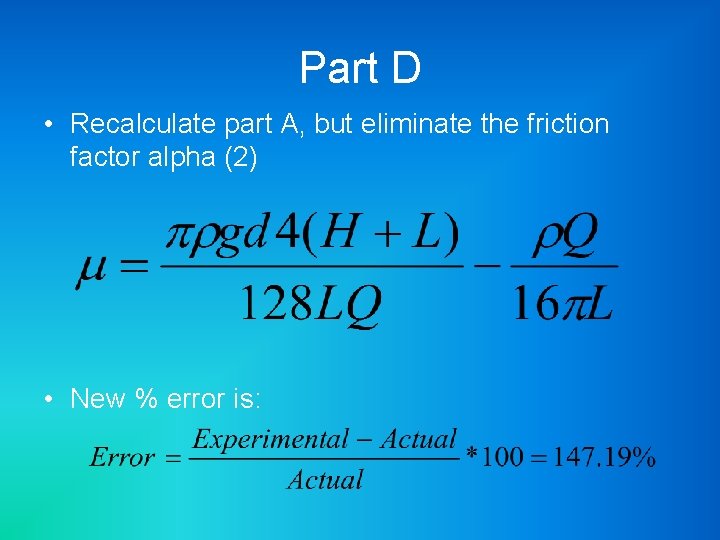
Part D • Recalculate part A, but eliminate the friction factor alpha (2) • New % error is:

Discussion • Several different variables affect viscosity • These factors are dependent on each otherchanging the fluid density did not yield an equally changed viscosity
Relation to Biofluids • Scenario is analogous to bladder/urethra setup • Equation could be used to mathematically model urine flow in catheterized patient • Entrance effects would need to be considered in the bladder model, because the urethra is much shorter than the capillary tube in this problem
- Slides: 11