
p 182 Four Market Models Pure Competition Market
- Slides: 33
p. 182
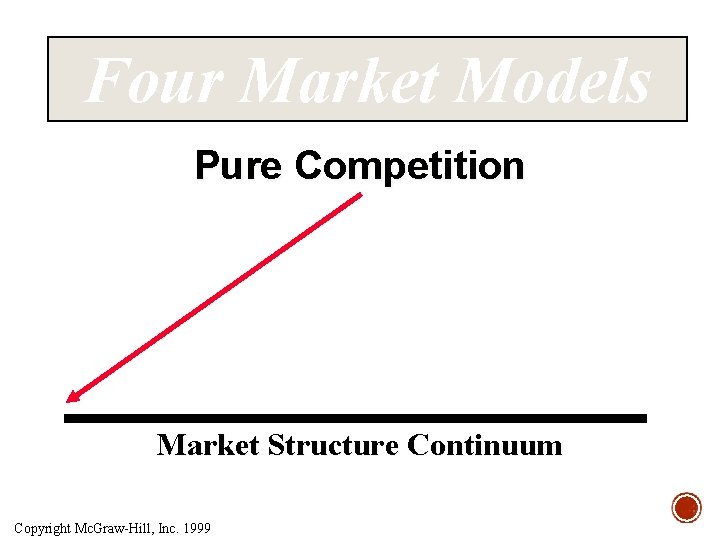
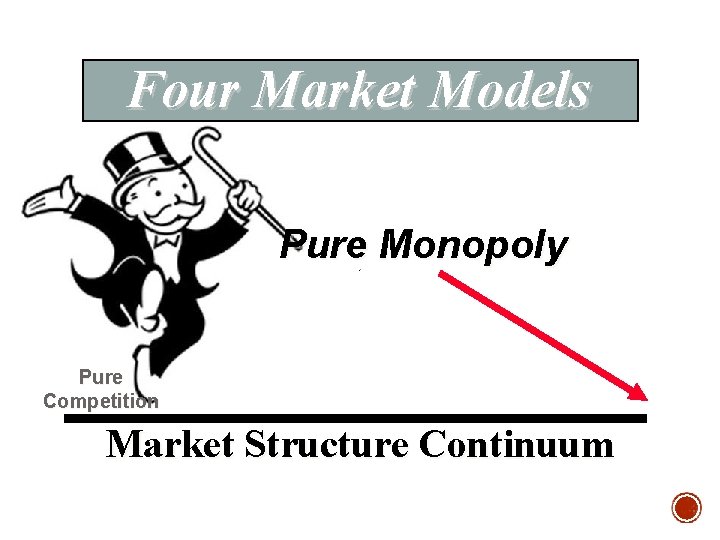
Four Market Models Pure Competition Market Structure Continuum Copyright Mc. Graw-Hill, Inc. 1999
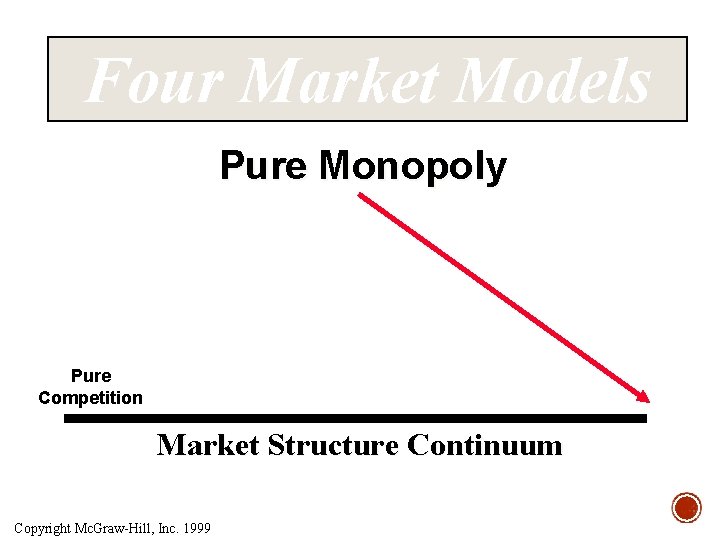
Four Market Models Pure Monopoly Pure Competition Market Structure Continuum Copyright Mc. Graw-Hill, Inc. 1999
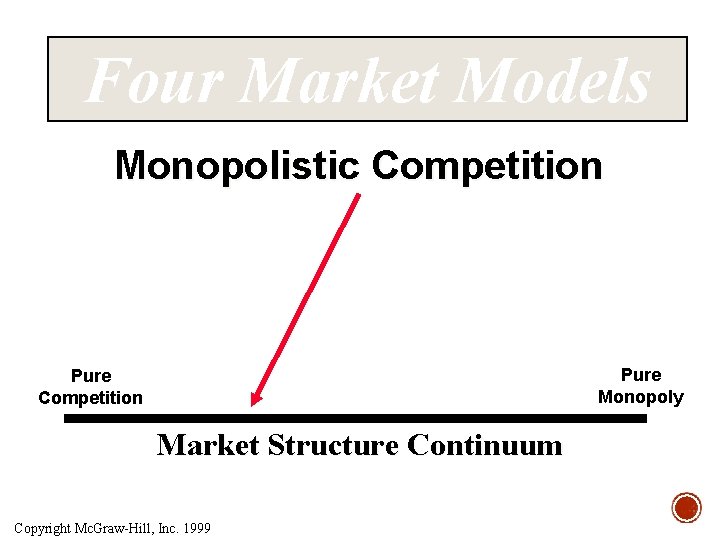
Four Market Models Monopolistic Competition Pure Monopoly Pure Competition Market Structure Continuum Copyright Mc. Graw-Hill, Inc. 1999
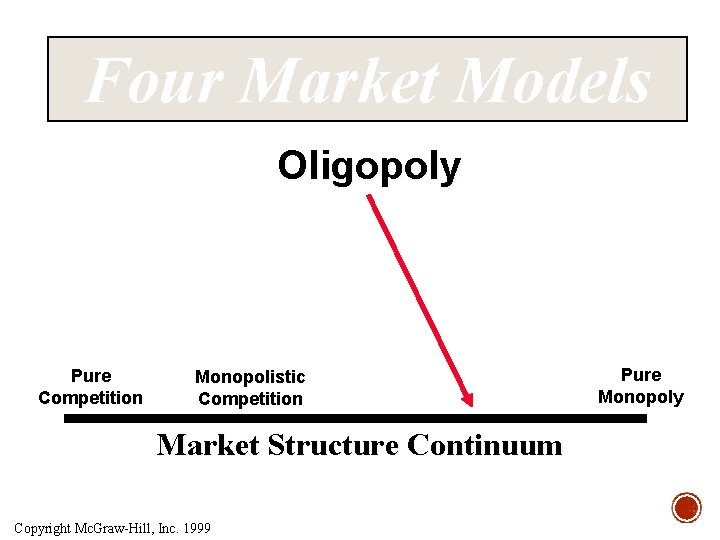
Four Market Models Oligopoly Pure Competition Monopolistic Competition Market Structure Continuum Copyright Mc. Graw-Hill, Inc. 1999 Pure Monopoly
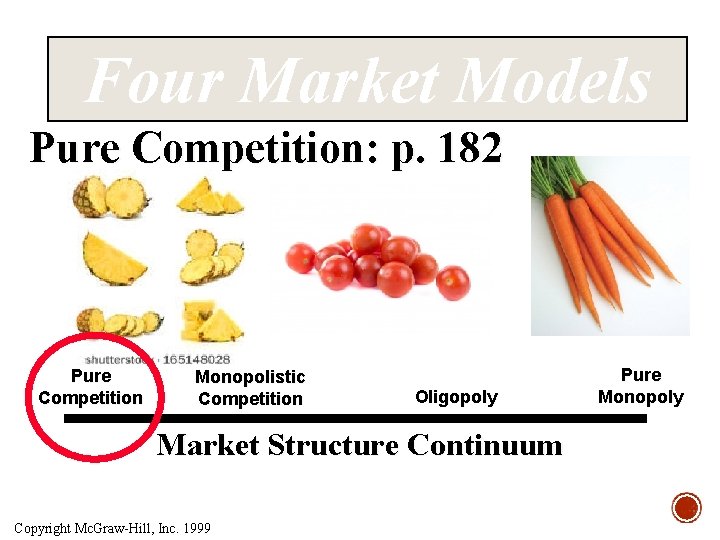
Four Market Models Pure Competition: p. 182 Pure Competition Monopolistic Competition Oligopoly Market Structure Continuum Copyright Mc. Graw-Hill, Inc. 1999 Pure Monopoly
SECTION 1 Highly Competitive Markets
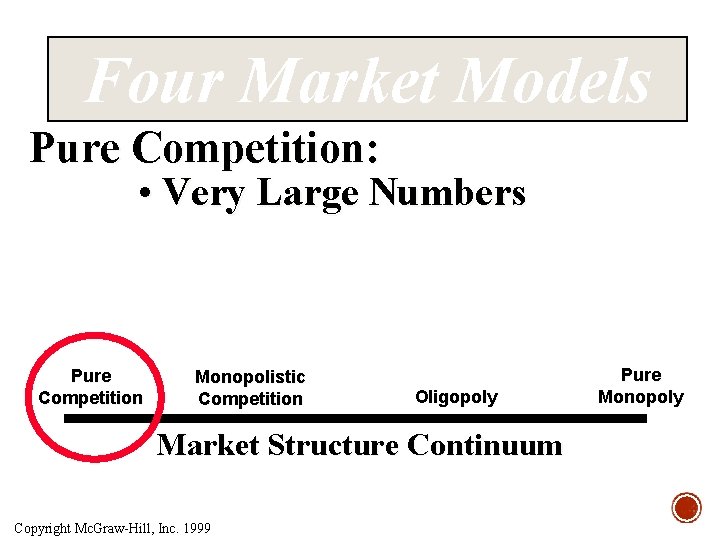
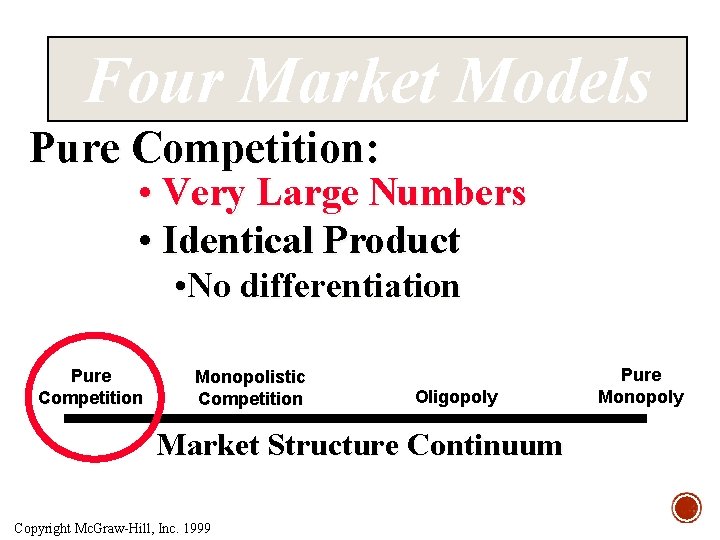
Four Market Models Pure Competition: • Very Large Numbers Pure Competition Monopolistic Competition Oligopoly Market Structure Continuum Copyright Mc. Graw-Hill, Inc. 1999 Pure Monopoly
Four Market Models Pure Competition: • Very Large Numbers • Identical Product • No differentiation Pure Competition Monopolistic Competition Oligopoly Market Structure Continuum Copyright Mc. Graw-Hill, Inc. 1999 Pure Monopoly
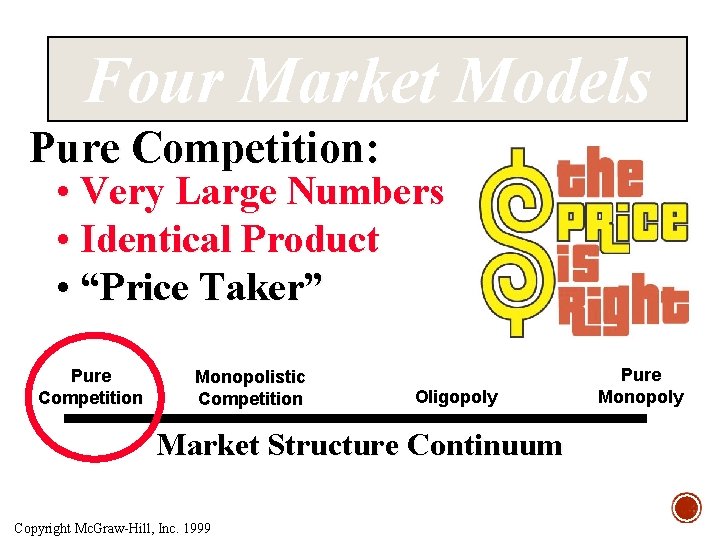
Four Market Models Pure Competition: • Very Large Numbers • Identical Product • “Price Taker” Pure Competition Monopolistic Competition Oligopoly Market Structure Continuum Copyright Mc. Graw-Hill, Inc. 1999 Pure Monopoly
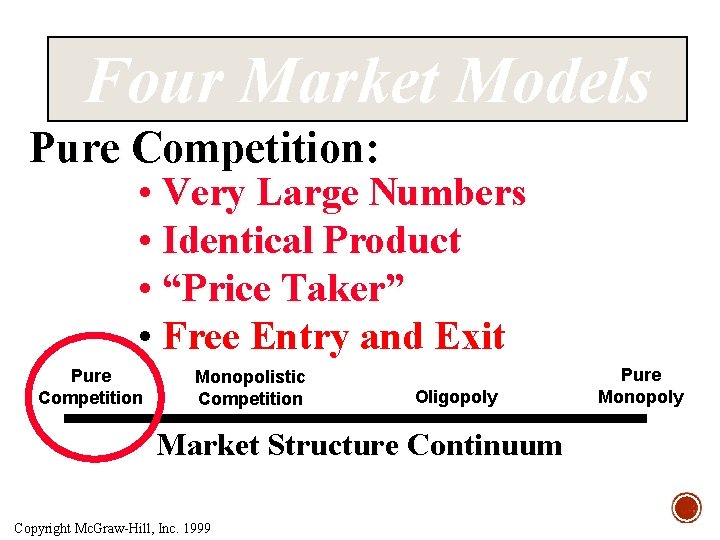
Four Market Models Pure Competition: • Very Large Numbers • Identical Product • “Price Taker” • Free Entry and Exit Pure Competition Monopolistic Competition Oligopoly Market Structure Continuum Copyright Mc. Graw-Hill, Inc. 1999 Pure Monopoly
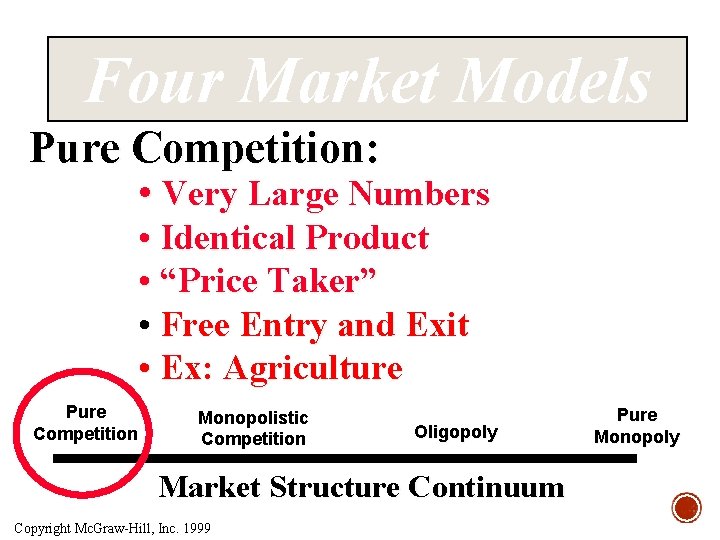
Four Market Models Pure Competition: • Very Large Numbers • Identical Product • “Price Taker” • Free Entry and Exit • Ex: Agriculture Pure Competition Monopolistic Competition Oligopoly Market Structure Continuum Copyright Mc. Graw-Hill, Inc. 1999 Pure Monopoly
Four Market Models Monopolistic Competition p. 184 Pure Monopoly Pure Competition Market Structure Continuum Copyright Mc. Graw-Hill, Inc. 1999
SECTION 1 Highly Competitive Markets
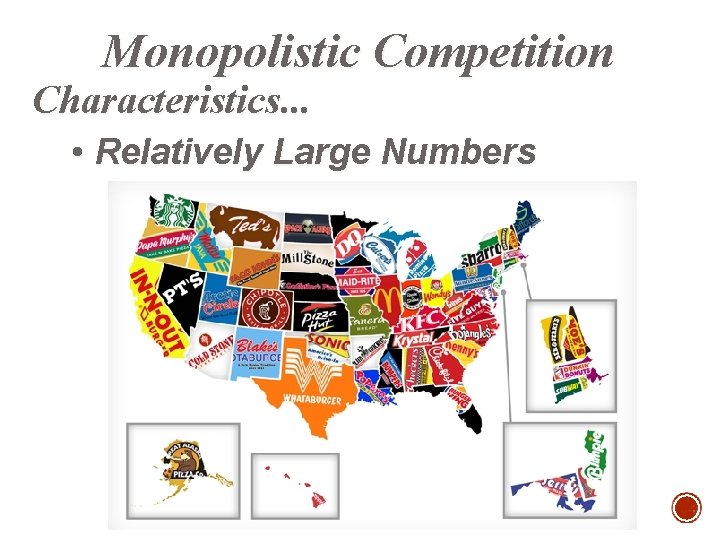
Monopolistic Competition Characteristics. . . • Relatively Large Numbers
Monopolistic Competition Characteristics. . . • Relatively Large Numbers Small Market Share No Collusion Independent Actions
Monopolistic Competition Characteristics. . . • Relatively Large Numbers Small Market Share No Collusion Independent Actions • Product Differentiation
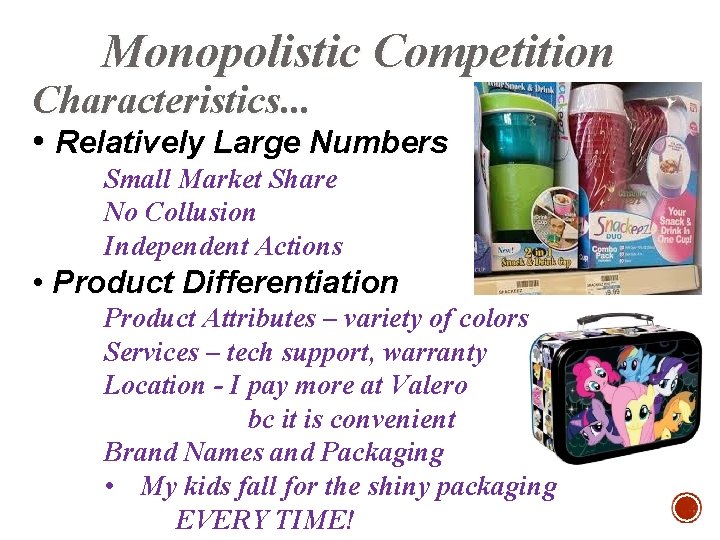
Monopolistic Competition Characteristics. . . • Relatively Large Numbers Small Market Share No Collusion Independent Actions • Product Differentiation Product Attributes – variety of colors Services – tech support, warranty Location - I pay more at Valero bc it is convenient Brand Names and Packaging • My kids fall for the shiny packaging EVERY TIME!
Monopolistic Competition Characteristics. . . • Easy Entry and Exit • Nonprice Competition • Advertising • Examples: • Fast food • Electronics • Gas Stations
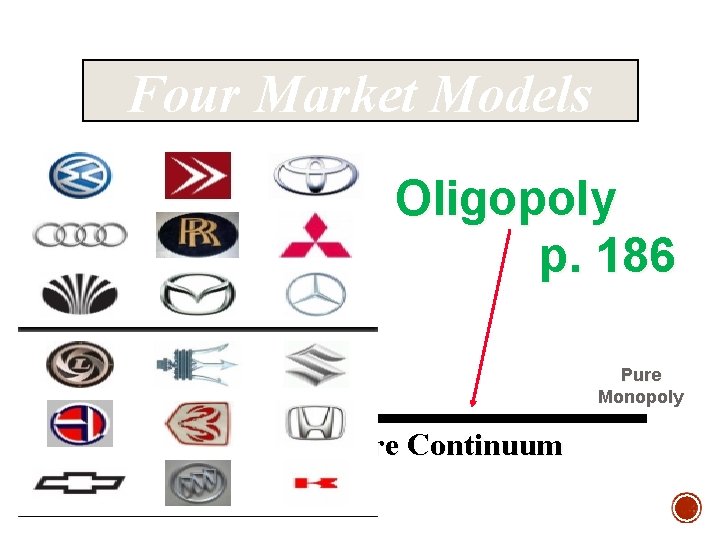
Four Market Models Oligopoly p. 186 Pure Competition Monopolistic Competition Market Structure Continuum Pure Monopoly
A few large sellers control most of the production of a good or service.
Oligopoly: Characteristics • Some control over Price • Mutual Interdependence • Entry Barriers • Mergers: • Sprint & Nextel • Office Max & Office Depot
Cartels and Collusion • If a few firms face identical or highly similar demand costs. . . • They will seek joint profit maximization by collusion • Examples: • Make up counters in the mall • Car companies • Both illegal
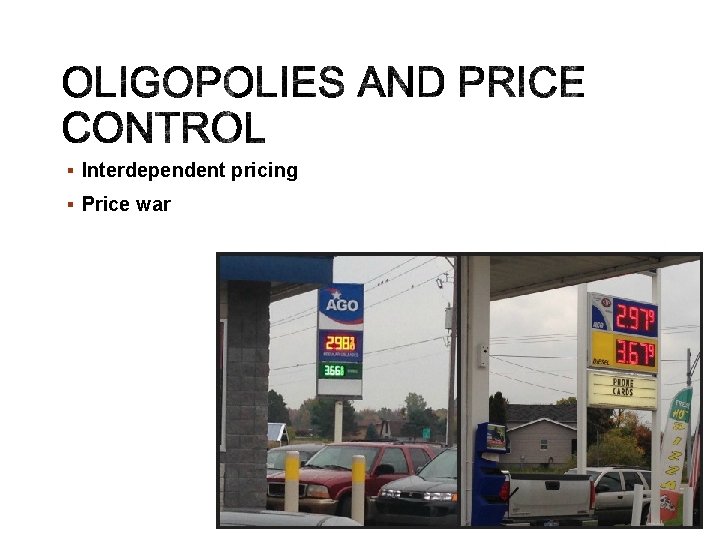
§ Interdependent pricing § Price war P. 125
Four Market Models Pure Monopoly Pure Competition Market Structure Continuum
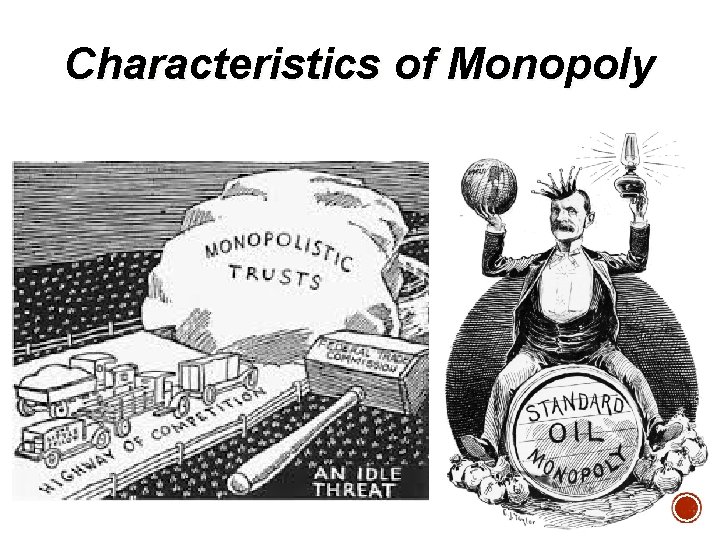
Characteristics of Monopoly
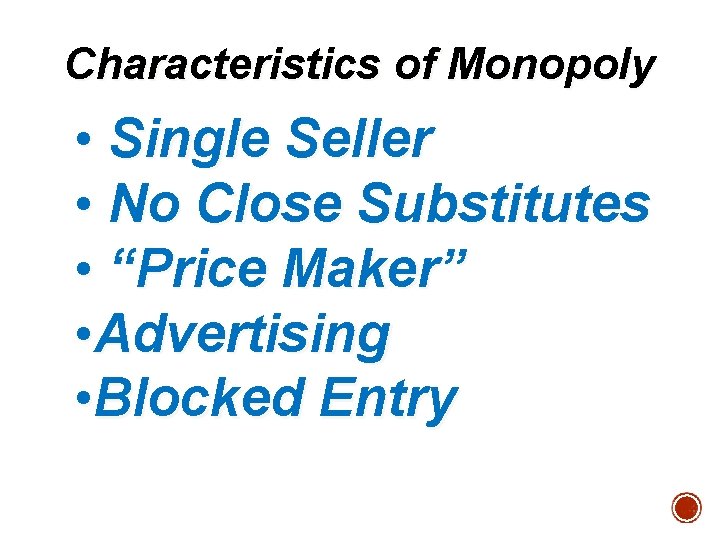
Characteristics of Monopoly • Single Seller • No Close Substitutes • “Price Maker” • Advertising • Blocked Entry
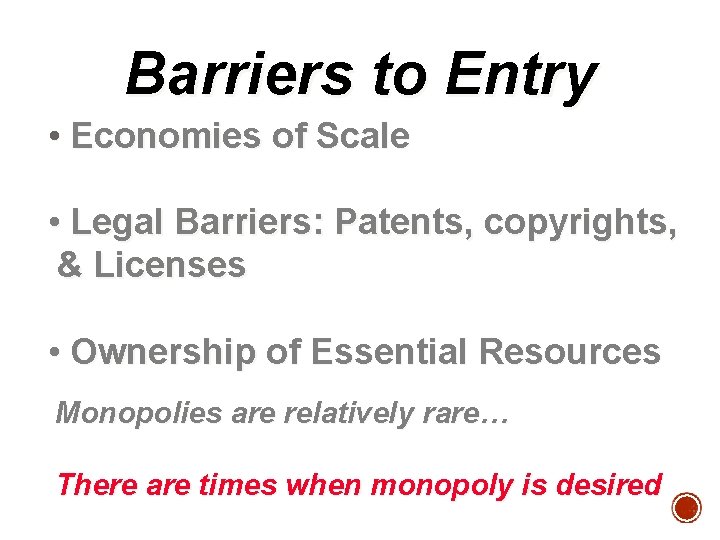
Barriers to Entry • Economies of Scale • Legal Barriers: Patents, copyrights, & Licenses • Ownership of Essential Resources Monopolies are relatively rare… There are times when monopoly is desired
§ natural monopolies—one large seller produces a good or service most efficiently § geographic monopolies—isolated geographic location attracts only one seller § technological monopolies—one producer owns the technology that created the market § government monopolies—government is the sole seller of a product
§ Trusts - monopolies or large combinations of business and capital, espe cially with a view to restricting competition: § Laissez - Faire – Government is hands- off business. § Often found in young, industrial nations § The U. S. was like this prior to and for a while after the Industrial Revolution.
§ Market Failure – when a flaw in § Externalities – (spillover § Public Goods – Goods that are § Positive: leisure time the system prevents the efficient allocation of resources. used by everyone and does not diminish the availability of the good for others. Often paid for with taxes. § Highways, schools, national defense. effects) Side effects of production. § Negative: pollution
§ broke up Standard Oil Company of Ohio in 1911 and AT&T in 1982 with the Sherman Antitrust Act § created watchdog groups, such as the Interstate Commerce Commission (ICC) and the Federal Trade Commission (FTC) § strengthened antitrust legislation with acts such as the Celler-Kefauver Act of 1950, the Antitrust Procedures and Penalties Act of 1975, and the Parens Patriae Act of 1976
§P. 199 §Charging different prices to different people. §Airlines charging different prices for seats. §Only illegal if it substantially limits competition. §RR giving better rates for long haul vs. short haul runs.