
P 13201 Tiger Bot Humanoid Robot Team Graeme
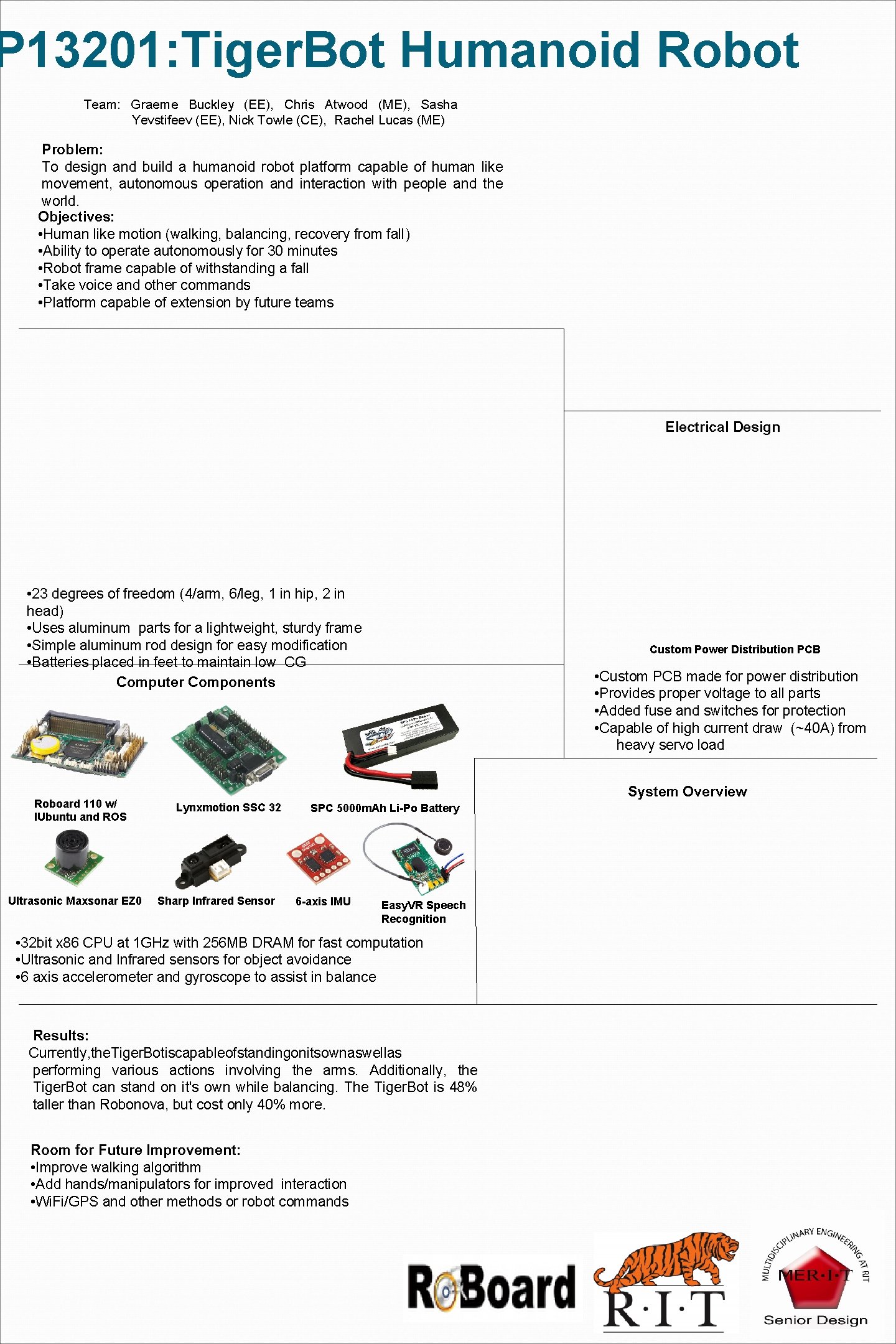
P 13201: Tiger. Bot Humanoid Robot Team: Graeme Buckley (EE), Chris Atwood (ME), Sasha Yevstifeev (EE), Nick Towle (CE), Rachel Lucas (ME) Problem: To design and build a humanoid robot platform capable of human like movement, autonomous operation and interaction with people and the world. Objectives: • Human like motion (walking, balancing, recovery from fall) • Ability to operate autonomously for 30 minutes • Robot frame capable of withstanding a fall • Take voice and other commands • Platform capable of extension by future teams Electrical Design • 23 degrees of freedom (4/arm, 6/leg, 1 in hip, 2 in head) • Uses aluminum parts for a lightweight, sturdy frame • Simple aluminum rod design for easy modification • Batteries placed in feet to maintain low CG Computer Components Roboard 110 w/ l. Ubuntu and ROS Ultrasonic Maxsonar EZ 0 Custom Power Distribution PCB • Custom PCB made for power distribution • Provides proper voltage to all parts • Added fuse and switches for protection • Capable of high current draw (~40 A) from heavy servo load System Overview Lynxmotion SSC 32 Sharp Infrared Sensor SPC 5000 m. Ah Li-Po Battery 6 -axis IMU Easy. VR Speech Recognition • 32 bit x 86 CPU at 1 GHz with 256 MB DRAM for fast computation • Ultrasonic and Infrared sensors for object avoidance • 6 axis accelerometer and gyroscope to assist in balance Results: Currently, the. Tiger. Botiscapableofstandingonitsownaswellas performing various actions involving the arms. Additionally, the Tiger. Bot can stand on it's own while balancing. The Tiger. Bot is 48% taller than Robonova, but cost only 40% more. Room for Future Improvement: • Improve walking algorithm • Add hands/manipulators for improved interaction • Wi. Fi/GPS and other methods or robot commands
- Slides: 1