
P 11227 Formula Exhaust Acoustic Tuning Brad Fiedler
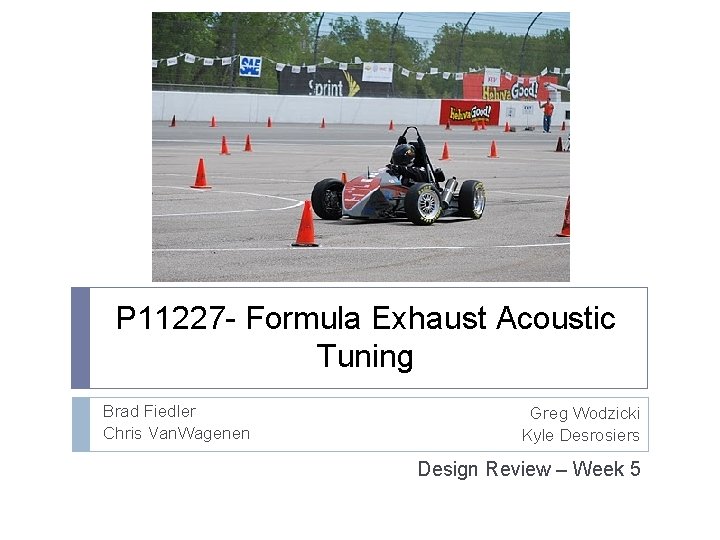
P 11227 - Formula Exhaust Acoustic Tuning Brad Fiedler Chris Van. Wagenen Greg Wodzicki Kyle Desrosiers Design Review – Week 5
Agenda � Introduction / Background � Problem Statement � Customer Needs � Engineering Specs � Understanding the Problem and Current Technology � Concept Review � Test Bench � Closing � Questions
Problem Statement � Formula SAE rules state exhaust noise volume must be lower than 110 d. B before allowing a team’s car to compete. Any vehicle that does not pass may be modified and retested until it passes. Current muffler design is glass pack, which is often repacked at competition to lower the noise level within spec. The purpose of this project is to provide the RIT Formula team with means to lower their exhaust noise consistently and more predictably. Introduction / Background
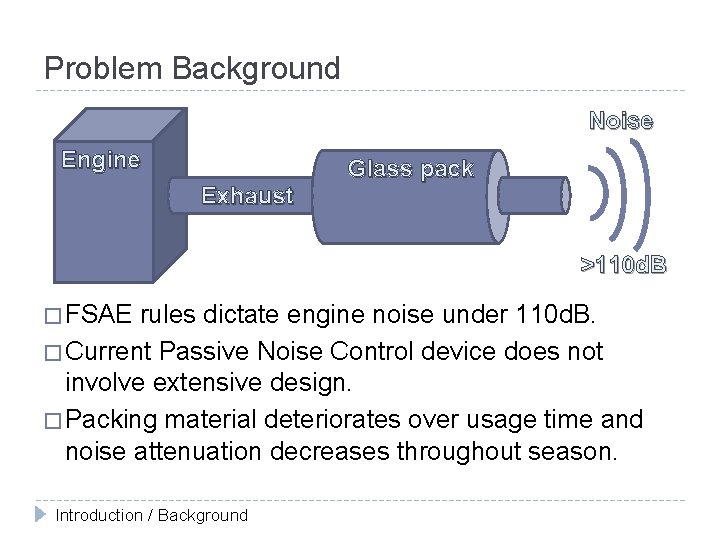
Problem Background Noise Engine Exhaust Glass pack >110 d. B � FSAE rules dictate engine noise under 110 d. B. � Current Passive Noise Control device does not involve extensive design. � Packing material deteriorates over usage time and noise attenuation decreases throughout season. Introduction / Background
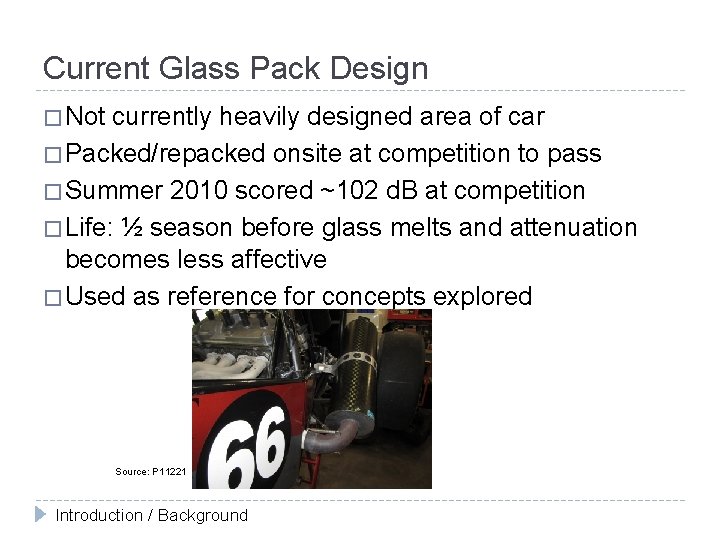
Current Glass Pack Design � Not currently heavily designed area of car � Packed/repacked onsite at competition to pass � Summer 2010 scored ~102 d. B at competition � Life: ½ season before glass melts and attenuation becomes less affective � Used as reference for concepts explored Source: P 11221 Introduction / Background
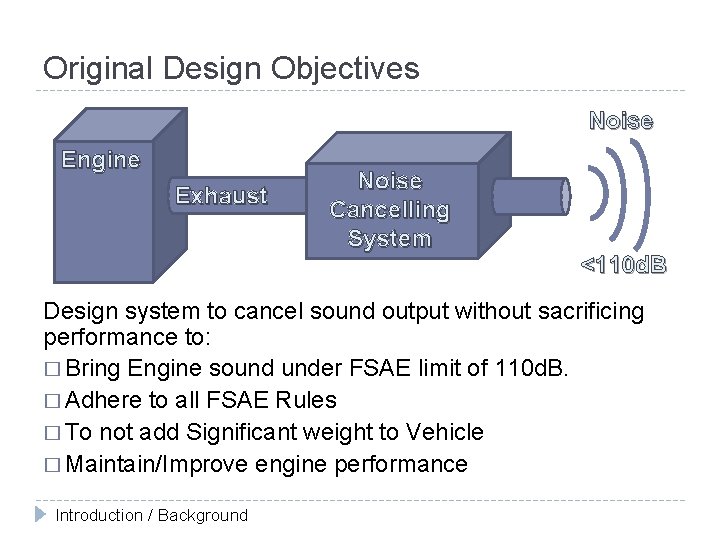
Original Design Objectives Noise Engine Exhaust Noise Cancelling System <110 d. B Design system to cancel sound output without sacrificing performance to: � Bring Engine sound under FSAE limit of 110 d. B. � Adhere to all FSAE Rules � To not add Significant weight to Vehicle � Maintain/Improve engine performance Introduction / Background
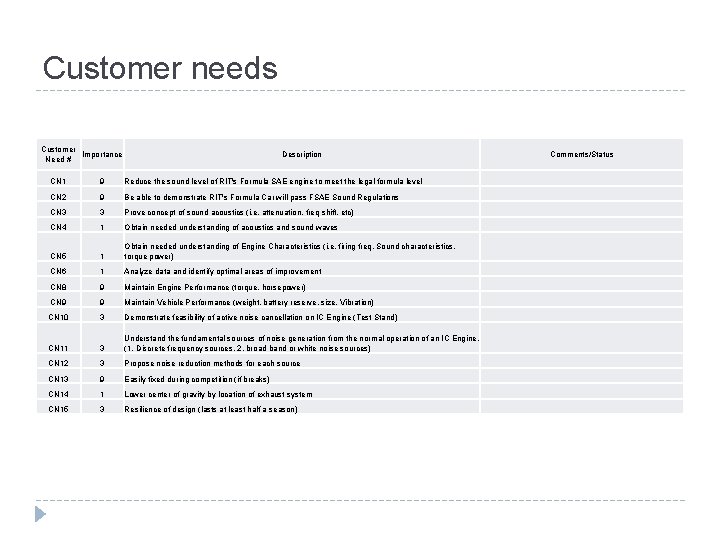
Customer needs Customer Importance Need # Description Comments/Status CN 1 9 Reduce the sound level of RIT's Formula SAE engine to meet the legal formula level CN 2 9 Be able to demonstrate RIT's Formula Car will pass FSAE Sound Regulations CN 3 3 Prove concept of sound acoustics (i. e. attenuation, freq shift, etc) CN 4 1 Obtain needed understanding of acoustics and sound waves CN 5 1 Obtain needed understanding of Engine Characteristics (i. e. firing freq, Sound characteristics, torque power) CN 6 1 Analyze data and identify optimal areas of improvement CN 8 9 Maintain Engine Performance (torque, horsepower) CN 9 9 Maintain Vehicle Performance (weight, battery reserve, size, Vibration) CN 10 3 Demonstrate feasibility of active noise cancellation on IC Engine (Test Stand) CN 11 3 Understand the fundamental sources of noise generation from the normal operation of an IC Engine. (1. Discrete frequency sources, 2. broad band or white noise sources) CN 12 3 Propose noise reduction methods for each source CN 13 9 Easily fixed during competition (if breaks) CN 14 1 Lower center of gravity by location of exhaust system CN 15 3 Resilience of design (lasts at least half a season)
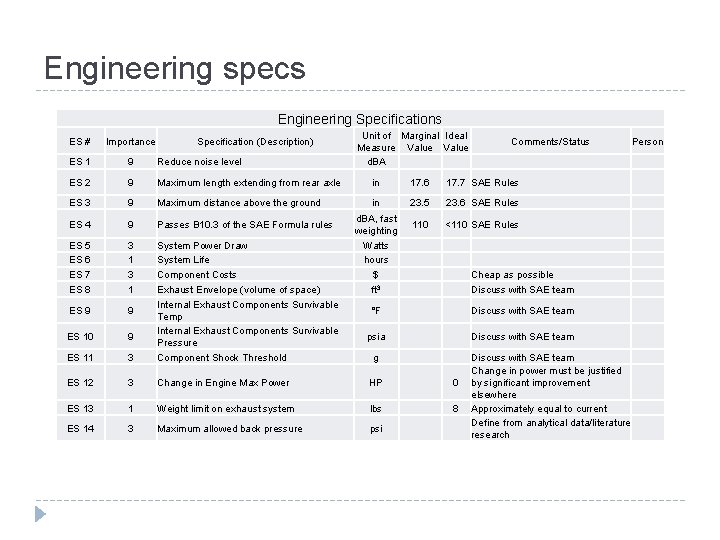
Engineering specs Engineering Specifications Specification (Description) Unit of Marginal Ideal Measure Value d. BA ES # Importance Comments/Status Person ES 1 9 Reduce noise level ES 2 9 Maximum length extending from rear axle in 17. 6 17. 7 SAE Rules ES 3 9 Maximum distance above the ground in 23. 5 23. 6 SAE Rules ES 4 9 Passes B 10. 3 of the SAE Formula rules d. BA, fast weighting 110 <110 SAE Rules ES 5 ES 6 ES 7 ES 8 3 1 System Power Draw System Life Component Costs Exhaust Envelope (volume of space) Watts hours $ ft 3 Cheap as possible Discuss with SAE team ES 9 9 °F Discuss with SAE team ES 10 9 psia Discuss with SAE team ES 11 3 Internal Exhaust Components Survivable Temp Internal Exhaust Components Survivable Pressure Component Shock Threshold g ES 12 3 Change in Engine Max Power HP 0 ES 13 1 Weight limit on exhaust system lbs 8 ES 14 3 Maximum allowed back pressure psi Discuss with SAE team Change in power must be justified by significant improvement elsewhere Approximately equal to current Define from analytical data/literature research
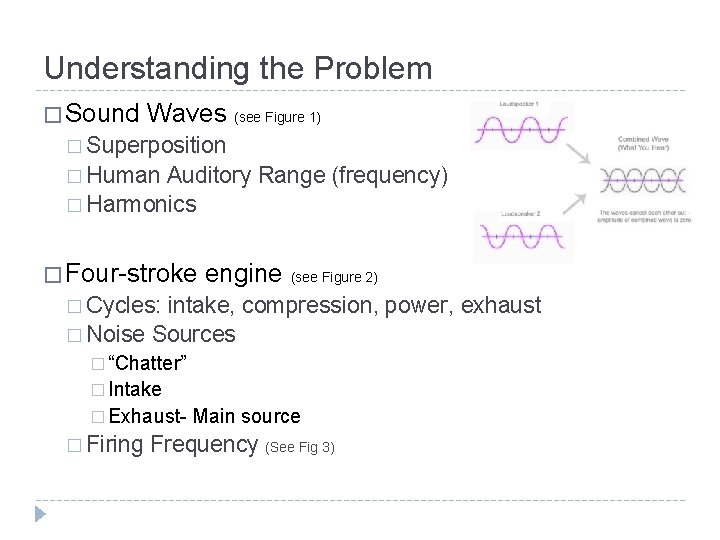
Understanding the Problem � Sound Waves (see Figure 1) � Superposition � Human Auditory Range (frequency) � Harmonics � Four-stroke engine (see Figure 2) � Cycles: intake, compression, power, exhaust � Noise Sources � “Chatter” � Intake � Exhaust- Main source � Firing Frequency (See Fig 3)
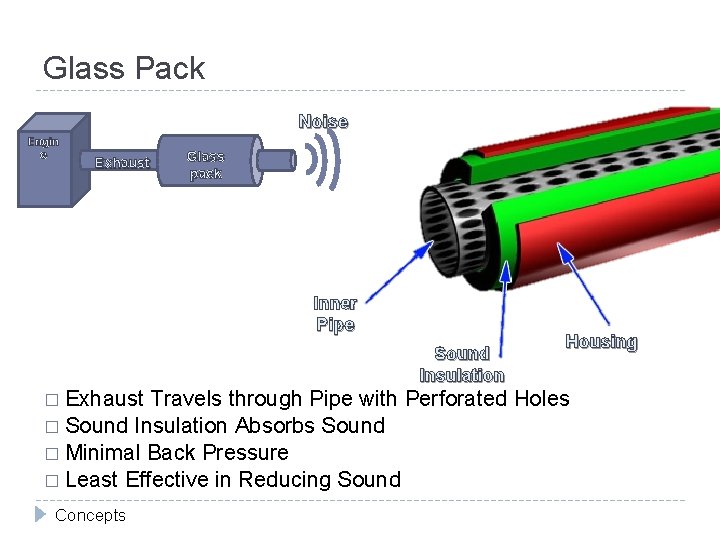
Glass Pack Noise Engin e Exhaust Glass pack Inner Pipe Sound Insulation Housing � Exhaust Travels through Pipe with Perforated Holes � Sound Insulation Absorbs Sound � Minimal Back Pressure � Least Effective in Reducing Sound Concepts
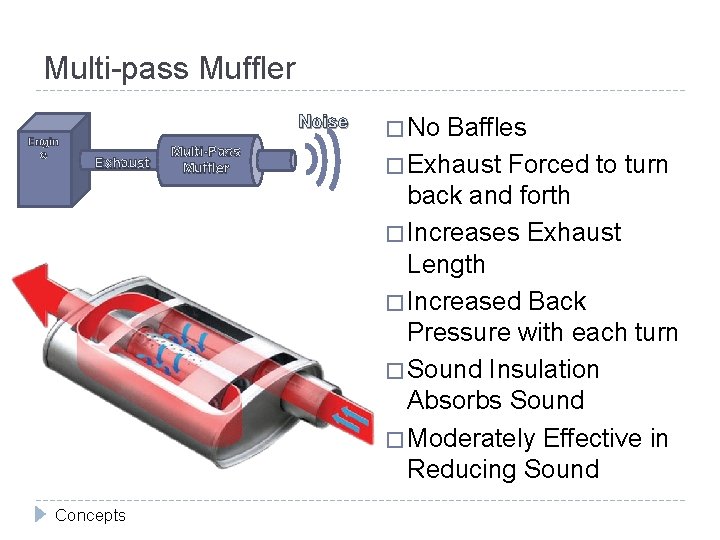
Multi-pass Muffler Noise Engin e Exhaust Multi-Pass Muffler � No Baffles � Exhaust Forced to turn back and forth � Increases Exhaust Length � Increased Back Pressure with each turn � Sound Insulation Absorbs Sound � Moderately Effective in Reducing Sound Concepts
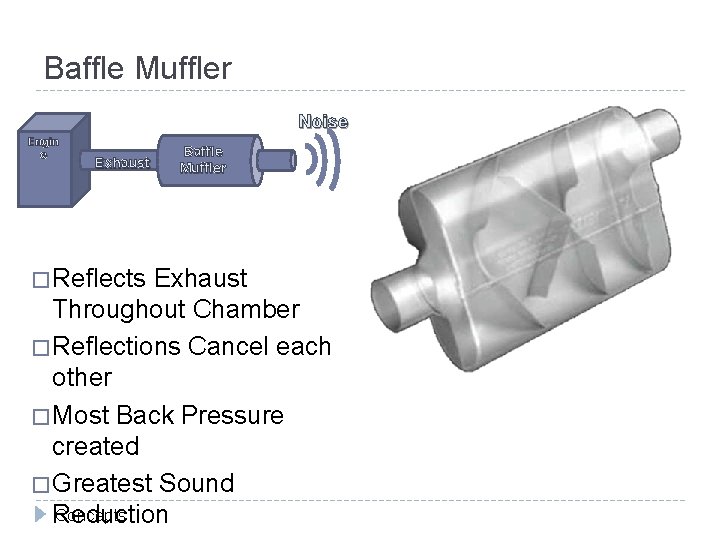
Baffle Muffler Noise Engin e Exhaust Baffle Muffler � Reflects Exhaust Throughout Chamber � Reflections Cancel each other � Most Back Pressure created � Greatest Sound Concepts Reduction
Elimination of Baffle and Multi-Pass Pros: � Multi-pass provides better attenuation than glass pack. � Baffle (chamber style) muffler provides even better attenuation than multi-pass. Cons: � Multi-pass increases exhaust back pressure � Baffle style will cause the most back pressure of all the design concepts. Baffle and multi-pass are quieter, but increase backpressure. It has already been seen that Glass Pack can achieve FSAE limit with lower backpressure Concepts
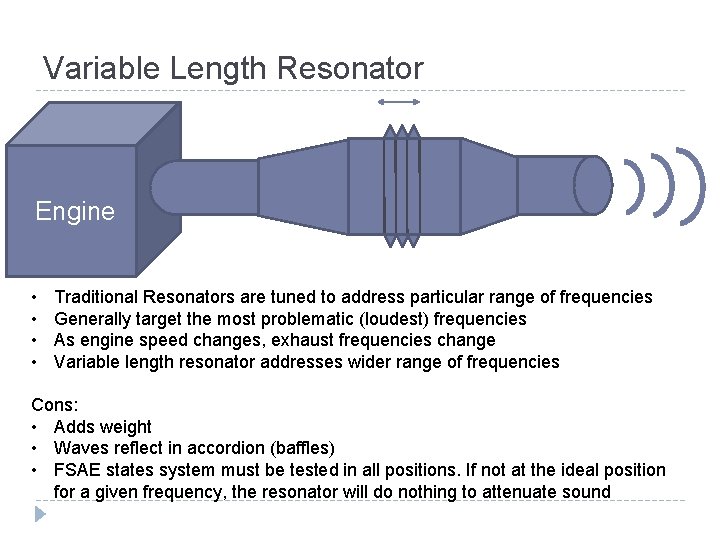
Variable Length Resonator � Engine • • Traditional Resonators are tuned to address particular range of frequencies Generally target the most problematic (loudest) frequencies As engine speed changes, exhaust frequencies change Variable length resonator addresses wider range of frequencies Cons: • Adds weight • Waves reflect in accordion (baffles) • FSAE states system must be tested in all positions. If not at the ideal position for a given frequency, the resonator will do nothing to attenuate sound
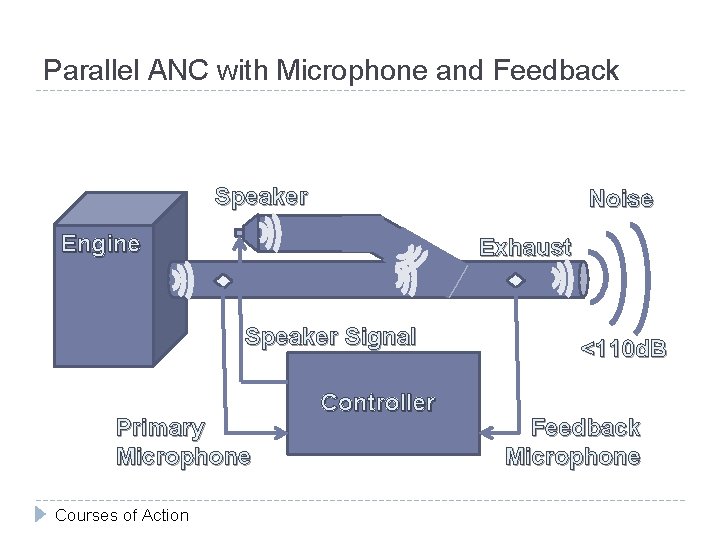
Parallel ANC with Microphone and Feedback Speaker Noise Engine Exhaust Speaker Signal Primary Microphone Courses of Action Controller <110 d. B Feedback Microphone
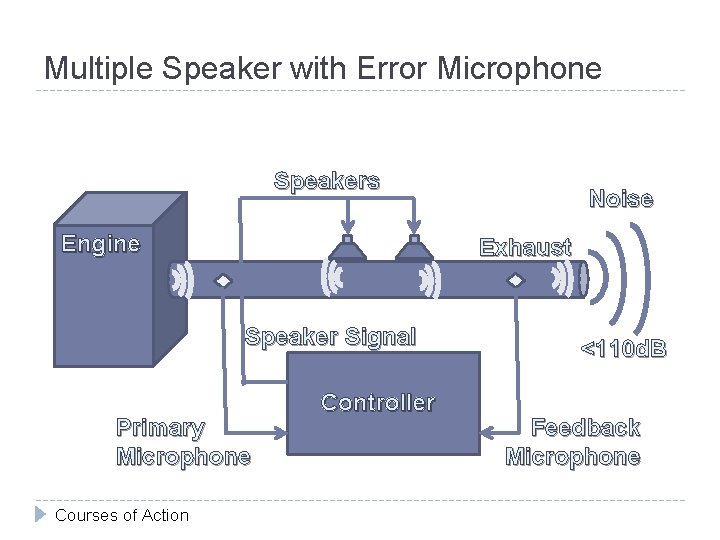
Multiple Speaker with Error Microphone Speakers Engine Exhaust Speaker Signal Primary Microphone Courses of Action Noise Controller <110 d. B Feedback Microphone
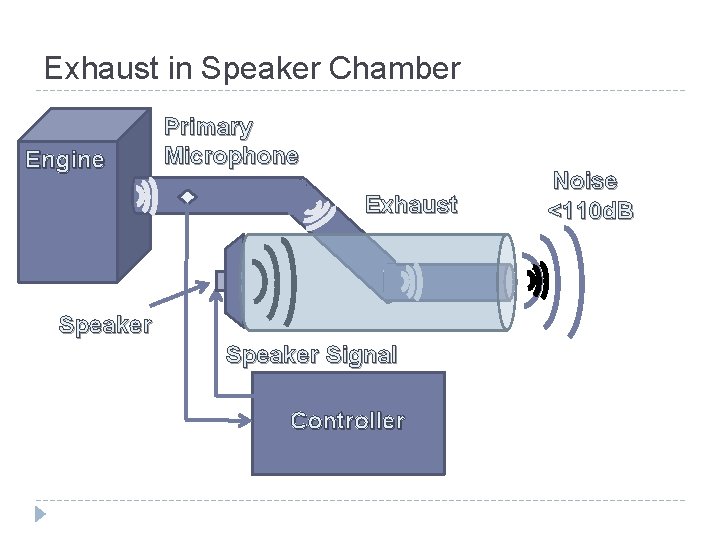
Exhaust in Speaker Chamber Engine Primary Microphone Exhaust Speaker Signal Controller Noise <110 d. B
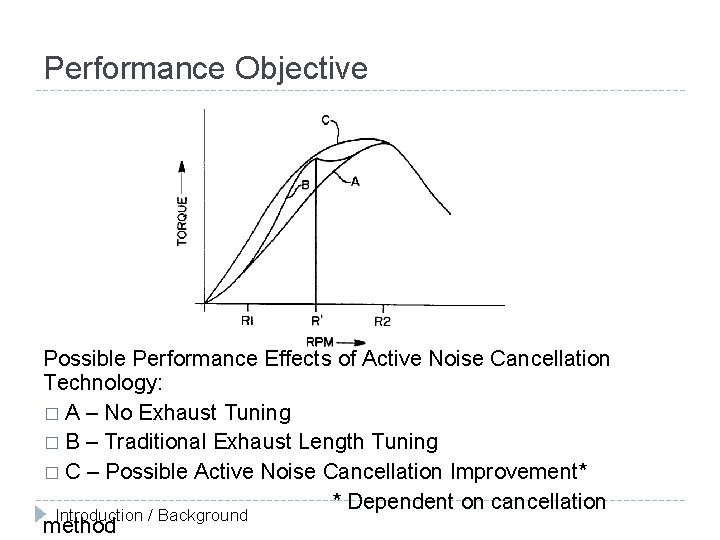
Performance Objective Possible Performance Effects of Active Noise Cancellation Technology: � A – No Exhaust Tuning � B – Traditional Exhaust Length Tuning � C – Possible Active Noise Cancellation Improvement* * Dependent on cancellation Introduction / Background method
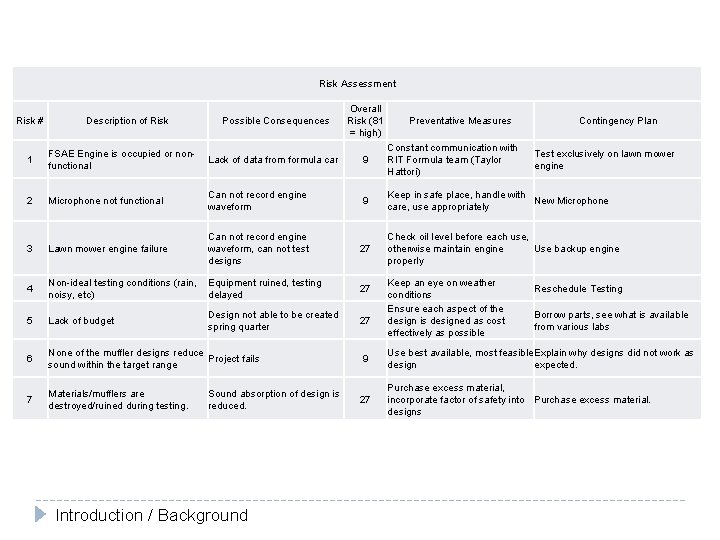
Risk Assessment Risk # Description of Risk Possible Consequences Overall Risk (81 = high) Preventative Measures Contingency Plan 1 FSAE Engine is occupied or nonfunctional Lack of data from formula car 9 Constant communication with RIT Formula team (Taylor Hattori) 2 Microphone not functional Can not record engine waveform 9 Keep in safe place, handle with New Microphone care, use appropriately 3 Lawn mower engine failure Can not record engine waveform, can not test designs 27 Check oil level before each use, otherwise maintain engine Use backup engine properly 4 Non-ideal testing conditions (rain, Equipment ruined, testing noisy, etc) delayed 5 Lack of budget 6 None of the muffler designs reduce Project fails sound within the target range 9 Use best available, most feasible Explain why designs did not work as design expected. 7 Materials/mufflers are destroyed/ruined during testing. 27 Purchase excess material, incorporate factor of safety into Purchase excess material. designs Design not able to be created spring quarter Sound absorption of design is reduced. Introduction / Background 27 27 Keep an eye on weather conditions Ensure each aspect of the design is designed as cost effectively as possible Test exclusively on lawn mower engine Reschedule Testing Borrow parts, see what is available from various labs
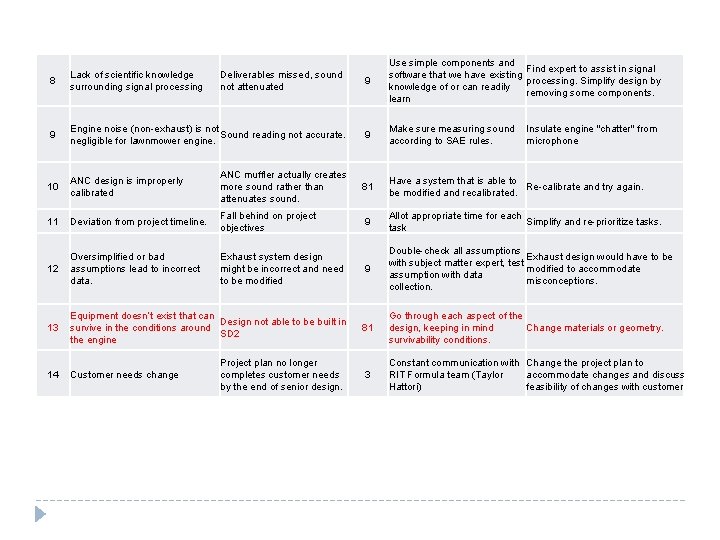
8 Lack of scientific knowledge surrounding signal processing Deliverables missed, sound not attenuated 9 Use simple components and Find expert to assist in signal software that we have existing processing. Simplify design by knowledge of or can readily removing some components. learn 9 Engine noise (non-exhaust) is not Sound reading not accurate. negligible for lawnmower engine. 9 Make sure measuring sound Insulate engine "chatter" from according to SAE rules. microphone 10 ANC design is improperly calibrated ANC muffler actually creates more sound rather than attenuates sound. 81 Have a system that is able to Re-calibrate and try again. be modified and recalibrated. 11 Deviation from project timeline. Fall behind on project objectives 9 Allot appropriate time for each Simplify and re-prioritize tasks. task 12 Oversimplified or bad assumptions lead to incorrect data. Exhaust system design might be incorrect and need to be modified 9 Double-check all assumptions Exhaust design would have to be with subject matter expert, test modified to accommodate assumption with data misconceptions. collection. 13 Equipment doesn’t exist that can Design not able to be built in survive in the conditions around SD 2 the engine 81 Go through each aspect of the design, keeping in mind Change materials or geometry. survivability conditions. 14 Customer needs change 3 Constant communication with Change the project plan to RIT Formula team (Taylor accommodate changes and discuss Hattori) feasibility of changes with customer Project plan no longer completes customer needs by the end of senior design.
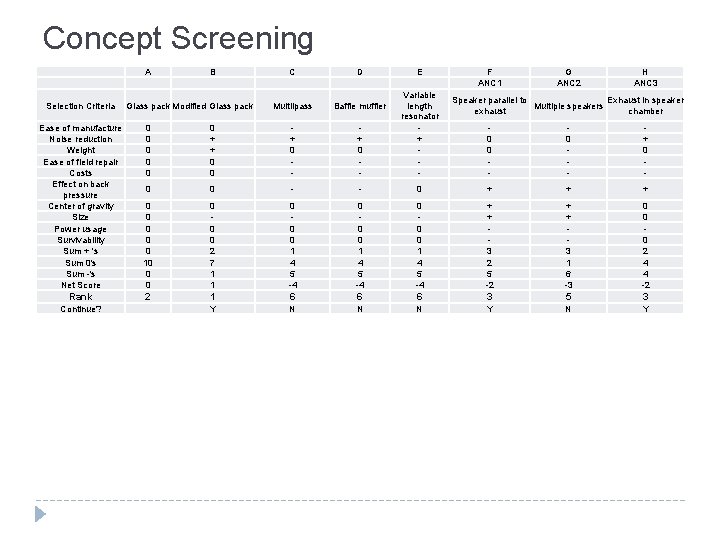
Concept Screening Selection Criteria A B 0 0 0 + + 0 0 + 0 - E Variable length resonator + - 0 0 - - 0 0 0 10 0 0 2 7 1 1 0 0 0 1 4 5 -4 Glass pack Modified Glass pack C D Multlipass Baffle muffler F ANC 1 G ANC 2 H ANC 3 Speaker parallel to Exhaust in speaker Multiple speakers exhaust chamber Ease of manufacture Noise reduction Weight Ease of field repair Costs Effect on back pressure Center of gravity Size Power usage Survivability Sum + 's Sum 0's Sum -'s Net Score 0 0 - + 0 - 0 + + + 0 0 0 1 4 5 -4 + + 3 2 5 -2 + + 3 1 6 -3 0 0 0 2 4 4 -2 Rank 2 1 6 6 6 3 5 3 Continue? Y N N N Y
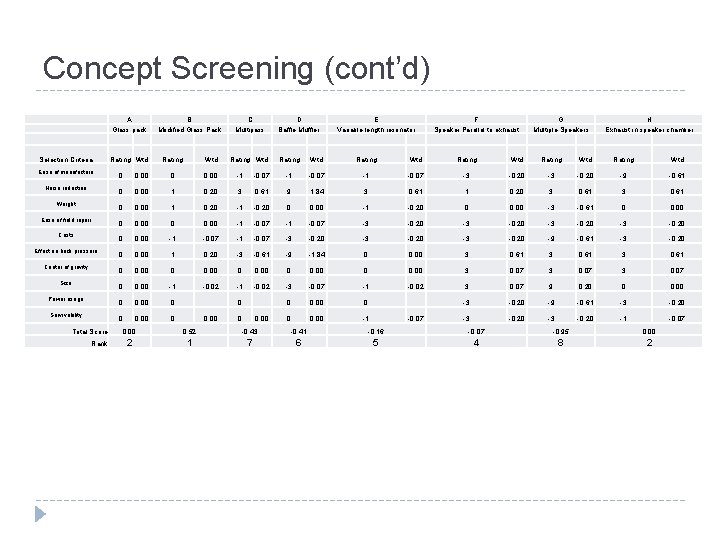
Concept Screening (cont’d) A Glass pack Selection Criteria Ease of manufacture Noise reduction Weight Ease of field repair Costs Effect on back pressure Center of gravity Size Power usage Survivability Rating Wtd Rank Rating Wtd C Multipass Rating Wtd D Baffle Muffler E Variable length resonator F Speaker Parallel to exhaust G Multiple Speakers H Exhaust in speaker chamber Rating Wtd Rating Wtd 0 0. 00 -1 -0. 07 -3 -0. 20 -9 -0. 61 0 0. 00 1 0. 20 3 0. 61 9 1. 84 3 0. 61 1 0. 20 3 0. 61 0 0. 00 1 0. 20 -1 -0. 20 0 0. 00 -3 -0. 61 0 0. 00 -1 -0. 07 -3 -0. 20 0 0. 00 -1 -0. 07 -3 -0. 20 -9 -0. 61 -3 -0. 20 0 0. 00 1 0. 20 -3 -0. 61 -9 -1. 84 0 0. 00 3 0. 61 0 0. 00 3 0. 07 0 0. 00 -1 -0. 02 -3 -0. 07 -1 -0. 02 3 0. 07 9 0. 20 0 0. 00 0 -3 -0. 20 -9 -0. 61 -3 -0. 20 0. 00 -1 -0. 07 -3 -0. 20 -1 0 Total Score B Modified Glass Pack -0. 07 0. 00 0. 52 -0. 43 -0. 41 -0. 16 -0. 07 -0. 95 0. 00 2 1 7 6 5 4 8 2
Proposed Design Objective � Test Bench that can be used as a tool by the formula team to facilitate muffler design and evaluate possible solutions prior to competition � Characteristics to be analyzed may include: Pressure drop across muffler � Flow rate (volumetric, mass flow rate) � Sound level output � Waveform data � Test Bench
- Slides: 23