
P 10041 Managerial Review MSD 2 Primary Objectives
P 10041 Managerial Review
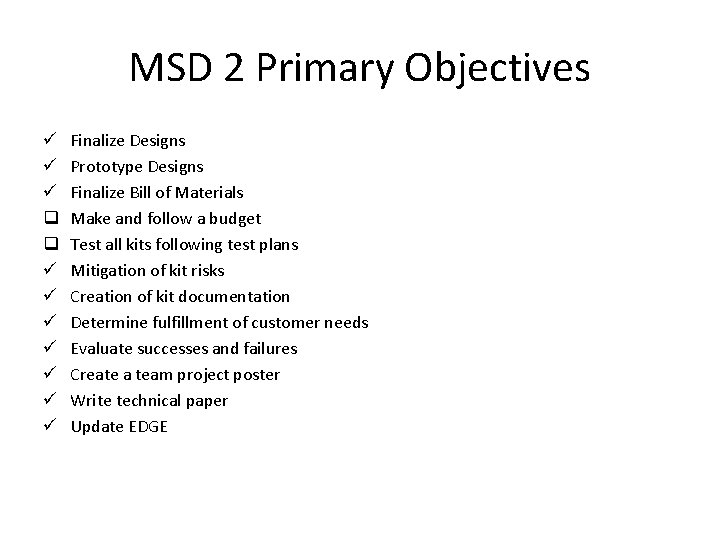
MSD 2 Primary Objectives ü ü ü q q ü ü ü ü Finalize Designs Prototype Designs Finalize Bill of Materials Make and follow a budget Test all kits following test plans Mitigation of kit risks Creation of kit documentation Determine fulfillment of customer needs Evaluate successes and failures Create a team project poster Write technical paper Update EDGE
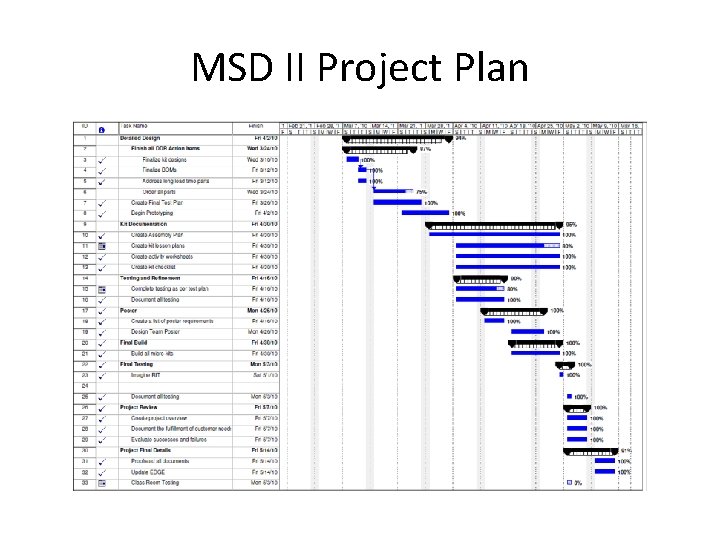
MSD II Project Plan
Project Plan Evaluation • • All MSD 1 action items closed (finalize kit designs, BOMs, test plans) Last minute design changes caused some parts to be ordered late Prototyping successfully completed on time Kit documentation still in development – Some lesson plans in progress, some assembly plans need refinement • • Testing not completed fully due to failure to attain access to classroom All completed testing has been documented Poster and technical paper both completed on time EDGE continuously and fully updated
Causes • Most of these deviances result from the delay caused by being behind in MSD 1 – Needing to reconfigure activity hardware at the beginning of MSD 2 – Not enough time to build multiple kits – Kits weren’t finished with enough time to schedule classroom visitation
What we would do differently • Contact teachers regardless of kit completion so that it would be feasible to schedule an appointment for in-class testing • Try to interface more to work collectively on each kit, this was a challenge though due to the amount of work required for each kit and the limited time available due to our other full-time job (School). • Before ordering materials have a meeting to discuss ordering common parts for each kit.
Customer Needs Checklist Kits must operate safely in a classroom environment Kits must relate music and sound to engineering concepts and design Kits must be portable and durable Kits must be usable by groups of up to 30 students Quick set up and storage Kits must be well documented
Xylophone Kit Individual Project Status • Testing – Completed: d. B level, life expectancy, weight and dimension, turnover time – Not Completed: classroom implementation, time to familiarize v All completed testing is documented but needs to be updated to EDGE by Wednesday night • Kit Documentation – Completed: lesson plan, activity handouts, assembly plan, visit checklist – In Progress: creating pdfs of all documents • Hardware – Products for Science Industries is assembling and when completed I will be picking them up.
Xylophone Kit Individual Project Status • Personal responsibilities – Project organization (EDGE, templates) – Xylophone Kit • • Bar construction Base construction Kit documentation Kit testing – Starting the tech paper • Compared to the original project plan • I am behind schedule with the testing since it was not all completed • I am behind on completing all of the micro-kits since an outside company is assembling them
Xylophone kit Design Strong Points Design Weak Points • Highly Portable • No small parts that can go missing • Zero replenishment cost barring damages • Offers multiple test scenarios • Acrylic base looks professional and has more of a “wow” factor • Sounds produced were not designed to be harmonic in nature as focus was on material properties • Base material is more brittle and has a slightly higher possibility to break
Electronic Keyboard Kit Individual Project Status • Personal responsibilities – Help update project plan, and various group document templates – Electronic Keyboard Kit • Microcontroller Integration and Programming • Oscillator Testing • Filter Design • Amplifier Design • Synth Shield Design, Plan of Layout • MSD 1 Project Plan – Plan was too ambitious; I did not have enough time to finalize the kit design, plus it was requested that I change design • MSD 2 Project Plan – I am following the team MSD 2 plan, with my own testing requirements
Electronic Keyboard Kit Individual Project Status • Plan for MSD 2 – Finish up all MSD 1 action items – Follow project plan to complete all testing, building, and document writing • Test Plan Completed • What I would have done differently – Not wasted time on Analog design since it is not the industry standard anyway – Made a meeting agenda/action item template to maximize efficiency of the team’s time together
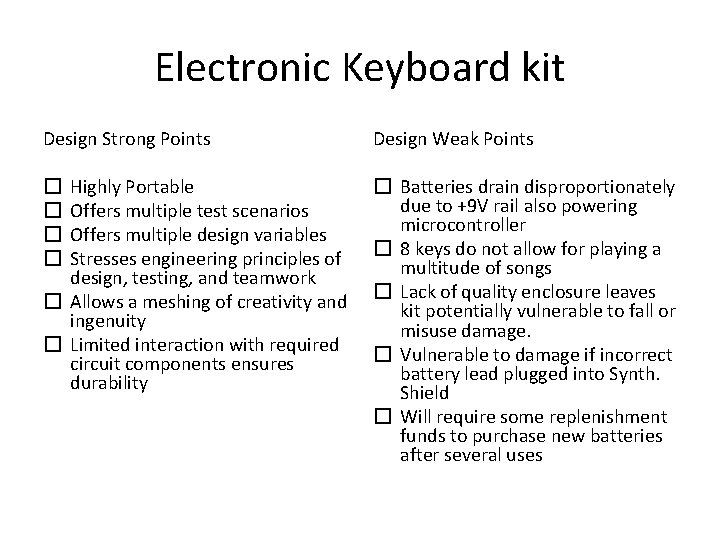
Electronic Keyboard kit Design Strong Points Design Weak Points Highly Portable Offers multiple test scenarios Offers multiple design variables Stresses engineering principles of design, testing, and teamwork � Allows a meshing of creativity and ingenuity � Limited interaction with required circuit components ensures durability � Batteries drain disproportionately due to +9 V rail also powering microcontroller � 8 keys do not allow for playing a multitude of songs � Lack of quality enclosure leaves kit potentially vulnerable to fall or misuse damage. � Vulnerable to damage if incorrect battery lead plugged into Synth. Shield � Will require some replenishment funds to purchase new batteries after several uses � �
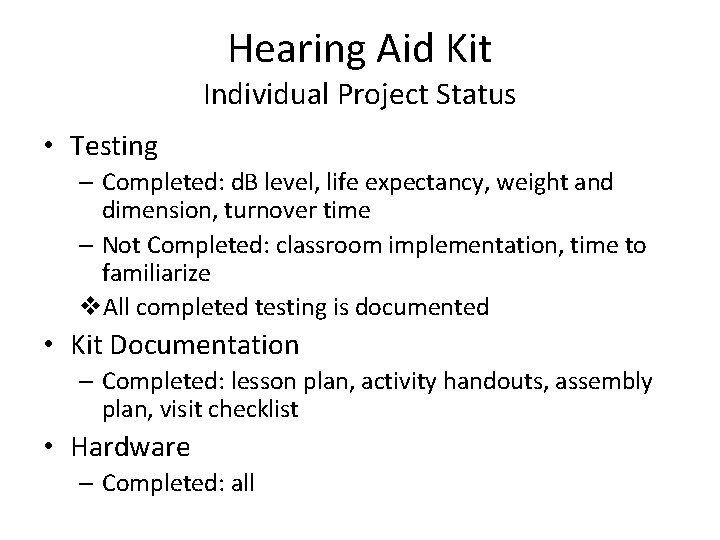
Hearing Aid Kit Individual Project Status • Testing – Completed: d. B level, life expectancy, weight and dimension, turnover time – Not Completed: classroom implementation, time to familiarize v. All completed testing is documented • Kit Documentation – Completed: lesson plan, activity handouts, assembly plan, visit checklist • Hardware – Completed: all
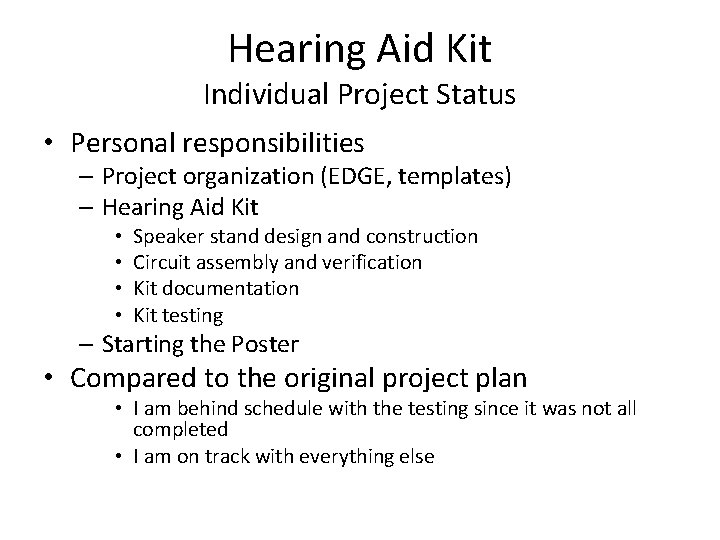
Hearing Aid Kit Individual Project Status • Personal responsibilities – Project organization (EDGE, templates) – Hearing Aid Kit • • Speaker stand design and construction Circuit assembly and verification Kit documentation Kit testing – Starting the Poster • Compared to the original project plan • I am behind schedule with the testing since it was not all completed • I am on track with everything else
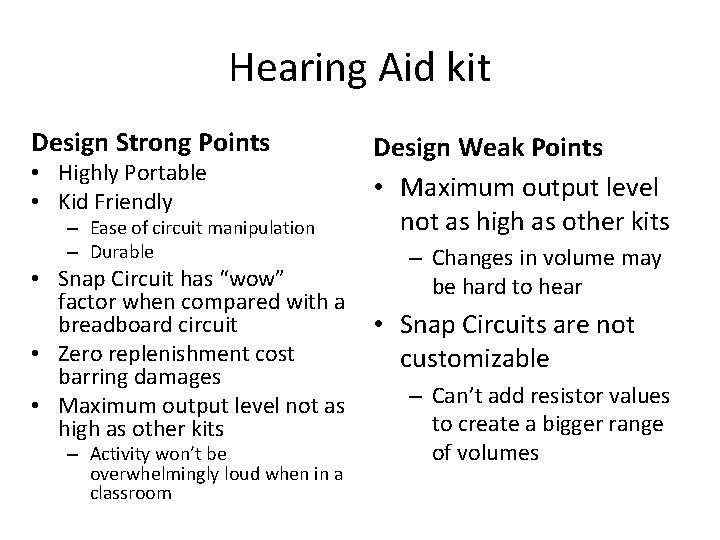
Hearing Aid kit Design Strong Points • Highly Portable • Kid Friendly – Ease of circuit manipulation – Durable • Snap Circuit has “wow” factor when compared with a breadboard circuit • Zero replenishment cost barring damages • Maximum output level not as high as other kits – Activity won’t be overwhelmingly loud when in a classroom Design Weak Points • Maximum output level not as high as other kits – Changes in volume may be hard to hear • Snap Circuits are not customizable – Can’t add resistor values to create a bigger range of volumes
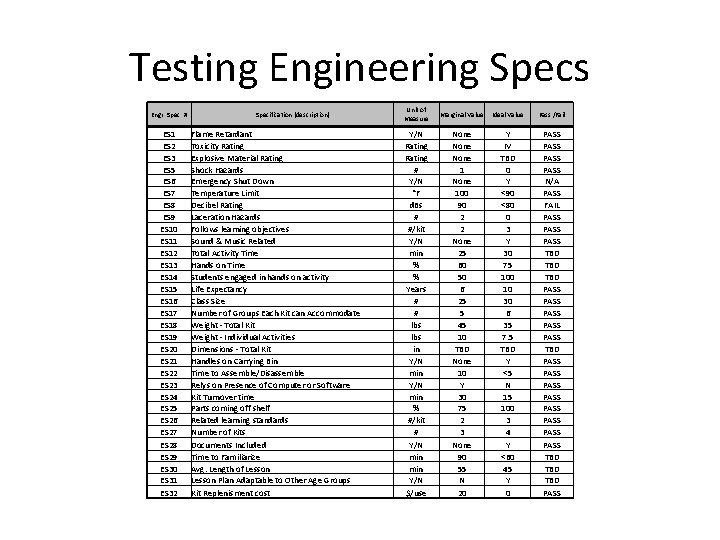
Testing Engineering Specs Engr. Spec. # ES 1 ES 2 ES 3 ES 5 ES 6 ES 7 ES 8 ES 9 ES 10 ES 11 ES 12 ES 13 ES 14 ES 15 ES 16 ES 17 ES 18 ES 19 ES 20 ES 21 ES 22 ES 23 ES 24 ES 25 ES 26 ES 27 ES 28 ES 29 ES 30 ES 31 ES 32 Specification (description) Flame Retardant Toxicity Rating Explosive Material Rating Shock Hazards Emergency Shut Down Temperature Limit Decibel Rating Laceration Hazards Follows learning objectives Sound & Music Related Total Activity Time Hands on Time Students engaged in hands on activity Life Expectancy Class Size Number of Groups Each Kit can Accommodate Weight - Total Kit Weight - Individual Activities Dimensions - Total Kit Handles on Carrying Bin Time to Assemble/Disassemble Relys on Presence of Computer or Software Kit Turnover time Parts coming off shelf Related learning standards Number of Kits Documents Included Time to Familiarize Avg. Length of Lesson Plan Adaptable to Other Age Groups Kit Replenisment cost Unit of Measure Marginal Value Ideal Value Pass /Fail Y/N Rating # Y/N °F d. Bs # #/kit Y/N min % % Years # # lbs in Y/N min % #/kit # Y/N min Y/N $/use None 100 90 2 2 None 25 60 50 6 25 5 45 10 TBD None 10 Y 30 75 2 3 None 90 55 N 20 Y IV TBD 0 Y <90 <80 0 3 Y 30 75 100 10 30 6 35 7. 5 TBD Y <5 N 15 100 3 4 Y <60 45 Y 0 PASS N/A PASS FAIL PASS TBD TBD PASS PASS PASS PASS TBD TBD PASS
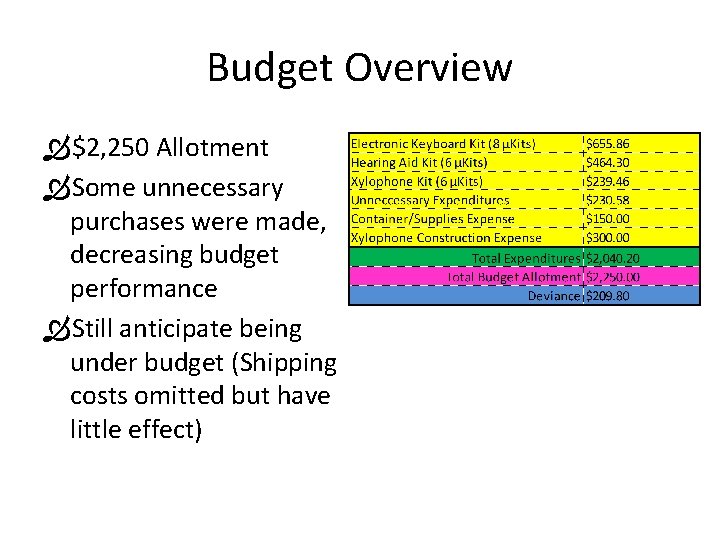
Budget Overview $2, 250 Allotment Some unnecessary purchases were made, decreasing budget performance Still anticipate being under budget (Shipping costs omitted but have little effect)
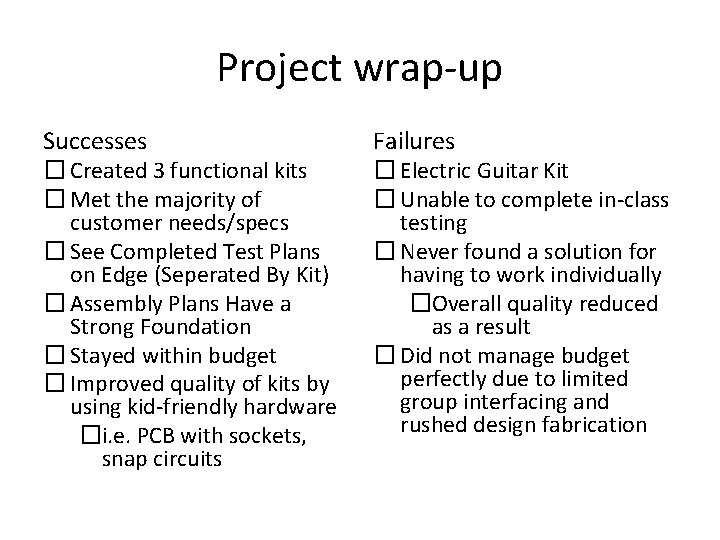
Project wrap-up Successes � Created 3 functional kits � Met the majority of customer needs/specs � See Completed Test Plans on Edge (Seperated By Kit) � Assembly Plans Have a Strong Foundation � Stayed within budget � Improved quality of kits by using kid-friendly hardware �i. e. PCB with sockets, snap circuits Failures � Electric Guitar Kit � Unable to complete in-class testing � Never found a solution for having to work individually �Overall quality reduced as a result � Did not manage budget perfectly due to limited group interfacing and rushed design fabrication
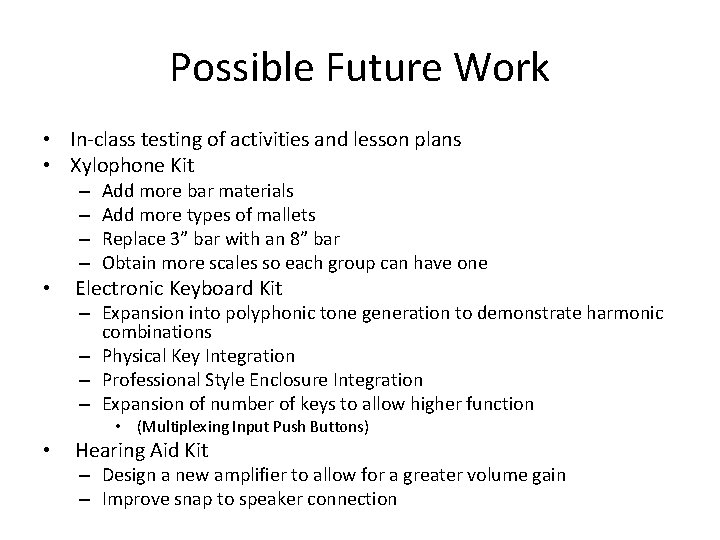
Possible Future Work • In-class testing of activities and lesson plans • Xylophone Kit – – • Add more bar materials Add more types of mallets Replace 3” bar with an 8” bar Obtain more scales so each group can have one Electronic Keyboard Kit – Expansion into polyphonic tone generation to demonstrate harmonic combinations – Physical Key Integration – Professional Style Enclosure Integration – Expansion of number of keys to allow higher function • (Multiplexing Input Push Buttons) • Hearing Aid Kit – Design a new amplifier to allow for a greater volume gain – Improve snap to speaker connection
Lessons Learned • Document everything • Have a realistic project plan and stick to it • Working together is a lot more productive and beneficial than working separately • Sometimes the most familiar method is not the best method, thus it is intelligent to perform thorough concept generation
- Slides: 21