
P 1 Describe the Structure Function of the
P 1 – Describe the Structure & Function of the Skeletal System Unit 1 – Principles of Anatomy & Physiology in Sport
The Skeletal System Consists of 206 bones Bones = living tissue, constantly adapting to stresses placed on them Split into Axial & Appendicular skeleton Has different types of bones Has a number of functions Bones meet together at joints
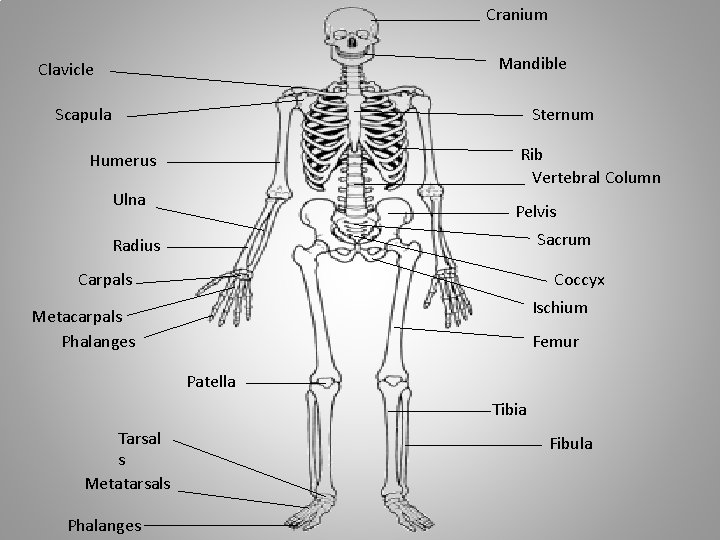
Cranium Mandible Clavicle Scapula Sternum Rib Vertebral Column Humerus Ulna Pelvis Sacrum Radius Carpals Coccyx Ischium Metacarpals Phalanges Femur Patella Tibia Tarsal s Metatarsals Phalanges Fibula
• Cranium – box like structure brain sits inside protects the brain made up of a number of different bones fuse together between 1 -3 yrs old • Mandible – jaw bone • Sternum – breast bone long, flat bone centre of chest
• Ribs – long, flat bones 12 pairs 1 st 7 pairs attached to sternum other 5 pairs called false ribs • Pelvis – made up of 2 sets of 3 bones Ilium – upper wing like bones, provides the sockets for the hip bones, upper edge = iliac crest Pubis – pubic bone, front of the pelvis Ischium – lower, posterior bones, sitting bones
• Clavicle – collar bone long, thin bone makes up the anterior (front) of the shoulder girdle is a strong, mobile attachment for arms • Scapula – large, triangle shape back (posterior) part of shoulder girdle • Humerus – long bone, upper arm proximal head = shoulder joint distal end = elbow joint
• Ulna – Forearm little finger side • Radius – forearm thumb side moves around ulna when turning hand • Carpals – 8 short bones wrist 2 rows of 4 • Metacarpals – 5 long bones palm of the hand run from the carpals to each finger & thumb
• Phalanges – small long bones fingers & toes 3 in each finger & toes 2 in each thumb & big toe • Femur – thigh bone longest & strongest top (proximal end) sits in socket of pelvis bottom (distal end) forms the knee joint • Patella – kneecap large, triangle shaped sesamoid bone sits inside the quadriceps tendon protects knee joint
• Tibia – shin bone medial, thicker bone proximal end = knee joint with femur distal end = ankle joint • Fibula – lateral, thinner bone non weight bearing distal end = ankle joint • Tarsals – 7 bones (ankle) • Metatarsals – 5 foot bones
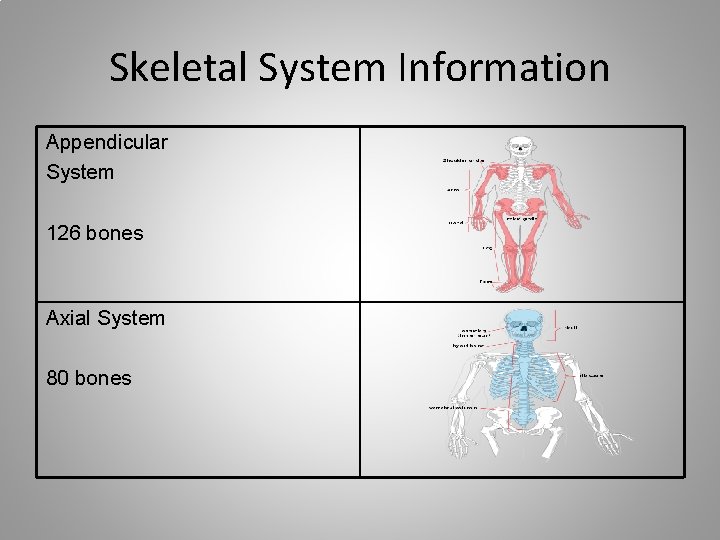
Skeletal System Information Appendicular System 126 bones Axial System 80 bones
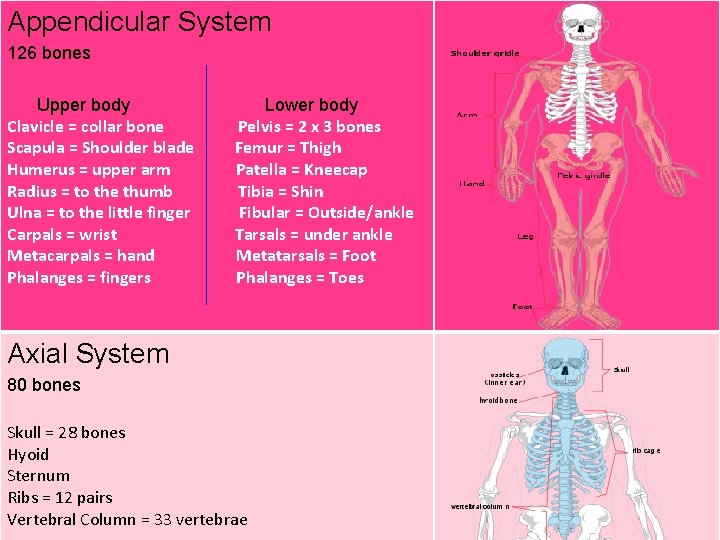
Appendicular System 126 bones Upper body Clavicle = collar bone Scapula = Shoulder blade Humerus = upper arm Radius = to the thumb Ulna = to the little finger Carpals = wrist Metacarpals = hand Phalanges = fingers Lower body Pelvis = 2 x 3 bones Femur = Thigh Patella = Kneecap Tibia = Shin Fibular = Outside/ankle Tarsals = under ankle Metatarsals = Foot Phalanges = Toes Axial System 80 bones Skull = 28 bones Hyoid Sternum Ribs = 12 pairs Vertebral Column = 33 vertebrae
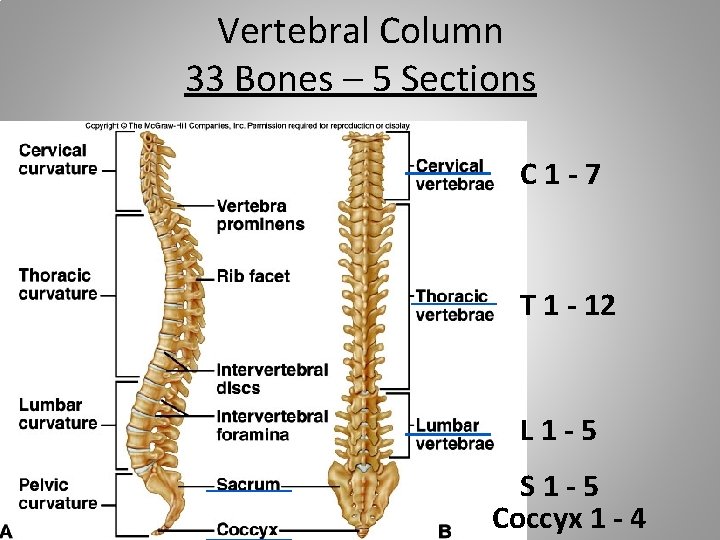
Vertebral Column 33 Bones – 5 Sections C 1 -7 T 1 - 12 L 1 -5 S 1 -5 Coccyx 1 - 4
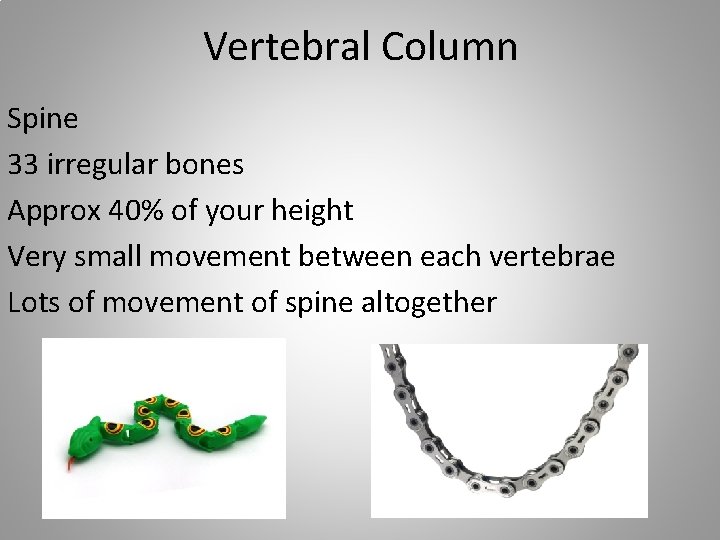
Vertebral Column Spine 33 irregular bones Approx 40% of your height Very small movement between each vertebrae Lots of movement of spine altogether
Bones Living tissue = • grow during childhood • Bleed & hurt if damaged • Able to repair if broken Ossification – a hardening process that takes place when bones mature. Makes bones solid structures that can withstand a lot of pressure/stresses. Collagen = resilience Calcium = strength
Types of Bones F. L. I. S. S. • F lat Protection Scapula, sternum, ribs, pelvis • L ong Movement Femur, humorus, tibia • I rregular Shape Vertebrae, facial bones • S hort Cube shaped Carpals, tarsals • S esamoid Inside a tendon Patella
- Slides: 15