
OZYMANDIAS Percy Shelley VOCAB5 Word Imperialis m Tyrant
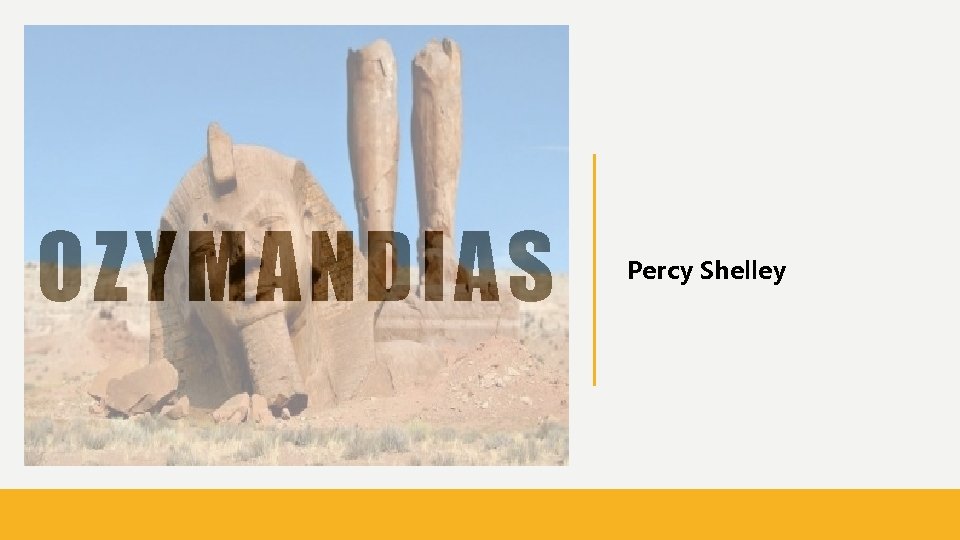
OZYMANDIAS Percy Shelley
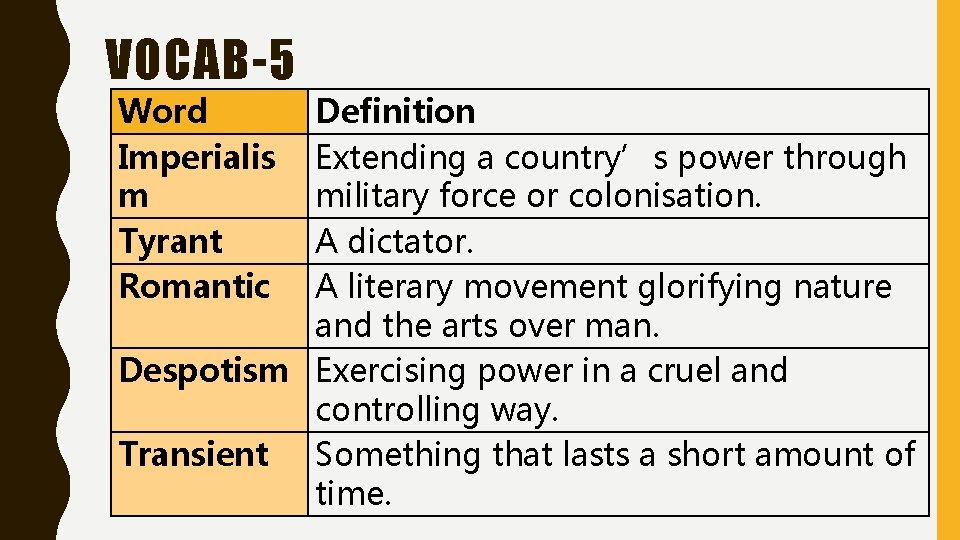
VOCAB-5 Word Imperialis m Tyrant Romantic Definition Extending a country’s power through military force or colonisation. A dictator. A literary movement glorifying nature and the arts over man. Despotism Exercising power in a cruel and controlling way. Transient Something that lasts a short amount of time.
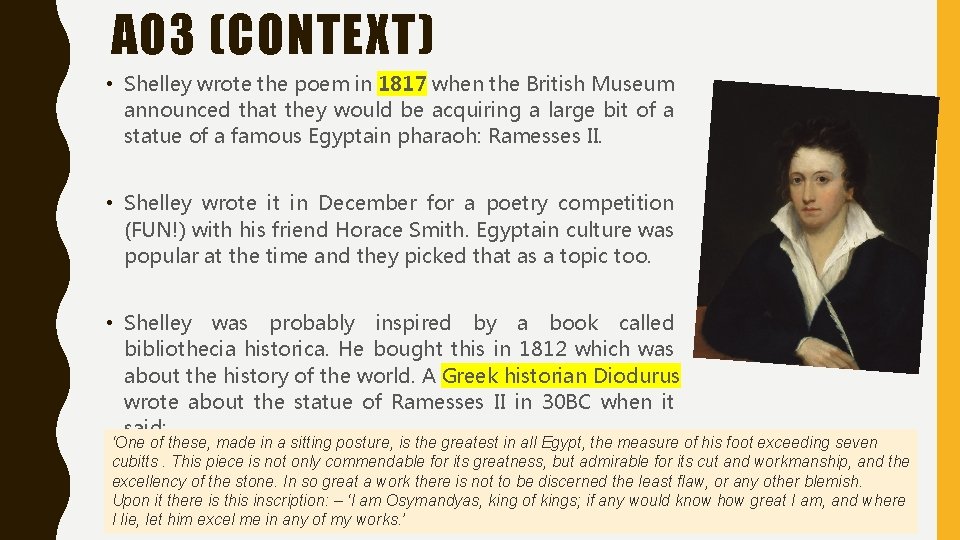
AO 3 (CONTEXT) • Shelley wrote the poem in 1817 when the British Museum announced that they would be acquiring a large bit of a statue of a famous Egyptain pharaoh: Ramesses II. • Shelley wrote it in December for a poetry competition (FUN!) with his friend Horace Smith. Egyptain culture was popular at the time and they picked that as a topic too. • Shelley was probably inspired by a book called bibliothecia historica. He bought this in 1812 which was about the history of the world. A Greek historian Diodurus wrote about the statue of Ramesses II in 30 BC when it said: ‘One of these, made in a sitting posture, is the greatest in all Egypt, the measure of his foot exceeding seven cubitts. This piece is not only commendable for its greatness, but admirable for its cut and workmanship, and the excellency of the stone. In so great a work there is not to be discerned the least flaw, or any other blemish. Upon it there is this inscription: – ‘I am Osymandyas, king of kings; if any would know how great I am, and where I lie, let him excel me in any of my works. ’
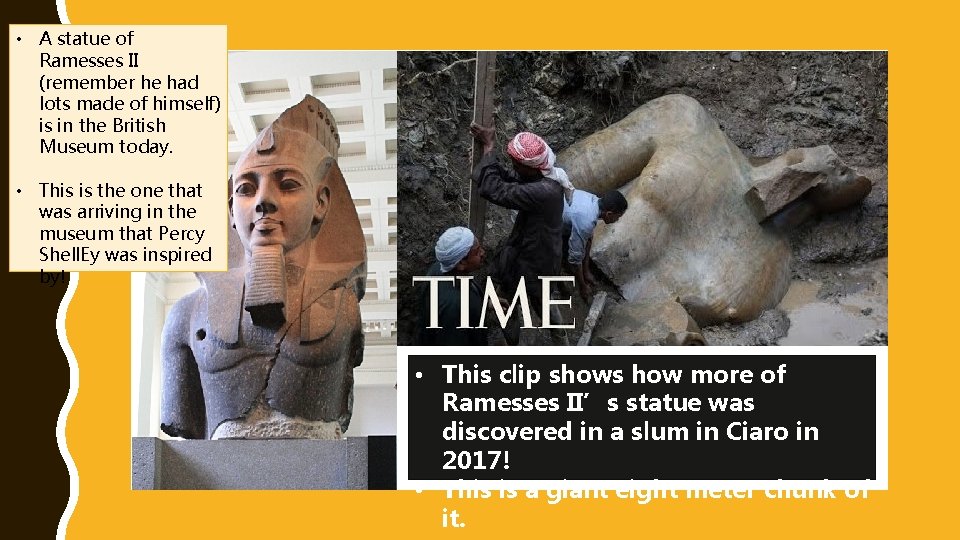
• A statue of Ramesses II (remember he had lots made of himself) is in the British Museum today. • This is the one that was arriving in the museum that Percy Shell. Ey was inspired by! • This clip shows how more of Ramesses II’s statue was discovered in a slum in Ciaro in 2017! • This is a giant eight meter chunk of it.
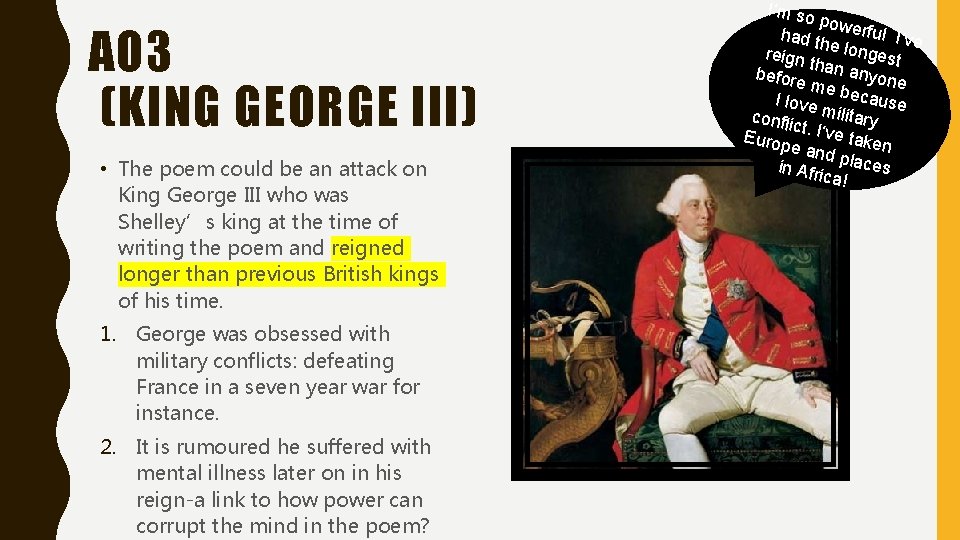
AO 3 (KING GEORGE III) • The poem could be an attack on King George III who was Shelley’s king at the time of writing the poem and reigned longer than previous British kings of his time. 1. George was obsessed with military conflicts: defeating France in a seven year war for instance. 2. It is rumoured he suffered with mental illness later on in his reign-a link to how power can corrupt the mind in the poem? I’m so pow had th erful I’ve reign e longest th before an anyon e me be cause I love m ilit confli ct. I’v ary et Europ e and aken in Afr places ica!
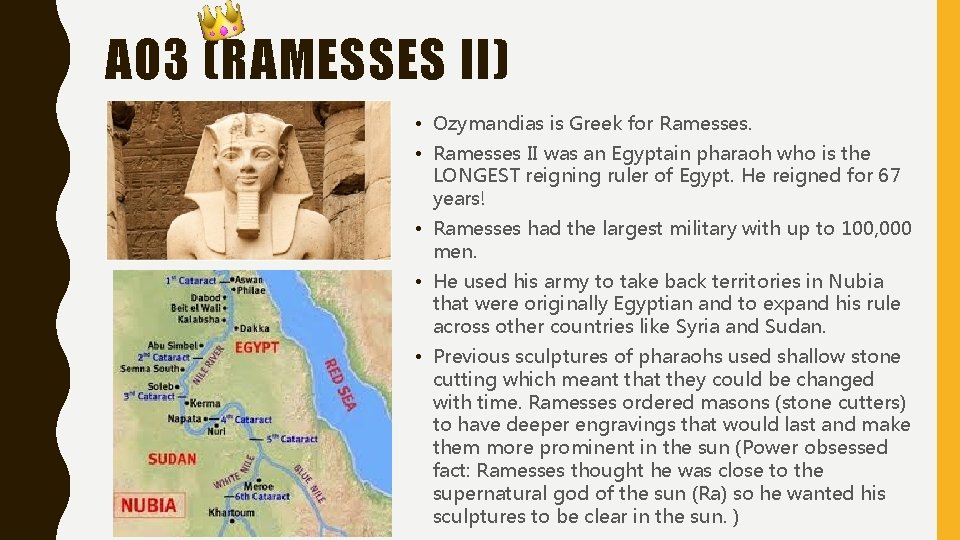
AO 3 (RAMESSES II) • Ozymandias is Greek for Ramesses. • Ramesses II was an Egyptain pharaoh who is the LONGEST reigning ruler of Egypt. He reigned for 67 years! • Ramesses had the largest military with up to 100, 000 men. • He used his army to take back territories in Nubia that were originally Egyptian and to expand his rule across other countries like Syria and Sudan. • Previous sculptures of pharaohs used shallow stone cutting which meant that they could be changed with time. Ramesses ordered masons (stone cutters) to have deeper engravings that would last and make them more prominent in the sun (Power obsessed fact: Ramesses thought he was close to the supernatural god of the sun (Ra) so he wanted his sculptures to be clear in the sun. )
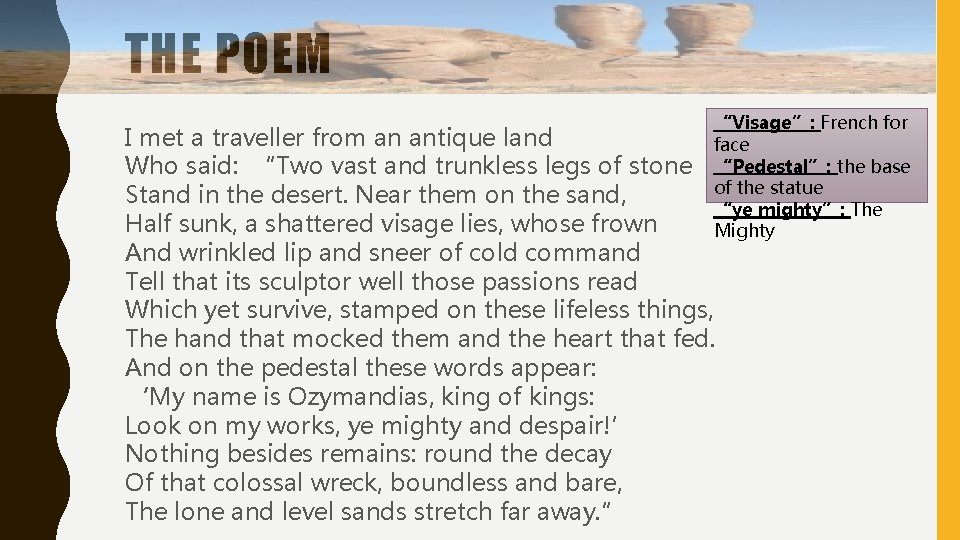
THE POEM “Visage”: French for face “Pedestal”: the base of the statue “ye mighty”: The Mighty I met a traveller from an antique land Who said: “Two vast and trunkless legs of stone Stand in the desert. Near them on the sand, Half sunk, a shattered visage lies, whose frown And wrinkled lip and sneer of cold command Tell that its sculptor well those passions read Which yet survive, stamped on these lifeless things, The hand that mocked them and the heart that fed. And on the pedestal these words appear: ‘My name is Ozymandias, king of kings: Look on my works, ye mighty and despair!’ Nothing besides remains: round the decay Of that colossal wreck, boundless and bare, The lone and level sands stretch far away. ”
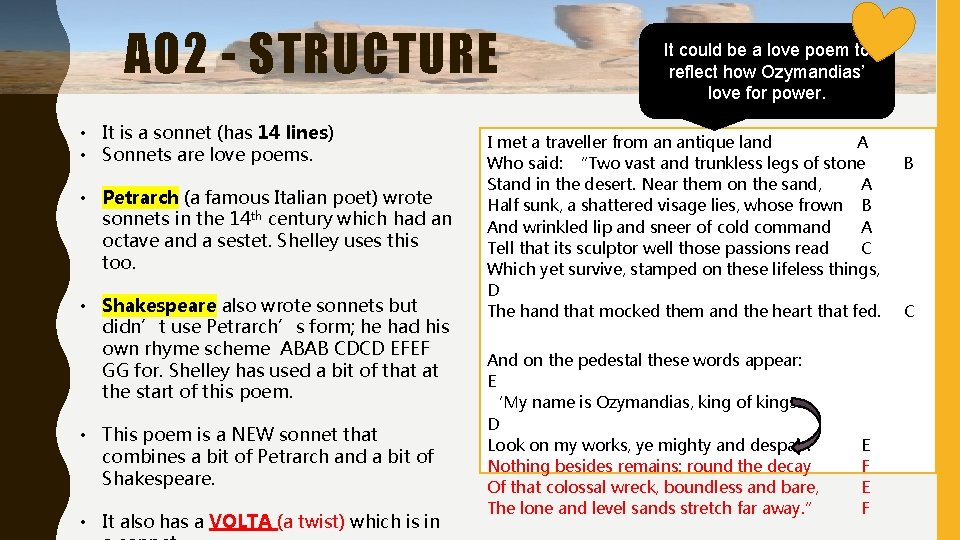
AO 2 - STRUCTURE • It is a sonnet (has 14 lines) • Sonnets are love poems. • Petrarch (a famous Italian poet) wrote sonnets in the 14 th century which had an octave and a sestet. Shelley uses this too. • Shakespeare also wrote sonnets but didn’t use Petrarch’s form; he had his own rhyme scheme ABAB CDCD EFEF GG for. Shelley has used a bit of that at the start of this poem. • This poem is a NEW sonnet that combines a bit of Petrarch and a bit of Shakespeare. • It also has a VOLTA (a twist) which is in It could be a love poem to reflect how Ozymandias’ love for power. I met a traveller from an antique land A Who said: “Two vast and trunkless legs of stone Stand in the desert. Near them on the sand, A Half sunk, a shattered visage lies, whose frown B And wrinkled lip and sneer of cold command A Tell that its sculptor well those passions read C Which yet survive, stamped on these lifeless things, D The hand that mocked them and the heart that fed. And on the pedestal these words appear: E ‘My name is Ozymandias, king of kings: D Look on my works, ye mighty and despair!’ Nothing besides remains: round the decay Of that colossal wreck, boundless and bare, The lone and level sands stretch far away. ” E F B C
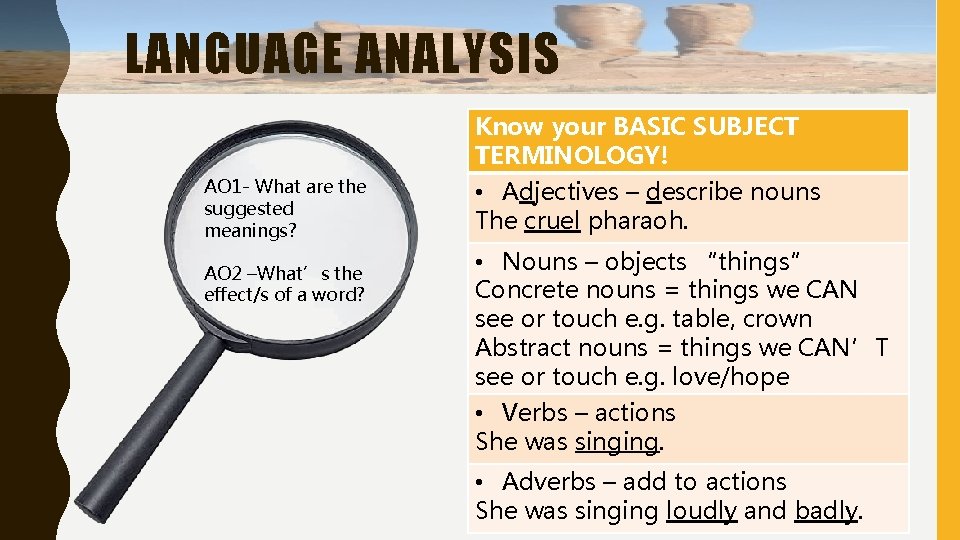
LANGUAGE ANALYSIS AO 1 - What are the suggested meanings? AO 2 –What’s the effect/s of a word? Know your BASIC SUBJECT TERMINOLOGY! • Adjectives – describe nouns The cruel pharaoh. • Nouns – objects “things” Concrete nouns = things we CAN see or touch e. g. table, crown Abstract nouns = things we CAN’T see or touch e. g. love/hope • Verbs – actions She was singing. • Adverbs – add to actions She was singing loudly and badly.
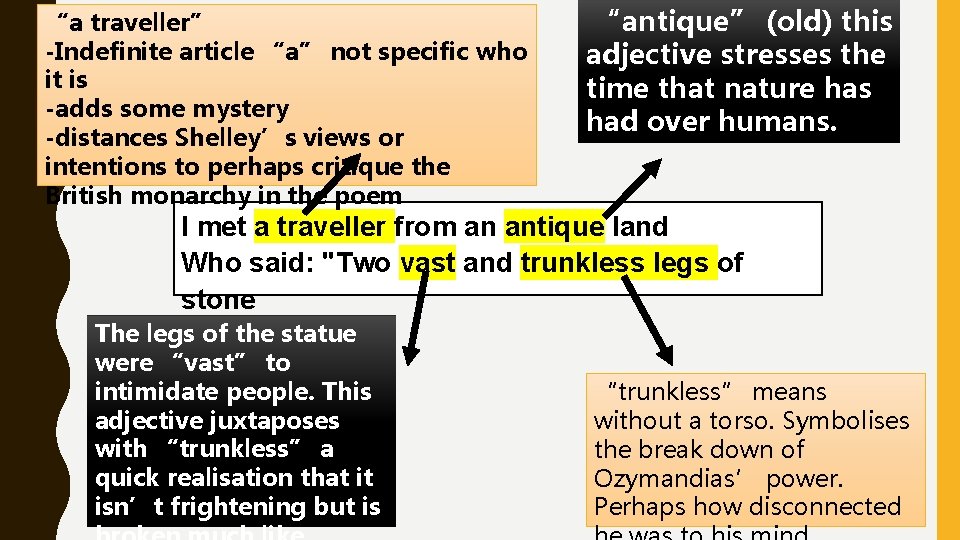
“a traveller” -Indefinite article “a” not specific who it is -adds some mystery -distances Shelley’s views or intentions to perhaps critique the British monarchy in the poem “antique” (old) this adjective stresses the time that nature has had over humans. I met a traveller from an antique land Who said: "Two vast and trunkless legs of stone The legs of the statue were “vast” to intimidate people. This adjective juxtaposes with “trunkless” a quick realisation that it isn’t frightening but is “trunkless” means without a torso. Symbolises the break down of Ozymandias’ power. Perhaps how disconnected
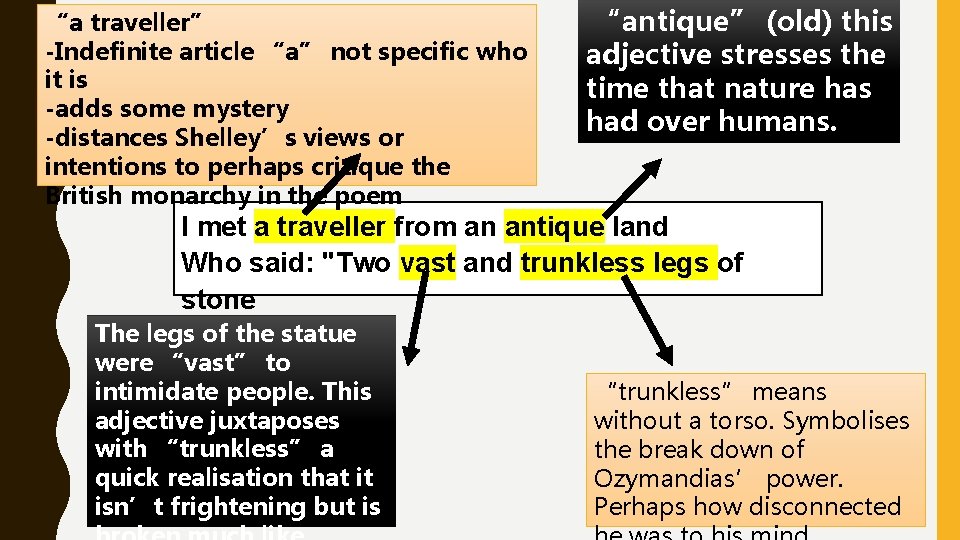
“a traveller” -Indefinite article “a” not specific who it is -adds some mystery -distances Shelley’s views or intentions to perhaps critique the British monarchy in the poem “antique” (old) this adjective stresses the time that nature has had over humans. I met a traveller from an antique land Who said: "Two vast and trunkless legs of stone The legs of the statue were “vast” to intimidate people. This adjective juxtaposes with “trunkless” a quick realisation that it isn’t frightening but is “trunkless” means without a torso. Symbolises the break down of Ozymandias’ power. Perhaps how disconnected
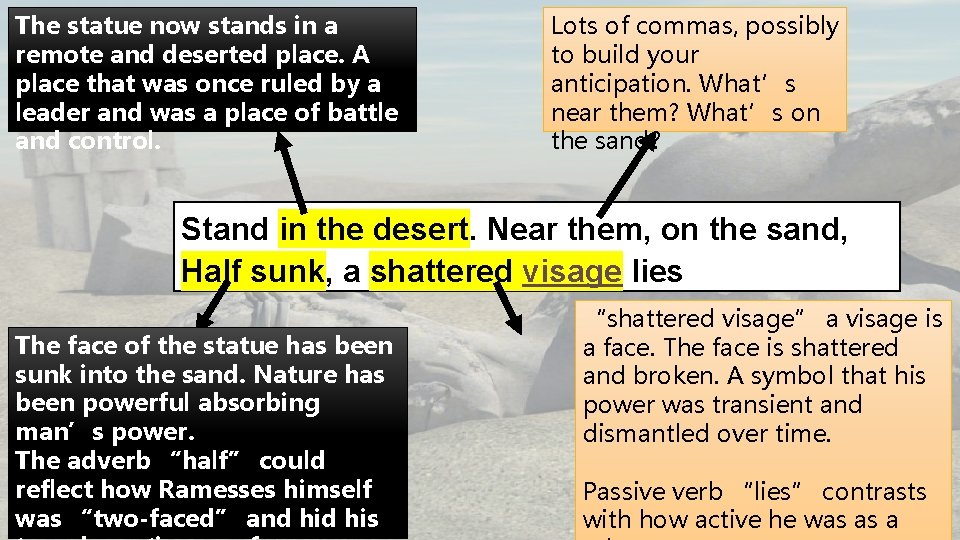
The statue now stands in a remote and deserted place. A place that was once ruled by a leader and was a place of battle and control. Lots of commas, possibly to build your anticipation. What’s near them? What’s on the sand? Stand in the desert. Near them, on the sand, Half sunk, a shattered visage lies The face of the statue has been sunk into the sand. Nature has been powerful absorbing man’s power. The adverb “half” could reflect how Ramesses himself was “two-faced” and his “shattered visage” a visage is a face. The face is shattered and broken. A symbol that his power was transient and dismantled over time. Passive verb “lies” contrasts with how active he was as a
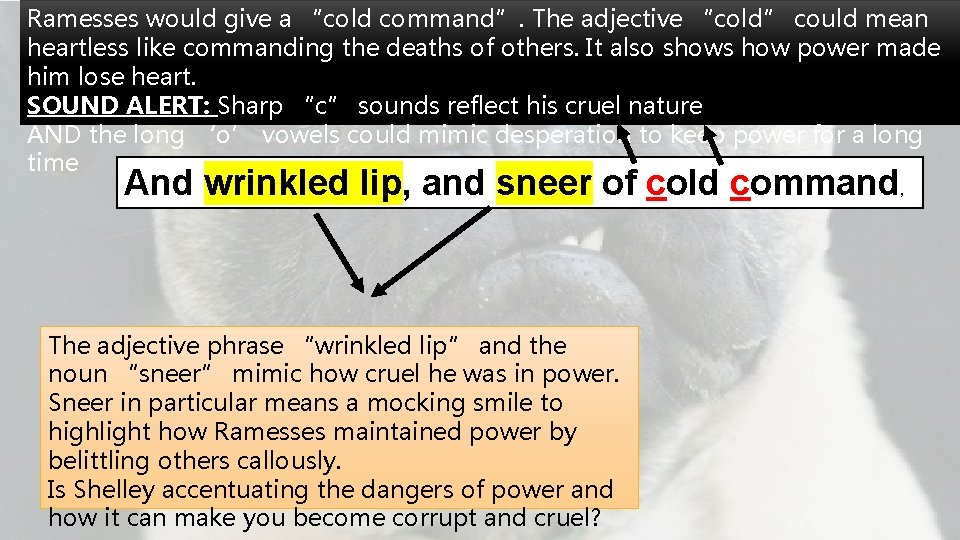
Ramesses would give a “cold command”. The adjective “cold” could mean heartless like commanding the deaths of others. It also shows how power made him lose heart. SOUND ALERT: Sharp “c” sounds reflect his cruel nature AND the long ‘o’ vowels could mimic desperation to keep power for a long time And wrinkled lip, and sneer of cold command The adjective phrase “wrinkled lip” and the noun “sneer” mimic how cruel he was in power. Sneer in particular means a mocking smile to highlight how Ramesses maintained power by belittling others callously. Is Shelley accentuating the dangers of power and how it can make you become corrupt and cruel? ,
This means that the sculptor, making Ramesses’ statue, captured the cold command sneer on his lip really well as it was clear on the statue This makes ‘the arts’ and creativity seem glorified which is typical of Romantic poets. Tell that its sculptor well those passions read Which yet survive, stamped on these lifeless things, Could mean: The cruelness on his face AND the artwork has survived LONGER than Ramesses itself. It shows how transient humans are and how his despotism will always remain. Could mean: The sculptor stamped on the cold command wrinkled lip which are “lifeless” things and are cold-hearted empty things in the world. How Ramesses “stamped” on his Egyptian civilians and saw them as “lifeless things”. The demonstrative “these” carries a disgusted tone to reflect how he saw
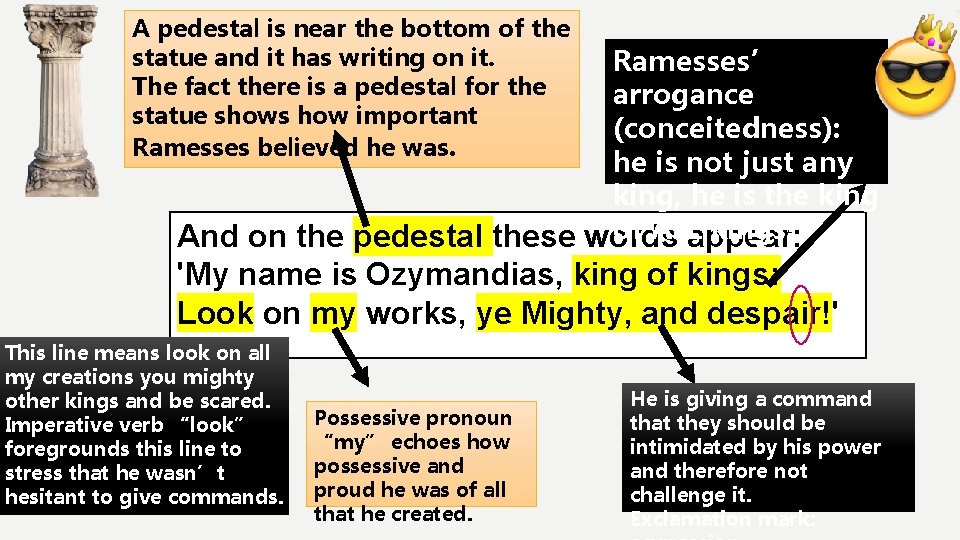
A pedestal is near the bottom of the statue and it has writing on it. The fact there is a pedestal for the statue shows how important Ramesses believed he was. Ramesses’ arrogance (conceitedness): he is not just any king, he is the king of ALL kings! And on the pedestal these words appear: 'My name is Ozymandias, king of kings: Look on my works, ye Mighty, and despair!' This line means look on all my creations you mighty other kings and be scared. Imperative verb “look” foregrounds this line to stress that he wasn’t hesitant to give commands. Possessive pronoun “my” echoes how possessive and proud he was of all that he created. He is giving a command that they should be intimidated by his power and therefore not challenge it. Exclamation mark:
This means the hand of the SCULPTOR not the hand of Ozymandias. Them does NOT mean people it refers back to the lip and sneer before. The hand that mocked them and the heart that fed: Mocked means to ridicule or joke but it also meant to imitate or copy. SO it could mean the Sculptor copied the cold command the wrinkled lip well OR that the sculptor was ridiculing The heart now means Ramesses’ heart. His love for power (heart) fed the horrible snarling, commands and wrinkled lip. It makes him seem power-hungry and suggest that power is unstoppable over
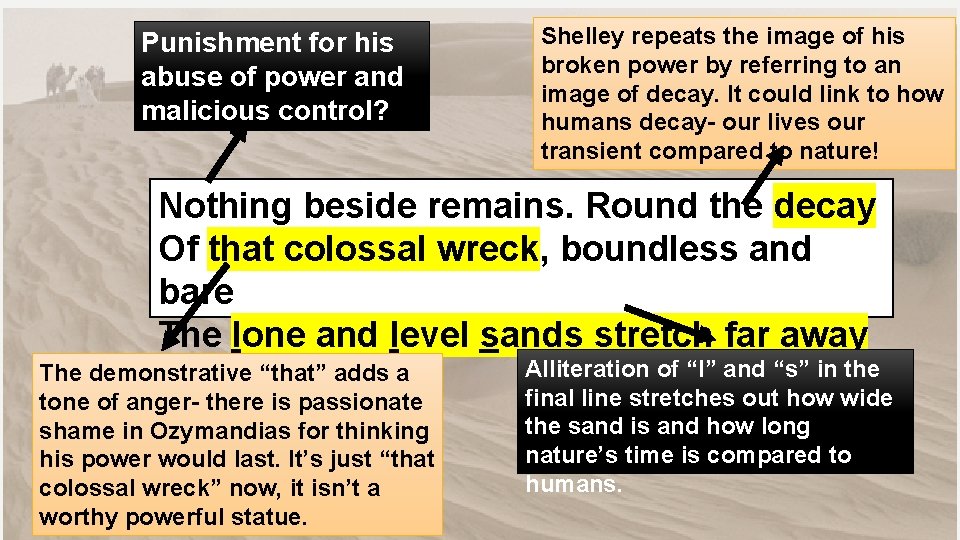
Punishment for his abuse of power and malicious control? Shelley repeats the image of his broken power by referring to an image of decay. It could link to how humans decay- our lives our transient compared to nature! Nothing beside remains. Round the decay Of that colossal wreck, boundless and bare The lone and level sands stretch far away The demonstrative “that” adds a tone of anger- there is passionate shame in Ozymandias for thinking his power would last. It’s just “that colossal wreck” now, it isn’t a worthy powerful statue. Alliteration of “l” and “s” in the final line stretches out how wide the sand is and how long nature’s time is compared to humans.
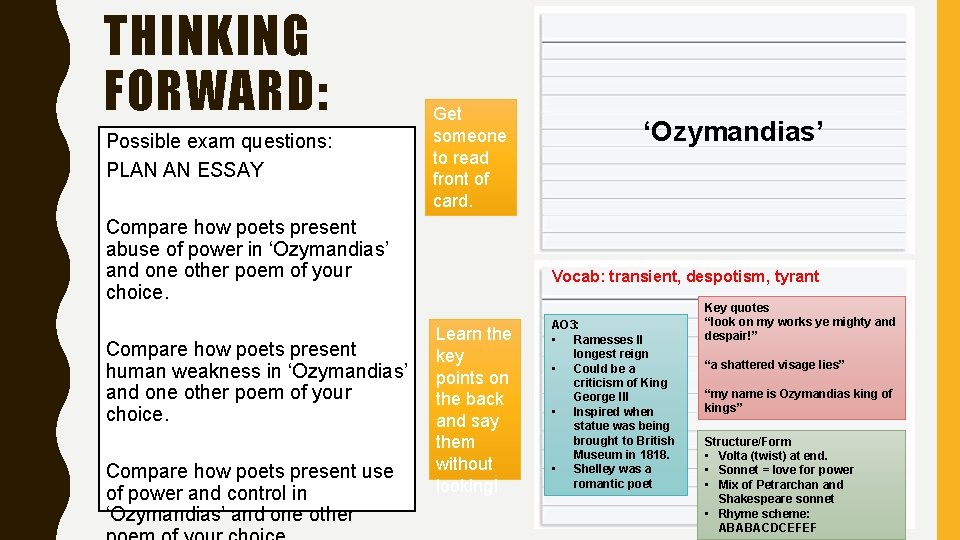
THINKING FORWARD: Possible exam questions: PLAN AN ESSAY Get someone to read front of card. Compare how poets present abuse of power in ‘Ozymandias’ and one other poem of your choice. Compare how poets present human weakness in ‘Ozymandias’ and one other poem of your choice. Compare how poets present use of power and control in ‘Ozymandias’ and one other ‘Ozymandias’ Vocab: transient, despotism, tyrant Learn the key points on the back and say them without looking! AO 3: • Ramesses II longest reign • Could be a criticism of King George III • Inspired when statue was being brought to British Museum in 1818. • Shelley was a romantic poet Key quotes “look on my works ye mighty and despair!” “a shattered visage lies” “my name is Ozymandias king of kings” Structure/Form • Volta (twist) at end. • Sonnet = love for power • Mix of Petrarchan and Shakespeare sonnet • Rhyme scheme: ABABACDCEFEF
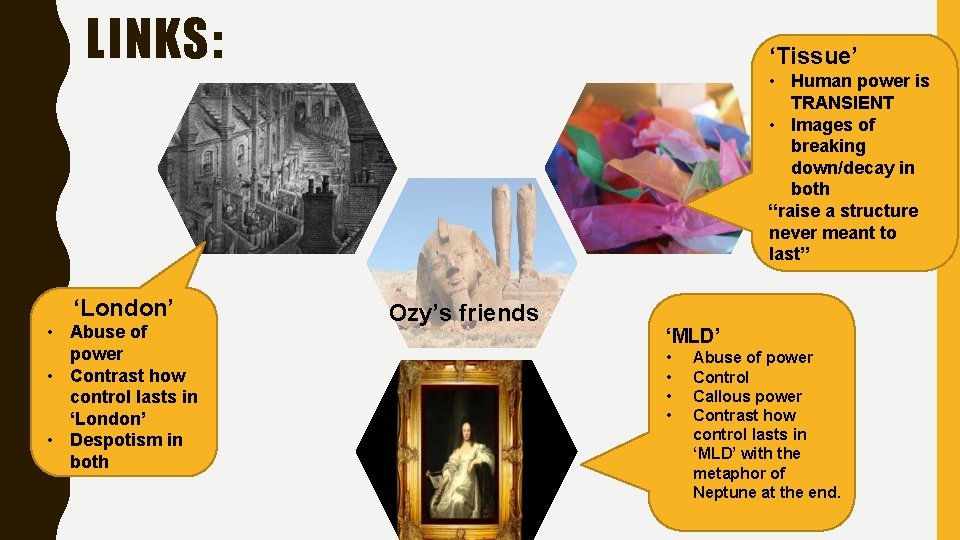
LINKS: ‘Tissue’ • Human power is TRANSIENT • Images of breaking down/decay in both “raise a structure never meant to last” ‘London’ • Abuse of power • Contrast how control lasts in ‘London’ • Despotism in both Ozy’s friends ‘MLD’ • • Abuse of power Control Callous power Contrast how control lasts in ‘MLD’ with the metaphor of Neptune at the end.
- Slides: 19