
Ozone Pollution This illustration shows how the different
- Slides: 40
Ozone Pollution
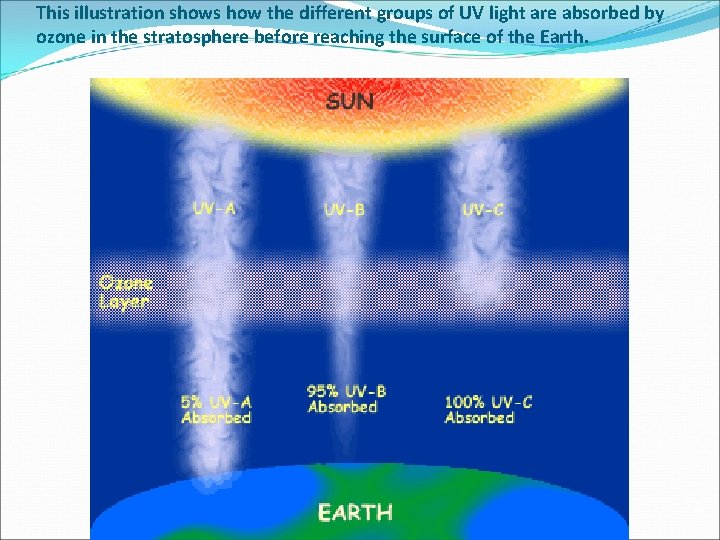
This illustration shows how the different groups of UV light are absorbed by ozone in the stratosphere before reaching the surface of the Earth.
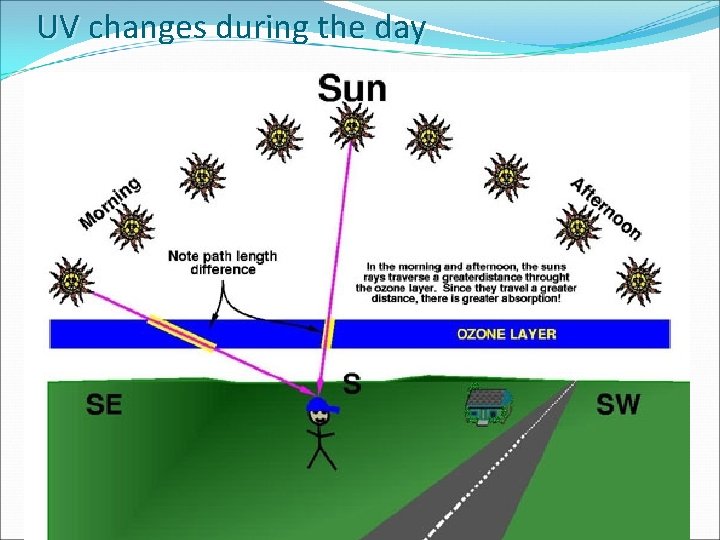
UV changes during the day 4
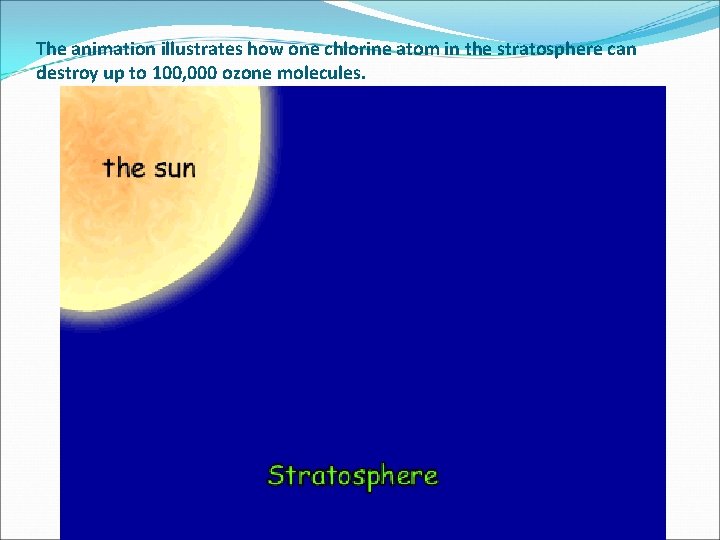
The animation illustrates how one chlorine atom in the stratosphere can destroy up to 100, 000 ozone molecules.
http: //www. gsfc. nasa. gov/topstory /20010917 ozonelayer. html Ozone loss at the poles
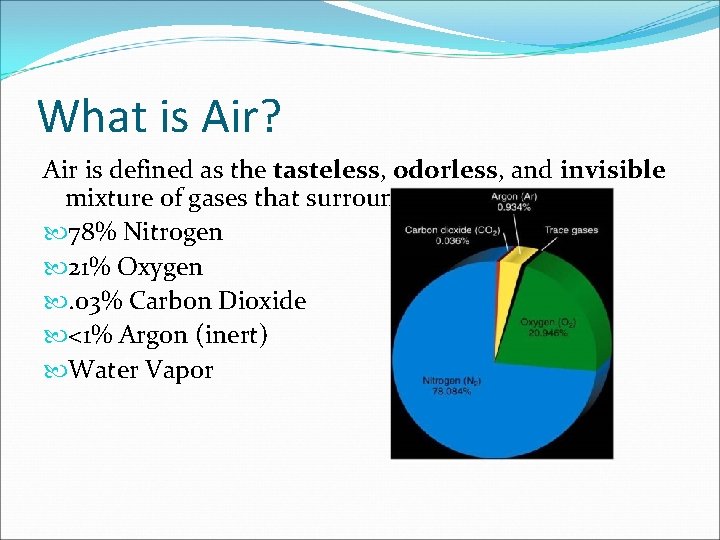
What is Air? Air is defined as the tasteless, odorless, and invisible mixture of gases that surrounds the earth. 78% Nitrogen 21% Oxygen . 03% Carbon Dioxide <1% Argon (inert) Water Vapor
What is Air Pollution? Air is said to be “Polluted” when it is no longer tasteless, odorless, colorless Gaseous or particulate substances released into the atmosphere in sufficient quantities or concentrations to cause injury to plants, animals, or humans. Typically emitted into the atmosphere and transported from the source to the affected organism.
History of Air Pollution in the United States Late 1800’s: Industrial revolution in the U. S. caused a major increase in air pollution emissions 1943: First recognized episodes of smog occurred in Los Angeles 1948: The first known air pollution disaster in the U. S. occurred in Donora, PA
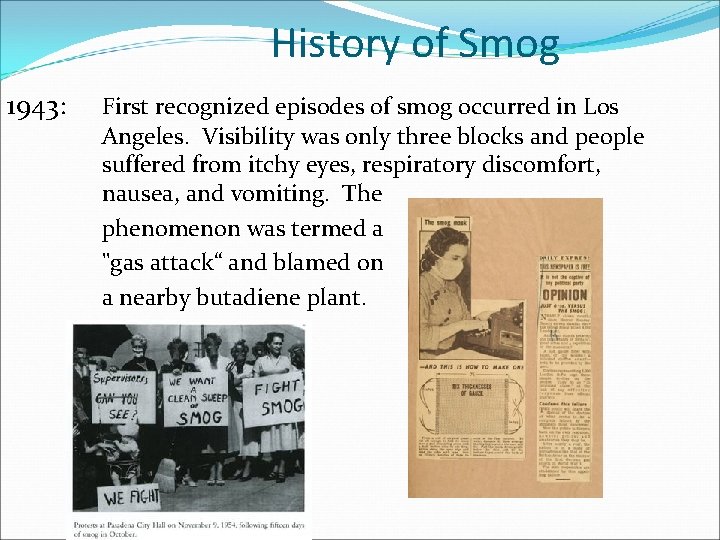
History of Smog 1943: First recognized episodes of smog occurred in Los Angeles. Visibility was only three blocks and people suffered from itchy eyes, respiratory discomfort, nausea, and vomiting. The phenomenon was termed a "gas attack“ and blamed on a nearby butadiene plant.
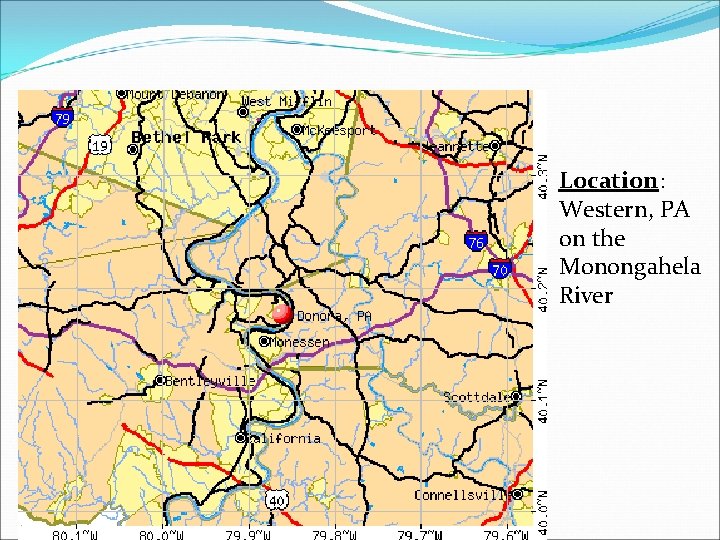
Donora, PA - 1948 Location: Western, PA on the Monongahela River
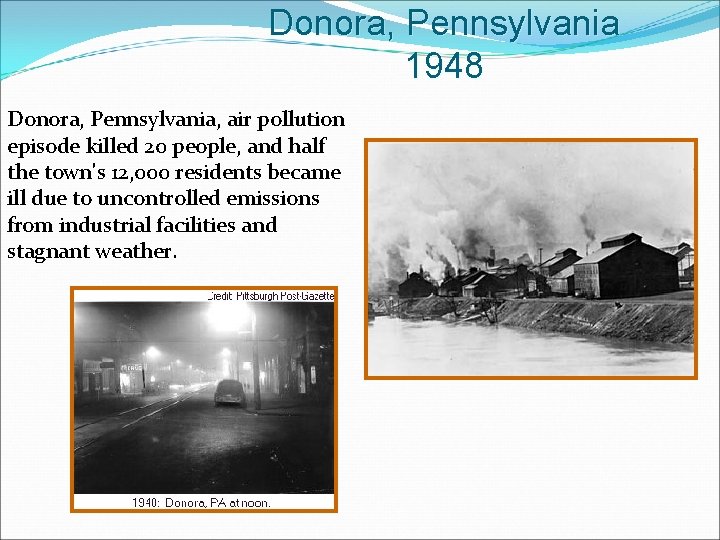
Donora, Pennsylvania 1948 Donora, Pennsylvania, air pollution episode killed 20 people, and half the town's 12, 000 residents became ill due to uncontrolled emissions from industrial facilities and stagnant weather.
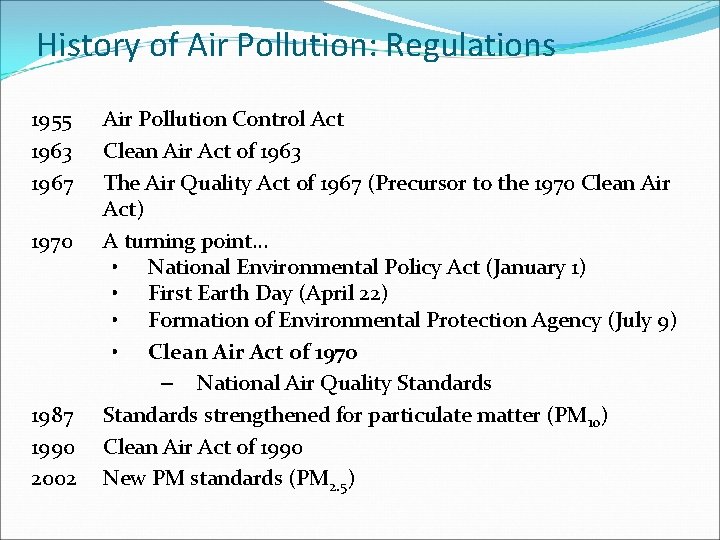
History of Air Pollution: Regulations 1955 1963 1967 1970 1987 1990 2002 Air Pollution Control Act Clean Air Act of 1963 The Air Quality Act of 1967 (Precursor to the 1970 Clean Air Act) A turning point… • National Environmental Policy Act (January 1) • First Earth Day (April 22) • Formation of Environmental Protection Agency (July 9) • Clean Air Act of 1970 – National Air Quality Standards strengthened for particulate matter (PM 10) Clean Air Act of 1990 New PM standards (PM 2. 5)
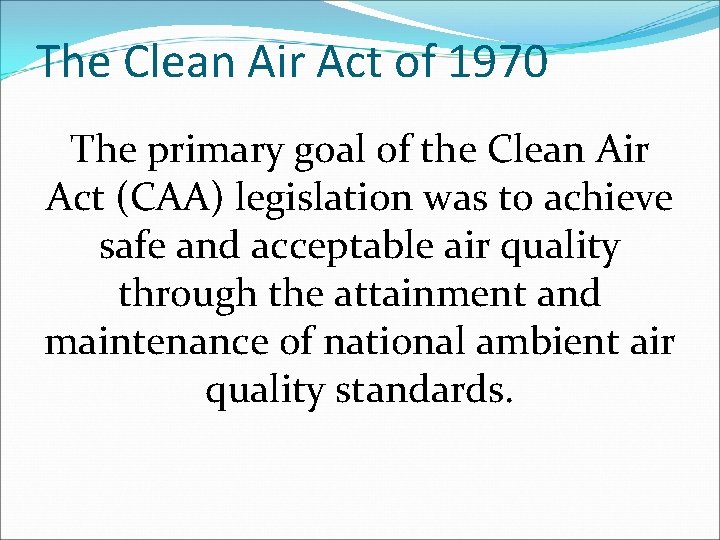
The Clean Air Act of 1970 The primary goal of the Clean Air Act (CAA) legislation was to achieve safe and acceptable air quality through the attainment and maintenance of national ambient air quality standards.
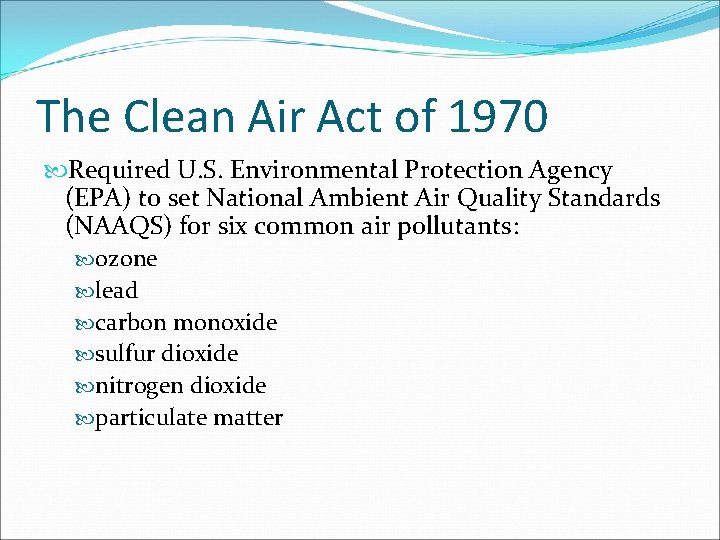
The Clean Air Act of 1970 Required U. S. Environmental Protection Agency (EPA) to set National Ambient Air Quality Standards (NAAQS) for six common air pollutants: ozone lead carbon monoxide sulfur dioxide nitrogen dioxide particulate matter
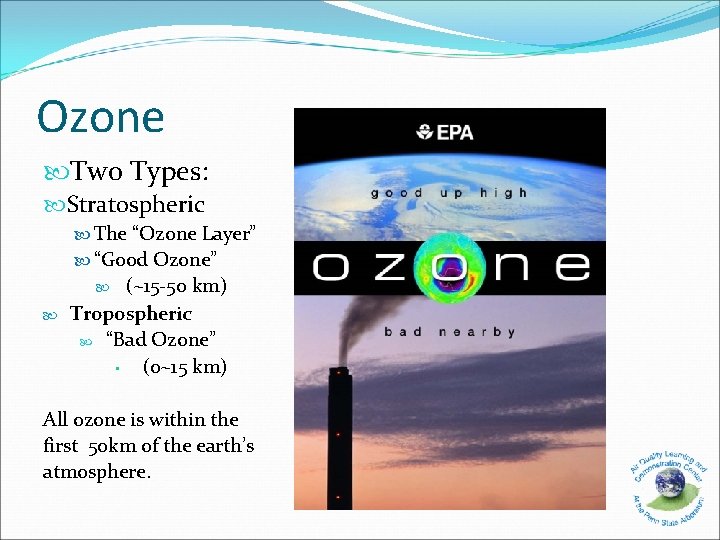
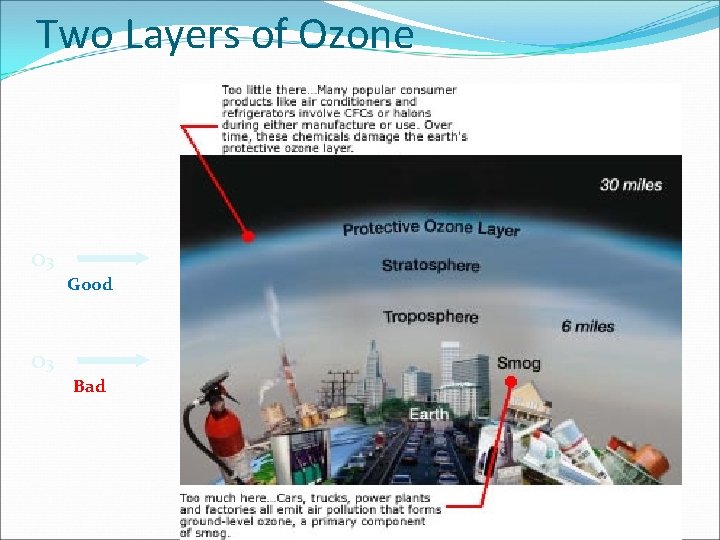
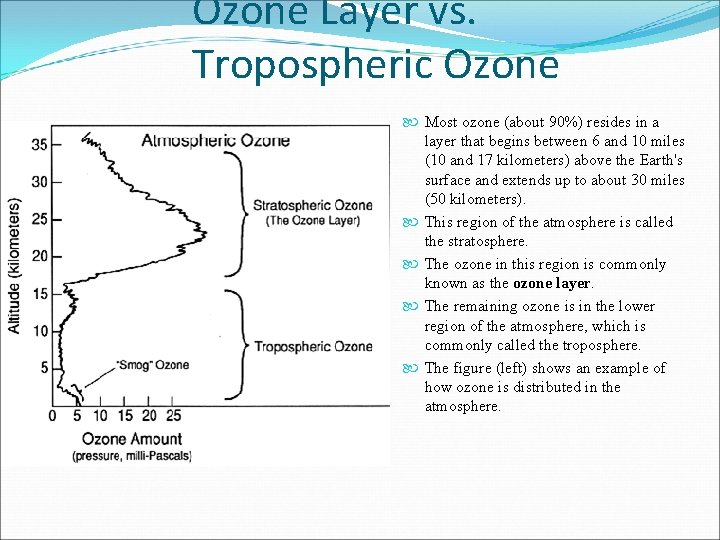
Ozone Two Types: Stratospheric The “Ozone Layer” “Good Ozone” (~15 -50 km) Tropospheric “Bad Ozone” • (0~15 km) All ozone is within the first 50 km of the earth’s atmosphere.
Two Layers of Ozone O 3 Good O 3 Bad
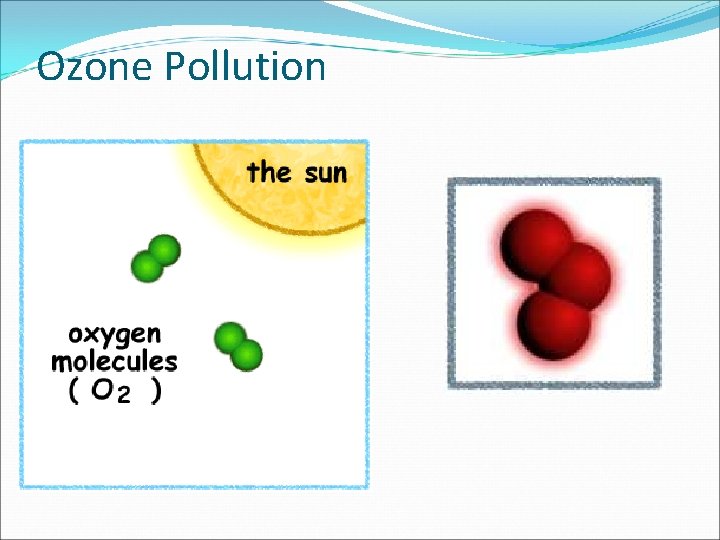
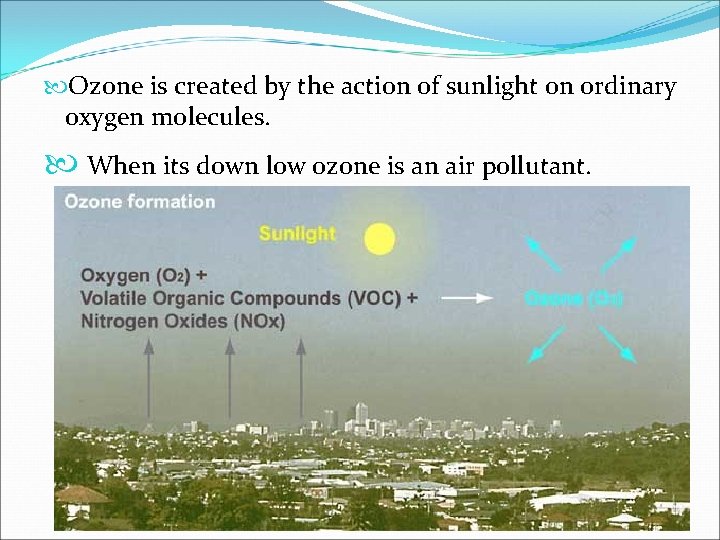
Ozone is created by the action of sunlight on ordinary oxygen molecules. When its down low ozone is an air pollutant.
Ozone Layer vs. Tropospheric Ozone Most ozone (about 90%) resides in a layer that begins between 6 and 10 miles (10 and 17 kilometers) above the Earth's surface and extends up to about 30 miles (50 kilometers). This region of the atmosphere is called the stratosphere. The ozone in this region is commonly known as the ozone layer. The remaining ozone is in the lower region of the atmosphere, which is commonly called the troposphere. The figure (left) shows an example of how ozone is distributed in the atmosphere.
Importance of learning about ozone pollution Economic: - $2 billion lost annually in the U. S. from ozone damage to agriculture and commercial forestry alone. -To put this in perspective, UT’s total crop production for 2009 was approximately $1. 7 billion - $5 billion in some other countries such as China - Several billion more from health related issues
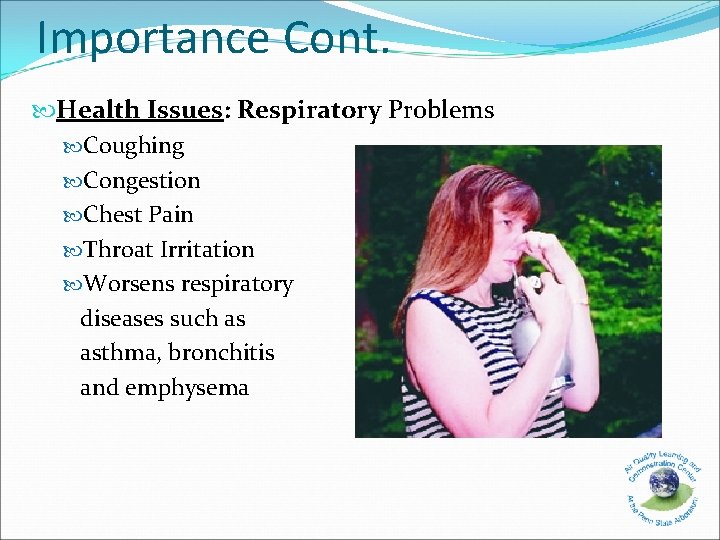
Importance Cont. Health Issues: Respiratory Problems Coughing Congestion Chest Pain Throat Irritation Worsens respiratory diseases such as asthma, bronchitis and emphysema
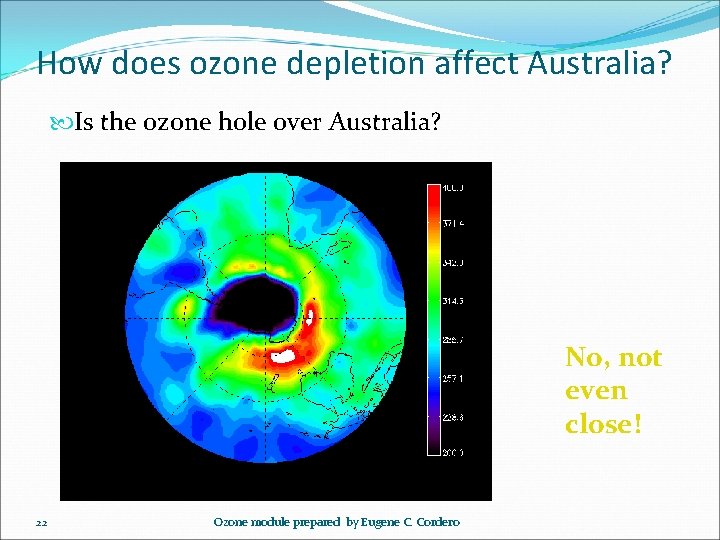
How does ozone depletion affect Australia? Is the ozone hole over Australia? No, not even close! 22 Ozone module prepared by Eugene C. Cordero
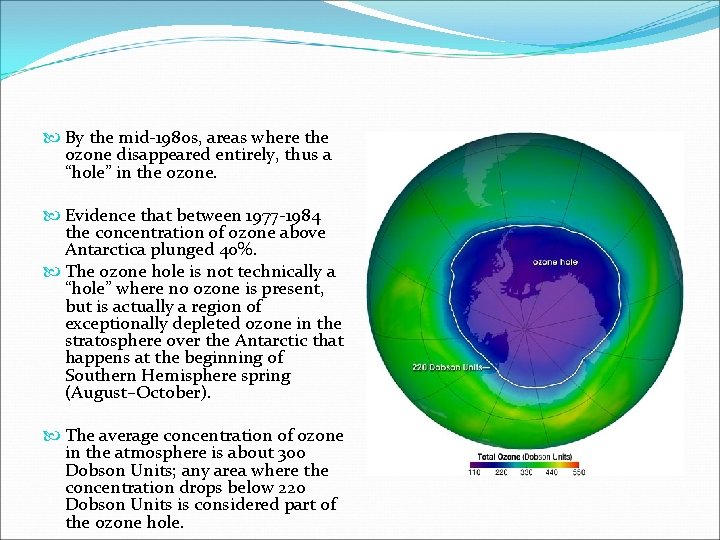
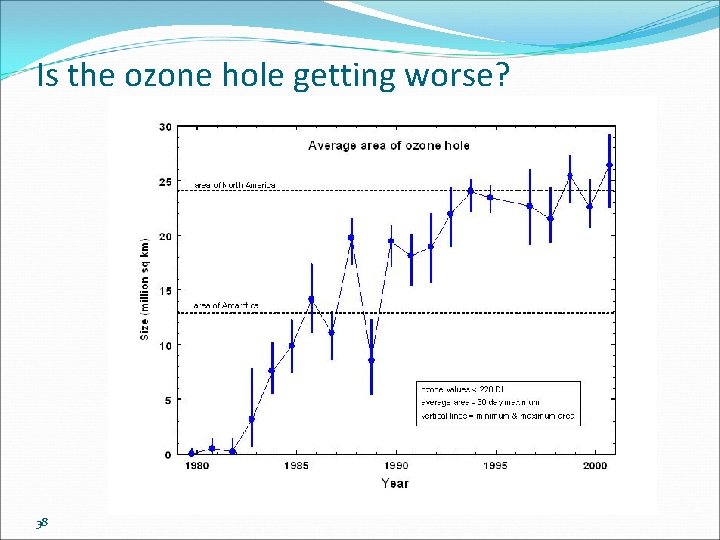
By the mid-1980 s, areas where the ozone disappeared entirely, thus a “hole” in the ozone. Evidence that between 1977 -1984 the concentration of ozone above Antarctica plunged 40%. The ozone hole is not technically a “hole” where no ozone is present, but is actually a region of exceptionally depleted ozone in the stratosphere over the Antarctic that happens at the beginning of Southern Hemisphere spring (August–October). The average concentration of ozone in the atmosphere is about 300 Dobson Units; any area where the concentration drops below 220 Dobson Units is considered part of the ozone hole.
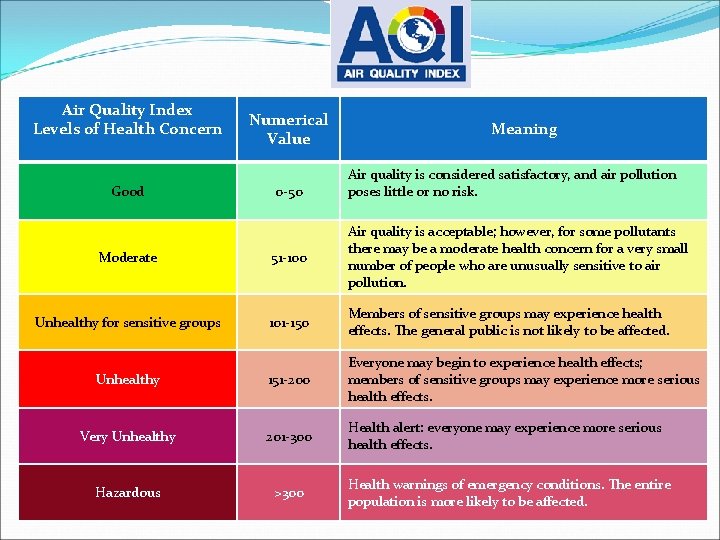
Air Quality Index Levels of Health Concern Good Numerical Value 0 -50 Meaning Air quality is considered satisfactory, and air pollution poses little or no risk. Moderate 51 -100 Air quality is acceptable; however, for some pollutants there may be a moderate health concern for a very small number of people who are unusually sensitive to air pollution. Unhealthy for sensitive groups 101 -150 Members of sensitive groups may experience health effects. The general public is not likely to be affected. Unhealthy 151 -200 Everyone may begin to experience health effects; members of sensitive groups may experience more serious health effects. Very Unhealthy 201 -300 Health alert: everyone may experience more serious health effects. Hazardous >300 Health warnings of emergency conditions. The entire population is more likely to be affected.
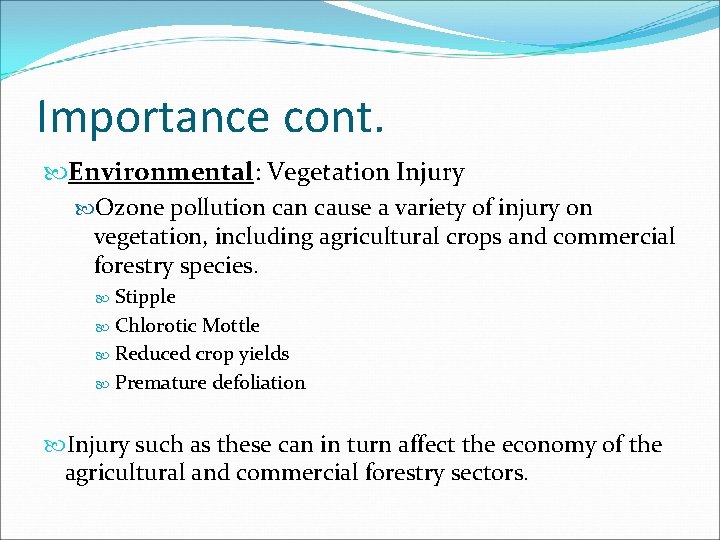
Importance cont. Environmental: Vegetation Injury Ozone pollution cause a variety of injury on vegetation, including agricultural crops and commercial forestry species. Stipple Chlorotic Mottle Reduced crop yields Premature defoliation Injury such as these can in turn affect the economy of the agricultural and commercial forestry sectors.
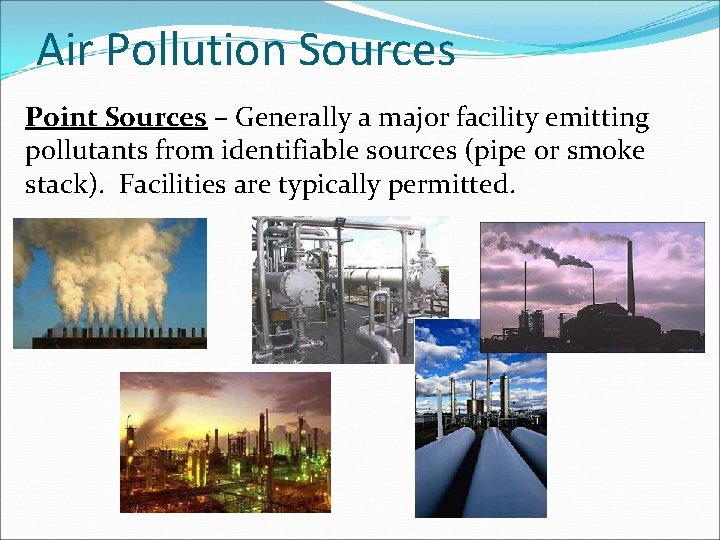
Air Pollution Sources Point Sources – Generally a major facility emitting pollutants from identifiable sources (pipe or smoke stack). Facilities are typically permitted.
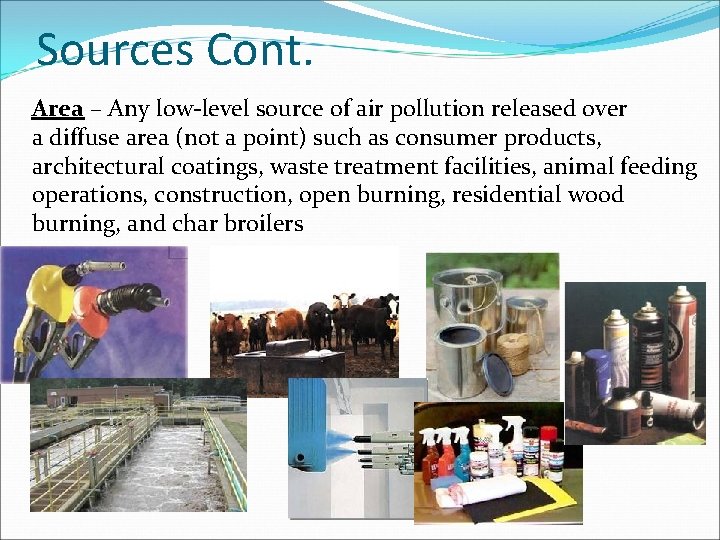
Sources Cont. Area – Any low-level source of air pollution released over a diffuse area (not a point) such as consumer products, architectural coatings, waste treatment facilities, animal feeding operations, construction, open burning, residential wood burning, and char broilers
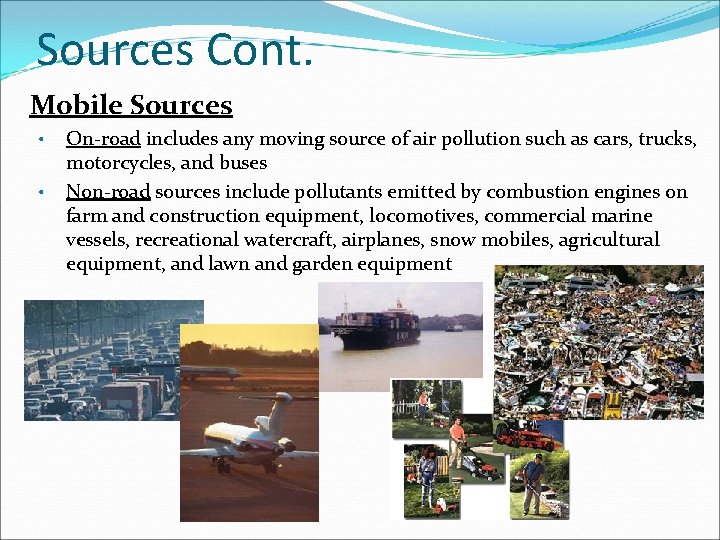
Sources Cont. Mobile Sources • • On-road includes any moving source of air pollution such as cars, trucks, motorcycles, and buses Non-road sources include pollutants emitted by combustion engines on farm and construction equipment, locomotives, commercial marine vessels, recreational watercraft, airplanes, snow mobiles, agricultural equipment, and lawn and garden equipment
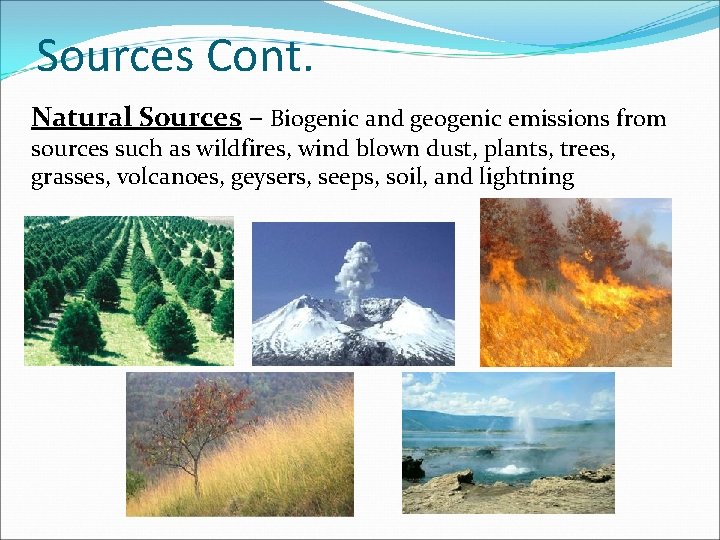
Sources Cont. Natural Sources – Biogenic and geogenic emissions from sources such as wildfires, wind blown dust, plants, trees, grasses, volcanoes, geysers, seeps, soil, and lightning
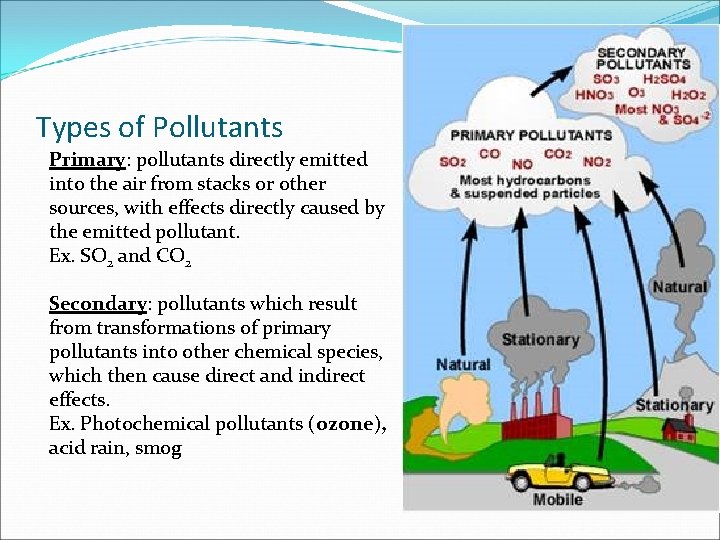
Types of Pollutants Primary: pollutants directly emitted into the air from stacks or other sources, with effects directly caused by the emitted pollutant. Ex. SO 2 and CO 2 Secondary: pollutants which result from transformations of primary pollutants into other chemical species, which then cause direct and indirect effects. Ex. Photochemical pollutants (ozone), acid rain, smog
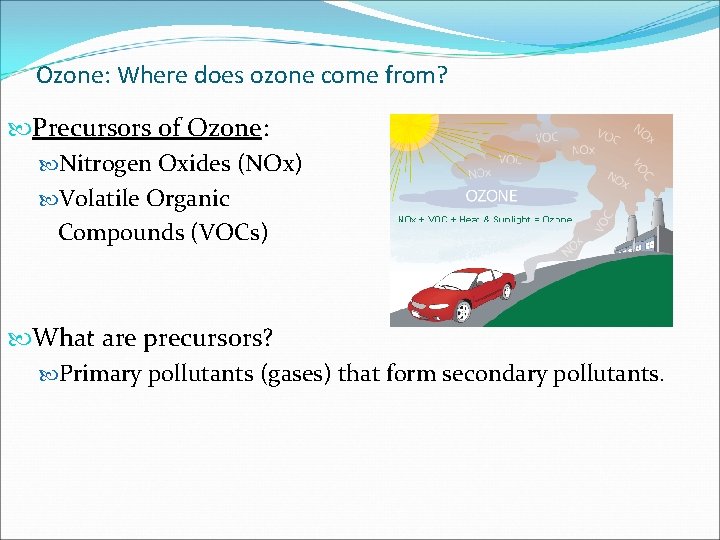
Ozone: Where does ozone come from? Precursors of Ozone: Nitrogen Oxides (NOx) Volatile Organic Compounds (VOCs) What are precursors? Primary pollutants (gases) that form secondary pollutants.
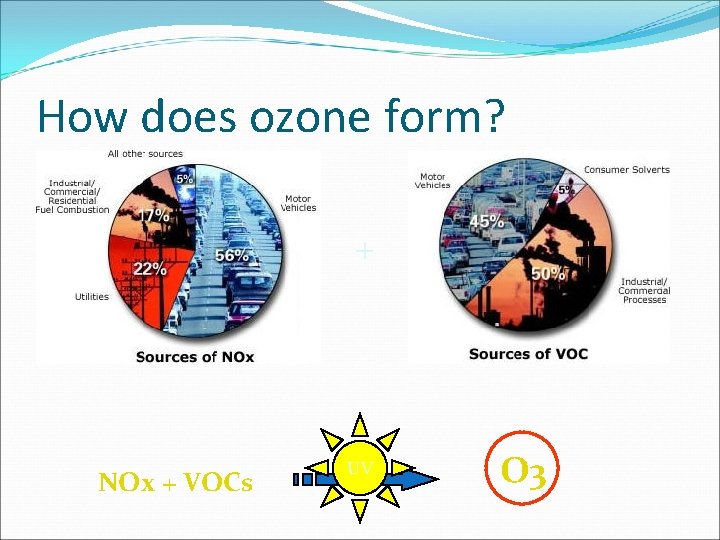
How does ozone form? + NOx + VOCs UV O 3
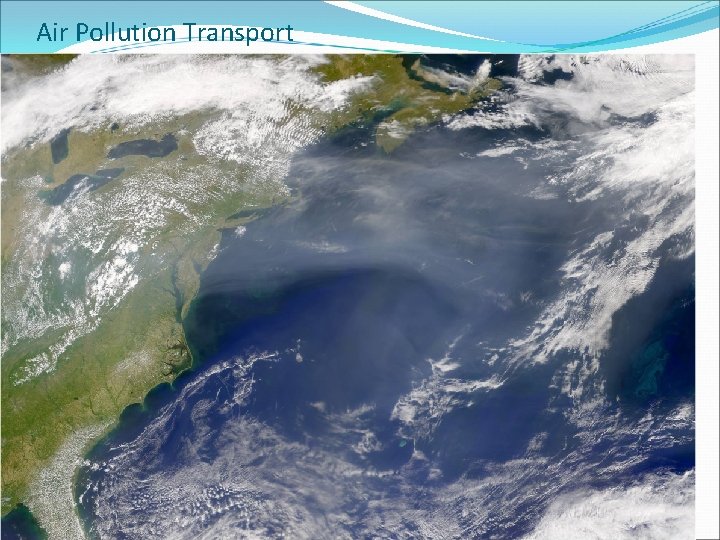
Air Pollution Transport
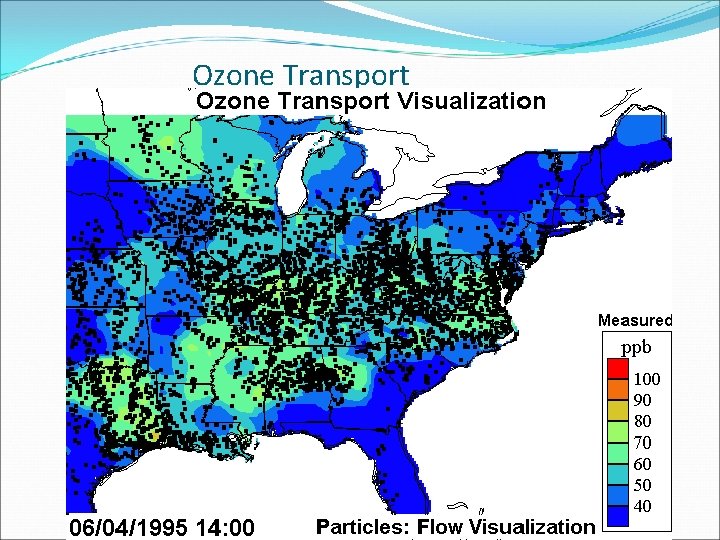
Ozone Transport
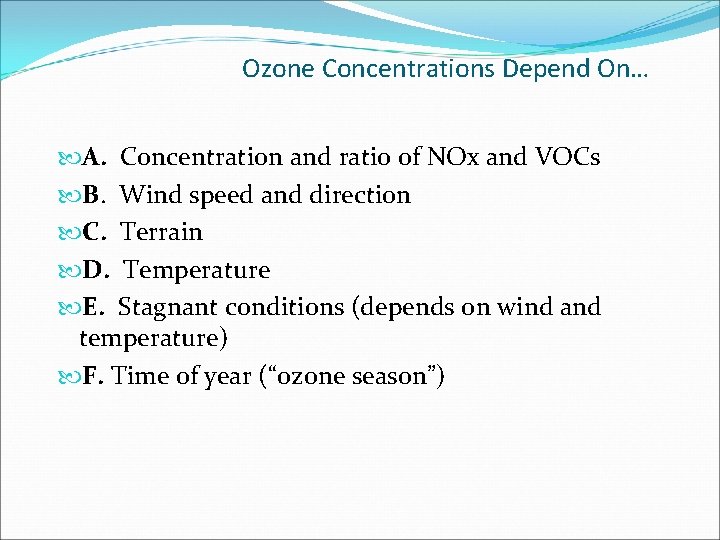
Ozone Concentrations Depend On… A. Concentration and ratio of NOx and VOCs B. Wind speed and direction C. Terrain D. Temperature E. Stagnant conditions (depends on wind and temperature) F. Time of year (“ozone season”)
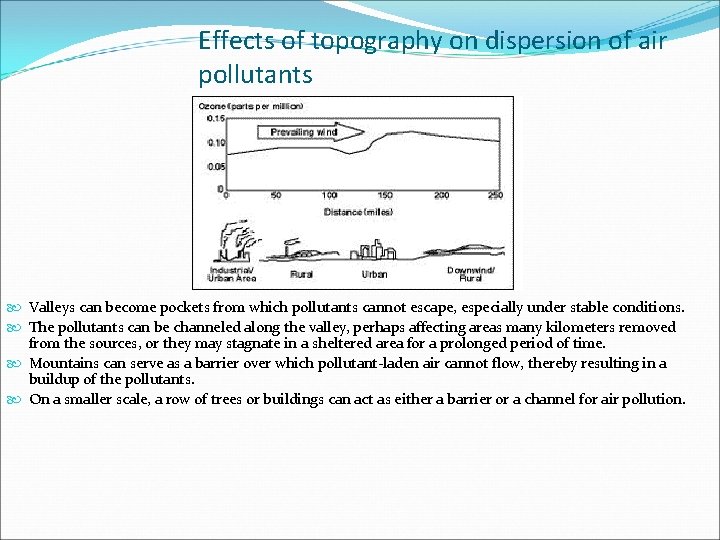
Effects of topography on dispersion of air pollutants Valleys can become pockets from which pollutants cannot escape, especially under stable conditions. The pollutants can be channeled along the valley, perhaps affecting areas many kilometers removed from the sources, or they may stagnate in a sheltered area for a prolonged period of time. Mountains can serve as a barrier over which pollutant-laden air cannot flow, thereby resulting in a buildup of the pollutants. On a smaller scale, a row of trees or buildings can act as either a barrier or a channel for air pollution.
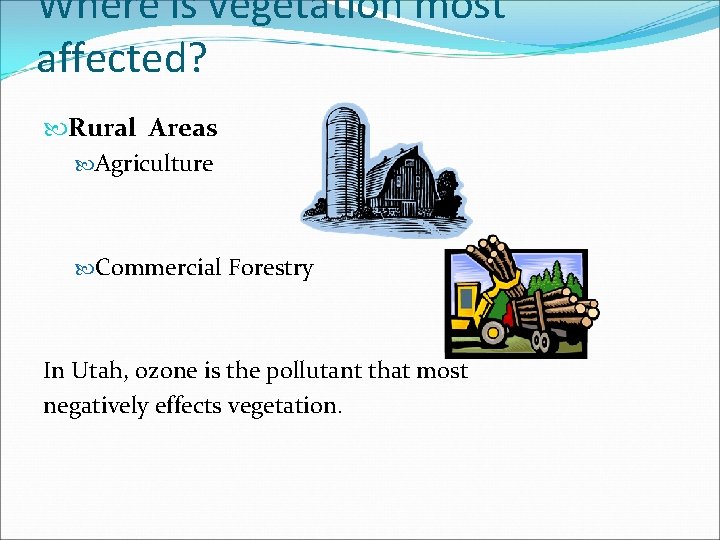
Where is vegetation most affected? Rural Areas Agriculture Commercial Forestry In Utah, ozone is the pollutant that most negatively effects vegetation.
Is the ozone hole getting worse? 38
What is going to happen in the future? Model simulations suggest: atmospheric chlorine will return to pre-80’s in next 50 or more years. a slow ozone recovery will follow decreasing chlorine concentrations Still many questions!!! Phase out and use of CFC’s Contribution from global warming 39
Summary Air is said to be “Polluted” when it is no longer tasteless, odorless, colorless Two types of ozone, Stratospheric (good) and Tropospheric (bad) Ozone pollution has major effects on economics, human health, and environmental health. Ozone is a secondary pollutant and its precursors are NOx and VOCs. Precursors of ozone reach areas by long distance transport from areas to the west (ex. LA) Environmental health is most effected in rural areas.