
Oxygen Is there a problem Tom Heaps Acute
Oxygen: Is there a problem? Tom Heaps Acute Physician
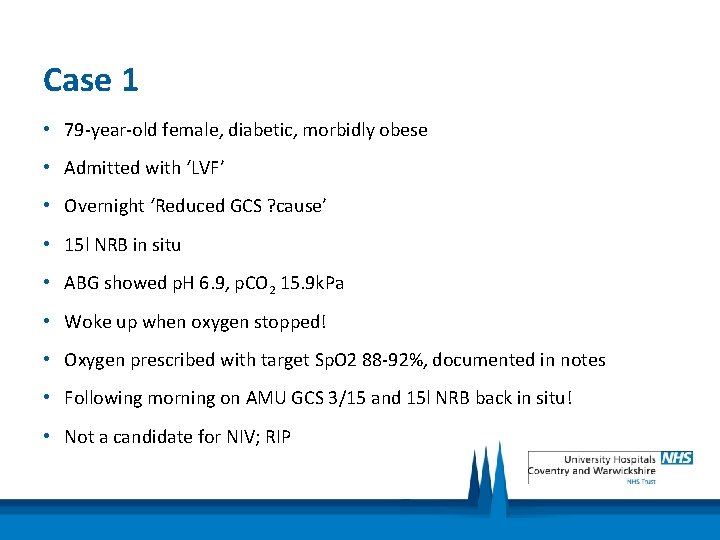
Case 1 • 79 -year-old female, diabetic, morbidly obese • Admitted with ‘LVF’ • Overnight ‘Reduced GCS ? cause’ • 15 l NRB in situ • ABG showed p. H 6. 9, p. CO 2 15. 9 k. Pa • Woke up when oxygen stopped! • Oxygen prescribed with target Sp. O 2 88 -92%, documented in notes • Following morning on AMU GCS 3/15 and 15 l NRB back in situ! • Not a candidate for NIV; RIP
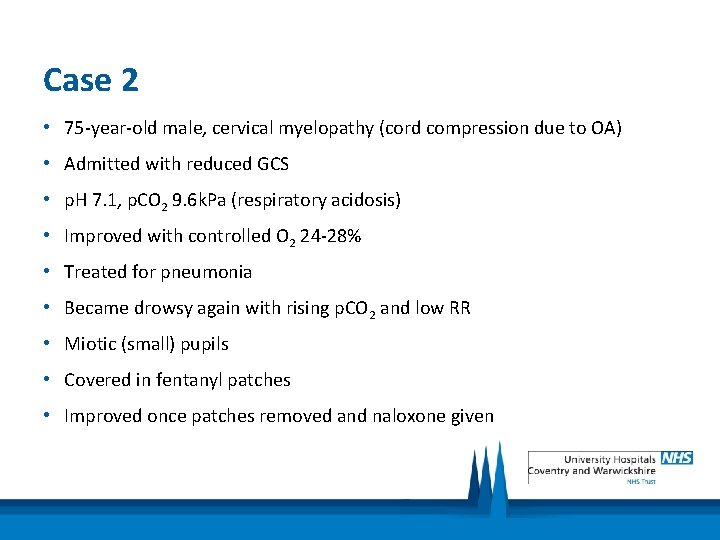
Case 2 • 75 -year-old male, cervical myelopathy (cord compression due to OA) • Admitted with reduced GCS • p. H 7. 1, p. CO 2 9. 6 k. Pa (respiratory acidosis) • Improved with controlled O 2 24 -28% • Treated for pneumonia • Became drowsy again with rising p. CO 2 and low RR • Miotic (small) pupils • Covered in fentanyl patches • Improved once patches removed and naloxone given
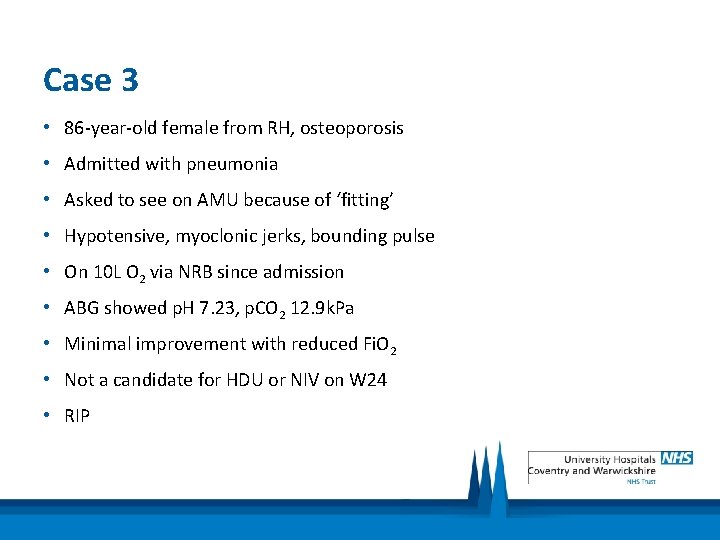
Case 3 • 86 -year-old female from RH, osteoporosis • Admitted with pneumonia • Asked to see on AMU because of ‘fitting’ • Hypotensive, myoclonic jerks, bounding pulse • On 10 L O 2 via NRB since admission • ABG showed p. H 7. 23, p. CO 2 12. 9 k. Pa • Minimal improvement with reduced Fi. O 2 • Not a candidate for HDU or NIV on W 24 • RIP
Oxygen: there is definitely a (big) problem… Published national audits have shown; • Doctors and nurses have a poor understanding of how oxygen should be used • Oxygen is often given without any prescription • If there is a prescription, it is unusual for the patient to receive what is specified on the prescription • Monitoring of oxygen administration is often poor OXYGEN IS DANGEROUS (NPSA alert 2009)
BTS Guideline 2009: Emergency Oxygen Use in Adult Patients • Prescribing by target oxygen saturation • Keeping Sp. O 2 within ‘normal’ limits • Target Sp. O 2 94 -98% for most patients (92 -98% if >70) • Target Sp. O 2 88 -92% (p. O 2 6. 7 -10 k. Pa) for those with or at risk of hypercapnic (high CO 2) respiratory failure
Aims of emergency oxygen therapy • To correct or prevent potentially harmful hypoxaemia • To alleviate breathlessness (only if hypoxaemic) Increasing Fi. O 2 (inspired oxygen concentration) is only one element of increasing overall O 2 carrying capacity of blood; – Protect airway – Enhance circulating volume and cardiac output – Correct severe anaemia – Avoid or reverse respiratory depressants e. g. morphine – Treat underlying cause e. g. LVF, asthma
Indications for Emergency O 2 Therapy 1. Sp. O 2 <94% (<88% if risk of hypercapnia) 2. Critical illness e. g. septic shock, major trauma, anaphylaxis, acute LVF 3. Carbon monoxide poisoning
Exposure to high O 2 concentrations can be harmful… • Risk of hypercapnia (high CO 2) in selected patients – some patients with chronic hypercapnia are dependent on hypoxaemia to maintain respiratory drive • Constriction of coronary arteries – high O 2 levels INCREASED mortality in survivors of cardiac arrest • Constriction of cerebral arteries – high O 2 levels INCREASED mortality in non-hypoxic patients with mild-moderate stroke
Patients at risk of hypercapnic (type 2) respiratory failure 1. COPD (not all patients with COPD, elevated HCO 3 - on ABG is a useful clue to chronic CO 2 retention) 2. Morbid obesity (OHS and OSA) 3. Neuromuscular weakness (MND, myasthenia) 4. Chest wall deformity (kyphoscoliosis) 5. Reduced conscious level 6. Morphine and other respiratory sedatives
A Word of Warning… • Patients with high CO 2 levels have very little room for oxygen in their alveoli • DO NOT SUDDENLY REMOVE OXYGEN IN SEVERELY HYPERCAPNIC PATIENTS • risk of life-threatening alveolar hypoxaemia • Reduce oxygen to 35% initially and titrate down further if required
Oxygen is a drug and should be prescribed on EP (unless an emergency)……. You wouldn’t give any other drugs without a prescription would you?
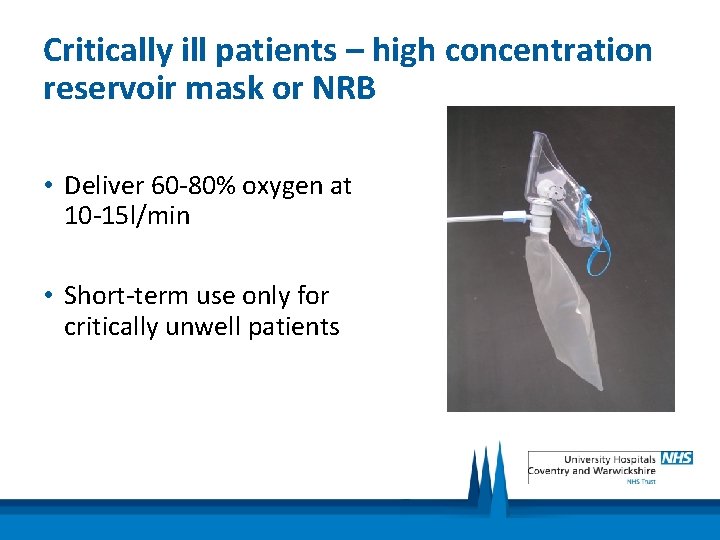
Critically ill patients – high concentration reservoir mask or NRB • Deliver 60 -80% oxygen at 10 -15 l/min • Short-term use only for critically unwell patients
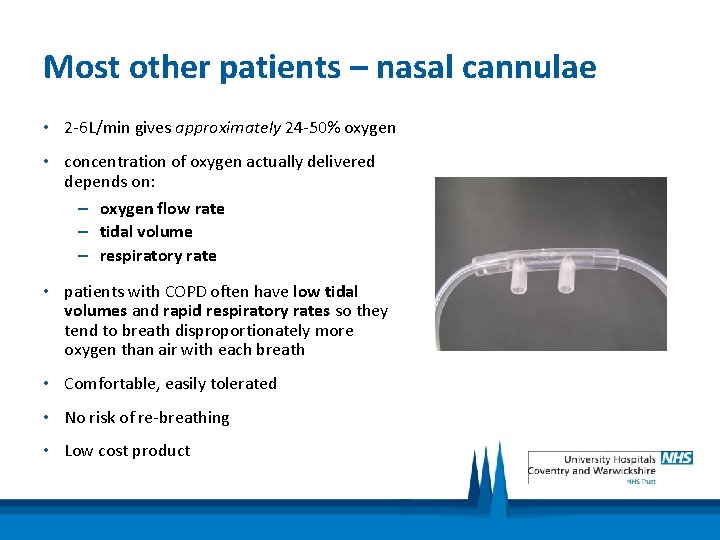
Most other patients – nasal cannulae • 2 -6 L/min gives approximately 24 -50% oxygen • concentration of oxygen actually delivered depends on: – oxygen flow rate – tidal volume – respiratory rate • patients with COPD often have low tidal volumes and rapid respiratory rates so they tend to breath disproportionately more oxygen than air with each breath • Comfortable, easily tolerated • No risk of re-breathing • Low cost product

Patients at risk of hypercapnic (type 2) respiratory failure – venturi masks • Fixed performance masks i. e. deliver a fixed concentration of oxygen • Less affected by tidal volume and RR (useful in COPD) • Increasing flow does not increase Fi. O 2 beyond that stated on mask • Accurate at 24 -40% • 60% venturi delivers ~50% Fi. O 2
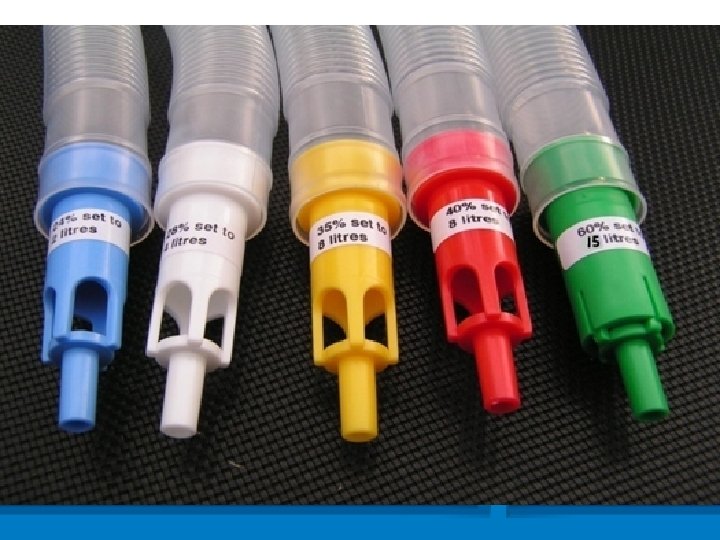
Venturi masks
Monitoring and Titration • Monitor oxygen saturations frequently/continuously • Titrate flow rate and/or device up or down until target O 2 saturation is achieved • ALWAYS use minimum flow rate required and seek to wean off oxygen as soon as stable • NEVER leave patients on high-concentration O 2 for prolonged periods without repeating ABGs
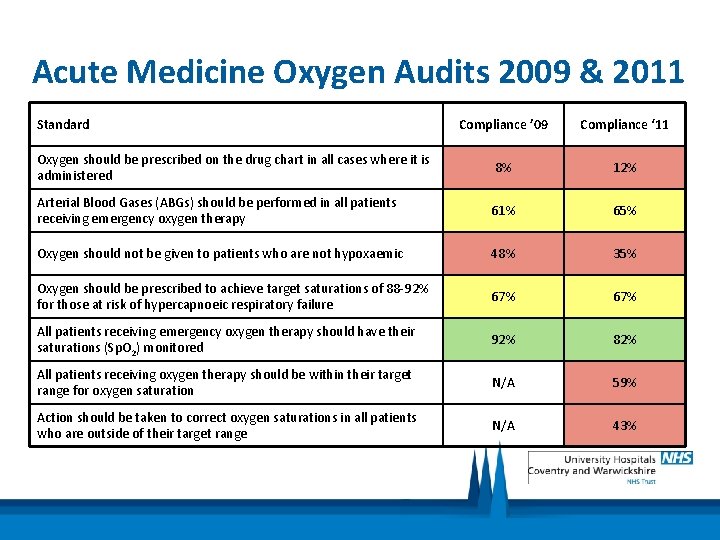
Acute Medicine Oxygen Audits 2009 & 2011 Standard Compliance ’ 09 Compliance ‘ 11 Oxygen should be prescribed on the drug chart in all cases where it is administered 8% 12% Arterial Blood Gases (ABGs) should be performed in all patients receiving emergency oxygen therapy 61% 65% Oxygen should not be given to patients who are not hypoxaemic 48% 35% Oxygen should be prescribed to achieve target saturations of 88 -92% for those at risk of hypercapnoeic respiratory failure 67% All patients receiving emergency oxygen therapy should have their saturations (Sp. O 2) monitored 92% 82% All patients receiving oxygen therapy should be within their target range for oxygen saturation N/A 59% Action should be taken to correct oxygen saturations in all patients who are outside of their target range N/A 43%
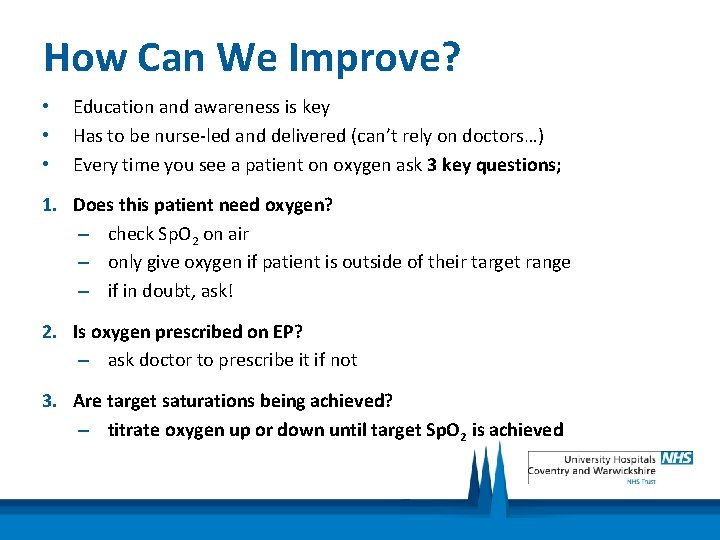
How Can We Improve? • • • Education and awareness is key Has to be nurse-led and delivered (can’t rely on doctors…) Every time you see a patient on oxygen ask 3 key questions; 1. Does this patient need oxygen? – check Sp. O 2 on air – only give oxygen if patient is outside of their target range – if in doubt, ask! 2. Is oxygen prescribed on EP? – ask doctor to prescribe it if not 3. Are target saturations being achieved? – titrate oxygen up or down until target Sp. O 2 is achieved
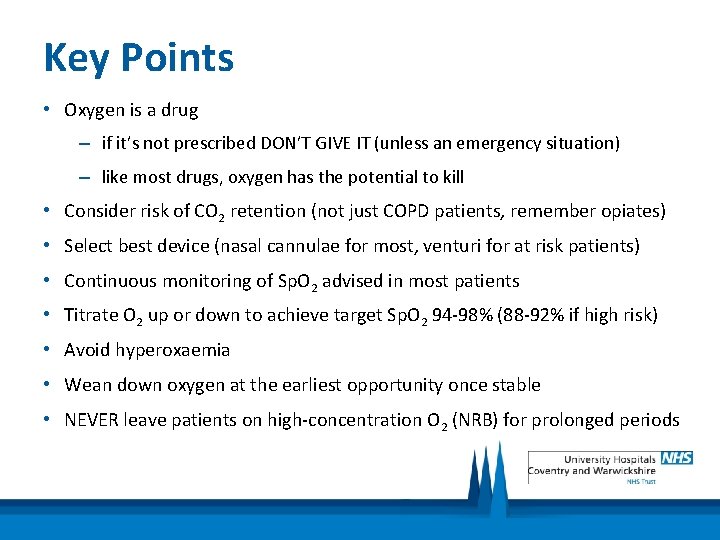
Key Points • Oxygen is a drug – if it’s not prescribed DON’T GIVE IT (unless an emergency situation) – like most drugs, oxygen has the potential to kill • Consider risk of CO 2 retention (not just COPD patients, remember opiates) • Select best device (nasal cannulae for most, venturi for at risk patients) • Continuous monitoring of Sp. O 2 advised in most patients • Titrate O 2 up or down to achieve target Sp. O 2 94 -98% (88 -92% if high risk) • Avoid hyperoxaemia • Wean down oxygen at the earliest opportunity once stable • NEVER leave patients on high-concentration O 2 (NRB) for prolonged periods
Any Questions?
- Slides: 21