
Oxygen hemoglobin dissociation curve Dr Arwa Rawashdeh OBJECTIVES
Oxygen hemoglobin dissociation curve Dr. Arwa Rawashdeh
OBJECTIVES Define oxygen hemoglobin dissociation curve Factors affecting oxygen hemoglobin dissociation curve Implications of oxygen hemoglobin dissociation curve

Oxygen hemoglobin dissociation curve Let us imagine a hemoglobin molecule inside a red blood cell, and the red blood cell is going to floating inside a blood capillary and the red blood cell is surrounded by oxygen particles. Depending on concentration of oxygen particle , the oxygen particles is freely dissolved down it is concentration gradient through the red blood cell membrane and this would very close to the concentration of oxygen within the cytoplasm of red blood cells The majority is going to be carried on a receptors, in the previous lecture we have discussed that the normal partial pressure of O 2 is around 100 mm. Hg then about 95%98% the receptors of hemoglobin is going to be filled (the saturation of oxygen )
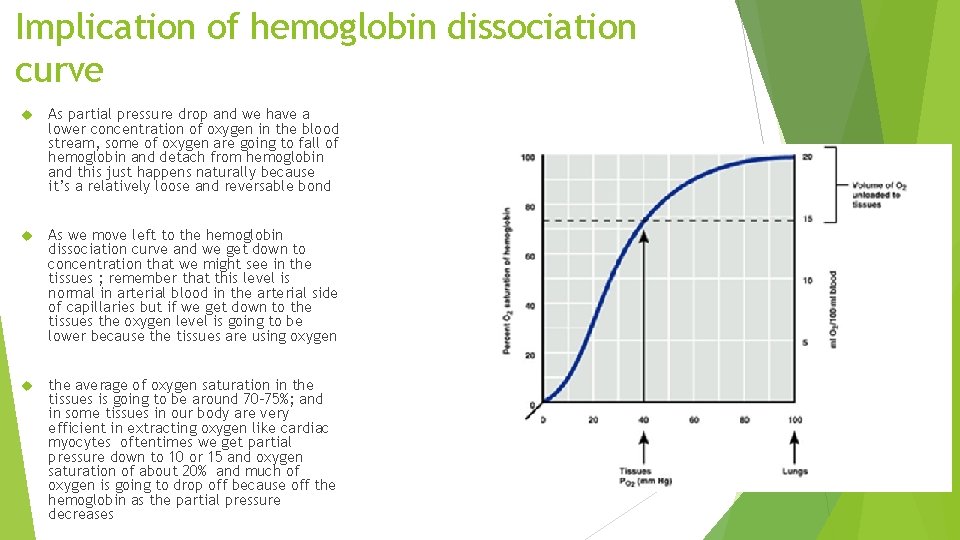
Implication of hemoglobin dissociation curve As partial pressure drop and we have a lower concentration of oxygen in the blood stream, some of oxygen are going to fall of hemoglobin and detach from hemoglobin and this just happens naturally because it’s a relatively loose and reversable bond As we move left to the hemoglobin dissociation curve and we get down to concentration that we might see in the tissues ; remember that this level is normal in arterial blood in the arterial side of capillaries but if we get down to the tissues the oxygen level is going to be lower because the tissues are using oxygen the average of oxygen saturation in the tissues is going to be around 70 -75%; and in some tissues in our body are very efficient in extracting oxygen like cardiac myocytes oftentimes we get partial pressure down to 10 or 15 and oxygen saturation of about 20% and much of oxygen is going to drop off because off the hemoglobin as the partial pressure decreases
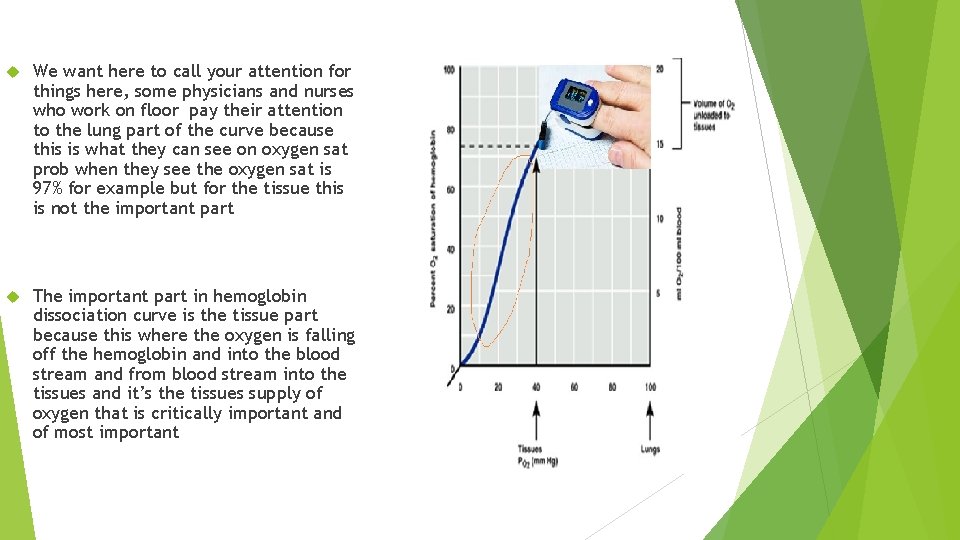
We want here to call your attention for things here, some physicians and nurses who work on floor pay their attention to the lung part of the curve because this is what they can see on oxygen sat prob when they see the oxygen sat is 97% for example but for the tissue this is not the important part The important part in hemoglobin dissociation curve is the tissue part because this where the oxygen is falling off the hemoglobin and into the blood stream and from blood stream into the tissues and it’s the tissues supply of oxygen that is critically important and of most important
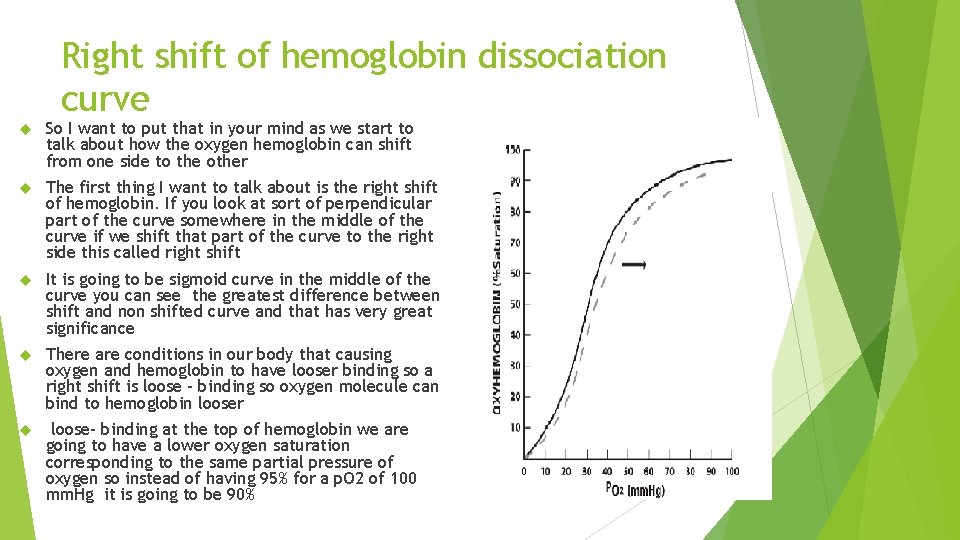
Right shift of hemoglobin dissociation curve So I want to put that in your mind as we start to talk about how the oxygen hemoglobin can shift from one side to the other The first thing I want to talk about is the right shift of hemoglobin. If you look at sort of perpendicular part of the curve somewhere in the middle of the curve if we shift that part of the curve to the right side this called right shift It is going to be sigmoid curve in the middle of the curve you can see the greatest difference between shift and non shifted curve and that has very great significance There are conditions in our body that causing oxygen and hemoglobin to have looser binding so a right shift is loose – binding so oxygen molecule can bind to hemoglobin looser loose- binding at the top of hemoglobin we are going to have a lower oxygen saturation corresponding to the same partial pressure of oxygen so instead of having 95% for a p. O 2 of 100 mm. Hg it is going to be 90%
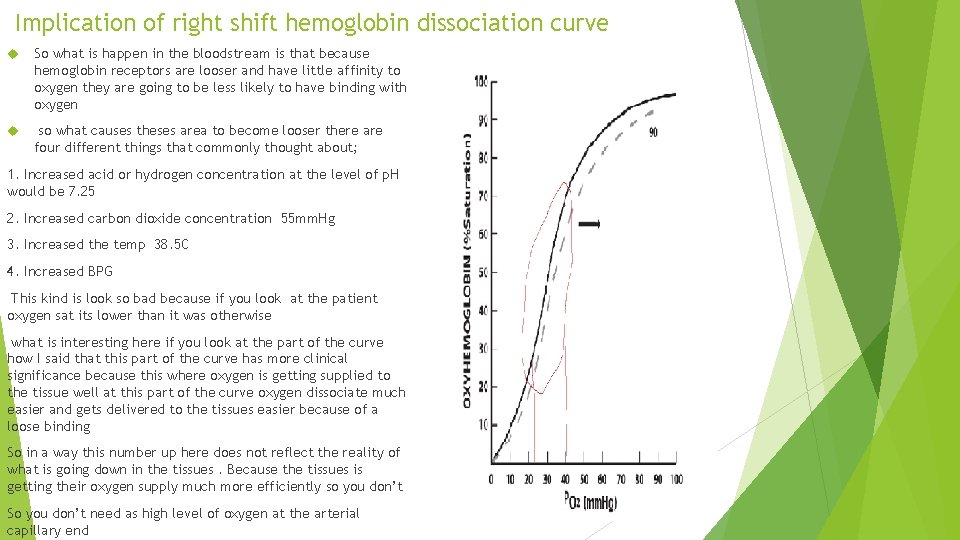
Implication of right shift hemoglobin dissociation curve So what is happen in the bloodstream is that because hemoglobin receptors are looser and have little affinity to oxygen they are going to be less likely to have binding with oxygen so what causes theses area to become looser there are four different things that commonly thought about; 1. Increased acid or hydrogen concentration at the level of p. H would be 7. 25 2. Increased carbon dioxide concentration 55 mm. Hg 3. Increased the temp 38. 5 C 4. Increased BPG This kind is look so bad because if you look at the patient oxygen sat its lower than it was otherwise what is interesting here if you look at the part of the curve how I said that this part of the curve has more clinical significance because this where oxygen is getting supplied to the tissue well at this part of the curve oxygen dissociate much easier and gets delivered to the tissues easier because of a loose binding So in a way this number up here does not reflect the reality of what is going down in the tissues. Because the tissues is getting their oxygen supply much more efficiently so you don’t So you don’t need as high level of oxygen at the arterial capillary end

Left shift of hemoglobin dissociation curve If you shift the curve to the lift you are going to end up with tight binding And all the body conditions that cause left shift is going to be the opposite of that right shift Causing of tight binding 1. Decreased acid or hydrogen concentration at the level of p. H would be 7. 55 2. Decreased carbon dioxide 25 mm. Hg concentration 3. Decreased the temp 35 C 4. Decreased BPG And this happens in state of alkalosis respiratory or metabolic alkalosis
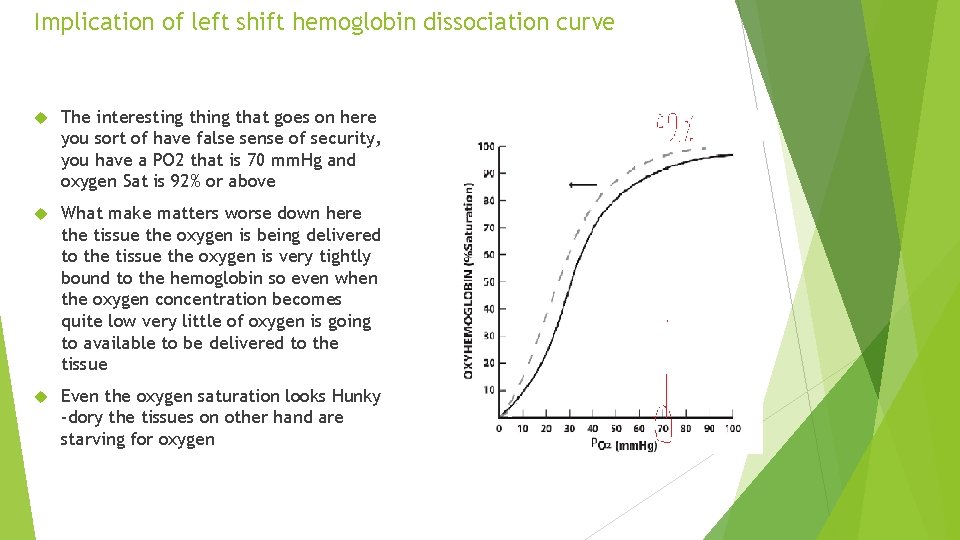
Implication of left shift hemoglobin dissociation curve The interesting that goes on here you sort of have false sense of security, you have a PO 2 that is 70 mm. Hg and oxygen Sat is 92% or above What make matters worse down here the tissue the oxygen is being delivered to the tissue the oxygen is very tightly bound to the hemoglobin so even when the oxygen concentration becomes quite low very little of oxygen is going to available to be delivered to the tissue Even the oxygen saturation looks Hunky -dory the tissues on other hand are starving for oxygen
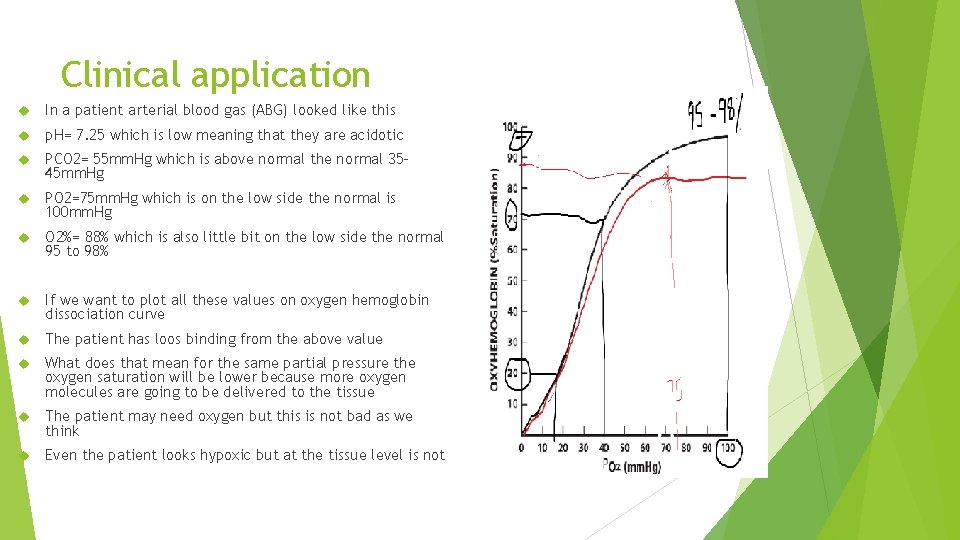
Clinical application In a patient arterial blood gas (ABG) looked like this p. H= 7. 25 which is low meaning that they are acidotic PCO 2= 55 mm. Hg which is above normal the normal 3545 mm. Hg PO 2=75 mm. Hg which is on the low side the normal is 100 mm. Hg O 2%= 88% which is also little bit on the low side the normal 95 to 98% If we want to plot all these values on oxygen hemoglobin dissociation curve The patient has loos binding from the above value What does that mean for the same partial pressure the oxygen saturation will be lower because more oxygen molecules are going to be delivered to the tissue The patient may need oxygen but this is not bad as we think Even the patient looks hypoxic but at the tissue level is not
2, 3 -Diphosphoglycerate 1. 2, 3 -DPG is a highly anionic organic phosphate which promotes the release of oxygen from haemoglobin. present in large quantities in the erythrocyte. 2. One 2, 3 -DPG molecule binds between the β-globin chains of deoxyhaemoglobin, altering the protein structure and so reducing oxygen affinity. 3. The production of 2, 3 -DPG is increased in anaemia and as a result, the relative tissue hypoxia is partially corrected by the increased P 50, promoting more oxygen release to the tissues. 4. The chronic hypoxia occurring at altitude also causes an increase in the 2, 3 -DPG concentration and a subsequent right shift of the oxyhaemoglobin dissociation curve. 5. Chronic obstructive pulmonary disease COPD 6. At higher altitude more than 16000 feet , this beneficial effect may be opposed by a left shift of the oxyhaemoglobin dissociation curve as a result of the respiratory alkalosis caused by hyperventilation
- Slides: 11