
Oxygen binding to Mb HbO 2 dissociation curve
Oxygen binding to Mb & Hb-O 2 dissociation curve
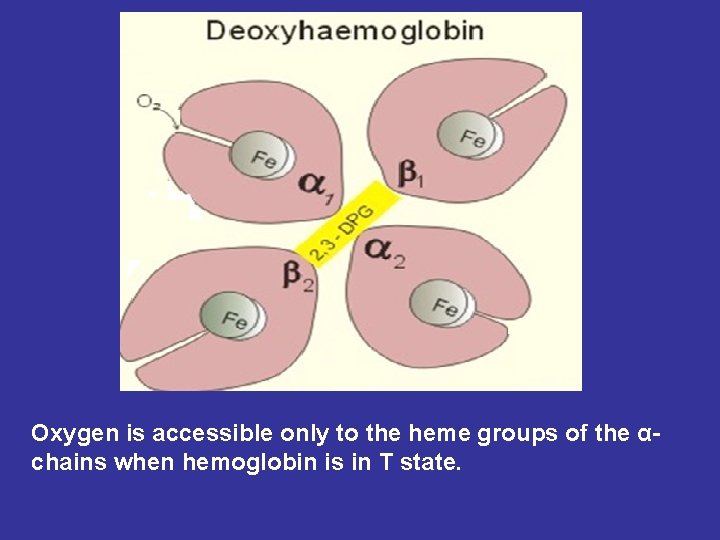
Oxygen is accessible only to the heme groups of the αchains when hemoglobin is in T state.
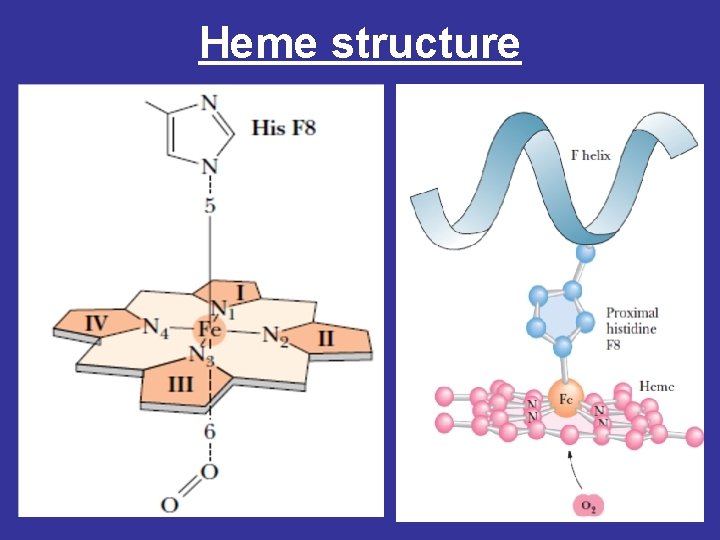
Heme structure
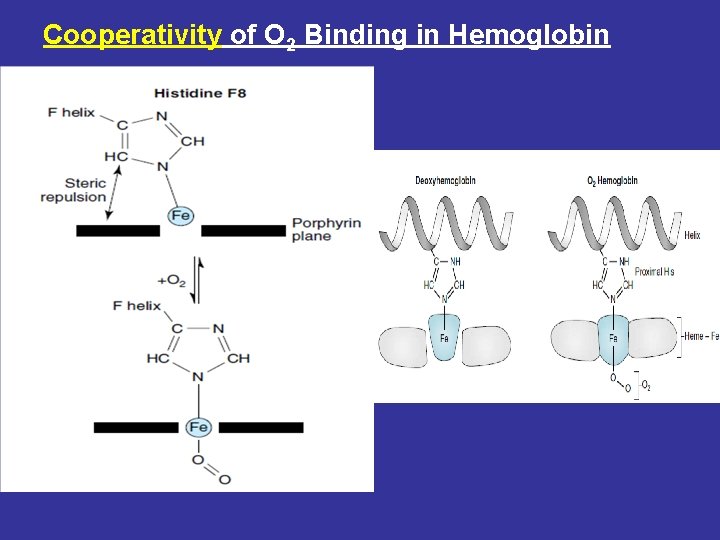
Cooperativity of O 2 Binding in Hemoglobin
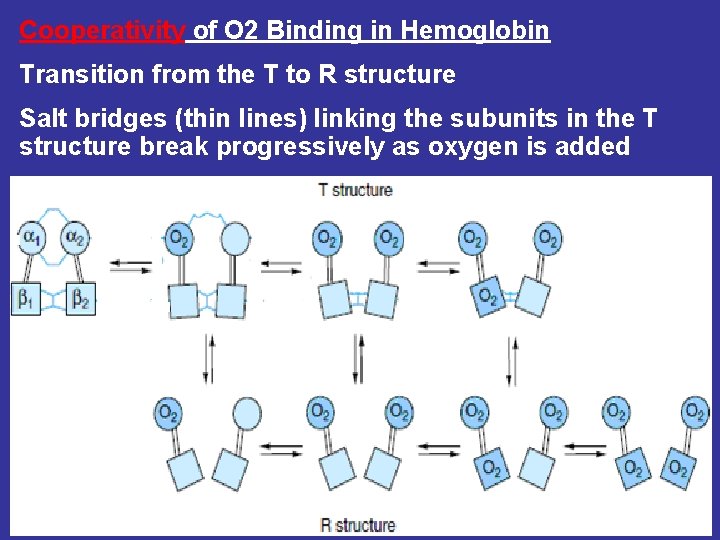
Cooperativity of O 2 Binding in Hemoglobin Transition from the T to R structure Salt bridges (thin lines) linking the subunits in the T structure break progressively as oxygen is added
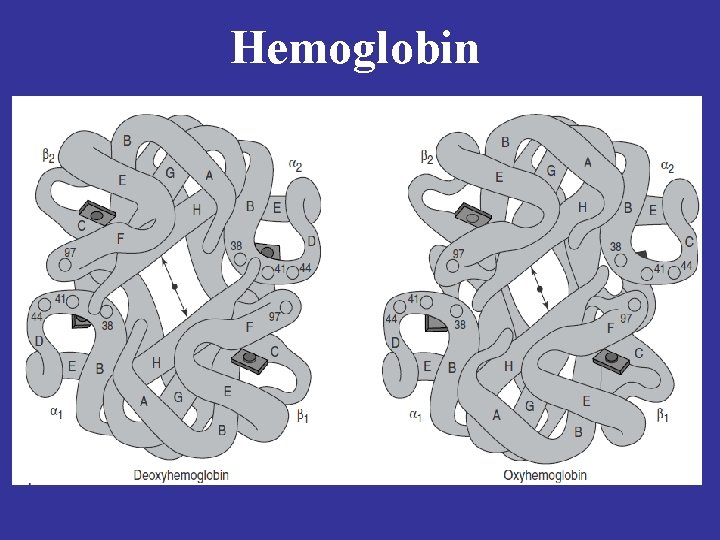
Hemoglobin
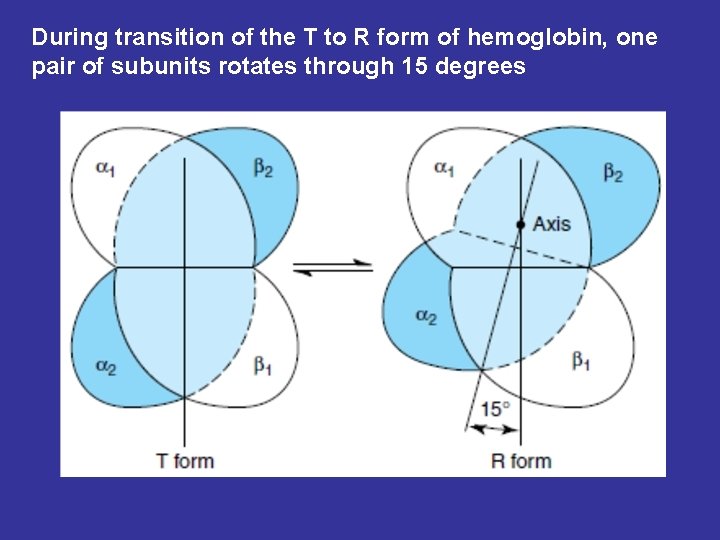
During transition of the T to R form of hemoglobin, one pair of subunits rotates through 15 degrees
Oxygen dissociation curve • Describes the relation between the partial pressure of oxygen (x axis) and the oxygen saturation (y axis) • The oxygen saturation is the ratio of the amount of oxygen bound to the hemoglobin, to the oxygen carrying capacity of the hemoglobin • The amount of oxygen bound to the hemoglobin is related to the O 2 pressure • Hemoglobin's affinity for oxygen increases as more molecules of oxygen bind • The curve has a sigmoidal or S-shape
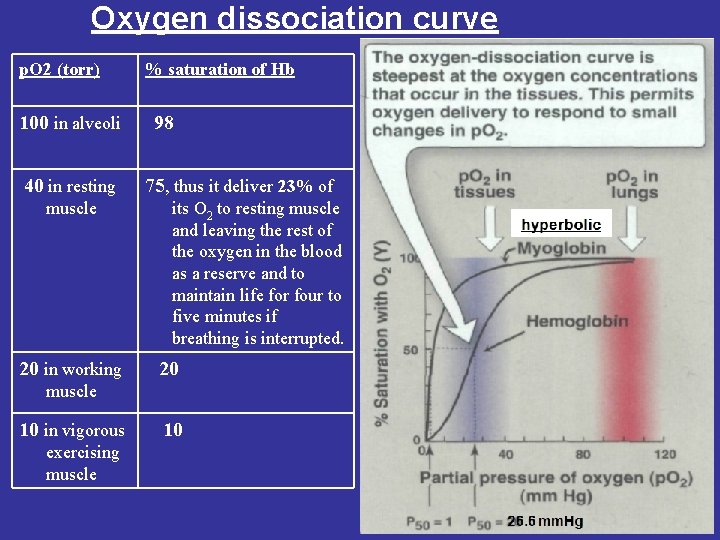
Oxygen dissociation curve p. O 2 (torr) 100 in alveoli 40 in resting muscle 20 in working % saturation of Hb 98 75, thus it deliver 23% of its O 2 to resting muscle and leaving the rest of the oxygen in the blood as a reserve and to maintain life for four to five minutes if breathing is interrupted. 20 muscle 10 in vigorous exercising muscle 10
• Cooperativity Hb-O 2 • Sigmoidal Hb • Hyperbolic Mb
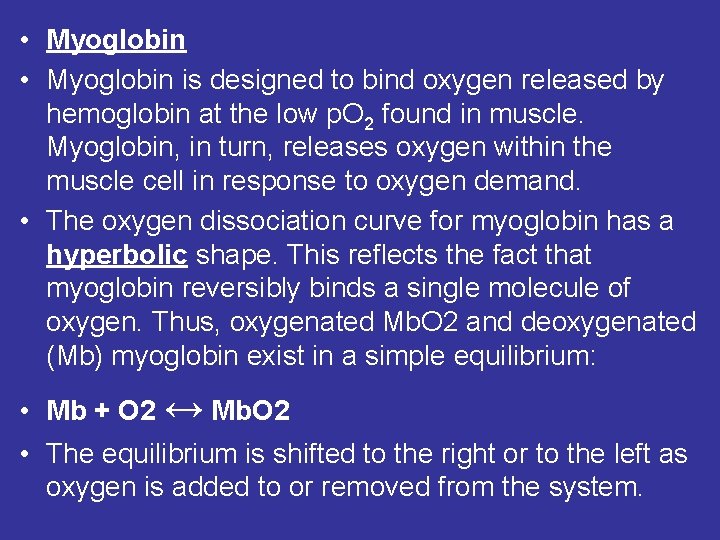
• Myoglobin is designed to bind oxygen released by hemoglobin at the low p. O 2 found in muscle. Myoglobin, in turn, releases oxygen within the muscle cell in response to oxygen demand. • The oxygen dissociation curve for myoglobin has a hyperbolic shape. This reflects the fact that myoglobin reversibly binds a single molecule of oxygen. Thus, oxygenated Mb. O 2 and deoxygenated (Mb) myoglobin exist in a simple equilibrium: • Mb + O 2 ↔ Mb. O 2 • The equilibrium is shifted to the right or to the left as oxygen is added to or removed from the system.
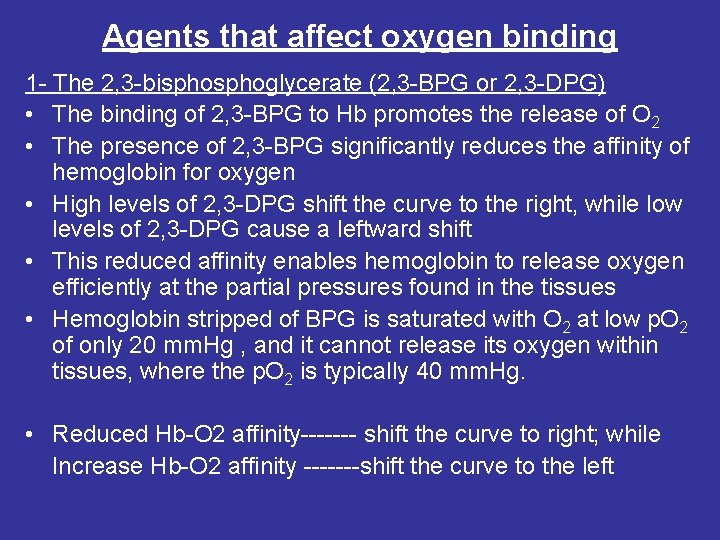
Agents that affect oxygen binding 1 - The 2, 3 -bisphoglycerate (2, 3 -BPG or 2, 3 -DPG) • The binding of 2, 3 -BPG to Hb promotes the release of O 2 • The presence of 2, 3 -BPG significantly reduces the affinity of hemoglobin for oxygen • High levels of 2, 3 -DPG shift the curve to the right, while low levels of 2, 3 -DPG cause a leftward shift • This reduced affinity enables hemoglobin to release oxygen efficiently at the partial pressures found in the tissues • Hemoglobin stripped of BPG is saturated with O 2 at low p. O 2 of only 20 mm. Hg , and it cannot release its oxygen within tissues, where the p. O 2 is typically 40 mm. Hg. • Reduced Hb-O 2 affinity------- shift the curve to right; while Increase Hb-O 2 affinity -------shift the curve to the left
• The concentration of 2, 3 -BPG in the red blood cell increases in response to chronic hypoxia, such as that observed in obstructive pulmonary emphysema, or at high altitudes, where circulating hemoglobin may have difficulty receiving sufficient oxygen. • Intracellular levels of 2, 3 -BPG are also elevated in chronic anaemia, in which fewer than normal red blood cells are available to supply the body's oxygen needs. • Elevated 2, 3 -BPG levels lower the oxygen affinity of hemoglobin, permitting greater unloading of oxygen in the capillaries of the tissues
• 2 - Bohr effect • The binding of protons by hemoglobin lowers its affinity for oxygen therefore, a shift to the right in the oxygen dissociation curve. • Raising the p. H or lowering the concentration of CO 2 results in a greater affinity for oxygen, and a shift to the left in the oxygen dissociation curve. • This phenomenon is known as the Bohr effect. • The p. H of the blood decreases as it enters the tissues because of CO 2 produced by metabolism. • Protons that react with several amino acid residues in hemoglobin (such as histidine side chains), causing conformational changes that promote the release of oxygen. • Thus, in tissues in which the p. H of the blood is low because of the CO 2 produced by metabolism, oxygen is released from hemoglobin.
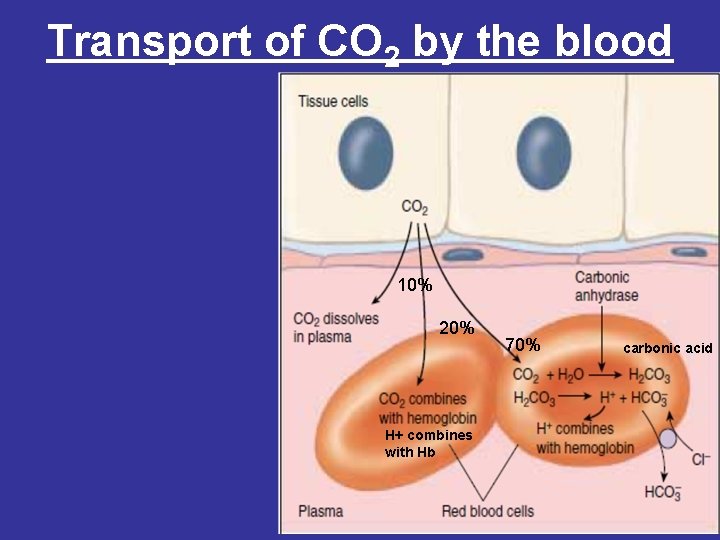
Transport of CO 2 by the blood 10% 20% H+ combines with Hb 70% carbonic acid
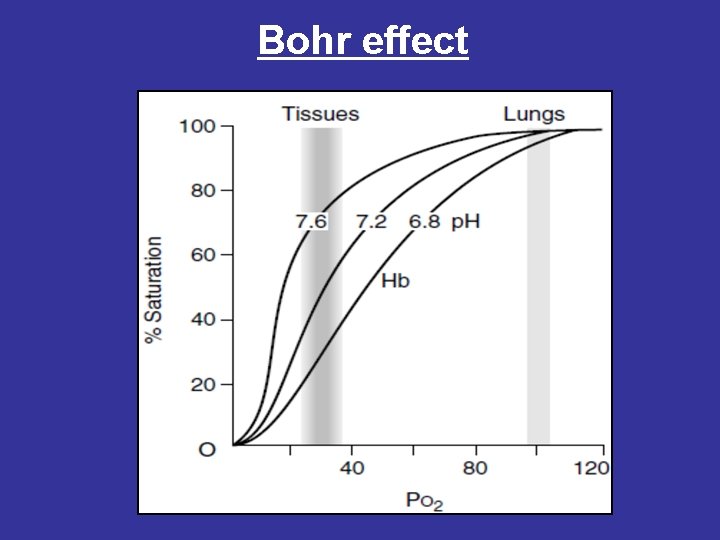
Bohr effect
• 3 - Binding of CO 2 • 20% of CO 2 is carried as carbamino- hemoglobin bound to the uncharged α-amino groups of hemoglobin, which can be represented schematically as follows: Hb-NH 2 + CO 2 ↔ Hb-NH-COO- + H+ • The binding of CO 2 stabilizes the T (taut) or deoxyhemoglobin, resulting in a decrease in its affinity for oxygen. • Hemoglobin resists oxygenation because the deoxy form is stabilized by specific hydrogen bonds and salt bridges (ion-pair bonds). All of these interactions are broken in oxyhemoglobin, as the molecule stabilizes into a new conformation.
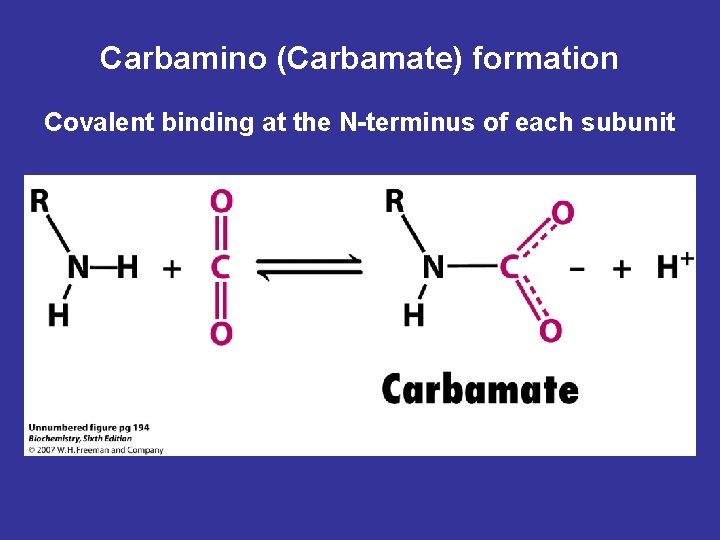
Carbamino (Carbamate) formation Covalent binding at the N-terminus of each subunit
• Myoglobin • as an oxygen storage protein, has a greater affinity for O 2 than hemoglobin at all oxygen pressures. • Hemoglobin, as the oxygen carrier, becomes saturated with O 2 in the lungs, where the partial pressure of O 2 (p. O 2) is about 100 torr. In the capillaries of tissues, p. O 2 is typically 40 torr so oxygen is released from Hb.
Atmospheric air consists primarily of nitrogen (approximately 79 percent) and oxygen (approximately 21 percent), with very small quantities of water vapour, carbon dioxide, and inert gases. The sum of the partial pressures of all these gases is termed atmospheric pressure, or barometric pressure. It varies in different parts of the world as a result of differences in altitude (it also varies with local weather conditions), but at sea level it is 760 mm. Hg. Since the partial pressure of any gas in a mixture is the fractional concentration of that gas times the total pressure of all the gases, the PO 2 of atmospheric air is 0. 21 X 760 mm. Hg = 160 mm. Hg at sea level.
- Slides: 20