
OXIDATIVE PHOSPHORYLATION Biochemistry Departement Medical Faculty Of Andalas
OXIDATIVE PHOSPHORYLATION Biochemistry Departement Medical Faculty Of Andalas University Padang
Organisme Autotrofik • • • Artinya memberi makan diri sendiri. Organisme ini memperoleh pasokan energi bebas melalui perangkaian metabolismenya dgn proses eksergonik sederhana tertentu dalam lingkungan sekitarnya. Contoh; Tumbuhan hijau menggunakan energi dari cahaya matahari untuk fotosintesis. 2

Organisme Heterotrofik • • • Artinya tidak mencukupi diri sendiri. Adalah organisme yang memperoleh pasokan energi bebas melalui perangkaian metabolismenya dgn pemecahan molekul organik komplek dalam lingkungannya. Pada proses ini, ATP (Adenosin Trifosfat) berperan dalam pemindahan energi bebas dari proses eksergonik kepada proses endergonik. 3
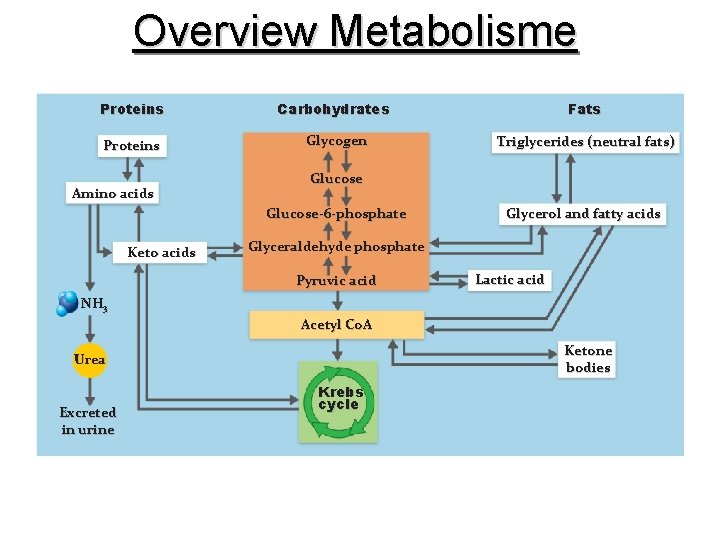
Overview Metabolisme Proteins Carbohydrates Fats Proteins Glycogen Triglycerides (neutral fats) Amino acids Glucose-6 -phosphate Keto acids Glycerol and fatty acids Glyceraldehyde phosphate Pyruvic acid Lactic acid NH 3 Acetyl Co. A Ketone bodies Urea Excreted in urine Krebs cycle
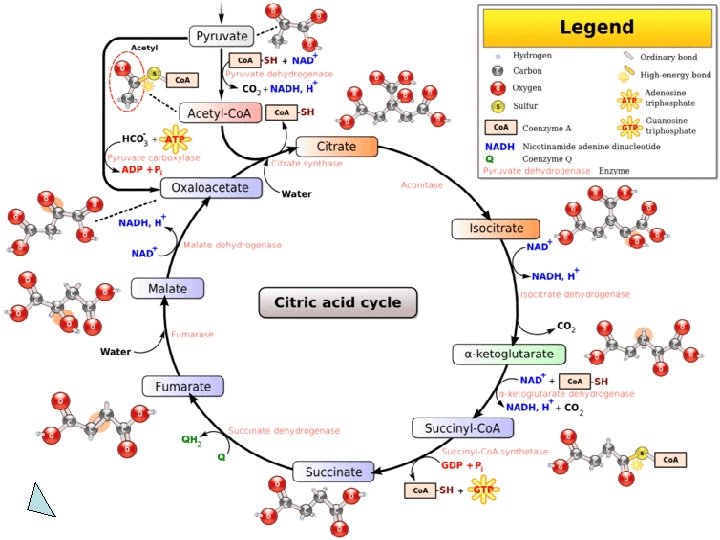
Sumber Utama P-berenergi-tinggi 1. Fosforilasi oksidasi; -Sumber P terbesar dlm organisme aerobik. -Energi bebasnya berasal dari oksidasi rantai respirasi. 2. Glikolisis; -Pembentukan dua P dari hasil katalisis fosfogliserat kinase & piruvat kinase. 3. Daur Krebs; -Satu P-berenergi-tinggi dibentuk pada tahap suksinil tiokinase. 5
Energi • Oxidation of fuels to generate ATP is called respiration • Electrons lost from the fuels during oxidative reactions : transferred to O 2 by a series of proteins in the electron transport chain • Energy of electron transfer : used to convert ADP and Pi to ATP by a process known as oxidative phosphorylation
Adenosin Trifosfat (ATP) • • Adalah nukleotida trifosfat yg mengandung adenin, ribosa, & 3 gugus fosfat. Agar dapat bekerja, ATP membentuk komplek Mg 2+. ATP mengandung 2 gugus fosfat-berenergi tinggi & sebuah fosfat berenergi-rendah (ikatan ester biasa). Gugus fosfat berenergi-tinggi dilambangkan sebagai P 7
Siklus ATP/ADP • • • Berperan untuk menghubungkan proses yg menghasilkan P-berenergi-tinggi dgn proses yg menggunakan P-berenergitinggi. ATP dikonsumsi & dibentuk kembali secara kontinu. Depot ATP/ADP sangat kecil, sehingga hanya cukup untuk mempertahankan jaringan aktif dlm waktu beberapa detik saja. 8
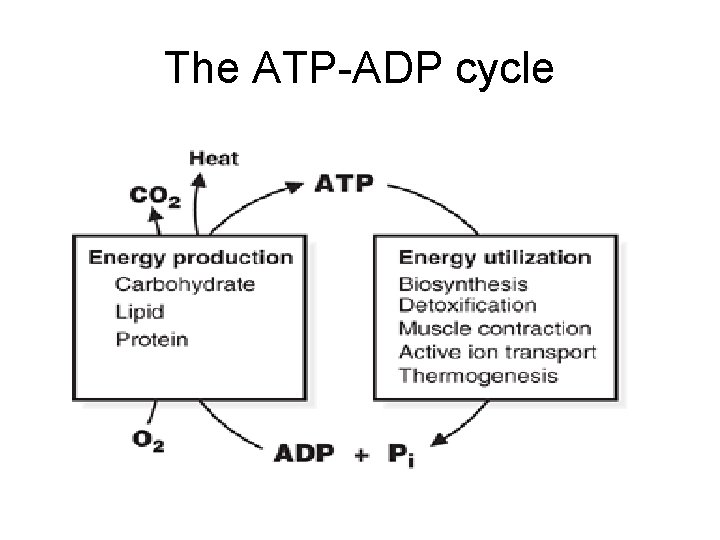
The ATP-ADP cycle

Generation of ATP
11
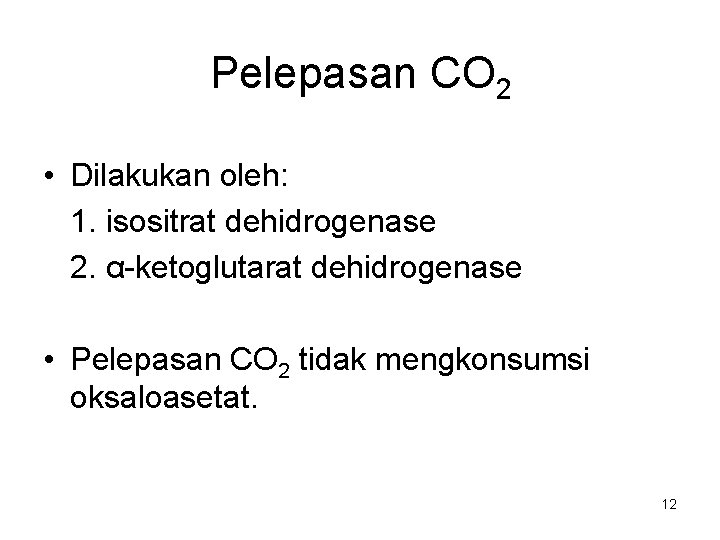
Pelepasan CO 2 • Dilakukan oleh: 1. isositrat dehidrogenase 2. α-ketoglutarat dehidrogenase • Pelepasan CO 2 tidak mengkonsumsi oksaloasetat. 12
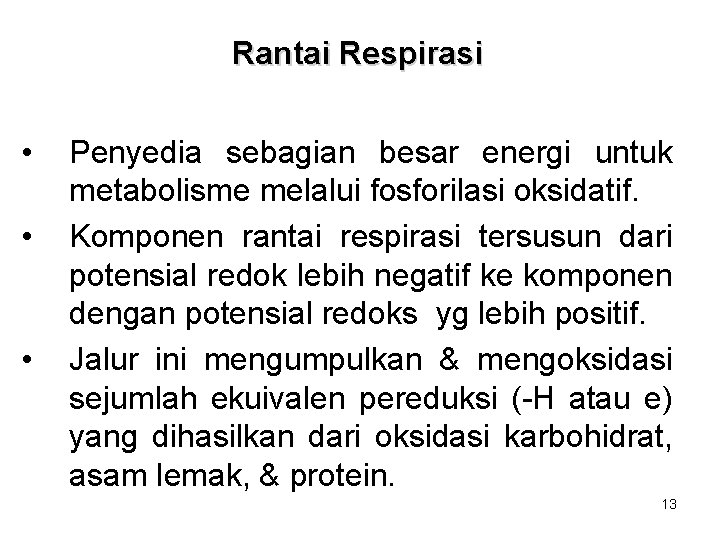
Rantai Respirasi • • • Penyedia sebagian besar energi untuk metabolisme melalui fosforilasi oksidatif. Komponen rantai respirasi tersusun dari potensial redok lebih negatif ke komponen dengan potensial redoks yg lebih positif. Jalur ini mengumpulkan & mengoksidasi sejumlah ekuivalen pereduksi (-H atau e) yang dihasilkan dari oksidasi karbohidrat, asam lemak, & protein. 13
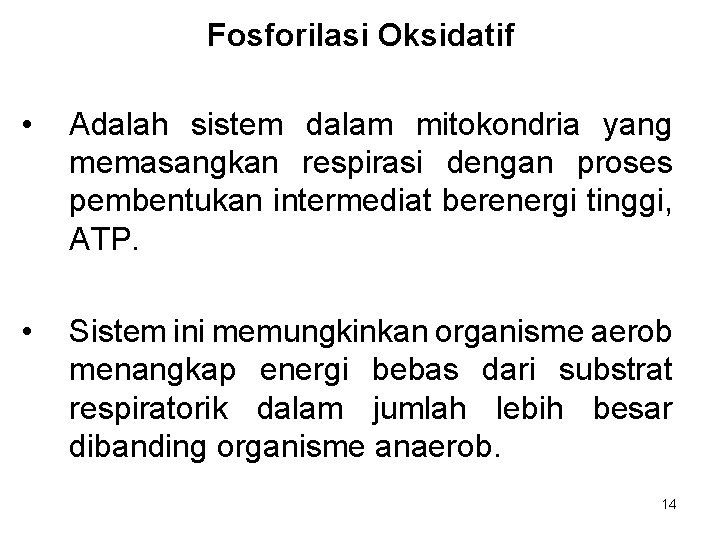
Fosforilasi Oksidatif • Adalah sistem dalam mitokondria yang memasangkan respirasi dengan proses pembentukan intermediat berenergi tinggi, ATP. • Sistem ini memungkinkan organisme aerob menangkap energi bebas dari substrat respiratorik dalam jumlah lebih besar dibanding organisme anaerob. 14
Electron Transport chain (respiratory chain) • The electron transport chain in the inner mitochondrial membrane can be isolated in four proteins complexes(I, III, IV). • A lipid soluble coenzyme (Q) and a water soluble protein (cyt c) shuttle between protein complexes • Electrons transfer through the chain - from complexes I and II to complex IV
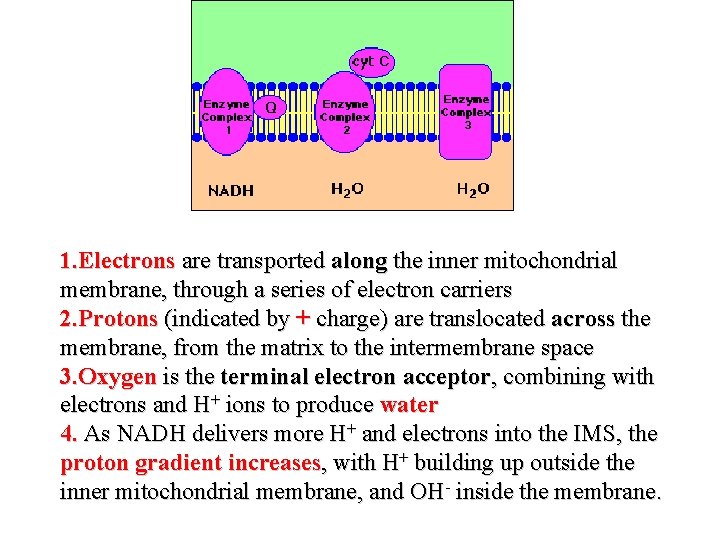
1. Electrons are transported along the inner mitochondrial membrane, through a series of electron carriers 2. Protons (indicated by + charge) are translocated across the membrane, from the matrix to the intermembrane space 3. Oxygen is the terminal electron acceptor, combining with electrons and H+ ions to produce water 4. As NADH delivers more H+ and electrons into the IMS, the proton gradient increases, with H+ building up outside the inner mitochondrial membrane, and OH- inside the membrane.
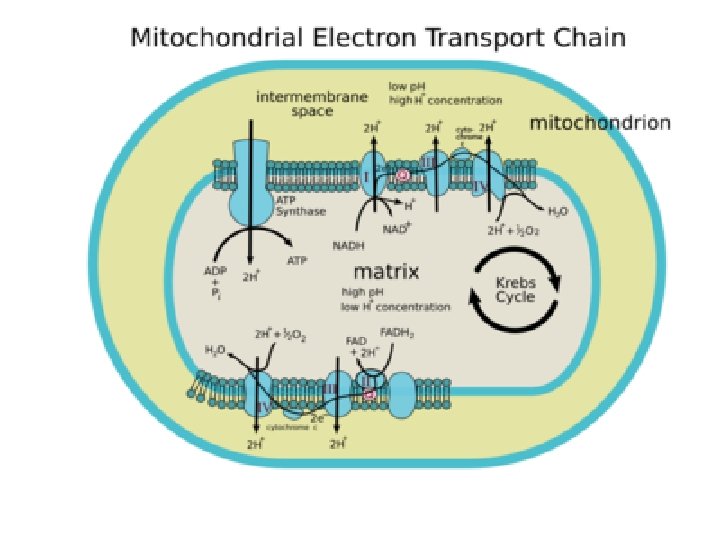
17
Produk ATP pada Fosforilasi Oksidatif Berdasarkan hipotesis kimiosmotik dari Mitchell yaitu; rantai bekerja --> proton dipompa keluar dari membran dlm mitokondria --> p. H antar membran turun --> proton balik ke dalam matrik lewat tonjolan ATP-sintase--> fosforilasi ADP menjadi ATP. 18
Produk ATP pada Fosforilasi Oksidatif • • • Diperkirakan satu ATP disintesis setiap dua proton melewati tonjolan tsb. Hasilnya ialah; - 3 mol. ATP utk oksidasi 1 mol. NADH - 2 mol. ATP utk oksidasi 1 mol. FADH 2 Laju fosforilasi oksidatif dikendalikan oleh; NADH, oksigen, ADP 19
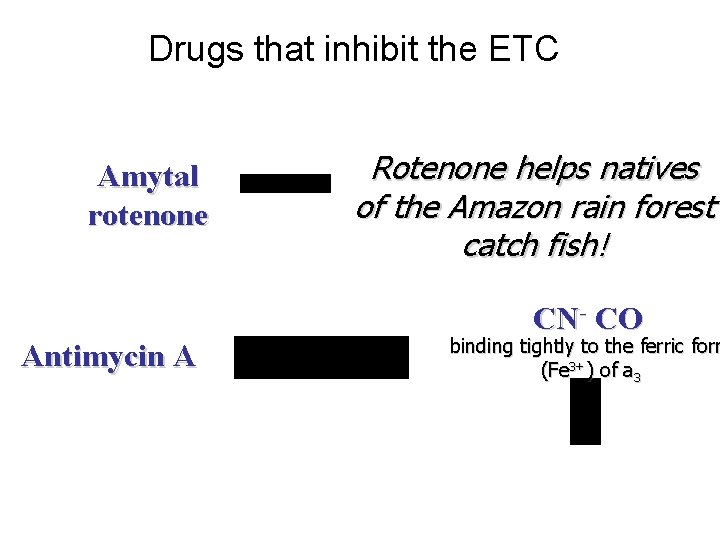
Drugs that inhibit the ETC Amytal rotenone Rotenone helps natives of the Amazon rain forest catch fish! CN- CO Antimycin A binding tightly to the ferric form (Fe 3+) of a 3
Resources • BIOEN 589: Integrative Physiology. Download 24 jan 05. • Kennelly, PJ. , Rodwell, V W. Proteins: Myoglobin & Hemoglobin. In: Harper’s Illustrated Biochemistry. 27 th Ed. 41 - 8. • Miliefsky, M. Respiratory System Ch. 23. Download 24 Nov 10. • Sheardown, H. Blood Biochemistry. Mc. Master University. Download 20 Mei 07. • Irvin, CG. Respiratory Physiology. Lecture 4 A CO 2 Transport. In: MEDICAL PHYSIOLOGY 30. Download 22 Jun 09. • Marks, DB. , Marks, AD. , Smith CM. Basic medical biochemistry: a clinical approach. 1996. Dalam: B. U. Pendit, penerjemah. Biokimia Kedokteran Dasar: Sebuah Pendekatan Klinis. Eds. J. Suyono. , V. Sadikin. , L. I. Mandera. Jakarta: EGC, 2000 • R. K. Murray, D. K. Granner, P. A. Mayes, V. W. Rodwell Harper’s Biochemistry. 27 th ed. Mc. Graw-Hill Companies, New York. 2006. 21
- Slides: 21