
Oxidative Addition Simultaneous introduction of a pair of
- Slides: 9
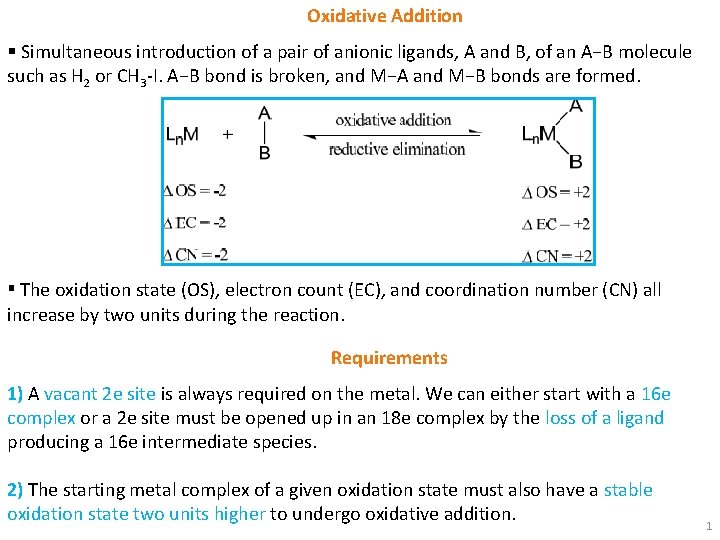
Oxidative Addition § Simultaneous introduction of a pair of anionic ligands, A and B, of an A−B molecule such as H 2 or CH 3‐I. A−B bond is broken, and M−A and M−B bonds are formed. ▪ The oxidation state (OS), electron count (EC), and coordination number (CN) all increase by two units during the reaction. Requirements 1) A vacant 2 e site is always required on the metal. We can either start with a 16 e complex or a 2 e site must be opened up in an 18 e complex by the loss of a ligand producing a 16 e intermediate species. 2) The starting metal complex of a given oxidation state must also have a stable oxidation state two units higher to undergo oxidative addition. 1
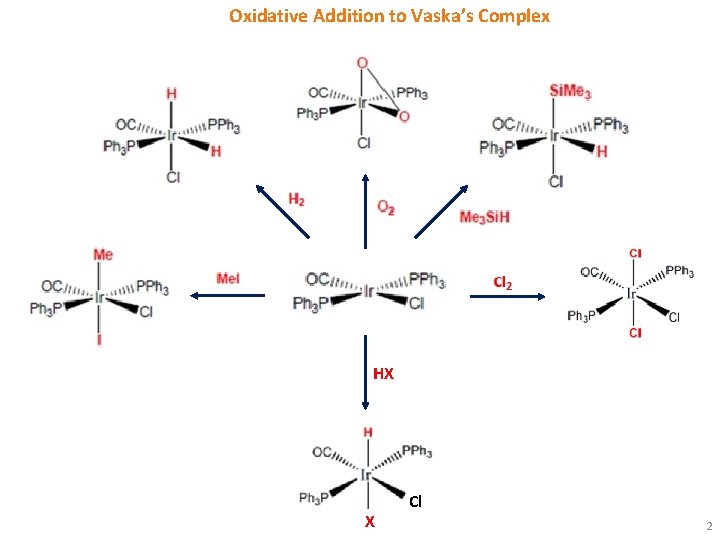
Oxidative Addition to Vaska’s Complex HX X Cl 2
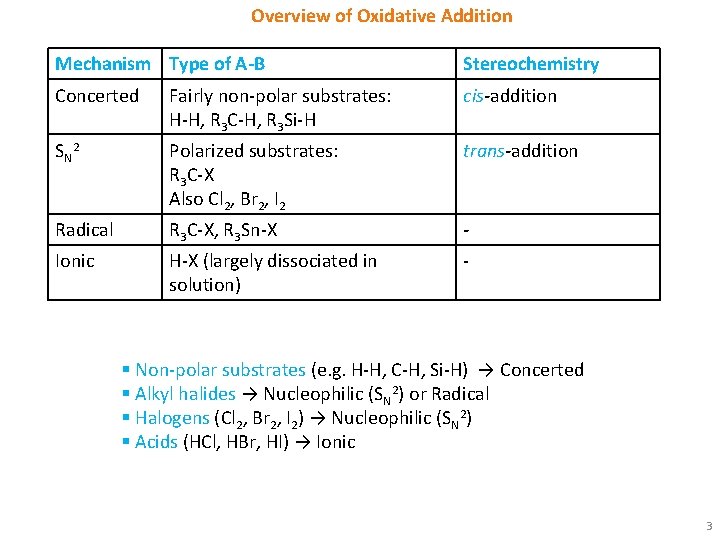
Overview of Oxidative Addition Mechanism Type of A‐B Stereochemistry Concerted Fairly non‐polar substrates: H‐H, R 3 C‐H, R 3 Si‐H cis-addition SN 2 Polarized substrates: R 3 C‐X Also Cl 2, Br 2, I 2 trans-addition Radical R 3 C‐X, R 3 Sn‐X - Ionic H‐X (largely dissociated in solution) ‐ § Non‐polar substrates (e. g. H‐H, C‐H, Si‐H) → Concerted § Alkyl halides → Nucleophilic (SN 2) or Radical § Halogens (Cl 2, Br 2, I 2) → Nucleophilic (SN 2) § Acids (HCl, HBr, HI) → Ionic 3
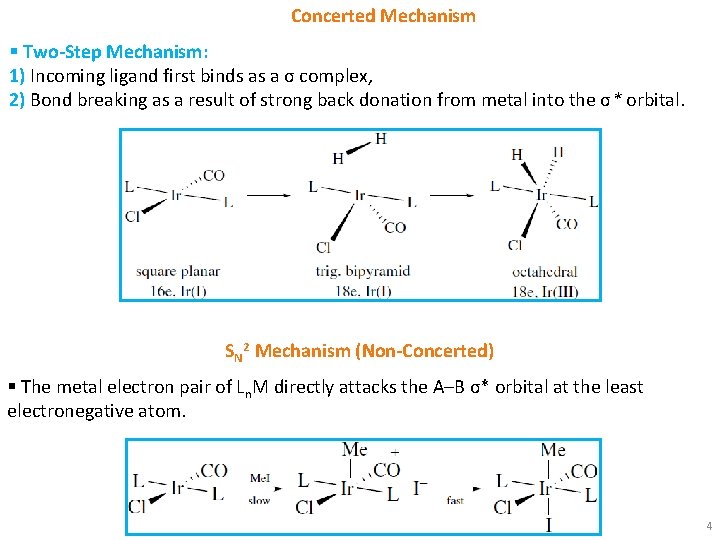
Concerted Mechanism § Two‐Step Mechanism: 1) Incoming ligand first binds as a σ complex, 2) Bond breaking as a result of strong back donation from metal into the σ* orbital. SN 2 Mechanism (Non‐Concerted) § The metal electron pair of Ln. M directly attacks the A–B σ* orbital at the least electronegative atom. 4
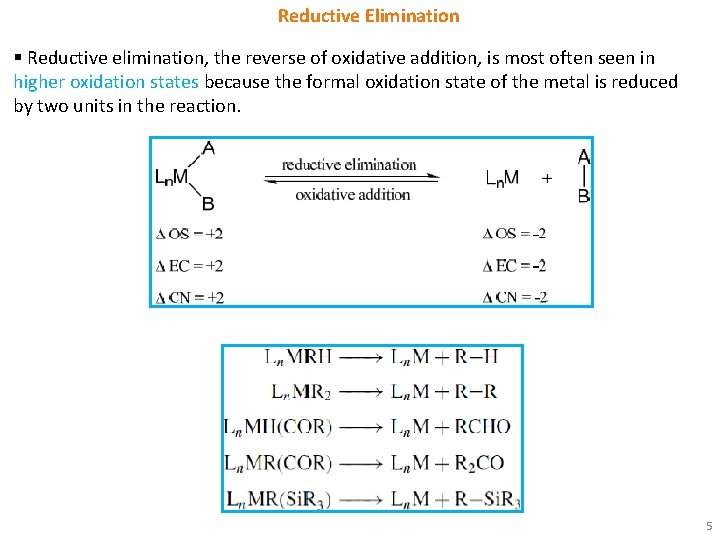
Reductive Elimination § Reductive elimination, the reverse of oxidative addition, is most often seen in higher oxidation states because the formal oxidation state of the metal is reduced by two units in the reaction. 5
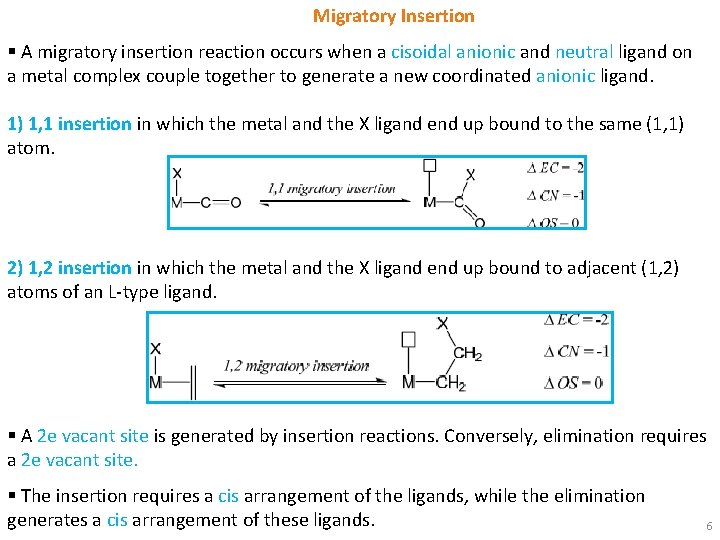
Migratory Insertion § A migratory insertion reaction occurs when a cisoidal anionic and neutral ligand on a metal complex couple together to generate a new coordinated anionic ligand. 1) 1, 1 insertion in which the metal and the X ligand end up bound to the same (1, 1) atom. 2) 1, 2 insertion in which the metal and the X ligand end up bound to adjacent (1, 2) atoms of an L‐type ligand. § A 2 e vacant site is generated by insertion reactions. Conversely, elimination requires a 2 e vacant site. § The insertion requires a cis arrangement of the ligands, while the elimination generates a cis arrangement of these ligands. 6
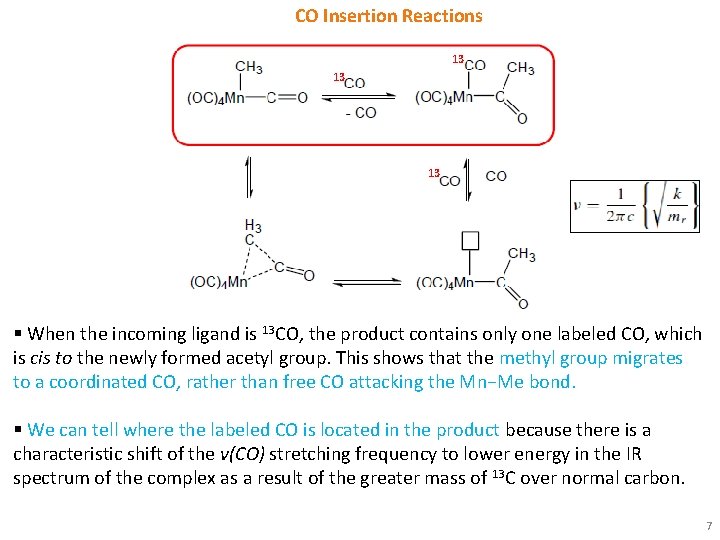
CO Insertion Reactions 13 13 13 § When the incoming ligand is 13 CO, the product contains only one labeled CO, which is cis to the newly formed acetyl group. This shows that the methyl group migrates to a coordinated CO, rather than free CO attacking the Mn−Me bond. § We can tell where the labeled CO is located in the product because there is a characteristic shift of the ν(CO) stretching frequency to lower energy in the IR spectrum of the complex as a result of the greater mass of 13 C over normal carbon. 7
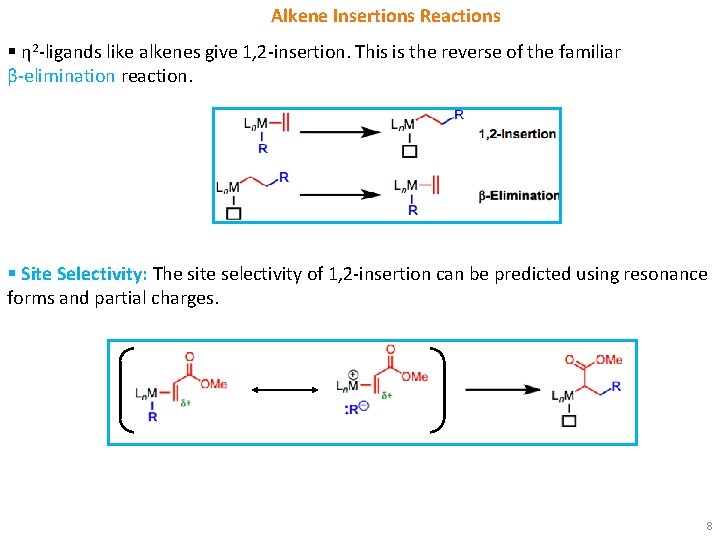
Alkene Insertions Reactions § η 2‐ligands like alkenes give 1, 2‐insertion. This is the reverse of the familiar β‐elimination reaction. § Site Selectivity: The site selectivity of 1, 2‐insertion can be predicted using resonance forms and partial charges. 8
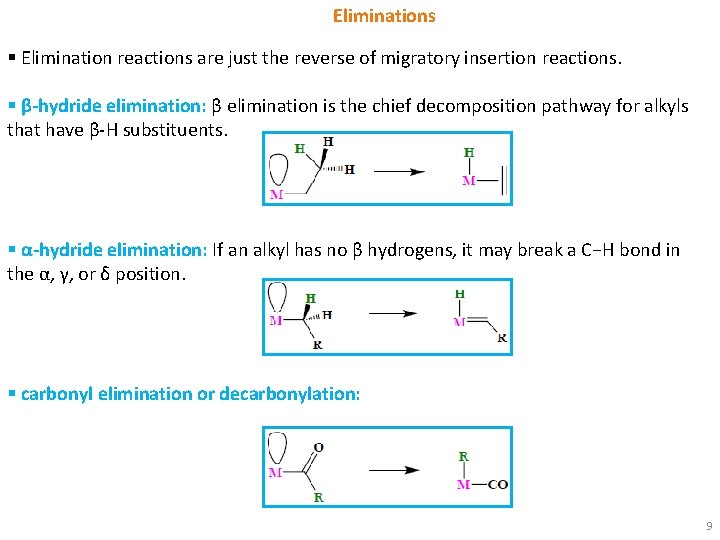
Eliminations § Elimination reactions are just the reverse of migratory insertion reactions. § β‐hydride elimination: β elimination is the chief decomposition pathway for alkyls that have β‐H substituents. § α‐hydride elimination: If an alkyl has no β hydrogens, it may break a C−H bond in the α, γ, or δ position. § carbonyl elimination or decarbonylation: 9