
Oxidation States Inorganic chemistry Oxidation is a loss
- Slides: 13
Oxidation States • Inorganic chemistry: – Oxidation is a loss of electrons. – Reduction is a gain of electrons. • Organic chemistry – Oxidation: Gain of O, O 2, or X 2; loss of H 2 – Reduction: Gain of H 2 (or H–); loss of O or O 2; and loss of X 2 – Neither: The gain or loss of H+, H 2 O, –OH, HX, etc. is neither an oxidation nor a reduction. © 2017 Pearson Education, Inc.
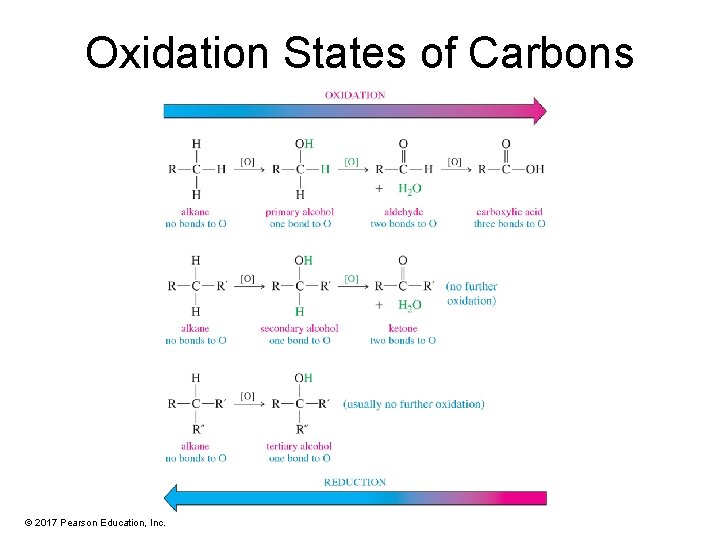
Oxidation States of Carbons © 2017 Pearson Education, Inc.
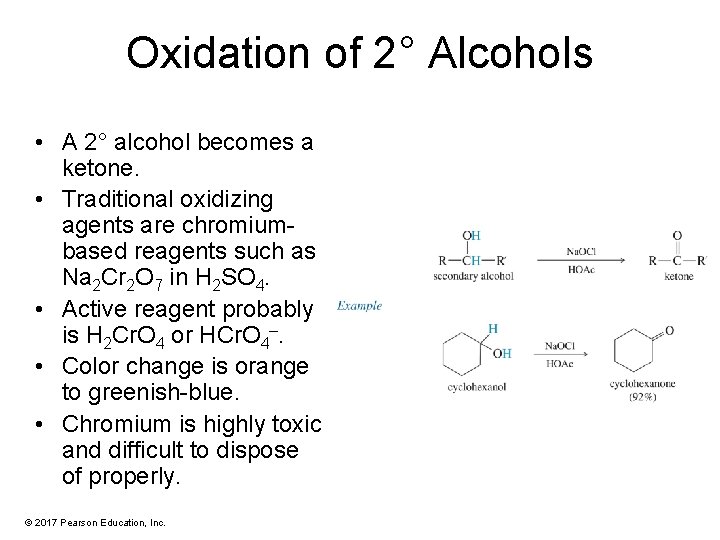
Oxidation of 2° Alcohols • A 2° alcohol becomes a ketone. • Traditional oxidizing agents are chromiumbased reagents such as Na 2 Cr 2 O 7 in H 2 SO 4. • Active reagent probably is H 2 Cr. O 4 or HCr. O 4–. • Color change is orange to greenish-blue. • Chromium is highly toxic and difficult to dispose of properly. © 2017 Pearson Education, Inc.
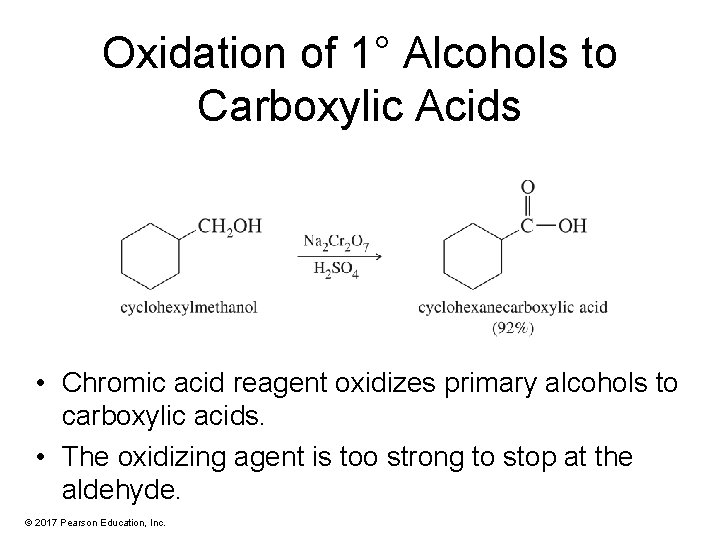
Oxidation of 1° Alcohols to Carboxylic Acids • Chromic acid reagent oxidizes primary alcohols to carboxylic acids. • The oxidizing agent is too strong to stop at the aldehyde. © 2017 Pearson Education, Inc.
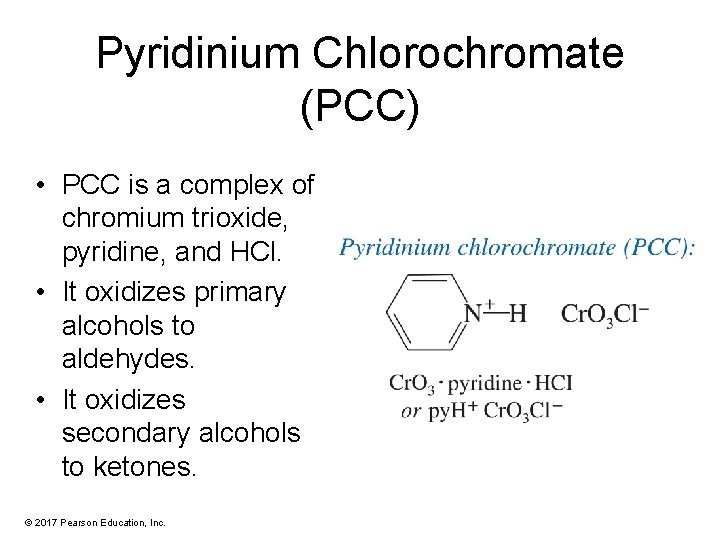
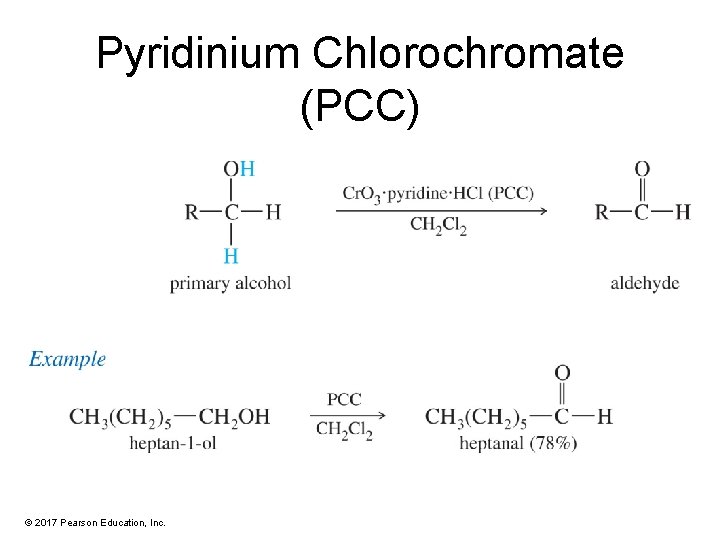
Pyridinium Chlorochromate (PCC) • PCC is a complex of chromium trioxide, pyridine, and HCl. • It oxidizes primary alcohols to aldehydes. • It oxidizes secondary alcohols to ketones. © 2017 Pearson Education, Inc.
Pyridinium Chlorochromate (PCC) © 2017 Pearson Education, Inc.
3° Alcohols Cannot Be Oxidized • Carbon does not have hydrogen, so oxidation is difficult and involves the breakage of a C—C bond. • Chromic acid test is for primary and secondary alcohols because tertiary alcohols do not react. © 2017 Pearson Education, Inc.
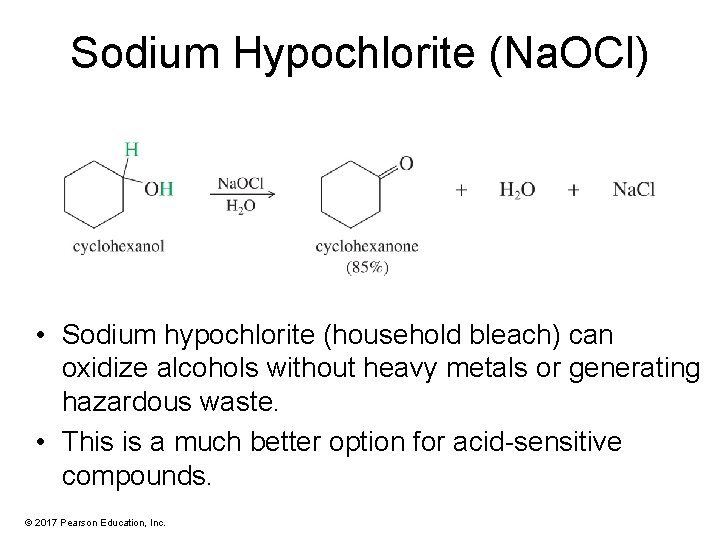
Sodium Hypochlorite (Na. OCl) • Sodium hypochlorite (household bleach) can oxidize alcohols without heavy metals or generating hazardous waste. • This is a much better option for acid-sensitive compounds. © 2017 Pearson Education, Inc.
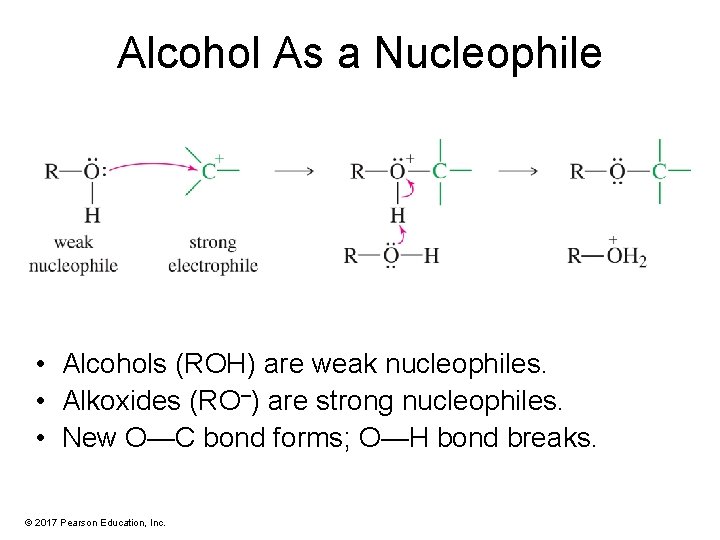
Alcohol As a Nucleophile • Alcohols (ROH) are weak nucleophiles. • Alkoxides (RO–) are strong nucleophiles. • New O—C bond forms; O—H bond breaks. © 2017 Pearson Education, Inc.
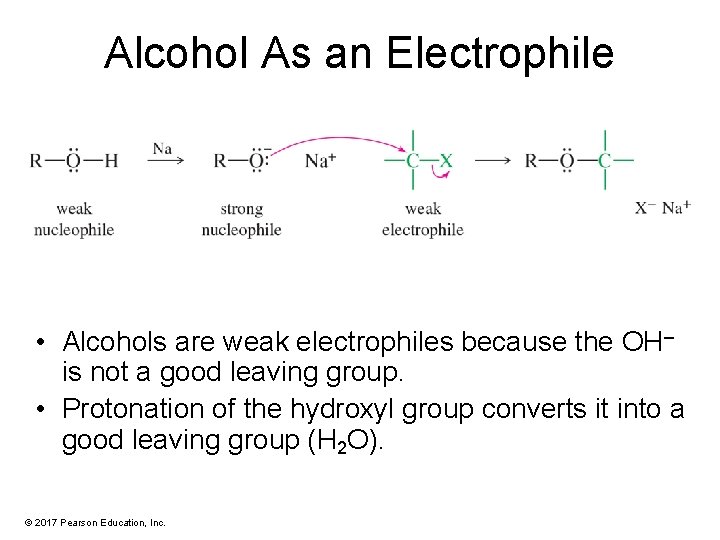
Alcohol As an Electrophile • Alcohols are weak electrophiles because the OH– is not a good leaving group. • Protonation of the hydroxyl group converts it into a good leaving group (H 2 O). © 2017 Pearson Education, Inc.
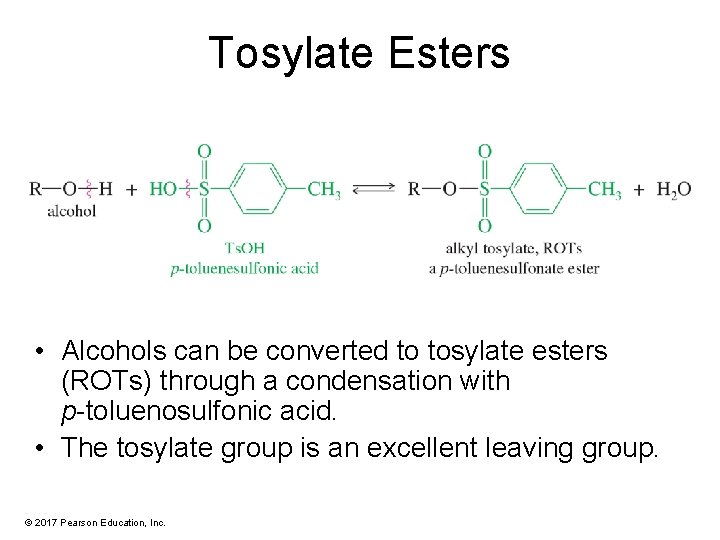
Tosylate Esters • Alcohols can be converted to tosylate esters (ROTs) through a condensation with p-toluenosulfonic acid. • The tosylate group is an excellent leaving group. © 2017 Pearson Education, Inc.
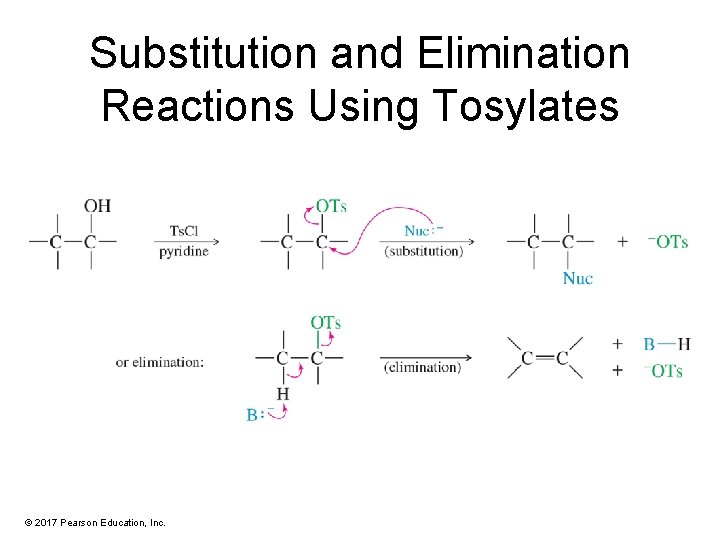
Substitution and Elimination Reactions Using Tosylates © 2017 Pearson Education, Inc.
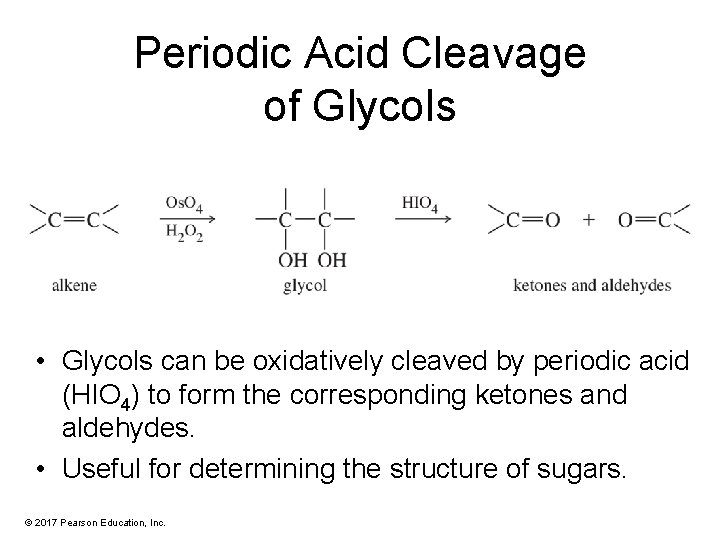
Periodic Acid Cleavage of Glycols • Glycols can be oxidatively cleaved by periodic acid (HIO 4) to form the corresponding ketones and aldehydes. • Useful for determining the structure of sugars. © 2017 Pearson Education, Inc.