
Oxidation States Effects of Polarity on Molecules n
- Slides: 10
Oxidation States
Effects of Polarity on Molecules n Polarity causes atoms in a molecule to have electrons for uneven amounts of time. n The atoms in a polar molecule act like they have a slight positive or slight negative charge.
What is an oxidation state? n An oxidation state is the slight positive or negative charge created in a polar molecule.
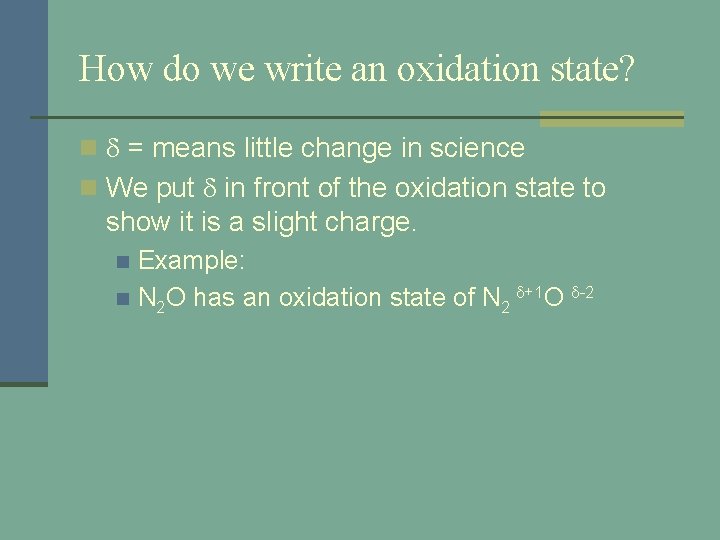
How do we write an oxidation state? n = means little change in science n We put in front of the oxidation state to show it is a slight charge. Example: n N 2 O has an oxidation state of N 2 +1 O -2 n
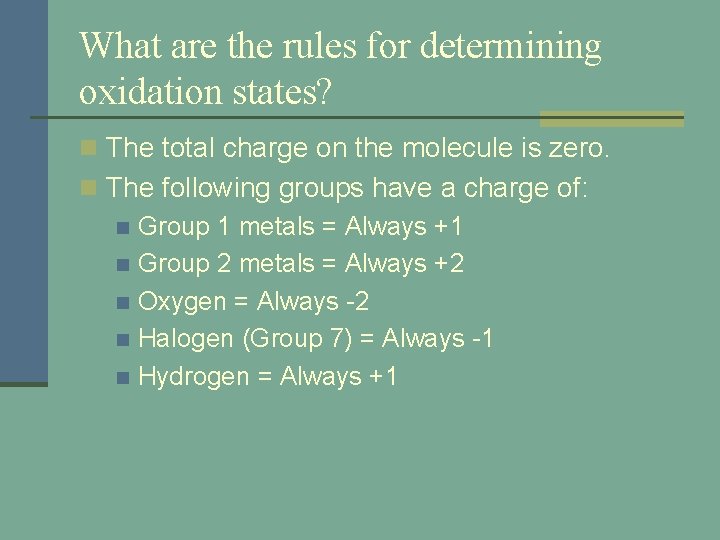
What are the rules for determining oxidation states? n The total charge on the molecule is zero. n The following groups have a charge of: n Group 1 metals = Always +1 n Group 2 metals = Always +2 n Oxygen = Always -2 n Halogen (Group 7) = Always -1 n Hydrogen = Always +1
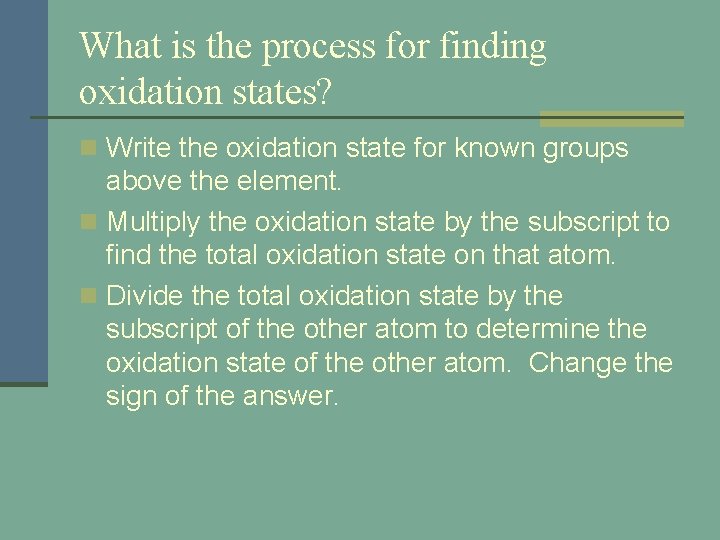
What is the process for finding oxidation states? n Write the oxidation state for known groups above the element. n Multiply the oxidation state by the subscript to find the total oxidation state on that atom. n Divide the total oxidation state by the subscript of the other atom to determine the oxidation state of the other atom. Change the sign of the answer.
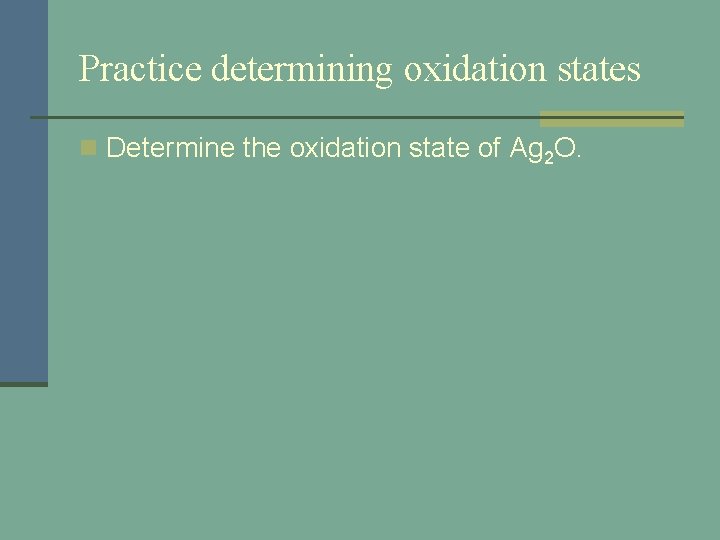
Practice determining oxidation states n Determine the oxidation state of Ag 2 O.
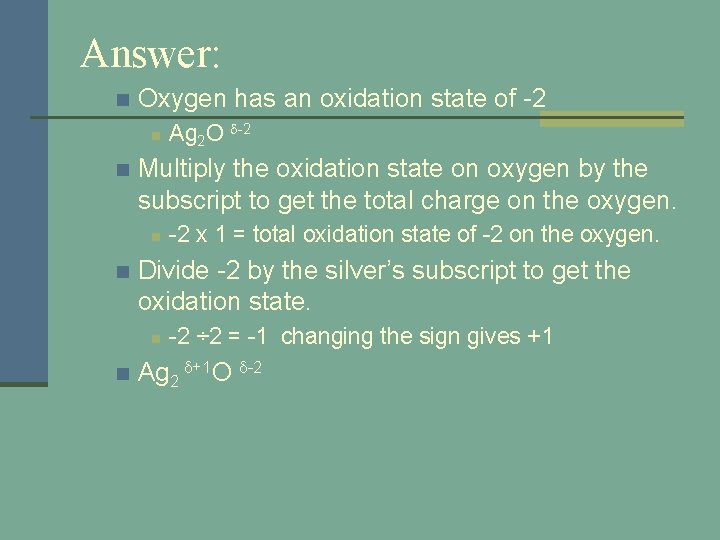
Answer: n Oxygen has an oxidation state of -2 n n Multiply the oxidation state on oxygen by the subscript to get the total charge on the oxygen. n n -2 x 1 = total oxidation state of -2 on the oxygen. Divide -2 by the silver’s subscript to get the oxidation state. n n Ag 2 O -2 -2 ÷ 2 = -1 changing the sign gives +1 Ag 2 +1 O -2
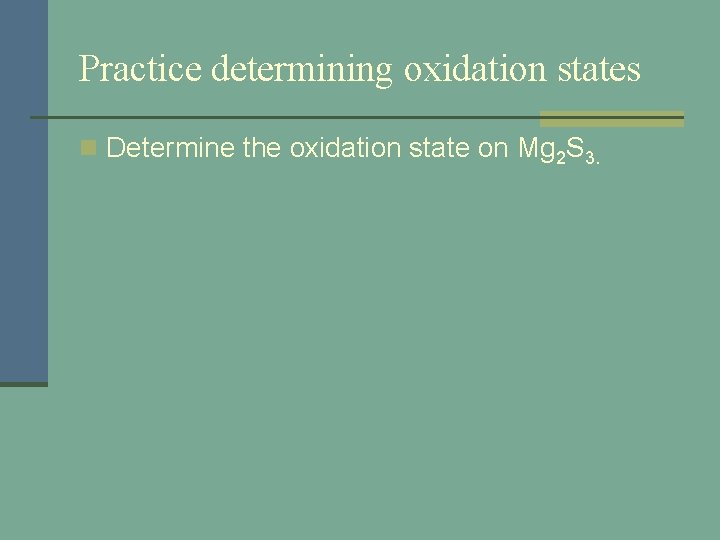
Practice determining oxidation states n Determine the oxidation state on Mg 2 S 3.
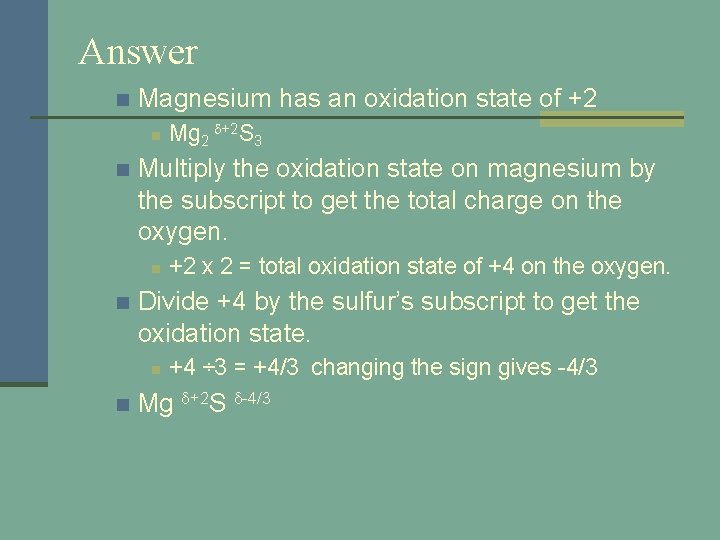
Answer n Magnesium has an oxidation state of +2 n n Multiply the oxidation state on magnesium by the subscript to get the total charge on the oxygen. n n +2 x 2 = total oxidation state of +4 on the oxygen. Divide +4 by the sulfur’s subscript to get the oxidation state. n n Mg 2 +2 S 3 +4 ÷ 3 = +4/3 changing the sign gives -4/3 Mg +2 S -4/3