
Oxidation Reduction Reactions n Oxidation numbers are values
+ Oxidation Reduction Reactions
+ n. Oxidation numbers are values that demonstrate the oxidation state of each atom. n. These values are assigned based on arbitrary rules agreed upon by chemists.

These rules are: + 1. Oxygen is the most attractive element (except fluorine) and always gains two electrons so it has an oxidation number of -2. Unless it is with fluorine and then has an oxidation number of +2. Or if it is in hydrogen peroxide and then has an oxidation number of -1. 2. Hydrogen is the least attractive element (except for metal hydrides, group I or II metals) and always has an oxidation number of +1. 3. Simple ions have an oxidation number equal to their charge.
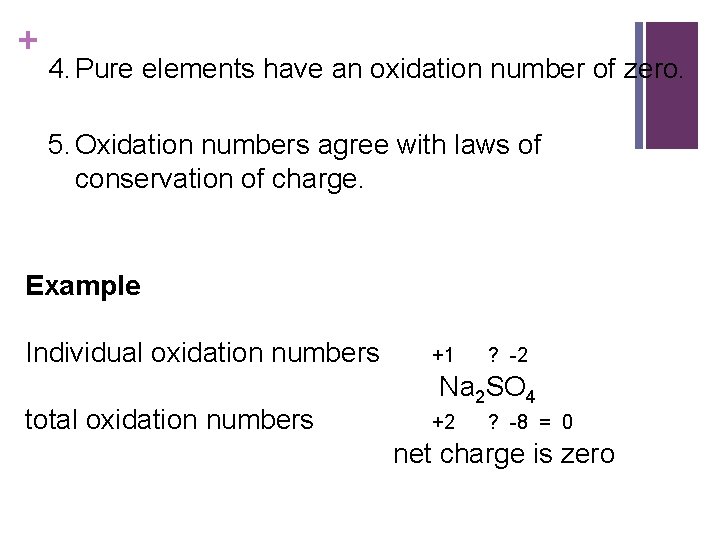
+ 4. Pure elements have an oxidation number of zero. 5. Oxidation numbers agree with laws of conservation of charge. Example Individual oxidation numbers total oxidation numbers +1 ? -2 Na 2 SO 4 +2 ? -8 = 0 net charge is zero
+ What are redox reactions? n Any time electrons are transferred from one atom to another the reaction is called an oxidation-reduction reaction or redox reaction.
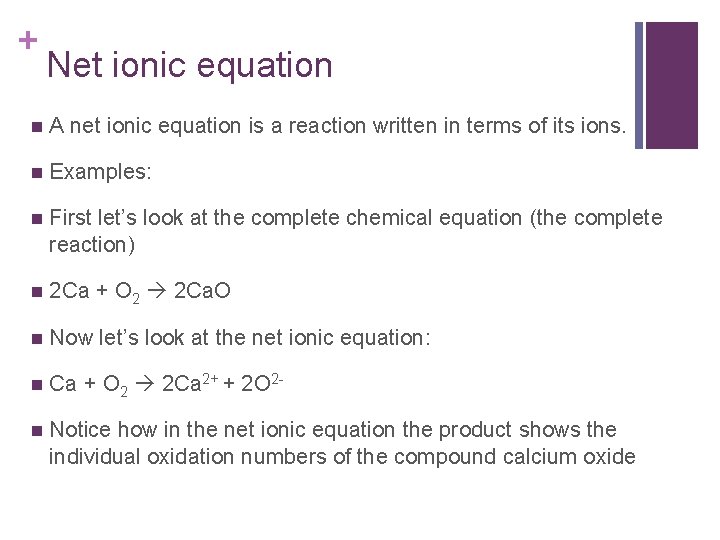
+ Net ionic equation n A net ionic equation is a reaction written in terms of its ions. n Examples: n First let’s look at the complete chemical equation (the complete reaction) n 2 Ca + O 2 2 Ca. O n Now let’s look at the net ionic equation: n Ca + O 2 2 Ca 2+ + 2 O 2 - n Notice how in the net ionic equation the product shows the individual oxidation numbers of the compound calcium oxide
+ Now you try one n. Synthesis reaction of sodium chloride n. First write the complete chemical equation: n. Then write the net ionic equation
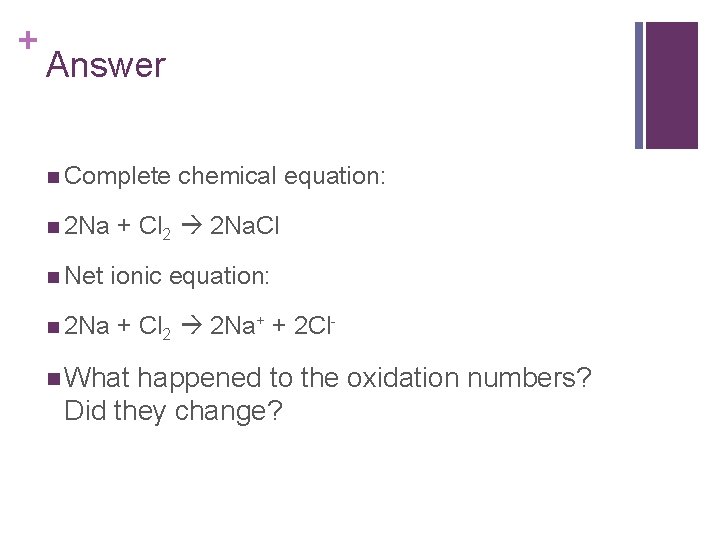
+ Answer n Complete n 2 Na n Net chemical equation: + Cl 2 2 Na. Cl ionic equation: n 2 Na + Cl 2 2 Na+ + 2 Cl- n What happened to the oxidation numbers? Did they change?
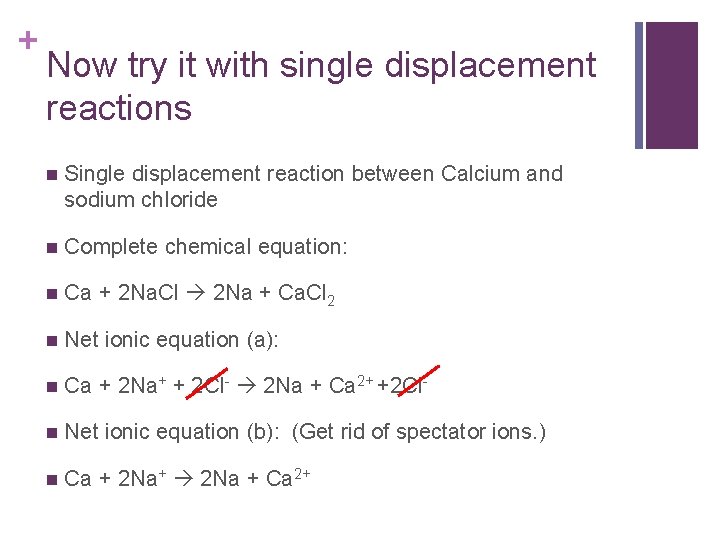
+ Now try it with single displacement reactions n Single displacement reaction between Calcium and sodium chloride n Complete chemical equation: n Ca + 2 Na. Cl 2 Na + Ca. Cl 2 n Net ionic equation (a): n Ca + 2 Na+ + 2 Cl- 2 Na + Ca 2+ +2 Cl- n Net ionic equation (b): (Get rid of spectator ions. ) n Ca + 2 Na+ 2 Na + Ca 2+

+ NOTE n Notice how in each of the previous examples the OXIDATION NUMBERS of the elements changed from the reactants to the products. n If you hadn’t notice go back and check n This is due to the oxidation-reduction reaction
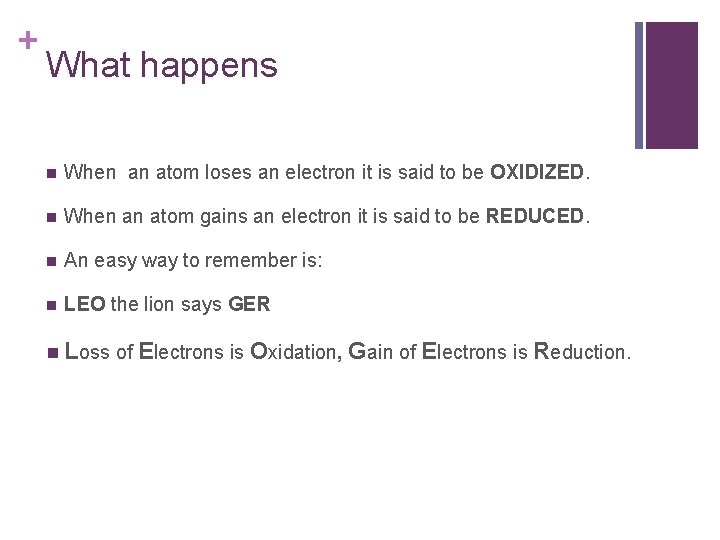
+ What happens n When an atom loses an electron it is said to be OXIDIZED. n When an atom gains an electron it is said to be REDUCED. n An easy way to remember is: n LEO the lion says GER n Loss of Electrons is Oxidation, Gain of Electrons is Reduction.
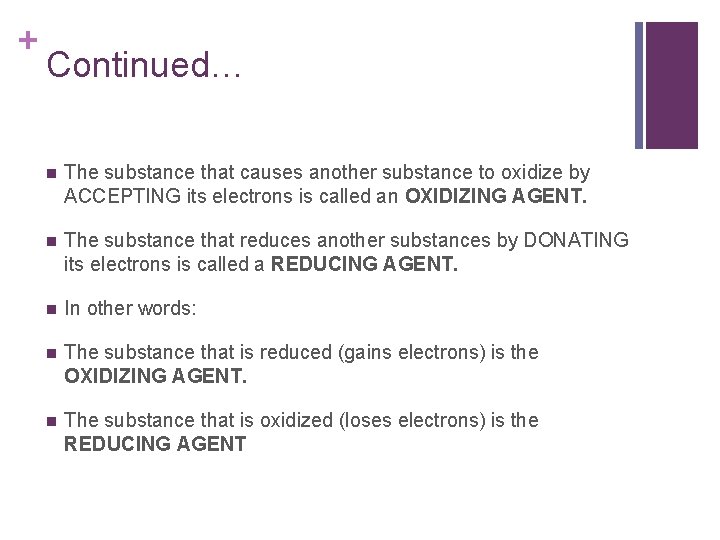
+ Continued… n The substance that causes another substance to oxidize by ACCEPTING its electrons is called an OXIDIZING AGENT. n The substance that reduces another substances by DONATING its electrons is called a REDUCING AGENT. n In other words: n The substance that is reduced (gains electrons) is the OXIDIZING AGENT. n The substance that is oxidized (loses electrons) is the REDUCING AGENT
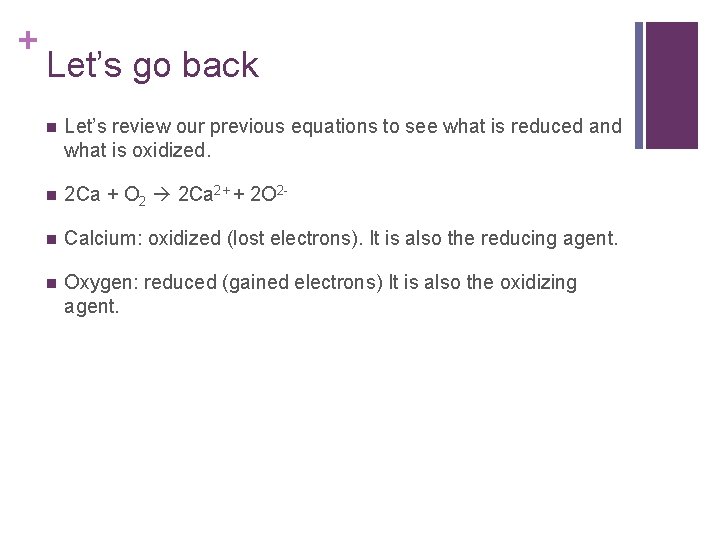
+ Let’s go back n Let’s review our previous equations to see what is reduced and what is oxidized. n 2 Ca + O 2 2 Ca 2+ + 2 O 2 - n Calcium: oxidized (lost electrons). It is also the reducing agent. n Oxygen: reduced (gained electrons) It is also the oxidizing agent.
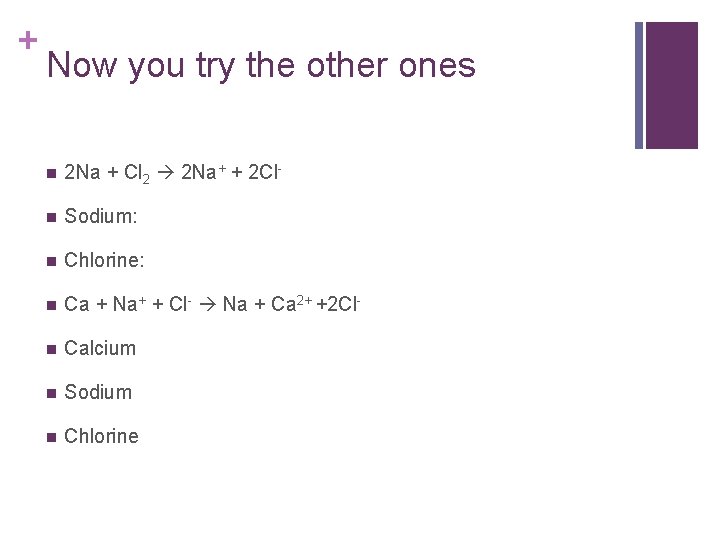
+ Now you try the other ones n 2 Na + Cl 2 2 Na+ + 2 Cl- n Sodium: n Chlorine: n Ca + Na+ + Cl- Na + Ca 2+ +2 Cl- n Calcium n Sodium n Chlorine
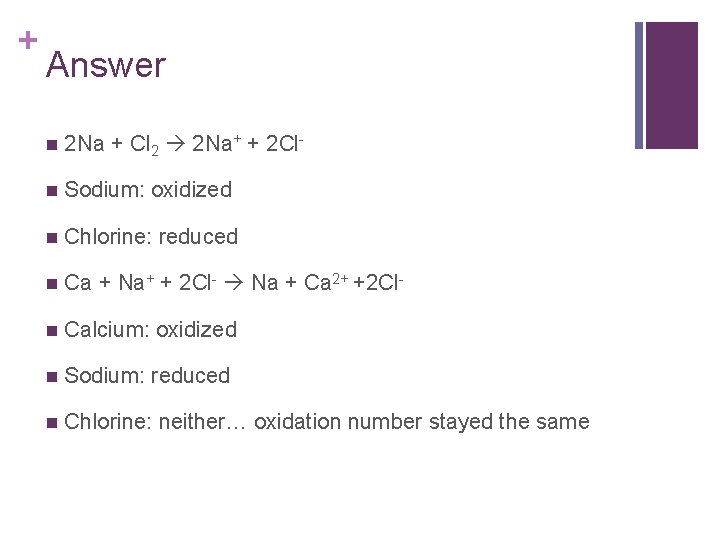
+ Answer n 2 Na + Cl 2 2 Na+ + 2 Cl- n Sodium: oxidized n Chlorine: reduced n Ca + Na+ + 2 Cl- Na + Ca 2+ +2 Cl- n Calcium: oxidized n Sodium: reduced n Chlorine: neither… oxidation number stayed the same
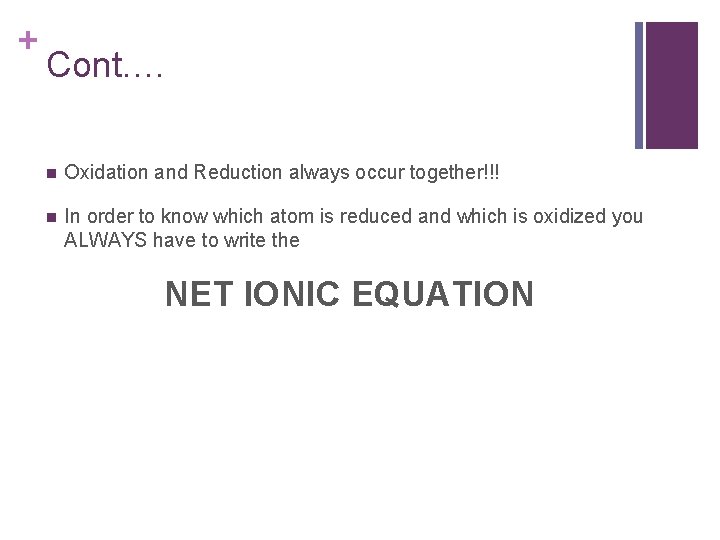
+ Cont. … n Oxidation and Reduction always occur together!!! n In order to know which atom is reduced and which is oxidized you ALWAYS have to write the NET IONIC EQUATION
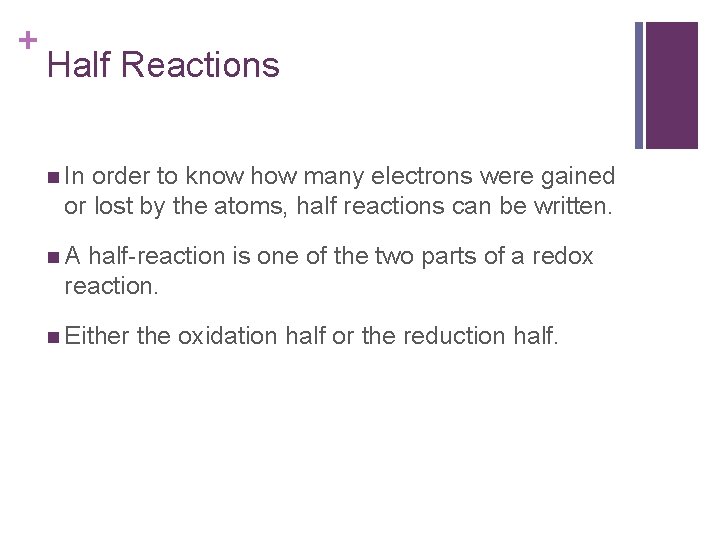
+ Half Reactions n In order to know how many electrons were gained or lost by the atoms, half reactions can be written. n. A half-reaction is one of the two parts of a redox reaction. n Either the oxidation half or the reduction half.
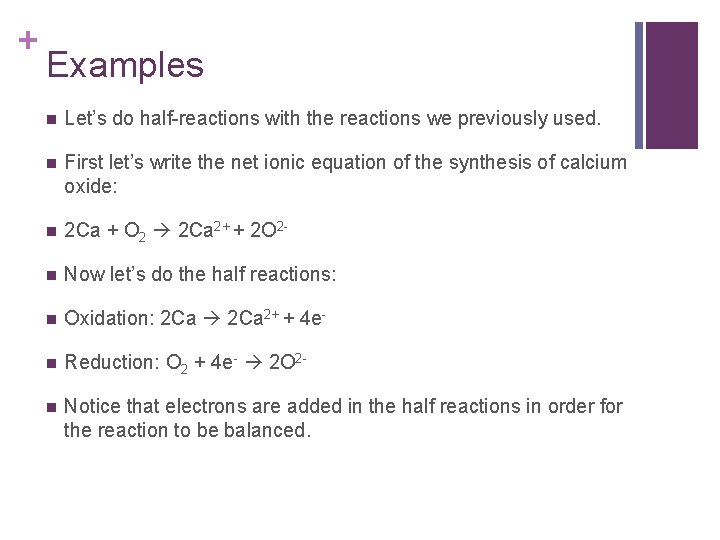
+ Examples n Let’s do half-reactions with the reactions we previously used. n First let’s write the net ionic equation of the synthesis of calcium oxide: n 2 Ca + O 2 2 Ca 2+ + 2 O 2 - n Now let’s do the half reactions: n Oxidation: 2 Ca 2+ + 4 e- n Reduction: O 2 + 4 e- 2 O 2 - n Notice that electrons are added in the half reactions in order for the reaction to be balanced.
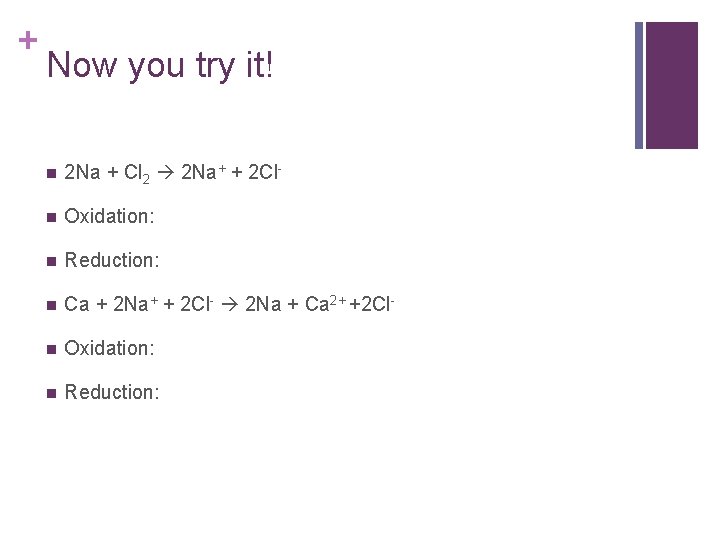
+ Now you try it! n 2 Na + Cl 2 2 Na+ + 2 Cl- n Oxidation: n Reduction: n Ca + 2 Na+ + 2 Cl- 2 Na + Ca 2+ +2 Cl- n Oxidation: n Reduction:
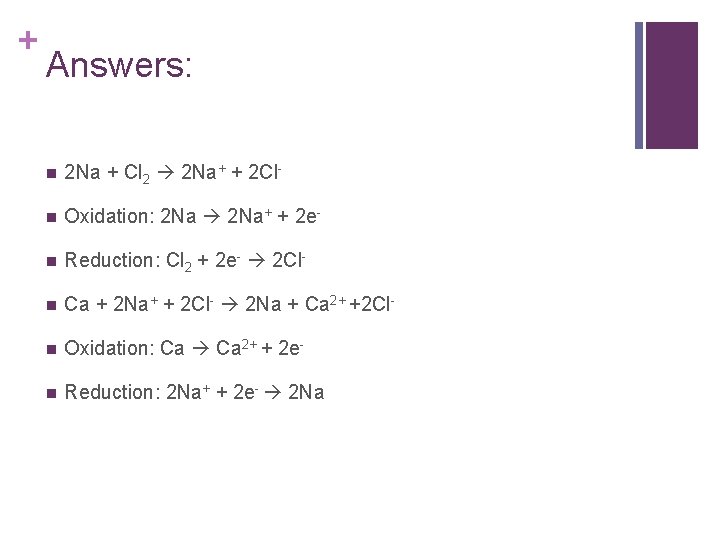
+ Answers: n 2 Na + Cl 2 2 Na+ + 2 Cl- n Oxidation: 2 Na+ + 2 e- n Reduction: Cl 2 + 2 e- 2 Cl- n Ca + 2 Na+ + 2 Cl- 2 Na + Ca 2+ +2 Cl- n Oxidation: Ca 2+ + 2 e- n Reduction: 2 Na+ + 2 e- 2 Na
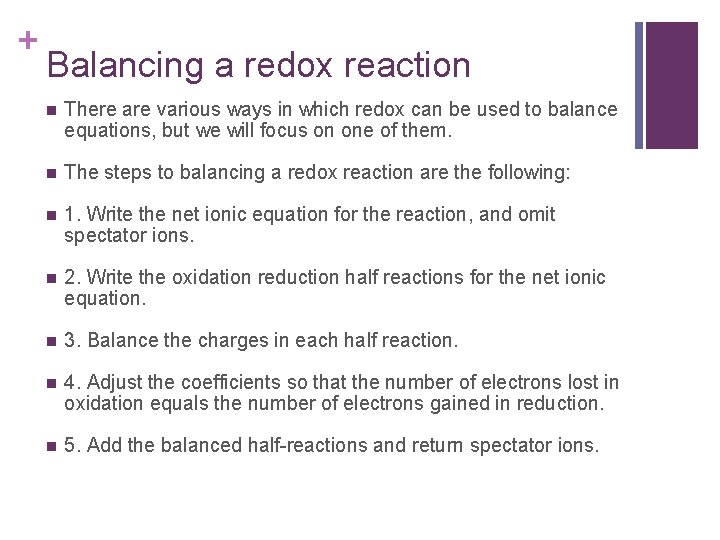
+ Balancing a redox reaction n There are various ways in which redox can be used to balance equations, but we will focus on one of them. n The steps to balancing a redox reaction are the following: n 1. Write the net ionic equation for the reaction, and omit spectator ions. n 2. Write the oxidation reduction half reactions for the net ionic equation. n 3. Balance the charges in each half reaction. n 4. Adjust the coefficients so that the number of electrons lost in oxidation equals the number of electrons gained in reduction. n 5. Add the balanced half-reactions and return spectator ions.
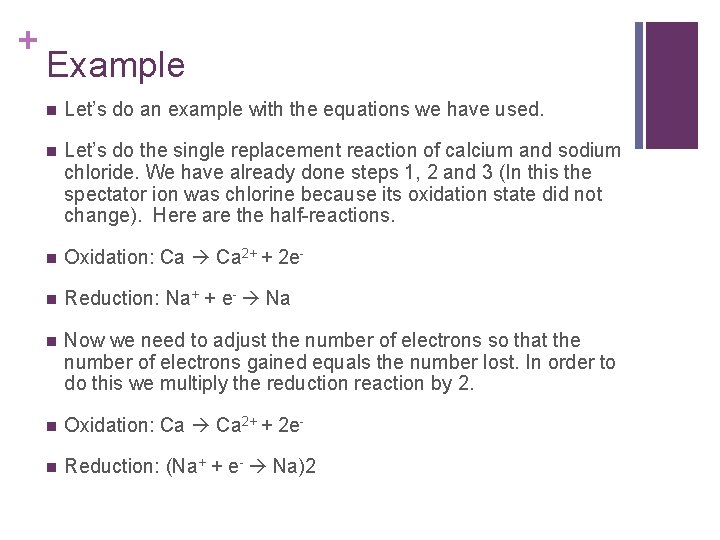
+ Example n Let’s do an example with the equations we have used. n Let’s do the single replacement reaction of calcium and sodium chloride. We have already done steps 1, 2 and 3 (In this the spectator ion was chlorine because its oxidation state did not change). Here are the half-reactions. n Oxidation: Ca 2+ + 2 e- n Reduction: Na+ + e- Na n Now we need to adjust the number of electrons so that the number of electrons gained equals the number lost. In order to do this we multiply the reduction reaction by 2. n Oxidation: Ca 2+ + 2 e- n Reduction: (Na+ + e- Na)2
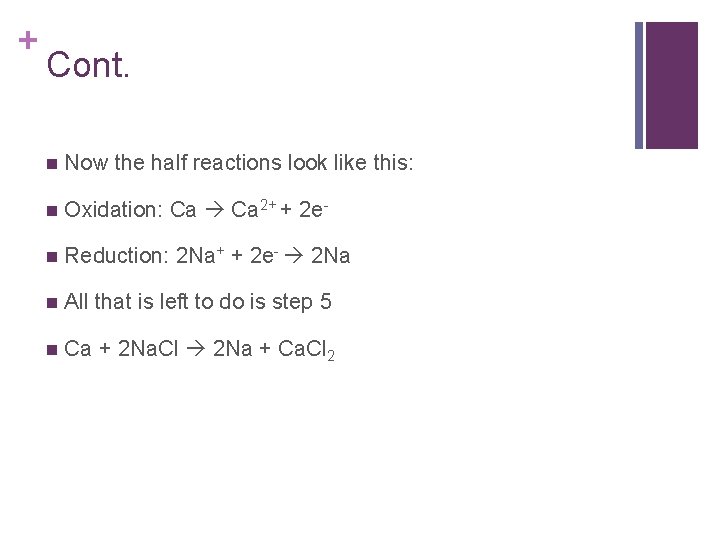
+ Cont. n Now the half reactions look like this: n Oxidation: Ca 2+ + 2 e- n Reduction: 2 Na+ + 2 e- 2 Na n All that is left to do is step 5 n Ca + 2 Na. Cl 2 Na + Ca. Cl 2
- Slides: 23