
Oxidation Reduction IB Topics 9 19 AP Chapters
Oxidation & Reduction IB Topics 9 & 19 AP Chapters 4. 9 -4. 10; 17
Oxidation-Reduction (“Redox”) l l l Ionic compounds are formed through the transfer of electrons An oxidation-reduction rxn involves the transfer of electrons We need a way of keeping track – oxidation states
Oxidation States l l A way of keeping track of the electrons. Not necessarily true of what is in nature, but it works. • Use “+2” instead of “ 2+” since not necessarily actual charge l need the rules for assigning • memorize these!
Rules for assigning oxidation states 1 The oxidation state of an atom in an element is zero (i. e. 2 3 4 5 6 Na(s), O 2(g), O 3(g), Hg(l)) Oxidation state for monoatomic ions are the same as their charge. (i. e. Na+, Cl-) Oxygen is assigned an oxidation state of -2 in its covalent compounds except as a peroxide (such as H 2 O 2). In compounds with nonmetals hydrogen is assigned the oxidation state +1. In its compounds fluorine is always – 1. The sum of the oxidation states must be zero in compounds or equal the charge of the ion.
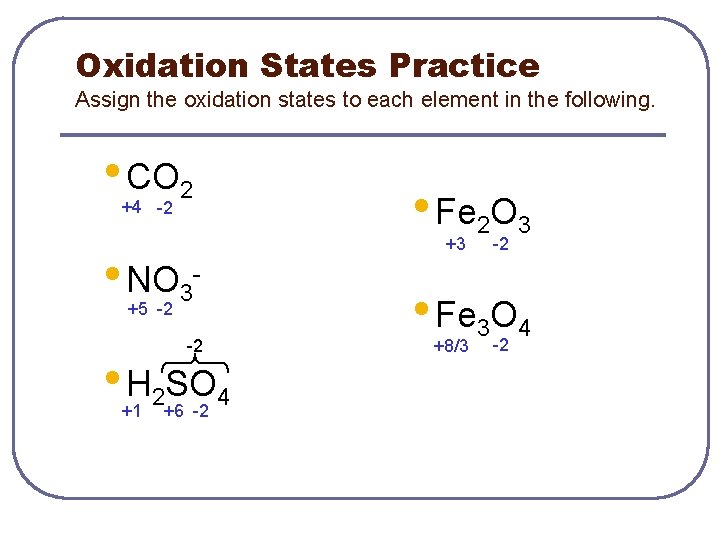
Oxidation States Practice Assign the oxidation states to each element in the following. • CO 2 +4 -2 • NO 3+5 -2 -2 • H 2 SO 4 +1 +6 -2 • Fe 2 O 3 +3 -2 • Fe 3 O 4 +8/3 -2
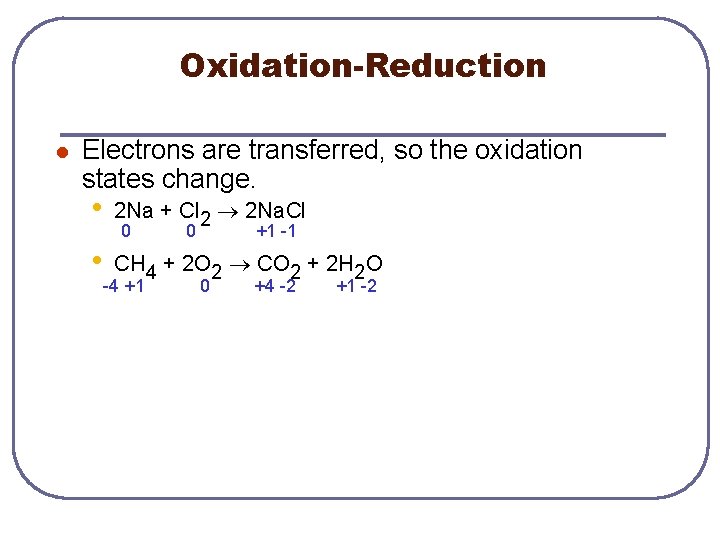
Oxidation-Reduction l Electrons are transferred, so the oxidation states change. • 2 Na + Cl 2 2 Na. Cl • CH 4 + 2 O 2 CO 2 + 2 H 2 O 0 -4 +1 0 +1 -1 0 +4 -2 +1 -2
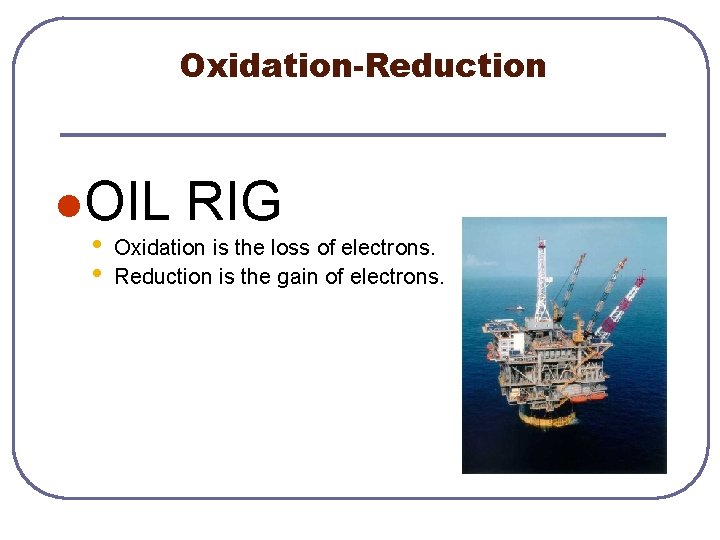
Oxidation-Reduction l. OIL • • RIG Oxidation is the loss of electrons. Reduction is the gain of electrons.
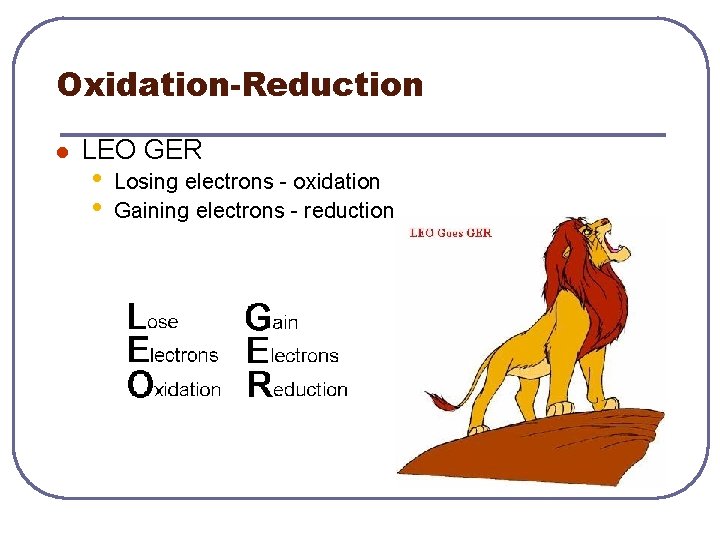
Oxidation-Reduction l LEO GER • • Losing electrons - oxidation Gaining electrons - reduction
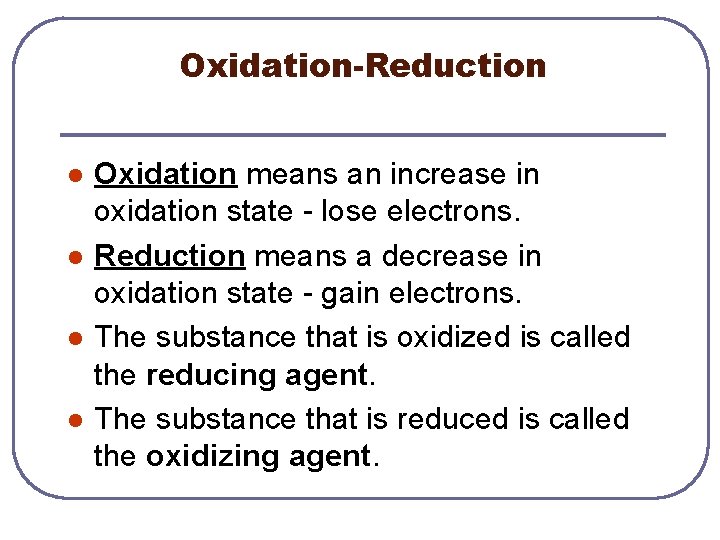
Oxidation-Reduction l l Oxidation means an increase in oxidation state - lose electrons. Reduction means a decrease in oxidation state - gain electrons. The substance that is oxidized is called the reducing agent. The substance that is reduced is called the oxidizing agent.
Redox Reactions
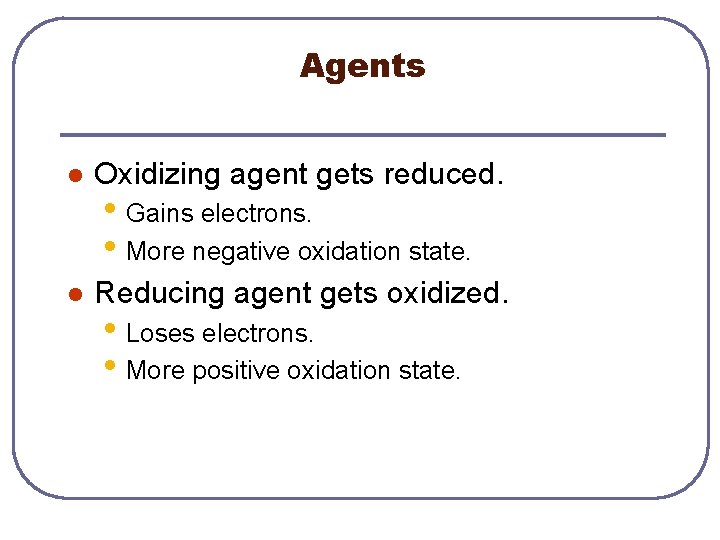
Agents l Oxidizing agent gets reduced. l Reducing agent gets oxidized. • Gains electrons. • More negative oxidation state. • Loses electrons. • More positive oxidation state.
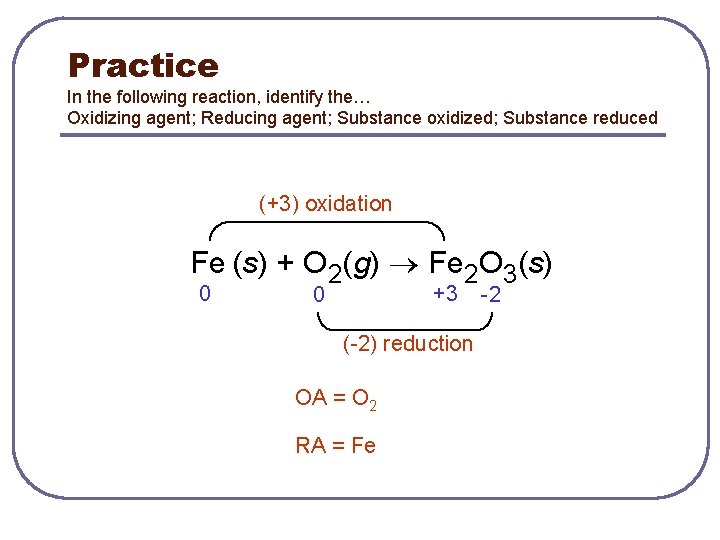
Practice In the following reaction, identify the… Oxidizing agent; Reducing agent; Substance oxidized; Substance reduced (+3) oxidation Fe (s) + O 2(g) Fe 2 O 3(s) 0 +3 0 (-2) reduction OA = O 2 RA = Fe -2
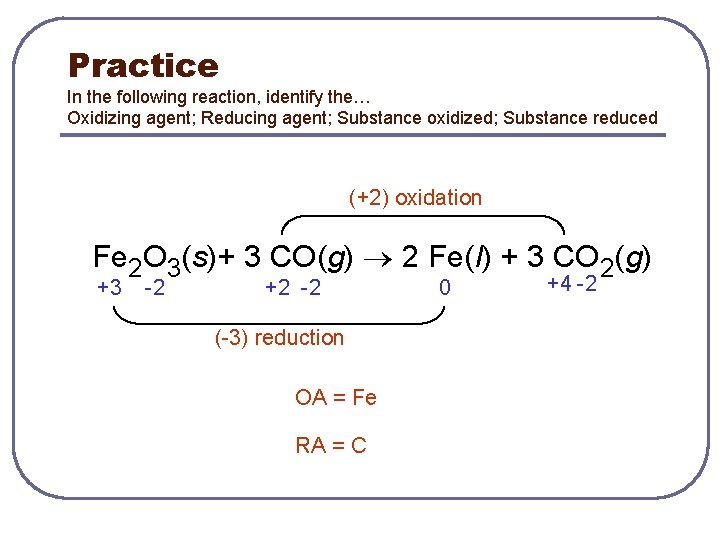
Practice In the following reaction, identify the… Oxidizing agent; Reducing agent; Substance oxidized; Substance reduced (+2) oxidation Fe 2 O 3(s)+ 3 CO(g) 2 Fe(l) + 3 CO 2(g) +3 -2 +2 -2 (-3) reduction OA = Fe RA = C 0 +4 -2
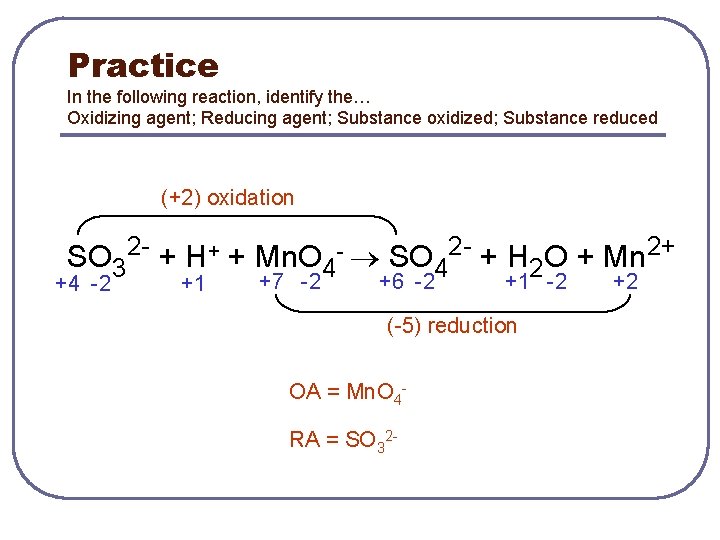
Practice In the following reaction, identify the… Oxidizing agent; Reducing agent; Substance oxidized; Substance reduced (+2) oxidation SO 32 - + H+ + Mn. O 4 - SO 42 - + H 2 O + Mn 2+ +4 -2 +1 +7 -2 +6 -2 +1 -2 (-5) reduction OA = Mn. O 4 RA = SO 32 - +2
Half-Reactions l l l All redox reactions can be thought of as happening in two halves. One produces electrons - oxidation half. The other requires electrons - reduction half.
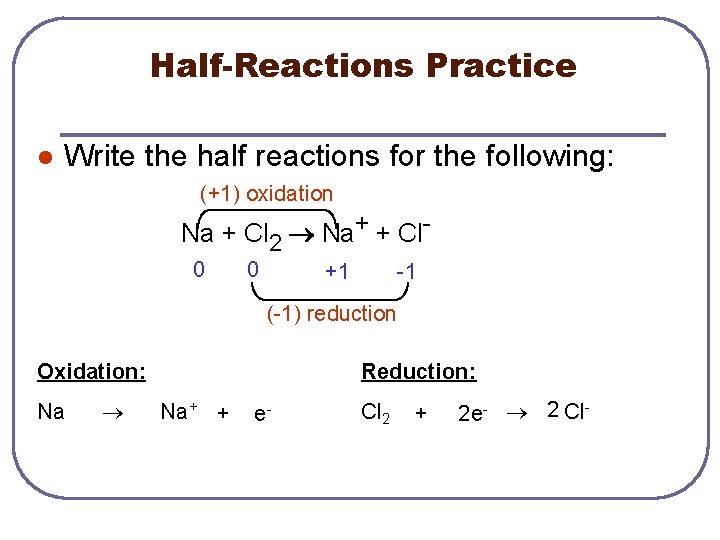
Half-Reactions Practice l Write the half reactions for the following: (+1) oxidation Na + Cl 2 Na+ + Cl 0 0 +1 -1 (-1) reduction Oxidation: Na Reduction: Na+ + e- Cl 2 + 2 e- 2 Cl-
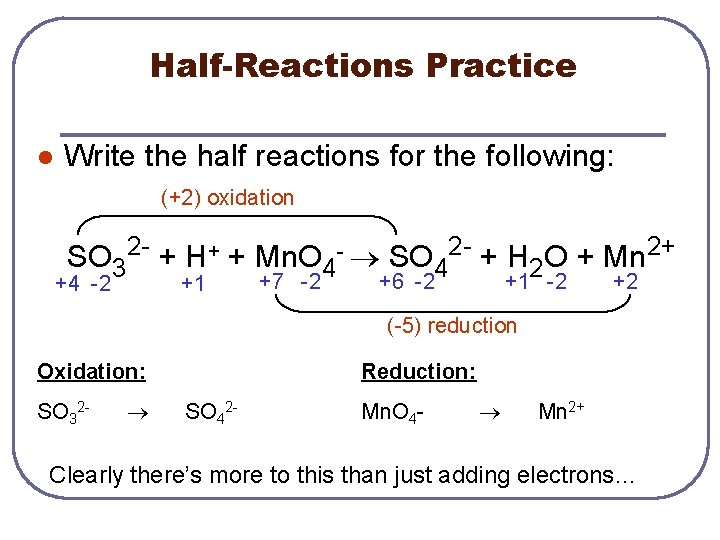
Half-Reactions Practice l Write the half reactions for the following: (+2) oxidation SO 32 - + H+ + Mn. O 4 - SO 42 - + H 2 O + Mn 2+ +4 -2 +1 +7 -2 +6 -2 +1 -2 +2 (-5) reduction Oxidation: SO 32 - Reduction: SO 42 - Mn. O 4 - Mn 2+ Clearly there’s more to this than just adding electrons…
Balancing Redox Equations l In aqueous solutions the key is the number of electrons produced must be the same as those required.
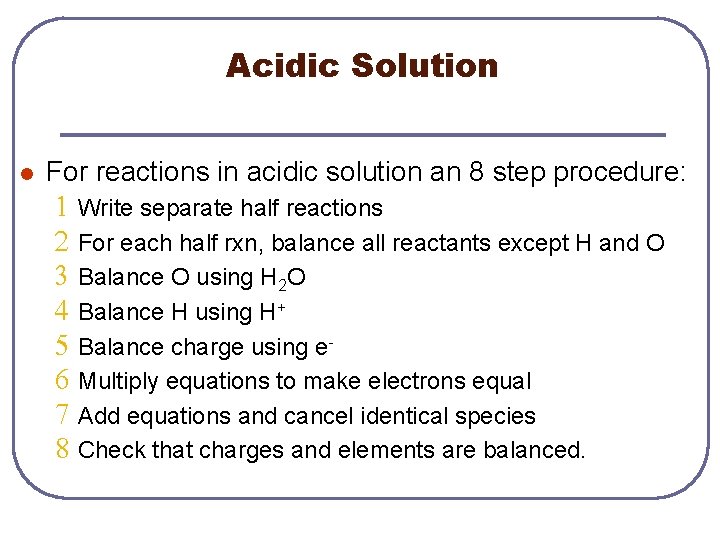
Acidic Solution l For reactions in acidic solution an 8 step procedure: 1 Write separate half reactions 2 For each half rxn, balance all reactants except H and O 3 Balance O using H 2 O 4 Balance H using H+ 5 Balance charge using e 6 Multiply equations to make electrons equal 7 Add equations and cancel identical species 8 Check that charges and elements are balanced.
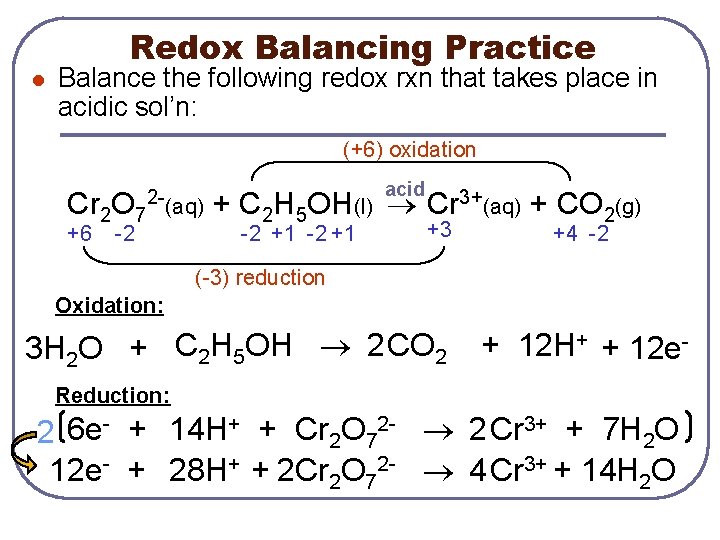
Redox Balancing Practice l Balance the following redox rxn that takes place in acidic sol’n: (+6) oxidation Cr 2 O 7 +6 2 -(aq) -2 acid + C 2 H 5 OH(l) Cr 3+(aq) + CO 2(g) -2 +1 +3 +4 -2 (-3) reduction Oxidation: 3 H 2 O + C 2 H 5 OH 2 CO 2 Reduction: 6 e- + 14 H+ + 12 e- + Cr 2 O 72 - 2 Cr 3+ + 7 H 2 O 2 12 e- + 28 H+ + 2 Cr 2 O 72 - 4 Cr 3+ + 14 H 2 O
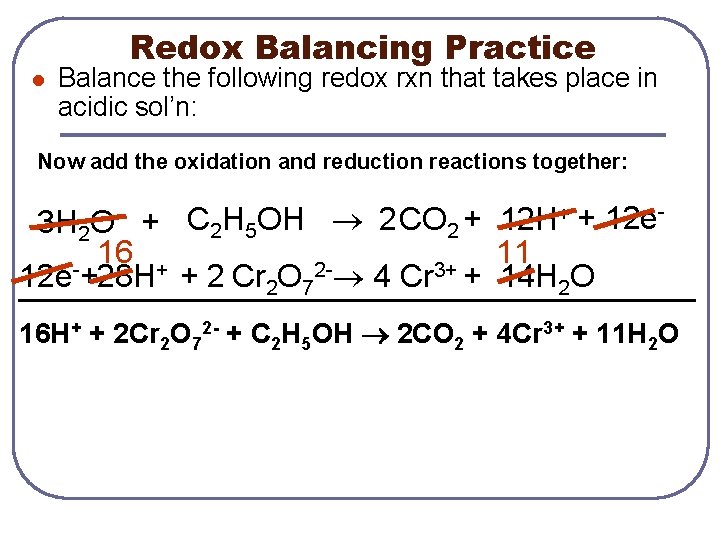
Redox Balancing Practice l Balance the following redox rxn that takes place in acidic sol’n: Now add the oxidation and reduction reactions together: + + 12 e. C H OH 2 CO + 12 H 3 H 2 O + 2 5 2 16 11 12 e-+28 H+ + 2 Cr 2 O 72 - 4 Cr 3+ + 14 H 2 O 16 H+ + 2 Cr 2 O 72 - + C 2 H 5 OH 2 CO 2 + 4 Cr 3+ + 11 H 2 O
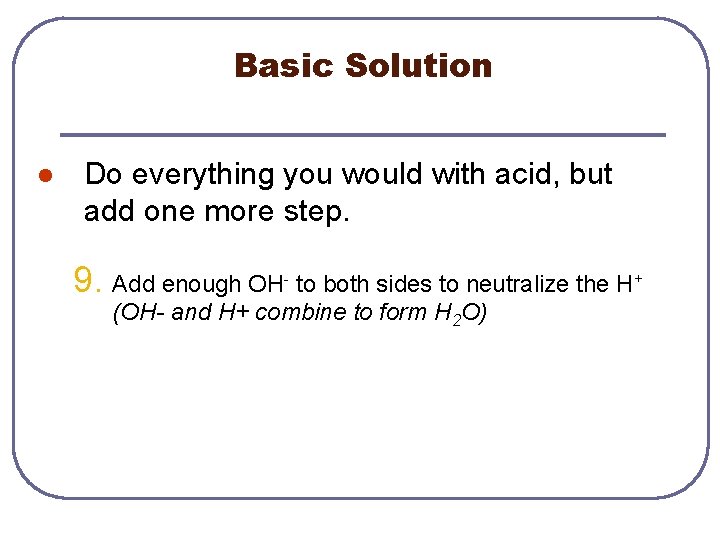
Basic Solution l Do everything you would with acid, but add one more step. 9. Add enough OH- to both sides to neutralize the H+ (OH- and H+ combine to form H 2 O)
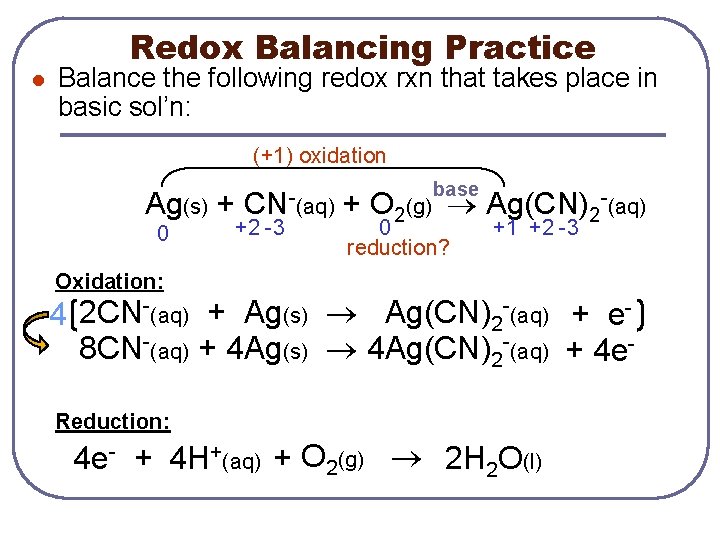
Redox Balancing Practice l Balance the following redox rxn that takes place in basic sol’n: (+1) oxidation Ag(s) + 0 CN-(aq) +2 -3 base + O 2(g) Ag(CN)2 -(aq) 0 reduction? +1 +2 -3 Oxidation: 2 CN-(aq) 4 + Ag(s) Ag(CN)2 -(aq) + e 8 CN-(aq) + 4 Ag(s) 4 Ag(CN)2 -(aq) + 4 e- Reduction: 4 e- + 4 H+(aq) + O 2(g) 2 H 2 O(l)
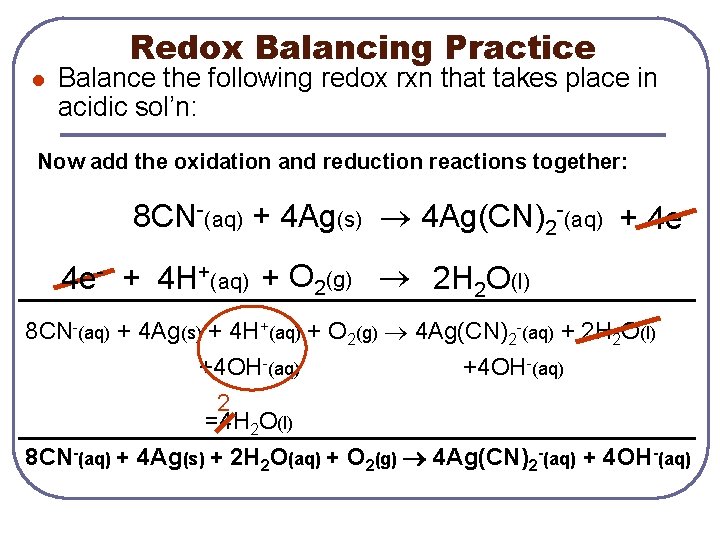
Redox Balancing Practice l Balance the following redox rxn that takes place in acidic sol’n: Now add the oxidation and reduction reactions together: 8 CN-(aq) + 4 Ag(s) 4 Ag(CN)2 -(aq) + 4 e 4 e- + 4 H+(aq) + O 2(g) 2 H 2 O(l) 8 CN-(aq) + 4 Ag(s) + 4 H+(aq) + O 2(g) 4 Ag(CN)2 -(aq) + 2 H 2 O(l) +4 OH-(aq) 2 =4 H 2 O(l) 8 CN-(aq) + 4 Ag(s) + 2 H 2 O(aq) + O 2(g) 4 Ag(CN)2 -(aq) + 4 OH-(aq)
Redox Titrations l l Same as any other titration. The permanganate ion is used often because it is its own indicator. • Mn. O 4 - is purple, Mn+2 is colorless. When reaction solution remains clear, Mn. O 4 - is gone. l Chromate ion is also useful, but color change (orangish-yellow to green) is harder to detect.
- Slides: 25