
Oxidation of Alcohols Aldehydes Ketones and Carboxylic Acids
Oxidation of Alcohols
Aldehydes, Ketones and Carboxylic Acids • General formulas:
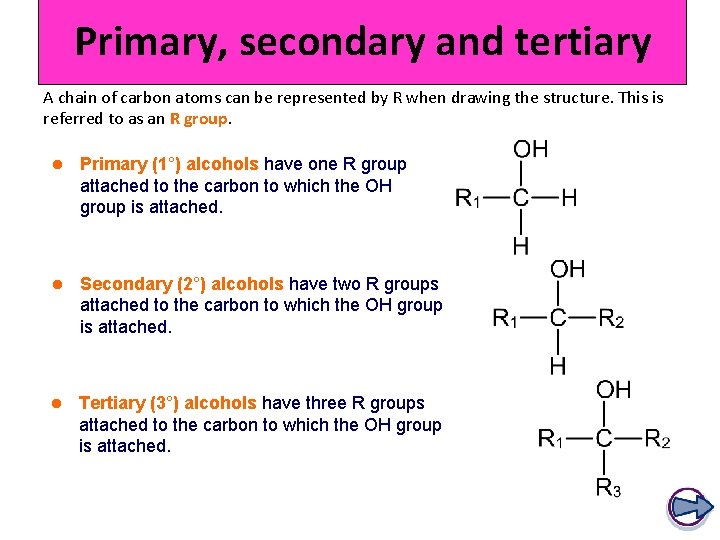
Primary, secondary and tertiary A chain of carbon atoms can be represented by R when drawing the structure. This is referred to as an R group. l Primary (1°) alcohols have one R group attached to the carbon to which the OH group is attached. l Secondary (2°) alcohols have two R groups attached to the carbon to which the OH group is attached. l Tertiary (3°) alcohols have three R groups attached to the carbon to which the OH group is attached.
MBW – Draw the following compounds. . • • Ethanal Ethanoic acid Propanal Propanoic acid Propanone Butanal Butanoic acid Butanone
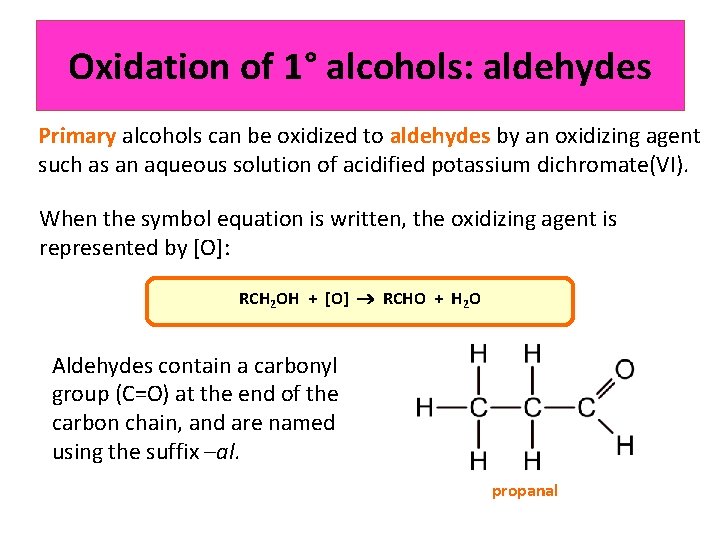
Oxidation of 1° alcohols: aldehydes Primary alcohols can be oxidized to aldehydes by an oxidizing agent such as an aqueous solution of acidified potassium dichromate(VI). When the symbol equation is written, the oxidizing agent is represented by [O]: RCH 2 OH + [O] RCHO + H 2 O Aldehydes contain a carbonyl group (C=O) at the end of the carbon chain, and are named using the suffix –al. propanal
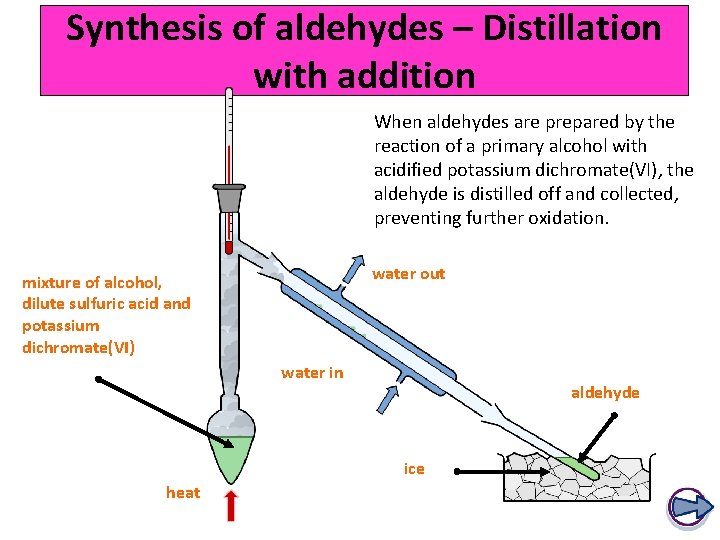
Synthesis of aldehydes – Distillation with addition When aldehydes are prepared by the reaction of a primary alcohol with acidified potassium dichromate(VI), the aldehyde is distilled off and collected, preventing further oxidation. water out mixture of alcohol, dilute sulfuric acid and potassium dichromate(VI) water in aldehyde ice heat
The Conditions… • Potassium chromate, acidified with dilute sulfuric acid is used to oxidise alcohols. • It is an oxidising agent. • The orange dichromate ions are reduced to green chromium ions.
![Oxidising Agent [O] = oxidising agent NOT oxygen!!! CH 3 CH 2 OH(l) +](http://slidetodoc.com/presentation_image_h2/a1391d0d93e0729ec2867388ede18c5b/image-8.jpg "Oxidising Agent [O] = oxidising agent NOT oxygen!!! CH 3 CH 2 OH(l) +")
Oxidising Agent [O] = oxidising agent NOT oxygen!!! CH 3 CH 2 OH(l) + [O] CH 3 CHO(g) + H 2 O(g) Still has to balance!!!
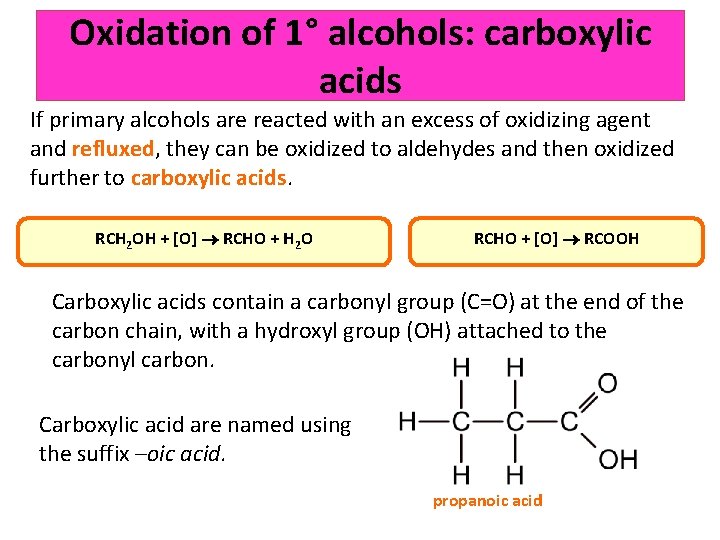
Oxidation of 1° alcohols: carboxylic acids If primary alcohols are reacted with an excess of oxidizing agent and refluxed, they can be oxidized to aldehydes and then oxidized further to carboxylic acids. RCH 2 OH + [O] RCHO + H 2 O RCHO + [O] RCOOH Carboxylic acids contain a carbonyl group (C=O) at the end of the carbon chain, with a hydroxyl group (OH) attached to the carbonyl carbon. Carboxylic acid are named using the suffix –oic acid. propanoic acid
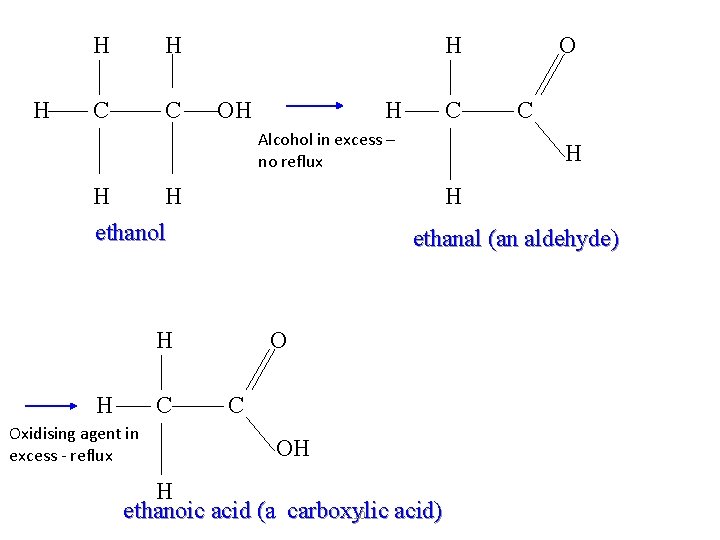
H H H C C H OH H C Alcohol in excess – no reflux H H ethanol C Oxidising agent in excess - reflux C H H ethanal (an aldehyde) H H O O C OH H ethanoic acid (a carboxylic acid) 10
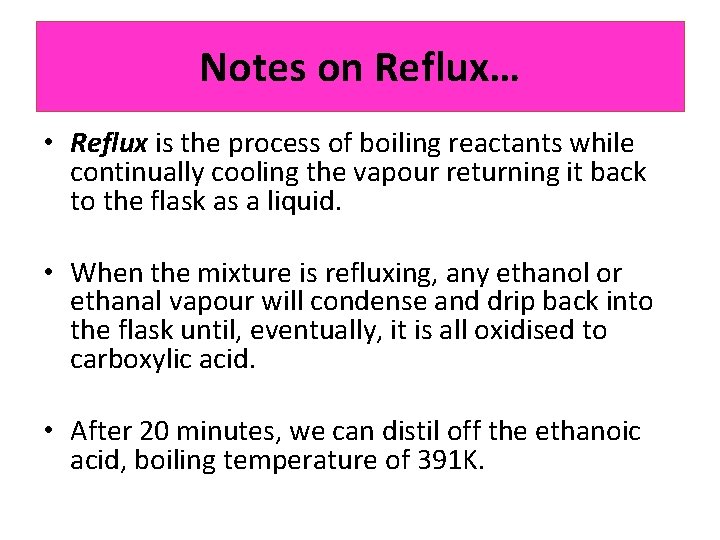
Notes on Reflux… • Reflux is the process of boiling reactants while continually cooling the vapour returning it back to the flask as a liquid. • When the mixture is refluxing, any ethanol or ethanal vapour will condense and drip back into the flask until, eventually, it is all oxidised to carboxylic acid. • After 20 minutes, we can distil off the ethanoic acid, boiling temperature of 391 K.
![Ethanol Ethanoic Acid CH 3 CH 2 OH(l) + 2 [O] CH 3 COOH(g)](http://slidetodoc.com/presentation_image_h2/a1391d0d93e0729ec2867388ede18c5b/image-13.jpg "Ethanol Ethanoic Acid CH 3 CH 2 OH(l) + 2 [O] CH 3 COOH(g)")
Ethanol Ethanoic Acid CH 3 CH 2 OH(l) + 2 [O] CH 3 COOH(g) + H 2 O(l) What is the difference between this reaction and the reaction to make ethanal?
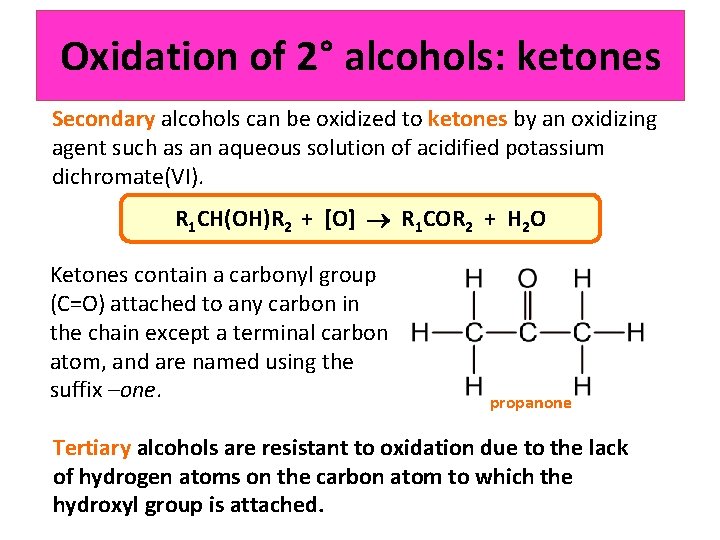
Oxidation of 2° alcohols: ketones Secondary alcohols can be oxidized to ketones by an oxidizing agent such as an aqueous solution of acidified potassium dichromate(VI). R 1 CH(OH)R 2 + [O] R 1 COR 2 + H 2 O Ketones contain a carbonyl group (C=O) attached to any carbon in the chain except a terminal carbon atom, and are named using the suffix –one. propanone Tertiary alcohols are resistant to oxidation due to the lack of hydrogen atoms on the carbon atom to which the hydroxyl group is attached.
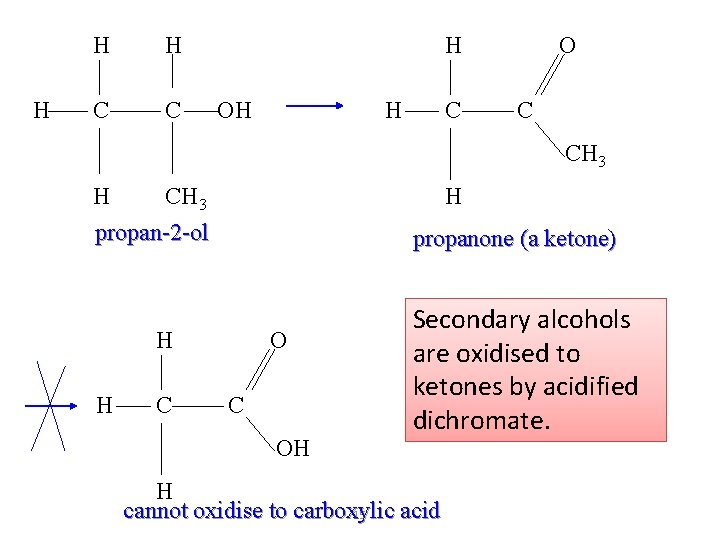
H H H C C H OH H C O C CH 3 H CH 3 propan-2 -ol H propanone (a ketone) H H C OH Secondary alcohols are oxidised to ketones by acidified dichromate. H cannot oxidise to carboxylic acid 15
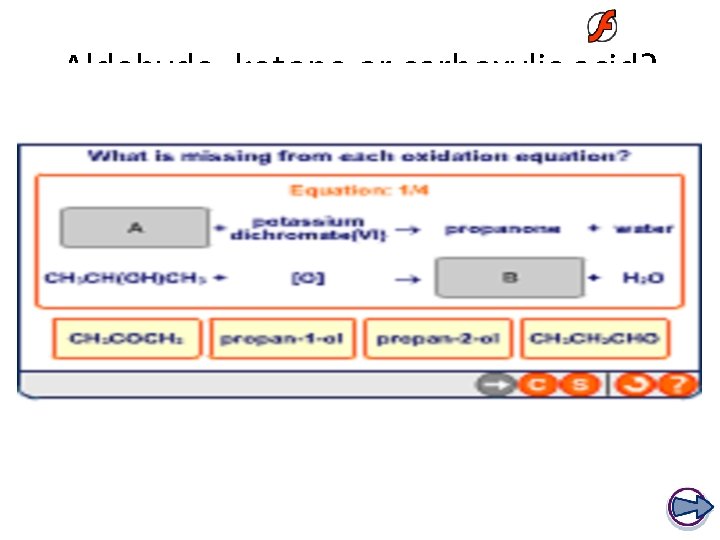
Aldehyde, ketone or carboxylic acid?
What’s the structure?

Exam Questions
- Slides: 18