
Oxidation Numbers 1 the oxidation state of a
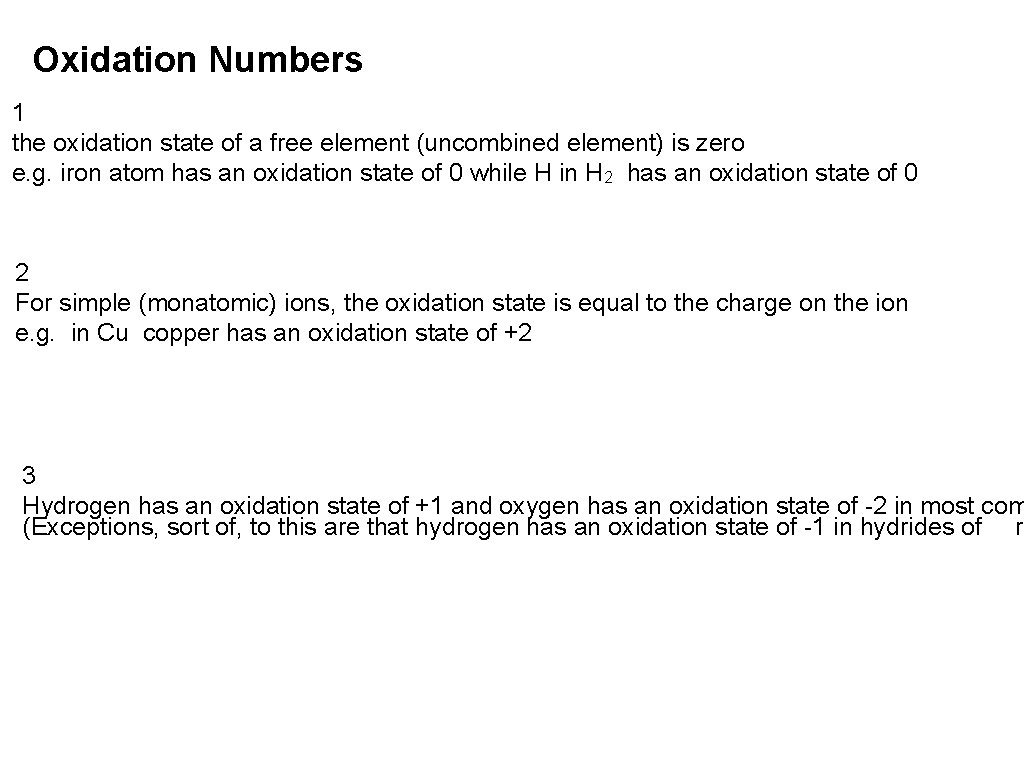
Oxidation Numbers 1 the oxidation state of a free element (uncombined element) is zero e. g. iron atom has an oxidation state of 0 while H in H 2 has an oxidation state of 0 2 For simple (monatomic) ions, the oxidation state is equal to the charge on the ion e. g. in Cu copper has an oxidation state of +2 3 Hydrogen has an oxidation state of +1 and oxygen has an oxidation state of -2 in most com (Exceptions, sort of, to this are that hydrogen has an oxidation state of -1 in hydrides of re
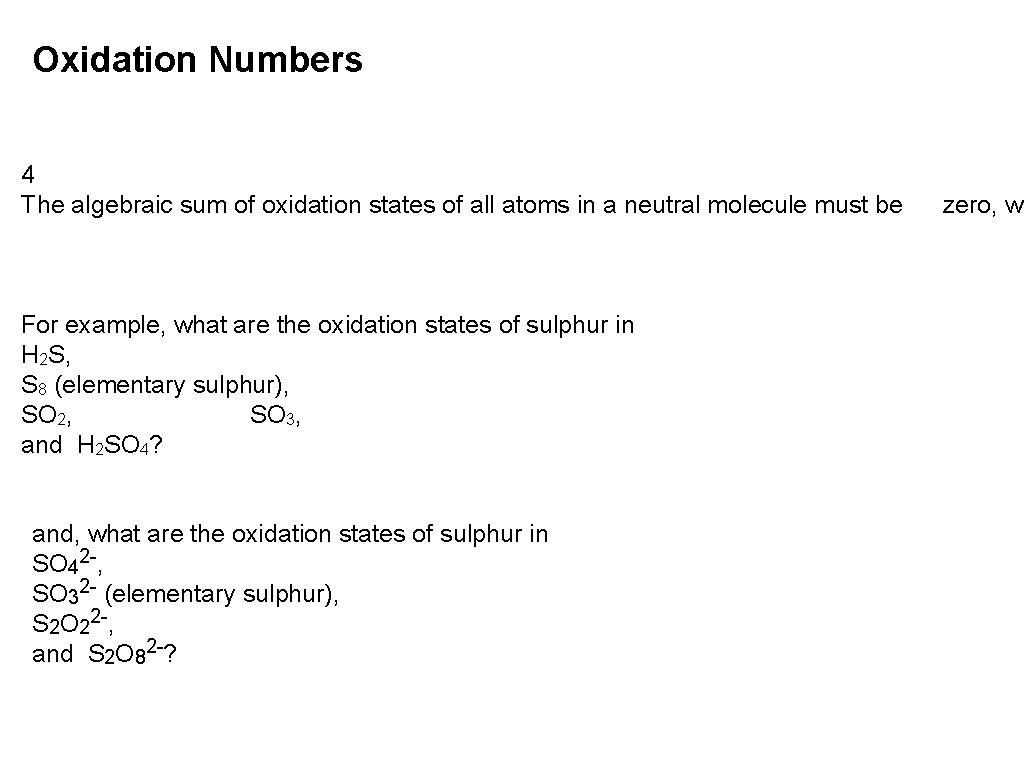
Oxidation Numbers 4 The algebraic sum of oxidation states of all atoms in a neutral molecule must be For example, what are the oxidation states of sulphur in H 2 S, S 8 (elementary sulphur), SO 2, SO 3, and H 2 SO 4? and, what are the oxidation states of sulphur in SO 42 -, SO 32 - (elementary sulphur), S 2 O 22 -, and S 2 O 82 -? zero, wh
Oxidation Numbers Compounds containing metals in high oxidation states tend to be oxidising agents whereas compounds with metals in low oxidation states are often reducing agents.
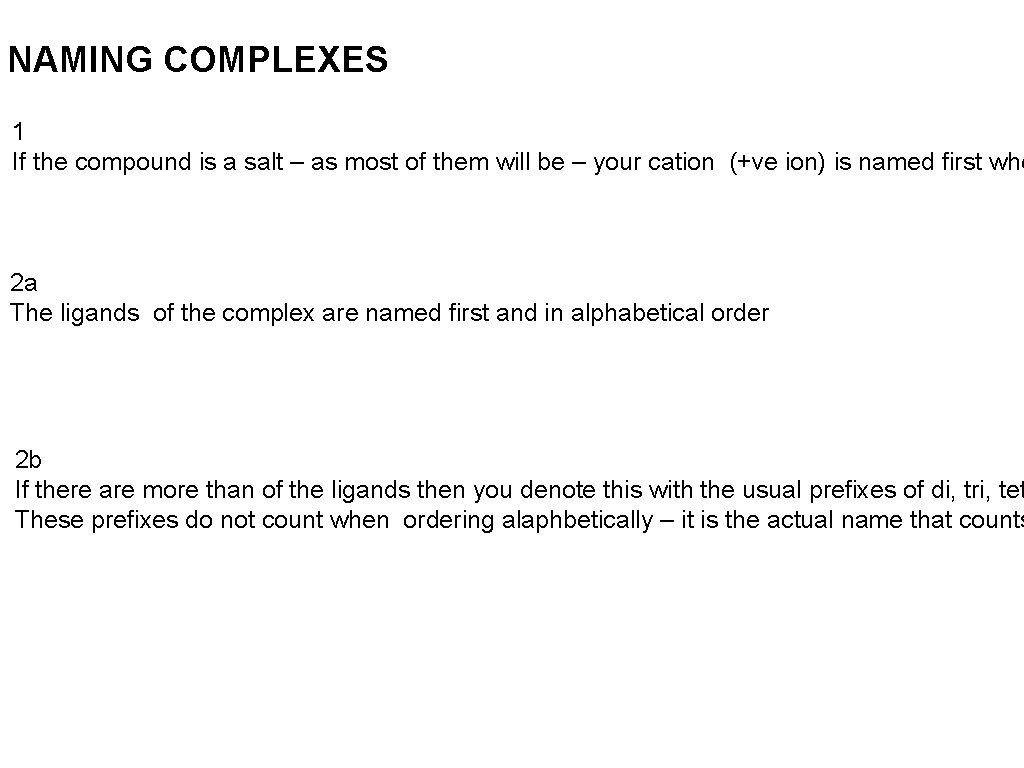
NAMING COMPLEXES 1 If the compound is a salt – as most of them will be – your cation (+ve ion) is named first whe 2 a The ligands of the complex are named first and in alphabetical order 2 b If there are more than of the ligands then you denote this with the usual prefixes of di, tri, tet These prefixes do not count when ordering alaphbetically – it is the actual name that counts
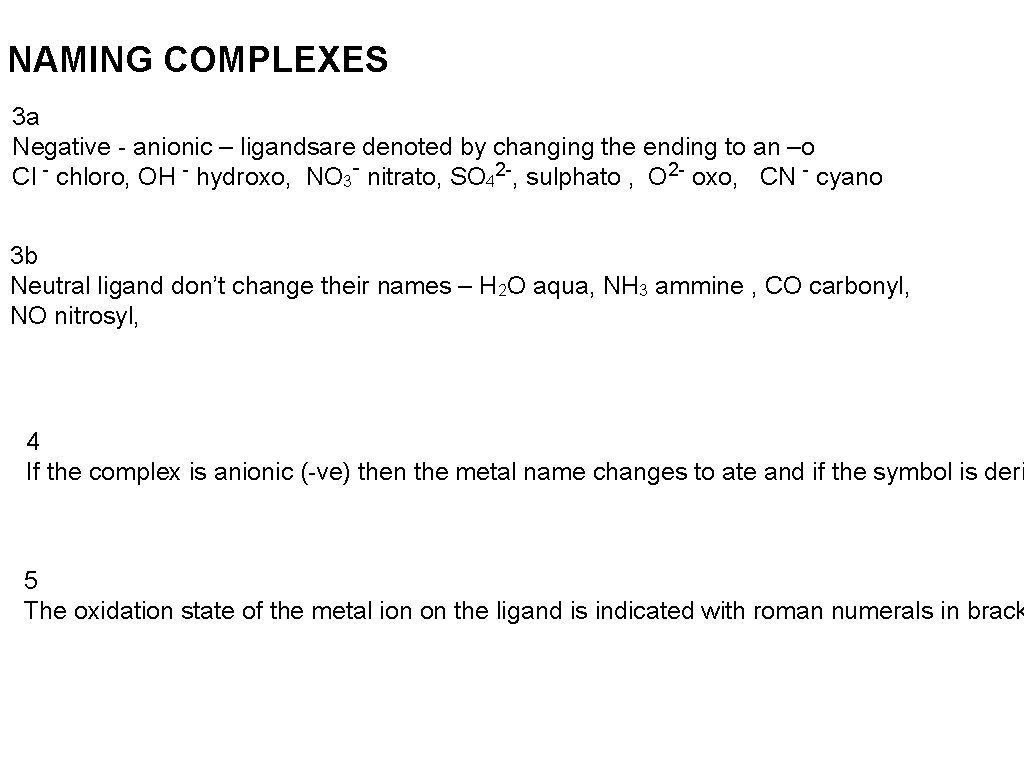
NAMING COMPLEXES 3 a Negative - anionic – ligandsare denoted by changing the ending to an –o Cl - chloro, OH - hydroxo, NO 3 - nitrato, SO 42 -, sulphato , O 2 - oxo, CN - cyano 3 b Neutral ligand don’t change their names – H 2 O aqua, NH 3 ammine , CO carbonyl, NO nitrosyl, 4 If the complex is anionic (-ve) then the metal name changes to ate and if the symbol is deri 5 The oxidation state of the metal ion on the ligand is indicated with roman numerals in brack
![NAMING COMPLEXES [Mn(H 2 O)6]SO 4 1 If the compound is a salt –](http://slidetodoc.com/presentation_image_h/3087153ead3fec58479c636d8abe7c52/image-6.jpg "NAMING COMPLEXES [Mn(H 2 O)6]SO 4 1 If the compound is a salt –")
NAMING COMPLEXES [Mn(H 2 O)6]SO 4 1 If the compound is a salt – as most of them will be – your cation (+ve ion) is named first whe 2+ SO 2[Mn(H 2 O)6] 4 [Mn(H 2 O)6]2+ 2 a The ligands of the complex are named first and in alphabetical order H 2 O aqua 3 b Neutral ligand don’t change their names – H 2 O aqua, NH 3 ammine , CO carbonyl, NO nitrosyl (H 2 O)6 hexaaqua [Mn(H 2 O)6] [Mn(H 2 O)6 ]2+ [Mn(H 2 O)6]2+ hexaaquamanganese(I I) hexaaquamanganese(II)sulphat SO 42 e
![NAMING COMPLEXES K 2[Cd(CN)4] 1 If the compound is a salt – as most](http://slidetodoc.com/presentation_image_h/3087153ead3fec58479c636d8abe7c52/image-7.jpg "NAMING COMPLEXES K 2[Cd(CN)4] 1 If the compound is a salt – as most")
NAMING COMPLEXES K 2[Cd(CN)4] 1 If the compound is a salt – as most of them will be – your cation (+ve ion) is named first whe +) 2(K [Cd(CN) 2 4] K+ potassium
![NAMING COMPLEXES K 2[Cd(CN)4] 3 a Negative - anionic – ligands are denoted by](http://slidetodoc.com/presentation_image_h/3087153ead3fec58479c636d8abe7c52/image-8.jpg "NAMING COMPLEXES K 2[Cd(CN)4] 3 a Negative - anionic – ligands are denoted by")
NAMING COMPLEXES K 2[Cd(CN)4] 3 a Negative - anionic – ligands are denoted by changing the ending to an –o Cl - chloro, OH - hydroxo, NO 3 - nitrato, SO 42 -, sulphato , O 2 - oxo, CN - cyano CN cyano (CN)4 tetracyano [Cd(CN)4]2 - 4 If the complex is anionic (-ve) then the metal name changes to ate and if the symbol is deriv tetracyanocadamat tetracyanocadmium e [Cd(CN)4]2 - 5 The oxidation state of the metal ion is indicated with roman numerals in brackets tetracyanocadamat (II) e potassium tetracyanocadamate (II)
![NAMING COMPLEXES [Co(H 2 O)6][Ag(CN)2]3 1 If the compound is a salt – as](http://slidetodoc.com/presentation_image_h/3087153ead3fec58479c636d8abe7c52/image-9.jpg "NAMING COMPLEXES [Co(H 2 O)6][Ag(CN)2]3 1 If the compound is a salt – as")
NAMING COMPLEXES [Co(H 2 O)6][Ag(CN)2]3 1 If the compound is a salt – as most of them will be – your cation (+ve ion) is named first whe [Co(H 2 O)6]3+ [Ag(CN)2]- 3 [Co(H 2 O)6]3+ hexaaquacoba (III) lt
![NAMING COMPLEXES [Co(H 2 O)6][Ag(CN)2]3 1 If the compound is a salt – as](http://slidetodoc.com/presentation_image_h/3087153ead3fec58479c636d8abe7c52/image-10.jpg "NAMING COMPLEXES [Co(H 2 O)6][Ag(CN)2]3 1 If the compound is a salt – as")
NAMING COMPLEXES [Co(H 2 O)6][Ag(CN)2]3 1 If the compound is a salt – as most of them will be – your cation (+ve ion) is named first whe [Co(H 2 O)6]3+ [Ag(CN)2]- 3 [Co(H 2 O)6]3+ hexaaquacoba (III) lt 3 a Negative - anionic – ligands are denoted by changing the ending to an –o Cl - chloro, OH - hydroxo, NO 3 - nitrato, SO 42 -, sulphato , O 2 - oxo, CN - cyano [Ag(CN)2]- 3 di cyano
![NAMING COMPLEXES [Co(H 2 O)6][Ag(CN)2]3 1 If the compound is a salt – as](http://slidetodoc.com/presentation_image_h/3087153ead3fec58479c636d8abe7c52/image-11.jpg "NAMING COMPLEXES [Co(H 2 O)6][Ag(CN)2]3 1 If the compound is a salt – as")
NAMING COMPLEXES [Co(H 2 O)6][Ag(CN)2]3 1 If the compound is a salt – as most of them will be – your cation (+ve ion) is named first whe [Co(H 2 O)6]3+ [Ag(CN)2]- 3 [Co(H 2 O)6]3+ hexaaquacoba (III) lt 4 If the complex is anionic (-ve) then the metal name changes to ate and if the symbol is derive [Ag(CN)2]- 3 di cyanoargentate
![NAMING COMPLEXES [Co(H 2 O)6][Ag(CN)2]3 5 The oxidation state of the metal ion is](http://slidetodoc.com/presentation_image_h/3087153ead3fec58479c636d8abe7c52/image-12.jpg "NAMING COMPLEXES [Co(H 2 O)6][Ag(CN)2]3 5 The oxidation state of the metal ion is")
NAMING COMPLEXES [Co(H 2 O)6][Ag(CN)2]3 5 The oxidation state of the metal ion is indicated with roman numerals in brackets hexaaquacoba (III) lt di cyano argentate(I)
- Slides: 12