
Oxidation number The charge the atom would have
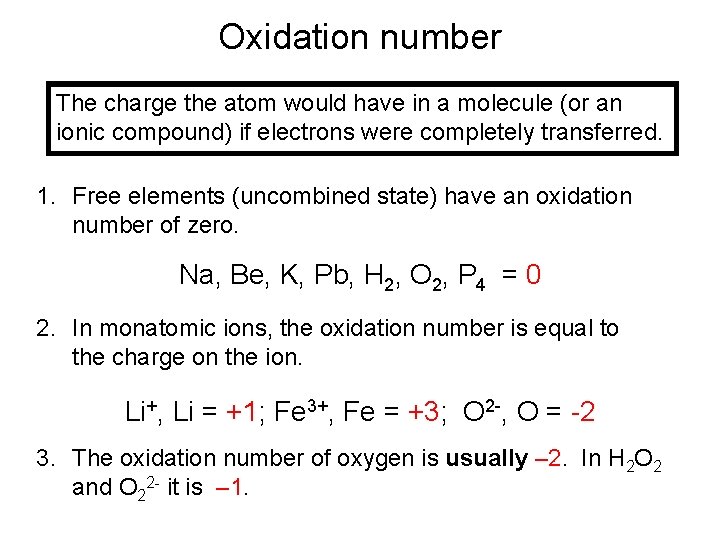
Oxidation number The charge the atom would have in a molecule (or an ionic compound) if electrons were completely transferred. 1. Free elements (uncombined state) have an oxidation number of zero. Na, Be, K, Pb, H 2, O 2, P 4 = 0 2. In monatomic ions, the oxidation number is equal to the charge on the ion. Li+, Li = +1; Fe 3+, Fe = +3; O 2 -, O = -2 3. The oxidation number of oxygen is usually – 2. In H 2 O 2 and O 22 - it is – 1.
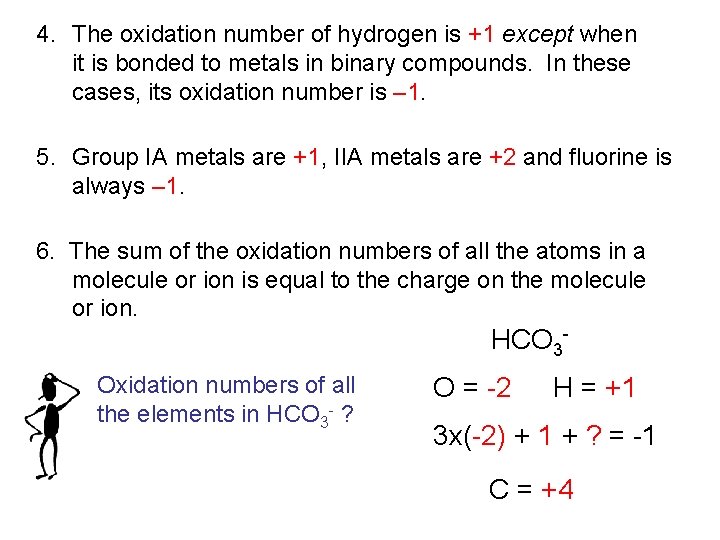
4. The oxidation number of hydrogen is +1 except when it is bonded to metals in binary compounds. In these cases, its oxidation number is – 1. 5. Group IA metals are +1, IIA metals are +2 and fluorine is always – 1. 6. The sum of the oxidation numbers of all the atoms in a molecule or ion is equal to the charge on the molecule or ion. HCO 3 Oxidation numbers of all the elements in HCO 3 - ? O = -2 H = +1 3 x(-2) + 1 + ? = -1 C = +4
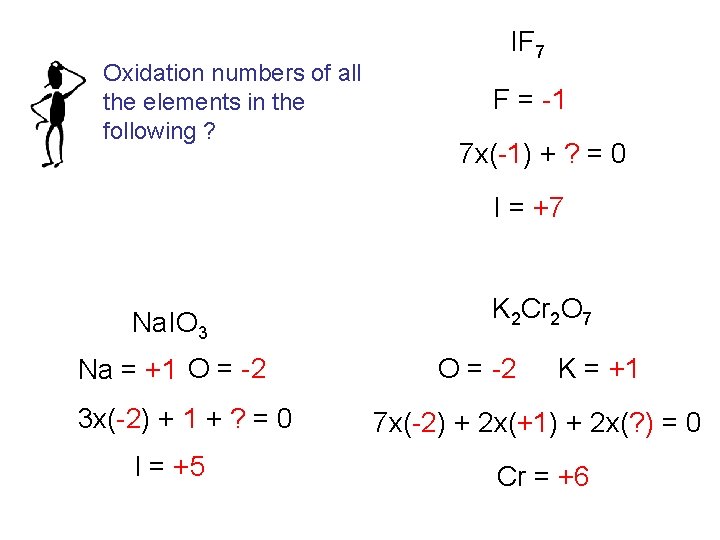
Oxidation numbers of all the elements in the following ? IF 7 F = -1 7 x(-1) + ? = 0 I = +7 Na. IO 3 Na = +1 O = -2 3 x(-2) + 1 + ? = 0 I = +5 K 2 Cr 2 O 7 O = -2 K = +1 7 x(-2) + 2 x(+1) + 2 x(? ) = 0 Cr = +6
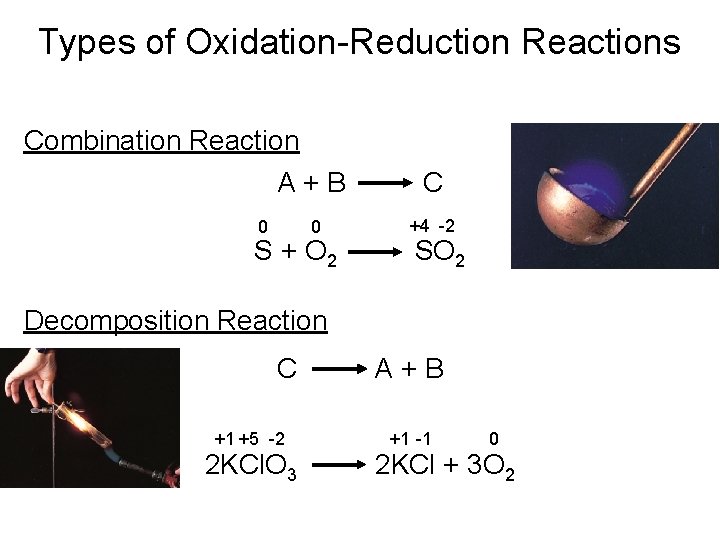
Types of Oxidation-Reduction Reactions Combination Reaction A+B C 0 +4 -2 0 S + O 2 SO 2 Decomposition Reaction C +1 +5 -2 2 KCl. O 3 A+B +1 -1 0 2 KCl + 3 O 2
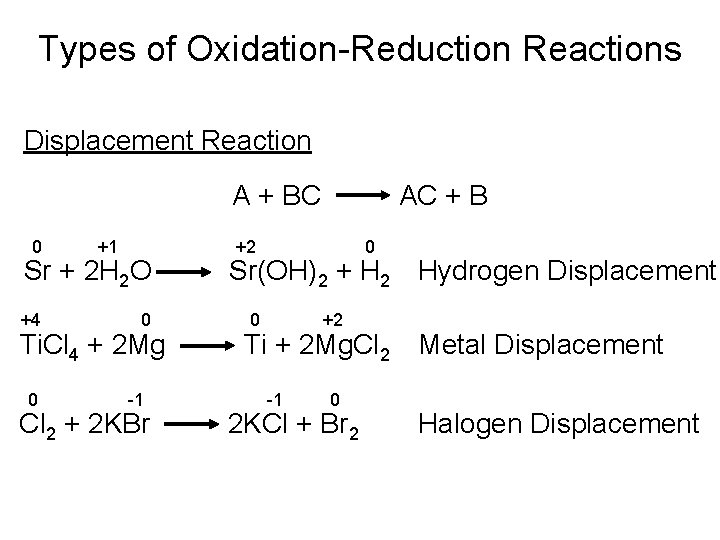
Types of Oxidation-Reduction Reactions Displacement Reaction A + BC 0 +1 Sr + 2 H 2 O +4 0 Ti. Cl 4 + 2 Mg 0 -1 Cl 2 + 2 KBr AC + B +2 0 Sr(OH)2 + H 2 Hydrogen Displacement 0 +2 Ti + 2 Mg. Cl 2 Metal Displacement -1 0 2 KCl + Br 2 Halogen Displacement
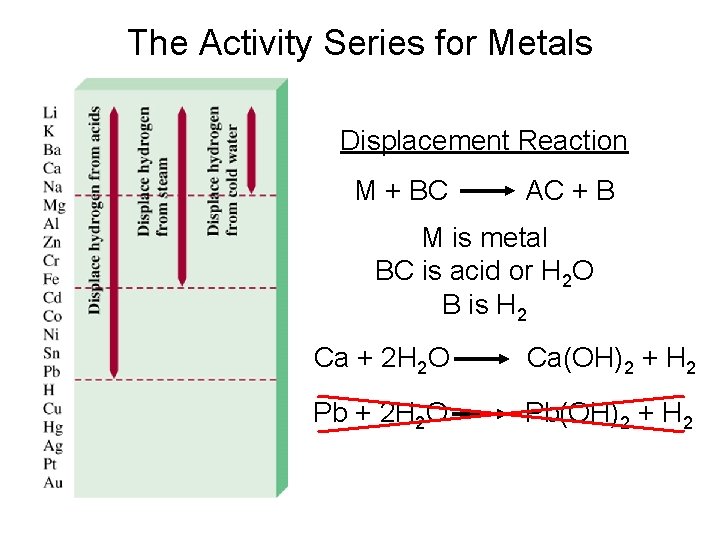
The Activity Series for Metals Displacement Reaction M + BC AC + B M is metal BC is acid or H 2 O B is H 2 Ca + 2 H 2 O Ca(OH)2 + H 2 Pb + 2 H 2 O Pb(OH)2 + H 2
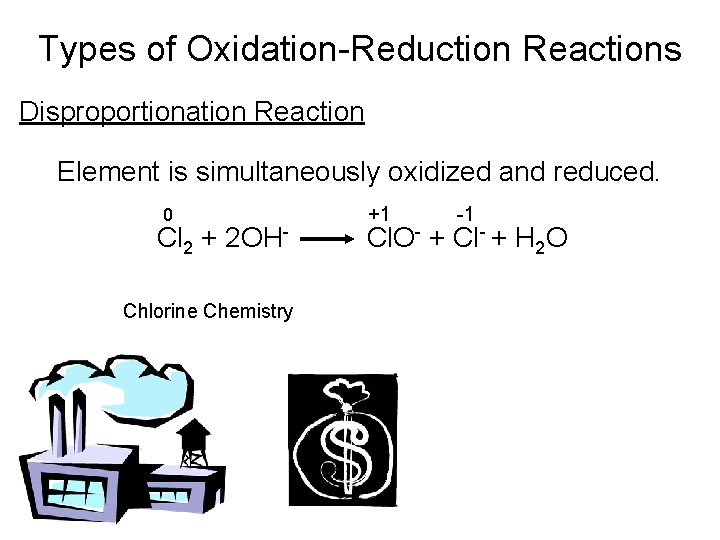
Types of Oxidation-Reduction Reactions Disproportionation Reaction Element is simultaneously oxidized and reduced. 0 Cl 2 + 2 OHChlorine Chemistry +1 -1 Cl. O- + Cl- + H 2 O
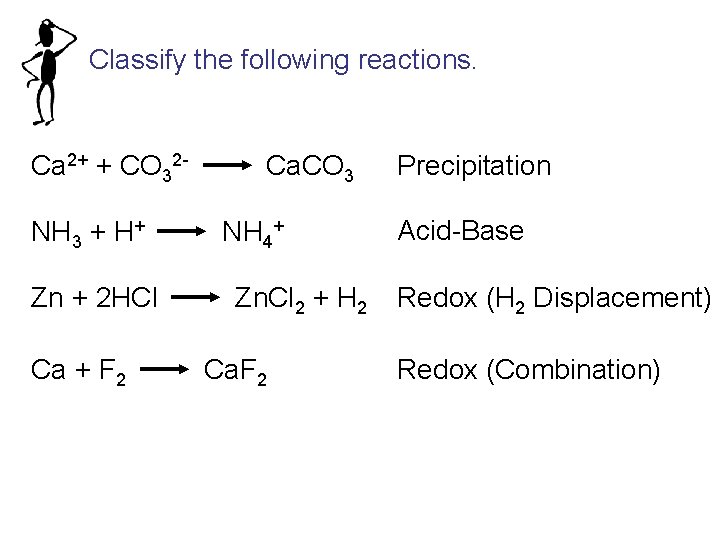
Classify the following reactions. Ca 2+ + CO 32 NH 3 + H+ Zn + 2 HCl Ca + F 2 Ca. CO 3 NH 4+ Zn. Cl 2 + H 2 Ca. F 2 Precipitation Acid-Base Redox (H 2 Displacement) Redox (Combination)
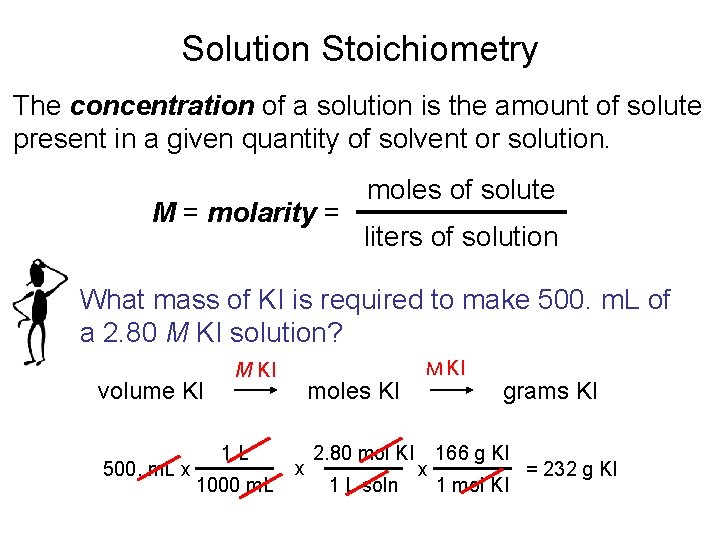
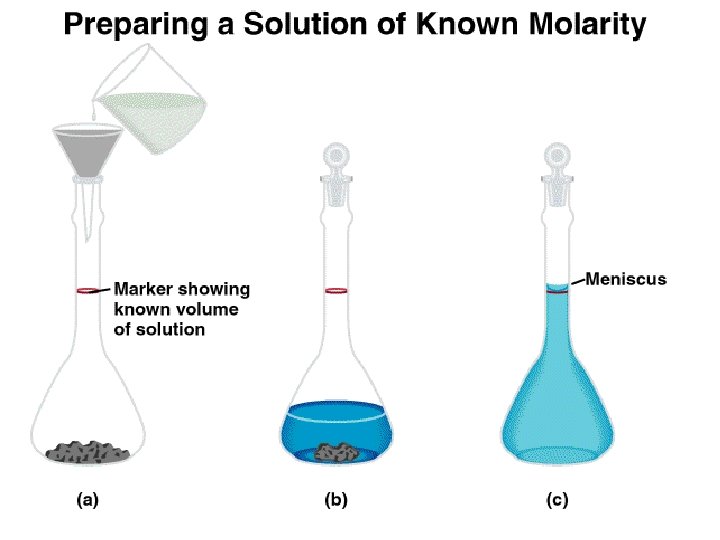
Solution Stoichiometry The concentration of a solution is the amount of solute present in a given quantity of solvent or solution. M = molarity = moles of solute liters of solution What mass of KI is required to make 500. m. L of a 2. 80 M KI solution? volume KI 500. m. L x M KI 1 L 1000 m. L moles KI x 2. 80 mol KI 1 L soln M KI x grams KI 166 g KI 1 mol KI = 232 g KI
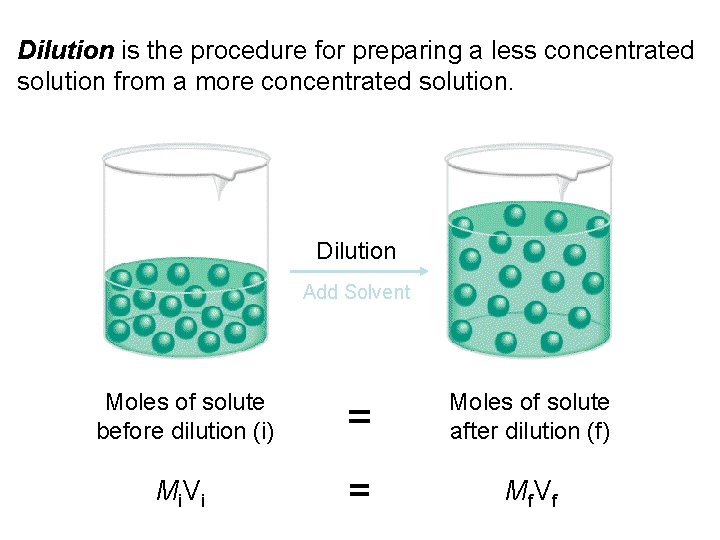
Dilution is the procedure for preparing a less concentrated solution from a more concentrated solution. Dilution Add Solvent Moles of solute before dilution (i) = Moles of solute after dilution (f) Mi V i = Mf V f
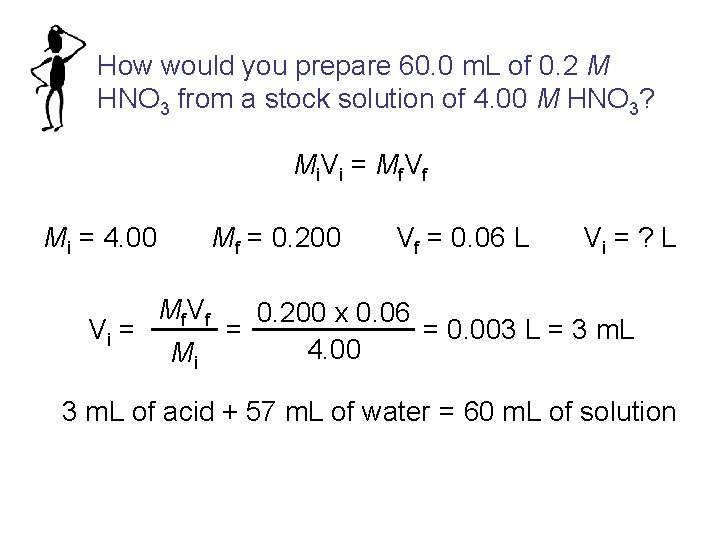
How would you prepare 60. 0 m. L of 0. 2 M HNO 3 from a stock solution of 4. 00 M HNO 3? Mi V i = Mf V f Mi = 4. 00 Vi = Mf = 0. 200 Mf V f Mi Vf = 0. 06 L Vi = ? L 0. 200 x 0. 06 = 0. 003 L = 3 m. L = 4. 00 3 m. L of acid + 57 m. L of water = 60 m. L of solution
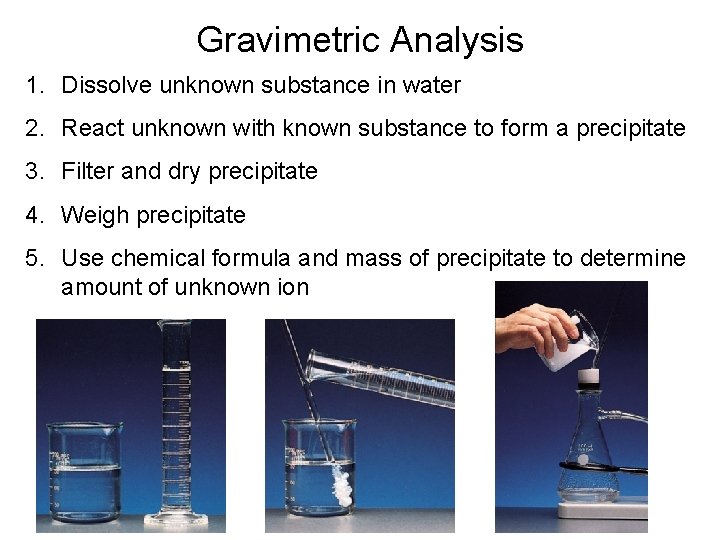
Gravimetric Analysis 1. Dissolve unknown substance in water 2. React unknown with known substance to form a precipitate 3. Filter and dry precipitate 4. Weigh precipitate 5. Use chemical formula and mass of precipitate to determine amount of unknown ion
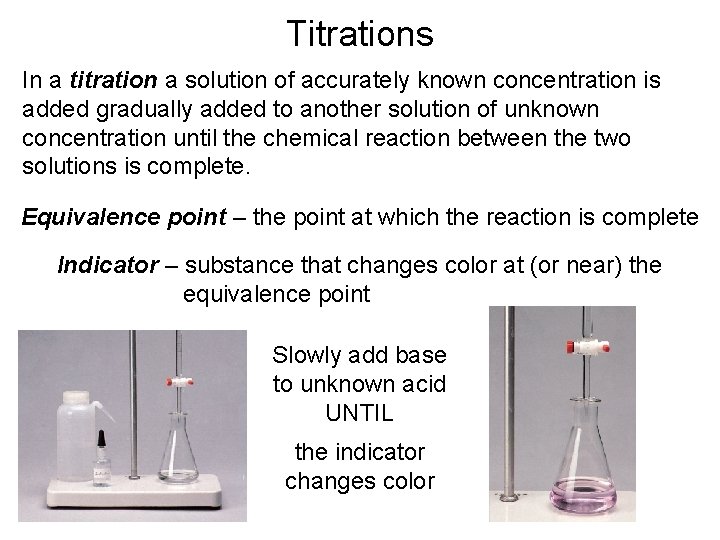
Titrations In a titration a solution of accurately known concentration is added gradually added to another solution of unknown concentration until the chemical reaction between the two solutions is complete. Equivalence point – the point at which the reaction is complete Indicator – substance that changes color at (or near) the equivalence point Slowly add base to unknown acid UNTIL the indicator changes color
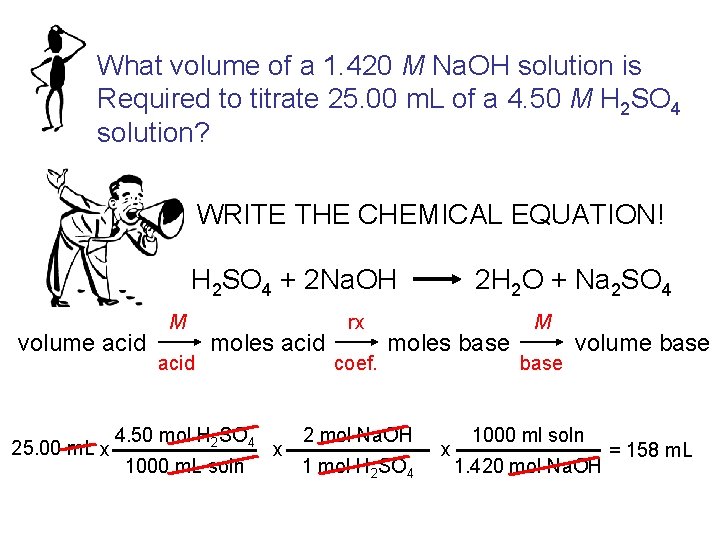
What volume of a 1. 420 M Na. OH solution is Required to titrate 25. 00 m. L of a 4. 50 M H 2 SO 4 solution? WRITE THE CHEMICAL EQUATION! H 2 SO 4 + 2 Na. OH volume acid 25. 00 m. L x M acid moles acid 4. 50 mol H 2 SO 4 1000 m. L soln x rx coef. 2 H 2 O + Na 2 SO 4 moles base 2 mol Na. OH 1 mol H 2 SO 4 x M base volume base 1000 ml soln 1. 420 mol Na. OH = 158 m. L
- Slides: 15