
Oxford Radcliffe Hospitals NHS Trust Specimens Safe Handling
- Slides: 1
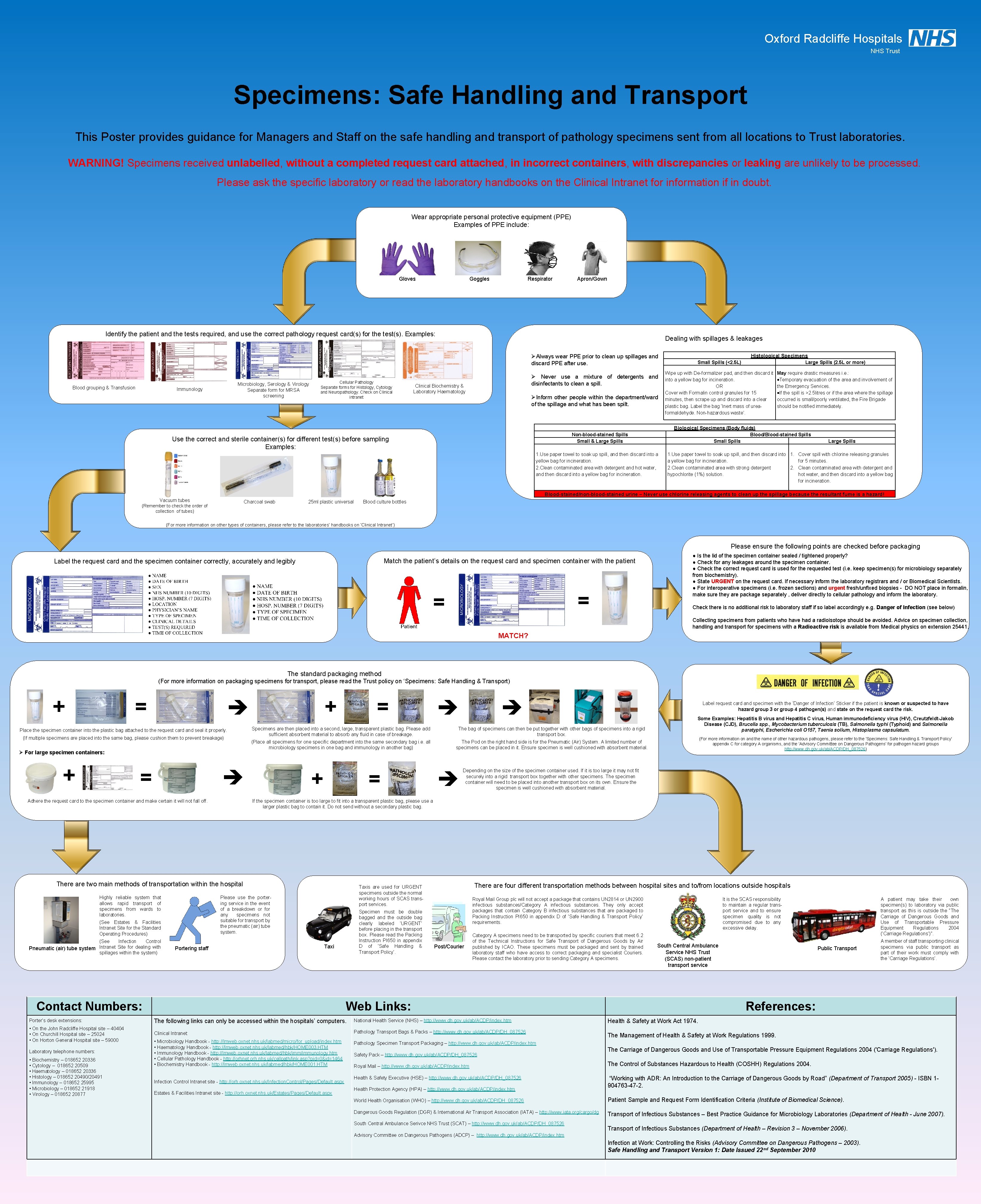
Oxford Radcliffe Hospitals NHS Trust Specimens: Safe Handling and Transport This Poster provides guidance for Managers and Staff on the safe handling and transport of pathology specimens sent from all locations to Trust laboratories. WARNING! Specimens received unlabelled, without a completed request card attached, in incorrect containers, with discrepancies or leaking are unlikely to be processed. Please ask the specific laboratory or read the laboratory handbooks on the Clinical Intranet for information if in doubt. Wear appropriate personal protective equipment (PPE) Examples of PPE include: Gloves Goggles Respirator Apron/Gown Identify the patient and the tests required, and use the correct pathology request card(s) for the test(s). Examples: Dealing with spillages & leakages ØAlways wear PPE prior to clean up spillages and discard PPE after use. Blood grouping & Transfusion Microbiology, Serology & Virology Separate form for MRSA screening Immunology Cellular Pathology Separate forms for Histology, Cytology and Neuropathology. Check on Clinical intranet Ø Never use a mixture of detergents and disinfectants to clean a spill. Clinical Biochemistry & Laboratory Haematology ØInform other people within the department/ward of the spillage and what has been spilt. Histological Specimens Small Spills (<2. 5 L) Large Spills (2. 5 L or more) Wipe up with De-formalizer pad, and then discard it into a yellow bag for incineration. OR Cover with Formalin control granules for 15 minutes, then scrape up and discard into a clear plastic bag. Label the bag ‘Inert mass of ureaformaldehyde. Non-hazardous waste’. May require drastic measures i. e. : Temporary evacuation of the area and involvement of the Emergency Services. If the spill is >2. 5 litres or if the area where the spillage occurred is small/poorly ventilated, the Fire Brigade should be notified immediately. Biological Specimens (Body fluids) Non-blood-stained Spills Small & Large Spills Use the correct and sterile container(s) for different test(s) before sampling Examples: Blood/Blood-stained Spills Small Spills 1. Use paper towel to soak up spill, and then discard into a yellow bag for incineration. 2. Clean contaminated area with detergent and hot water, and then discard into a yellow bag for incineration. Large Spills 1. Use paper towel to soak up spill, and then discard into 1. Cover spill with chlorine releasing granules a yellow bag for incineration. for 5 minutes. 2. Clean contaminated area with strong detergent 2. Clean contaminated area with detergent and hypochlorite (1%) solution. hot water, and then discard into a yellow bag for incineration. Blood-stained/non-blood-stained urine – Never use chlorine releasing agents to clean up the spillage because the resultant fume is a hazard! Vacuum tubes Charcoal swab (Remember to check the order of collection of tubes) 25 ml plastic universal Blood culture bottles (For more information on other types of containers, please refer to the laboratories’ handbooks on ‘Clinical Intranet’) Please ensure the following points are checked before packaging Match the patient’s details on the request card and specimen container with the patient Label the request card and the specimen container correctly, accurately and legibly = = ● Is the lid of the specimen container sealed / tightened properly? ● Check for any leakages around the specimen container. ● Check the correct request card is used for the requested test (i. e. keep specimen(s) for microbiology separately from biochemistry). ● State URGENT on the request card. If necessary inform the laboratory registrars and / or Biomedical Scientists. ● For interoperative specimens (i. e. frozen sections) and urgent fresh/unfixed biopsies - DO NOT place in formalin, make sure they are package separately , deliver directly to cellular pathology and inform the laboratory. Check there is no additional risk to laboratory staff if so label accordingly e. g. Danger of Infection (see below) Collecting specimens from patients who have had a radioisotope should be avoided. Advice on specimen collection, handling and transport for specimens with a Radioactive risk is available from Medical physics on extension 25441. MATCH? The standard packaging method (For more information on packaging specimens for transport, please read the Trust policy on ‘Specimens: Safe Handling & Transport) + = Place the specimen container into the plastic bag attached to the request card and seal it properly. (If multiple specimens are placed into the same bag, please cushion them to prevent breakage) Ø For large specimen containers: + + = (Place all specimens for one specific department into the same secondary bag i. e. all microbiology specimens in one bag and immunology in another bag) The Pod on the right hand side is for the Pneumatic (Air) System. A limited number of specimens can be placed in it. Ensure specimen is well cushioned with absorbent material. + = (See Infection Control Pneumatic (air) tube system Intranet Site for dealing with spillages within the system) Portering staff There are four different transportation methods between hospital sites and to/from locations outside hospitals Specimen must be double bagged and the outside bag clearly labeled ‘URGENT’ before placing in the transport box. Please read the Packing Instruction PI 650 in appendix D of ‘Safe Handling & Transport Policy’. Taxi Royal Mail Group plc will not accept a package that contains UN 2814 or UN 2900 infectious substances/Category A infectious substances. They only accept packages that contain Category B infectious substances that are packaged to Packing Instruction PI 650 in appendix D of ‘Safe Handling & Transport Policy’ requirements. Post/Courier Category A specimens need to be transported by specific couriers that meet 6. 2 of the Technical Instructions for Safe Transport of Dangerous Goods by Air published by ICAO. These specimens must be packaged and sent by trained laboratory staff who have access to correct packaging and specialist Couriers. Please contact the laboratory prior to sending Category A specimens. It is the SCAS responsibility to maintain a regular transport service and to ensure specimen quality is not compromised due to any excessive delay. South Central Ambulance Service NHS Trust (SCAS) non-patient transport service Web Links: Porter’s desk extensions: The following links can only be accessed within the hospitals’ computers. National Health Service (NHS) – http: //www. dh. gov. uk/ab/ACDP/index. htm • On the John Radcliffe Hospital site – 40404 • On Churchill Hospital site – 25024 • On Horton General Hospital site – 59000 Clinical Intranet: Pathology Transport Bags & Packs – http: //www. dh. gov. uk/ab/ACDP/DH_087526 • Microbiology Handbook - http: //lmweb. oxnet. nhs. uk/labmed/micro/for_upload/index. htm • Haematology Handbook - http: //lmweb. oxnet. nhs. uk/labmed/hbk/HOME 003. HTM • Immunology Handbook - http: //lmweb. oxnet. nhs. uk/labmed/hbk/immunology. htm • Cellular Pathology Handbook - http: //orhnet. orh. nhs. uk/cellpath/link. asp? pid=0&id=1464 • Biochemistry Handbook - http: //lmweb. oxnet. nhs. uk/labmed/hbk/HOME 001. HTM Pathology Specimen Transport Packaging – http: //www. dh. gov. uk/ab/ACDP/index. htm • Biochemistry – 018652 20336 • Cytology – 018652 20509 • Haematology – 018652 20336 • Histology – 018652 20490/20491 • Immunology – 018652 25995 • Microbiology – 018652 21918 • Virology – 018652 20877 (For more information on and the name of other hazardous pathogens, please refer to the ‘Specimens: Safe Handling & Transport Policy’ appendix C for category A organisms, and the ‘Advisory Committee on Dangerous Pathogens’ for pathogen hazard groups http: //www. dh. gov. uk/ab/ACDP/DH_087526) Depending on the size of the specimen container used. If it is too large it may not fit securely into a rigid transport box together with other specimens. The specimen container will need to be placed into another transport box on its own. Ensure the specimen is well cushioned with absorbent material. Taxis are used for URGENT specimens outside the normal working hours of SCAS transport services. Contact Numbers: Laboratory telephone numbers: Some Examples: Hepatitis B virus and Hepatitis C virus, Human immunodeficiency virus (HIV), Creutzfeldt-Jakob Disease (CJD), Brucella spp. , Mycobacterium tuberculosis (TB), Salmonella typhi (Typhoid) and Salmonella paratyphi, Escherichia coli O 157, Taenia solium, Histoplasma capsulatum. If the specimen container is too large to fit into a transparent plastic bag, please use a larger plastic bag to contain it. Do not send without a secondary plastic bag. Please use the portering service in the event of a breakdown or for any specimens not suitable for transport by the pneumatic (air) tube system. (See Estates & Facilities Intranet Site for the Standard Operating Procedures) The bag of specimens can then be put together with other bags of specimens into a rigid transport box. There are two main methods of transportation within the hospital Highly reliable system that allows rapid transport of specimens from wards to laboratories. Specimens are then placed into a second, large, transparent plastic bag. Please add sufficient absorbent material to absorb any fluid in case of breakage. Adhere the request card to the specimen container and make certain it will not fall off. = Label request card and specimen with the ‘Danger of Infection’ Sticker if the patient is known or suspected to have hazard group 3 or group 4 pathogen(s) and state on the request card the risk. Infection Control Intranet site - http: //orh. oxnet. nhs. uk/Infection. Control/Pages/Default. aspx Estates & Facilities Intranet site - http: //orh. oxnet. nhs. uk/Estates/Pages/Default. aspx Safety Pack – http: //www. dh. gov. uk/ab/ACDP/DH_087526 Royal Mail – http: //www. dh. gov. uk/ab/ACDP/index. htm Health & Safety Executive (HSE) – http: //www. dh. gov. uk/ab/ACDP/DH_087526 Health Protection Agency (HPA) – http: //www. dh. gov. uk/ab/ACDP/index. htm A patient may take their own specimen(s) to laboratory via public transport as this is outside the “The Carriage of Dangerous Goods and Use of Transportable Pressure Equipment Regulations 2004 (‘Carriage Regulations’)”. Public Transport A member of staff transporting clinical specimens via public transport as part of their work must comply with the ‘Carriage Regulations’. References: Health & Safety at Work Act 1974. The Management of Health & Safety at Work Regulations 1999. The Carriage of Dangerous Goods and Use of Transportable Pressure Equipment Regulations 2004 ('Carriage Regulations'). The Control of Substances Hazardous to Health (COSHH) Regulations 2004. “Working with ADR: An Introduction to the Carriage of Dangerous Goods by Road” (Department of Transport 2005) - ISBN 1904763 -47 -2. World Health Organisation (WHO) – http: //www. dh. gov. uk/ab/ACDP/DH_087526 Patient Sample and Request Form Identification Criteria (Institute of Biomedical Science). Dangerous Goods Regulation (DGR) & International Air Transport Association (IATA) – http: //www. iata. org/cargo/dg Transport of Infectious Substances – Best Practice Guidance for Microbiology Laboratories (Department of Health - June 2007). South Central Ambulance Serivce NHS Trust (SCAT) – http: //www. dh. gov. uk/ab/ACDP/DH_087526 Transport of Infectious Substances (Department of Health – Revision 3 – November 2006). Advisory Committee on Dangerous Pathogens (ADCP) – http: //www. dh. gov. uk/ab/ACDP/index. htm Infection at Work: Controlling the Risks (Advisory Committee on Dangerous Pathogens – 2003). Safe Handling and Transport Version 1: Date Issued 22 nd September 2010