
Ox Cart Oxygen Concentrator and Analyzer for the
- Slides: 1
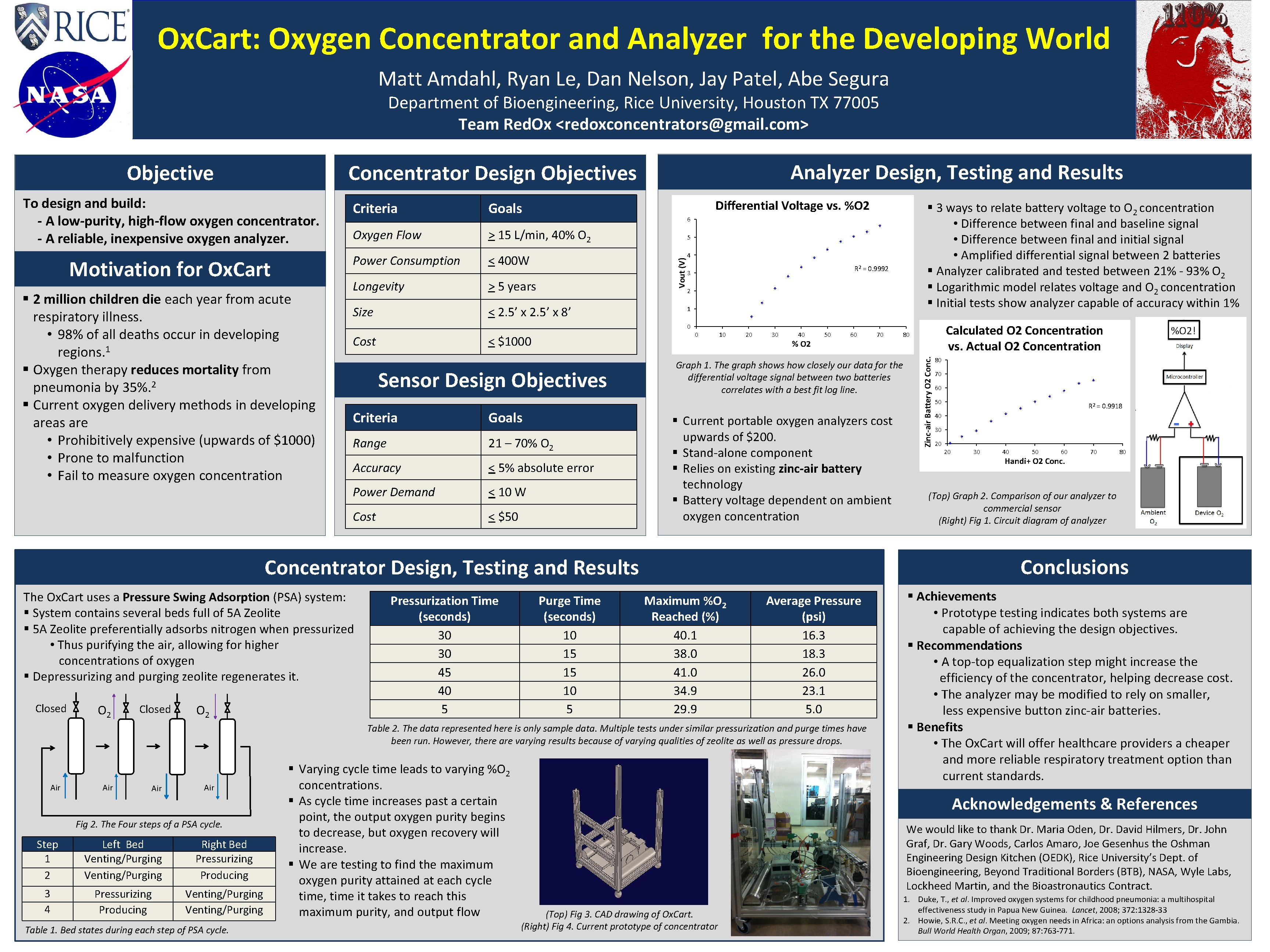
Ox. Cart: Oxygen Concentrator and Analyzer for the Developing World Matt Amdahl, Ryan Le, Dan Nelson, Jay Patel, Abe Segura Department of Bioengineering, Rice University, Houston TX 77005 Team Red. Ox <redoxconcentrators@gmail. com> Analyzer Design, Testing and Results Concentrator Design Objectives Goals Oxygen Flow > 15 L/min, 40% O 2 Power Consumption Motivation for Ox. Cart § 2 million children die each year from acute respiratory illness. • 98% of all deaths occur in developing regions. 1 § Oxygen therapy reduces mortality from pneumonia by 35%. 2 § Current oxygen delivery methods in developing areas are • Prohibitively expensive (upwards of $1000) • Prone to malfunction • Fail to measure oxygen concentration Differential Voltage vs. %O 2 Criteria 6 < 400 W Longevity > 5 years Size < 2. 5’ x 8’ 5 4 < $1000 Sensor Design Objectives Criteria Goals Range 21 – 70% O 2 Accuracy < 5% absolute error Power Demand < 10 W Cost < $50 R 2 = 0. 9992 3 2 1 0 Cost 0 10 20 30 40 % O 2 50 60 Closed O 2 Pressurization Time (seconds) 30 30 45 40 5 Purge Time (seconds) 10 15 15 10 5 § Current portable oxygen analyzers cost upwards of $200. § Stand-alone component § Relies on existing zinc-air battery technology § Battery voltage dependent on ambient oxygen concentration Air Air Fig 2. The Four steps of a PSA cycle. Step 1 2 Left Bed Venting/Purging Right Bed Pressurizing Producing 3 4 Pressurizing Producing Venting/Purging Table 1. Bed states during each step of PSA cycle. Calculated O 2 Concentration vs. Actual O 2 Concentration 80 80 70 60 50 R 2 = 0. 9918 40 30 20 20 30 40 50 60 Handi+ O 2 Conc. 70 80 (Top) Graph 2. Comparison of our analyzer to commercial sensor (Right) Fig 1. Circuit diagram of analyzer Conclusions Maximum %O 2 Reached (%) 40. 1 38. 0 41. 0 34. 9 29. 9 Average Pressure (psi) 16. 3 18. 3 26. 0 23. 1 5. 0 Table 2. The data represented here is only sample data. Multiple tests under similar pressurization and purge times have been run. However, there are varying results because of varying qualities of zeolite as well as pressure drops. § Varying cycle time leads to varying %O 2 concentrations. § As cycle time increases past a certain point, the output oxygen purity begins to decrease, but oxygen recovery will increase. § We are testing to find the maximum oxygen purity attained at each cycle time, time it takes to reach this maximum purity, and output flow 70 Graph 1. The graph shows how closely our data for the differential voltage signal between two batteries correlates with a best fit log line. Concentrator Design, Testing and Results The Ox. Cart uses a Pressure Swing Adsorption (PSA) system: § System contains several beds full of 5 A Zeolite § 5 A Zeolite preferentially adsorbs nitrogen when pressurized • Thus purifying the air, allowing for higher concentrations of oxygen § Depressurizing and purging zeolite regenerates it. § 3 ways to relate battery voltage to O 2 concentration • Difference between final and baseline signal • Difference between final and initial signal • Amplified differential signal between 2 batteries § Analyzer calibrated and tested between 21% - 93% O 2 § Logarithmic model relates voltage and O 2 concentration § Initial tests show analyzer capable of accuracy within 1% Zinc-air Battery O 2 Conc. To design and build: - A low-purity, high-flow oxygen concentrator. - A reliable, inexpensive oxygen analyzer. Vout (V) Objective § Achievements • Prototype testing indicates both systems are capable of achieving the design objectives. § Recommendations • A top-top equalization step might increase the efficiency of the concentrator, helping decrease cost. • The analyzer may be modified to rely on smaller, less expensive button zinc-air batteries. § Benefits • The Ox. Cart will offer healthcare providers a cheaper and more reliable respiratory treatment option than current standards. Acknowledgements & References We would like to thank Dr. Maria Oden, Dr. David Hilmers, Dr. John Graf, Dr. Gary Woods, Carlos Amaro, Joe Gesenhus the Oshman Engineering Design Kitchen (OEDK), Rice University’s Dept. of Bioengineering, Beyond Traditional Borders (BTB), NASA, Wyle Labs, Lockheed Martin, and the Bioastronautics Contract. (Top) Fig 3. CAD drawing of Ox. Cart. (Right) Fig 4. Current prototype of concentrator 1. Duke, T. , et al. Improved oxygen systems for childhood pneumonia: a multihospital effectiveness study in Papua New Guinea. Lancet, 2008; 372: 1328 -33 2. Howie, S. R. C. , et al. Meeting oxygen needs in Africa: an options analysis from the Gambia. Bull World Health Organ, 2009; 87: 763 -771.